Health Management: Implementation of Minimally Invasive Knee Technique
VerifiedAdded on 2023/01/20
|10
|2122
|53
Report
AI Summary
This report provides an overview of the minimally invasive knee replacement technique, comparing it to traditional methods and detailing its benefits, risks, and implementation strategies within a hospital setting. It emphasizes the reduced invasiveness, faster recovery times, and smaller incisions associated with the new technique. The report includes a risk management plan addressing financial and operational risks, a marketing plan utilizing various media platforms, and a communication plan targeting hospital stakeholders. Governance and training aspects are also covered to ensure proper utilization of the technique, along with a detailed implementation plan outlining policies, procedures, and training processes necessary for successful adoption in the hospital.

Running Head: CONTEMPORARY HEALTH MANAGEMENT 1
Contemporary health management
Name
Affiliation
Date
Contemporary health management
Name
Affiliation
Date

Paraphrase This Document
Need a fresh take? Get an instant paraphrase of this document with our AI Paraphraser
CONTEMPORARY HEALTH MANAGEMENT 2
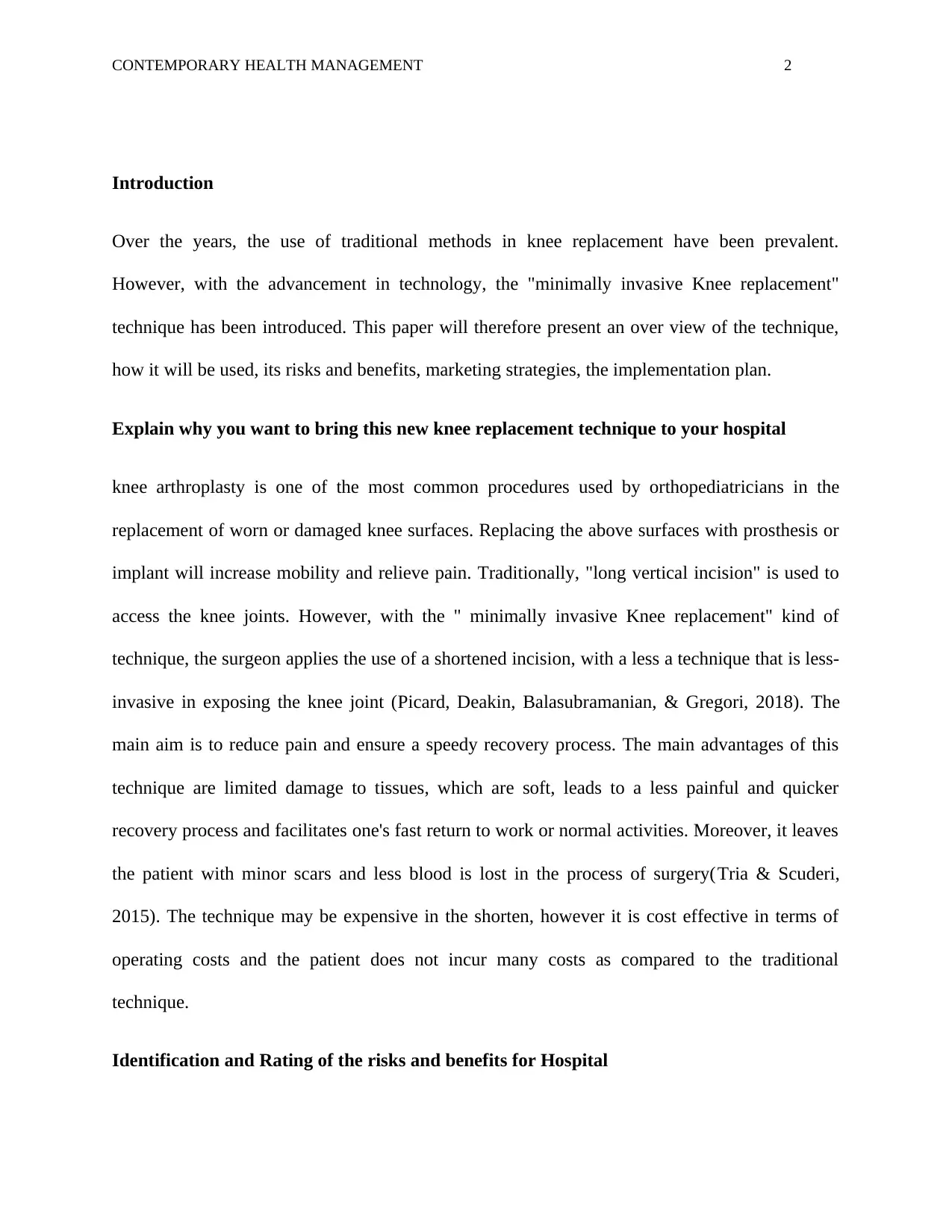
Introduction
Over the years, the use of traditional methods in knee replacement have been prevalent.
However, with the advancement in technology, the "minimally invasive Knee replacement"
technique has been introduced. This paper will therefore present an over view of the technique,
how it will be used, its risks and benefits, marketing strategies, the implementation plan.
Explain why you want to bring this new knee replacement technique to your hospital
knee arthroplasty is one of the most common procedures used by orthopediatricians in the
replacement of worn or damaged knee surfaces. Replacing the above surfaces with prosthesis or
implant will increase mobility and relieve pain. Traditionally, "long vertical incision" is used to
access the knee joints. However, with the " minimally invasive Knee replacement" kind of
technique, the surgeon applies the use of a shortened incision, with a less a technique that is less-
invasive in exposing the knee joint (Picard, Deakin, Balasubramanian, & Gregori, 2018). The
main aim is to reduce pain and ensure a speedy recovery process. The main advantages of this
technique are limited damage to tissues, which are soft, leads to a less painful and quicker
recovery process and facilitates one's fast return to work or normal activities. Moreover, it leaves
the patient with minor scars and less blood is lost in the process of surgery(Tria & Scuderi,
2015). The technique may be expensive in the shorten, however it is cost effective in terms of
operating costs and the patient does not incur many costs as compared to the traditional
technique.
Identification and Rating of the risks and benefits for Hospital
Introduction
Over the years, the use of traditional methods in knee replacement have been prevalent.
However, with the advancement in technology, the "minimally invasive Knee replacement"
technique has been introduced. This paper will therefore present an over view of the technique,
how it will be used, its risks and benefits, marketing strategies, the implementation plan.
Explain why you want to bring this new knee replacement technique to your hospital
knee arthroplasty is one of the most common procedures used by orthopediatricians in the
replacement of worn or damaged knee surfaces. Replacing the above surfaces with prosthesis or
implant will increase mobility and relieve pain. Traditionally, "long vertical incision" is used to
access the knee joints. However, with the " minimally invasive Knee replacement" kind of
technique, the surgeon applies the use of a shortened incision, with a less a technique that is less-
invasive in exposing the knee joint (Picard, Deakin, Balasubramanian, & Gregori, 2018). The
main aim is to reduce pain and ensure a speedy recovery process. The main advantages of this
technique are limited damage to tissues, which are soft, leads to a less painful and quicker
recovery process and facilitates one's fast return to work or normal activities. Moreover, it leaves
the patient with minor scars and less blood is lost in the process of surgery(Tria & Scuderi,
2015). The technique may be expensive in the shorten, however it is cost effective in terms of
operating costs and the patient does not incur many costs as compared to the traditional
technique.
Identification and Rating of the risks and benefits for Hospital
CONTEMPORARY HEALTH MANAGEMENT 3
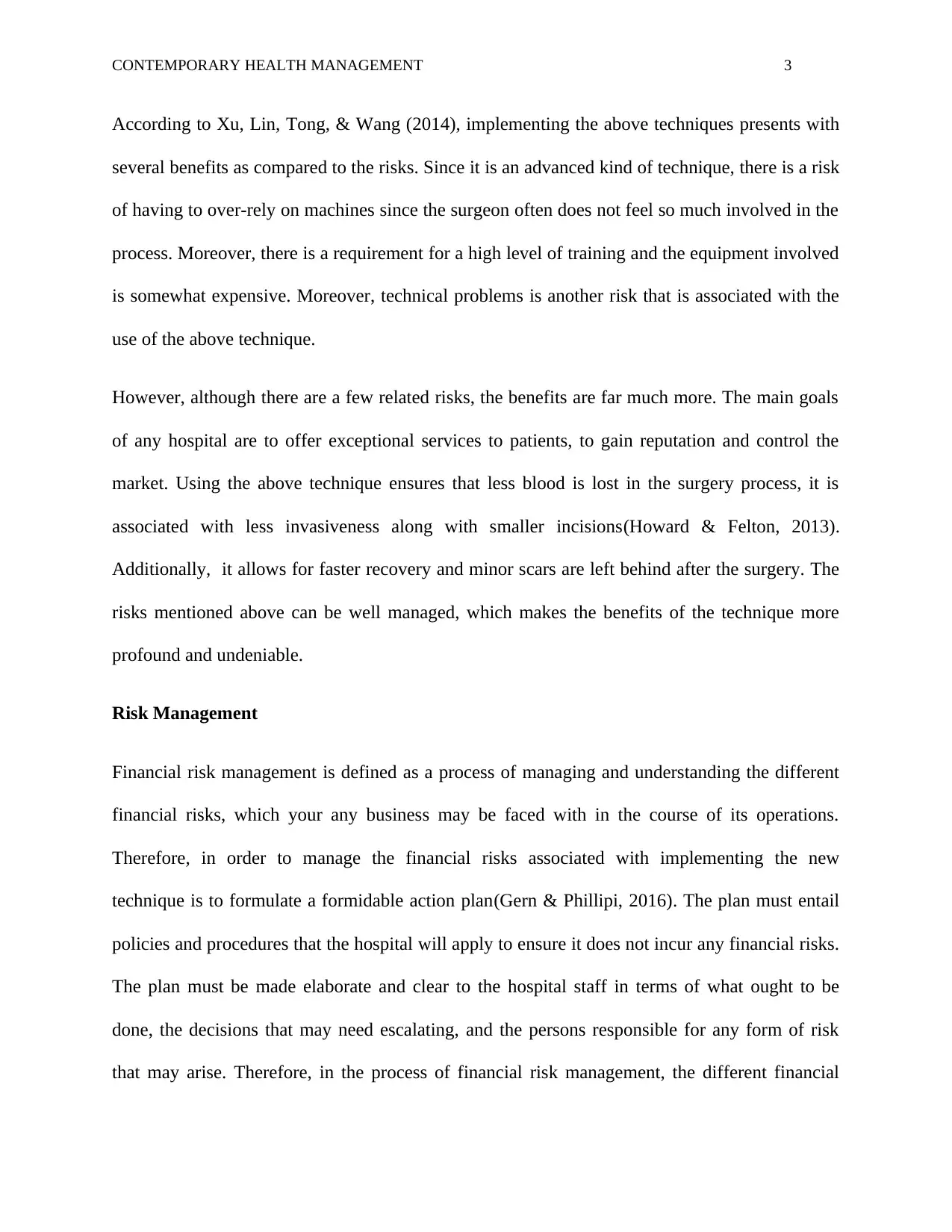
According to Xu, Lin, Tong, & Wang (2014), implementing the above techniques presents with
several benefits as compared to the risks. Since it is an advanced kind of technique, there is a risk
of having to over-rely on machines since the surgeon often does not feel so much involved in the
process. Moreover, there is a requirement for a high level of training and the equipment involved
is somewhat expensive. Moreover, technical problems is another risk that is associated with the
use of the above technique.
However, although there are a few related risks, the benefits are far much more. The main goals
of any hospital are to offer exceptional services to patients, to gain reputation and control the
market. Using the above technique ensures that less blood is lost in the surgery process, it is
associated with less invasiveness along with smaller incisions(Howard & Felton, 2013).
Additionally, it allows for faster recovery and minor scars are left behind after the surgery. The
risks mentioned above can be well managed, which makes the benefits of the technique more
profound and undeniable.
Risk Management
Financial risk management is defined as a process of managing and understanding the different
financial risks, which your any business may be faced with in the course of its operations.
Therefore, in order to manage the financial risks associated with implementing the new
technique is to formulate a formidable action plan(Gern & Phillipi, 2016). The plan must entail
policies and procedures that the hospital will apply to ensure it does not incur any financial risks.
The plan must be made elaborate and clear to the hospital staff in terms of what ought to be
done, the decisions that may need escalating, and the persons responsible for any form of risk
that may arise. Therefore, in the process of financial risk management, the different financial
According to Xu, Lin, Tong, & Wang (2014), implementing the above techniques presents with
several benefits as compared to the risks. Since it is an advanced kind of technique, there is a risk
of having to over-rely on machines since the surgeon often does not feel so much involved in the
process. Moreover, there is a requirement for a high level of training and the equipment involved
is somewhat expensive. Moreover, technical problems is another risk that is associated with the
use of the above technique.
However, although there are a few related risks, the benefits are far much more. The main goals
of any hospital are to offer exceptional services to patients, to gain reputation and control the
market. Using the above technique ensures that less blood is lost in the surgery process, it is
associated with less invasiveness along with smaller incisions(Howard & Felton, 2013).
Additionally, it allows for faster recovery and minor scars are left behind after the surgery. The
risks mentioned above can be well managed, which makes the benefits of the technique more
profound and undeniable.
Risk Management
Financial risk management is defined as a process of managing and understanding the different
financial risks, which your any business may be faced with in the course of its operations.
Therefore, in order to manage the financial risks associated with implementing the new
technique is to formulate a formidable action plan(Gern & Phillipi, 2016). The plan must entail
policies and procedures that the hospital will apply to ensure it does not incur any financial risks.
The plan must be made elaborate and clear to the hospital staff in terms of what ought to be
done, the decisions that may need escalating, and the persons responsible for any form of risk
that may arise. Therefore, in the process of financial risk management, the different financial
⊘ This is a preview!⊘
Do you want full access?
Subscribe today to unlock all pages.

Trusted by 1+ million students worldwide
CONTEMPORARY HEALTH MANAGEMENT 4
risks along with their causes will be identified. A numerical value will then be attached to the
identified risk in the process of quantifying the risks associated with the new technique. After the
above, a decision will be made on how to mitigate the sources and associated risks.
In terms of operational risk management, which is an organisational methodology focusing on
putting into place a meaningful strategy of risk management. In order to manage operational
risks, the first step is to identify the risks associated with the new technique in the hospital setting
(Dabboussi, Sakr, Girard, & Fakih, 2012). After risk identification, assessment in a qualitative
and quantitative perspective and other factors like severity and frequency of occurrence. Then
mitigation needs to be done as the next step before embarking on monitoring along with
reporting.
Marketing Plan
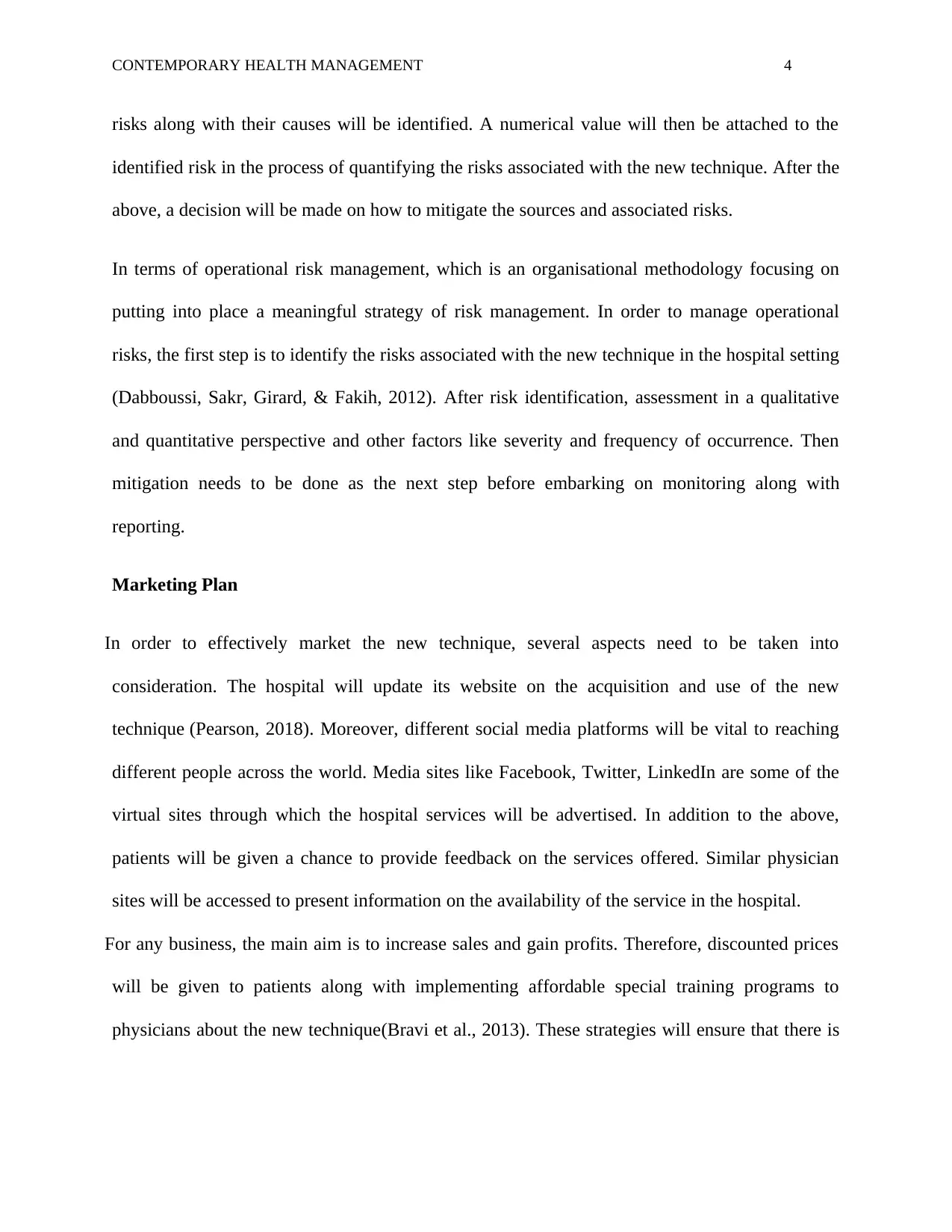
In order to effectively market the new technique, several aspects need to be taken into
consideration. The hospital will update its website on the acquisition and use of the new
technique (Pearson, 2018). Moreover, different social media platforms will be vital to reaching
different people across the world. Media sites like Facebook, Twitter, LinkedIn are some of the
virtual sites through which the hospital services will be advertised. In addition to the above,
patients will be given a chance to provide feedback on the services offered. Similar physician
sites will be accessed to present information on the availability of the service in the hospital.
For any business, the main aim is to increase sales and gain profits. Therefore, discounted prices
will be given to patients along with implementing affordable special training programs to
physicians about the new technique(Bravi et al., 2013). These strategies will ensure that there is
risks along with their causes will be identified. A numerical value will then be attached to the
identified risk in the process of quantifying the risks associated with the new technique. After the
above, a decision will be made on how to mitigate the sources and associated risks.
In terms of operational risk management, which is an organisational methodology focusing on
putting into place a meaningful strategy of risk management. In order to manage operational
risks, the first step is to identify the risks associated with the new technique in the hospital setting
(Dabboussi, Sakr, Girard, & Fakih, 2012). After risk identification, assessment in a qualitative
and quantitative perspective and other factors like severity and frequency of occurrence. Then
mitigation needs to be done as the next step before embarking on monitoring along with
reporting.
Marketing Plan
In order to effectively market the new technique, several aspects need to be taken into
consideration. The hospital will update its website on the acquisition and use of the new
technique (Pearson, 2018). Moreover, different social media platforms will be vital to reaching
different people across the world. Media sites like Facebook, Twitter, LinkedIn are some of the
virtual sites through which the hospital services will be advertised. In addition to the above,
patients will be given a chance to provide feedback on the services offered. Similar physician
sites will be accessed to present information on the availability of the service in the hospital.
For any business, the main aim is to increase sales and gain profits. Therefore, discounted prices
will be given to patients along with implementing affordable special training programs to
physicians about the new technique(Bravi et al., 2013). These strategies will ensure that there is
Paraphrase This Document
Need a fresh take? Get an instant paraphrase of this document with our AI Paraphraser
CONTEMPORARY HEALTH MANAGEMENT 5
effective awareness both internally and externally, and potentially increase the number of
customers.
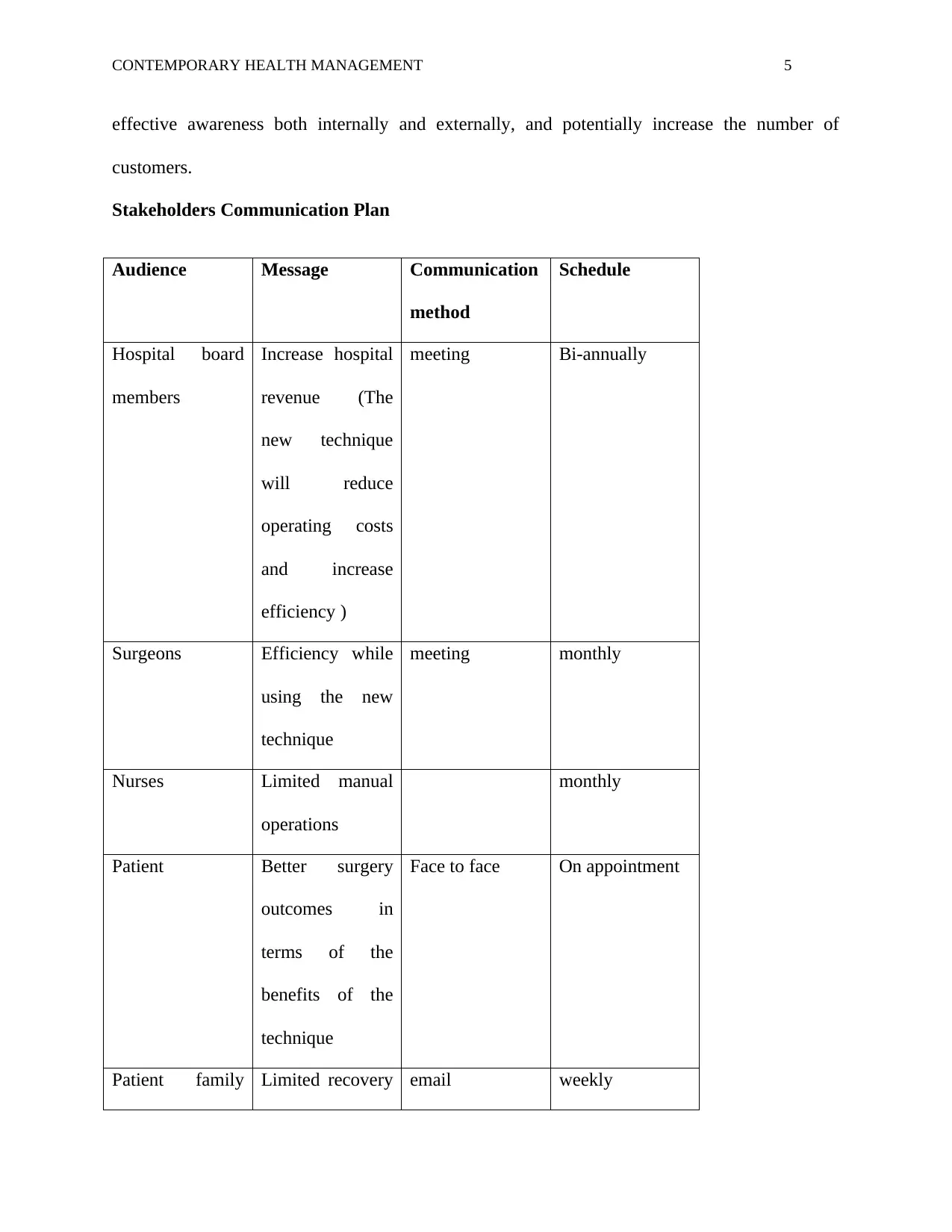
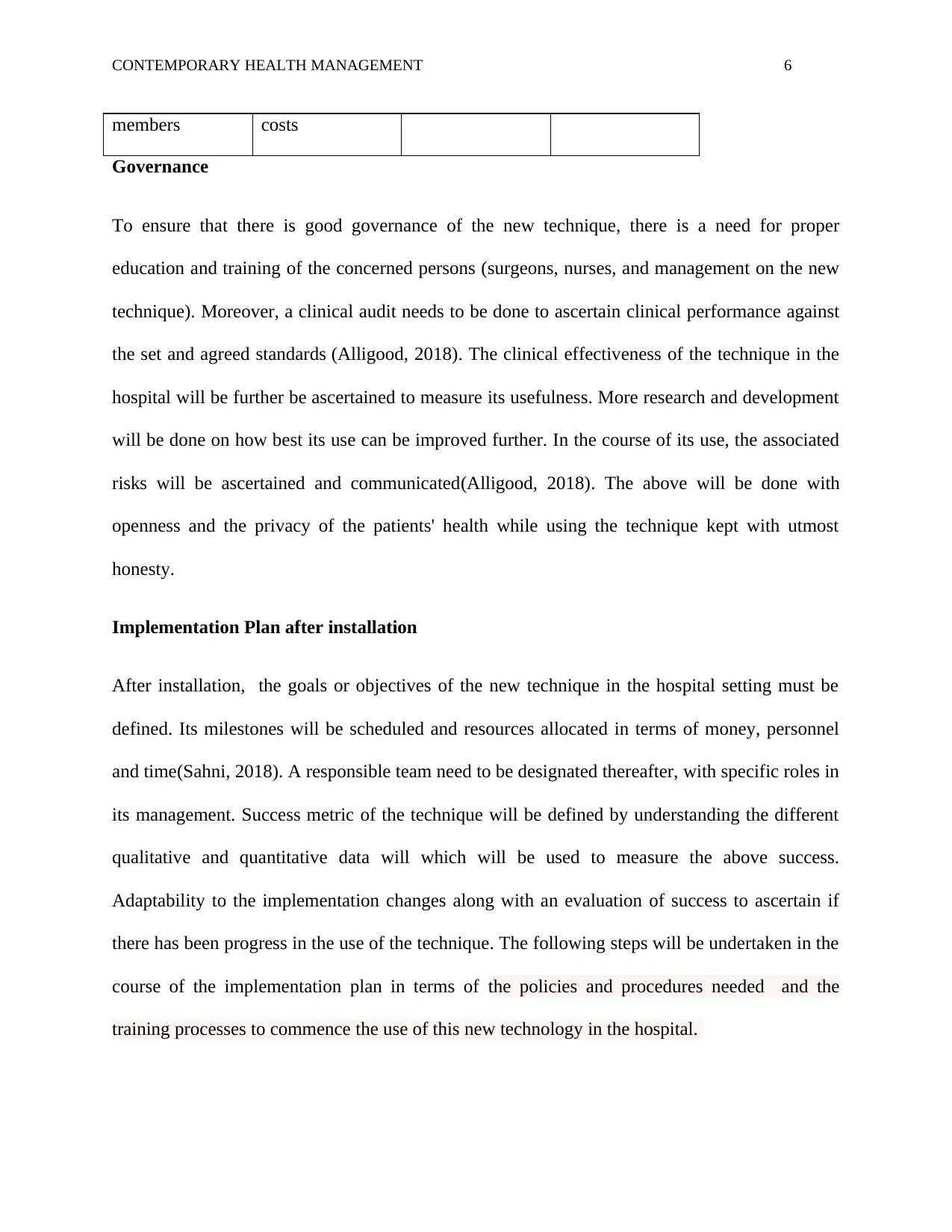
Stakeholders Communication Plan
Audience Message Communication
method
Schedule
Hospital board
members
Increase hospital
revenue (The
new technique
will reduce
operating costs
and increase
efficiency )
meeting Bi-annually
Surgeons Efficiency while
using the new
technique
meeting monthly
Nurses Limited manual
operations
monthly
Patient Better surgery
outcomes in
terms of the
benefits of the
technique
Face to face On appointment
Patient family Limited recovery email weekly
effective awareness both internally and externally, and potentially increase the number of
customers.
Stakeholders Communication Plan
Audience Message Communication
method
Schedule
Hospital board
members
Increase hospital
revenue (The
new technique
will reduce
operating costs
and increase
efficiency )
meeting Bi-annually
Surgeons Efficiency while
using the new
technique
meeting monthly
Nurses Limited manual
operations
monthly
Patient Better surgery
outcomes in
terms of the
benefits of the
technique
Face to face On appointment
Patient family Limited recovery email weekly
CONTEMPORARY HEALTH MANAGEMENT 6
members costs
Governance
To ensure that there is good governance of the new technique, there is a need for proper
education and training of the concerned persons (surgeons, nurses, and management on the new
technique). Moreover, a clinical audit needs to be done to ascertain clinical performance against
the set and agreed standards (Alligood, 2018). The clinical effectiveness of the technique in the
hospital will be further be ascertained to measure its usefulness. More research and development
will be done on how best its use can be improved further. In the course of its use, the associated
risks will be ascertained and communicated(Alligood, 2018). The above will be done with
openness and the privacy of the patients' health while using the technique kept with utmost
honesty.
Implementation Plan after installation
After installation, the goals or objectives of the new technique in the hospital setting must be
defined. Its milestones will be scheduled and resources allocated in terms of money, personnel
and time(Sahni, 2018). A responsible team need to be designated thereafter, with specific roles in
its management. Success metric of the technique will be defined by understanding the different
qualitative and quantitative data will which will be used to measure the above success.
Adaptability to the implementation changes along with an evaluation of success to ascertain if
there has been progress in the use of the technique. The following steps will be undertaken in the
course of the implementation plan in terms of the policies and procedures needed and the
training processes to commence the use of this new technology in the hospital.
members costs
Governance
To ensure that there is good governance of the new technique, there is a need for proper
education and training of the concerned persons (surgeons, nurses, and management on the new
technique). Moreover, a clinical audit needs to be done to ascertain clinical performance against
the set and agreed standards (Alligood, 2018). The clinical effectiveness of the technique in the
hospital will be further be ascertained to measure its usefulness. More research and development
will be done on how best its use can be improved further. In the course of its use, the associated
risks will be ascertained and communicated(Alligood, 2018). The above will be done with
openness and the privacy of the patients' health while using the technique kept with utmost
honesty.
Implementation Plan after installation
After installation, the goals or objectives of the new technique in the hospital setting must be
defined. Its milestones will be scheduled and resources allocated in terms of money, personnel
and time(Sahni, 2018). A responsible team need to be designated thereafter, with specific roles in
its management. Success metric of the technique will be defined by understanding the different
qualitative and quantitative data will which will be used to measure the above success.
Adaptability to the implementation changes along with an evaluation of success to ascertain if
there has been progress in the use of the technique. The following steps will be undertaken in the
course of the implementation plan in terms of the policies and procedures needed and the
training processes to commence the use of this new technology in the hospital.
⊘ This is a preview!⊘
Do you want full access?
Subscribe today to unlock all pages.
Trusted by 1+ million students worldwide
CONTEMPORARY HEALTH MANAGEMENT 7
In order to meet starting using the technique, an administrative policy on acquiring along with
maintaining the technique needs to be met. Moreover, the different vendors requirements,
credential and licensing requirements along with the record requirements.
Moreover, patient care kind of policies need to be realised. How patients will be admitted and
discharged, the patients' rights and the charting process while using the technique needs to be
spelled out. Moreover, patient security, prevention of infections, and waste disposal.
The technique must also be in compliance with IT policies, which advocate for protection of
sensitive information while using the technique.
In order for one to become a surgeon to work with the technique, they need to have earned a
licence, must have a complete general surgery residency. Moreover, they must have earned a
certification from the general surgery board.
Step 1: Guide will be thought from experts on how the project will be executed or even
undertake self-induction to get acquainted with the project details.
Step 2:Appropriate project tools and softwares will be acquired. Supporting infrastructure needs
to be availed in the hospital for the project to be a success.
step 3: Clarification of the project details, where a detailed proposals needs to be formulated.
step 4: Project team members will be assigned their different roles and responsibilities.
Step 5: Establishing a formidable plan to effectively monitors the progress of the project.
step 6: Effective documentation of project information for easy reporting and evaluation of its
success.
In order to meet starting using the technique, an administrative policy on acquiring along with
maintaining the technique needs to be met. Moreover, the different vendors requirements,
credential and licensing requirements along with the record requirements.
Moreover, patient care kind of policies need to be realised. How patients will be admitted and
discharged, the patients' rights and the charting process while using the technique needs to be
spelled out. Moreover, patient security, prevention of infections, and waste disposal.
The technique must also be in compliance with IT policies, which advocate for protection of
sensitive information while using the technique.
In order for one to become a surgeon to work with the technique, they need to have earned a
licence, must have a complete general surgery residency. Moreover, they must have earned a
certification from the general surgery board.
Step 1: Guide will be thought from experts on how the project will be executed or even
undertake self-induction to get acquainted with the project details.
Step 2:Appropriate project tools and softwares will be acquired. Supporting infrastructure needs
to be availed in the hospital for the project to be a success.
step 3: Clarification of the project details, where a detailed proposals needs to be formulated.
step 4: Project team members will be assigned their different roles and responsibilities.
Step 5: Establishing a formidable plan to effectively monitors the progress of the project.
step 6: Effective documentation of project information for easy reporting and evaluation of its
success.
Paraphrase This Document
Need a fresh take? Get an instant paraphrase of this document with our AI Paraphraser
CONTEMPORARY HEALTH MANAGEMENT 8
Step 7: Communicate effectively with upper management on the hospital on the success of the
projects and whether it meets the goals and objects benchmarked.
Conclusion
As elucidated in the above paragraph, the new " minimally invasive Knee replacement"
technique has more benefit as compared to the risks. Therefore, through the rigorous marketing
and effective communication, its implementation will be effectively done in the hospital.
Step 7: Communicate effectively with upper management on the hospital on the success of the
projects and whether it meets the goals and objects benchmarked.
Conclusion
As elucidated in the above paragraph, the new " minimally invasive Knee replacement"
technique has more benefit as compared to the risks. Therefore, through the rigorous marketing
and effective communication, its implementation will be effectively done in the hospital.
CONTEMPORARY HEALTH MANAGEMENT 9
References
Picard, F., Deakin, A., Balasubramanian, N., & Gregori, A. (2018). Minimally invasive total
knee replacement: techniques and results. European journal of orthopaedic surgery &
traumatology: orthopedie traumatologie, 28(5), 781–791. doi:10.1007/s00590-018-2164-
4
Xu S-Z, Lin X-J, Tong X, Wang X-W (2014) Minimally Invasive Midvastus versus Standard
Parapatellar Approach in Total Knee Arthroplasty: A Meta-Analysis of Randomized
Controlled Trials. PLoS ONE 9(5): e95311. https://doi.org/10.1371/journal.pone.0095311
Sahni, B. (2018). An Implementation Plan to Improve Student Learning Outcomes in
Delhi. SSRN Electronic Journal. doi: 10.2139/ssrn.3134743
Alligood, E. (2018). Nursing Shared Governance: Hospital Librarians Collaborating for
Quality. Journal Of Hospital Librarianship, 18(2), 160-167. doi:
10.1080/15323269.2018.1437518
Bravi, F., Gibertoni, D., Marcon, A., Sicotte, C., Minvielle, E., & Rucci, P. et al. (2013).
Hospital network performance: A survey of hospital stakeholders’ perspectives. Health
Policy, 109(2), 150-157. doi: 10.1016/j.healthpol.2012.11.003
Pearson, D. (2018). A Social Media Roadmap—Tips on Developing a Content Marketing Plan
for a Hospital Library. Journal Of Hospital Librarianship, 18(2), 168-177. doi:
10.1080/15323269.2018.1437515
References
Picard, F., Deakin, A., Balasubramanian, N., & Gregori, A. (2018). Minimally invasive total
knee replacement: techniques and results. European journal of orthopaedic surgery &
traumatology: orthopedie traumatologie, 28(5), 781–791. doi:10.1007/s00590-018-2164-
4
Xu S-Z, Lin X-J, Tong X, Wang X-W (2014) Minimally Invasive Midvastus versus Standard
Parapatellar Approach in Total Knee Arthroplasty: A Meta-Analysis of Randomized
Controlled Trials. PLoS ONE 9(5): e95311. https://doi.org/10.1371/journal.pone.0095311
Sahni, B. (2018). An Implementation Plan to Improve Student Learning Outcomes in
Delhi. SSRN Electronic Journal. doi: 10.2139/ssrn.3134743
Alligood, E. (2018). Nursing Shared Governance: Hospital Librarians Collaborating for
Quality. Journal Of Hospital Librarianship, 18(2), 160-167. doi:
10.1080/15323269.2018.1437518
Bravi, F., Gibertoni, D., Marcon, A., Sicotte, C., Minvielle, E., & Rucci, P. et al. (2013).
Hospital network performance: A survey of hospital stakeholders’ perspectives. Health
Policy, 109(2), 150-157. doi: 10.1016/j.healthpol.2012.11.003
Pearson, D. (2018). A Social Media Roadmap—Tips on Developing a Content Marketing Plan
for a Hospital Library. Journal Of Hospital Librarianship, 18(2), 168-177. doi:
10.1080/15323269.2018.1437515
⊘ This is a preview!⊘
Do you want full access?
Subscribe today to unlock all pages.
Trusted by 1+ million students worldwide
CONTEMPORARY HEALTH MANAGEMENT 10
Howard, C., & Felton, K. (2013). Determining hospital risk management staffing through
analytics. Journal Of Healthcare Risk Management, 33(2), 36-42. doi:
10.1002/jhrm.21125
Gern, B., & Phillipi, C. (2016). Risks and Benefits of Out-of-Hospital Births. AAP Grand
Rounds, 35(4), 38-38. doi: 10.1542/gr.35-4-38
Tria, A. J., & Scuderi, G. R. (2015). Minimally invasive knee arthroplasty: An overview. World
journal of orthopedics, 6(10), 804–811. doi:10.5312/wjo.v6.i10.804
Dabboussi, N., Sakr, M., Girard, J., & Fakih, R. (2012). Minimally invasive total knee
arthroplasty: a comparative study to the standard approach. North American journal of
medical sciences, 4(2), 81–85. doi:10.4103/1947-2714.93381
Howard, C., & Felton, K. (2013). Determining hospital risk management staffing through
analytics. Journal Of Healthcare Risk Management, 33(2), 36-42. doi:
10.1002/jhrm.21125
Gern, B., & Phillipi, C. (2016). Risks and Benefits of Out-of-Hospital Births. AAP Grand
Rounds, 35(4), 38-38. doi: 10.1542/gr.35-4-38
Tria, A. J., & Scuderi, G. R. (2015). Minimally invasive knee arthroplasty: An overview. World
journal of orthopedics, 6(10), 804–811. doi:10.5312/wjo.v6.i10.804
Dabboussi, N., Sakr, M., Girard, J., & Fakih, R. (2012). Minimally invasive total knee
arthroplasty: a comparative study to the standard approach. North American journal of
medical sciences, 4(2), 81–85. doi:10.4103/1947-2714.93381

1 out of 10


Related Documents


Your All-in-One AI-Powered Toolkit for Academic Success.
+13062052269
info@desklib.com
Available 24*7 on WhatsApp / Email
![[object Object]](/_next/static/media/star-bottom.7253800d.svg)
Unlock your academic potential
Copyright © 2020–2026 A2Z Services. All Rights Reserved. Developed and managed by ZUCOL.