Management Information System Report: SBM4203, Week 3 & 4 Reflection

Verified

Added on  2023/01/10

|8
|1706
|46
Report
AI Summary
This report provides a reflective analysis of Management Information Systems (MIS), covering topics from weeks 3 and 4 of a course. It begins by defining and differentiating various information systems, with a specific focus on the application of MIS in manufacturing, medical, and education sectors. The report then delves into Enterprise Resource Planning (ERP) systems, using SAP R/3 as a case study, and discusses its advantages and disadvantages. Furthermore, it explores the role of knowledge management systems in business decision-making. The report also examines the legal and ethical aspects of employee monitoring, offering the author's perspective and a real-world example of inappropriate online behavior. The conclusion summarizes the key findings and provides a comprehensive overview of the discussed topics.
Document Page
Running head: MANAGEMENT INFORMATION SYSTEM
MANAGEMENT INFORMATION SYSTEM
Name of the Student:
Name of the University:
Author Note:
tabler-icon-diamond-filled.svg

Paraphrase This Document

Need a fresh take? Get an instant paraphrase of this document with our AI Paraphraser
Document Page
1MANAGEMENT INFORMATION SYSTEM
Executive Summary
The report is written in a reflective manner which summarizes the topics taught in week 3 and
week 4. The report discusses on the different types of information systems with a special
focus on management information systems. The report also states the use of SAP R/3 in
organisations and illustrates its pros and cons. The report then discusses about the use of
knowledge management in improving and taking important business decisions. The report
also highlights on the various legal and ethical aspects of employee monitoring and talks
about the authors opinions on it. The report concludes with an example of employee
monitoring and the author’s opinion on how to tackle that situation.
Document Page
2MANAGEMENT INFORMATION SYSTEM
Table of Contents
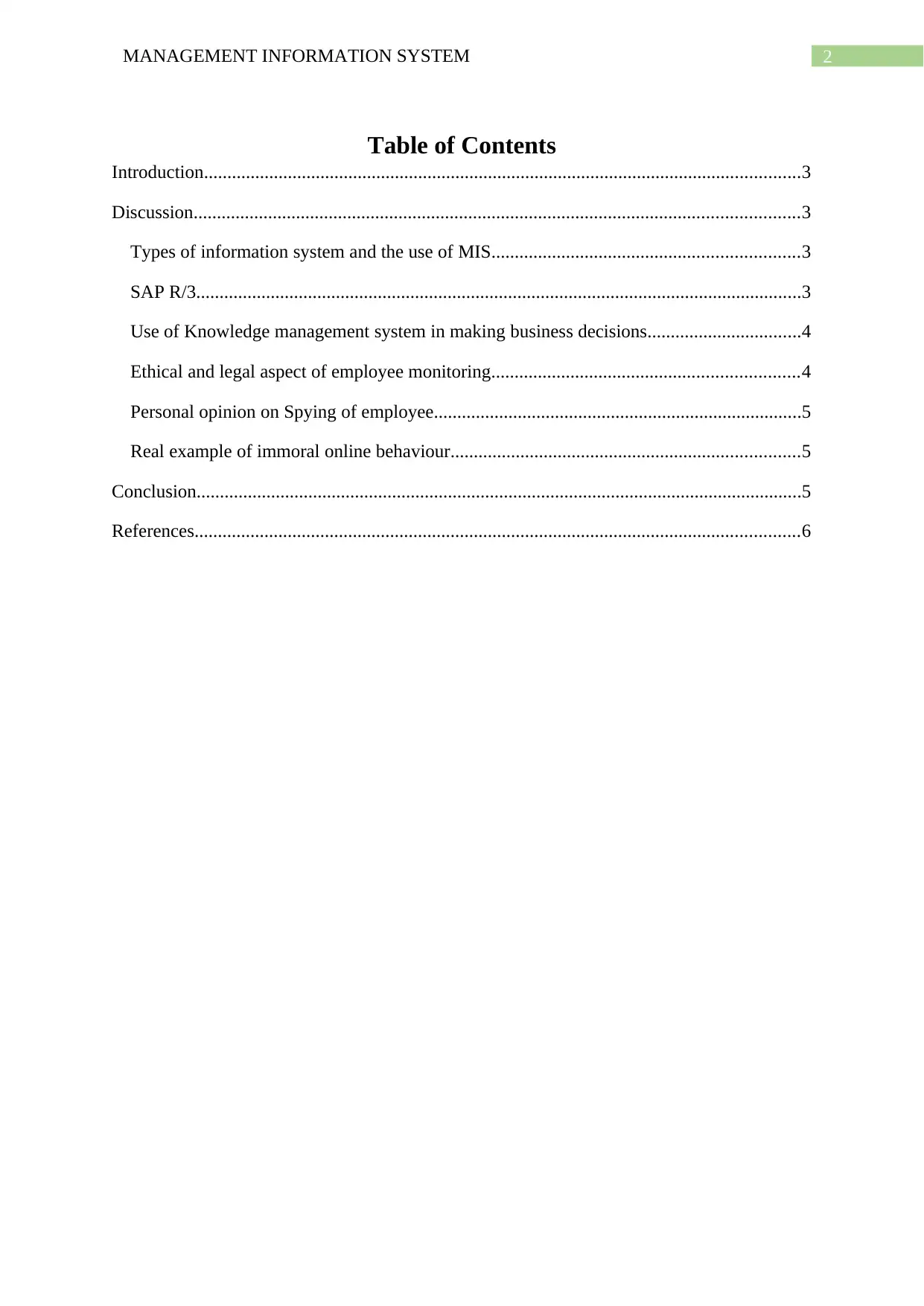
Introduction................................................................................................................................3
Discussion..................................................................................................................................3
Types of information system and the use of MIS..................................................................3
SAP R/3..................................................................................................................................3
Use of Knowledge management system in making business decisions.................................4
Ethical and legal aspect of employee monitoring..................................................................4
Personal opinion on Spying of employee...............................................................................5
Real example of immoral online behaviour...........................................................................5
Conclusion..................................................................................................................................5
References..................................................................................................................................6
Document Page
3MANAGEMENT INFORMATION SYSTEM
Introduction
Information systems are a critical part of developing any business. Information systems helps
to organise crucial data for any business and helps in providing a perspective to the business.
It helps in storage of important business data, avoiding crisis in during hard times, making
decision making easier, proper planning and analysing of data and it also helps in providing
proper data control to keep the system stable. Different information systems are used by
different companies to streamline their business processes. In this report, I am going to
explain the Enterprise Resource Planning system and discuss about its advantages and
disadvantages.
Discussion
Types of information system and the use of MIS
The major information systems that are used widely are Executive support systems or ESS,
Decision support system or DSS, Transaction processing system or TPS, Management
information system or MIS, Knowledge management system or KMS and office automation
system. The MIS helps in taking data from the transaction processing system and convert it
into many different reports. MIS is more used by operational supervisors and middle
management.
The applications of MIS in the education sector deals with the handling of the large amount
of data generated by schools or universities and convert them to graphs and charts to analyse
it. The MIS in education sector is specifically designed to monitor and supervise the
performance of programs offered by the institute and help in the managing and allocation of
the resources. The MIS in manufacturing sector serves different areas such as personnel,
production, finance, marketing, materials and corporate business management. The MIS also
helps in providing data for strategic planning at the top level and business planning at the
middle level. The MIS in medical sectors are used for managing client and business level data
in order to manage the administrative, clinical and financial aspect of the hospitals (Wager,
Lee, & Glaser, 2017).
SAP R/3
The SAP R/3 is one of the most important product of SAP where the R means real time and
the 3 means the three levels of its architecture (Kim, Kang, & Lee, 2016). Around 80% of
today’s business use SAP R/3 software. The software is capable of producing unmatched
tabler-icon-diamond-filled.svg

Paraphrase This Document

Need a fresh take? Get an instant paraphrase of this document with our AI Paraphraser
Document Page
4MANAGEMENT INFORMATION SYSTEM
Scalability, Robustness and Open standard support. The architecture of the system is such
that it can scale with increased server loads, supports most of today’s open standards and is
very robust. Though it has been implemented widely not all organisations have achieved the
intended results. This is because quite a few flaws were discovered in the system. These
flaws are no: cache memory in ICM, complex architecture, no support for other languages
and problems in the R/3 client terminals (Holub, & Bruckner, 2016). Therefore though the
software is very powerful it is still lacking in some areas that needs to be resolved. So it not
the optimum software for all businesses.
Use of Knowledge management system in making business decisions
The knowledge management system is a system that provides help to employees of a
company to access, share and update business information and knowledge (Hislop, Bosua, &
Helms, 2018). The major types of knowledge management applications used in organisations
are: Document management system, Chatbots, Social networking tools, Cross training
programs and content management systems. The major advantages of knowledge
management in a company are:
1. The people spend less time searching for already present knowledge as the data is
organised in a much better fashion.
2. The people involved spend much less time in finding an information as the system
enables fast searching of information.
3. The system prevents making of repetitive mistakes due to less sharing of information
(Donate, & de Pablo, 2015).
4. The system helps the decision makers take more informed decisions by accessing
previous outcomes of similar results already stored in the system.
5. The system also helps decision makers to standardise the process due to the
documentation and standardisation of the procedures.
So overall considering all points, the knowledge management system helps in making much
better decisions by optimising the process and providing data in a more organised manner.
Ethical and legal aspect of employee monitoring
The employee monitoring aspect might be legal from the company standpoint but it is not
valid from the ethical standpoint of the employee. I feel each employee is equally important
and responsible for the success of a company. The breach of privacy of an employee for the
improvement of security and safety of the company is not right (Stevens, 2018). The security
Document Page
5MANAGEMENT INFORMATION SYSTEM
of the system fails without the support of its employees. So I feel if employee monitoring
needed it should be for all the employees be it the company boss or the normal employees.
But it should be kept in mind that violating ethical standards in monitoring may lead to heavy
fines and law suits for the company (Chang, Liu, & Lin, 2015).
Personal opinion on Spying of employee
As a business leader I would limit my employee monitoring to certain aspects that I feel
would harm my business. For example, I would allow employee monitoring by using
software that tracks the devices used on company computers to prevent data theft. I would
also keep checks on employee’s activities on company computers to monitor illegal activities
done at the expense of my company. But I would never monitor the employee’s usage on his
or her personal devices like tablets, laptops or smartphones.
Real example of immoral online behaviour
A recent survey conducted in the United States reported that one out of every 40 employees
in 2012 was involved in data theft from his or her company. If I was in place of that business
leader, I would take legal action against the employee as theft of sensitive and copyrighted
company data is totally illegal.
Conclusion
To conclude, in this report I have talked about the different information systems that are used
globally. The report has described the common information systems along with the important
applications of management information systems in the fields of medical, education and
manufacturing. In this report I have also talked about the SAP R/3 and its pros and cons. The
report also illustrated the use of Knowledge management system in decision making with the
help of AI. The report concludes with a discussion on the legal and ethical issues related to
employee monitoring and my personal opinions on the same issue.
Document Page
6MANAGEMENT INFORMATION SYSTEM
References
Chang, S. E., Liu, A. Y., & Lin, S. (2015). Exploring privacy and trust for employee
monitoring. Industrial Management & Data Systems, 115(1), 88-106.
Donate, M. J., & de Pablo, J. D. S. (2015). The role of knowledge-oriented leadership in
knowledge management practices and innovation. Journal of Business
Research, 68(2), 360-370.
Hanseth, O., & Braa, K. (2016). SAP as Emergent Infrastructure in a Global
Organization. Systèmes d'Information et Management, 4(4), 3.
Hislop, D., Bosua, R., & Helms, R. (2018). Knowledge management in organizations: A
critical introduction. Oxford University Press.
Holub, I., & Bruckner, T. (2016). Measuring complexity of SAP systems. Complex Systems
Informatics and Modeling Quarterly, (8), 60-67.
Kim, Y. R., Kang, T. G., & Lee, E. B. (2016). SAP R/3 System Interface Technologies
Analysis and VBA Applied Data Input Proposal. Journal of the Korea Industrial
Information Systems Research, 21(2), 93-105.
Stevens, M. (2018). Monitoring employee activity: when is it appropriate?. Nursing And
Residential Care, 20(8), 402-404.
Wager, K. A., Lee, F. W., & Glaser, J. P. (2017). Health care information systems: a
practical approach for health care management. John Wiley & Sons.
tabler-icon-diamond-filled.svg

Paraphrase This Document

Need a fresh take? Get an instant paraphrase of this document with our AI Paraphraser
Document Page
7MANAGEMENT INFORMATION SYSTEM
chevron_up_icon
1 out of 8
circle_padding
hide_on_mobile
zoom_out_icon
[object Object]