Information Systems Outsourcing: Benefits and Challenges Report
VerifiedAdded on  2023/01/18
|5
|1841
|90
Report
AI Summary
This report provides a comprehensive overview of Information Systems (IS) outsourcing, examining its benefits and challenges. It begins with an abstract summarizing the key points, followed by an introduction outlining the report's objectives. The main body of the report delves into the advantages of IS outsourcing, such as cost reduction, access to specialist resources, enhanced focus on core business processes, and improved risk management. It also addresses the challenges associated with outsourcing, including staff qualifications of providers and the potential for contractual disagreements. The report concludes by summarizing the key findings and emphasizing the importance of proper risk assessment for successful IS outsourcing. The report is supported by references to relevant academic literature.
INFORMATION SYSTEMS OUTSOURCING
Name:
Student Id-
Name of univeristy:
1
Name:
Student Id-
Name of univeristy:
1
Paraphrase This Document
Need a fresh take? Get an instant paraphrase of this document with our AI Paraphraser

Abstract— The outsourcing is presently going through the
period of the overpowering growth. This paper provide the idea
about the major reasons why the firms are leading to the changes
and are adopting the features of the IS outsourcing and the
benefits that are gained by the business. The risks of the IS
outsourcing is clearly discussed in this report. It has been
observed that the organisation are provided with the opportunity
of having the improved IS services and there is the possibility of
achieving the technological improvements along with the cost
reserves in the staff as well as the technology have been
commonly viewed as significantly significant and they does not
appear as the precedence motives for the outsourcing in the
present study. Concerning the risks that are connected with the
IS outsourcing, these risks are majorly linked with the providers
along with the immense apprehension of being articulated
regarding the lack of the qualification amongst the staff of the
providers, the possible absence of the agreement with the
contracts along with the inability of the adapting the new
technologies.
(Keywords—IS outsourcing, Benefits, Challenges)
I. INTRODUCTION
Introduction
This report intends to provide the clear discussion of the
benefits and the challenges that are associated with the IS
outsourcing. The benefits of the IS outsourcing is briefly
stated in this report and the challenges of the IS outsourcing is
briefly discussed in this report. The introduction of the
information system in the organisation have been significantly
beneficial for the organisations but there might be some
challenges that are associated with the outsourcing that could
damage the working of the information system in the
organisation. Lastly this report concludes with the appropriate
conclusion for the report.
II. BENEFITS AND CHALLENGS IN INFORMATION SYSTEMS
OUTSOURCING
A. Benefits
As it has been discussed in the earlier studies, the
organisations majorly outsource the aspects that could not be
effectively managed by the business [1]. It is sometimes done
for being immensely effective and efficient in the competitive
environment. Some of the advantages of the IS outsourcing for
the businesses are:
Cost reduction: The method of the outsourcing could be
used by the organisations for the gaining of the inferior cost
base of the external services benefactors that allows the
decrease in the operation costs of the IT or the complete cost of
the IT ownership [2]. It allows the company in releasing the
supplementary finances for the utilisation in the other zones
with the strategic standards. The requirement of the
information systems in the organisation could be over
emphasized as several companies requires the IS outsourcing
for the providing the service at the lower costs. The hardware
and the software that are required for the implementation of the
information system are significantly expensive but this rate
could be easily reduced by the outsourcing of the various
components to the external service providers [3]. It could be
significantly costly while maintaining and also improving the
systems for constantly meeting the requirements of the
business.
Access to the specialist resources: The specialist are
significantly important in the outsourcing due to the fact that
the training and the development of the employees could be
significantly expensive for the businesses [4]. There is the
requirement of the selecting the service benefactor with the
modern technologies as well as the abilities who could offer
the entrance to the capabilities and the professional resources
that could decrease risk of any failure while at similar time
overtake the opponents on the technological front.
Enhanced focus: The outsourcing of the information
systems permits the companies in focussing on the core
business processes by the offloading of the operational phases
to the service provider with the major proficiency in the IT
grounds [5]. The companies could immensely focus on the
optimisation of the supply chain, fulfilling the requirements of
the customers as well as improving the contribution towards
the business objectives. The information systems that are
implemented in the organisation requires the extensive
management and the monitoring for the efficient working and
this task could be difficult for the organisations without the
proper resources and the procuring of the resources could be
costly also [6]. This is among the major reason why the
companies choose the core functions of the information
systems.
Improved risk administration: The risks are significantly
intrinsic in any of the business conclusions, because of the
vigorous competition in the markets, the government
legislations, the economic circumstances and the inclinations in
the technology. It could be immensely costly for the
management of the all kinds of the risks internally [7]. The
outsourcing permits the companies in the better utilisation of
the properties and the proficiency of the professionals that
effects in the improved risk administration as associated to the
internal handling. The failure could not be considered as the
option for the organisation who are working in the business
environment where there could the loss due to the inefficiency
[8].
period of the overpowering growth. This paper provide the idea
about the major reasons why the firms are leading to the changes
and are adopting the features of the IS outsourcing and the
benefits that are gained by the business. The risks of the IS
outsourcing is clearly discussed in this report. It has been
observed that the organisation are provided with the opportunity
of having the improved IS services and there is the possibility of
achieving the technological improvements along with the cost
reserves in the staff as well as the technology have been
commonly viewed as significantly significant and they does not
appear as the precedence motives for the outsourcing in the
present study. Concerning the risks that are connected with the
IS outsourcing, these risks are majorly linked with the providers
along with the immense apprehension of being articulated
regarding the lack of the qualification amongst the staff of the
providers, the possible absence of the agreement with the
contracts along with the inability of the adapting the new
technologies.
(Keywords—IS outsourcing, Benefits, Challenges)
I. INTRODUCTION
Introduction
This report intends to provide the clear discussion of the
benefits and the challenges that are associated with the IS
outsourcing. The benefits of the IS outsourcing is briefly
stated in this report and the challenges of the IS outsourcing is
briefly discussed in this report. The introduction of the
information system in the organisation have been significantly
beneficial for the organisations but there might be some
challenges that are associated with the outsourcing that could
damage the working of the information system in the
organisation. Lastly this report concludes with the appropriate
conclusion for the report.
II. BENEFITS AND CHALLENGS IN INFORMATION SYSTEMS
OUTSOURCING
A. Benefits
As it has been discussed in the earlier studies, the
organisations majorly outsource the aspects that could not be
effectively managed by the business [1]. It is sometimes done
for being immensely effective and efficient in the competitive
environment. Some of the advantages of the IS outsourcing for
the businesses are:
Cost reduction: The method of the outsourcing could be
used by the organisations for the gaining of the inferior cost
base of the external services benefactors that allows the
decrease in the operation costs of the IT or the complete cost of
the IT ownership [2]. It allows the company in releasing the
supplementary finances for the utilisation in the other zones
with the strategic standards. The requirement of the
information systems in the organisation could be over
emphasized as several companies requires the IS outsourcing
for the providing the service at the lower costs. The hardware
and the software that are required for the implementation of the
information system are significantly expensive but this rate
could be easily reduced by the outsourcing of the various
components to the external service providers [3]. It could be
significantly costly while maintaining and also improving the
systems for constantly meeting the requirements of the
business.
Access to the specialist resources: The specialist are
significantly important in the outsourcing due to the fact that
the training and the development of the employees could be
significantly expensive for the businesses [4]. There is the
requirement of the selecting the service benefactor with the
modern technologies as well as the abilities who could offer
the entrance to the capabilities and the professional resources
that could decrease risk of any failure while at similar time
overtake the opponents on the technological front.
Enhanced focus: The outsourcing of the information
systems permits the companies in focussing on the core
business processes by the offloading of the operational phases
to the service provider with the major proficiency in the IT
grounds [5]. The companies could immensely focus on the
optimisation of the supply chain, fulfilling the requirements of
the customers as well as improving the contribution towards
the business objectives. The information systems that are
implemented in the organisation requires the extensive
management and the monitoring for the efficient working and
this task could be difficult for the organisations without the
proper resources and the procuring of the resources could be
costly also [6]. This is among the major reason why the
companies choose the core functions of the information
systems.
Improved risk administration: The risks are significantly
intrinsic in any of the business conclusions, because of the
vigorous competition in the markets, the government
legislations, the economic circumstances and the inclinations in
the technology. It could be immensely costly for the
management of the all kinds of the risks internally [7]. The
outsourcing permits the companies in the better utilisation of
the properties and the proficiency of the professionals that
effects in the improved risk administration as associated to the
internal handling. The failure could not be considered as the
option for the organisation who are working in the business
environment where there could the loss due to the inefficiency
[8].

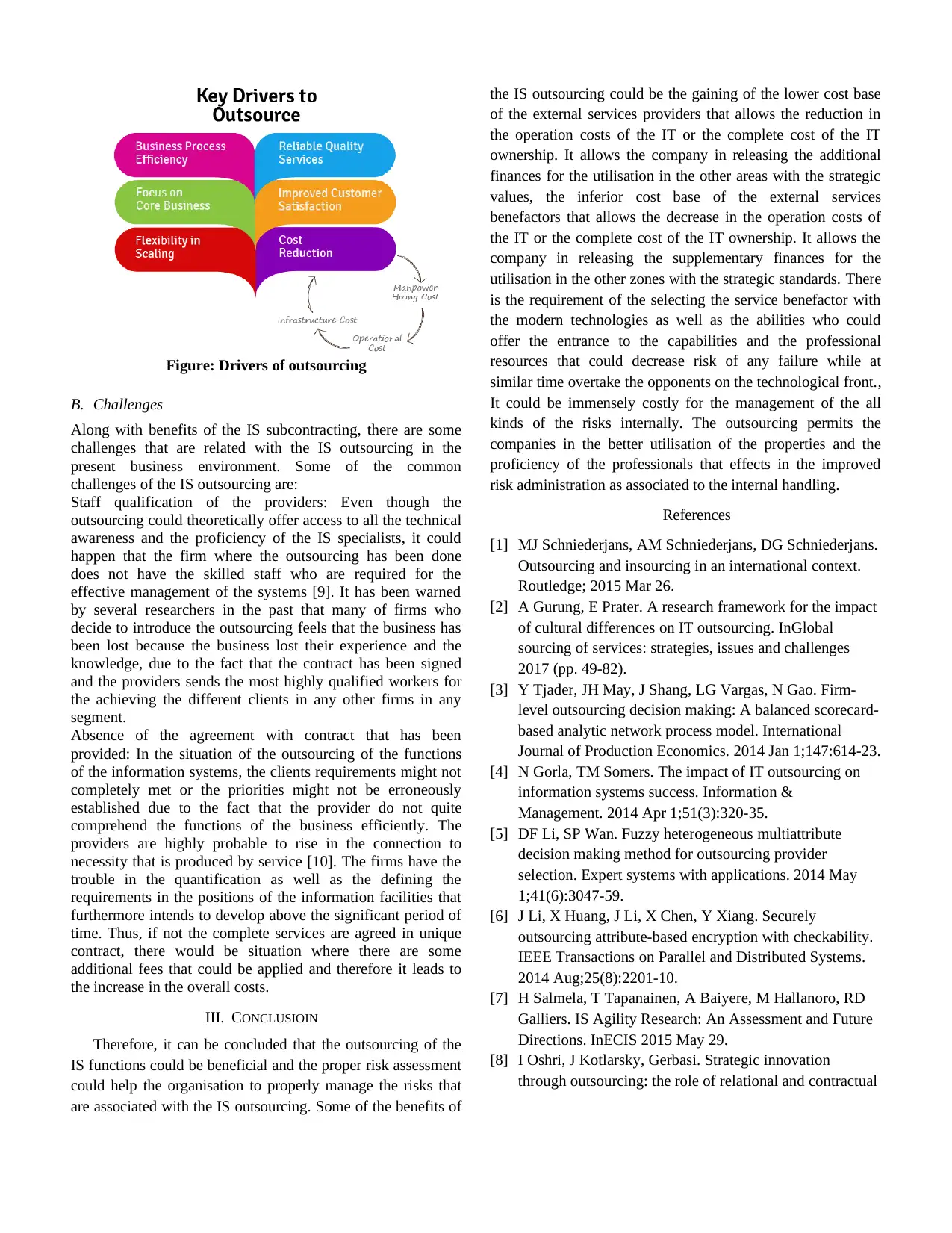
Figure: Drivers of outsourcing
B. Challenges
Along with benefits of the IS subcontracting, there are some
challenges that are related with the IS outsourcing in the
present business environment. Some of the common
challenges of the IS outsourcing are:
Staff qualification of the providers: Even though the
outsourcing could theoretically offer access to all the technical
awareness and the proficiency of the IS specialists, it could
happen that the firm where the outsourcing has been done
does not have the skilled staff who are required for the
effective management of the systems [9]. It has been warned
by several researchers in the past that many of firms who
decide to introduce the outsourcing feels that the business has
been lost because the business lost their experience and the
knowledge, due to the fact that the contract has been signed
and the providers sends the most highly qualified workers for
the achieving the different clients in any other firms in any
segment.
Absence of the agreement with contract that has been
provided: In the situation of the outsourcing of the functions
of the information systems, the clients requirements might not
completely met or the priorities might not be erroneously
established due to the fact that the provider do not quite
comprehend the functions of the business efficiently. The
providers are highly probable to rise in the connection to
necessity that is produced by service [10]. The firms have the
trouble in the quantification as well as the defining the
requirements in the positions of the information facilities that
furthermore intends to develop above the significant period of
time. Thus, if not the complete services are agreed in unique
contract, there would be situation where there are some
additional fees that could be applied and therefore it leads to
the increase in the overall costs.
III. CONCLUSIOIN
Therefore, it can be concluded that the outsourcing of the
IS functions could be beneficial and the proper risk assessment
could help the organisation to properly manage the risks that
are associated with the IS outsourcing. Some of the benefits of
the IS outsourcing could be the gaining of the lower cost base
of the external services providers that allows the reduction in
the operation costs of the IT or the complete cost of the IT
ownership. It allows the company in releasing the additional
finances for the utilisation in the other areas with the strategic
values, the inferior cost base of the external services
benefactors that allows the decrease in the operation costs of
the IT or the complete cost of the IT ownership. It allows the
company in releasing the supplementary finances for the
utilisation in the other zones with the strategic standards. There
is the requirement of the selecting the service benefactor with
the modern technologies as well as the abilities who could
offer the entrance to the capabilities and the professional
resources that could decrease risk of any failure while at
similar time overtake the opponents on the technological front.,
It could be immensely costly for the management of the all
kinds of the risks internally. The outsourcing permits the
companies in the better utilisation of the properties and the
proficiency of the professionals that effects in the improved
risk administration as associated to the internal handling.
References
[1] MJ Schniederjans, AM Schniederjans, DG Schniederjans.
Outsourcing and insourcing in an international context.
Routledge; 2015 Mar 26.
[2] A Gurung, E Prater. A research framework for the impact
of cultural differences on IT outsourcing. InGlobal
sourcing of services: strategies, issues and challenges
2017 (pp. 49-82).
[3] Y Tjader, JH May, J Shang, LG Vargas, N Gao. Firm-
level outsourcing decision making: A balanced scorecard-
based analytic network process model. International
Journal of Production Economics. 2014 Jan 1;147:614-23.
[4] N Gorla, TM Somers. The impact of IT outsourcing on
information systems success. Information &
Management. 2014 Apr 1;51(3):320-35.
[5] DF Li, SP Wan. Fuzzy heterogeneous multiattribute
decision making method for outsourcing provider
selection. Expert systems with applications. 2014 May
1;41(6):3047-59.
[6] J Li, X Huang, J Li, X Chen, Y Xiang. Securely
outsourcing attribute-based encryption with checkability.
IEEE Transactions on Parallel and Distributed Systems.
2014 Aug;25(8):2201-10.
[7] H Salmela, T Tapanainen, A Baiyere, M Hallanoro, RD
Galliers. IS Agility Research: An Assessment and Future
Directions. InECIS 2015 May 29.
[8] I Oshri, J Kotlarsky, Gerbasi. Strategic innovation
through outsourcing: the role of relational and contractual
B. Challenges
Along with benefits of the IS subcontracting, there are some
challenges that are related with the IS outsourcing in the
present business environment. Some of the common
challenges of the IS outsourcing are:
Staff qualification of the providers: Even though the
outsourcing could theoretically offer access to all the technical
awareness and the proficiency of the IS specialists, it could
happen that the firm where the outsourcing has been done
does not have the skilled staff who are required for the
effective management of the systems [9]. It has been warned
by several researchers in the past that many of firms who
decide to introduce the outsourcing feels that the business has
been lost because the business lost their experience and the
knowledge, due to the fact that the contract has been signed
and the providers sends the most highly qualified workers for
the achieving the different clients in any other firms in any
segment.
Absence of the agreement with contract that has been
provided: In the situation of the outsourcing of the functions
of the information systems, the clients requirements might not
completely met or the priorities might not be erroneously
established due to the fact that the provider do not quite
comprehend the functions of the business efficiently. The
providers are highly probable to rise in the connection to
necessity that is produced by service [10]. The firms have the
trouble in the quantification as well as the defining the
requirements in the positions of the information facilities that
furthermore intends to develop above the significant period of
time. Thus, if not the complete services are agreed in unique
contract, there would be situation where there are some
additional fees that could be applied and therefore it leads to
the increase in the overall costs.
III. CONCLUSIOIN
Therefore, it can be concluded that the outsourcing of the
IS functions could be beneficial and the proper risk assessment
could help the organisation to properly manage the risks that
are associated with the IS outsourcing. Some of the benefits of
the IS outsourcing could be the gaining of the lower cost base
of the external services providers that allows the reduction in
the operation costs of the IT or the complete cost of the IT
ownership. It allows the company in releasing the additional
finances for the utilisation in the other areas with the strategic
values, the inferior cost base of the external services
benefactors that allows the decrease in the operation costs of
the IT or the complete cost of the IT ownership. It allows the
company in releasing the supplementary finances for the
utilisation in the other zones with the strategic standards. There
is the requirement of the selecting the service benefactor with
the modern technologies as well as the abilities who could
offer the entrance to the capabilities and the professional
resources that could decrease risk of any failure while at
similar time overtake the opponents on the technological front.,
It could be immensely costly for the management of the all
kinds of the risks internally. The outsourcing permits the
companies in the better utilisation of the properties and the
proficiency of the professionals that effects in the improved
risk administration as associated to the internal handling.
References
[1] MJ Schniederjans, AM Schniederjans, DG Schniederjans.
Outsourcing and insourcing in an international context.
Routledge; 2015 Mar 26.
[2] A Gurung, E Prater. A research framework for the impact
of cultural differences on IT outsourcing. InGlobal
sourcing of services: strategies, issues and challenges
2017 (pp. 49-82).
[3] Y Tjader, JH May, J Shang, LG Vargas, N Gao. Firm-
level outsourcing decision making: A balanced scorecard-
based analytic network process model. International
Journal of Production Economics. 2014 Jan 1;147:614-23.
[4] N Gorla, TM Somers. The impact of IT outsourcing on
information systems success. Information &
Management. 2014 Apr 1;51(3):320-35.
[5] DF Li, SP Wan. Fuzzy heterogeneous multiattribute
decision making method for outsourcing provider
selection. Expert systems with applications. 2014 May
1;41(6):3047-59.
[6] J Li, X Huang, J Li, X Chen, Y Xiang. Securely
outsourcing attribute-based encryption with checkability.
IEEE Transactions on Parallel and Distributed Systems.
2014 Aug;25(8):2201-10.
[7] H Salmela, T Tapanainen, A Baiyere, M Hallanoro, RD
Galliers. IS Agility Research: An Assessment and Future
Directions. InECIS 2015 May 29.
[8] I Oshri, J Kotlarsky, Gerbasi. Strategic innovation
through outsourcing: the role of relational and contractual
⊘ This is a preview!⊘
Do you want full access?
Subscribe today to unlock all pages.

Trusted by 1+ million students worldwide

governance. The Journal of Strategic Information
Systems. 2015 Sep 1;24(3):203-16.
[9] C Schwarz. Toward an understanding of the nature and
conceptualization of outsourcing success. Information &
Management. 2014 Jan 1;51(1):152-64.
[10] A Gunasekaran, Z Irani, KL Choy, L Filippi, T
Papadopoulos. Performance measures and metrics in
outsourcing decisions: A review for research and
applications. International Journal of Production
Economics. 2015 Mar 1;161:153-66.
.
Systems. 2015 Sep 1;24(3):203-16.
[9] C Schwarz. Toward an understanding of the nature and
conceptualization of outsourcing success. Information &
Management. 2014 Jan 1;51(1):152-64.
[10] A Gunasekaran, Z Irani, KL Choy, L Filippi, T
Papadopoulos. Performance measures and metrics in
outsourcing decisions: A review for research and
applications. International Journal of Production
Economics. 2015 Mar 1;161:153-66.
.
Paraphrase This Document
Need a fresh take? Get an instant paraphrase of this document with our AI Paraphraser

.
1 out of 5
Related Documents
Your All-in-One AI-Powered Toolkit for Academic Success.
 +13062052269
info@desklib.com
Available 24*7 on WhatsApp / Email
Unlock your academic potential
Copyright © 2020–2025 A2Z Services. All Rights Reserved. Developed and managed by ZUCOL.