Wireless Communication Assignment: Digital Modulation, CRC, and DSSS

Verified

Added on  2022/10/06

|6
|334
|17
Homework Assignment
AI Summary
This assignment solution addresses key concepts in wireless communication, including digital-to-analog conversion techniques such as 2-level ASK, FSK, PSK, DPSK, and various multi-level modulation schemes like 4-level ASK, PSK, and 8-level PSK, along with their representations. It includes the modulation techniques of baseband to AM and 16QAM constellation. The solution provides a detailed explanation of the Cyclic Redundancy Check (CRC) error detection process, demonstrating the calculation of the Frame Check Sequence (FCS) and the overall process of error detection. Furthermore, the solution delves into Direct Sequence Spread Spectrum (DSSS) signal generation and explains the advantages of hexagonal cell patterns in cellular communications for complete area coverage, contrasting them with the limitations of square-based cell patterns.
Document Page
Wireless Communication
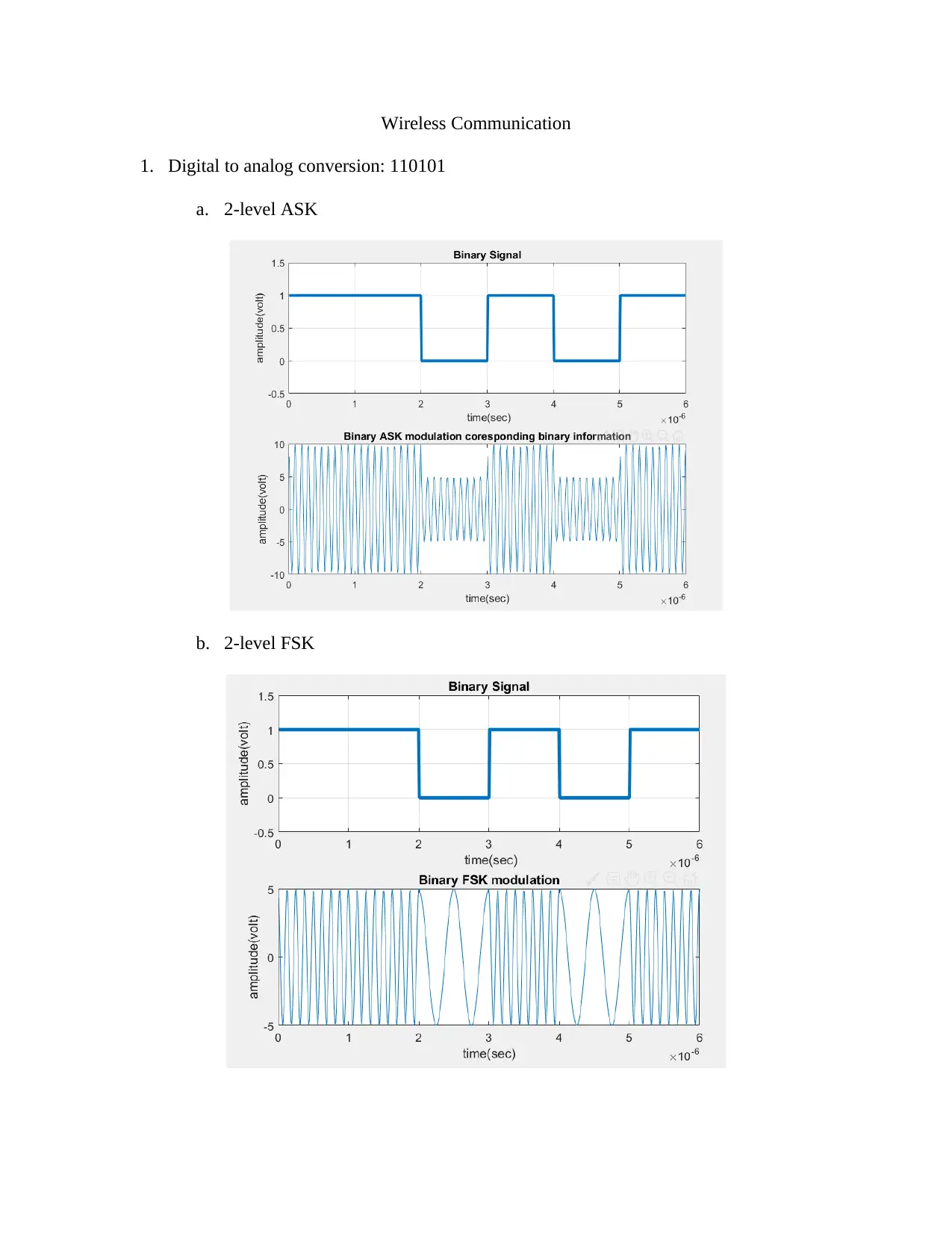
1. Digital to analog conversion: 110101
a. 2-level ASK
b. 2-level FSK
tabler-icon-diamond-filled.svg

Paraphrase This Document

Need a fresh take? Get an instant paraphrase of this document with our AI Paraphraser
Document Page
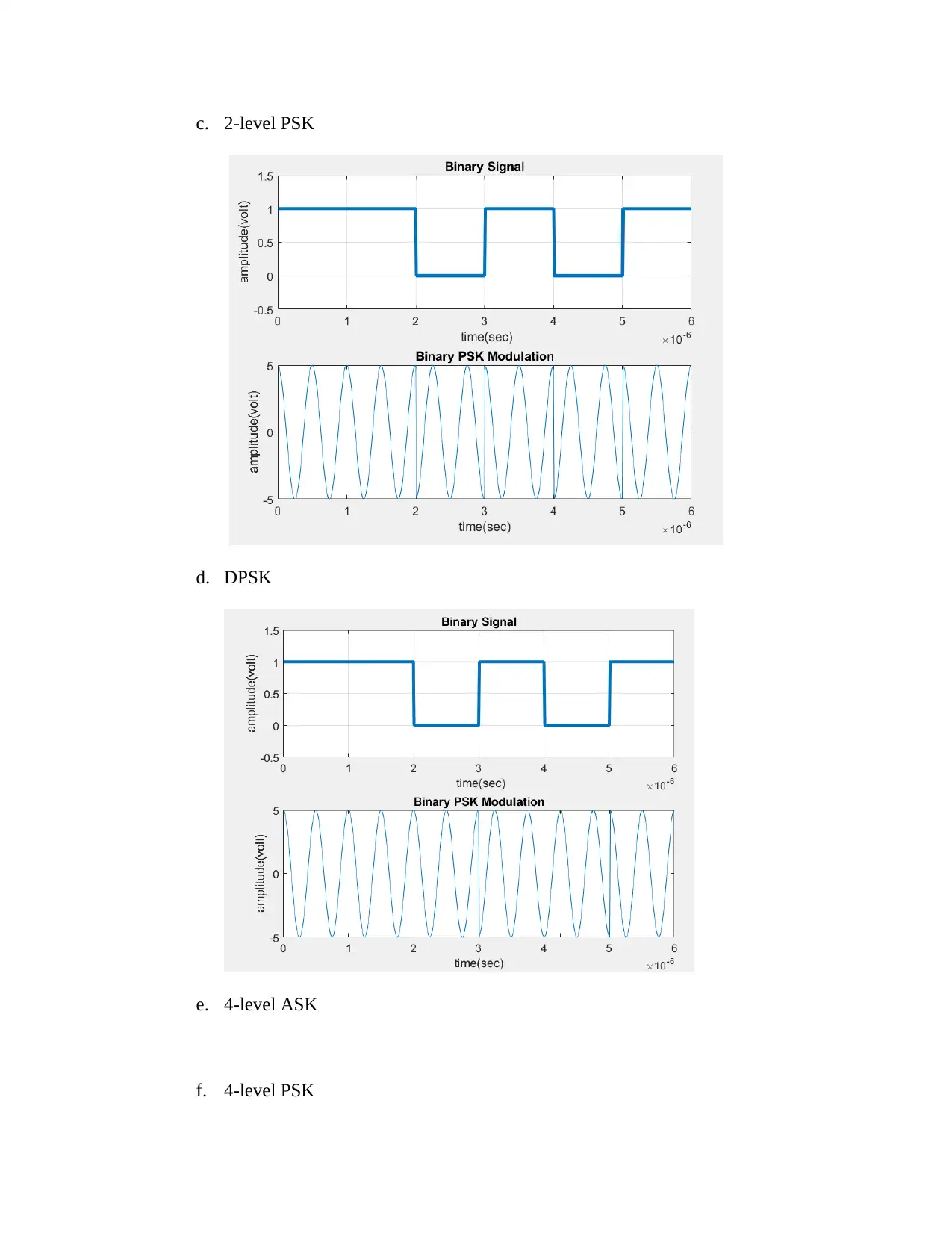
c. 2-level PSK
d. DPSK
e. 4-level ASK
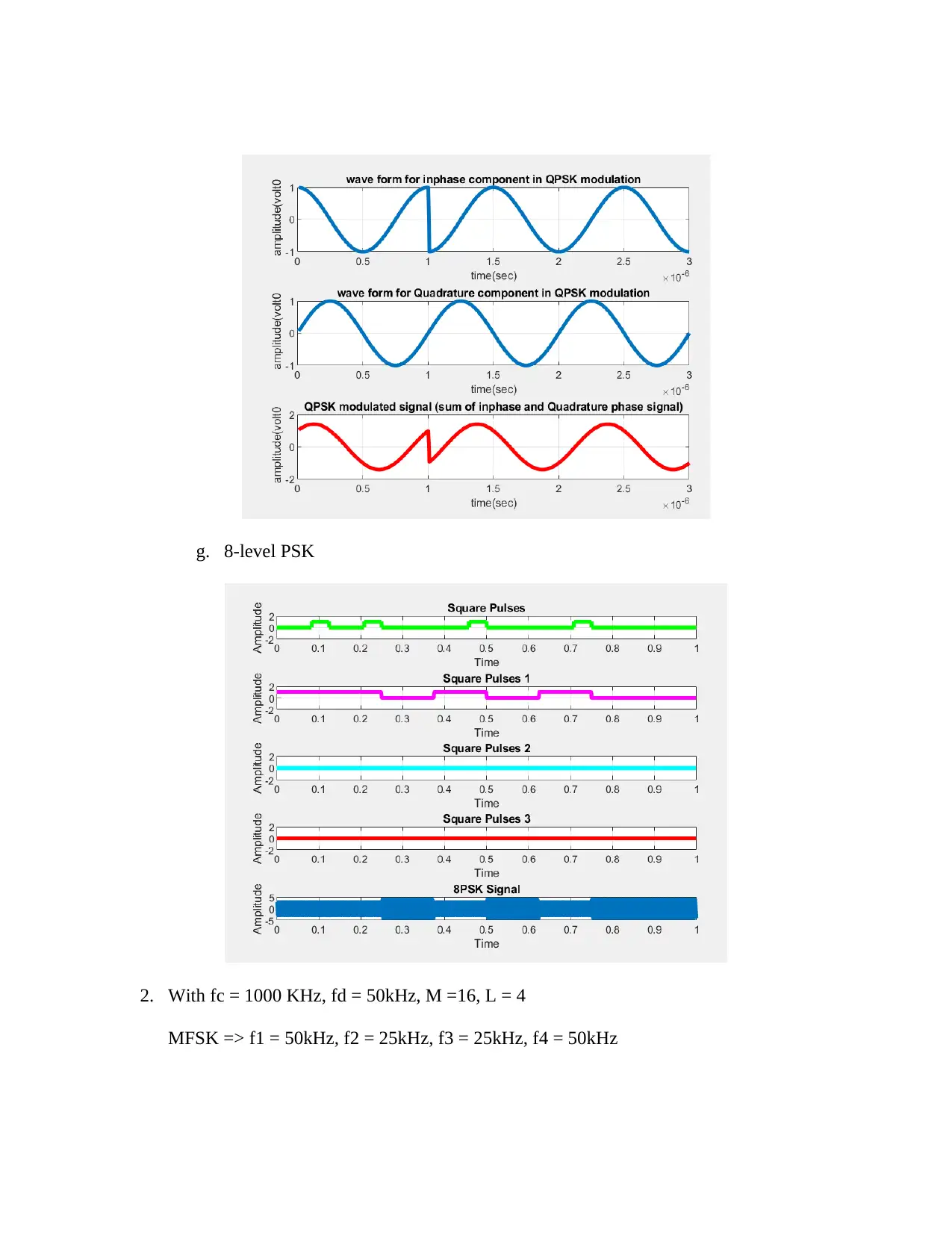
f. 4-level PSK
Document Page
g. 8-level PSK
2. With fc = 1000 KHz, fd = 50kHz, M =16, L = 4
MFSK => f1 = 50kHz, f2 = 25kHz, f3 = 25kHz, f4 = 50kHz
Document Page
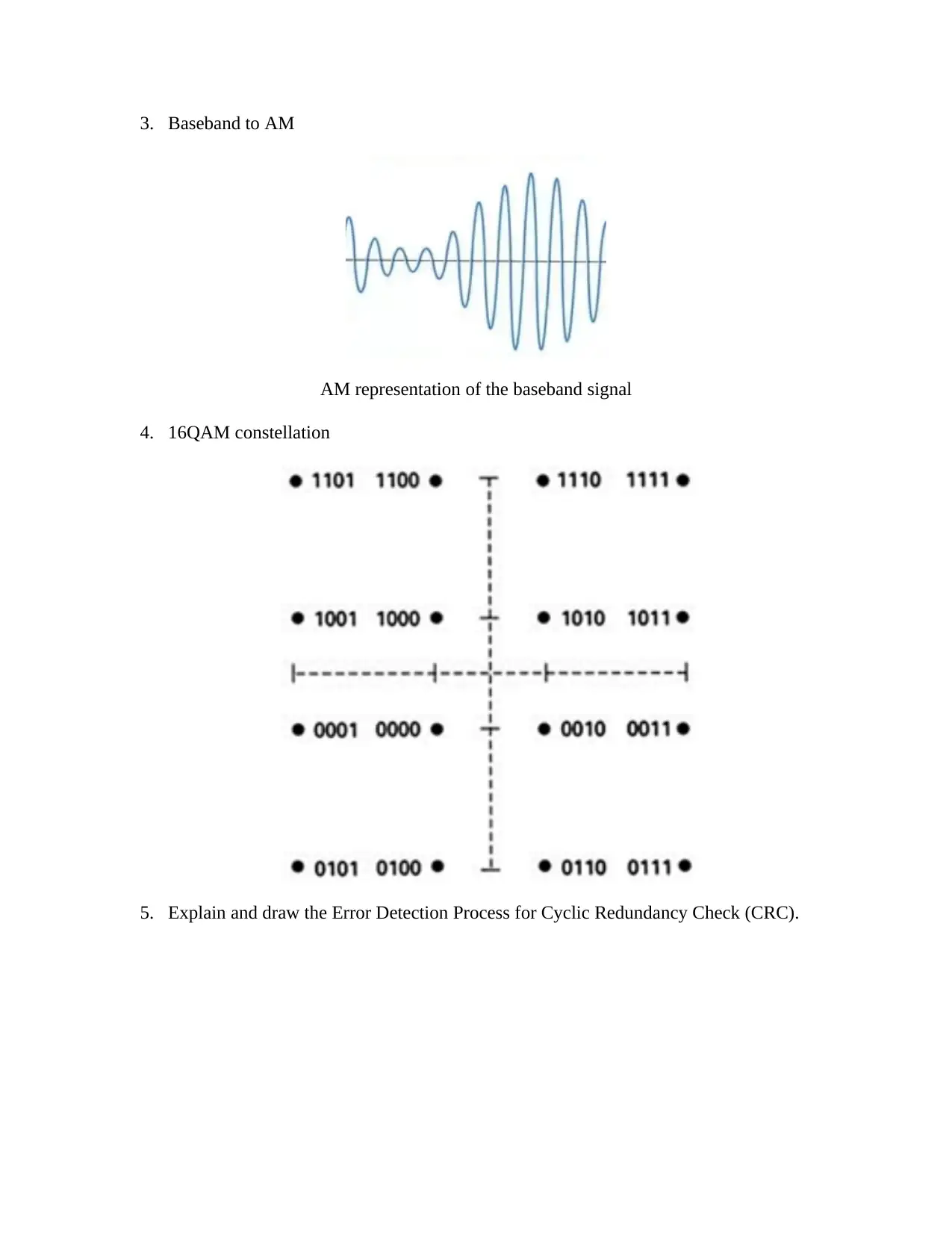
3. Baseband to AM
AM representation of the baseband signal
4. 16QAM constellation
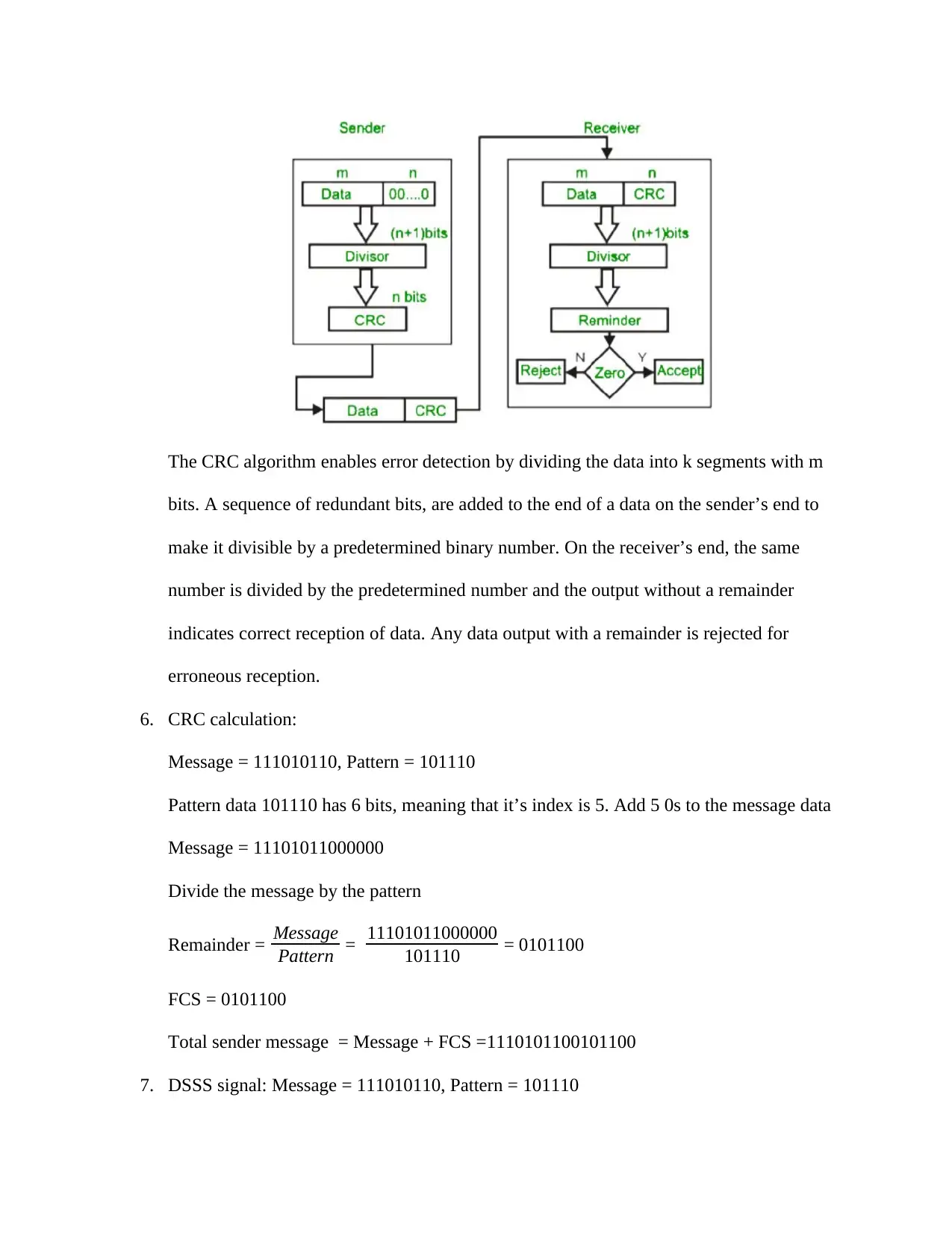
5. Explain and draw the Error Detection Process for Cyclic Redundancy Check (CRC).
tabler-icon-diamond-filled.svg

Paraphrase This Document

Need a fresh take? Get an instant paraphrase of this document with our AI Paraphraser
Document Page
The CRC algorithm enables error detection by dividing the data into k segments with m
bits. A sequence of redundant bits, are added to the end of a data on the sender’s end to
make it divisible by a predetermined binary number. On the receiver’s end, the same
number is divided by the predetermined number and the output without a remainder
indicates correct reception of data. Any data output with a remainder is rejected for
erroneous reception.
6. CRC calculation:
Message = 111010110, Pattern = 101110
Pattern data 101110 has 6 bits, meaning that it’s index is 5. Add 5 0s to the message data
Message = 11101011000000
Divide the message by the pattern
Remainder = Message
Pattern = 11101011000000
101110 = 0101100
FCS = 0101100
Total sender message = Message + FCS =1110101100101100
7. DSSS signal: Message = 111010110, Pattern = 101110
Document Page
1 1 1 0 1 0 1 1 0
010001 010001 010001 101110 010001 101110 010001 010001 101110
Transmitted signal: 01000101000110001101110010001101110010001010001101110
8. The cellular communications are beneficial and more efficient when the whole area is
covered by the radiation patterns. Square patterns cannot be covered fully because all
radiating antennas radiate in either directional or unidirectional spherical-like patterns. As
a result, a square-based cell will have signal overlaps in certain areas and uncovered
regions. Hexagonal based cells can be covered fully with 120 or 60 degree radiation
pattern fully without such issues.
chevron_up_icon
1 out of 6
circle_padding
hide_on_mobile
zoom_out_icon
[object Object]