Mixed Methods Research Design Analysis: Barriers and Limitations

Verified

Added on  2023/03/20

|4
|733
|80
Homework Assignment
AI Summary
This assignment provides an overview of the mixed methods research design, which combines both qualitative and quantitative research methods. It highlights the strengths of the method, such as triangulation, complementation, development of ideas, and initiation, while also acknowledging its weaknesses, including the lack of clear guidance on how to mix the methods effectively. The assignment argues that the mixed methods approach may not be suitable for all research problems, particularly those that primarily require qualitative data. It discusses potential barriers to integration, such as the different nature of data collection and the complexities of combining findings. The assignment also notes the limitations associated with short projects and the possibility of irrelevant information. In conclusion, the assignment emphasizes the need for further research to provide clear guidelines for implementing the mixed methods design effectively and suggests that its current limitations could significantly alter research findings.
Document Page
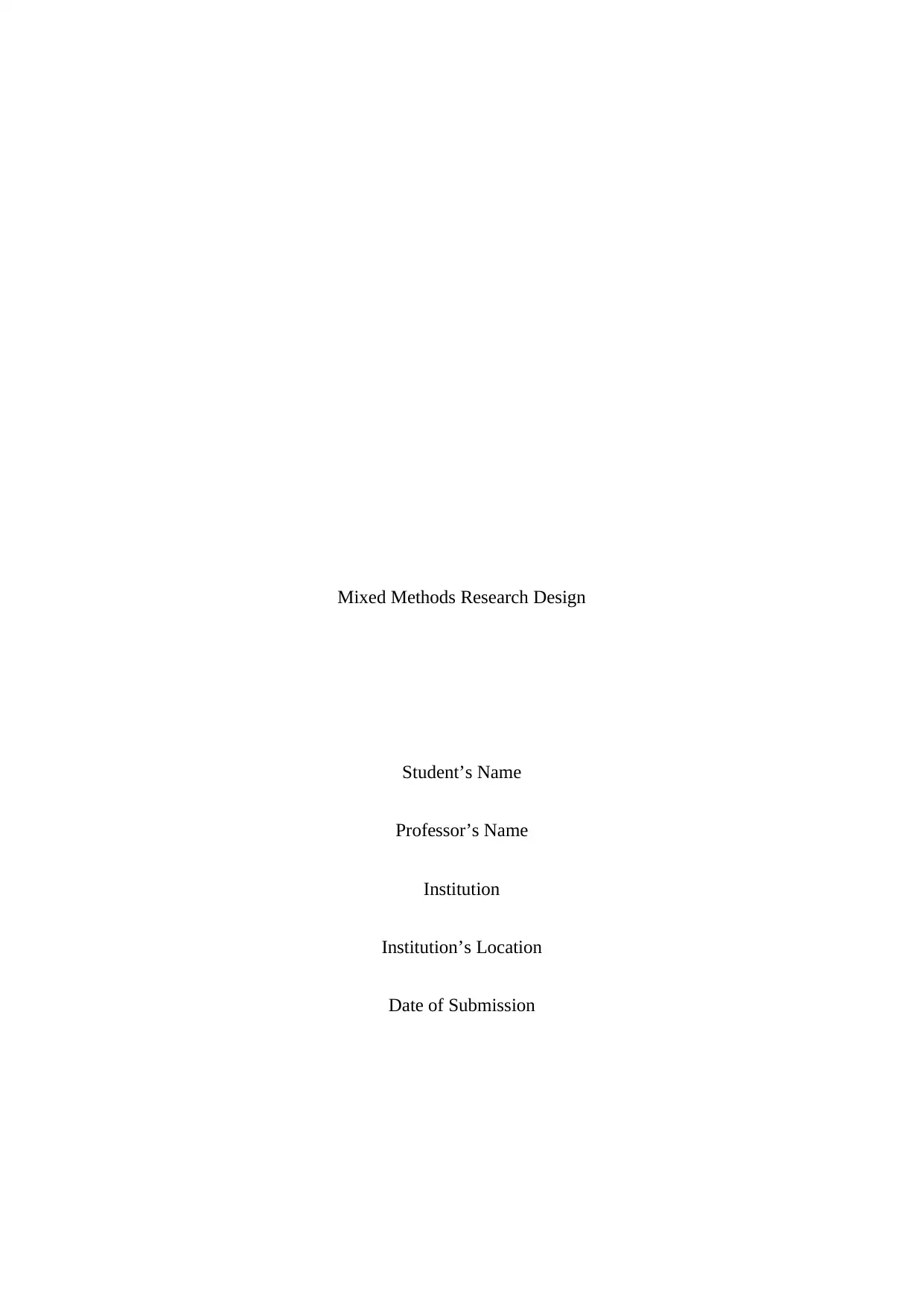
Mixed Methods Research Design
Student’s Name
Professor’s Name
Institution
Institution’s Location
Date of Submission
tabler-icon-diamond-filled.svg

Paraphrase This Document

Need a fresh take? Get an instant paraphrase of this document with our AI Paraphraser
Document Page
Mixed Methods Research Design
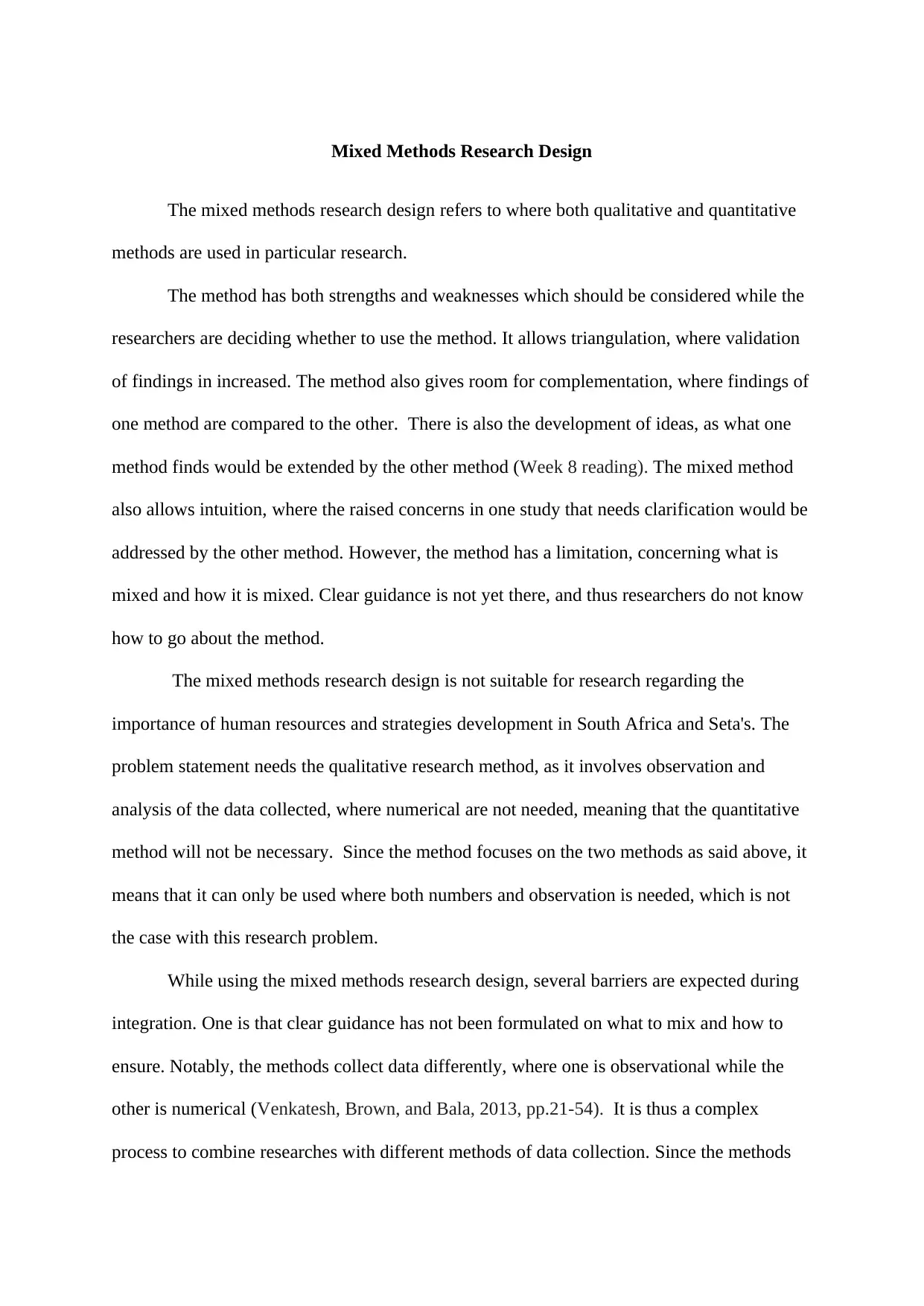
The mixed methods research design refers to where both qualitative and quantitative
methods are used in particular research.
The method has both strengths and weaknesses which should be considered while the
researchers are deciding whether to use the method. It allows triangulation, where validation
of findings in increased. The method also gives room for complementation, where findings of
one method are compared to the other. There is also the development of ideas, as what one
method finds would be extended by the other method (Week 8 reading). The mixed method
also allows intuition, where the raised concerns in one study that needs clarification would be
addressed by the other method. However, the method has a limitation, concerning what is
mixed and how it is mixed. Clear guidance is not yet there, and thus researchers do not know
how to go about the method.
The mixed methods research design is not suitable for research regarding the
importance of human resources and strategies development in South Africa and Seta's. The
problem statement needs the qualitative research method, as it involves observation and
analysis of the data collected, where numerical are not needed, meaning that the quantitative
method will not be necessary. Since the method focuses on the two methods as said above, it
means that it can only be used where both numbers and observation is needed, which is not
the case with this research problem.
While using the mixed methods research design, several barriers are expected during
integration. One is that clear guidance has not been formulated on what to mix and how to
ensure. Notably, the methods collect data differently, where one is observational while the
other is numerical (Venkatesh, Brown, and Bala, 2013, pp.21-54). It is thus a complex
process to combine researches with different methods of data collection. Since the methods
Document Page
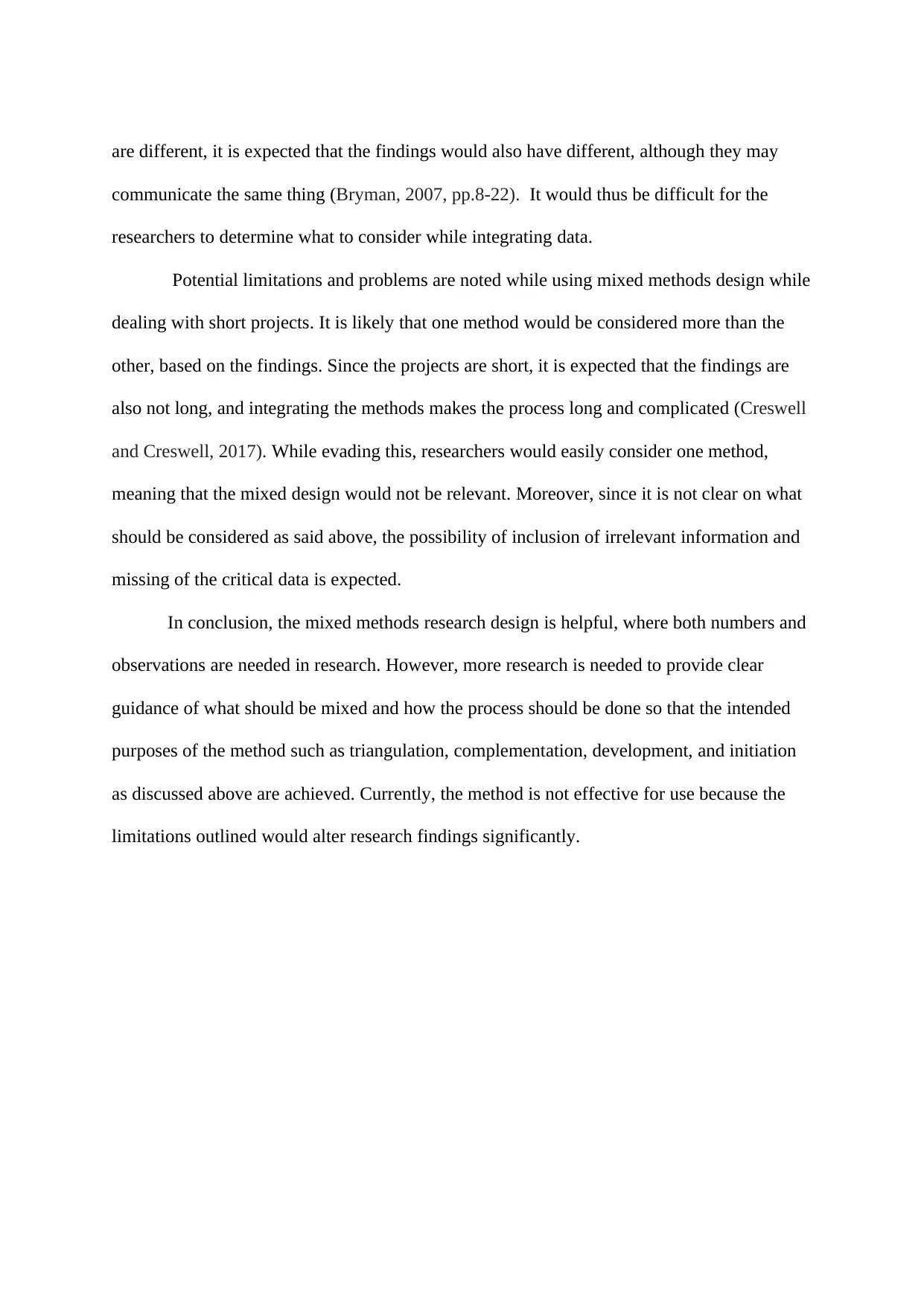
are different, it is expected that the findings would also have different, although they may
communicate the same thing (Bryman, 2007, pp.8-22). It would thus be difficult for the
researchers to determine what to consider while integrating data.
Potential limitations and problems are noted while using mixed methods design while
dealing with short projects. It is likely that one method would be considered more than the
other, based on the findings. Since the projects are short, it is expected that the findings are
also not long, and integrating the methods makes the process long and complicated (Creswell
and Creswell, 2017). While evading this, researchers would easily consider one method,
meaning that the mixed design would not be relevant. Moreover, since it is not clear on what
should be considered as said above, the possibility of inclusion of irrelevant information and
missing of the critical data is expected.
In conclusion, the mixed methods research design is helpful, where both numbers and
observations are needed in research. However, more research is needed to provide clear
guidance of what should be mixed and how the process should be done so that the intended
purposes of the method such as triangulation, complementation, development, and initiation
as discussed above are achieved. Currently, the method is not effective for use because the
limitations outlined would alter research findings significantly.
Document Page
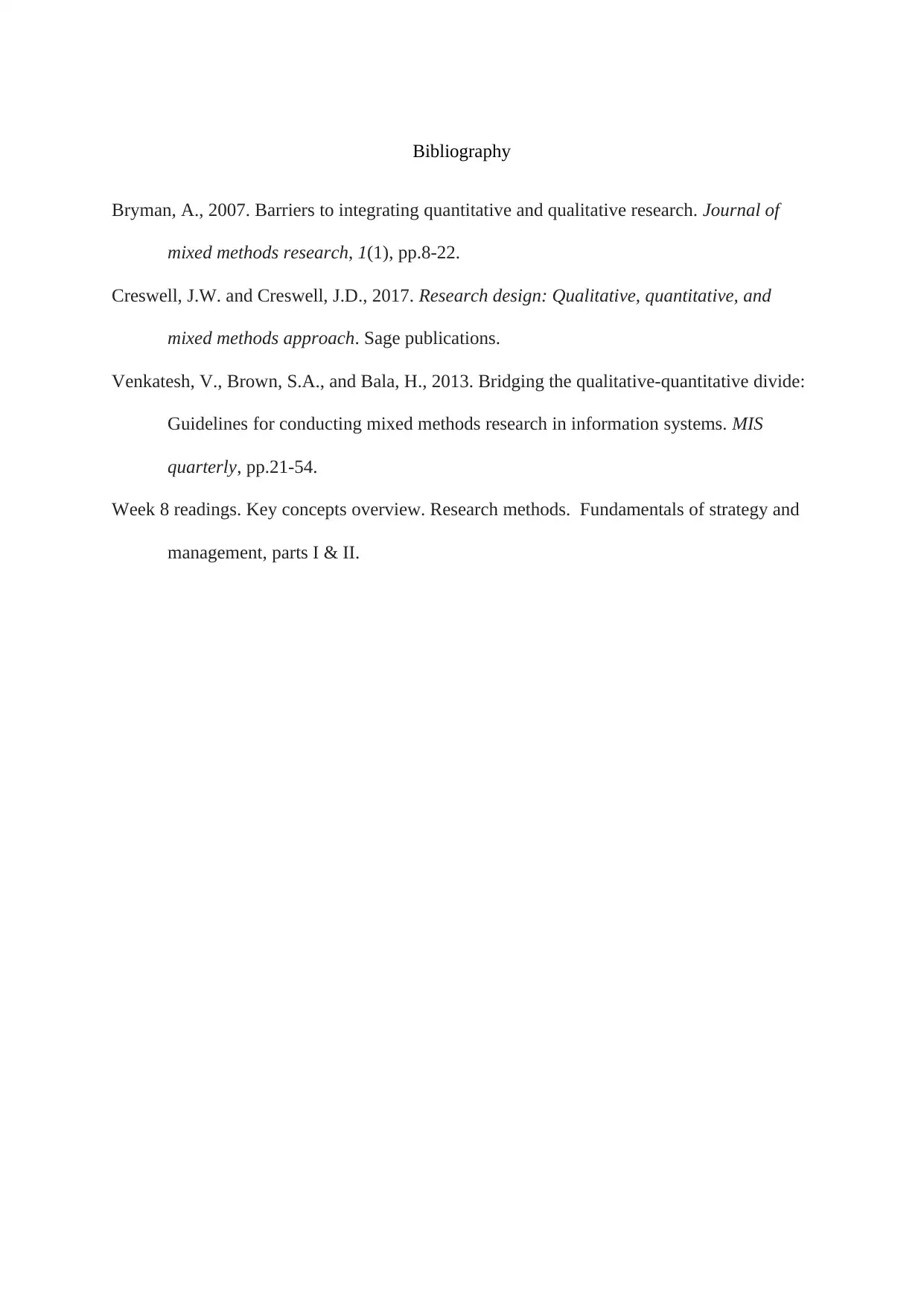
Bibliography
Bryman, A., 2007. Barriers to integrating quantitative and qualitative research. Journal of
mixed methods research, 1(1), pp.8-22.
Creswell, J.W. and Creswell, J.D., 2017. Research design: Qualitative, quantitative, and
mixed methods approach. Sage publications.
Venkatesh, V., Brown, S.A., and Bala, H., 2013. Bridging the qualitative-quantitative divide:
Guidelines for conducting mixed methods research in information systems. MIS
quarterly, pp.21-54.
Week 8 readings. Key concepts overview. Research methods. Fundamentals of strategy and
management, parts I & II.
chevron_up_icon
1 out of 4
circle_padding
hide_on_mobile
zoom_out_icon
[object Object]