MKT202 Marketing Research: Designing Patient Satisfaction Data Tools

Verified

Added on  2023/06/07

|11
|1519
|297
Report
AI Summary
This report focuses on designing primary data collection tools for assessing patient satisfaction in Australian healthcare within the context of MKT202 Marketing Research Essentials. It includes a research plan outlining activities, resources, and timelines for improving patient satisfaction through addressing complaints and promoting quality care. The report details the design of a survey questionnaire based on the Australian Hospital Patient Experience Question Set (AHPEQS), incorporating various scales and techniques. A test market study is also developed to evaluate the impact of healthcare service delivery in specific regions before national implementation. The analysis of collected data using IBM SPSS is discussed, along with considerations for data presentation and statistical significance. The report concludes by highlighting the importance of questionnaires in strategic health planning and identifies limitations in their utilization. This assignment solution is available on Desklib, a platform offering a range of study tools and resources for students.

Document Page
CUSTOMER SATISFACTION 1
Customer Satisfaction
By (Name)
Course
Instructor’s Name
Institutional Affiliation
The City and State
The Date
tabler-icon-diamond-filled.svg

Paraphrase This Document

Need a fresh take? Get an instant paraphrase of this document with our AI Paraphraser
Document Page
CUSTOMER SATISFACTION 2
Design of primary Data collection tools.
There are number of data collection tools that could be used in collecting data related to
the factors that influence the satisfaction of Patients in private and public healthcare services
within Australia. These tools include; use of focus groups, Questionnaires and surveys,
Experimentations and trials, observations, and In-depth interviews (Anastasia 2015). Using focus
groups in market research involves questioning of a given group of individuals within a given
arena about their preference and tastes on the provided goods and services; Group members
should possesse similar demographic factor and should be chosen according to targeted
audience. The observation primary data collection technique involves the evaluation of behaviors
of participants either through communication and interactions or no interactions. The other
primary data source is through In-depth Interviews where the quality of healthcare to the citizens
could be estimated through carrying out interactions between respondent and moderator; through
using these form of interview there are no restriction to certain sets of questions rather exists
inform of conversation with target customers and in this case there are the patients (Anastasia
2015). The other primary data source is the application b of survey and questionnaires; this is
always referred to as the most effective and superb method for conduction of primary research.
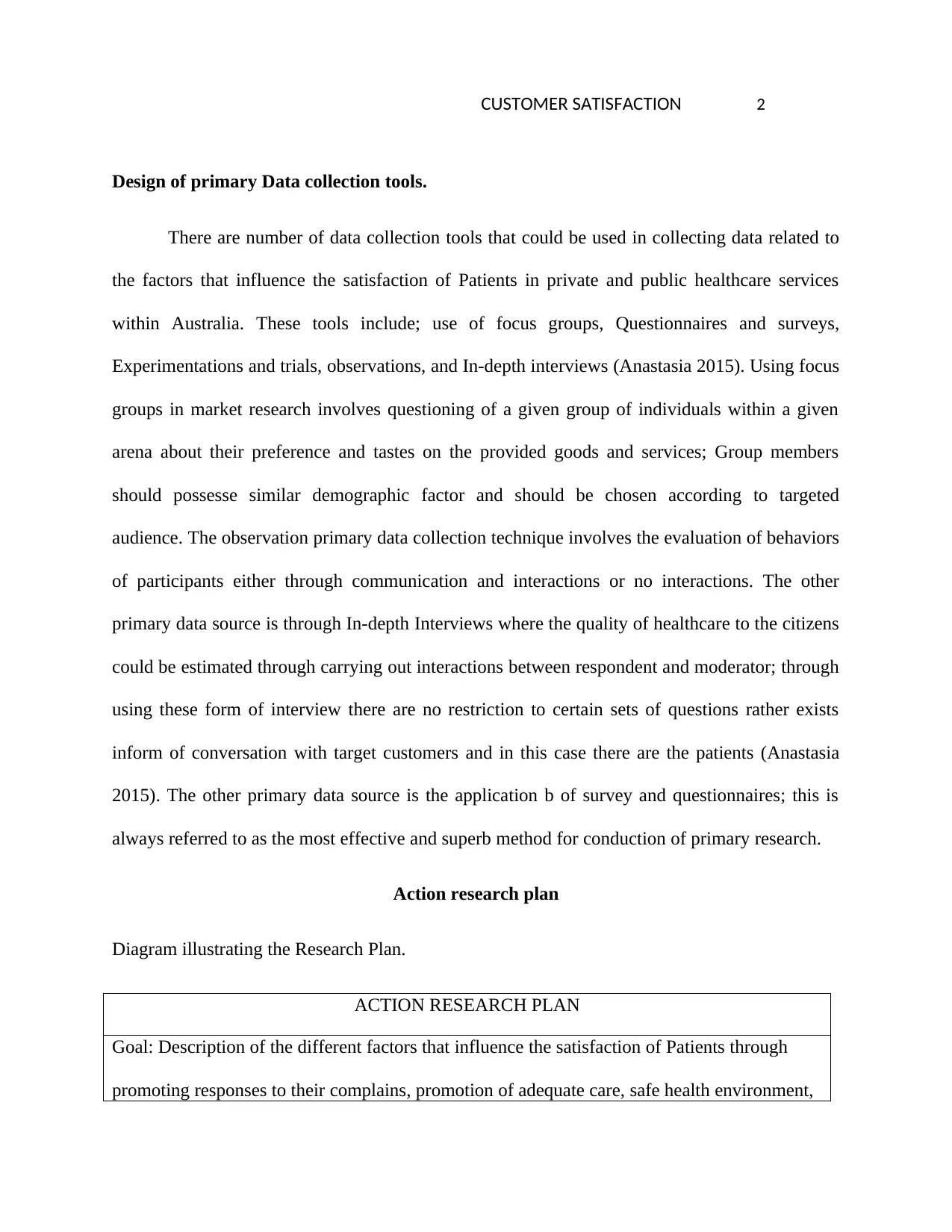
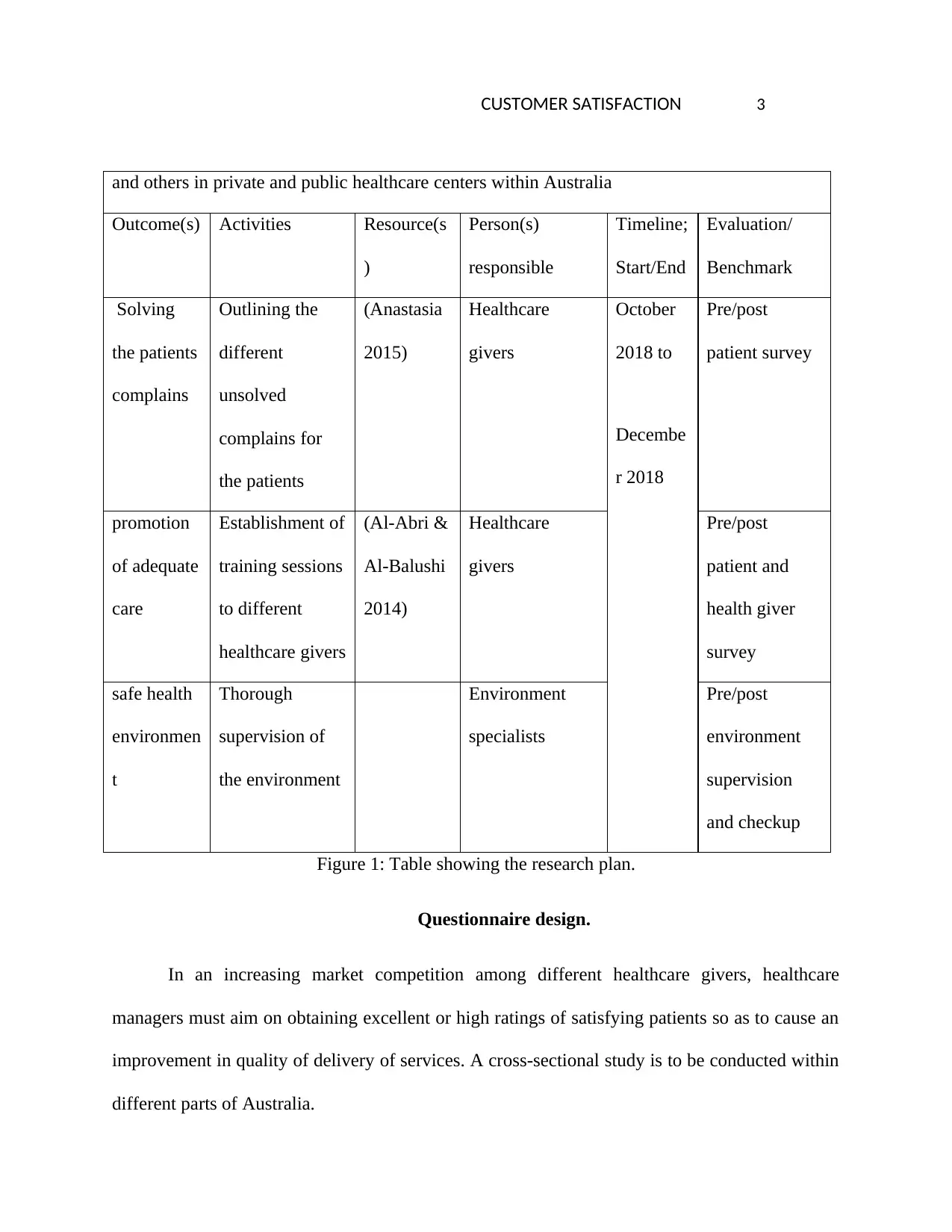
Action research plan
Diagram illustrating the Research Plan.
ACTION RESEARCH PLAN
Goal: Description of the different factors that influence the satisfaction of Patients through
promoting responses to their complains, promotion of adequate care, safe health environment,
Document Page
CUSTOMER SATISFACTION 3
and others in private and public healthcare centers within Australia
Outcome(s) Activities Resource(s
)
Person(s)
responsible
Timeline;
Start/End
Evaluation/
Benchmark
Solving
the patients
complains
Outlining the
different
unsolved
complains for
the patients
(Anastasia
2015)
Healthcare
givers
October
2018 to
Decembe
r 2018
Pre/post
patient survey
promotion
of adequate
care
Establishment of
training sessions
to different
healthcare givers
(Al-Abri &
Al-Balushi
2014)
Healthcare
givers
Pre/post
patient and
health giver
survey
safe health
environmen
t
Thorough
supervision of
the environment
Environment
specialists
Pre/post
environment
supervision
and checkup
Figure 1: Table showing the research plan.
Questionnaire design.
In an increasing market competition among different healthcare givers, healthcare
managers must aim on obtaining excellent or high ratings of satisfying patients so as to cause an
improvement in quality of delivery of services. A cross-sectional study is to be conducted within
different parts of Australia.
Document Page
CUSTOMER SATISFACTION 4
Subjects.
A stratified sample of 172 healthcare givers is to be recruited from both private and
public health centers. These will be in position to offer research minimamully to 2400
patients/expected participants. These are from both rural and urban health center locations. This
study is to include patients who are above 18 years and have experience in general practice (Al-
Abri & Al-Balushi 2014).
Questionnaire procedures.
Interviews are to be conducted in any random week day except Friday and Monday.
Variables, scales and Instruments.
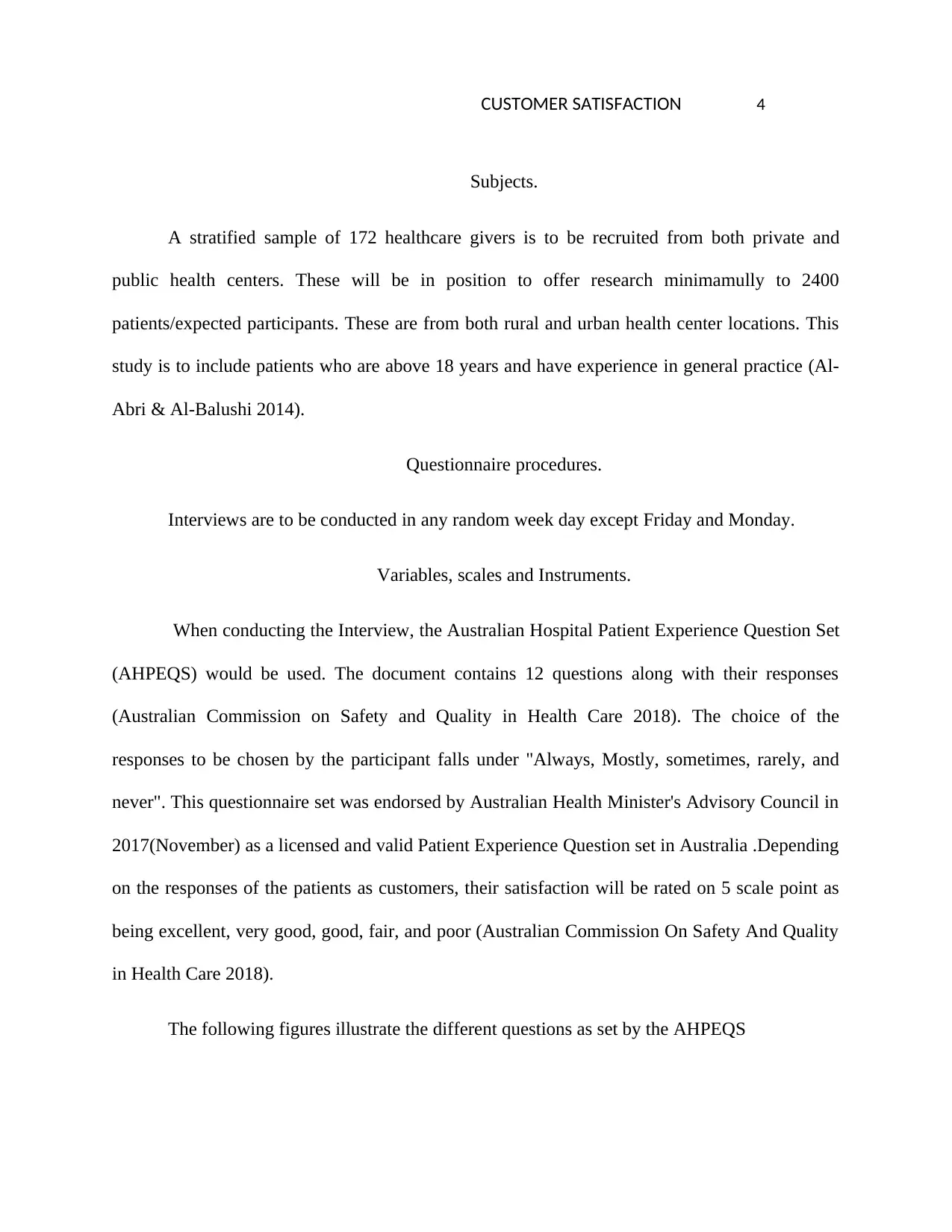
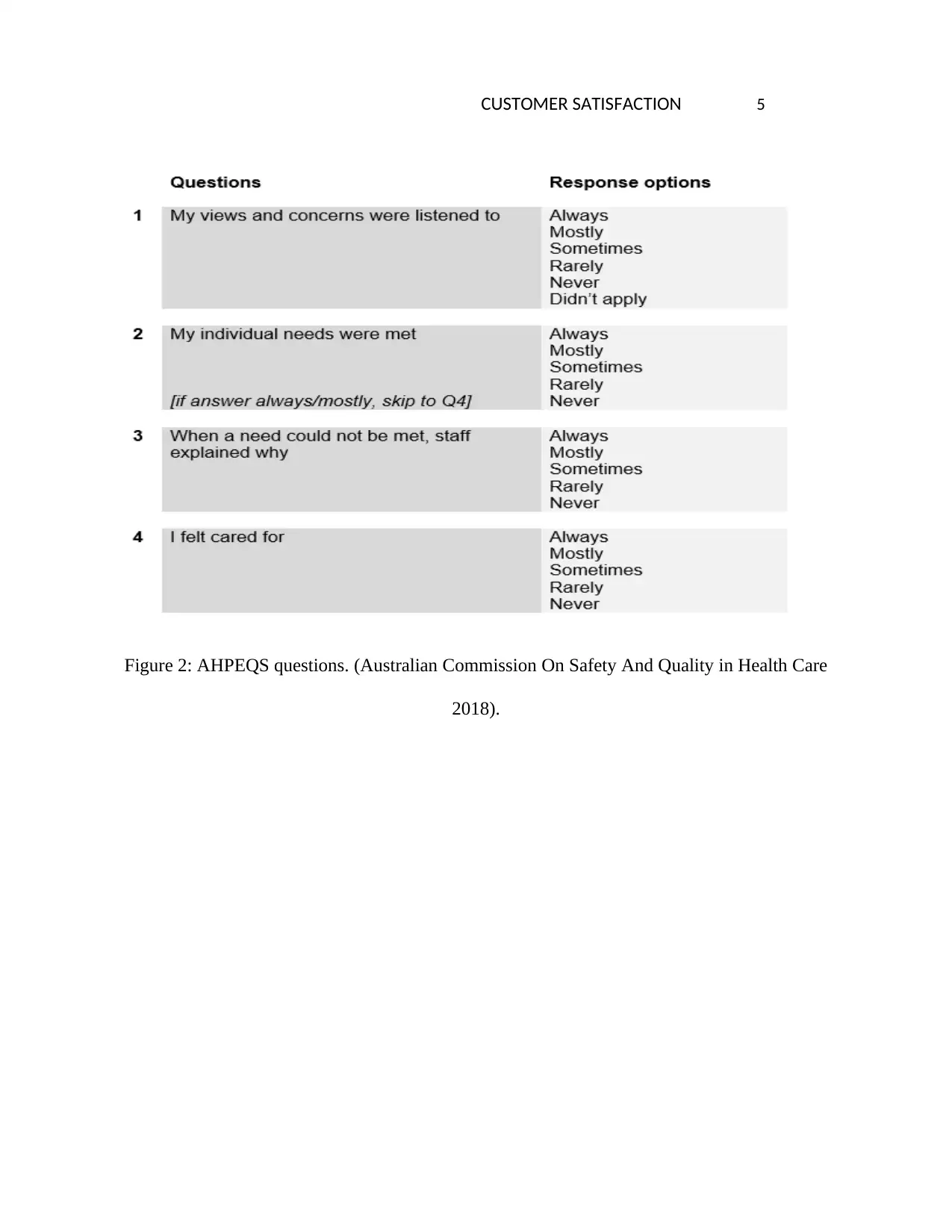
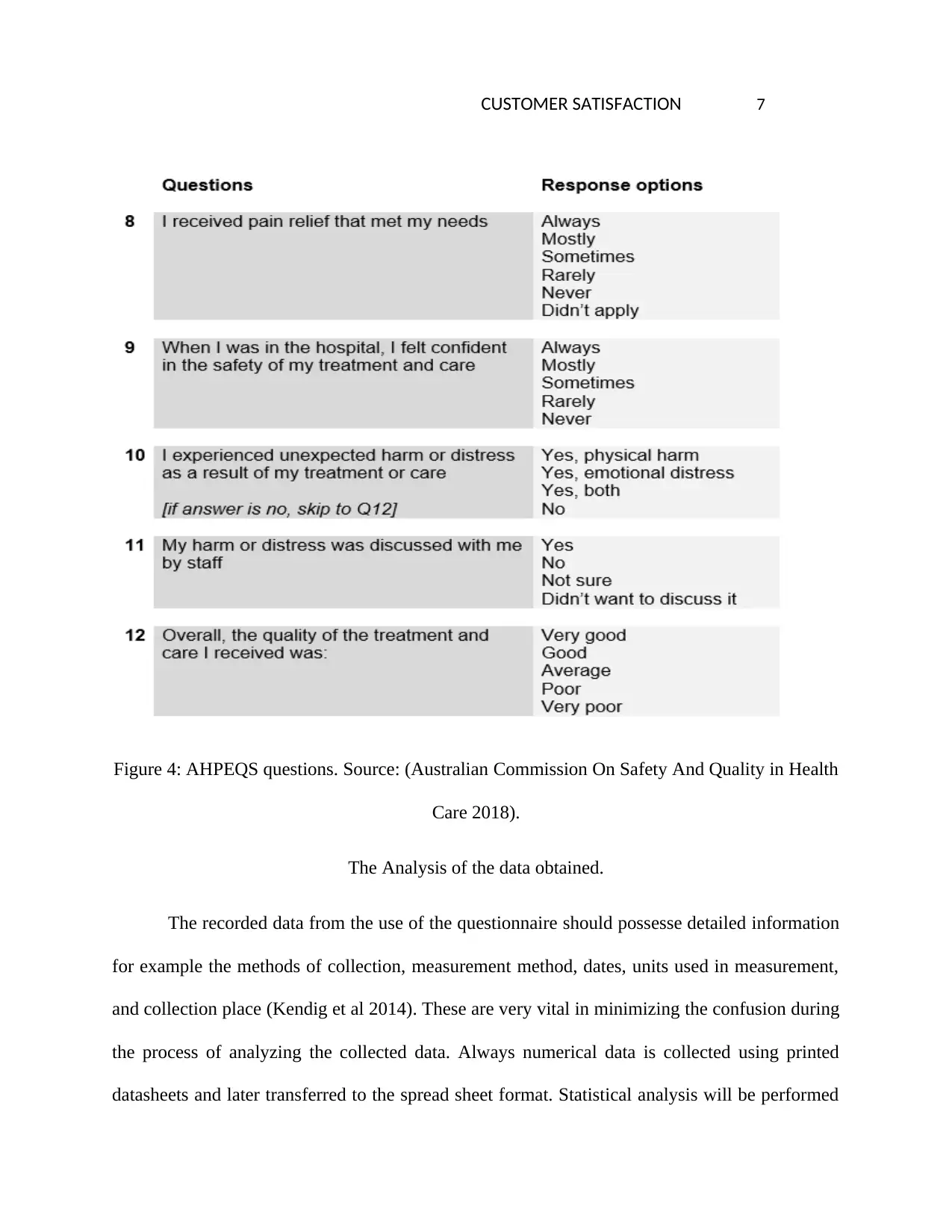
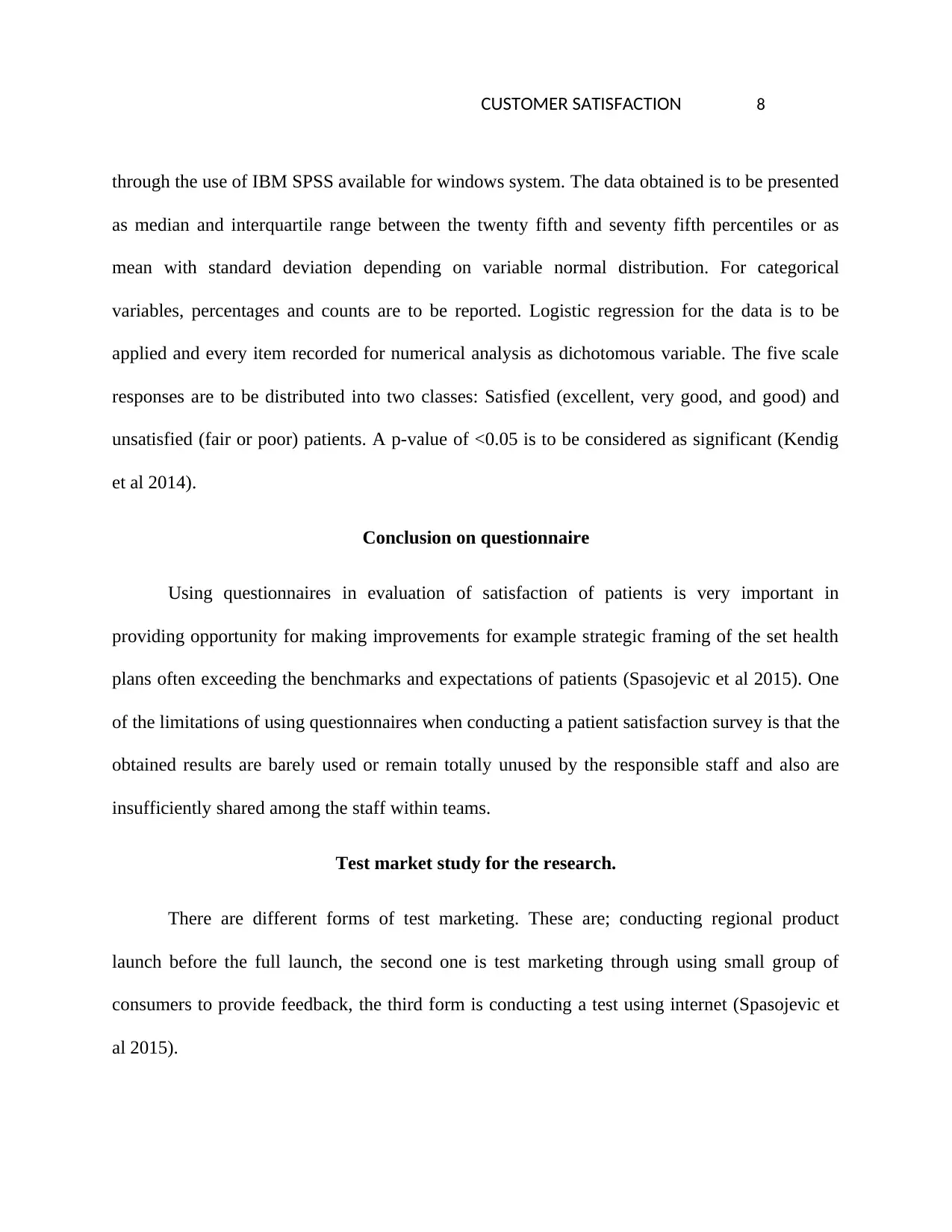
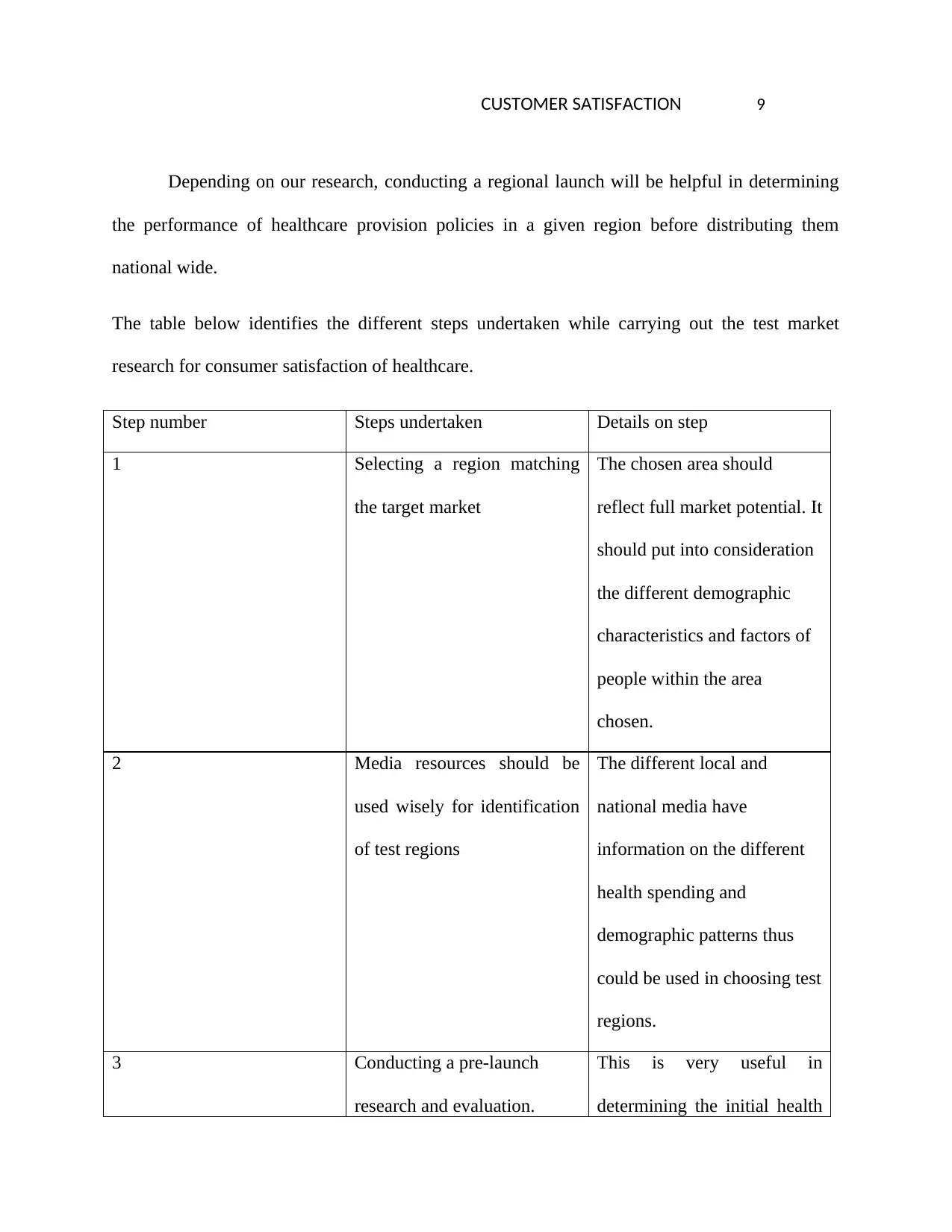
When conducting the Interview, the Australian Hospital Patient Experience Question Set
(AHPEQS) would be used. The document contains 12 questions along with their responses
(Australian Commission on Safety and Quality in Health Care 2018). The choice of the
responses to be chosen by the participant falls under "Always, Mostly, sometimes, rarely, and
never". This questionnaire set was endorsed by Australian Health Minister's Advisory Council in
2017(November) as a licensed and valid Patient Experience Question set in Australia .Depending
on the responses of the patients as customers, their satisfaction will be rated on 5 scale point as
being excellent, very good, good, fair, and poor (Australian Commission On Safety And Quality
in Health Care 2018).
The following figures illustrate the different questions as set by the AHPEQS
tabler-icon-diamond-filled.svg

Paraphrase This Document

Need a fresh take? Get an instant paraphrase of this document with our AI Paraphraser
Document Page
CUSTOMER SATISFACTION 5
Figure 2: AHPEQS questions. (Australian Commission On Safety And Quality in Health Care
2018).
Document Page
CUSTOMER SATISFACTION 6
Figure 3: AHPEQS questions.
Document Page
CUSTOMER SATISFACTION 7
Figure 4: AHPEQS questions. Source: (Australian Commission On Safety And Quality in Health
Care 2018).
The Analysis of the data obtained.
The recorded data from the use of the questionnaire should possesse detailed information
for example the methods of collection, measurement method, dates, units used in measurement,
and collection place (Kendig et al 2014). These are very vital in minimizing the confusion during
the process of analyzing the collected data. Always numerical data is collected using printed
datasheets and later transferred to the spread sheet format. Statistical analysis will be performed
tabler-icon-diamond-filled.svg

Paraphrase This Document

Need a fresh take? Get an instant paraphrase of this document with our AI Paraphraser
Document Page
CUSTOMER SATISFACTION 8
through the use of IBM SPSS available for windows system. The data obtained is to be presented
as median and interquartile range between the twenty fifth and seventy fifth percentiles or as
mean with standard deviation depending on variable normal distribution. For categorical
variables, percentages and counts are to be reported. Logistic regression for the data is to be
applied and every item recorded for numerical analysis as dichotomous variable. The five scale
responses are to be distributed into two classes: Satisfied (excellent, very good, and good) and
unsatisfied (fair or poor) patients. A p-value of <0.05 is to be considered as significant (Kendig
et al 2014).
Conclusion on questionnaire
Using questionnaires in evaluation of satisfaction of patients is very important in
providing opportunity for making improvements for example strategic framing of the set health
plans often exceeding the benchmarks and expectations of patients (Spasojevic et al 2015). One
of the limitations of using questionnaires when conducting a patient satisfaction survey is that the
obtained results are barely used or remain totally unused by the responsible staff and also are
insufficiently shared among the staff within teams.
Test market study for the research.
There are different forms of test marketing. These are; conducting regional product
launch before the full launch, the second one is test marketing through using small group of
consumers to provide feedback, the third form is conducting a test using internet (Spasojevic et
al 2015).
Document Page
CUSTOMER SATISFACTION 9
Depending on our research, conducting a regional launch will be helpful in determining
the performance of healthcare provision policies in a given region before distributing them
national wide.
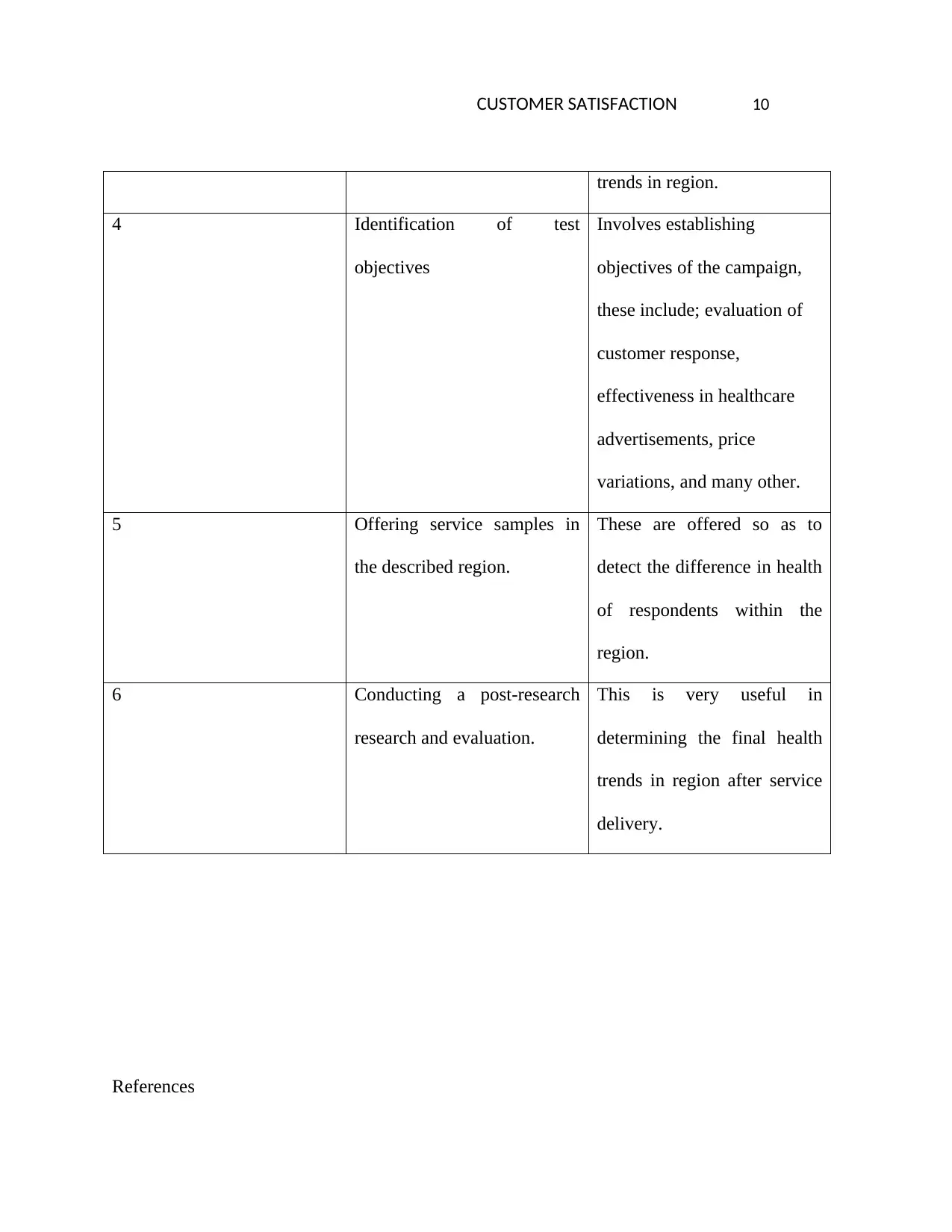
The table below identifies the different steps undertaken while carrying out the test market
research for consumer satisfaction of healthcare.
Step number Steps undertaken Details on step
1 Selecting a region matching
the target market
The chosen area should
reflect full market potential. It
should put into consideration
the different demographic
characteristics and factors of
people within the area
chosen.
2 Media resources should be
used wisely for identification
of test regions
The different local and
national media have
information on the different
health spending and
demographic patterns thus
could be used in choosing test
regions.
3 Conducting a pre-launch
research and evaluation.
This is very useful in
determining the initial health
Document Page
CUSTOMER SATISFACTION 10
trends in region.
4 Identification of test
objectives
Involves establishing
objectives of the campaign,
these include; evaluation of
customer response,
effectiveness in healthcare
advertisements, price
variations, and many other.
5 Offering service samples in
the described region.
These are offered so as to
detect the difference in health
of respondents within the
region.
6 Conducting a post-research
research and evaluation.
This is very useful in
determining the final health
trends in region after service
delivery.
References
tabler-icon-diamond-filled.svg

Paraphrase This Document

Need a fresh take? Get an instant paraphrase of this document with our AI Paraphraser
Document Page
CUSTOMER SATISFACTION 11
Al-Abri, R., & Al-Balushi, A. 2014. Patient Satisfaction Survey as a Tool towards Quality
Improvement. Oman Medical Journal, 29(1), 3–7. http://doi.org/10.5001/omj.2014.02
Australian Commission On Safety And Quality in Health Care.2018.Australian Hospital Patient
Experience Question Set (AHPEQS),
https://www.safetyandquality.gov.au/our-work/indicators/hospital-patient-experience/
Anastasia, R. 2015. Market Research Techniques: Primary and Secondary Market
Research.https://www.cleverism.com/market-research-techniques-primary-secondary/
Kendig H, Byles JE, O'Loughlin K, et al.2014. Adapting data collection methods in the
Australian Life Histories and Health Survey: a retrospective life course study BMJ Open;
4:e004476. Doi: 10.1136/bmjopen-2013-004476
Spasojevic, N., Hrabac, B., & Huseinagic, S. 2015. Patient’s Satisfaction with Health Care: a
Questionnaire Study of Different Aspects of Care. Materia Socio-Medica, 27(4), 220–
224. http://doi.org/10.5455/msm.2015.27.220-224
chevron_up_icon
1 out of 11
circle_padding
hide_on_mobile
zoom_out_icon
[object Object]