Comprehensive Case Notes for MLL324 Administrative Law: Key Cases
VerifiedAdded on 2022/07/08
|46
|12584
|11
Case Study
AI Summary
This document presents detailed case notes on Administrative Law, focusing on key legal principles and landmark cases. It begins by outlining the scope of administrative law and judicial review, including the criteria for when judicial review is available, as established in cases like Datafin. The notes then delve into the scope of judicial review, distinguishing between review and appeal, and the legality versus merits decisions, citing cases such as Green and Quin. The applicability of the ADJR Act is discussed, covering key aspects like what constitutes a decision made under an enactment and the capacity of an entity to make a decision, as seen in Tang and NEAT. The document also explores judicial review remedies, including the impact of breaching provisions, and the availability of declaratory relief, referencing cases like Project Blue Sky and Ainsworth. Furthermore, the notes cover the grounds of judicial review, including procedural grounds (natural justice, bias) and reasoning process grounds (relevance, improper purpose, fettering of discretion). Decisional grounds, such as jurisdictional error, are also examined. The document concludes with discussions on access to judicial review (standing), restrictions on judicial review (privity), and the role of tribunals and merits review. The notes cover numerous cases, including Datafin, Green v Daniels, Griffith University v Tang, and Project Blue Sky, providing a comprehensive overview of the subject.
1
MLL324
Administrative Law
Case Notes
Jason Stockdale
MLL324
Administrative Law
Case Notes
Jason Stockdale

Paraphrase This Document
Need a fresh take? Get an instant paraphrase of this document with our AI Paraphraser
2
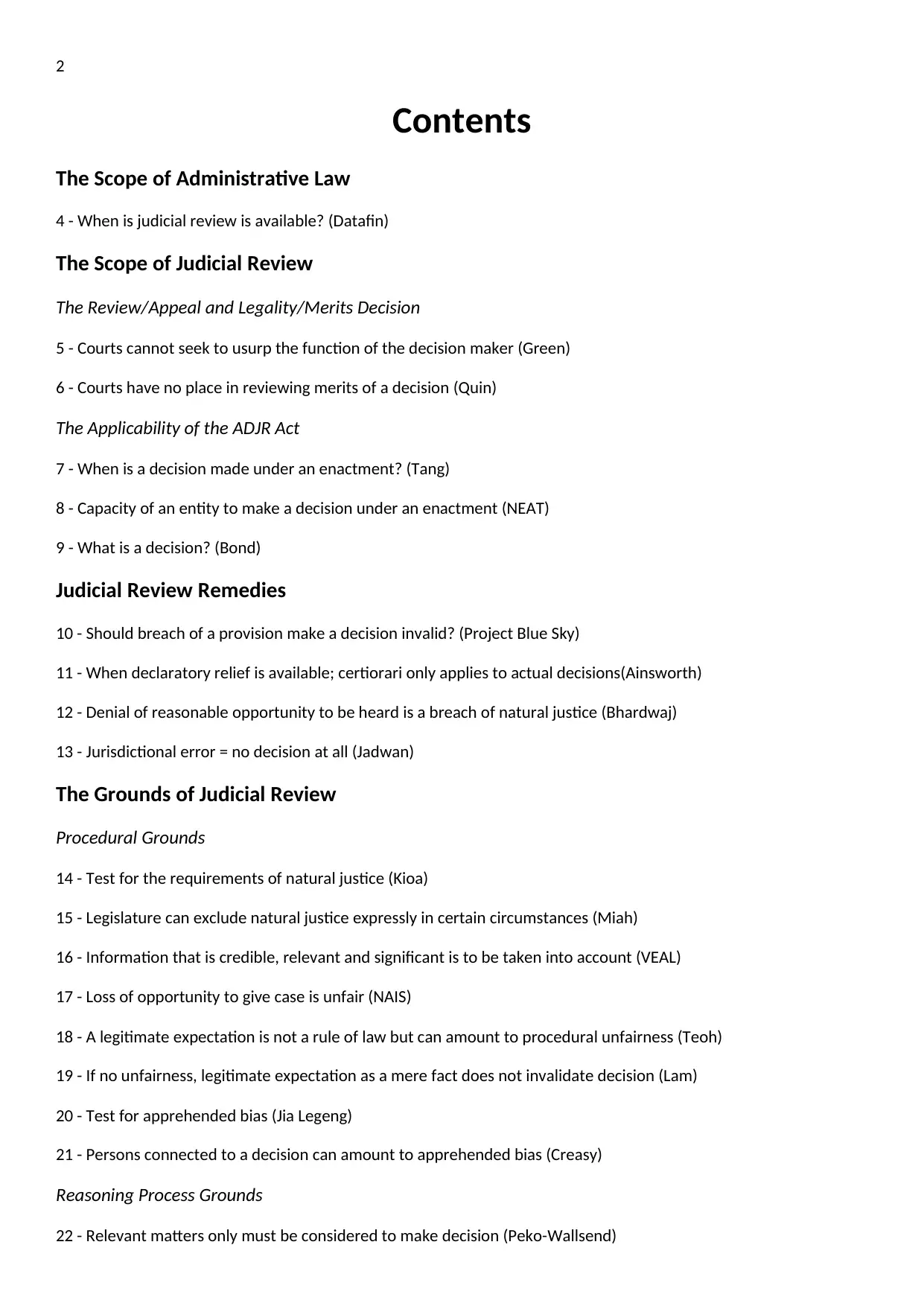
Contents
The Scope of Administrative Law
4 - When is judicial review is available? (Datafin)
The Scope of Judicial Review
The Review/Appeal and Legality/Merits Decision
5 - Courts cannot seek to usurp the function of the decision maker (Green)
6 - Courts have no place in reviewing merits of a decision (Quin)
The Applicability of the ADJR Act
7 - When is a decision made under an enactment? (Tang)
8 - Capacity of an entity to make a decision under an enactment (NEAT)
9 - What is a decision? (Bond)
Judicial Review Remedies
10 - Should breach of a provision make a decision invalid? (Project Blue Sky)
11 - When declaratory relief is available; certiorari only applies to actual decisions(Ainsworth)
12 - Denial of reasonable opportunity to be heard is a breach of natural justice (Bhardwaj)
13 - Jurisdictional error = no decision at all (Jadwan)
The Grounds of Judicial Review
Procedural Grounds
14 - Test for the requirements of natural justice (Kioa)
15 - Legislature can exclude natural justice expressly in certain circumstances (Miah)
16 - Information that is credible, relevant and significant is to be taken into account (VEAL)
17 - Loss of opportunity to give case is unfair (NAIS)
18 - A legitimate expectation is not a rule of law but can amount to procedural unfairness (Teoh)
19 - If no unfairness, legitimate expectation as a mere fact does not invalidate decision (Lam)
20 - Test for apprehended bias (Jia Legeng)
21 - Persons connected to a decision can amount to apprehended bias (Creasy)
Reasoning Process Grounds
22 - Relevant matters only must be considered to make decision (Peko-Wallsend)
Contents
The Scope of Administrative Law
4 - When is judicial review is available? (Datafin)
The Scope of Judicial Review
The Review/Appeal and Legality/Merits Decision
5 - Courts cannot seek to usurp the function of the decision maker (Green)
6 - Courts have no place in reviewing merits of a decision (Quin)
The Applicability of the ADJR Act
7 - When is a decision made under an enactment? (Tang)
8 - Capacity of an entity to make a decision under an enactment (NEAT)
9 - What is a decision? (Bond)
Judicial Review Remedies
10 - Should breach of a provision make a decision invalid? (Project Blue Sky)
11 - When declaratory relief is available; certiorari only applies to actual decisions(Ainsworth)
12 - Denial of reasonable opportunity to be heard is a breach of natural justice (Bhardwaj)
13 - Jurisdictional error = no decision at all (Jadwan)
The Grounds of Judicial Review
Procedural Grounds
14 - Test for the requirements of natural justice (Kioa)
15 - Legislature can exclude natural justice expressly in certain circumstances (Miah)
16 - Information that is credible, relevant and significant is to be taken into account (VEAL)
17 - Loss of opportunity to give case is unfair (NAIS)
18 - A legitimate expectation is not a rule of law but can amount to procedural unfairness (Teoh)
19 - If no unfairness, legitimate expectation as a mere fact does not invalidate decision (Lam)
20 - Test for apprehended bias (Jia Legeng)
21 - Persons connected to a decision can amount to apprehended bias (Creasy)
Reasoning Process Grounds
22 - Relevant matters only must be considered to make decision (Peko-Wallsend)
3
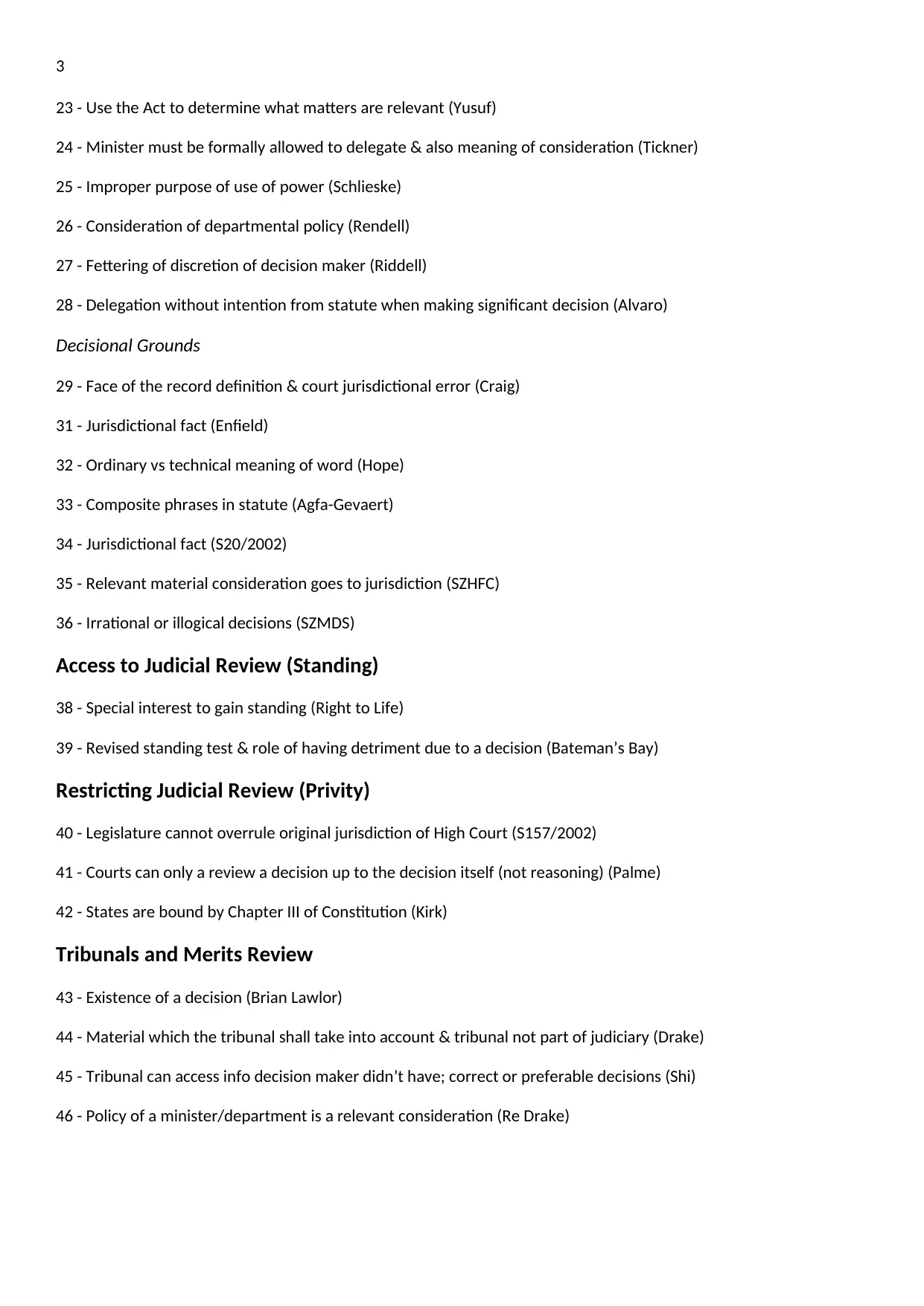
23 - Use the Act to determine what matters are relevant (Yusuf)
24 - Minister must be formally allowed to delegate & also meaning of consideration (Tickner)
25 - Improper purpose of use of power (Schlieske)
26 - Consideration of departmental policy (Rendell)
27 - Fettering of discretion of decision maker (Riddell)
28 - Delegation without intention from statute when making significant decision (Alvaro)
Decisional Grounds
29 - Face of the record definition & court jurisdictional error (Craig)
31 - Jurisdictional fact (Enfield)
32 - Ordinary vs technical meaning of word (Hope)
33 - Composite phrases in statute (Agfa-Gevaert)
34 - Jurisdictional fact (S20/2002)
35 - Relevant material consideration goes to jurisdiction (SZHFC)
36 - Irrational or illogical decisions (SZMDS)
Access to Judicial Review (Standing)
38 - Special interest to gain standing (Right to Life)
39 - Revised standing test & role of having detriment due to a decision (Bateman’s Bay)
Restricting Judicial Review (Privity)
40 - Legislature cannot overrule original jurisdiction of High Court (S157/2002)
41 - Courts can only a review a decision up to the decision itself (not reasoning) (Palme)
42 - States are bound by Chapter III of Constitution (Kirk)
Tribunals and Merits Review
43 - Existence of a decision (Brian Lawlor)
44 - Material which the tribunal shall take into account & tribunal not part of judiciary (Drake)
45 - Tribunal can access info decision maker didn’t have; correct or preferable decisions (Shi)
46 - Policy of a minister/department is a relevant consideration (Re Drake)
23 - Use the Act to determine what matters are relevant (Yusuf)
24 - Minister must be formally allowed to delegate & also meaning of consideration (Tickner)
25 - Improper purpose of use of power (Schlieske)
26 - Consideration of departmental policy (Rendell)
27 - Fettering of discretion of decision maker (Riddell)
28 - Delegation without intention from statute when making significant decision (Alvaro)
Decisional Grounds
29 - Face of the record definition & court jurisdictional error (Craig)
31 - Jurisdictional fact (Enfield)
32 - Ordinary vs technical meaning of word (Hope)
33 - Composite phrases in statute (Agfa-Gevaert)
34 - Jurisdictional fact (S20/2002)
35 - Relevant material consideration goes to jurisdiction (SZHFC)
36 - Irrational or illogical decisions (SZMDS)
Access to Judicial Review (Standing)
38 - Special interest to gain standing (Right to Life)
39 - Revised standing test & role of having detriment due to a decision (Bateman’s Bay)
Restricting Judicial Review (Privity)
40 - Legislature cannot overrule original jurisdiction of High Court (S157/2002)
41 - Courts can only a review a decision up to the decision itself (not reasoning) (Palme)
42 - States are bound by Chapter III of Constitution (Kirk)
Tribunals and Merits Review
43 - Existence of a decision (Brian Lawlor)
44 - Material which the tribunal shall take into account & tribunal not part of judiciary (Drake)
45 - Tribunal can access info decision maker didn’t have; correct or preferable decisions (Shi)
46 - Policy of a minister/department is a relevant consideration (Re Drake)
⊘ This is a preview!⊘
Do you want full access?
Subscribe today to unlock all pages.

Trusted by 1+ million students worldwide
4
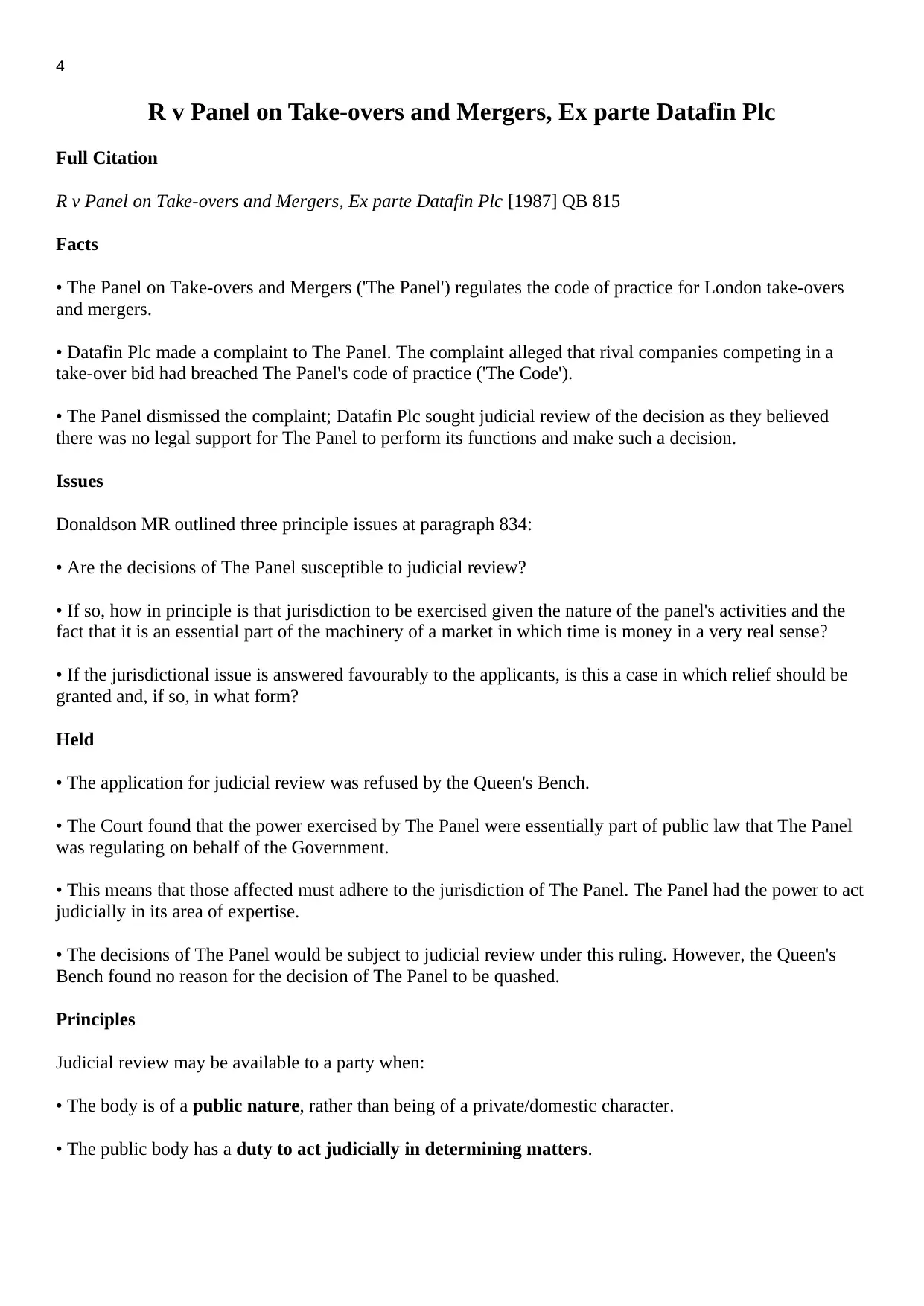
R v Panel on Take-overs and Mergers, Ex parte Datafin Plc
Full Citation
R v Panel on Take-overs and Mergers, Ex parte Datafin Plc [1987] QB 815
Facts
• The Panel on Take-overs and Mergers ('The Panel') regulates the code of practice for London take-overs
and mergers.
• Datafin Plc made a complaint to The Panel. The complaint alleged that rival companies competing in a
take-over bid had breached The Panel's code of practice ('The Code').
• The Panel dismissed the complaint; Datafin Plc sought judicial review of the decision as they believed
there was no legal support for The Panel to perform its functions and make such a decision.
Issues
Donaldson MR outlined three principle issues at paragraph 834:
• Are the decisions of The Panel susceptible to judicial review?
• If so, how in principle is that jurisdiction to be exercised given the nature of the panel's activities and the
fact that it is an essential part of the machinery of a market in which time is money in a very real sense?
• If the jurisdictional issue is answered favourably to the applicants, is this a case in which relief should be
granted and, if so, in what form?
Held
• The application for judicial review was refused by the Queen's Bench.
• The Court found that the power exercised by The Panel were essentially part of public law that The Panel
was regulating on behalf of the Government.
• This means that those affected must adhere to the jurisdiction of The Panel. The Panel had the power to act
judicially in its area of expertise.
• The decisions of The Panel would be subject to judicial review under this ruling. However, the Queen's
Bench found no reason for the decision of The Panel to be quashed.
Principles
Judicial review may be available to a party when:
• The body is of a public nature, rather than being of a private/domestic character.
• The public body has a duty to act judicially in determining matters.
R v Panel on Take-overs and Mergers, Ex parte Datafin Plc
Full Citation
R v Panel on Take-overs and Mergers, Ex parte Datafin Plc [1987] QB 815
Facts
• The Panel on Take-overs and Mergers ('The Panel') regulates the code of practice for London take-overs
and mergers.
• Datafin Plc made a complaint to The Panel. The complaint alleged that rival companies competing in a
take-over bid had breached The Panel's code of practice ('The Code').
• The Panel dismissed the complaint; Datafin Plc sought judicial review of the decision as they believed
there was no legal support for The Panel to perform its functions and make such a decision.
Issues
Donaldson MR outlined three principle issues at paragraph 834:
• Are the decisions of The Panel susceptible to judicial review?
• If so, how in principle is that jurisdiction to be exercised given the nature of the panel's activities and the
fact that it is an essential part of the machinery of a market in which time is money in a very real sense?
• If the jurisdictional issue is answered favourably to the applicants, is this a case in which relief should be
granted and, if so, in what form?
Held
• The application for judicial review was refused by the Queen's Bench.
• The Court found that the power exercised by The Panel were essentially part of public law that The Panel
was regulating on behalf of the Government.
• This means that those affected must adhere to the jurisdiction of The Panel. The Panel had the power to act
judicially in its area of expertise.
• The decisions of The Panel would be subject to judicial review under this ruling. However, the Queen's
Bench found no reason for the decision of The Panel to be quashed.
Principles
Judicial review may be available to a party when:
• The body is of a public nature, rather than being of a private/domestic character.
• The public body has a duty to act judicially in determining matters.
Paraphrase This Document
Need a fresh take? Get an instant paraphrase of this document with our AI Paraphraser
5
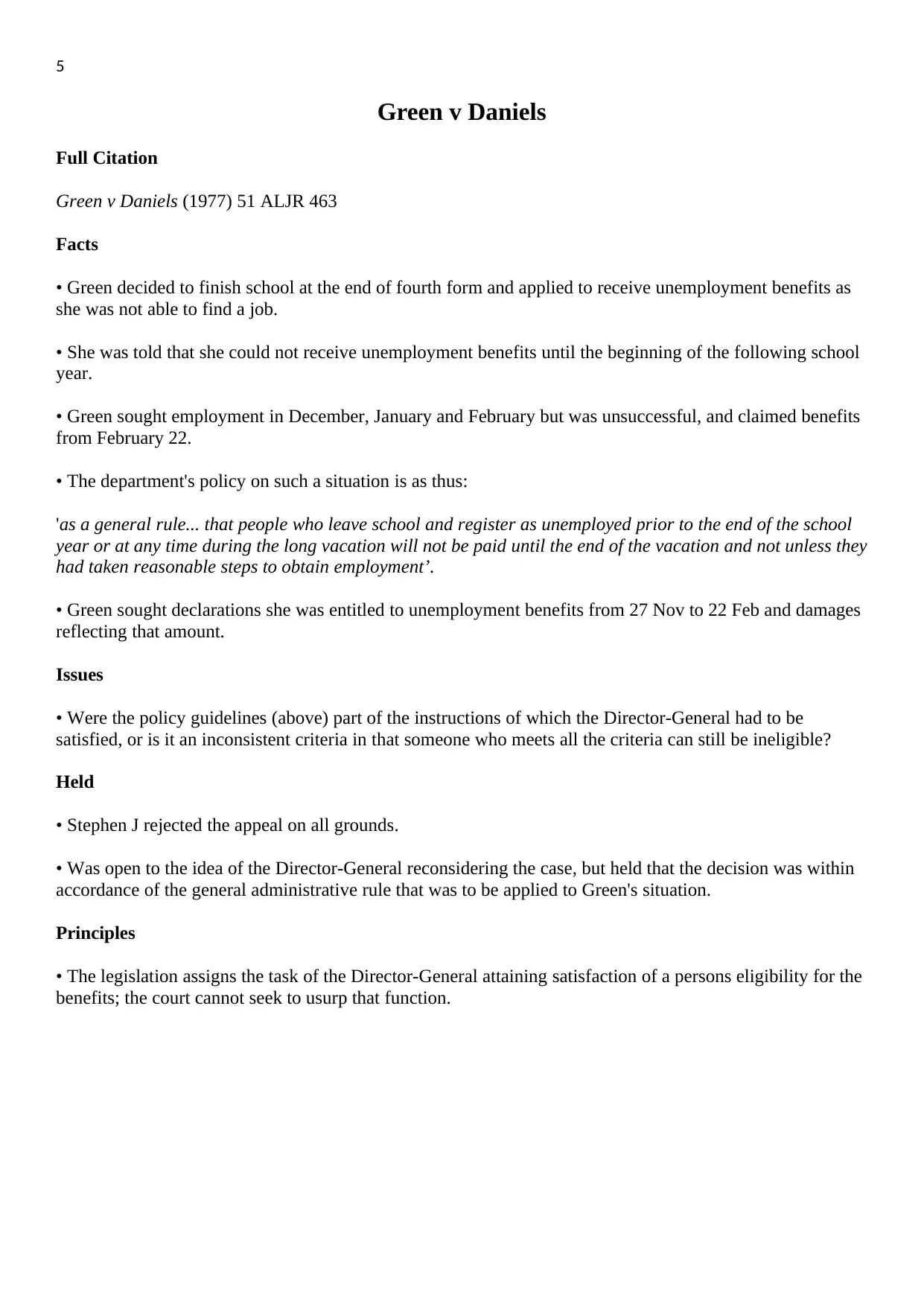
Green v Daniels
Full Citation
Green v Daniels (1977) 51 ALJR 463
Facts
• Green decided to finish school at the end of fourth form and applied to receive unemployment benefits as
she was not able to find a job.
• She was told that she could not receive unemployment benefits until the beginning of the following school
year.
• Green sought employment in December, January and February but was unsuccessful, and claimed benefits
from February 22.
• The department's policy on such a situation is as thus:
'as a general rule... that people who leave school and register as unemployed prior to the end of the school
year or at any time during the long vacation will not be paid until the end of the vacation and not unless they
had taken reasonable steps to obtain employment’.
• Green sought declarations she was entitled to unemployment benefits from 27 Nov to 22 Feb and damages
reflecting that amount.
Issues
• Were the policy guidelines (above) part of the instructions of which the Director-General had to be
satisfied, or is it an inconsistent criteria in that someone who meets all the criteria can still be ineligible?
Held
• Stephen J rejected the appeal on all grounds.
• Was open to the idea of the Director-General reconsidering the case, but held that the decision was within
accordance of the general administrative rule that was to be applied to Green's situation.
Principles
• The legislation assigns the task of the Director-General attaining satisfaction of a persons eligibility for the
benefits; the court cannot seek to usurp that function.
Green v Daniels
Full Citation
Green v Daniels (1977) 51 ALJR 463
Facts
• Green decided to finish school at the end of fourth form and applied to receive unemployment benefits as
she was not able to find a job.
• She was told that she could not receive unemployment benefits until the beginning of the following school
year.
• Green sought employment in December, January and February but was unsuccessful, and claimed benefits
from February 22.
• The department's policy on such a situation is as thus:
'as a general rule... that people who leave school and register as unemployed prior to the end of the school
year or at any time during the long vacation will not be paid until the end of the vacation and not unless they
had taken reasonable steps to obtain employment’.
• Green sought declarations she was entitled to unemployment benefits from 27 Nov to 22 Feb and damages
reflecting that amount.
Issues
• Were the policy guidelines (above) part of the instructions of which the Director-General had to be
satisfied, or is it an inconsistent criteria in that someone who meets all the criteria can still be ineligible?
Held
• Stephen J rejected the appeal on all grounds.
• Was open to the idea of the Director-General reconsidering the case, but held that the decision was within
accordance of the general administrative rule that was to be applied to Green's situation.
Principles
• The legislation assigns the task of the Director-General attaining satisfaction of a persons eligibility for the
benefits; the court cannot seek to usurp that function.
6
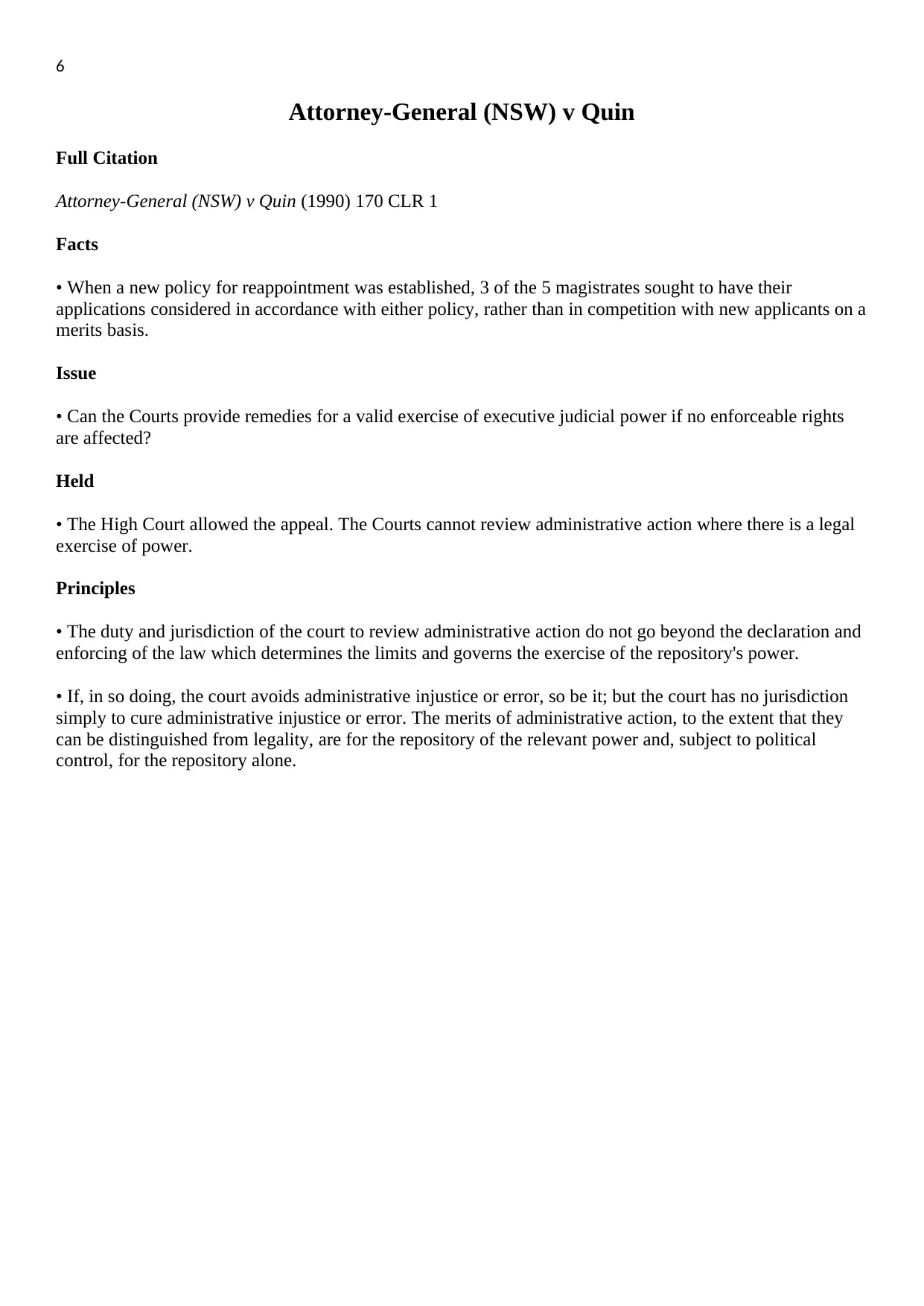
Attorney-General (NSW) v Quin
Full Citation
Attorney-General (NSW) v Quin (1990) 170 CLR 1
Facts
• When a new policy for reappointment was established, 3 of the 5 magistrates sought to have their
applications considered in accordance with either policy, rather than in competition with new applicants on a
merits basis.
Issue
• Can the Courts provide remedies for a valid exercise of executive judicial power if no enforceable rights
are affected?
Held
• The High Court allowed the appeal. The Courts cannot review administrative action where there is a legal
exercise of power.
Principles
• The duty and jurisdiction of the court to review administrative action do not go beyond the declaration and
enforcing of the law which determines the limits and governs the exercise of the repository's power.
• If, in so doing, the court avoids administrative injustice or error, so be it; but the court has no jurisdiction
simply to cure administrative injustice or error. The merits of administrative action, to the extent that they
can be distinguished from legality, are for the repository of the relevant power and, subject to political
control, for the repository alone.
Attorney-General (NSW) v Quin
Full Citation
Attorney-General (NSW) v Quin (1990) 170 CLR 1
Facts
• When a new policy for reappointment was established, 3 of the 5 magistrates sought to have their
applications considered in accordance with either policy, rather than in competition with new applicants on a
merits basis.
Issue
• Can the Courts provide remedies for a valid exercise of executive judicial power if no enforceable rights
are affected?
Held
• The High Court allowed the appeal. The Courts cannot review administrative action where there is a legal
exercise of power.
Principles
• The duty and jurisdiction of the court to review administrative action do not go beyond the declaration and
enforcing of the law which determines the limits and governs the exercise of the repository's power.
• If, in so doing, the court avoids administrative injustice or error, so be it; but the court has no jurisdiction
simply to cure administrative injustice or error. The merits of administrative action, to the extent that they
can be distinguished from legality, are for the repository of the relevant power and, subject to political
control, for the repository alone.
⊘ This is a preview!⊘
Do you want full access?
Subscribe today to unlock all pages.
Trusted by 1+ million students worldwide
7
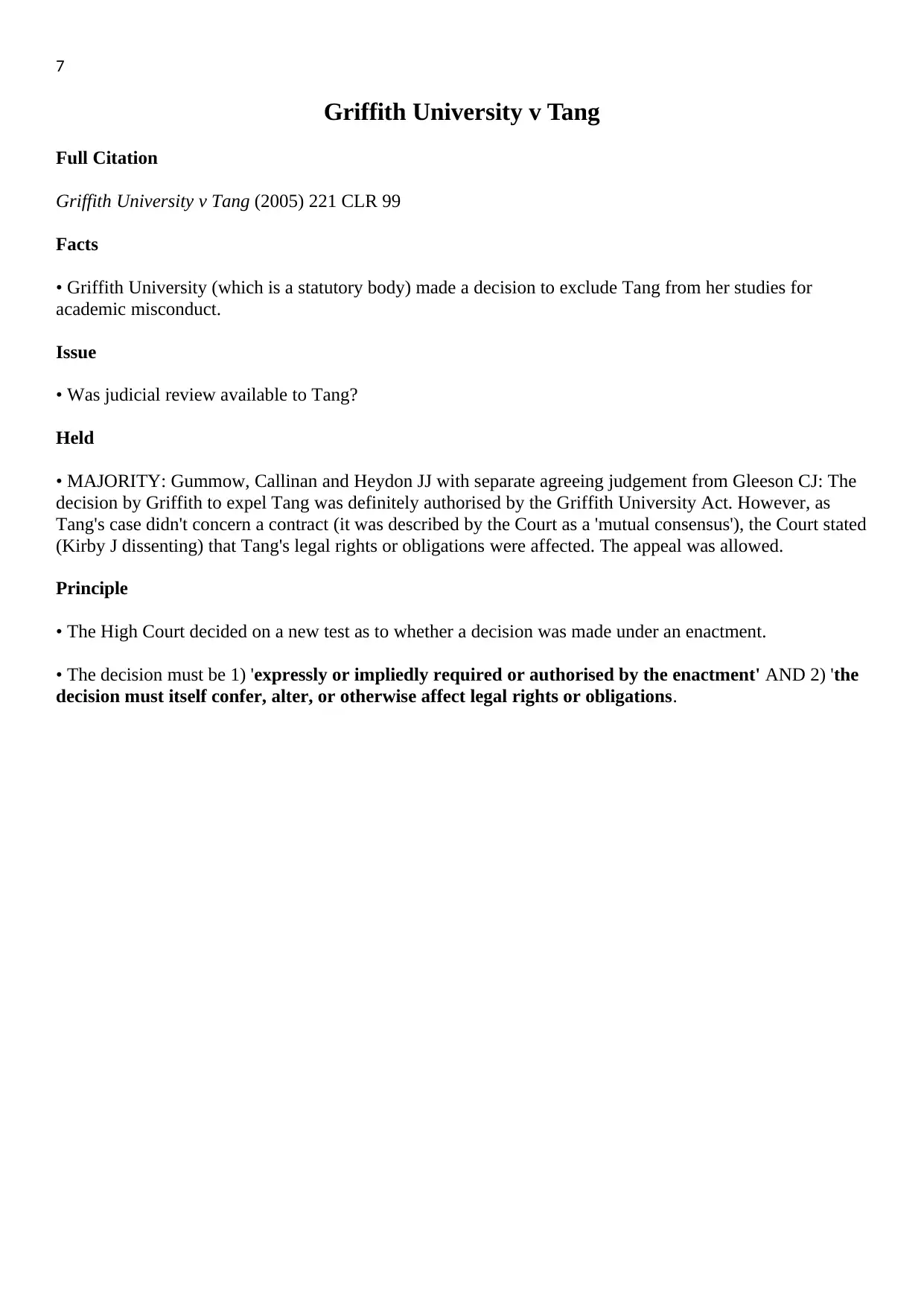
Griffith University v Tang
Full Citation
Griffith University v Tang (2005) 221 CLR 99
Facts
• Griffith University (which is a statutory body) made a decision to exclude Tang from her studies for
academic misconduct.
Issue
• Was judicial review available to Tang?
Held
• MAJORITY: Gummow, Callinan and Heydon JJ with separate agreeing judgement from Gleeson CJ: The
decision by Griffith to expel Tang was definitely authorised by the Griffith University Act. However, as
Tang's case didn't concern a contract (it was described by the Court as a 'mutual consensus'), the Court stated
(Kirby J dissenting) that Tang's legal rights or obligations were affected. The appeal was allowed.
Principle
• The High Court decided on a new test as to whether a decision was made under an enactment.
• The decision must be 1) 'expressly or impliedly required or authorised by the enactment' AND 2) 'the
decision must itself confer, alter, or otherwise affect legal rights or obligations.
Griffith University v Tang
Full Citation
Griffith University v Tang (2005) 221 CLR 99
Facts
• Griffith University (which is a statutory body) made a decision to exclude Tang from her studies for
academic misconduct.
Issue
• Was judicial review available to Tang?
Held
• MAJORITY: Gummow, Callinan and Heydon JJ with separate agreeing judgement from Gleeson CJ: The
decision by Griffith to expel Tang was definitely authorised by the Griffith University Act. However, as
Tang's case didn't concern a contract (it was described by the Court as a 'mutual consensus'), the Court stated
(Kirby J dissenting) that Tang's legal rights or obligations were affected. The appeal was allowed.
Principle
• The High Court decided on a new test as to whether a decision was made under an enactment.
• The decision must be 1) 'expressly or impliedly required or authorised by the enactment' AND 2) 'the
decision must itself confer, alter, or otherwise affect legal rights or obligations.
Paraphrase This Document
Need a fresh take? Get an instant paraphrase of this document with our AI Paraphraser
8
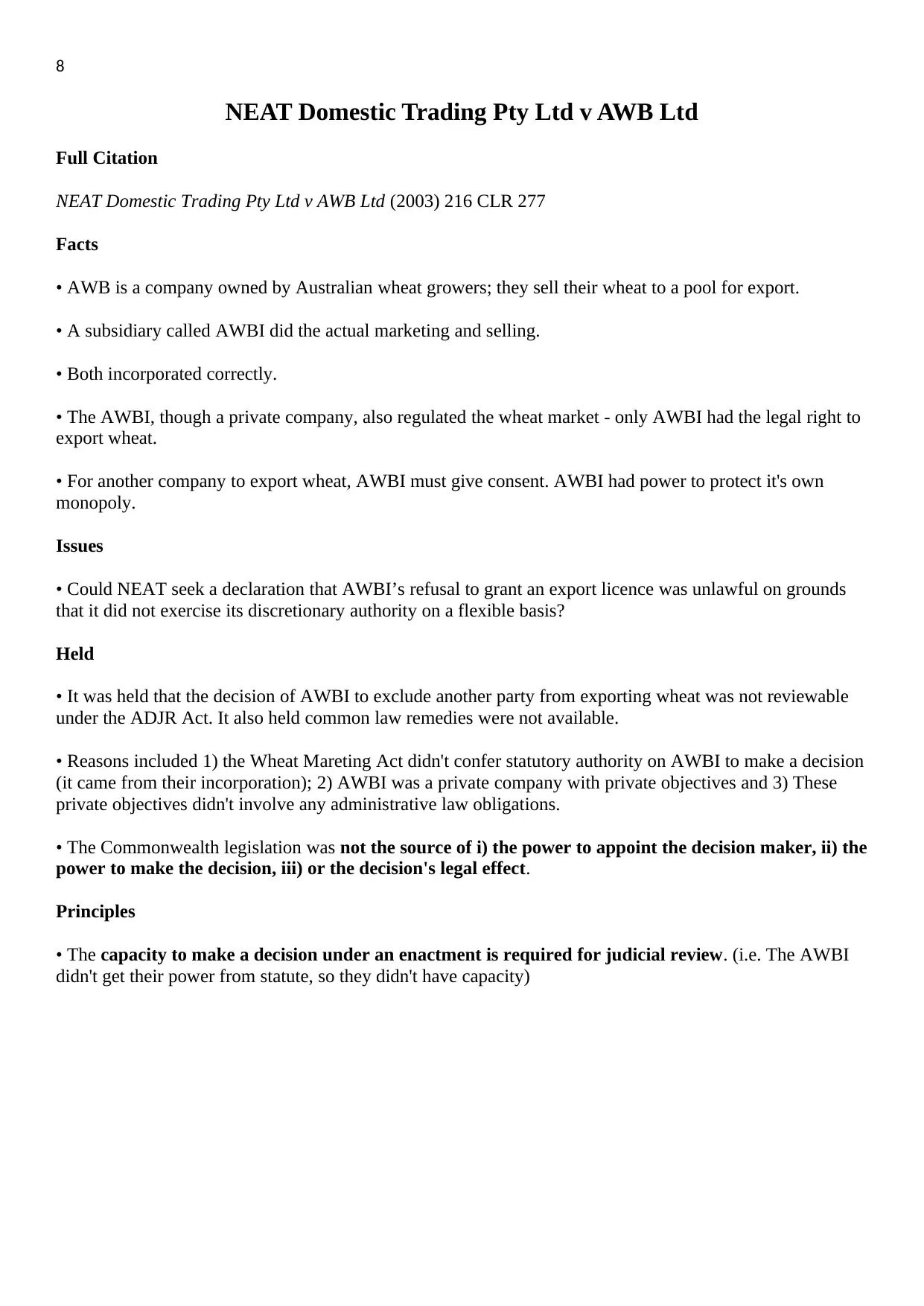
NEAT Domestic Trading Pty Ltd v AWB Ltd
Full Citation
NEAT Domestic Trading Pty Ltd v AWB Ltd (2003) 216 CLR 277
Facts
• AWB is a company owned by Australian wheat growers; they sell their wheat to a pool for export.
• A subsidiary called AWBI did the actual marketing and selling.
• Both incorporated correctly.
• The AWBI, though a private company, also regulated the wheat market - only AWBI had the legal right to
export wheat.
• For another company to export wheat, AWBI must give consent. AWBI had power to protect it's own
monopoly.
Issues
• Could NEAT seek a declaration that AWBI’s refusal to grant an export licence was unlawful on grounds
that it did not exercise its discretionary authority on a flexible basis?
Held
• It was held that the decision of AWBI to exclude another party from exporting wheat was not reviewable
under the ADJR Act. It also held common law remedies were not available.
• Reasons included 1) the Wheat Mareting Act didn't confer statutory authority on AWBI to make a decision
(it came from their incorporation); 2) AWBI was a private company with private objectives and 3) These
private objectives didn't involve any administrative law obligations.
• The Commonwealth legislation was not the source of i) the power to appoint the decision maker, ii) the
power to make the decision, iii) or the decision's legal effect.
Principles
• The capacity to make a decision under an enactment is required for judicial review. (i.e. The AWBI
didn't get their power from statute, so they didn't have capacity)
NEAT Domestic Trading Pty Ltd v AWB Ltd
Full Citation
NEAT Domestic Trading Pty Ltd v AWB Ltd (2003) 216 CLR 277
Facts
• AWB is a company owned by Australian wheat growers; they sell their wheat to a pool for export.
• A subsidiary called AWBI did the actual marketing and selling.
• Both incorporated correctly.
• The AWBI, though a private company, also regulated the wheat market - only AWBI had the legal right to
export wheat.
• For another company to export wheat, AWBI must give consent. AWBI had power to protect it's own
monopoly.
Issues
• Could NEAT seek a declaration that AWBI’s refusal to grant an export licence was unlawful on grounds
that it did not exercise its discretionary authority on a flexible basis?
Held
• It was held that the decision of AWBI to exclude another party from exporting wheat was not reviewable
under the ADJR Act. It also held common law remedies were not available.
• Reasons included 1) the Wheat Mareting Act didn't confer statutory authority on AWBI to make a decision
(it came from their incorporation); 2) AWBI was a private company with private objectives and 3) These
private objectives didn't involve any administrative law obligations.
• The Commonwealth legislation was not the source of i) the power to appoint the decision maker, ii) the
power to make the decision, iii) or the decision's legal effect.
Principles
• The capacity to make a decision under an enactment is required for judicial review. (i.e. The AWBI
didn't get their power from statute, so they didn't have capacity)
9
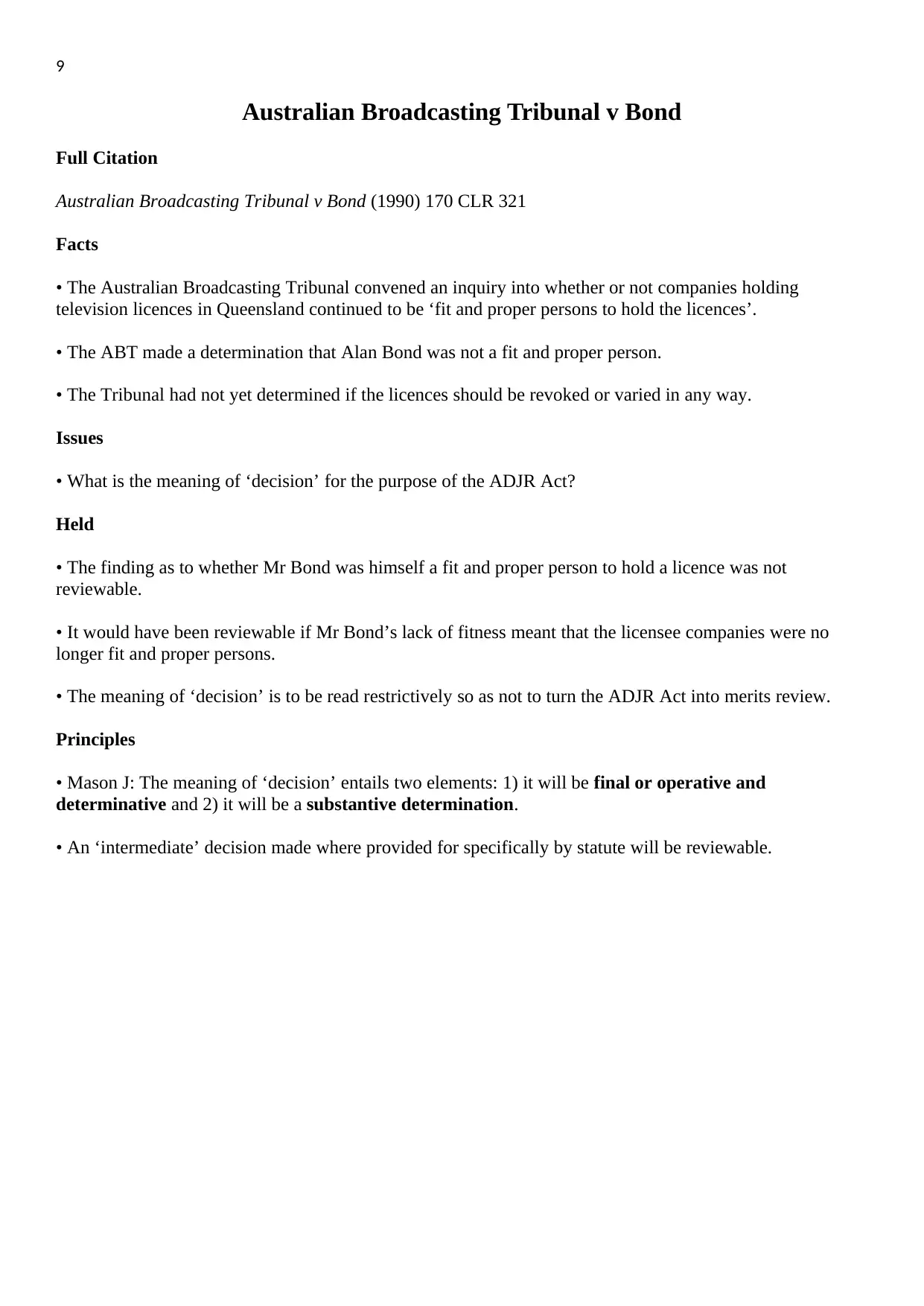
Australian Broadcasting Tribunal v Bond
Full Citation
Australian Broadcasting Tribunal v Bond (1990) 170 CLR 321
Facts
• The Australian Broadcasting Tribunal convened an inquiry into whether or not companies holding
television licences in Queensland continued to be ‘fit and proper persons to hold the licences’.
• The ABT made a determination that Alan Bond was not a fit and proper person.
• The Tribunal had not yet determined if the licences should be revoked or varied in any way.
Issues
• What is the meaning of ‘decision’ for the purpose of the ADJR Act?
Held
• The finding as to whether Mr Bond was himself a fit and proper person to hold a licence was not
reviewable.
• It would have been reviewable if Mr Bond’s lack of fitness meant that the licensee companies were no
longer fit and proper persons.
• The meaning of ‘decision’ is to be read restrictively so as not to turn the ADJR Act into merits review.
Principles
• Mason J: The meaning of ‘decision’ entails two elements: 1) it will be final or operative and
determinative and 2) it will be a substantive determination.
• An ‘intermediate’ decision made where provided for specifically by statute will be reviewable.
Australian Broadcasting Tribunal v Bond
Full Citation
Australian Broadcasting Tribunal v Bond (1990) 170 CLR 321
Facts
• The Australian Broadcasting Tribunal convened an inquiry into whether or not companies holding
television licences in Queensland continued to be ‘fit and proper persons to hold the licences’.
• The ABT made a determination that Alan Bond was not a fit and proper person.
• The Tribunal had not yet determined if the licences should be revoked or varied in any way.
Issues
• What is the meaning of ‘decision’ for the purpose of the ADJR Act?
Held
• The finding as to whether Mr Bond was himself a fit and proper person to hold a licence was not
reviewable.
• It would have been reviewable if Mr Bond’s lack of fitness meant that the licensee companies were no
longer fit and proper persons.
• The meaning of ‘decision’ is to be read restrictively so as not to turn the ADJR Act into merits review.
Principles
• Mason J: The meaning of ‘decision’ entails two elements: 1) it will be final or operative and
determinative and 2) it will be a substantive determination.
• An ‘intermediate’ decision made where provided for specifically by statute will be reviewable.
⊘ This is a preview!⊘
Do you want full access?
Subscribe today to unlock all pages.
Trusted by 1+ million students worldwide
10
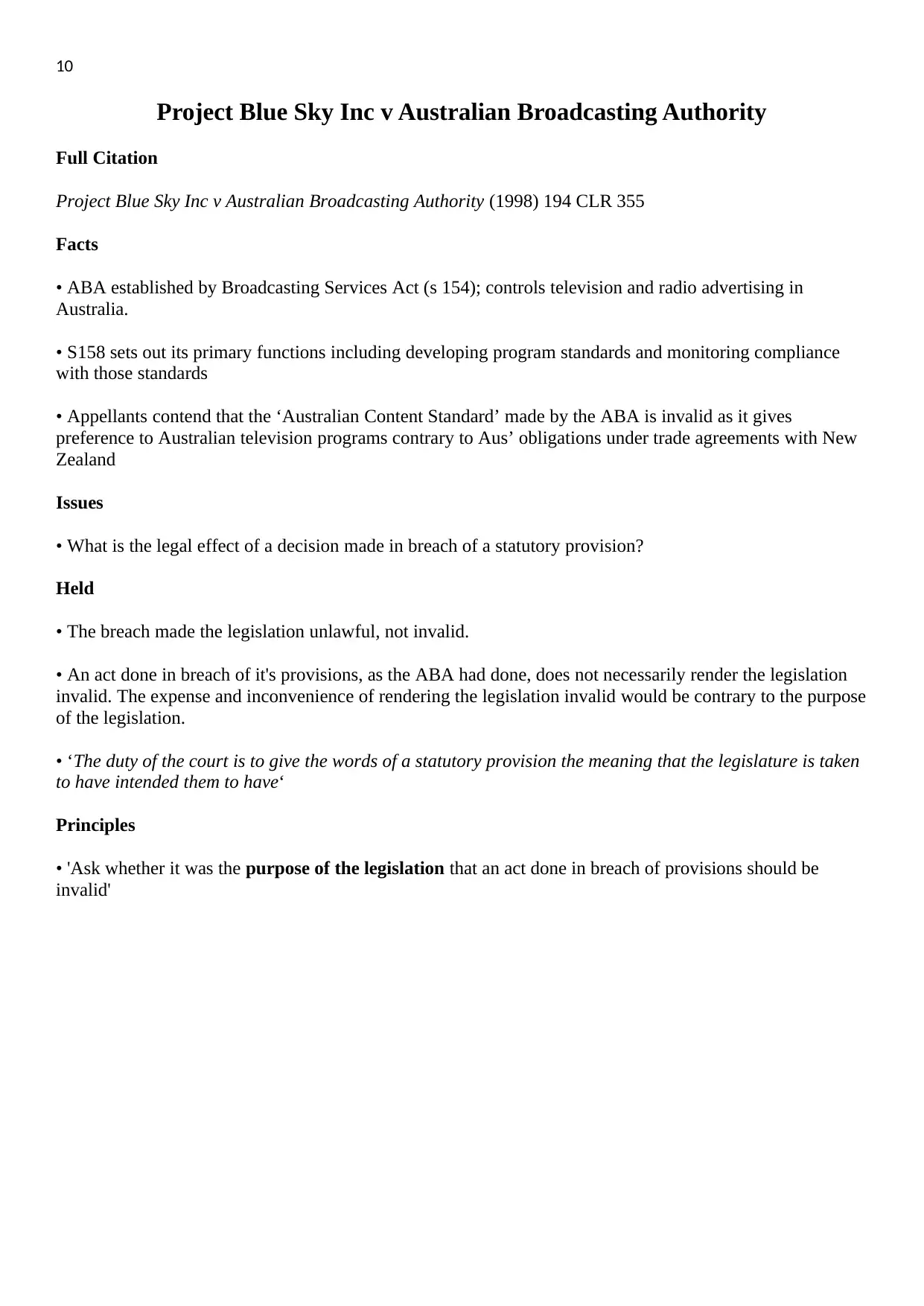
Project Blue Sky Inc v Australian Broadcasting Authority
Full Citation
Project Blue Sky Inc v Australian Broadcasting Authority (1998) 194 CLR 355
Facts
• ABA established by Broadcasting Services Act (s 154); controls television and radio advertising in
Australia.
• S158 sets out its primary functions including developing program standards and monitoring compliance
with those standards
• Appellants contend that the ‘Australian Content Standard’ made by the ABA is invalid as it gives
preference to Australian television programs contrary to Aus’ obligations under trade agreements with New
Zealand
Issues
• What is the legal effect of a decision made in breach of a statutory provision?
Held
• The breach made the legislation unlawful, not invalid.
• An act done in breach of it's provisions, as the ABA had done, does not necessarily render the legislation
invalid. The expense and inconvenience of rendering the legislation invalid would be contrary to the purpose
of the legislation.
• ‘The duty of the court is to give the words of a statutory provision the meaning that the legislature is taken
to have intended them to have‘
Principles
• 'Ask whether it was the purpose of the legislation that an act done in breach of provisions should be
invalid'
Project Blue Sky Inc v Australian Broadcasting Authority
Full Citation
Project Blue Sky Inc v Australian Broadcasting Authority (1998) 194 CLR 355
Facts
• ABA established by Broadcasting Services Act (s 154); controls television and radio advertising in
Australia.
• S158 sets out its primary functions including developing program standards and monitoring compliance
with those standards
• Appellants contend that the ‘Australian Content Standard’ made by the ABA is invalid as it gives
preference to Australian television programs contrary to Aus’ obligations under trade agreements with New
Zealand
Issues
• What is the legal effect of a decision made in breach of a statutory provision?
Held
• The breach made the legislation unlawful, not invalid.
• An act done in breach of it's provisions, as the ABA had done, does not necessarily render the legislation
invalid. The expense and inconvenience of rendering the legislation invalid would be contrary to the purpose
of the legislation.
• ‘The duty of the court is to give the words of a statutory provision the meaning that the legislature is taken
to have intended them to have‘
Principles
• 'Ask whether it was the purpose of the legislation that an act done in breach of provisions should be
invalid'
Paraphrase This Document
Need a fresh take? Get an instant paraphrase of this document with our AI Paraphraser
11
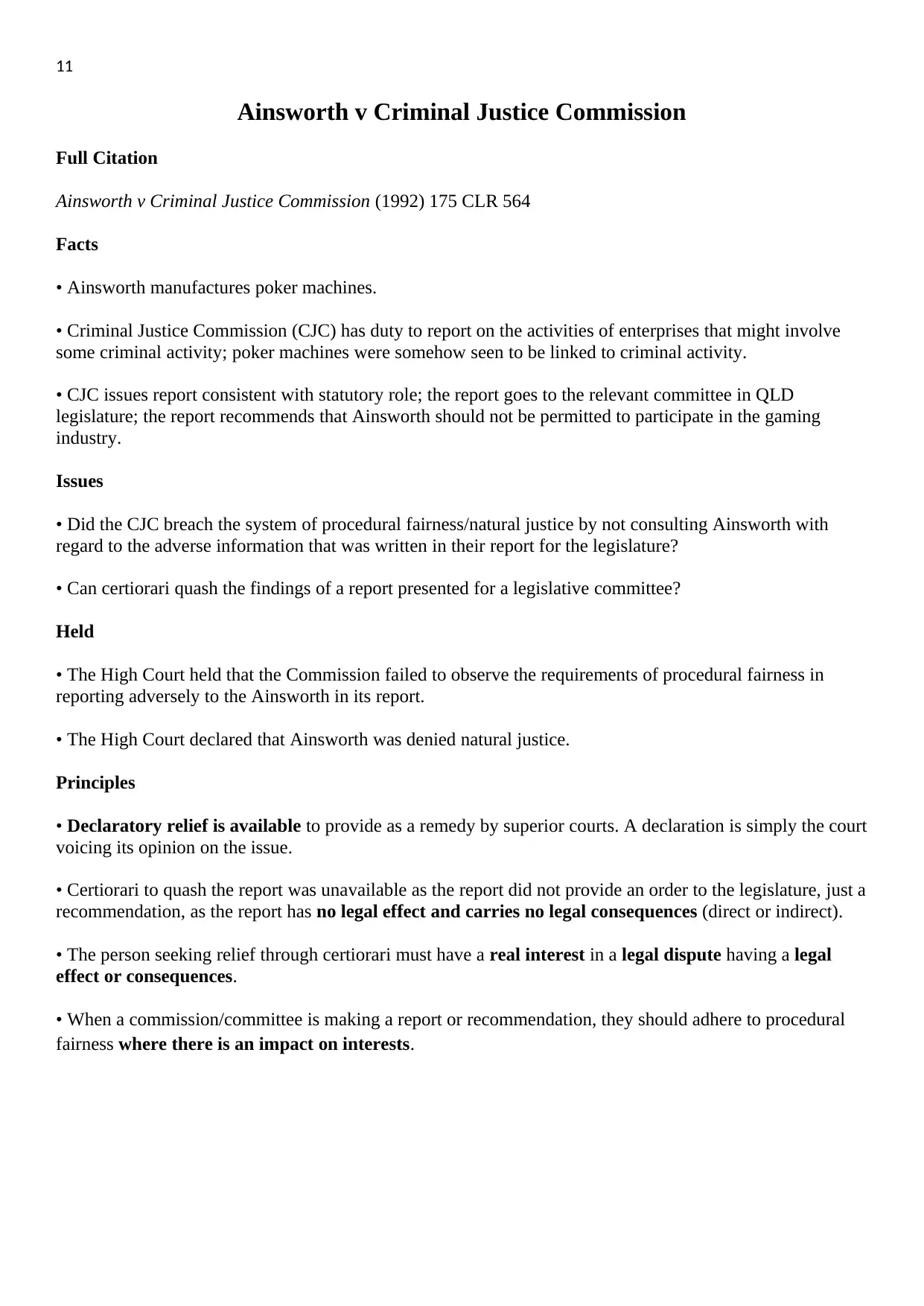
Ainsworth v Criminal Justice Commission
Full Citation
Ainsworth v Criminal Justice Commission (1992) 175 CLR 564
Facts
• Ainsworth manufactures poker machines.
• Criminal Justice Commission (CJC) has duty to report on the activities of enterprises that might involve
some criminal activity; poker machines were somehow seen to be linked to criminal activity.
• CJC issues report consistent with statutory role; the report goes to the relevant committee in QLD
legislature; the report recommends that Ainsworth should not be permitted to participate in the gaming
industry.
Issues
• Did the CJC breach the system of procedural fairness/natural justice by not consulting Ainsworth with
regard to the adverse information that was written in their report for the legislature?
• Can certiorari quash the findings of a report presented for a legislative committee?
Held
• The High Court held that the Commission failed to observe the requirements of procedural fairness in
reporting adversely to the Ainsworth in its report.
• The High Court declared that Ainsworth was denied natural justice.
Principles
• Declaratory relief is available to provide as a remedy by superior courts. A declaration is simply the court
voicing its opinion on the issue.
• Certiorari to quash the report was unavailable as the report did not provide an order to the legislature, just a
recommendation, as the report has no legal effect and carries no legal consequences (direct or indirect).
• The person seeking relief through certiorari must have a real interest in a legal dispute having a legal
effect or consequences.
• When a commission/committee is making a report or recommendation, they should adhere to procedural
fairness where there is an impact on interests.
Ainsworth v Criminal Justice Commission
Full Citation
Ainsworth v Criminal Justice Commission (1992) 175 CLR 564
Facts
• Ainsworth manufactures poker machines.
• Criminal Justice Commission (CJC) has duty to report on the activities of enterprises that might involve
some criminal activity; poker machines were somehow seen to be linked to criminal activity.
• CJC issues report consistent with statutory role; the report goes to the relevant committee in QLD
legislature; the report recommends that Ainsworth should not be permitted to participate in the gaming
industry.
Issues
• Did the CJC breach the system of procedural fairness/natural justice by not consulting Ainsworth with
regard to the adverse information that was written in their report for the legislature?
• Can certiorari quash the findings of a report presented for a legislative committee?
Held
• The High Court held that the Commission failed to observe the requirements of procedural fairness in
reporting adversely to the Ainsworth in its report.
• The High Court declared that Ainsworth was denied natural justice.
Principles
• Declaratory relief is available to provide as a remedy by superior courts. A declaration is simply the court
voicing its opinion on the issue.
• Certiorari to quash the report was unavailable as the report did not provide an order to the legislature, just a
recommendation, as the report has no legal effect and carries no legal consequences (direct or indirect).
• The person seeking relief through certiorari must have a real interest in a legal dispute having a legal
effect or consequences.
• When a commission/committee is making a report or recommendation, they should adhere to procedural
fairness where there is an impact on interests.
12
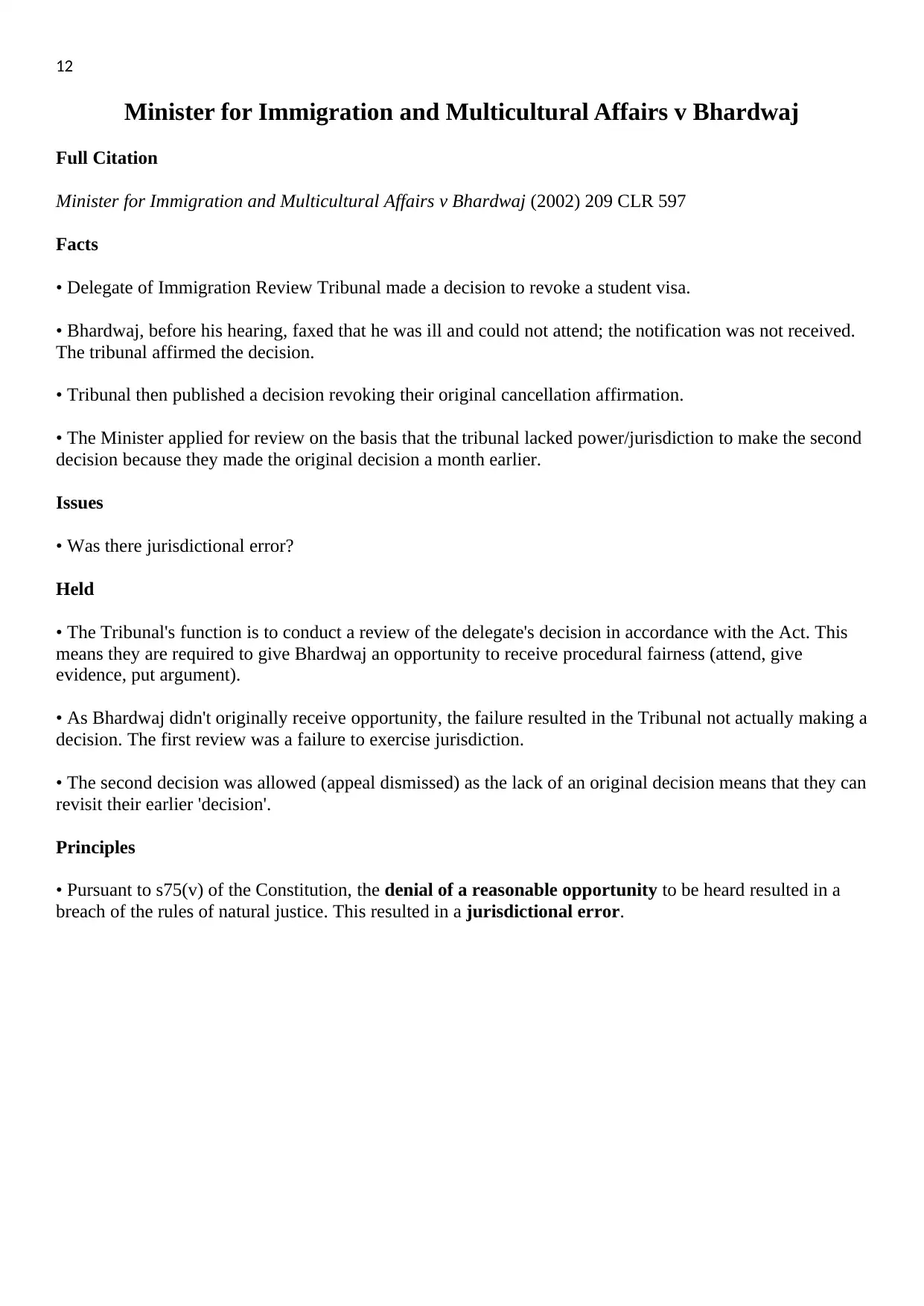
Minister for Immigration and Multicultural Affairs v Bhardwaj
Full Citation
Minister for Immigration and Multicultural Affairs v Bhardwaj (2002) 209 CLR 597
Facts
• Delegate of Immigration Review Tribunal made a decision to revoke a student visa.
• Bhardwaj, before his hearing, faxed that he was ill and could not attend; the notification was not received.
The tribunal affirmed the decision.
• Tribunal then published a decision revoking their original cancellation affirmation.
• The Minister applied for review on the basis that the tribunal lacked power/jurisdiction to make the second
decision because they made the original decision a month earlier.
Issues
• Was there jurisdictional error?
Held
• The Tribunal's function is to conduct a review of the delegate's decision in accordance with the Act. This
means they are required to give Bhardwaj an opportunity to receive procedural fairness (attend, give
evidence, put argument).
• As Bhardwaj didn't originally receive opportunity, the failure resulted in the Tribunal not actually making a
decision. The first review was a failure to exercise jurisdiction.
• The second decision was allowed (appeal dismissed) as the lack of an original decision means that they can
revisit their earlier 'decision'.
Principles
• Pursuant to s75(v) of the Constitution, the denial of a reasonable opportunity to be heard resulted in a
breach of the rules of natural justice. This resulted in a jurisdictional error.
Minister for Immigration and Multicultural Affairs v Bhardwaj
Full Citation
Minister for Immigration and Multicultural Affairs v Bhardwaj (2002) 209 CLR 597
Facts
• Delegate of Immigration Review Tribunal made a decision to revoke a student visa.
• Bhardwaj, before his hearing, faxed that he was ill and could not attend; the notification was not received.
The tribunal affirmed the decision.
• Tribunal then published a decision revoking their original cancellation affirmation.
• The Minister applied for review on the basis that the tribunal lacked power/jurisdiction to make the second
decision because they made the original decision a month earlier.
Issues
• Was there jurisdictional error?
Held
• The Tribunal's function is to conduct a review of the delegate's decision in accordance with the Act. This
means they are required to give Bhardwaj an opportunity to receive procedural fairness (attend, give
evidence, put argument).
• As Bhardwaj didn't originally receive opportunity, the failure resulted in the Tribunal not actually making a
decision. The first review was a failure to exercise jurisdiction.
• The second decision was allowed (appeal dismissed) as the lack of an original decision means that they can
revisit their earlier 'decision'.
Principles
• Pursuant to s75(v) of the Constitution, the denial of a reasonable opportunity to be heard resulted in a
breach of the rules of natural justice. This resulted in a jurisdictional error.
⊘ This is a preview!⊘
Do you want full access?
Subscribe today to unlock all pages.
Trusted by 1+ million students worldwide

1 out of 46


Your All-in-One AI-Powered Toolkit for Academic Success.
+13062052269
info@desklib.com
Available 24*7 on WhatsApp / Email
![[object Object]](/_next/static/media/star-bottom.7253800d.svg)
Unlock your academic potential
Copyright © 2020–2026 A2Z Services. All Rights Reserved. Developed and managed by ZUCOL.