Exploring the Economics of Health Care: MLR and Physician Roles

Verified

Added on  2023/06/09

|4
|501
|78
Report
AI Summary
This report delves into the economics of healthcare, primarily focusing on the Medical Loss Ratio (MLR) as mandated by the Affordable Care Act (ACA), which requires health insurance companies to spend a significant portion of premium revenues on clinical services and quality improvement programs. It highlights the importance of meeting minimum MLR standards (80-85%) and provides examples of qualifying and non-qualifying expenses. The report also explores the potential impact of eliminating restrictions on Physician Assistants, discussing both the benefits in addressing primary care physician shortages and the potential risks of increased competition and compromised service quality. Ultimately, the analysis considers how these factors influence the overall healthcare market and pricing dynamics. Desklib offers a wealth of resources, including similar reports and past papers, for students seeking to further explore these topics.

Document Page
Running head: HEALTH CARE ECONOMIC
Health Care Economic
Name
Institution
Instructor
Course
Date
tabler-icon-diamond-filled.svg

Paraphrase This Document

Need a fresh take? Get an instant paraphrase of this document with our AI Paraphraser
Document Page
HEALTH CARE ECONOMIC
2
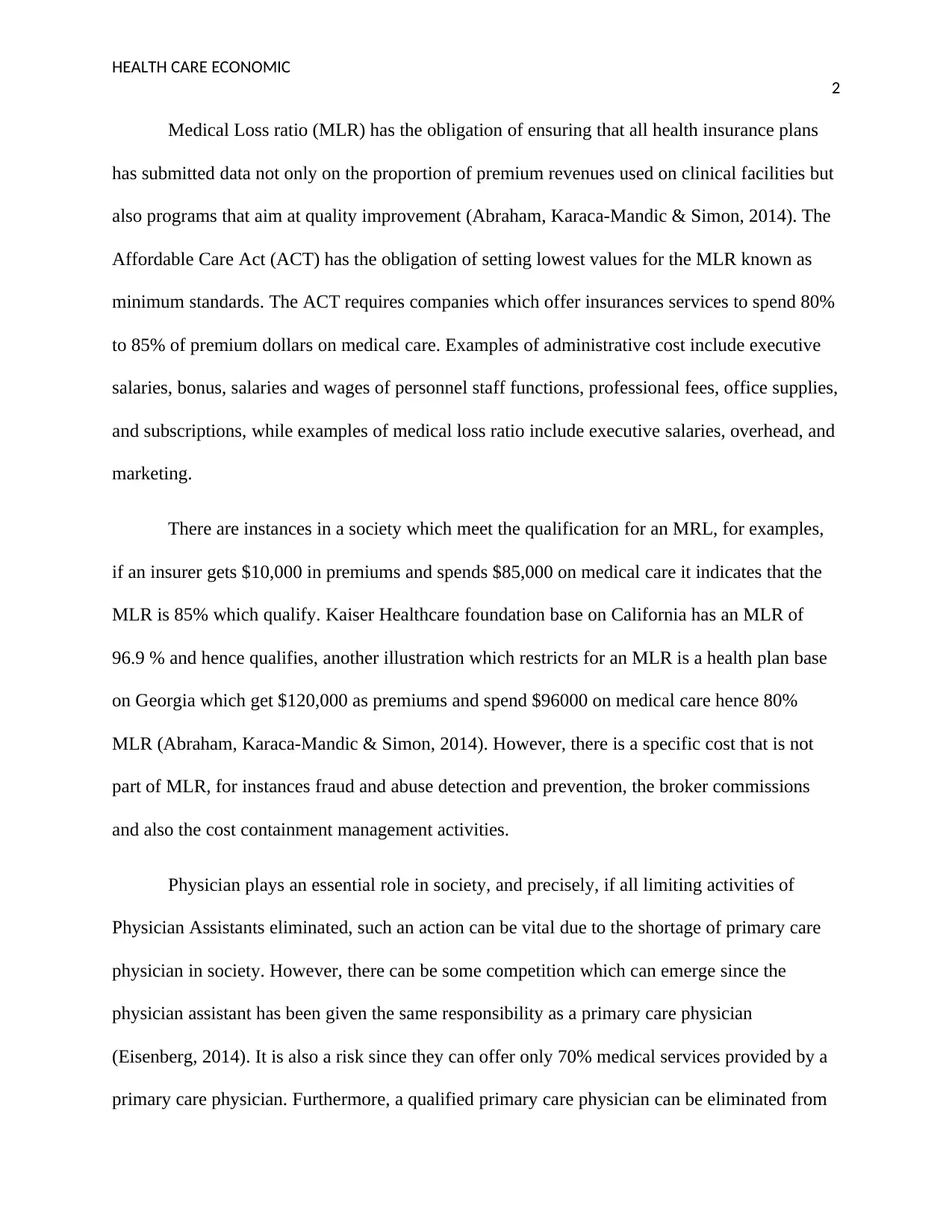
Medical Loss ratio (MLR) has the obligation of ensuring that all health insurance plans
has submitted data not only on the proportion of premium revenues used on clinical facilities but
also programs that aim at quality improvement (Abraham, Karaca-Mandic & Simon, 2014). The
Affordable Care Act (ACT) has the obligation of setting lowest values for the MLR known as
minimum standards. The ACT requires companies which offer insurances services to spend 80%
to 85% of premium dollars on medical care. Examples of administrative cost include executive
salaries, bonus, salaries and wages of personnel staff functions, professional fees, office supplies,
and subscriptions, while examples of medical loss ratio include executive salaries, overhead, and
marketing.
There are instances in a society which meet the qualification for an MRL, for examples,
if an insurer gets $10,000 in premiums and spends $85,000 on medical care it indicates that the
MLR is 85% which qualify. Kaiser Healthcare foundation base on California has an MLR of
96.9 % and hence qualifies, another illustration which restricts for an MLR is a health plan base
on Georgia which get $120,000 as premiums and spend $96000 on medical care hence 80%
MLR (Abraham, Karaca-Mandic & Simon, 2014). However, there is a specific cost that is not
part of MLR, for instances fraud and abuse detection and prevention, the broker commissions
and also the cost containment management activities.
Physician plays an essential role in society, and precisely, if all limiting activities of
Physician Assistants eliminated, such an action can be vital due to the shortage of primary care
physician in society. However, there can be some competition which can emerge since the
physician assistant has been given the same responsibility as a primary care physician
(Eisenberg, 2014). It is also a risk since they can offer only 70% medical services provided by a
primary care physician. Furthermore, a qualified primary care physician can be eliminated from
Document Page
HEALTH CARE ECONOMIC
3
services by non-qualified personnel. The level pf competition will increase since physician will
be able to perform most of the tasks the physician can do at reduced price, this will lead to prices
to go down.
Document Page
HEALTH CARE ECONOMIC
4
References
Abraham, J. M., Karaca-Mandic, P., & Simon, K. (2014). How has the Affordable Care Act’s
medical loss ratio regulation affected insurer behavior? Medical care, 52(4), 370-377.
Eisenberg, M. D. (2014). The Impact of Competition on Quality in Physician Markets: The Case
of Cardiologists.
chevron_up_icon
1 out of 4
circle_padding
hide_on_mobile
zoom_out_icon
[object Object]