MMK101 Marketing Strategy Recommendations for Plastic Whale, T1 2019
VerifiedAdded on 2022/12/14
|10
|2589
|61
Report
AI Summary
This report presents a marketing strategy for Plastic Whale, a company focused on cleaning up waterways and promoting environmental awareness. The report begins with an analysis of the target market, identifying household consumers aged 25-39 with families and an interest in leisure activities. A positioning statement places Plastic Whale as a well-established and socially accepted brand. The core of the report comprises marketing strategy recommendations, including an advertising strategy based on the 5Ms framework (mission, money, message, media, and measurement), with creative messages emphasizing the "Savers of Sea" campaign. The report suggests persuasive appeals, such as smart and adventure themes, and proposes media channels like television, print, and digital platforms. Public relations strategies involve storytelling and social media campaigns to engage consumers. Digital marketing recommendations focus on social media advertising and online brochures. The report concludes that integrated marketing communications (IMC) tools are crucial for reaching the target audience and achieving business objectives, emphasizing the blend of adventure, exploration, and environmental conservation offered by Plastic Whale. The report references various academic sources to support its recommendations.
ASSESSMENT 3
MMK101 TRIMESTER 1
2019
MARKETING STRATEGY
RECOMMENDATIONS
Student Name:
Student Number:
MMK101 TRIMESTER 1
2019
MARKETING STRATEGY
RECOMMENDATIONS
Student Name:
Student Number:

Paraphrase This Document
Need a fresh take? Get an instant paraphrase of this document with our AI Paraphraser
Table of Contents
2.1. Target Market and Positioning Statement................................................................................3
2.2. Marketing Strategy Recommendations.....................................................................................3
2.2.1. Advertising Strategy..........................................................................................................3
2.2.2. Public relations..................................................................................................................6
2.2.3. Digital media.....................................................................................................................7
2.3. Conclusion................................................................................................................................7
Reference List..................................................................................................................................9
2.1. Target Market and Positioning Statement................................................................................3
2.2. Marketing Strategy Recommendations.....................................................................................3
2.2.1. Advertising Strategy..........................................................................................................3
2.2.2. Public relations..................................................................................................................6
2.2.3. Digital media.....................................................................................................................7
2.3. Conclusion................................................................................................................................7
Reference List..................................................................................................................................9
2.1. Target Market and Positioning Statement.
Target Market: the target market for Plastic whale has been analysed to be mainly household
consumers as this group has consumers profile between 25-39 years of age, who mostly are
urban living consumers and have busy lifestyles. This group of consumers are family oriented
and have kids. So for Plastic Whale these group will be perfect target market as they prefer to
go out on weekends to sea beach like Sydney Harbor and usually like to get involved in some
leisure activities with family and kids. Experience and activities offered by Plastic Whale
would be entertaining for household consumers as parents would get opportunity to teach
something valuable to their kids during activities conducted by Plastic Whale. This group of
target market would get exposure to teach their kids how plastics are dumped in sea which
pollutes water and makes living dangerous for sea habitats. These learnings would make
children learn importance of fresh air and how plastics pollute, which would serve purpose of
Plastic Whale as well as would meet learning and leisure needs of consumers.
Positioning Statement: in recycle plastic collection, Ampelmann is positioned as low in growth
level and is in growing phase, while Parley Air is positioned is high in growth and is a fast
growing firm. Contrary to these competitors, Plastic Whale is positioned as well established
and socially accepted brand and firm.
2.2. Marketing Strategy Recommendations.
2.2.1. Advertising Strategy
The promotional tool that will be most suitable for Plastic Whale is advertising which is
described as paid form of communication or promotional technique utilized for product or
services. The advertising strategy is based on theory that involves decision based on 5M’s i.e.
mission, money, message, media and measurement. In mission element of advertising strategy,
objectives are set for advertisement which includes goals of informing, persuading or reinforcing
Target Market: the target market for Plastic whale has been analysed to be mainly household
consumers as this group has consumers profile between 25-39 years of age, who mostly are
urban living consumers and have busy lifestyles. This group of consumers are family oriented
and have kids. So for Plastic Whale these group will be perfect target market as they prefer to
go out on weekends to sea beach like Sydney Harbor and usually like to get involved in some
leisure activities with family and kids. Experience and activities offered by Plastic Whale
would be entertaining for household consumers as parents would get opportunity to teach
something valuable to their kids during activities conducted by Plastic Whale. This group of
target market would get exposure to teach their kids how plastics are dumped in sea which
pollutes water and makes living dangerous for sea habitats. These learnings would make
children learn importance of fresh air and how plastics pollute, which would serve purpose of
Plastic Whale as well as would meet learning and leisure needs of consumers.
Positioning Statement: in recycle plastic collection, Ampelmann is positioned as low in growth
level and is in growing phase, while Parley Air is positioned is high in growth and is a fast
growing firm. Contrary to these competitors, Plastic Whale is positioned as well established
and socially accepted brand and firm.
2.2. Marketing Strategy Recommendations.
2.2.1. Advertising Strategy
The promotional tool that will be most suitable for Plastic Whale is advertising which is
described as paid form of communication or promotional technique utilized for product or
services. The advertising strategy is based on theory that involves decision based on 5M’s i.e.
mission, money, message, media and measurement. In mission element of advertising strategy,
objectives are set for advertisement which includes goals of informing, persuading or reinforcing
⊘ This is a preview!⊘
Do you want full access?
Subscribe today to unlock all pages.

Trusted by 1+ million students worldwide
consumers towards a product/ service. These objectives need to follow marketing approach
established by the firm. Money is second element of advertising strategy which decides on
budget of advertising and focuses on product life cycle stage, market share, consumer base,
competition, frequency of advertisement and product substitutability (Buil, De Chernatony &
Martínez 2013,p 115-122). Message is third element of advertising strategy which focuses on
development of advertisement message through deciding on message creation, evaluation,
selection, implementation and review. After the message is finalized the nest element is media
which decides on tool to deliver the message and is based on media reach, transmission
frequency and influence on prospective consumers. Depending on media selection either print,
tv, radio, magazine, direct mail or internet is used where message is broadcasted to catch
attention of consumers. The last element is measuring effectiveness of advertisement through
measuring effectiveness of communication and sales effect (Kumar & Raju 2013,p.37-45)
The promotion mix strategy for advertising tool of Plastic Whale will target mainly household
and young consumers and the content of message will be developed to correspond leverages of
adventure to potential consumers of Plastic Whale who would be offered exciting sightseeing,
learning and clean up opportunities. The message would be appealing to catch interest of
consumers and their adoption decisions.
Creative message
The message will be kept simple and attractive that Plastic Whale offers consumers opportunity
to become Savers of Sea by offering sightseeing, adventure, learning and cleaning activities to
protect and conserve sea habitat. The special exploration and adventure activities of Plastic
Whale will help to enhance awareness of consumers towards plastic waste and pollution it
creates in sea, thus persuading consumers join together to serve mission to become Savers of Sea
and keep the sea habitat free from plastic waste to make it pollution free zone. The message will
be kept short, simple and not loaded with technical contents so that prospective customers would
easily understand the message and information contained in limited time after reading the
advertisement.
Persuasive content and message appeal
The advertisement will be a teaser content that will have exciting and persuading themes:
established by the firm. Money is second element of advertising strategy which decides on
budget of advertising and focuses on product life cycle stage, market share, consumer base,
competition, frequency of advertisement and product substitutability (Buil, De Chernatony &
Martínez 2013,p 115-122). Message is third element of advertising strategy which focuses on
development of advertisement message through deciding on message creation, evaluation,
selection, implementation and review. After the message is finalized the nest element is media
which decides on tool to deliver the message and is based on media reach, transmission
frequency and influence on prospective consumers. Depending on media selection either print,
tv, radio, magazine, direct mail or internet is used where message is broadcasted to catch
attention of consumers. The last element is measuring effectiveness of advertisement through
measuring effectiveness of communication and sales effect (Kumar & Raju 2013,p.37-45)
The promotion mix strategy for advertising tool of Plastic Whale will target mainly household
and young consumers and the content of message will be developed to correspond leverages of
adventure to potential consumers of Plastic Whale who would be offered exciting sightseeing,
learning and clean up opportunities. The message would be appealing to catch interest of
consumers and their adoption decisions.
Creative message
The message will be kept simple and attractive that Plastic Whale offers consumers opportunity
to become Savers of Sea by offering sightseeing, adventure, learning and cleaning activities to
protect and conserve sea habitat. The special exploration and adventure activities of Plastic
Whale will help to enhance awareness of consumers towards plastic waste and pollution it
creates in sea, thus persuading consumers join together to serve mission to become Savers of Sea
and keep the sea habitat free from plastic waste to make it pollution free zone. The message will
be kept short, simple and not loaded with technical contents so that prospective customers would
easily understand the message and information contained in limited time after reading the
advertisement.
Persuasive content and message appeal
The advertisement will be a teaser content that will have exciting and persuading themes:
Paraphrase This Document
Need a fresh take? Get an instant paraphrase of this document with our AI Paraphraser
Smart appeal: in this smart and responsive theme can be utilized for appeal such as young man or
lady getting engaged in adventure and clean up sea garbage activities to free planet from
pollution. This advertisement will offer a hint that a person who participates in Plastic Whale
will not only have attractive looks, smart appeal but a responsible feel as good as the person
implying in advert content (Waheed et al. 2017,p.56-69)
Adventure appeal: second appealing theme can be for adventure and activities lovers where
prospective consumers will be attracted to exploration adventure movement which includes
sightseeing, exploring city and cleaning up canals to do some good to planet, seas and
environment. The message will communicate feeling of goodness, alive expression and
satisfaction to protect waterways and habitat from plastics which pollutes and chokes.
Strategy
The IMC tool i.e. advertising strategy will meet needs of target markets of Plastic Whales as
through the brand they have objective to impart learning amongst people, youngsters and
children. The identified household group of consumers have need to spend quality time with
family and kids during weekends and Plastic Whale’s advertising strategy will fulfil this need by
communicating activity and adventure offerings to audiences that can be enjoyed in weekends
like sightseeing, exploration of city. Further as Plastic Whale is positioned as stably established
and socially acceptable brand so the advertising catch word “Savers of Sea” will emphasize
Plastic Whale’s offerings to consumers and these will gather more social acceptance as services
are targeted where entertainment and social purpose co-exists (Pham & Gammoh 2015,p.321-
337). Moreover it will meet objectives of Plastic Whale where consumers will participate to
clean their city’s waterways as well as will explore new things about their city. To generate this
perception in Sydney market, Plastic Whale will use persuasive advertising strategy which will at
same time be innovative, appealing and original and will make best application of
communication tools to significantly contribute to objectives of Plastic Whale. It can launch
“Savers of Sea” campaign to spread awareness of brand and exposure in markets of Sydney, to
educate, make people aware about their offerings and concept. As the market has several active
and adventure offerings sold either through adventure sports, themes, fun parks etc. so the
offerings of Plastic Whale will be entirely new concept in Australian market where people will
get chance to learn, explore and save their waterways. For advertising strategy the media
lady getting engaged in adventure and clean up sea garbage activities to free planet from
pollution. This advertisement will offer a hint that a person who participates in Plastic Whale
will not only have attractive looks, smart appeal but a responsible feel as good as the person
implying in advert content (Waheed et al. 2017,p.56-69)
Adventure appeal: second appealing theme can be for adventure and activities lovers where
prospective consumers will be attracted to exploration adventure movement which includes
sightseeing, exploring city and cleaning up canals to do some good to planet, seas and
environment. The message will communicate feeling of goodness, alive expression and
satisfaction to protect waterways and habitat from plastics which pollutes and chokes.
Strategy
The IMC tool i.e. advertising strategy will meet needs of target markets of Plastic Whales as
through the brand they have objective to impart learning amongst people, youngsters and
children. The identified household group of consumers have need to spend quality time with
family and kids during weekends and Plastic Whale’s advertising strategy will fulfil this need by
communicating activity and adventure offerings to audiences that can be enjoyed in weekends
like sightseeing, exploration of city. Further as Plastic Whale is positioned as stably established
and socially acceptable brand so the advertising catch word “Savers of Sea” will emphasize
Plastic Whale’s offerings to consumers and these will gather more social acceptance as services
are targeted where entertainment and social purpose co-exists (Pham & Gammoh 2015,p.321-
337). Moreover it will meet objectives of Plastic Whale where consumers will participate to
clean their city’s waterways as well as will explore new things about their city. To generate this
perception in Sydney market, Plastic Whale will use persuasive advertising strategy which will at
same time be innovative, appealing and original and will make best application of
communication tools to significantly contribute to objectives of Plastic Whale. It can launch
“Savers of Sea” campaign to spread awareness of brand and exposure in markets of Sydney, to
educate, make people aware about their offerings and concept. As the market has several active
and adventure offerings sold either through adventure sports, themes, fun parks etc. so the
offerings of Plastic Whale will be entirely new concept in Australian market where people will
get chance to learn, explore and save their waterways. For advertising strategy the media
decision that can be considered by Plastic Whale includes television as it is a platform that
catches interest of consumers and promotes brand awareness correspondingly. Events like sports,
culture and lifestyle can be covered or featured to indirectly promote Plastic Whale brand
offerings. Also media contents can be advertised in print media as well as digital platforms to
generate awareness among target audiences (Barker 2013,p.102-121). B2B advertisement can be
launched by media houses which will generate sources of revenue. Also popular magazines and
billboards can be used for advertisement purposes. Also cinema advertisement can be considered
as it is effective promotion medium for appealing visual interest of audience with les distractions
in contrast to television ads. Also as household target group of consumers belong to 25-39 years
so they are more inclined to cinema ads as this group consist of family persons, professionals,
students etc. So cinema ads is ideal way to promote objectives and offerings of Plastic Whale as
this young, household consumer group are more likely to watch movies and visit theaters. Plastic
Whale can collaborate ads with blockbuster movies which can run 30 sec advertisement to
inspire inner environmental superhero’s in people.
2.2.2. Public relations
As firms cannot stand in isolation so they require consistent correspondence with consumers and
various stakeholders, to serve relations through public relations. The PR is the manner through
which firms interact with public and media and interact directly or indirectly with target
consumers to generate strong positive image and relationship with audiences. These activities
includes press release, newsletters, public appearance etc. PR activities supports corporate and
product promotion objectives by combining marketing activities and public relation in branding
activities (Ashley & Tuten 2015,p.15-27). Plastic Whale can launch public relations campaign
by telling audiences story of Environment Superhero to catch their reactions and interest
towards entirely new adventure and clean up concept of Plastic Whale. The story can include an
interesting concept, essence of connection with environment, natural habitats and a sense of
belonging and responsibility to protect Sydney Harbor and its sea creatures. A video for
becoming “ Savers of Sea” can be produced that can explain reason behind Plastic Whales new
brand concept and can welcome public to create their own story or custom experience for Saving
Sydney Harbor where Plastic Whale can share personalized stories of consumers across their
media release, campaigns and newsletters, so that more active users could get connected with
catches interest of consumers and promotes brand awareness correspondingly. Events like sports,
culture and lifestyle can be covered or featured to indirectly promote Plastic Whale brand
offerings. Also media contents can be advertised in print media as well as digital platforms to
generate awareness among target audiences (Barker 2013,p.102-121). B2B advertisement can be
launched by media houses which will generate sources of revenue. Also popular magazines and
billboards can be used for advertisement purposes. Also cinema advertisement can be considered
as it is effective promotion medium for appealing visual interest of audience with les distractions
in contrast to television ads. Also as household target group of consumers belong to 25-39 years
so they are more inclined to cinema ads as this group consist of family persons, professionals,
students etc. So cinema ads is ideal way to promote objectives and offerings of Plastic Whale as
this young, household consumer group are more likely to watch movies and visit theaters. Plastic
Whale can collaborate ads with blockbuster movies which can run 30 sec advertisement to
inspire inner environmental superhero’s in people.
2.2.2. Public relations
As firms cannot stand in isolation so they require consistent correspondence with consumers and
various stakeholders, to serve relations through public relations. The PR is the manner through
which firms interact with public and media and interact directly or indirectly with target
consumers to generate strong positive image and relationship with audiences. These activities
includes press release, newsletters, public appearance etc. PR activities supports corporate and
product promotion objectives by combining marketing activities and public relation in branding
activities (Ashley & Tuten 2015,p.15-27). Plastic Whale can launch public relations campaign
by telling audiences story of Environment Superhero to catch their reactions and interest
towards entirely new adventure and clean up concept of Plastic Whale. The story can include an
interesting concept, essence of connection with environment, natural habitats and a sense of
belonging and responsibility to protect Sydney Harbor and its sea creatures. A video for
becoming “ Savers of Sea” can be produced that can explain reason behind Plastic Whales new
brand concept and can welcome public to create their own story or custom experience for Saving
Sydney Harbor where Plastic Whale can share personalized stories of consumers across their
media release, campaigns and newsletters, so that more active users could get connected with
⊘ This is a preview!⊘
Do you want full access?
Subscribe today to unlock all pages.
Trusted by 1+ million students worldwide
services (Felix, Rauschnabel & Hinsch 2017,p. 118-126). Plastic Whale can also launch their PR
campaign in social media to make Australians become Savers of Sea by offering them a
challenge to protect their Sydney Harbor. The social media PR campaign can be created to
encourage positive participation in #Save Sydney Harbor Drive, so that it generates interest
around hashtag, which can drive awareness for the campaign on social media.
2.2.3. Digital media
Digital marketing surrounds marketing and promotion activities through utilization of electronic
device or internet platform and involves promotion efforts on digital channels like search
engines, social media, websites etc. to connect with potential and existing customers. Digital
marketing utilizes various digital techniques and platforms to connect with consumers where
they spend their time most i.e. online (Mudzanani 2015,p.90-97). Plastic Whale can use social
media advertising and online brochures as media platforms under digital marketing tools. Like
social media platforms can be used by Plastic Whale to promote their brand awareness, product
offerings and generate interest for their clean up objectives of Sydney Harbor. Channels like
Facebook, twitter, LinkedIn, Instagram can be used for this purpose. For example, on World
Environment Day, Plastic Whales can launch their social media campaign to connect with
millions of people who are fans of Sydney Harbor and are concerned about its increasing plastic
pollution. A series of boards can be developed by Plastic Whale where users could make their
own Environment Saver Cards , which will help generate more awareness for causes and
objectives of Plastic Whale in a way that is fun and free (Belch & Belch 2014, p.130-136). The
content should be engaging with things that users would desire to do in future to protect Sydney
Harbor and would allow users generate to-do wishes. This approach will draw target consumers
attention to the problem at Sydney Harbor and will give them unique way to develop their own
solution.
2.3. Conclusion
Thus it can be concluded that IMC tools helps to integrate promotion tools and communication
tactics to ensure that brands offerings and awareness reaches to more potential customers
effectively to target interest of audiences. Hence IMC is significant element of promotional
campaign in social media to make Australians become Savers of Sea by offering them a
challenge to protect their Sydney Harbor. The social media PR campaign can be created to
encourage positive participation in #Save Sydney Harbor Drive, so that it generates interest
around hashtag, which can drive awareness for the campaign on social media.
2.2.3. Digital media
Digital marketing surrounds marketing and promotion activities through utilization of electronic
device or internet platform and involves promotion efforts on digital channels like search
engines, social media, websites etc. to connect with potential and existing customers. Digital
marketing utilizes various digital techniques and platforms to connect with consumers where
they spend their time most i.e. online (Mudzanani 2015,p.90-97). Plastic Whale can use social
media advertising and online brochures as media platforms under digital marketing tools. Like
social media platforms can be used by Plastic Whale to promote their brand awareness, product
offerings and generate interest for their clean up objectives of Sydney Harbor. Channels like
Facebook, twitter, LinkedIn, Instagram can be used for this purpose. For example, on World
Environment Day, Plastic Whales can launch their social media campaign to connect with
millions of people who are fans of Sydney Harbor and are concerned about its increasing plastic
pollution. A series of boards can be developed by Plastic Whale where users could make their
own Environment Saver Cards , which will help generate more awareness for causes and
objectives of Plastic Whale in a way that is fun and free (Belch & Belch 2014, p.130-136). The
content should be engaging with things that users would desire to do in future to protect Sydney
Harbor and would allow users generate to-do wishes. This approach will draw target consumers
attention to the problem at Sydney Harbor and will give them unique way to develop their own
solution.
2.3. Conclusion
Thus it can be concluded that IMC tools helps to integrate promotion tools and communication
tactics to ensure that brands offerings and awareness reaches to more potential customers
effectively to target interest of audiences. Hence IMC is significant element of promotional
Paraphrase This Document
Need a fresh take? Get an instant paraphrase of this document with our AI Paraphraser
activities as it promotes brand and helps to meet business objectives. These powerful mechanism
has been used by Plastic Whale to build their brand awareness among people of Sydney so that
waterways of city could be saved with concept of fun and clean activities, thus ensuring
conservation of Sydney Harbor. Also IMC techniques like advertising, PR and digital marketing
used by Plastic Whales will help to target their audience so that they can be informed about
company’s service which would meet needs of business as well as consumers by blending
adventure, exploration with unique concept of saving city’s waterways by cleaning.
has been used by Plastic Whale to build their brand awareness among people of Sydney so that
waterways of city could be saved with concept of fun and clean activities, thus ensuring
conservation of Sydney Harbor. Also IMC techniques like advertising, PR and digital marketing
used by Plastic Whales will help to target their audience so that they can be informed about
company’s service which would meet needs of business as well as consumers by blending
adventure, exploration with unique concept of saving city’s waterways by cleaning.
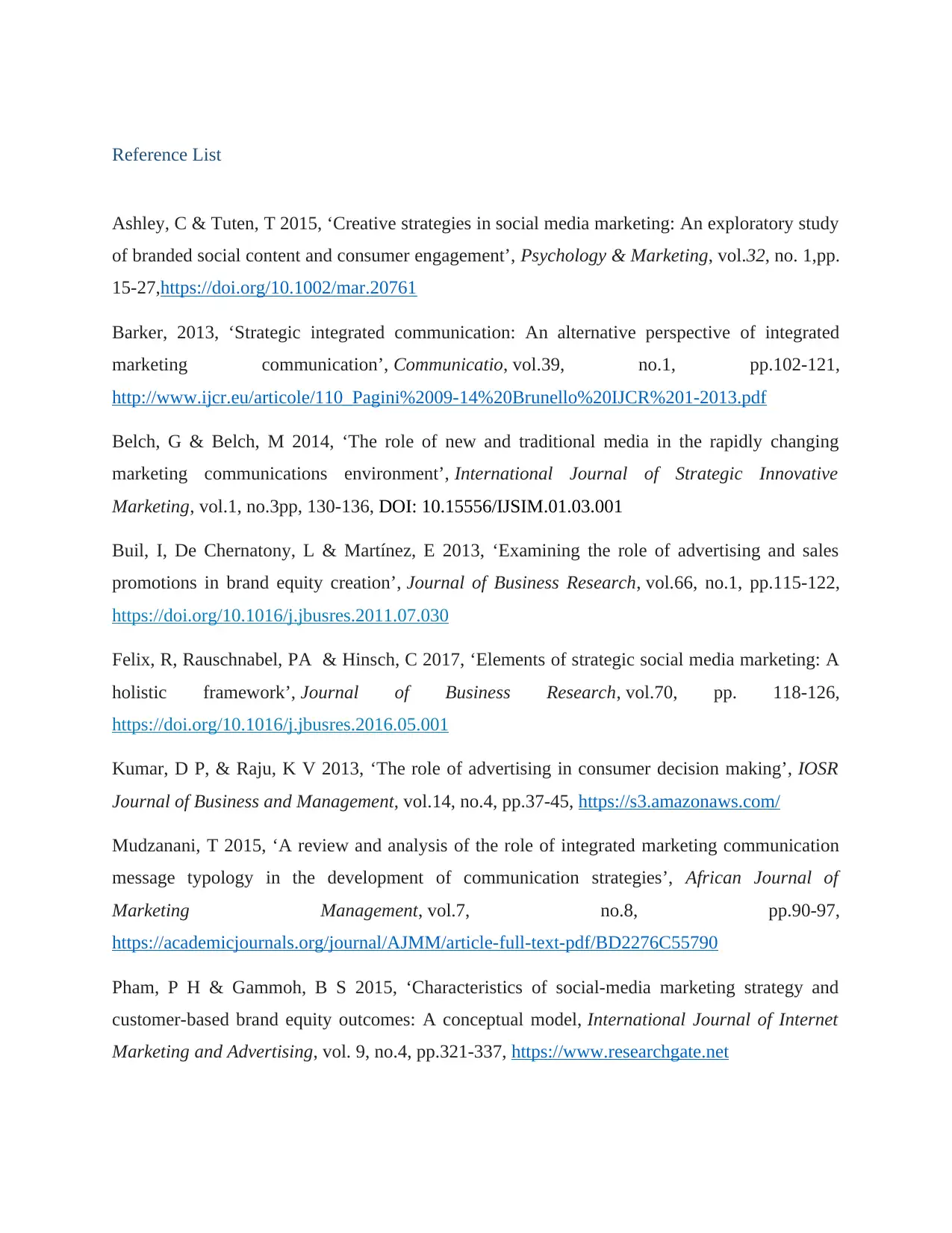
Reference List
Ashley, C & Tuten, T 2015, ‘Creative strategies in social media marketing: An exploratory study
of branded social content and consumer engagement’, Psychology & Marketing, vol.32, no. 1,pp.
15-27,https://doi.org/10.1002/mar.20761
Barker, 2013, ‘Strategic integrated communication: An alternative perspective of integrated
marketing communication’, Communicatio, vol.39, no.1, pp.102-121,
http://www.ijcr.eu/articole/110_Pagini%2009-14%20Brunello%20IJCR%201-2013.pdf
Belch, G & Belch, M 2014, ‘The role of new and traditional media in the rapidly changing
marketing communications environment’, International Journal of Strategic Innovative
Marketing, vol.1, no.3pp, 130-136, DOI: 10.15556/IJSIM.01.03.001
Buil, I, De Chernatony, L & Martínez, E 2013, ‘Examining the role of advertising and sales
promotions in brand equity creation’, Journal of Business Research, vol.66, no.1, pp.115-122,
https://doi.org/10.1016/j.jbusres.2011.07.030
Felix, R, Rauschnabel, PA & Hinsch, C 2017, ‘Elements of strategic social media marketing: A
holistic framework’, Journal of Business Research, vol.70, pp. 118-126,
https://doi.org/10.1016/j.jbusres.2016.05.001
Kumar, D P, & Raju, K V 2013, ‘The role of advertising in consumer decision making’, IOSR
Journal of Business and Management, vol.14, no.4, pp.37-45, https://s3.amazonaws.com/
Mudzanani, T 2015, ‘A review and analysis of the role of integrated marketing communication
message typology in the development of communication strategies’, African Journal of
Marketing Management, vol.7, no.8, pp.90-97,
https://academicjournals.org/journal/AJMM/article-full-text-pdf/BD2276C55790
Pham, P H & Gammoh, B S 2015, ‘Characteristics of social-media marketing strategy and
customer-based brand equity outcomes: A conceptual model, International Journal of Internet
Marketing and Advertising, vol. 9, no.4, pp.321-337, https://www.researchgate.net
Ashley, C & Tuten, T 2015, ‘Creative strategies in social media marketing: An exploratory study
of branded social content and consumer engagement’, Psychology & Marketing, vol.32, no. 1,pp.
15-27,https://doi.org/10.1002/mar.20761
Barker, 2013, ‘Strategic integrated communication: An alternative perspective of integrated
marketing communication’, Communicatio, vol.39, no.1, pp.102-121,
http://www.ijcr.eu/articole/110_Pagini%2009-14%20Brunello%20IJCR%201-2013.pdf
Belch, G & Belch, M 2014, ‘The role of new and traditional media in the rapidly changing
marketing communications environment’, International Journal of Strategic Innovative
Marketing, vol.1, no.3pp, 130-136, DOI: 10.15556/IJSIM.01.03.001
Buil, I, De Chernatony, L & Martínez, E 2013, ‘Examining the role of advertising and sales
promotions in brand equity creation’, Journal of Business Research, vol.66, no.1, pp.115-122,
https://doi.org/10.1016/j.jbusres.2011.07.030
Felix, R, Rauschnabel, PA & Hinsch, C 2017, ‘Elements of strategic social media marketing: A
holistic framework’, Journal of Business Research, vol.70, pp. 118-126,
https://doi.org/10.1016/j.jbusres.2016.05.001
Kumar, D P, & Raju, K V 2013, ‘The role of advertising in consumer decision making’, IOSR
Journal of Business and Management, vol.14, no.4, pp.37-45, https://s3.amazonaws.com/
Mudzanani, T 2015, ‘A review and analysis of the role of integrated marketing communication
message typology in the development of communication strategies’, African Journal of
Marketing Management, vol.7, no.8, pp.90-97,
https://academicjournals.org/journal/AJMM/article-full-text-pdf/BD2276C55790
Pham, P H & Gammoh, B S 2015, ‘Characteristics of social-media marketing strategy and
customer-based brand equity outcomes: A conceptual model, International Journal of Internet
Marketing and Advertising, vol. 9, no.4, pp.321-337, https://www.researchgate.net
⊘ This is a preview!⊘
Do you want full access?
Subscribe today to unlock all pages.
Trusted by 1+ million students worldwide

Waheed, A, Yang, J, Ahmed, Z, Rafique, K. & Ashfaq, M 2017, ‘Is marketing limited to
promotional activities? The concept of marketing: A concise review of the literature’, Asian
Development Policy Review, vol.5, no.1, pp.56-69, https://www.researchgate.net/
promotional activities? The concept of marketing: A concise review of the literature’, Asian
Development Policy Review, vol.5, no.1, pp.56-69, https://www.researchgate.net/

1 out of 10


Your All-in-One AI-Powered Toolkit for Academic Success.
+13062052269
info@desklib.com
Available 24*7 on WhatsApp / Email
![[object Object]](/_next/static/media/star-bottom.7253800d.svg)
Unlock your academic potential
Copyright © 2020–2026 A2Z Services. All Rights Reserved. Developed and managed by ZUCOL.