MN501 Network Management: Ethical and Social Issues in ICT Use

Verified

Added on  2023/04/20

|6
|1607
|230
Essay
AI Summary
This essay addresses the ethical and social issues arising from the use of ICT technologies in network management, with a focus on cyber bullying. It identifies privacy and security risks associated with mobile technologies and social media platforms, highlighting the potential for behavioral changes and negative impacts on individuals and businesses. The analysis explores the consequences of cyber bullying, including anger, frustration, and suicidal tendencies, as well as the risks of data breaches and financial losses for organizations. The essay evaluates ethical solutions, such as stringent policies and real-time reporting systems, to minimize the impact of cyber crime and promote responsible use of ICT. The document is available on Desklib, a platform offering study tools for students.
Document Page
Running head: NETWORK MANAGEMENT IN ORGANIZATIONS
Network Management in Organizations
Name of the Student
Name of the University
Author Note:
tabler-icon-diamond-filled.svg

Paraphrase This Document

Need a fresh take? Get an instant paraphrase of this document with our AI Paraphraser
Document Page
1
NETWORK MANAGEMENT IN ORGANIZATIONS
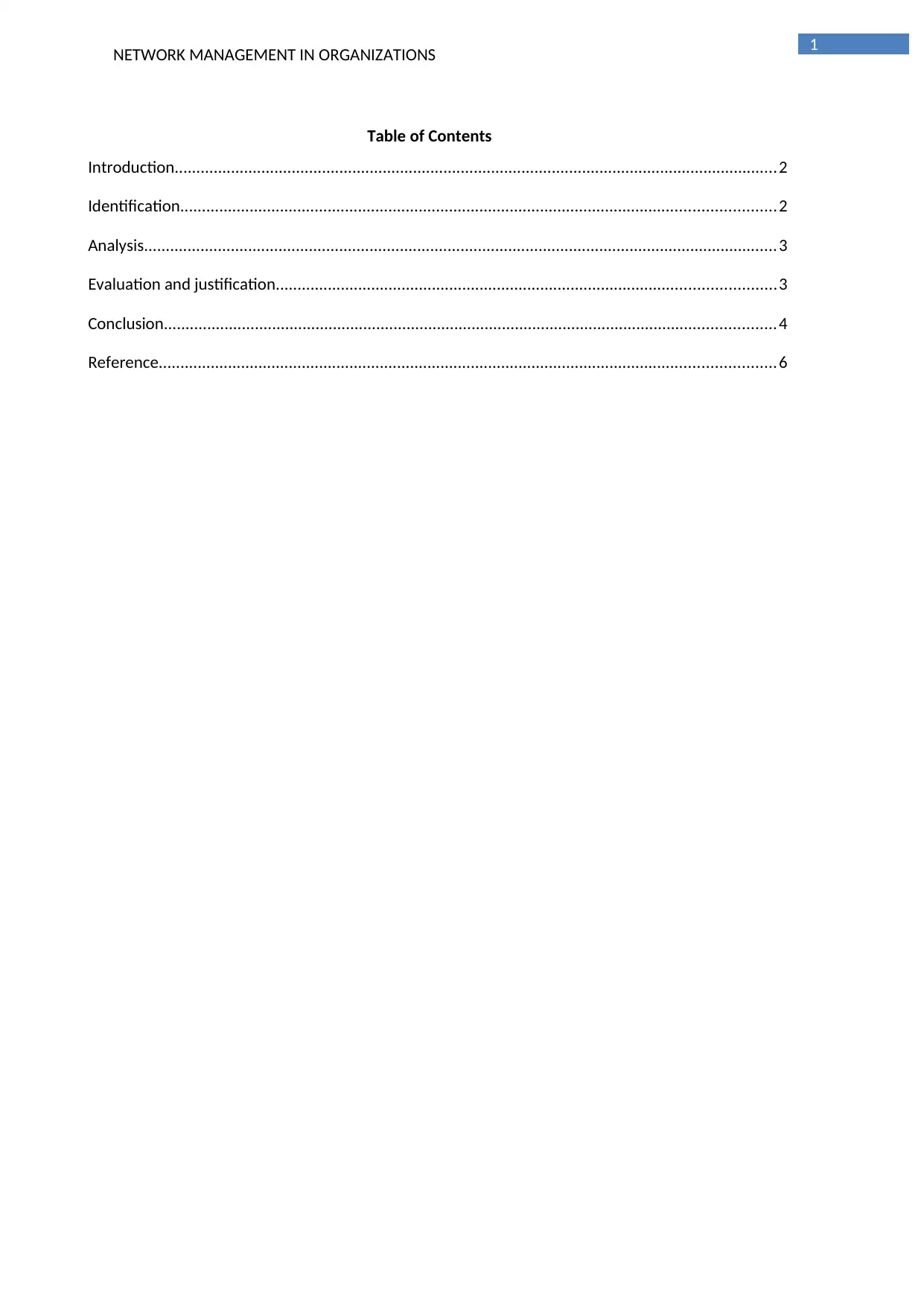
Table of Contents
Introduction...........................................................................................................................................2
Identification.........................................................................................................................................2
Analysis..................................................................................................................................................3
Evaluation and justification...................................................................................................................3
Conclusion.............................................................................................................................................4
Reference..............................................................................................................................................6
Document Page
2
NETWORK MANAGEMENT IN ORGANIZATIONS
Introduction
The extensive development in the field of ICT technologies has led to the growth of numerous
ethical issues. The foremost determination of this paper is to focus on the ethical and social issues caused
due to cyber bullying. Apart from the ethical issues there are numerous security issues associated with
cyber bullying also, which will be discussed in the paper.
Cyber bullying is a global security concern these days as it is the misusing of the technological
advancements made in the field of ICT (Modecki et al., 2014). These security concerns do not follow the
professional code of conduct. The paper will be highlighting the ethical solutions for this security concern.
The following unit of the paper will be identifying the two ethical issues caused due to cyber bullying.
Identification
The extensive development in the field of ICT has led to the growth of many good and bad things
for our society and our business. Our society is hugely benefitted by the positive developments of the
smart technologies and very badly damaged due to the negative developments as it is not only harmful for
the society but also our businesses as well (Hinduja&Patchin, 2014). This unit of the paper will be
highlighting the different types of issues caused due to the global problem of cyber bullying. This category
of online bullying is done in online platforms such as the social media platforms where all the personal data
of the users are stored safely. There are different types of security issues associated with cyber bullying as
the followings:
Privacy of the users of mobile technologies are at stake most of the times as they accept all the
conditions of the technologies during the installation process without even going through the details
(Pabian&Vandebosch, 2016). Security of the users is at stake as the mobile applications are sometimes tied
up with many third parties. The users of the mobile applications are often victimized with their personal
data, which are the social ethical issues of cyber bullying.
The other important ethical issue is the traditional bullying techniques are converted into cyber
bullying without even knowing about its consequences on our society which causes behavioral changes (Del
Rey et al., 2016). The following unit of the paper will be analyzing the discussed issues in a detailed manner.
Analysis
Cyber-bullying is one of the most trending categories of cyber harassment. Electronic
communication methods are the platforms for the cyber criminals for this crime. Threating calls or offensive
emails are the other sort of issue associated withthe cyber-bullying. These kinds of issues may have very
direct impact on the users of those mobile applications as their behavior may seem to change after a cyber-
Document Page
3
NETWORK MANAGEMENT IN ORGANIZATIONS
bully incident (Corcoran, Guckin& Prentice, 2015). Hacking and stealing of identity are the other major
consequences of sharing much information in the social media applications, as the social media platforms
works on global servers so the task of the cyber criminals gets easier. However, there are instances when
these kinds of incidents have no impact on the victim. Anger, frustration and the fear are the most common
after effects of cyber bullying. It can be said that even a suicidal tendency also falls as a negative impact of
cyber-bullying. The latest developments in the field of ICT have given lot of positivity’s to our society but
have also given us lots of privacy concerns (Heiman&Olenik-Shemesh, 2015). The security issues may be a
huge concern for the business organization as their private and confidential data may be leaked to their
rival organization and this may cause huge business loss for the company. Thus it can be said that the
discussed issues associated with cyber-bullying have the capability to damage both our society and also our
business.
Evaluation and justification
The discussed issues of cyber-bullying in the previous units of the paper will be evaluated and
justified in this unit of the paper. The cyber bullying incidents do not follow the professional code of
conduct as the cyber criminals are not at all concerned as the negative impact of cyber-bullying. They only
mean to harm the society for their personal benefits. The solutions of the ethical issuers caused by cyber-
bulling include the stringent policies protecting the privacy and security of mobile applications and the
social media platforms should be encouraged both by the mobile corporations as well as the
telecommunication units of the government (Lonigro et al., 2015). The application of the social media
application and the other types of mobile technologies are increasing each day due to personal and
business activities which is the main reason behind the need of the ethical solutions. Since these kinds of
global security concern is increasing each day real time fully automated computerized reporting systems
should be there for reporting these cases so that immediate steps can be taken to prevent further damage.
Based on different types of researches it was found that cyber-bullying conducted mostly by the younger
sections of the society for their personal benefits (Cantone et al., 2015). The plan of action for the cyber
criminals also keeps on updating as there are different categories of security protocols which are
maintained by the users of the mobile applications these days.
The stringent policies may be significantly minimizing the increasing number of cases of cyber-
bullying. The discussed reporting system will be helping the government to track the activities of the cyber
criminals as they are also getting benefitted from the advancements of ICT technologies, so it will be easier
to bring down the issue of cyber-bullying with the help of the discussed preventive measures. The following
unit will be considering the conclusions we may get from going through the paper.
tabler-icon-diamond-filled.svg

Paraphrase This Document

Need a fresh take? Get an instant paraphrase of this document with our AI Paraphraser
Document Page
4
NETWORK MANAGEMENT IN ORGANIZATIONS
Conclusion
The paper was very much helpful to understand the concept of cyber bullying which is a growing
concern for you society these days considering the use of the ICT technologies. The different types of social
and ethical issues associated with cyber-bullying were also identified in this paper. The paper was helpful to
understand the impact of this crime in our society as well as on our business. The ethical solutions of these
ethical issues were also highlighted in the paper. Thus it can be concluded that, ethical solutions should be
highly considered to minimize this global concern.
Document Page
5
NETWORK MANAGEMENT IN ORGANIZATIONS
Reference
Barlett, C., & Coyne, S. M. (2014). A meta analysis of sex differences in cyber bullying behavior: The
moderating role of age. Aggressive behavior, 40(5), 474-488.
Cantone, E., Piras, A. P., Vellante, M., Preti, A., Daníelsdóttir, S., D’Aloja, E., ...&Bhugra, D. (2015).
Interventions on bullying and cyberbullying in schools: A systematic review. Clinical practice and
epidemiology in mental health: CP & EMH, 11(Suppl 1 M4), 58.
Corcoran, L., Guckin, C., & Prentice, G. (2015). Cyberbullying or cyber aggression?: A review of existing
definitions of cyber-based peer-to-peer aggression. Societies, 5(2), 245-255.
Del Rey, R., Lazuras, L., Casas, J. A., Barkoukis, V., Ortega-Ruiz, R., &Tsorbatzoudis, H. (2016). Does empathy
predict (cyber) bullying perpetration, and how do age, gender and nationality affect this
relationship?.Learning and Individual Differences, 45, 275-281.
Heiman, T., &Olenik-Shemesh, D. (2015).Cyberbullying experience and gender differences among
adolescents in different educational settings.Journal of Learning Disabilities, 48(2), 146-155.
Hinduja, S., &Patchin, J. W. (2014). Cyberbullying: Identification. Prevention, and.
Lonigro, A., Schneider, B. H., Laghi, F., Baiocco, R., Pallini, S., & Brunner, T. (2015). Is cyberbullying related to
trait or state anger?.Child Psychiatry & Human Development, 46(3), 445-454.
Modecki, K. L., Minchin, J., Harbaugh, A. G., Guerra, N. G., &Runions, K. C. (2014). Bullying prevalence
across contexts: A meta-analysis measuring cyber and traditional bullying.Journal of Adolescent
Health, 55(5), 602-611.
Pabian, S., &Vandebosch, H. (2016).An investigation of short-term longitudinal associations between social
anxiety and victimization and perpetration of traditional bullying and cyberbullying. Journal of youth
and adolescence, 45(2), 328-339.
chevron_up_icon
1 out of 6
circle_padding
hide_on_mobile
zoom_out_icon
[object Object]