Global Business Portfolio: EEC, MNCs, Market Entry Strategy Report
VerifiedAdded on 2023/06/15
|15
|5250
|456
Portfolio
AI Summary
This assignment is a portfolio focusing on global business, comprising several key components. It includes research on the European Economic Community (EEC), discussing its pros and cons, and a critical analysis of the reasons behind Multinational Corporations (MNCs) internationalizing, along with the challenges they face. The portfolio also contains an individual report selecting an MNC and analyzing its potential entry into a new international market, detailing market analysis, internationalization strategies, modes of entry, challenges, and necessary leadership qualities. Finally, it includes a reflective essay summarizing learning outcomes from the module and a self-assessment of entrepreneurial qualities. This portfolio provides a comprehensive overview of global business concepts and strategies.

Global Business

Paraphrase This Document
Need a fresh take? Get an instant paraphrase of this document with our AI Paraphraser
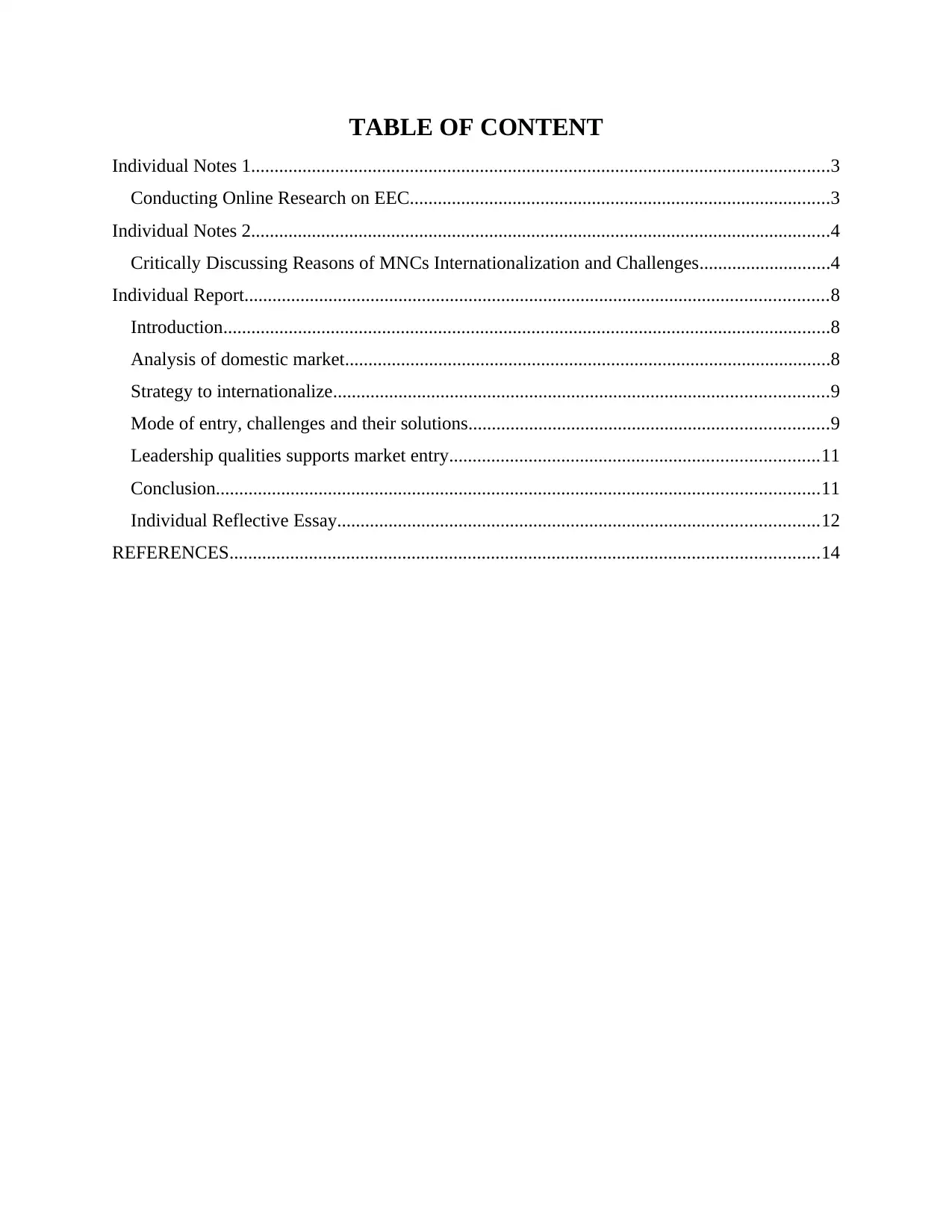
TABLE OF CONTENT
Individual Notes 1............................................................................................................................3
Conducting Online Research on EEC..........................................................................................3
Individual Notes 2............................................................................................................................4
Critically Discussing Reasons of MNCs Internationalization and Challenges............................4
Individual Report.............................................................................................................................8
Introduction..................................................................................................................................8
Analysis of domestic market........................................................................................................8
Strategy to internationalize..........................................................................................................9
Mode of entry, challenges and their solutions.............................................................................9
Leadership qualities supports market entry...............................................................................11
Conclusion.................................................................................................................................11
Individual Reflective Essay.......................................................................................................12
REFERENCES..............................................................................................................................14
Individual Notes 1............................................................................................................................3
Conducting Online Research on EEC..........................................................................................3
Individual Notes 2............................................................................................................................4
Critically Discussing Reasons of MNCs Internationalization and Challenges............................4
Individual Report.............................................................................................................................8
Introduction..................................................................................................................................8
Analysis of domestic market........................................................................................................8
Strategy to internationalize..........................................................................................................9
Mode of entry, challenges and their solutions.............................................................................9
Leadership qualities supports market entry...............................................................................11
Conclusion.................................................................................................................................11
Individual Reflective Essay.......................................................................................................12
REFERENCES..............................................................................................................................14
Individual Notes 1
Conducting Online Research on EEC
The European Economic Community was established in 1957, to design an integrated
economy for European nations (Williams, 2018). Initially its aim was to integrate economy
through common market and customs union. The countries who are members of this union has
reduced trade barriers mostly through multilateral negotiations like, General Agreement on
Tariffs and Trade also known as GATT. There are almost few from two dozen countries in EEC
which is now incorporated to The European Union (EU) including countries like, France, Italy
Portugal and many more. United Kingdom was one of the important member of EEC which
ended their membership with Brexit after almost five decades. There were six states that has
founded the EEC that were known as Inner six. These six states are France, West Germany, Italy
and other three Benelux countries which are Belgium, Netherlands and Luxembourg. There are
some advantages and disadvantages of the EEC are as follows:
Pros of European Economic Community
1. The European Economic Community creates an allied against outside aggression:
From the past 50 years the country has the most peaceful years (Goniewicz and
et.al., 2020). This creates stability because all the nations are belonged to the
agreement and work for together for mutual benefits.
2. Have more jobs and wages across Europe: With happening of the Brexit, this
community creates the more employment opportunities, high wages and skilled
labour available in the country.
3. Union takes eco-friendly policies seriously: This community helps the nation to
be more focused on the environment. This benefit makes the tourist love to see
the Europe.
Cons Of European Economic Community
1. It makes easier to cross the border in Europe today's because of this union. There
are only fewer transaction in order to cross the borders.
2. After the establishing of this union still there are many problems with the division
in the country despite the European Union. Malta is the best example of this
disadvantage because it receives six representative in the European Union
parliament.
Conducting Online Research on EEC
The European Economic Community was established in 1957, to design an integrated
economy for European nations (Williams, 2018). Initially its aim was to integrate economy
through common market and customs union. The countries who are members of this union has
reduced trade barriers mostly through multilateral negotiations like, General Agreement on
Tariffs and Trade also known as GATT. There are almost few from two dozen countries in EEC
which is now incorporated to The European Union (EU) including countries like, France, Italy
Portugal and many more. United Kingdom was one of the important member of EEC which
ended their membership with Brexit after almost five decades. There were six states that has
founded the EEC that were known as Inner six. These six states are France, West Germany, Italy
and other three Benelux countries which are Belgium, Netherlands and Luxembourg. There are
some advantages and disadvantages of the EEC are as follows:
Pros of European Economic Community
1. The European Economic Community creates an allied against outside aggression:
From the past 50 years the country has the most peaceful years (Goniewicz and
et.al., 2020). This creates stability because all the nations are belonged to the
agreement and work for together for mutual benefits.
2. Have more jobs and wages across Europe: With happening of the Brexit, this
community creates the more employment opportunities, high wages and skilled
labour available in the country.
3. Union takes eco-friendly policies seriously: This community helps the nation to
be more focused on the environment. This benefit makes the tourist love to see
the Europe.
Cons Of European Economic Community
1. It makes easier to cross the border in Europe today's because of this union. There
are only fewer transaction in order to cross the borders.
2. After the establishing of this union still there are many problems with the division
in the country despite the European Union. Malta is the best example of this
disadvantage because it receives six representative in the European Union
parliament.
⊘ This is a preview!⊘
Do you want full access?
Subscribe today to unlock all pages.

Trusted by 1+ million students worldwide
3. This union may suffer the lack of transparency at some times.
4. The taxation structure of the Europe does not encourage the development of the
new businesses in the market.
5. The union used to favours the large countries with the expenses of the smaller
countries.
Individual Notes 2
Critically Discussing Reasons of MNCs Internationalization and Challenges
Multinational Corporation (MNC) are businesses which operates in two or more
countries. These firms have headquarters usually located in home country from where everything
overlooked upon. MNCs does not simply export goods that are to be sold, they dwell into the
market of those countries and set up their offices in those locations. Mostly the larger
organizations operates as MNCs since it needs heavy financial capital and to notch work force
which can make strategies that make them retain in those marketplaces (Mihov, and Naranjo,
2019). There are many factors that differentiate the local market from international market,
which does limit to the size of the market but relates with different economies, culture and
ethnicity that affect the operations of the firm. There are many reasons of why the firms decides
to internationalize as MNCs taking risks of operations in various economy. Some reasons are
given and discussed below:
Seek Opportunities for Growth: As the company wants to expand their business and
seek growth, their best shot would be in other markets than in the market they are already
operating. They offer those products or service in other markets that are not available in
home country or provide those products and services which has already reached maturity
level in local market. This will rise their opportunity to increase demand in sector they
are already experienced in, and gain the advantages it comes with (Berry, 2020). There
are many companies which use this strategy to seek opportunity of growth.
New Customer Base: In new market the company would be creating demand for their
goods or service in the nation full of potential customers. The demand will allow the
company to supply their commodity and gain all the sales advantages. They would reach
to create a customer base that is new and loyal to the firm, which will later help and
support them to expand more. A new customer base will increase the value provided by
4. The taxation structure of the Europe does not encourage the development of the
new businesses in the market.
5. The union used to favours the large countries with the expenses of the smaller
countries.
Individual Notes 2
Critically Discussing Reasons of MNCs Internationalization and Challenges
Multinational Corporation (MNC) are businesses which operates in two or more
countries. These firms have headquarters usually located in home country from where everything
overlooked upon. MNCs does not simply export goods that are to be sold, they dwell into the
market of those countries and set up their offices in those locations. Mostly the larger
organizations operates as MNCs since it needs heavy financial capital and to notch work force
which can make strategies that make them retain in those marketplaces (Mihov, and Naranjo,
2019). There are many factors that differentiate the local market from international market,
which does limit to the size of the market but relates with different economies, culture and
ethnicity that affect the operations of the firm. There are many reasons of why the firms decides
to internationalize as MNCs taking risks of operations in various economy. Some reasons are
given and discussed below:
Seek Opportunities for Growth: As the company wants to expand their business and
seek growth, their best shot would be in other markets than in the market they are already
operating. They offer those products or service in other markets that are not available in
home country or provide those products and services which has already reached maturity
level in local market. This will rise their opportunity to increase demand in sector they
are already experienced in, and gain the advantages it comes with (Berry, 2020). There
are many companies which use this strategy to seek opportunity of growth.
New Customer Base: In new market the company would be creating demand for their
goods or service in the nation full of potential customers. The demand will allow the
company to supply their commodity and gain all the sales advantages. They would reach
to create a customer base that is new and loyal to the firm, which will later help and
support them to expand more. A new customer base will increase the value provided by
Paraphrase This Document
Need a fresh take? Get an instant paraphrase of this document with our AI Paraphraser
the MNC which will eventually result in customer retention and increase in customer
values.
Greater Approach and Access to Talent: Any new market is a place where diversified
people are found. Every person has his or her own charm, talent and knowledge, and have
different approach to situations. Those talents and unique attributes can be useful for
company's working. As firm would be expanding their business activities in different
locations, they would be required to have human capital to work for them, and they
would opt for the local talent which will make their reach to new talent easier and
efficient. This will also enhance company culture as more diversification in terms of
ethnicity and talent would be possible.
Global Sourcing Advantages: Through internationalization companies are enabled to
operate in an abroad location next to their suppliers. It will increase their efficiency of
supply chain management, as, chances of miss-communication decreases and decision-
making process are quicker. They would have easy access to operations and would be
able to acquire raw materials easily, hence, cost-effectiveness is also abled in MNCs.
They would be able to focus their finances in other sector due to advantages of global
sourcing.
Increase Margin and Revenue Potential: MNCs have different purpose, like
international brand recognition, cost-effectiveness, new customer base, access to new
talent and many more but the main reason for a company whose purpose for
establishment is to generate revenue, aims the same while going international (Lindner,
Klein, and Schmidt, 2018). The company set up new stores or industry in new market is
to increase their margins and revenue potential. This helps them to cope with intense
competition and survive while thriving and gain the advantages of high demand rate
offered in different countries.
Improve Reputation of The Company: If a company invest in new market that clearly
express that the financial condition of the firm is good, which also indicate that their
profit making strategies are strong because of the loyal customer base (Deng, Delios, and
Peng, 2020). Those loyal customer represent the commitment of the company to the
community which interest people in their goods and services they offer, which simply
values.
Greater Approach and Access to Talent: Any new market is a place where diversified
people are found. Every person has his or her own charm, talent and knowledge, and have
different approach to situations. Those talents and unique attributes can be useful for
company's working. As firm would be expanding their business activities in different
locations, they would be required to have human capital to work for them, and they
would opt for the local talent which will make their reach to new talent easier and
efficient. This will also enhance company culture as more diversification in terms of
ethnicity and talent would be possible.
Global Sourcing Advantages: Through internationalization companies are enabled to
operate in an abroad location next to their suppliers. It will increase their efficiency of
supply chain management, as, chances of miss-communication decreases and decision-
making process are quicker. They would have easy access to operations and would be
able to acquire raw materials easily, hence, cost-effectiveness is also abled in MNCs.
They would be able to focus their finances in other sector due to advantages of global
sourcing.
Increase Margin and Revenue Potential: MNCs have different purpose, like
international brand recognition, cost-effectiveness, new customer base, access to new
talent and many more but the main reason for a company whose purpose for
establishment is to generate revenue, aims the same while going international (Lindner,
Klein, and Schmidt, 2018). The company set up new stores or industry in new market is
to increase their margins and revenue potential. This helps them to cope with intense
competition and survive while thriving and gain the advantages of high demand rate
offered in different countries.
Improve Reputation of The Company: If a company invest in new market that clearly
express that the financial condition of the firm is good, which also indicate that their
profit making strategies are strong because of the loyal customer base (Deng, Delios, and
Peng, 2020). Those loyal customer represent the commitment of the company to the
community which interest people in their goods and services they offer, which simply
indicates their brand recognition, which eventually increases their reputation in the
market not only between potential customer but also between potential investors.
Gain Competitive Advantages: The global average wages of people are increasing day
by day which also increases their expense power, hence demand increases. Increase in
demand result in attraction of many companies to enter the market. In a small market
increase in competition increase threats for existing company (Hu, and et.al, 2019). So,
companies needs to gain advantage by any means and internationalization would be a
way they could gain competitive advantages, as they will give competition with better
and effective confrontation in the markets they are entering. They will also reduce the
risk of competition loss as better investment would also be abled to them in the new
market.
Although there are many advantages and reasons for internationalization of businesses as
MNCs, like any other sector it comes with potential risks. There are many factors that could turn
into threat in international market which does not exist in local market. From adjusting in a new
market to carrying out business in a country which has completely different laws, legislations
and culture that the company has ever come across with. The challenges that are faced by MNCs
are:
Infrastructure: Decisions regarding how big they are going to set up the corporation,
how much capital they are going to invest in the market, how wast they want the potential
customers to be targeted. All of these questions contributes to the decision regarding
infrastructure they are going to set up in the country. They need to make decision about
the particular location, if they are going to buy the land or lease it. How advance they
want to build it, labours they would need to build it. All of this decision-making is
challenge for the firm.
Recruitment: As the company are changing their location, they would need to
recruitment people who could work best of their interest. But it could be a challenge to
recruit the particular they are looking for in a country where quality of professionals are
only sub-par and does not fit the company. Increase in unemployment does not ensure the
availability of talent. It is not only challenge for the company but also for the people that
apply for such jobs.
market not only between potential customer but also between potential investors.
Gain Competitive Advantages: The global average wages of people are increasing day
by day which also increases their expense power, hence demand increases. Increase in
demand result in attraction of many companies to enter the market. In a small market
increase in competition increase threats for existing company (Hu, and et.al, 2019). So,
companies needs to gain advantage by any means and internationalization would be a
way they could gain competitive advantages, as they will give competition with better
and effective confrontation in the markets they are entering. They will also reduce the
risk of competition loss as better investment would also be abled to them in the new
market.
Although there are many advantages and reasons for internationalization of businesses as
MNCs, like any other sector it comes with potential risks. There are many factors that could turn
into threat in international market which does not exist in local market. From adjusting in a new
market to carrying out business in a country which has completely different laws, legislations
and culture that the company has ever come across with. The challenges that are faced by MNCs
are:
Infrastructure: Decisions regarding how big they are going to set up the corporation,
how much capital they are going to invest in the market, how wast they want the potential
customers to be targeted. All of these questions contributes to the decision regarding
infrastructure they are going to set up in the country. They need to make decision about
the particular location, if they are going to buy the land or lease it. How advance they
want to build it, labours they would need to build it. All of this decision-making is
challenge for the firm.
Recruitment: As the company are changing their location, they would need to
recruitment people who could work best of their interest. But it could be a challenge to
recruit the particular they are looking for in a country where quality of professionals are
only sub-par and does not fit the company. Increase in unemployment does not ensure the
availability of talent. It is not only challenge for the company but also for the people that
apply for such jobs.
⊘ This is a preview!⊘
Do you want full access?
Subscribe today to unlock all pages.
Trusted by 1+ million students worldwide
Diverse Culture: Every country has their own culture and traditions that they follow and
it can be challenge for new people or company in those country to adjust accordingly. In
some countries diversity could also seen from one location to another. There are instances
where one strategy that works in one country and won't work in another due to culture
differences and it can also lead to negative impact of their image in the market
(Beugelsdijk, and et.al, 2018).
Political Instability: The political situations differentiate from each other in different
countries. Political instability affects the people in the country and their economy, leads
to change in government policies which directly affects operations of businesses in the
country. If there is absence of reliable government authority, business cost and risk
increases. Also, reduces ability of people and their focus gets distracted. Rise in
corruption and poor legal framework discourages foreign investments.
Tax Competition: Nations sometimes competes against each other for the establishment
of MNC due to their provided facilities, employment, subsequent tax revenue and
economic activities. To gain those MNCs they offer incentives to them like, pledges of
government assistance, tax breaks, improved infrastructure. In case of fail in incentives,
they face challenges of attracting foreign investments which can limit their activities, and
affect revenue generation (Beuselinck, and et.al., 2019). And if the legalities increases the
tax paying then it could result in even worse situations.
Technology Challenges: As the countries have different development areas and
economic conditions, their technological advancement also varies from each other. There
are countries like Japan where technology is very advanced from any other country and
then there are countries like North Korea, where internet is not even a thing. MNCs
would have to adjust accordingly (Amin, and Smith, 2018). They would need to change
their resources, activities and even policies as location changes. Even their marketing
strategies would be affected by this as digitalization has made companies to focus on
social media, yet in some countries they would have to opt for traditional way (Bashir,
Papamichail, and Malik, 2017). Operational activities would also be dependent upon the
technological aspect.
Different Time Zone: MNCs operates in two or more countries, those countries could be
very far from each other that time zone problems could arise. The firms are all connected
it can be challenge for new people or company in those country to adjust accordingly. In
some countries diversity could also seen from one location to another. There are instances
where one strategy that works in one country and won't work in another due to culture
differences and it can also lead to negative impact of their image in the market
(Beugelsdijk, and et.al, 2018).
Political Instability: The political situations differentiate from each other in different
countries. Political instability affects the people in the country and their economy, leads
to change in government policies which directly affects operations of businesses in the
country. If there is absence of reliable government authority, business cost and risk
increases. Also, reduces ability of people and their focus gets distracted. Rise in
corruption and poor legal framework discourages foreign investments.
Tax Competition: Nations sometimes competes against each other for the establishment
of MNC due to their provided facilities, employment, subsequent tax revenue and
economic activities. To gain those MNCs they offer incentives to them like, pledges of
government assistance, tax breaks, improved infrastructure. In case of fail in incentives,
they face challenges of attracting foreign investments which can limit their activities, and
affect revenue generation (Beuselinck, and et.al., 2019). And if the legalities increases the
tax paying then it could result in even worse situations.
Technology Challenges: As the countries have different development areas and
economic conditions, their technological advancement also varies from each other. There
are countries like Japan where technology is very advanced from any other country and
then there are countries like North Korea, where internet is not even a thing. MNCs
would have to adjust accordingly (Amin, and Smith, 2018). They would need to change
their resources, activities and even policies as location changes. Even their marketing
strategies would be affected by this as digitalization has made companies to focus on
social media, yet in some countries they would have to opt for traditional way (Bashir,
Papamichail, and Malik, 2017). Operational activities would also be dependent upon the
technological aspect.
Different Time Zone: MNCs operates in two or more countries, those countries could be
very far from each other that time zone problems could arise. The firms are all connected
Paraphrase This Document
Need a fresh take? Get an instant paraphrase of this document with our AI Paraphraser
to the headquarters and because of that obstacles can occur, they would need to
coordinate with the difference. Night shifts from one side would be needed which will
rise challenges for recruitment. It will also rise lack of communication if channels are not
effectively managed (Cuervo-Cazurra, and Li, 2021). It can also rise issues in
management and coordination between two branches and affect the usual working of the
multinational corporation.
Individual Report
Introduction
The global business is the organization that used to operate in different countries in the
world. The report will be based on the Tesco company which the British multinational company
and it is the market leader in the groceries in UK. This report will outline the analysis of the
domestic market, strategy to internationalize and mode of entry with their challenges and
solutions. Further this report will outline leadership qualities that supports market entry.
Analysis of domestic market
Domestic market is also called as the internal market of the country or state. It means
supply of goods, demand of goods, services and securities within the country. The Indian
economy is characterized as the middle income developing economy in the market (Mukherjee
and et.al., 2018). The company has to expand its business in India and make its company lead in
the India. The domestic market of the India has been valued at USD 2.9 billion in 2020 and it has
to expand its market at the compound annual growth rate of 37.1% from the year 2021 to 2028.
As company has to expand its market in India it must have to analyse the domestic market of
India related to grocery items. Food and grocery are the backbone of the retail market of India.
From the Red Seer report of the past year it shows the India's Grocery market size of around
$790 billion till the year 2024. The grocery items includes the packaged or fresh seafood, meat or
poultry; packaged or fresh produce vegetables and packaged or fresh dry dairy products liken
cream, frozen curt or others. The analysis of the domestic market is very important for the
company in order to expand its market in India which makes them know about the market share
in goods related to grocery (Singh and Delios, 2017). The expansion of the grocery market in
India will increase the market share of the and makes the India to grow in the international
market.
coordinate with the difference. Night shifts from one side would be needed which will
rise challenges for recruitment. It will also rise lack of communication if channels are not
effectively managed (Cuervo-Cazurra, and Li, 2021). It can also rise issues in
management and coordination between two branches and affect the usual working of the
multinational corporation.
Individual Report
Introduction
The global business is the organization that used to operate in different countries in the
world. The report will be based on the Tesco company which the British multinational company
and it is the market leader in the groceries in UK. This report will outline the analysis of the
domestic market, strategy to internationalize and mode of entry with their challenges and
solutions. Further this report will outline leadership qualities that supports market entry.
Analysis of domestic market
Domestic market is also called as the internal market of the country or state. It means
supply of goods, demand of goods, services and securities within the country. The Indian
economy is characterized as the middle income developing economy in the market (Mukherjee
and et.al., 2018). The company has to expand its business in India and make its company lead in
the India. The domestic market of the India has been valued at USD 2.9 billion in 2020 and it has
to expand its market at the compound annual growth rate of 37.1% from the year 2021 to 2028.
As company has to expand its market in India it must have to analyse the domestic market of
India related to grocery items. Food and grocery are the backbone of the retail market of India.
From the Red Seer report of the past year it shows the India's Grocery market size of around
$790 billion till the year 2024. The grocery items includes the packaged or fresh seafood, meat or
poultry; packaged or fresh produce vegetables and packaged or fresh dry dairy products liken
cream, frozen curt or others. The analysis of the domestic market is very important for the
company in order to expand its market in India which makes them know about the market share
in goods related to grocery (Singh and Delios, 2017). The expansion of the grocery market in
India will increase the market share of the and makes the India to grow in the international
market.
Strategy to internationalize
Multinational corporation choose from the these three strategy in order to internationalize
the business. These are multi domestic strategy, global strategy and transactional strategy
(Gnizy, 2019). Tesco will choose the global strategy in order to internationalize their business.
When the organization adopts this strategy they have to make the world as the one market in
order to have and increase the revenue. As Tesco has adopted this strategy it has to produce the
homogeneous product for the India as well. This is because the customers wants the quality of
services by the organization expanding its business in India. Basically the products and services
are same but there are some small changes that company does in respect of the different
countries taste and preference. For example, the company will change the spices according to the
India in order to have their products in India. This strategy is adopted in order to maintain the
global business around the world. There are some features of the global strategy which are as
follows: it is an integrated approach across the countries and same or homogeneous products are
sold in order to minimize the cost of the products (What are the four international business
strategies?, 2018).
The global and international strategy are the same as company can adopt any strategy in
order to internationalize its products. The international strategy used to maintain the domestic
market and adapts the outside market (Cuervo‐Cazurra, Mudambi and Pedersen, 2019). The
company should have good pricing strategy in order to internationalize its products in India. This
increases the productivity and profitability of the company by producing more and qualitative
products.
Mode of entry, challenges and their solutions
There are different modes of entry in order to have the international business in different
countries. The organization must adopt that entry mode which makes the company to increase its
revenue (Lindsay, Rod and Ashill, 2017). Tesco must adopt the Licensing and franchising mode
of entry in order to internationalize its business in India. This is the best entry mode for the
company in order to establish their retail presence overseas market by having the minimal risk.
The licensing and franchising strategy give the authority to the another person or the business to
take sell the products of the company in that particular country. The risk is borne by that specific
person or business on behalf of that company. In Licensing and franchising agreement, the
company will pay the royalty in order to use the brand name, process of manufacturing, products
Multinational corporation choose from the these three strategy in order to internationalize
the business. These are multi domestic strategy, global strategy and transactional strategy
(Gnizy, 2019). Tesco will choose the global strategy in order to internationalize their business.
When the organization adopts this strategy they have to make the world as the one market in
order to have and increase the revenue. As Tesco has adopted this strategy it has to produce the
homogeneous product for the India as well. This is because the customers wants the quality of
services by the organization expanding its business in India. Basically the products and services
are same but there are some small changes that company does in respect of the different
countries taste and preference. For example, the company will change the spices according to the
India in order to have their products in India. This strategy is adopted in order to maintain the
global business around the world. There are some features of the global strategy which are as
follows: it is an integrated approach across the countries and same or homogeneous products are
sold in order to minimize the cost of the products (What are the four international business
strategies?, 2018).
The global and international strategy are the same as company can adopt any strategy in
order to internationalize its products. The international strategy used to maintain the domestic
market and adapts the outside market (Cuervo‐Cazurra, Mudambi and Pedersen, 2019). The
company should have good pricing strategy in order to internationalize its products in India. This
increases the productivity and profitability of the company by producing more and qualitative
products.
Mode of entry, challenges and their solutions
There are different modes of entry in order to have the international business in different
countries. The organization must adopt that entry mode which makes the company to increase its
revenue (Lindsay, Rod and Ashill, 2017). Tesco must adopt the Licensing and franchising mode
of entry in order to internationalize its business in India. This is the best entry mode for the
company in order to establish their retail presence overseas market by having the minimal risk.
The licensing and franchising strategy give the authority to the another person or the business to
take sell the products of the company in that particular country. The risk is borne by that specific
person or business on behalf of that company. In Licensing and franchising agreement, the
company will pay the royalty in order to use the brand name, process of manufacturing, products
⊘ This is a preview!⊘
Do you want full access?
Subscribe today to unlock all pages.
Trusted by 1+ million students worldwide
quality and quantity and many other properties which are necessary in order to start its business
in India (Modes of Entry into International Business [Advantages & Disadvantages], 2021).
There are some challenges that the organization may face in order to use this entry mode
which are as follows:
1. Profit: In order to increase the profit the company used this entry as it will
increase the profit of the organization (Lin and Ho, 2019). But it is not always the
company will earn profit by using this entry mode in India. After having the
growth the company may have the saturation point in which it may not have the
profit or have no sell in the India of the packed food items.
2. Competitors: This is the biggest challenge that the company may face by the
organization in order to expand its business by this mode of entry. The grocery
organization of that country will affect the revenue of the company.
3. Government restrictions: Foreign government intervenes the organization in
order to start its presence and business in the foreign market. The organization
will face this challenges as they government will impose many restrictions on that
country in order to sell their products.
There are some solutions in order to face the above challenges that are as follows:
1. The company must do innovation in their food products in order to maintain and
increase the revenue of the company in the foreign market. By having good taste
and spices in the products it makes the company to grow its productivity in India.
2. By having differentiated products the company may have the less or no
competitors in the foreign market. Tesco should produce some differentiate
product in order to gain and survive in the global market.
3. As the organization is trading outside that is foreign market it must follow the
trade regulations of India in order to have fewer restrictions of the government on
the company. By focusing on these solutions the organization can trade in India
by suing the licensing and franchising entry mode.
Leadership qualities supports market entry
The leadership qualities in order to support the market entry of the organization are as
follows:
in India (Modes of Entry into International Business [Advantages & Disadvantages], 2021).
There are some challenges that the organization may face in order to use this entry mode
which are as follows:
1. Profit: In order to increase the profit the company used this entry as it will
increase the profit of the organization (Lin and Ho, 2019). But it is not always the
company will earn profit by using this entry mode in India. After having the
growth the company may have the saturation point in which it may not have the
profit or have no sell in the India of the packed food items.
2. Competitors: This is the biggest challenge that the company may face by the
organization in order to expand its business by this mode of entry. The grocery
organization of that country will affect the revenue of the company.
3. Government restrictions: Foreign government intervenes the organization in
order to start its presence and business in the foreign market. The organization
will face this challenges as they government will impose many restrictions on that
country in order to sell their products.
There are some solutions in order to face the above challenges that are as follows:
1. The company must do innovation in their food products in order to maintain and
increase the revenue of the company in the foreign market. By having good taste
and spices in the products it makes the company to grow its productivity in India.
2. By having differentiated products the company may have the less or no
competitors in the foreign market. Tesco should produce some differentiate
product in order to gain and survive in the global market.
3. As the organization is trading outside that is foreign market it must follow the
trade regulations of India in order to have fewer restrictions of the government on
the company. By focusing on these solutions the organization can trade in India
by suing the licensing and franchising entry mode.
Leadership qualities supports market entry
The leadership qualities in order to support the market entry of the organization are as
follows:
Paraphrase This Document
Need a fresh take? Get an instant paraphrase of this document with our AI Paraphraser
Networking: The company must have good networking in order to have the international
business. In order to expand the company must have this quality of leadership to enter the
new market (Deligiannidou and et.al., 2020). This makes Tesco to have the personal
growth in the India. The company must have good profile while entering the new
country.
Communication skills: In order to be the good marketer the organization must develop
this skill for their future success. Without having extraordinary communication skills the
company can grow in the foreign market. By having the good communication skills it
supports the market entry of the company in India.
Focused: This is the main leadership quality that the company must have in order to have
entry in the new country. The customer focus is must as the customers will make the
revenue of the organization.
Critical thinking: This is also the main quality of the leadership that to have different
and critical thinking for the products of their company. The organization must analyse the
information relation to the foreign market and think realistically in order to have entry in
that market.
Conclusion
From the above report it has summarized the analysis of the domestic market of India as
Tesco is internationalizing its presence India, strategy to internationalize that is global strategy
that the company is adopting and mode of entry which include the licensing and franchising
with their challenges and solutions. At last, this report has evaluated leadership qualities that
supports market entry like networking, communication skills, focused and critical thinking.
Individual Reflective Essay
This module was a very interesting experience for me, as we see multinational
corporation, it was a new experience to get insight about it. I learned about European Economic
Community on which I had very less information about. This was a great initiative for all the
countries involved engage in trade activities with minimum barriers in the activity which helps
companies to carry out their business quite efficiently in other countries. The United Kingdom
has ended their membership through Brexit, which was a very talked topic and I knew about it
business. In order to expand the company must have this quality of leadership to enter the
new market (Deligiannidou and et.al., 2020). This makes Tesco to have the personal
growth in the India. The company must have good profile while entering the new
country.
Communication skills: In order to be the good marketer the organization must develop
this skill for their future success. Without having extraordinary communication skills the
company can grow in the foreign market. By having the good communication skills it
supports the market entry of the company in India.
Focused: This is the main leadership quality that the company must have in order to have
entry in the new country. The customer focus is must as the customers will make the
revenue of the organization.
Critical thinking: This is also the main quality of the leadership that to have different
and critical thinking for the products of their company. The organization must analyse the
information relation to the foreign market and think realistically in order to have entry in
that market.
Conclusion
From the above report it has summarized the analysis of the domestic market of India as
Tesco is internationalizing its presence India, strategy to internationalize that is global strategy
that the company is adopting and mode of entry which include the licensing and franchising
with their challenges and solutions. At last, this report has evaluated leadership qualities that
supports market entry like networking, communication skills, focused and critical thinking.
Individual Reflective Essay
This module was a very interesting experience for me, as we see multinational
corporation, it was a new experience to get insight about it. I learned about European Economic
Community on which I had very less information about. This was a great initiative for all the
countries involved engage in trade activities with minimum barriers in the activity which helps
companies to carry out their business quite efficiently in other countries. The United Kingdom
has ended their membership through Brexit, which was a very talked topic and I knew about it
but I did not have any detailed knowledge about its pros and cons and how it actually worked.
Also, internationalization of companies seemed little obvious in my point of view as profit would
be greater in more countries than remaining in the similar local market for rest of the life of
businesses. The module made we enable to look into specific area of interests which has always
remained as business for me. It made me see from a different perspective. How they opt for
MNCs not just for profit but for brand recognition, growth opportunities and life long revenue
generation which will retain the company for years. Yet I was unaware about the challenges they
have to face as everything just seem like a golden path for them. Tax competition was something
new I learned during working for this module and how countries goes against each other in order
to gain MNCs in their countries for the benefits and opportunities they create for the economies.
Entrepreneurship always fascinated me and MNCs is the goal that could change the game for a
company. I also read about many examples during the research and how they have achieved
heights through this internationalization of their firms. Facebook was one of the example whose
growth as a start-up attracted me the most, how social media came to its peak and how business
activities carried out by them related to everything I worked on during the assignment.
During the individual report, I chose the company TESCO for the assignment. I analysed
their domestic market that they are going to enter into, which was chosen as India. The market
was seen to be very large as it was one of the biggest nation in the world and one of the largest
growing economy. Strategies were made by me where I learned the most, it was fun and
knowledgable for me. Moreover, mode of entry was also discussed. I could learn more about
already existing company's entry and strategy in new markets and how the make their tactics to
gain advantages and retain in that market while leading the industry. The need of elements of
models like marketing mix such as pricing and product was also used during this which helps me
understand the real implementation of those factors even if it was not discussed much.
Furthermore, to enter a new organization they have a lot to consider like licensing and
franchising, legalities and demand generations. They also have to face challenges like local
competitors in the country, government's policies of foreign business venture operating in the
nation and need for leadership was also discussed by me. Critical thinking, customer focus,
communication skills, networking were all the factors that are supported by leadership, I
summarized how TESCO will enter the new market of India through their different strategies and
retain their position while becoming a leader.
Also, internationalization of companies seemed little obvious in my point of view as profit would
be greater in more countries than remaining in the similar local market for rest of the life of
businesses. The module made we enable to look into specific area of interests which has always
remained as business for me. It made me see from a different perspective. How they opt for
MNCs not just for profit but for brand recognition, growth opportunities and life long revenue
generation which will retain the company for years. Yet I was unaware about the challenges they
have to face as everything just seem like a golden path for them. Tax competition was something
new I learned during working for this module and how countries goes against each other in order
to gain MNCs in their countries for the benefits and opportunities they create for the economies.
Entrepreneurship always fascinated me and MNCs is the goal that could change the game for a
company. I also read about many examples during the research and how they have achieved
heights through this internationalization of their firms. Facebook was one of the example whose
growth as a start-up attracted me the most, how social media came to its peak and how business
activities carried out by them related to everything I worked on during the assignment.
During the individual report, I chose the company TESCO for the assignment. I analysed
their domestic market that they are going to enter into, which was chosen as India. The market
was seen to be very large as it was one of the biggest nation in the world and one of the largest
growing economy. Strategies were made by me where I learned the most, it was fun and
knowledgable for me. Moreover, mode of entry was also discussed. I could learn more about
already existing company's entry and strategy in new markets and how the make their tactics to
gain advantages and retain in that market while leading the industry. The need of elements of
models like marketing mix such as pricing and product was also used during this which helps me
understand the real implementation of those factors even if it was not discussed much.
Furthermore, to enter a new organization they have a lot to consider like licensing and
franchising, legalities and demand generations. They also have to face challenges like local
competitors in the country, government's policies of foreign business venture operating in the
nation and need for leadership was also discussed by me. Critical thinking, customer focus,
communication skills, networking were all the factors that are supported by leadership, I
summarized how TESCO will enter the new market of India through their different strategies and
retain their position while becoming a leader.
⊘ This is a preview!⊘
Do you want full access?
Subscribe today to unlock all pages.
Trusted by 1+ million students worldwide

1 out of 15


Related Documents


Your All-in-One AI-Powered Toolkit for Academic Success.
+13062052269
info@desklib.com
Available 24*7 on WhatsApp / Email
![[object Object]](/_next/static/media/star-bottom.7253800d.svg)
Unlock your academic potential
Copyright © 2020–2026 A2Z Services. All Rights Reserved. Developed and managed by ZUCOL.