MNG01222 - Facility & Risk Management: St Vincent’s Hospital VCA

Verified

Added on  2023/06/09

|7
|1509
|163
Report
AI Summary
This report presents a venue condition assessment of St Vincent’s Hospital in Sydney, Australia, founded in 1857 by the Sisters of Charity. Part 1 provides a case history, detailing the venue's description, location, size, purpose, historical refurbishments, current operating condition, and maintenance schedule, emphasizing its commitment to high-quality medical care and service to the disadvantaged. Part 2 includes a blank Venue Condition Assessment form, addressing the complexities of modern hospital structures, evacuation plans, floor space considerations, and the integration of various functional units within the hospital, such as medical units, polyclinics, and administrative premises. The assessment also touches upon the trend towards larger hospitals to rationalize resource use and reduce construction costs. The report references several studies related to facility management, topology mapping, semantic web integration, and energy management in industry.
Document Page
1
Name:
Course
Professor’s name
University name
City, State
Date of submission
tabler-icon-diamond-filled.svg

Paraphrase This Document

Need a fresh take? Get an instant paraphrase of this document with our AI Paraphraser
Document Page
2
Part 1: Case History (250 words)
A description of the venue, its location, size and purpose
The organization that I focus on is the St Vincent’s Hospital in Sydney Australia. It was founded
in 1857 by the Sisters of Charity and is one of Australia most highly regarded and iconic
hospitals. It serves all health issues including inpatients and outpatients. It is also a teaching and
referral hospital with the aim of impacting good health to the community and improving the
health standards of the people in Sydney and around Australia. (Chotipanich and Issarasak,
2017).
A history of the site, including any refurbishments or improvements. Providing
values for these will add context and value
The hospital was founded in the late 19th century. It has been improved overtime to meet the
requirements and the specialty that has been added. It has become an additional center for
specialty medicine and operations. The operation room and facilities have been enhanced. A lot
of modifications to meet current world theatre standards.
Current operating condition and maintenance schedule of the venue
The current operating and maintenance schedule of the venue is so great. It has been improved.
All the equipment have been replaced with new state of the art ones.
A floor plan for the relevant Venue Condition Assessment.
Document Page
3
St Vincent’s also is committed to providing high quality medical care for patients and helping
the disadvantaged and the poor as a core value (Grichnik and Caterpillar, 2014). The venue
condition is as great as it is supposed to be.
Part 2: Create a blank Venue Condition Assessment form
A modern hospital is a complex of buildings that provides a variety of functions. In recent years,
there has been a clear trend towards a more complex structure and function of hospitals. These
were hospital barracks type, consisting of a suite of entrance halls for 30-40 beds, without a
corridor (Kim and Yu, 2018). Then the central corridor was singled out. However, similar
hospitals of the corridor-barracks type became the centers of hospital infection, as sanitary and
technical improvement was primitive. The evacuation plan for the hospital is an official
document, the quality of which determines the life of the staff of the institution and visitors. It
should be borne in mind that many patients who come to the reception have serious health
problems that will not allow them to leave the building quickly and orderly. Moreover, such a
contingent of visitors can significantly hamper the movement of other people on flights of stairs
and corridors.
Evacuation plan
Proceeding from this, the plan of evacuation of a polyclinic, hospital or a dispensary should be
thought over up to trifles. Calculate it is necessary for the simultaneous stay in the building of the
maximum number of medical personnel and patients, as happens in the morning.
Document Page
4
Floor Space
This is a fairly large package of documents, which includes a description of the actions of
doctors, patients, public services and the fire brigade. Floor space is mostly used for evacuation
and ememrgencies especially. According to the current rules, this document consists of two
parts: text and graphic. The graphic part is a collection of diagrams on which a detailed outline of
the entire building is drawn up to every cabinet. In general, the schemes are designed for visitors
to the polyclinic. They contain brief and understandable information about the procedure for
dealing with critical situations.
Floor. Schemes are performed for each floor. All available ways for leaving the level and the
building are indicated. If necessary, a number of storey evacuation schemes are posted in a
conspicuous place.
Local. Such statements are made for compartments, wings and separately placed compartments.
They are hung in the frame to the right or left of all the doors.
Sectional. Display information and hang out in rooms that have a large area and complex layout.
Schemes should be large enough, intuitive and understandable, so that any person immediately
understands what he needs to do.
Proceeding from this, according to the requirements of GOST, their size should be 60x40 cm for
floors and 40x30 cm for individual rooms. Paper is placed in a frame and covered with glass.
The whole situation is applied exclusively in black. The premises are signed or numbered.
Explication is displayed in the free space of the diagram.
tabler-icon-diamond-filled.svg

Paraphrase This Document

Need a fresh take? Get an instant paraphrase of this document with our AI Paraphraser
Document Page
5
The structure of the hospital is a high base with the receiving rest, operating rooms, intensive
care chambers and other common premises for the whole institution (as well as various public
spaces) and resting on high buildings with chambers: general department, pediatrics, women's
health.
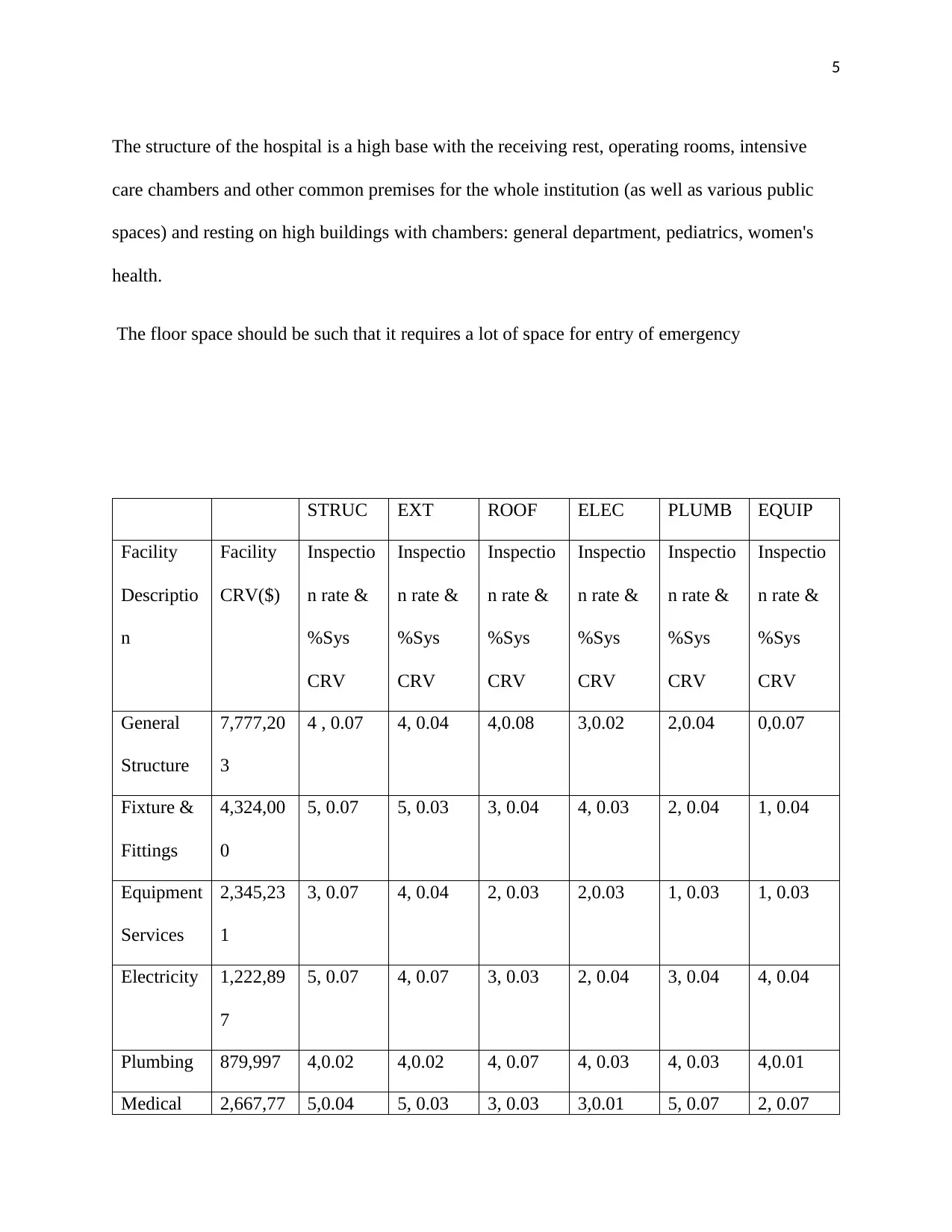
The floor space should be such that it requires a lot of space for entry of emergency
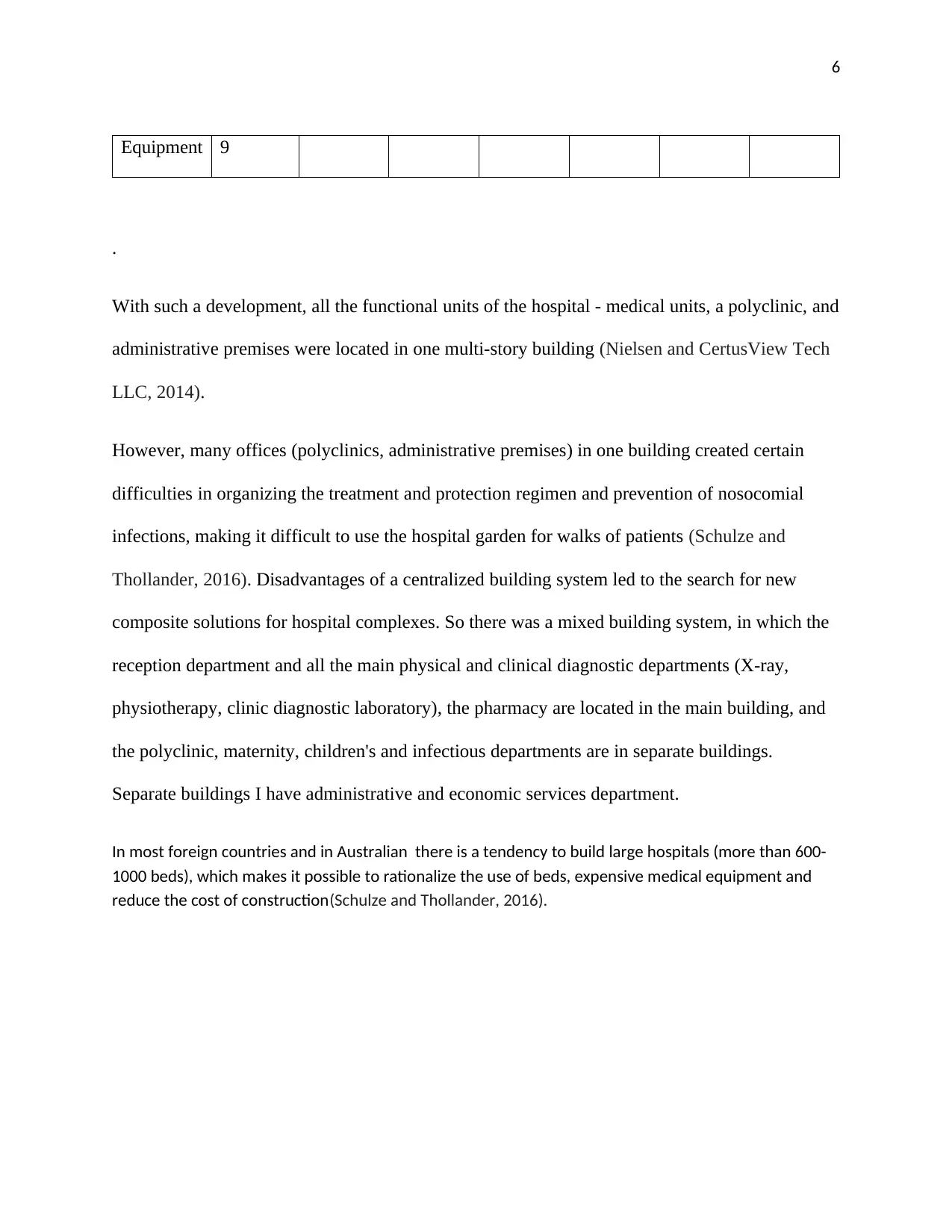
STRUC EXT ROOF ELEC PLUMB EQUIP
Facility
Descriptio
n
Facility
CRV($)
Inspectio
n rate &
%Sys
CRV
Inspectio
n rate &
%Sys
CRV
Inspectio
n rate &
%Sys
CRV
Inspectio
n rate &
%Sys
CRV
Inspectio
n rate &
%Sys
CRV
Inspectio
n rate &
%Sys
CRV
General
Structure
7,777,20
3
4 , 0.07 4, 0.04 4,0.08 3,0.02 2,0.04 0,0.07
Fixture &
Fittings
4,324,00
0
5, 0.07 5, 0.03 3, 0.04 4, 0.03 2, 0.04 1, 0.04
Equipment
Services
2,345,23
1
3, 0.07 4, 0.04 2, 0.03 2,0.03 1, 0.03 1, 0.03
Electricity 1,222,89
7
5, 0.07 4, 0.07 3, 0.03 2, 0.04 3, 0.04 4, 0.04
Plumbing 879,997 4,0.02 4,0.02 4, 0.07 4, 0.03 4, 0.03 4,0.01
Medical 2,667,77 5,0.04 5, 0.03 3, 0.03 3,0.01 5, 0.07 2, 0.07
Document Page
6
Equipment 9
.
With such a development, all the functional units of the hospital - medical units, a polyclinic, and
administrative premises were located in one multi-story building (Nielsen and CertusView Tech
LLC, 2014).
However, many offices (polyclinics, administrative premises) in one building created certain
difficulties in organizing the treatment and protection regimen and prevention of nosocomial
infections, making it difficult to use the hospital garden for walks of patients (Schulze and
Thollander, 2016). Disadvantages of a centralized building system led to the search for new
composite solutions for hospital complexes. So there was a mixed building system, in which the
reception department and all the main physical and clinical diagnostic departments (X-ray,
physiotherapy, clinic diagnostic laboratory), the pharmacy are located in the main building, and
the polyclinic, maternity, children's and infectious departments are in separate buildings.
Separate buildings I have administrative and economic services department.
In most foreign countries and in Australian there is a tendency to build large hospitals (more than 600-
1000 beds), which makes it possible to rationalize the use of beds, expensive medical equipment and
reduce the cost of construction(Schulze and Thollander, 2016).
Document Page
7
Bibliography
Chotipanich, S. and Issarasak, S., 2017. A study of facility management operation strategy in
shopping malls: Insights from 4 top-class shopping malls in Bangkok. Property
Management, 35(3), pp.236-253.
Grichnik, A.J., Kersh, T.B., Beckwith, L. and Bruns, T.E., Caterpillar Inc, 2014. Facility Design
and Management Systems Using Topology Mapping. U.S. Patent Application 13/827,157.
Kim, K., Kim, H., Kim, W., Kim, C., Kim, J. and Yu, J., 2018. Integration of ifc objects and
facility management work information using Semantic Web. Automation in Construction, 87,
pp.173-187.
Nielsen, S., Chambers, C. and Farr, J., CertusView Tech LLC, 2014. Management system, and
associated methods and apparatus, for dispatching tickets, receiving field information, and
performing a quality assessment for underground facility locate and/or marking operations. U.S.
Patent 8,626,571.
Schulze, M., Nehler, H., Ottosson, M. and Thollander, P., 2016. Energy management in
industry–a systematic review of previous findings and an integrative conceptual
framework. Journal of Cleaner Production, 112, pp.3692-3708.
chevron_up_icon
1 out of 7
circle_padding
hide_on_mobile
zoom_out_icon
[object Object]