Mobile Application Impact on Social Life in Tourism Sector
VerifiedAdded on 2021/01/02
|9
|2607
|250
Project
AI Summary
This project delves into the current trends and the pivotal role of mobile applications within the travel and tourism sector. It begins with an introduction outlining the research's aim, objectives, and research questions, emphasizing the industry's importance. The literature review explores the benefits of the tourism sector, the rise of online booking, and the importance of mobile applications for businesses and customers. It examines current trends such as low-budget travel options, visa on arrival, and the increasing use of mobile apps for planning and booking. The project highlights the advantages of mobile applications, including automation, collaboration, and enhanced security. Additionally, it investigates the impact of mobile apps on social life, emphasizing their role in simplifying travel, facilitating communication, and providing access to information. The methodology section details the inductive research approach, interpretivism philosophy, and exploratory research design, with a focus on probability sampling and a qualitative data collection method using an open-ended questionnaire survey. The project concludes with data analysis using a framework analysis approach, specifically thematic analysis, to interpret the collected qualitative data.

PROPOSAL

Paraphrase This Document
Need a fresh take? Get an instant paraphrase of this document with our AI Paraphraser
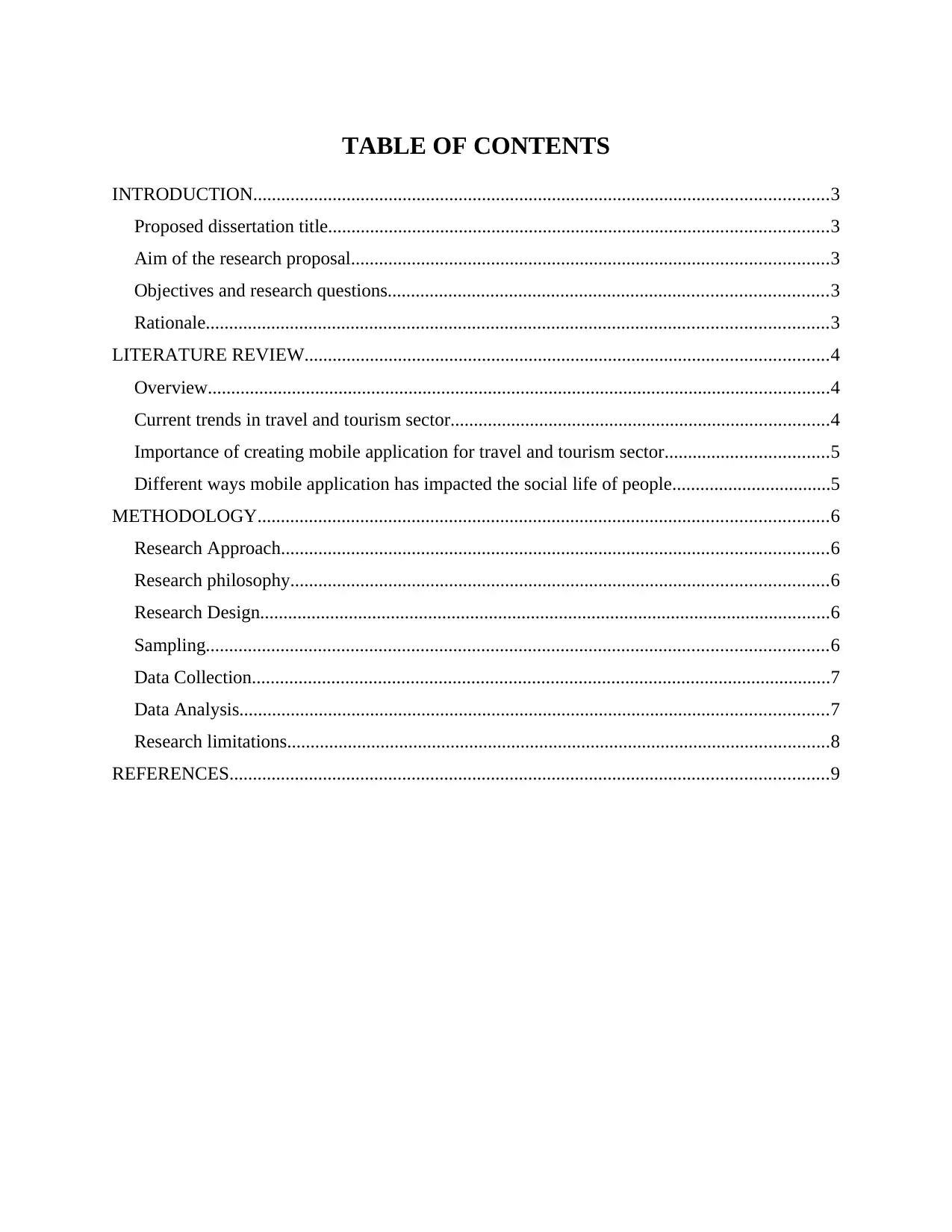
TABLE OF CONTENTS
INTRODUCTION...........................................................................................................................3
Proposed dissertation title...........................................................................................................3
Aim of the research proposal......................................................................................................3
Objectives and research questions..............................................................................................3
Rationale.....................................................................................................................................3
LITERATURE REVIEW................................................................................................................4
Overview.....................................................................................................................................4
Current trends in travel and tourism sector.................................................................................4
Importance of creating mobile application for travel and tourism sector...................................5
Different ways mobile application has impacted the social life of people..................................5
METHODOLOGY..........................................................................................................................6
Research Approach.....................................................................................................................6
Research philosophy...................................................................................................................6
Research Design..........................................................................................................................6
Sampling.....................................................................................................................................6
Data Collection............................................................................................................................7
Data Analysis..............................................................................................................................7
Research limitations....................................................................................................................8
REFERENCES................................................................................................................................9
INTRODUCTION...........................................................................................................................3
Proposed dissertation title...........................................................................................................3
Aim of the research proposal......................................................................................................3
Objectives and research questions..............................................................................................3
Rationale.....................................................................................................................................3
LITERATURE REVIEW................................................................................................................4
Overview.....................................................................................................................................4
Current trends in travel and tourism sector.................................................................................4
Importance of creating mobile application for travel and tourism sector...................................5
Different ways mobile application has impacted the social life of people..................................5
METHODOLOGY..........................................................................................................................6
Research Approach.....................................................................................................................6
Research philosophy...................................................................................................................6
Research Design..........................................................................................................................6
Sampling.....................................................................................................................................6
Data Collection............................................................................................................................7
Data Analysis..............................................................................................................................7
Research limitations....................................................................................................................8
REFERENCES................................................................................................................................9
INTRODUCTION
Proposed dissertation title
Current trends and mobile applications in travel and tourism sector.
Aim of the research proposal
To recommend current trends and mobile applications in travel and tourism sector.
Objectives and research questions
Objectives of this research proposal are:
To evaluate current trends in travel and tourism sector.
To analyse importance of creating mobile application for travel and tourism sector.
To analyse different ways mobile applications impact the social life of people.
Research Questions
Research questions for this research project are:
What are the current trends in travel and tourism sector?
What is the importance of creating mobile applications for travel and tourism sector?
What are the different ways in which mobile applications impact the social life of people?
Rationale
Rationale can be defined as a proposal within a research proposal which is normally done
or conducted to explain the importance and the reason because of this the research topic has been
chosen for the research. This research proposal will focus on the topic Current trends and mobile
application in travel and tourism sector. Today travel and tourism industry is one of the most
important and beneficial industry for both the customers as well as for the business owners. This
industry plays a most vital role in increasing the growth and demand for other industry such as
hotels etc. This industry is one of the most developing and growing industry with more economic
activities which has also helped in generating employment, revenue as well as has also helped in
growth of the nations. Today growing demand for travel and tourism has increased the demand
for mobile applications. Development of mobile applications in this industry has boosted the
business of travelling agencies and companies as well as it has also helped the customers to
easily plan and book their trip with the help of these applications.
Proposed dissertation title
Current trends and mobile applications in travel and tourism sector.
Aim of the research proposal
To recommend current trends and mobile applications in travel and tourism sector.
Objectives and research questions
Objectives of this research proposal are:
To evaluate current trends in travel and tourism sector.
To analyse importance of creating mobile application for travel and tourism sector.
To analyse different ways mobile applications impact the social life of people.
Research Questions
Research questions for this research project are:
What are the current trends in travel and tourism sector?
What is the importance of creating mobile applications for travel and tourism sector?
What are the different ways in which mobile applications impact the social life of people?
Rationale
Rationale can be defined as a proposal within a research proposal which is normally done
or conducted to explain the importance and the reason because of this the research topic has been
chosen for the research. This research proposal will focus on the topic Current trends and mobile
application in travel and tourism sector. Today travel and tourism industry is one of the most
important and beneficial industry for both the customers as well as for the business owners. This
industry plays a most vital role in increasing the growth and demand for other industry such as
hotels etc. This industry is one of the most developing and growing industry with more economic
activities which has also helped in generating employment, revenue as well as has also helped in
growth of the nations. Today growing demand for travel and tourism has increased the demand
for mobile applications. Development of mobile applications in this industry has boosted the
business of travelling agencies and companies as well as it has also helped the customers to
easily plan and book their trip with the help of these applications.
⊘ This is a preview!⊘
Do you want full access?
Subscribe today to unlock all pages.

Trusted by 1+ million students worldwide
LITERATURE REVIEW
Overview
According to Liang and et.al., (2017), Travel and tourism industry has brought various
kinds of benefits to many industries, their customers as well as to the host industry. This industry
is one of the major factor for development and growth of a country by bringing various economic
benefits and values to the country, by helping the country to build its brand value. This industry
is beyond attractive destinations as it is an economic contributor to the country. This industry has
also helped in developing relationship between different nations as well as within their people.
Today this industry has gained recognition globally therefore people and companies are investing
more and more in this industry for the growth of this sector, their business and for the nation. As
it is an important growth driver many organizations are investing in creation of mobile
applications in this industry. This industry has a wide or huge number of customer base with
both national and international customers. This increases the customer segmentation for all the
travel and tourism application owners. Most of the customers today prefer to use mobile
application for booking their trips as it is more easy, convenient to use and book as well as plan
their trips both nationally and internationally.
Current trends in travel and tourism sector
According to Henderson., (2017), More than 60% of travelling trips are planned and
booked online either through websites or mobile applications. The trend in this industry is
continuously changing according to the customers demands, needs and requirements. Some latest
and current trends that are prevailing in this industry are: such as nowadays options for low
budget travellers are growing continuously whether it is in terms of hotel, food, travelling source,
location etc. Connectivity has improved till an extent that even foreign trips can be planned
within the budget. Today visa on arrival in many country is also helping this industry to boost or
grow rapidly. This has reduced the barriers for many travelling companies to plan trips for their
customers. Demand for exploration of new destinations is continuously increasing within the
customers. It can be defined as the latest trend within the customers to travel and visit new
countries or different destinations both internationally and nationally. Use of mobile applications
for booking, planning, gathering information about the travel destination and host country is also
in trend nowadays.
Overview
According to Liang and et.al., (2017), Travel and tourism industry has brought various
kinds of benefits to many industries, their customers as well as to the host industry. This industry
is one of the major factor for development and growth of a country by bringing various economic
benefits and values to the country, by helping the country to build its brand value. This industry
is beyond attractive destinations as it is an economic contributor to the country. This industry has
also helped in developing relationship between different nations as well as within their people.
Today this industry has gained recognition globally therefore people and companies are investing
more and more in this industry for the growth of this sector, their business and for the nation. As
it is an important growth driver many organizations are investing in creation of mobile
applications in this industry. This industry has a wide or huge number of customer base with
both national and international customers. This increases the customer segmentation for all the
travel and tourism application owners. Most of the customers today prefer to use mobile
application for booking their trips as it is more easy, convenient to use and book as well as plan
their trips both nationally and internationally.
Current trends in travel and tourism sector
According to Henderson., (2017), More than 60% of travelling trips are planned and
booked online either through websites or mobile applications. The trend in this industry is
continuously changing according to the customers demands, needs and requirements. Some latest
and current trends that are prevailing in this industry are: such as nowadays options for low
budget travellers are growing continuously whether it is in terms of hotel, food, travelling source,
location etc. Connectivity has improved till an extent that even foreign trips can be planned
within the budget. Today visa on arrival in many country is also helping this industry to boost or
grow rapidly. This has reduced the barriers for many travelling companies to plan trips for their
customers. Demand for exploration of new destinations is continuously increasing within the
customers. It can be defined as the latest trend within the customers to travel and visit new
countries or different destinations both internationally and nationally. Use of mobile applications
for booking, planning, gathering information about the travel destination and host country is also
in trend nowadays.
Paraphrase This Document
Need a fresh take? Get an instant paraphrase of this document with our AI Paraphraser
Importance of creating mobile application for travel and tourism sector
As per the view of Chuang and et.al., (2017), With the advancement in technology use of
mobile application in mobile industry has almost become necessary for any business in order to
become active on social media, gain knowledge about current trends, customers demands.
Tourism industry is no other exception, it can also help the company to create an easy platform
for people to use and interact with the company so that they can easily trust and plan their trips to
anywhere around the world.
In addition to Bowen and Whalen., (2017), today all the activities or businesses are at
fingers of mobile users. Mobile users can gather information about anything in real time with
fraction of seconds. They can even book hotels, flights, hotel rooms etc. on their mobiles. If both
tour operators and customers benefits are seen then mobile application for tourism industry has
made both booking and business easy in various ways, such as: Automation in booking has
helped in saving both time and money for both companies and customers. It has also helped in
collaboration with almost every leading service providers within transportation, hotels etc.
Mobile applications has increased safety and security at both client and business side as chances
of fraud or fake booking has decreased, customers information can be kept safe. It has changed
the living style of people as more than 85% of people plan their trip through mobile applications.
According to a survey travel and tourism industry mobile applications has been ranked number
seven in the download category of mobile apps.
Different ways mobile application has impacted the social life of people
According to Yang and et.al., (2015), Today mobile applications has made an individuals'
life much easier as every thing is available at the finger tips of people through mobile
applications. Travelling ,booking, shopping, gathering information has become much easier.
With the help of social networking applications getting in touch with someone has become easier
and has reduced distance within people. It has also helped people to gather information about any
company or applications as reviews about any company or applications are already available on
applications. It has also helped in reduction of cost, time consumed as everything can be
searched or booked sitting at one place by comparing with applications. It has also helped in
preparing or presenting anything as all the information are just a click away. In other words it has
made an individuals' life much easier.
As per the view of Chuang and et.al., (2017), With the advancement in technology use of
mobile application in mobile industry has almost become necessary for any business in order to
become active on social media, gain knowledge about current trends, customers demands.
Tourism industry is no other exception, it can also help the company to create an easy platform
for people to use and interact with the company so that they can easily trust and plan their trips to
anywhere around the world.
In addition to Bowen and Whalen., (2017), today all the activities or businesses are at
fingers of mobile users. Mobile users can gather information about anything in real time with
fraction of seconds. They can even book hotels, flights, hotel rooms etc. on their mobiles. If both
tour operators and customers benefits are seen then mobile application for tourism industry has
made both booking and business easy in various ways, such as: Automation in booking has
helped in saving both time and money for both companies and customers. It has also helped in
collaboration with almost every leading service providers within transportation, hotels etc.
Mobile applications has increased safety and security at both client and business side as chances
of fraud or fake booking has decreased, customers information can be kept safe. It has changed
the living style of people as more than 85% of people plan their trip through mobile applications.
According to a survey travel and tourism industry mobile applications has been ranked number
seven in the download category of mobile apps.
Different ways mobile application has impacted the social life of people
According to Yang and et.al., (2015), Today mobile applications has made an individuals'
life much easier as every thing is available at the finger tips of people through mobile
applications. Travelling ,booking, shopping, gathering information has become much easier.
With the help of social networking applications getting in touch with someone has become easier
and has reduced distance within people. It has also helped people to gather information about any
company or applications as reviews about any company or applications are already available on
applications. It has also helped in reduction of cost, time consumed as everything can be
searched or booked sitting at one place by comparing with applications. It has also helped in
preparing or presenting anything as all the information are just a click away. In other words it has
made an individuals' life much easier.
METHODOLOGY
Research Approach
Research approach is defined as a plan or a procedure that consist of many broad steps of
assumption of detailed data collection methods, interpretation and analysis. This plan involves
several decisions that are needed to be taken in order to make decisions regarding the approach
that is used in the research. Research approach is divided into three types which are: Abduction,
inductive and deductive research approach (Gabriel., 2015). For this research, induction research
approach will be used. Inductive research approach normally starts from research aim, objective
and questions that are needed to be achieved during the research process. In this researcher users
observations in order to build a pattern or a picture to build a theory.
Research philosophy
Research philosophy is a wide area to be discussed but in simple words it can be defined
as a brief in which data about the research should be gathered, used and analysed. There are four
main types of philosophies that are normally used that are: pragmatism, positivism, realism,
interpretivism. For this research interpretivism research philosophy is used. It is normally used to
interpret all the elements of the research. As this is a qualitative research and interpretivism
research philosophy is only used in qualitative research which has small sample of data in which
in depth investigation is done wither through interview, survey, questionnaire etc.
Research Design
Research design is defined by various authors in different ways. Some says it is a
consideration or choice between qualitative and quantitative research methods (Pruzan., 2016).
Others says it is a choice between different methods of data analysis and collection. Research
design can be divided into two main types which are: exploratory and conclusive. Foe this
research exploratory research design will be used. It mainly aims to explore all the aspects of
research area. Its main purpose is to develop an insight of about the research situation. Data
collection form is open ended which consist of small sample data.
Sampling
Sampling is an area in which specific members of populations are selected to be included
in the study. It makes it easy for the researcher to work with the defined population in order to
get an accurate answer for the research questions due to which research size and type becomes
manageable and saves the overall cost of the data. It also helps in accelerating the speed of
Research Approach
Research approach is defined as a plan or a procedure that consist of many broad steps of
assumption of detailed data collection methods, interpretation and analysis. This plan involves
several decisions that are needed to be taken in order to make decisions regarding the approach
that is used in the research. Research approach is divided into three types which are: Abduction,
inductive and deductive research approach (Gabriel., 2015). For this research, induction research
approach will be used. Inductive research approach normally starts from research aim, objective
and questions that are needed to be achieved during the research process. In this researcher users
observations in order to build a pattern or a picture to build a theory.
Research philosophy
Research philosophy is a wide area to be discussed but in simple words it can be defined
as a brief in which data about the research should be gathered, used and analysed. There are four
main types of philosophies that are normally used that are: pragmatism, positivism, realism,
interpretivism. For this research interpretivism research philosophy is used. It is normally used to
interpret all the elements of the research. As this is a qualitative research and interpretivism
research philosophy is only used in qualitative research which has small sample of data in which
in depth investigation is done wither through interview, survey, questionnaire etc.
Research Design
Research design is defined by various authors in different ways. Some says it is a
consideration or choice between qualitative and quantitative research methods (Pruzan., 2016).
Others says it is a choice between different methods of data analysis and collection. Research
design can be divided into two main types which are: exploratory and conclusive. Foe this
research exploratory research design will be used. It mainly aims to explore all the aspects of
research area. Its main purpose is to develop an insight of about the research situation. Data
collection form is open ended which consist of small sample data.
Sampling
Sampling is an area in which specific members of populations are selected to be included
in the study. It makes it easy for the researcher to work with the defined population in order to
get an accurate answer for the research questions due to which research size and type becomes
manageable and saves the overall cost of the data. It also helps in accelerating the speed of
⊘ This is a preview!⊘
Do you want full access?
Subscribe today to unlock all pages.
Trusted by 1+ million students worldwide
primary data collection. Sampling is of two types i.e. probability and non-probability sampling
which are further divided into two. For this research probability sampling will be used.
Probability sampling is further of four types which are: simple random sampling, systematic
random sampling, stratified random sampling and cluster sampling. For this research simple
random sampling will be used (Creswell and Poth., 2017).
Data Collection
Data collection is a simple process of collecting information to answer research problem
by finding data from all the relevant sources. It can be divided into two main types which are:
Primary data collection method and secondary data collection method. Secondary data is
collected from already published newspapers, books, magazines online portals etc. Primary data
collection method is further divided into two types which are qualitative and quantitative data
collection method. Quantitative data collection method is completely based upon mathematical
calculations, while qualitative data collection method does not involve numbers or mathematical
calculations. For this research primary qualitative data collection method will be chosen. There
are various kinds of qualitative data collection methods which are: document analysis,
interviews, observations, exit interviews and survey. For this research a survey will be conducted
which will be conducted with the help of a questionnaire. There are various types of
questionnaires such as computer questionnaire, telephone questionnaire, in house survey, mail
questionnaire, open or multiple questions etc. For this an open questions questionnaire survey
will b e be conducted online. It is normally done when information is needed to be gathered in a
short duration of time and need to generate large amount of data.
Data Analysis
Data analysis can be defined as a simple process of transforming, cleaning, analysing,
modelling large amount of useful information collected for the research. It is mostly done with
primary data but in absence of primary data collected, common pattern can be discussed with
secondary data related to research area (Creswell and Creswell., 2017). Data analysis is further
of two types which are; qualitative data analysis and quantitative data analysis. For this research
qualitative data analysis will be done. It is normally done for non-numeric information and is
further of few types which are: Content analysis, narrative analysis, discourse analysis,
framework analysis and grounded theory. For this research framework analysis will be used an in
that thematic analysis will be done (Ary and et.al., 2018).
which are further divided into two. For this research probability sampling will be used.
Probability sampling is further of four types which are: simple random sampling, systematic
random sampling, stratified random sampling and cluster sampling. For this research simple
random sampling will be used (Creswell and Poth., 2017).
Data Collection
Data collection is a simple process of collecting information to answer research problem
by finding data from all the relevant sources. It can be divided into two main types which are:
Primary data collection method and secondary data collection method. Secondary data is
collected from already published newspapers, books, magazines online portals etc. Primary data
collection method is further divided into two types which are qualitative and quantitative data
collection method. Quantitative data collection method is completely based upon mathematical
calculations, while qualitative data collection method does not involve numbers or mathematical
calculations. For this research primary qualitative data collection method will be chosen. There
are various kinds of qualitative data collection methods which are: document analysis,
interviews, observations, exit interviews and survey. For this research a survey will be conducted
which will be conducted with the help of a questionnaire. There are various types of
questionnaires such as computer questionnaire, telephone questionnaire, in house survey, mail
questionnaire, open or multiple questions etc. For this an open questions questionnaire survey
will b e be conducted online. It is normally done when information is needed to be gathered in a
short duration of time and need to generate large amount of data.
Data Analysis
Data analysis can be defined as a simple process of transforming, cleaning, analysing,
modelling large amount of useful information collected for the research. It is mostly done with
primary data but in absence of primary data collected, common pattern can be discussed with
secondary data related to research area (Creswell and Creswell., 2017). Data analysis is further
of two types which are; qualitative data analysis and quantitative data analysis. For this research
qualitative data analysis will be done. It is normally done for non-numeric information and is
further of few types which are: Content analysis, narrative analysis, discourse analysis,
framework analysis and grounded theory. For this research framework analysis will be used an in
that thematic analysis will be done (Ary and et.al., 2018).
Paraphrase This Document
Need a fresh take? Get an instant paraphrase of this document with our AI Paraphraser
Research limitations
There are following research limitation that might be faced by the researcher or is faced
by the researchers such as: First research limitation was formation of research aim and objectives
as their should be defined in such a way that it completely focuses on the research study area.
Another limitation was sampling size for the research problem. If too small size was taken then
results would not be that accurate and if too large is taken then analysis would become a bit
difficult. Lack of study in the research was also a limitation as lots of detailed study was needed
to be done due to less knowledge in that area.
There are following research limitation that might be faced by the researcher or is faced
by the researchers such as: First research limitation was formation of research aim and objectives
as their should be defined in such a way that it completely focuses on the research study area.
Another limitation was sampling size for the research problem. If too small size was taken then
results would not be that accurate and if too large is taken then analysis would become a bit
difficult. Lack of study in the research was also a limitation as lots of detailed study was needed
to be done due to less knowledge in that area.
REFERENCES
Books and Journals
Ary, D., and et.al., 2018. Introduction to research in education. Cengage Learning.
Bowen, J. and Whalen, E., 2017. Trends that are changing travel and tourism. Worldwide
Hospitality and Tourism Themes. 9(6). pp.592-602.
Chuang, T.C., and et.al., 2017. The main paths of eTourism: trends of managing tourism through
Internet. Asia Pacific Journal of Tourism Research. 22(2). pp.213-231.
Creswell, J.W. and Creswell, J.D., 2017. Research design: Qualitative, quantitative, and mixed
methods approaches. Sage publications.
Creswell, J.W. and Poth, C.N., 2017. Qualitative inquiry and research design: Choosing among
five approaches. Sage publications.
Gabriel, Y., 2015. Reflexivity and beyond–a plea for imagination in qualitative research
methodology. Qualitative Research in Organizations and Management: An
International Journal. 10(4). pp.332-336.
Henderson, J.C., 2017. Destination development: Trends in Japan's inbound
tourism. International Journal of Tourism Research. 19(1). pp.89-98.
Liang, S., and et.al., 2017. The relevance of mobile tourism and information technology: an
analysis of recent trends and future research directions. Journal of Travel & Tourism
Marketing. 34(6). pp.732-748.
Pruzan, P., 2016. Research methodology: the aims, practices and ethics of science. Springer.
Yang, X., and et.al., 2015. Forecasting Chinese tourist volume with search engine data. Tourism
Management. 46. pp.386-397.
Books and Journals
Ary, D., and et.al., 2018. Introduction to research in education. Cengage Learning.
Bowen, J. and Whalen, E., 2017. Trends that are changing travel and tourism. Worldwide
Hospitality and Tourism Themes. 9(6). pp.592-602.
Chuang, T.C., and et.al., 2017. The main paths of eTourism: trends of managing tourism through
Internet. Asia Pacific Journal of Tourism Research. 22(2). pp.213-231.
Creswell, J.W. and Creswell, J.D., 2017. Research design: Qualitative, quantitative, and mixed
methods approaches. Sage publications.
Creswell, J.W. and Poth, C.N., 2017. Qualitative inquiry and research design: Choosing among
five approaches. Sage publications.
Gabriel, Y., 2015. Reflexivity and beyond–a plea for imagination in qualitative research
methodology. Qualitative Research in Organizations and Management: An
International Journal. 10(4). pp.332-336.
Henderson, J.C., 2017. Destination development: Trends in Japan's inbound
tourism. International Journal of Tourism Research. 19(1). pp.89-98.
Liang, S., and et.al., 2017. The relevance of mobile tourism and information technology: an
analysis of recent trends and future research directions. Journal of Travel & Tourism
Marketing. 34(6). pp.732-748.
Pruzan, P., 2016. Research methodology: the aims, practices and ethics of science. Springer.
Yang, X., and et.al., 2015. Forecasting Chinese tourist volume with search engine data. Tourism
Management. 46. pp.386-397.
⊘ This is a preview!⊘
Do you want full access?
Subscribe today to unlock all pages.
Trusted by 1+ million students worldwide

1 out of 9


Related Documents


Your All-in-One AI-Powered Toolkit for Academic Success.
+13062052269
info@desklib.com
Available 24*7 on WhatsApp / Email
![[object Object]](/_next/static/media/star-bottom.7253800d.svg)
Unlock your academic potential
Copyright © 2020–2026 A2Z Services. All Rights Reserved. Developed and managed by ZUCOL.