DET Course: Inspirational Teaching and Learning: Models and Theories
VerifiedAdded on 2022/12/26
|11
|3499
|25
Report
AI Summary
This report provides a comprehensive overview of models, principles, and theories essential for achieving inspirational teaching and learning, particularly within the context of the DET course. The report delves into various learning theories, including behaviorism and cognitive theories, and explores their practical applications in assessment, curriculum development, and inclusive learning environments. It examines models such as those by Kolb and Honey, as well as curriculum development models like those by Stenhouse and Tyler. Additionally, the report analyzes reflective practices using models like John's and Gibbs' models, and discusses the importance of communication models such as Aristotle’s and Lasswell’s, for effective teaching. The analysis of assessment practices and the competency model are also covered, making this a valuable resource for educators seeking to enhance their teaching methodologies and student outcomes.
Models, principles and
theories to achieve
inspirational teaching
and learning
theories to achieve
inspirational teaching
and learning

Paraphrase This Document
Need a fresh take? Get an instant paraphrase of this document with our AI Paraphraser
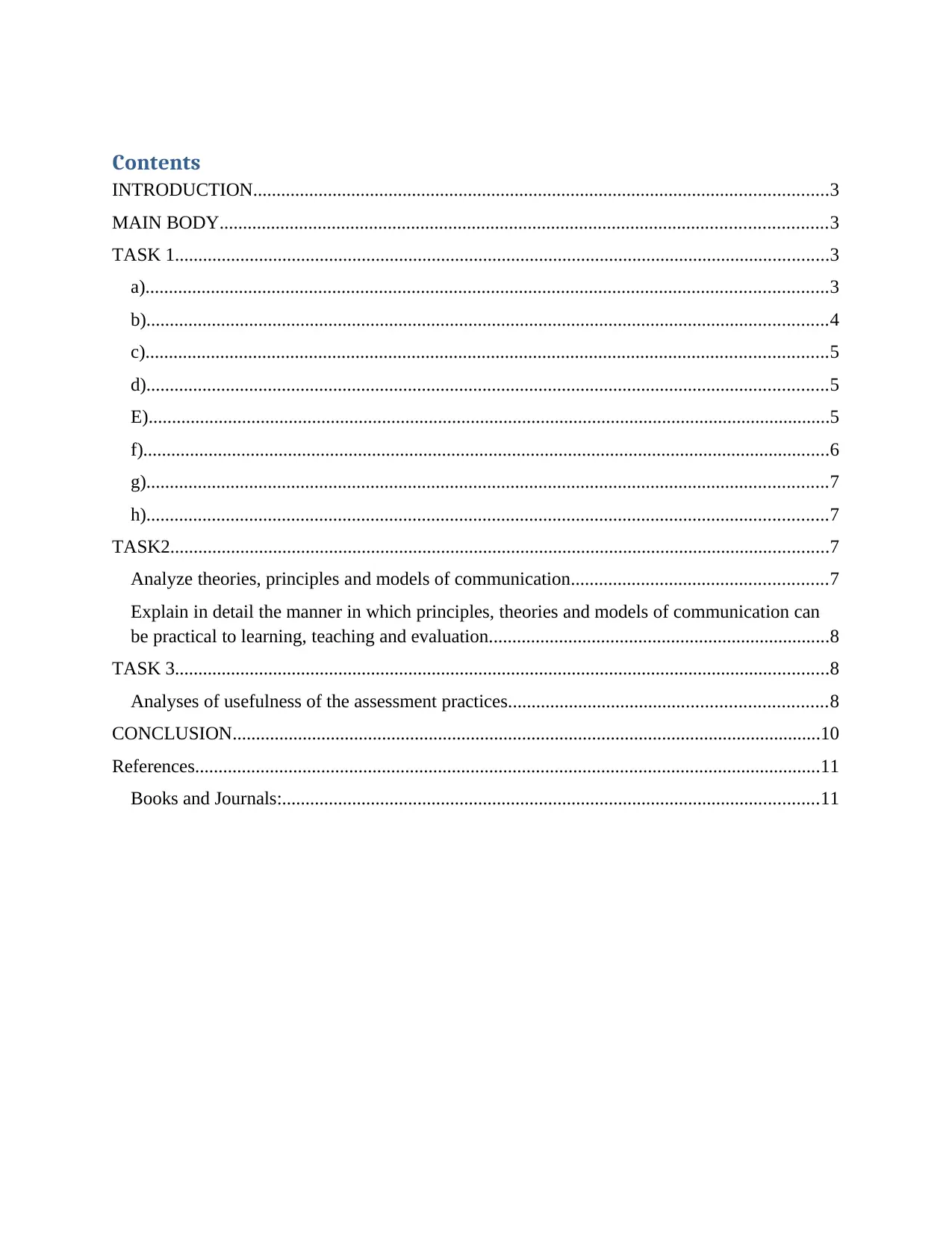
Contents
INTRODUCTION...........................................................................................................................3
MAIN BODY..................................................................................................................................3
TASK 1............................................................................................................................................3
a)..................................................................................................................................................3
b)..................................................................................................................................................4
c)..................................................................................................................................................5
d)..................................................................................................................................................5
E)..................................................................................................................................................5
f)...................................................................................................................................................6
g)..................................................................................................................................................7
h)..................................................................................................................................................7
TASK2.............................................................................................................................................7
Analyze theories, principles and models of communication.......................................................7
Explain in detail the manner in which principles, theories and models of communication can
be practical to learning, teaching and evaluation.........................................................................8
TASK 3............................................................................................................................................8
Analyses of usefulness of the assessment practices....................................................................8
CONCLUSION..............................................................................................................................10
References......................................................................................................................................11
Books and Journals:...................................................................................................................11
INTRODUCTION...........................................................................................................................3
MAIN BODY..................................................................................................................................3
TASK 1............................................................................................................................................3
a)..................................................................................................................................................3
b)..................................................................................................................................................4
c)..................................................................................................................................................5
d)..................................................................................................................................................5
E)..................................................................................................................................................5
f)...................................................................................................................................................6
g)..................................................................................................................................................7
h)..................................................................................................................................................7
TASK2.............................................................................................................................................7
Analyze theories, principles and models of communication.......................................................7
Explain in detail the manner in which principles, theories and models of communication can
be practical to learning, teaching and evaluation.........................................................................8
TASK 3............................................................................................................................................8
Analyses of usefulness of the assessment practices....................................................................8
CONCLUSION..............................................................................................................................10
References......................................................................................................................................11
Books and Journals:...................................................................................................................11
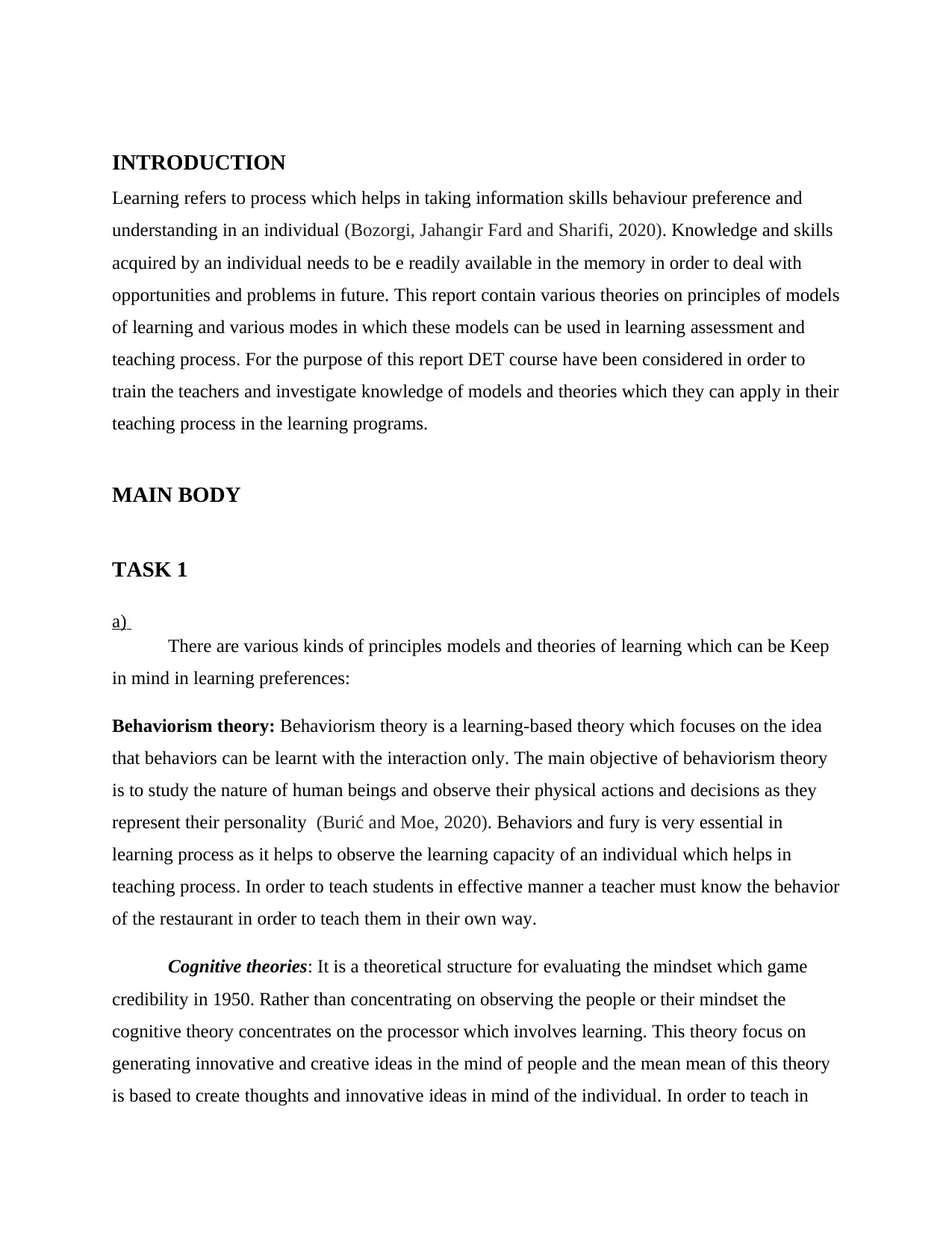
INTRODUCTION
Learning refers to process which helps in taking information skills behaviour preference and
understanding in an individual (Bozorgi, Jahangir Fard and Sharifi, 2020). Knowledge and skills
acquired by an individual needs to be e readily available in the memory in order to deal with
opportunities and problems in future. This report contain various theories on principles of models
of learning and various modes in which these models can be used in learning assessment and
teaching process. For the purpose of this report DET course have been considered in order to
train the teachers and investigate knowledge of models and theories which they can apply in their
teaching process in the learning programs.
MAIN BODY
TASK 1
a)
There are various kinds of principles models and theories of learning which can be Keep
in mind in learning preferences:
Behaviorism theory: Behaviorism theory is a learning-based theory which focuses on the idea
that behaviors can be learnt with the interaction only. The main objective of behaviorism theory
is to study the nature of human beings and observe their physical actions and decisions as they
represent their personality (Burić and Moe, 2020). Behaviors and fury is very essential in
learning process as it helps to observe the learning capacity of an individual which helps in
teaching process. In order to teach students in effective manner a teacher must know the behavior
of the restaurant in order to teach them in their own way.
Cognitive theories: It is a theoretical structure for evaluating the mindset which game
credibility in 1950. Rather than concentrating on observing the people or their mindset the
cognitive theory concentrates on the processor which involves learning. This theory focus on
generating innovative and creative ideas in the mind of people and the mean mean of this theory
is based to create thoughts and innovative ideas in mind of the individual. In order to teach in
Learning refers to process which helps in taking information skills behaviour preference and
understanding in an individual (Bozorgi, Jahangir Fard and Sharifi, 2020). Knowledge and skills
acquired by an individual needs to be e readily available in the memory in order to deal with
opportunities and problems in future. This report contain various theories on principles of models
of learning and various modes in which these models can be used in learning assessment and
teaching process. For the purpose of this report DET course have been considered in order to
train the teachers and investigate knowledge of models and theories which they can apply in their
teaching process in the learning programs.
MAIN BODY
TASK 1
a)
There are various kinds of principles models and theories of learning which can be Keep
in mind in learning preferences:
Behaviorism theory: Behaviorism theory is a learning-based theory which focuses on the idea
that behaviors can be learnt with the interaction only. The main objective of behaviorism theory
is to study the nature of human beings and observe their physical actions and decisions as they
represent their personality (Burić and Moe, 2020). Behaviors and fury is very essential in
learning process as it helps to observe the learning capacity of an individual which helps in
teaching process. In order to teach students in effective manner a teacher must know the behavior
of the restaurant in order to teach them in their own way.
Cognitive theories: It is a theoretical structure for evaluating the mindset which game
credibility in 1950. Rather than concentrating on observing the people or their mindset the
cognitive theory concentrates on the processor which involves learning. This theory focus on
generating innovative and creative ideas in the mind of people and the mean mean of this theory
is based to create thoughts and innovative ideas in mind of the individual. In order to teach in
⊘ This is a preview!⊘
Do you want full access?
Subscribe today to unlock all pages.

Trusted by 1+ million students worldwide
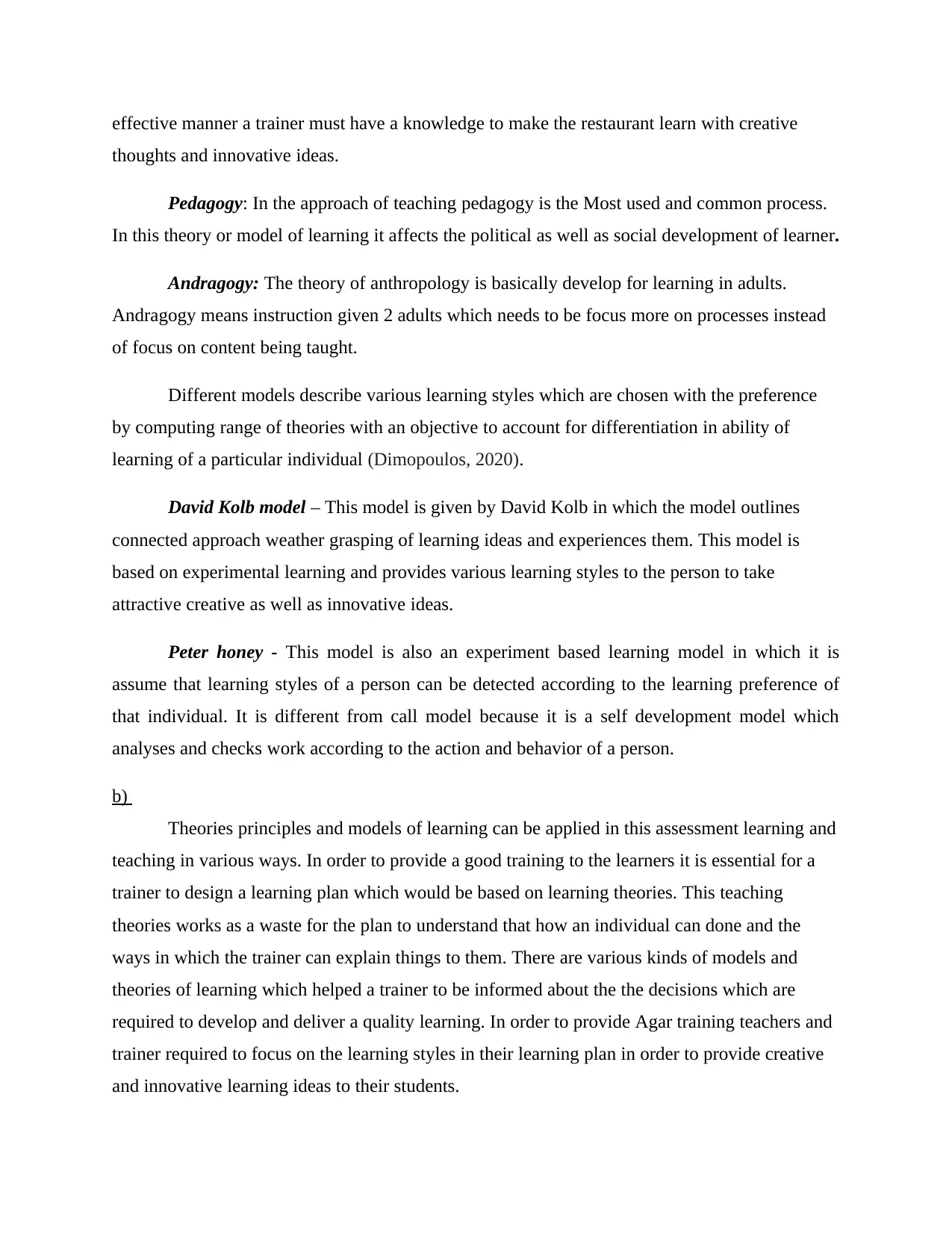
effective manner a trainer must have a knowledge to make the restaurant learn with creative
thoughts and innovative ideas.
Pedagogy: In the approach of teaching pedagogy is the Most used and common process.
In this theory or model of learning it affects the political as well as social development of learner.
Andragogy: The theory of anthropology is basically develop for learning in adults.
Andragogy means instruction given 2 adults which needs to be focus more on processes instead
of focus on content being taught.
Different models describe various learning styles which are chosen with the preference
by computing range of theories with an objective to account for differentiation in ability of
learning of a particular individual (Dimopoulos, 2020).
David Kolb model – This model is given by David Kolb in which the model outlines
connected approach weather grasping of learning ideas and experiences them. This model is
based on experimental learning and provides various learning styles to the person to take
attractive creative as well as innovative ideas.
Peter honey - This model is also an experiment based learning model in which it is
assume that learning styles of a person can be detected according to the learning preference of
that individual. It is different from call model because it is a self development model which
analyses and checks work according to the action and behavior of a person.
b)
Theories principles and models of learning can be applied in this assessment learning and
teaching in various ways. In order to provide a good training to the learners it is essential for a
trainer to design a learning plan which would be based on learning theories. This teaching
theories works as a waste for the plan to understand that how an individual can done and the
ways in which the trainer can explain things to them. There are various kinds of models and
theories of learning which helped a trainer to be informed about the the decisions which are
required to develop and deliver a quality learning. In order to provide Agar training teachers and
trainer required to focus on the learning styles in their learning plan in order to provide creative
and innovative learning ideas to their students.
thoughts and innovative ideas.
Pedagogy: In the approach of teaching pedagogy is the Most used and common process.
In this theory or model of learning it affects the political as well as social development of learner.
Andragogy: The theory of anthropology is basically develop for learning in adults.
Andragogy means instruction given 2 adults which needs to be focus more on processes instead
of focus on content being taught.
Different models describe various learning styles which are chosen with the preference
by computing range of theories with an objective to account for differentiation in ability of
learning of a particular individual (Dimopoulos, 2020).
David Kolb model – This model is given by David Kolb in which the model outlines
connected approach weather grasping of learning ideas and experiences them. This model is
based on experimental learning and provides various learning styles to the person to take
attractive creative as well as innovative ideas.
Peter honey - This model is also an experiment based learning model in which it is
assume that learning styles of a person can be detected according to the learning preference of
that individual. It is different from call model because it is a self development model which
analyses and checks work according to the action and behavior of a person.
b)
Theories principles and models of learning can be applied in this assessment learning and
teaching in various ways. In order to provide a good training to the learners it is essential for a
trainer to design a learning plan which would be based on learning theories. This teaching
theories works as a waste for the plan to understand that how an individual can done and the
ways in which the trainer can explain things to them. There are various kinds of models and
theories of learning which helped a trainer to be informed about the the decisions which are
required to develop and deliver a quality learning. In order to provide Agar training teachers and
trainer required to focus on the learning styles in their learning plan in order to provide creative
and innovative learning ideas to their students.
Paraphrase This Document
Need a fresh take? Get an instant paraphrase of this document with our AI Paraphraser
c)
Inclusive learning and teaching process means the process of learning in which each and
every learner can actively participate and experience learning in effective manner (Giesenbauer
and Müller-Christ, 2020). This inclusive learning process helps to overcome the barriers which
came under the learning process. Several models and ideas of learning helps the inclusive
learning to to include support of more and more students in the learning process. Identification
and evaluation of the ones of individual motivate them to learn in effective manner and help the
teacher or trainer to know the students in active manner. In case of DET course the trainee are
treated individually by the trainers in order to support and Make them learn the concept of
education.
d)
Curriculum growth is the method to know that theory is prospectus this focus on the
development and framework of a way of study at the teaching level.
Stenhouse: This model is developed by Lawrence Stenhouse for the purpose of Curriculum
development. This model suggests a process which involves three elements connected with the
nature of methodology and knowledge of an individual. In this model the process of evaluation
of learning is different from other models. It is considered and known as educational
investigation and which educator's analysis dynamics instead of evaluation of the results.
Tyler Model: It is the most commonly used model which was developed by Ralph Taylor in
1940. This model is based on curriculum development. The main objective to develop this model
is together and evaluates essential as well as important data to examine the target and objectives
of the curriculum planning to generate a particular pattern of Curriculum design for the purpose
of study.
E)
In respect of the course there are various methods through which models and theories of
curriculum development can be applied in order to develop curriculum of trainee as well as a
student (Guillén-Gámez, Higueras-Rodríguez and Medina-García, 2020). The application of
principles and models is very essential in the curriculum development as it reduces the negative
experience of education system and enables learners to express at some context and they know
Inclusive learning and teaching process means the process of learning in which each and
every learner can actively participate and experience learning in effective manner (Giesenbauer
and Müller-Christ, 2020). This inclusive learning process helps to overcome the barriers which
came under the learning process. Several models and ideas of learning helps the inclusive
learning to to include support of more and more students in the learning process. Identification
and evaluation of the ones of individual motivate them to learn in effective manner and help the
teacher or trainer to know the students in active manner. In case of DET course the trainee are
treated individually by the trainers in order to support and Make them learn the concept of
education.
d)
Curriculum growth is the method to know that theory is prospectus this focus on the
development and framework of a way of study at the teaching level.
Stenhouse: This model is developed by Lawrence Stenhouse for the purpose of Curriculum
development. This model suggests a process which involves three elements connected with the
nature of methodology and knowledge of an individual. In this model the process of evaluation
of learning is different from other models. It is considered and known as educational
investigation and which educator's analysis dynamics instead of evaluation of the results.
Tyler Model: It is the most commonly used model which was developed by Ralph Taylor in
1940. This model is based on curriculum development. The main objective to develop this model
is together and evaluates essential as well as important data to examine the target and objectives
of the curriculum planning to generate a particular pattern of Curriculum design for the purpose
of study.
E)
In respect of the course there are various methods through which models and theories of
curriculum development can be applied in order to develop curriculum of trainee as well as a
student (Guillén-Gámez, Higueras-Rodríguez and Medina-García, 2020). The application of
principles and models is very essential in the curriculum development as it reduces the negative
experience of education system and enables learners to express at some context and they know
that what they are going to learn and its requirement in their future. Various learning theories
offer various interpretations for the purpose of learning and teaching. These theories result and
diverse orientation for planning of curriculum and provide structure to guide and help decision
during the the execution of the curriculum development plan.
f)
Reflective practice is our mood to attract and develop self awareness among individuals which is
related to their performance and behaviour towards the growth and development. There are
various models and theories which assist an individual to analyse reflective practises some of the
models and theories are given below:
John’s model: John’s model is a model which is designed for structured reflection and assists to
analyze and evaluate more complex decisions. According to this theory there are five Method to
achieve behavioral changes which are ethics, reflexivity, in physics, personal and aesthetics.
Kirkpatrick Model: In this model of reflection the results that comes out of learning are
analysed and evaluated to find out defectiveness of training program. It helps in both formal as
well as informal methods of training in order to complete their assignments. There are four
elements by which a person who is learning is rated or can be ranked. First is aptitude test under
which critical thinking skills can be tested and another one is evaluation of behaviour of a
person. According to the learning process the reaction of learning are seen in the results that That
came in the end.
Schon Developed Model: According to this model reflection in action is a situation when
decisions are made with feeling and emotions during sharing of experience (Healy, Block and
Kelly, 2020). This reflection or action is taken after a specific event when there is a chance to get
a new information by a person.
Gibbs Model: This model has been designed and developed by gram gives which focus on
understanding new learning patterns and a good experience of learners. It depends upon
viewpoint thought I am feeling of learner which helps to know about the Experience they have
with the learning process and the manner they can use that in future.
offer various interpretations for the purpose of learning and teaching. These theories result and
diverse orientation for planning of curriculum and provide structure to guide and help decision
during the the execution of the curriculum development plan.
f)
Reflective practice is our mood to attract and develop self awareness among individuals which is
related to their performance and behaviour towards the growth and development. There are
various models and theories which assist an individual to analyse reflective practises some of the
models and theories are given below:
John’s model: John’s model is a model which is designed for structured reflection and assists to
analyze and evaluate more complex decisions. According to this theory there are five Method to
achieve behavioral changes which are ethics, reflexivity, in physics, personal and aesthetics.
Kirkpatrick Model: In this model of reflection the results that comes out of learning are
analysed and evaluated to find out defectiveness of training program. It helps in both formal as
well as informal methods of training in order to complete their assignments. There are four
elements by which a person who is learning is rated or can be ranked. First is aptitude test under
which critical thinking skills can be tested and another one is evaluation of behaviour of a
person. According to the learning process the reaction of learning are seen in the results that That
came in the end.
Schon Developed Model: According to this model reflection in action is a situation when
decisions are made with feeling and emotions during sharing of experience (Healy, Block and
Kelly, 2020). This reflection or action is taken after a specific event when there is a chance to get
a new information by a person.
Gibbs Model: This model has been designed and developed by gram gives which focus on
understanding new learning patterns and a good experience of learners. It depends upon
viewpoint thought I am feeling of learner which helps to know about the Experience they have
with the learning process and the manner they can use that in future.
⊘ This is a preview!⊘
Do you want full access?
Subscribe today to unlock all pages.
Trusted by 1+ million students worldwide
g)
Several theories of reflection assist students to express their views on the experience they get
from the learning process in a very constructive as well as attractive. It assists to provide content
in a manner that it they can grab knowledge and skills from the reflections which can be used by
them in their future. It is very essential for those students to have knowledge about the
experience they came from the learning process. The gift theory can be considered as a good
example to create an effective reflection for their experience (Rumjaun and Narod, 2020).
h)
It is very essential to evaluate and analyze the performance of learner. It can be done with the use
of several models and theories which are used to measure performance of students in a particular
situation. Kirkpatrick theory assists the learner to get information about their performance which
helps them in their development in future. It assists to know the strength and weaknesses of an
individual which will help them to achieve the objectives and goals in their future (Wu and Lee,
2020).
TASK2
Covered in poster
Analyze theories, principles and models of communication
The model stories and principles of communication allow an individual to understand the
importance of effective communication. These models help to get the knowledge about the
effective communication as effective communication is very essential for a teaching process.
Some of the models of communication are explained below:
Aristotle’s Model: According to this model there are five essential factors of communication
which are speaker, Audience, message, occasion and effect. This model has been designed
before years back and suggests that the speaker should construct a speech or message in order to
provide something to audience for a purpose. This model is applicable on speaking in public.
Several theories of reflection assist students to express their views on the experience they get
from the learning process in a very constructive as well as attractive. It assists to provide content
in a manner that it they can grab knowledge and skills from the reflections which can be used by
them in their future. It is very essential for those students to have knowledge about the
experience they came from the learning process. The gift theory can be considered as a good
example to create an effective reflection for their experience (Rumjaun and Narod, 2020).
h)
It is very essential to evaluate and analyze the performance of learner. It can be done with the use
of several models and theories which are used to measure performance of students in a particular
situation. Kirkpatrick theory assists the learner to get information about their performance which
helps them in their development in future. It assists to know the strength and weaknesses of an
individual which will help them to achieve the objectives and goals in their future (Wu and Lee,
2020).
TASK2
Covered in poster
Analyze theories, principles and models of communication
The model stories and principles of communication allow an individual to understand the
importance of effective communication. These models help to get the knowledge about the
effective communication as effective communication is very essential for a teaching process.
Some of the models of communication are explained below:
Aristotle’s Model: According to this model there are five essential factors of communication
which are speaker, Audience, message, occasion and effect. This model has been designed
before years back and suggests that the speaker should construct a speech or message in order to
provide something to audience for a purpose. This model is applicable on speaking in public.
Paraphrase This Document
Need a fresh take? Get an instant paraphrase of this document with our AI Paraphraser
Lasswell’s Model: This model of communication is designed in year 1948 for better
understanding of mass communication process. According to this model, Effect should be
absolved of the receiver instead of focusing on message.
Explain in detail the manner in which principles, theories and models of communication can be
practical to learning, teaching and evaluation.
Different people respond in a different manner in the form of communication. When talk
about teaching effective communication is very necessary to understand the point of trainer to
the learner. In the DET course trainers are trained in such a manner that they have effective
communication to provide training to the learners. In order to provide training to the learners the
most important thing which is required is the communication. The most important tool which is
used on the daily basis in communication is the feedback which needs to be taken by the learners
in order to know the strength and area of improvement of a trainer. In order to provide better
training Lasswell’s model has been considered in this case to provide a better training to the
learners in the learning program conducted in DET course (Soboleva and Karavaev, 2020).
TASK 3
Analyses of usefulness of the assessment practices.
In order to judge the effectiveness of assessment practice it is very essential to evaluate the
training process which is conducted in the learning program. This training process can be
analyzed from the competency model. Competency model is utilized to determine the
performance of students in the training process (Shamir-Inbal and Blau, 2020).
The Competency model states that it is necessary to carry out self-assessment because it
assist and individual to evaluate their strength and weakness and the skills which are required to
them for their for the development. This self assessment will help the trainer also by giving them
information about the ways we can use to learn that person in the learning program.
The competency models provide assistance to individual to assess the challenges they can
face or the abilities they have for their future growth. Learning program is a program which is
conducted to enhance the capabilities skills and knowledge of individuals who wants to join that
learning program. It is an idea which helps to provide skills and knowledge to the students so
understanding of mass communication process. According to this model, Effect should be
absolved of the receiver instead of focusing on message.
Explain in detail the manner in which principles, theories and models of communication can be
practical to learning, teaching and evaluation.
Different people respond in a different manner in the form of communication. When talk
about teaching effective communication is very necessary to understand the point of trainer to
the learner. In the DET course trainers are trained in such a manner that they have effective
communication to provide training to the learners. In order to provide training to the learners the
most important thing which is required is the communication. The most important tool which is
used on the daily basis in communication is the feedback which needs to be taken by the learners
in order to know the strength and area of improvement of a trainer. In order to provide better
training Lasswell’s model has been considered in this case to provide a better training to the
learners in the learning program conducted in DET course (Soboleva and Karavaev, 2020).
TASK 3
Analyses of usefulness of the assessment practices.
In order to judge the effectiveness of assessment practice it is very essential to evaluate the
training process which is conducted in the learning program. This training process can be
analyzed from the competency model. Competency model is utilized to determine the
performance of students in the training process (Shamir-Inbal and Blau, 2020).
The Competency model states that it is necessary to carry out self-assessment because it
assist and individual to evaluate their strength and weakness and the skills which are required to
them for their for the development. This self assessment will help the trainer also by giving them
information about the ways we can use to learn that person in the learning program.
The competency models provide assistance to individual to assess the challenges they can
face or the abilities they have for their future growth. Learning program is a program which is
conducted to enhance the capabilities skills and knowledge of individuals who wants to join that
learning program. It is an idea which helps to provide skills and knowledge to the students so
that they can apply and integrate that in their real life for their future growth. For the success of
the learning program it is a essential to analyze and evaluate the skills knowledge and
weaknesses of the students to make it efficient for them. To analyze my skills knowledge and
weakness in that in this program, I want to take help off competency evaluation model because it
is efficient to evaluate from this model (Simonton, 2020). At the time of evaluation of my
training and learning program I am make sure that I completed all my responsibility as a trainer
and provide required knowledge and skills to the individual which can help them in their future
growth. My confidence on my skills and ability to influence respective individuals helps me to
be incapable to provide these skills to the individuals.
Strengths
In order to assess the strength of an individual it is a sensual to refer those qualities in which the
individual behave in excellent manner. Strength refers to those abilities of individual in which
they perform very perfectly. Why actively participating in the learning program I have identified
several areas of strength In me. In order to provide good training to the trainees I need to have
effective communication is skills. It is A sensual to provide training in a manner that it can be
understand by each and every individual. Effective communication is required to understand
each student in the learning program and their behaviour to words their teaching and according
to me I have completed this task in a very effective manner. I observe each and every student in
the training program which helps me to understand their weakness and strength and their
learning patterns. The biggest strength which which I had observed of mine is to communicate
with so many learners at a time at a one place without any hesitation. I observe that I was so
confident during the learning program which helps me to understand my point to the learners in a
better manner. I have utilise the process of two-way communication through which I understand
the learners and their learning patterns also it helps me to show their dedication towards the
learning program. Through the two-way communication I was able to identify the students who
are truly interested in the learning program. I also analysed that I have some good team building
capabilities as I will team in the learning program in order to complete an assignment which
needs to be completed by students in our team. I will the team in such a manner that the week
and excellent students all can be benefited from the learning program I. I also build coordination
between different teams in spite of Creating a competition between them.
the learning program it is a essential to analyze and evaluate the skills knowledge and
weaknesses of the students to make it efficient for them. To analyze my skills knowledge and
weakness in that in this program, I want to take help off competency evaluation model because it
is efficient to evaluate from this model (Simonton, 2020). At the time of evaluation of my
training and learning program I am make sure that I completed all my responsibility as a trainer
and provide required knowledge and skills to the individual which can help them in their future
growth. My confidence on my skills and ability to influence respective individuals helps me to
be incapable to provide these skills to the individuals.
Strengths
In order to assess the strength of an individual it is a sensual to refer those qualities in which the
individual behave in excellent manner. Strength refers to those abilities of individual in which
they perform very perfectly. Why actively participating in the learning program I have identified
several areas of strength In me. In order to provide good training to the trainees I need to have
effective communication is skills. It is A sensual to provide training in a manner that it can be
understand by each and every individual. Effective communication is required to understand
each student in the learning program and their behaviour to words their teaching and according
to me I have completed this task in a very effective manner. I observe each and every student in
the training program which helps me to understand their weakness and strength and their
learning patterns. The biggest strength which which I had observed of mine is to communicate
with so many learners at a time at a one place without any hesitation. I observe that I was so
confident during the learning program which helps me to understand my point to the learners in a
better manner. I have utilise the process of two-way communication through which I understand
the learners and their learning patterns also it helps me to show their dedication towards the
learning program. Through the two-way communication I was able to identify the students who
are truly interested in the learning program. I also analysed that I have some good team building
capabilities as I will team in the learning program in order to complete an assignment which
needs to be completed by students in our team. I will the team in such a manner that the week
and excellent students all can be benefited from the learning program I. I also build coordination
between different teams in spite of Creating a competition between them.
⊘ This is a preview!⊘
Do you want full access?
Subscribe today to unlock all pages.
Trusted by 1+ million students worldwide
Area of Improvement
Although I give my best during the training period but still I feel that I have some area of
improvement which needs to be improved by me in timely manner. I realise that I need to focus
on my time management skills as I was so lost in my training that I forgot to manage my time on
the most important topics which needs to be covered with a proper time. I take too much of time
to explain the topics which affects the important topics which needs to be covered with a proper
time. In order to deliver effective training for the next time I would prefer to plan my training
program on the earlier basis. I will prefer to manage my time according to the importance of the
topic and assign them a proper time to be provided in the training process. It will help me to
improve my time management in my next training sessions.
CONCLUSION
The above discussion in the report helps to conclude that models and theories of learning
are very important element in education sector. These learning models and chilies are liable to
provide growth and development to individuals. This model also helps them in their development
of their carrier and assist organization to lead productivity and sustain in the Respective business
institution.
Although I give my best during the training period but still I feel that I have some area of
improvement which needs to be improved by me in timely manner. I realise that I need to focus
on my time management skills as I was so lost in my training that I forgot to manage my time on
the most important topics which needs to be covered with a proper time. I take too much of time
to explain the topics which affects the important topics which needs to be covered with a proper
time. In order to deliver effective training for the next time I would prefer to plan my training
program on the earlier basis. I will prefer to manage my time according to the importance of the
topic and assign them a proper time to be provided in the training process. It will help me to
improve my time management in my next training sessions.
CONCLUSION
The above discussion in the report helps to conclude that models and theories of learning
are very important element in education sector. These learning models and chilies are liable to
provide growth and development to individuals. This model also helps them in their development
of their carrier and assist organization to lead productivity and sustain in the Respective business
institution.
Paraphrase This Document
Need a fresh take? Get an instant paraphrase of this document with our AI Paraphraser
References
Books and Journals:
Bozorgi, F., Jahangir Fard, M. and Sharifi, A., 2020. Design of Quantum Leadership Model in
Iranian State Universities. Iranian journal of educational sociology, 3(1), pp.9-22.
Burić, I. and Moe, A., 2020. What makes teachers enthusiastic: The interplay of positive affect,
self-efficacy and job satisfaction. Teaching and Teacher Education, 89, p.103008.
Dimopoulos, A., 2020. Educational Leadership Effectiveness. Is it a Matter of a Leader’s
Characteristics, Behaviors, or Leadership Style?. Journal of Economics and Management
Sciences, 3(1), pp.p13-p13.
Giesenbauer, B. and Müller-Christ, G., 2020. University 4.0: Promoting the transformation of
higher education institutions toward sustainable development. Sustainability, 12(8),
p.3371.
Guillén-Gámez, F.D., Higueras-Rodríguez, L. and Medina-García, M., 2020. Developing a
regression model of cooperative learning methodology in pre-service teacher education:
A sustainable path for transition to teaching profession. Sustainability, 12(6), p.2215.
Healy, S., Block, M. and Kelly, L., 2020. The impact of online professional development on
physical educators ‘knowledge and implementation of peer tutoring. International
Journal of Disability, Development and Education, 67(4), pp.424-436.
Rumjaun, A. and Narod, F., 2020. Social Learning Theory—Albert Bandura. In Science
Education in Theory and Practice (pp. 85-99). Springer, Cham.
Shamir-Inbal, T. and Blau, I., 2020. Micro-learning in designing professional development for
ICT teacher leaders: The role of self-regulation and perceived learning. Professional
Development in Education, pp.1-17.
Simonton, K.L., 2020. Testing a model of personal attributes and emotions regarding physical
activity and sedentary behaviour. International Journal of Sport and Exercise
Psychology, pp.1-18.
Soboleva, E.V. and Karavaev, N.L., 2020. Preparing Engineers of the Future: The Development
of Environmental Thinking as a Universal Competency in Teaching Robotics. European
Journal Of Contemporary Education, 9(1), pp.160-176.
Wu, W.L. and Lee, Y.C., 2020. Do work engagement and transformational leadership facilitate
knowledge sharing? A perspective of conservation of resources theory. International
journal of environmental research and public health, 17(7), p.2615.
Books and Journals:
Bozorgi, F., Jahangir Fard, M. and Sharifi, A., 2020. Design of Quantum Leadership Model in
Iranian State Universities. Iranian journal of educational sociology, 3(1), pp.9-22.
Burić, I. and Moe, A., 2020. What makes teachers enthusiastic: The interplay of positive affect,
self-efficacy and job satisfaction. Teaching and Teacher Education, 89, p.103008.
Dimopoulos, A., 2020. Educational Leadership Effectiveness. Is it a Matter of a Leader’s
Characteristics, Behaviors, or Leadership Style?. Journal of Economics and Management
Sciences, 3(1), pp.p13-p13.
Giesenbauer, B. and Müller-Christ, G., 2020. University 4.0: Promoting the transformation of
higher education institutions toward sustainable development. Sustainability, 12(8),
p.3371.
Guillén-Gámez, F.D., Higueras-Rodríguez, L. and Medina-García, M., 2020. Developing a
regression model of cooperative learning methodology in pre-service teacher education:
A sustainable path for transition to teaching profession. Sustainability, 12(6), p.2215.
Healy, S., Block, M. and Kelly, L., 2020. The impact of online professional development on
physical educators ‘knowledge and implementation of peer tutoring. International
Journal of Disability, Development and Education, 67(4), pp.424-436.
Rumjaun, A. and Narod, F., 2020. Social Learning Theory—Albert Bandura. In Science
Education in Theory and Practice (pp. 85-99). Springer, Cham.
Shamir-Inbal, T. and Blau, I., 2020. Micro-learning in designing professional development for
ICT teacher leaders: The role of self-regulation and perceived learning. Professional
Development in Education, pp.1-17.
Simonton, K.L., 2020. Testing a model of personal attributes and emotions regarding physical
activity and sedentary behaviour. International Journal of Sport and Exercise
Psychology, pp.1-18.
Soboleva, E.V. and Karavaev, N.L., 2020. Preparing Engineers of the Future: The Development
of Environmental Thinking as a Universal Competency in Teaching Robotics. European
Journal Of Contemporary Education, 9(1), pp.160-176.
Wu, W.L. and Lee, Y.C., 2020. Do work engagement and transformational leadership facilitate
knowledge sharing? A perspective of conservation of resources theory. International
journal of environmental research and public health, 17(7), p.2615.

1 out of 11


Related Documents


Your All-in-One AI-Powered Toolkit for Academic Success.
+13062052269
info@desklib.com
Available 24*7 on WhatsApp / Email
![[object Object]](/_next/static/media/star-bottom.7253800d.svg)
Unlock your academic potential
Copyright © 2020–2026 A2Z Services. All Rights Reserved. Developed and managed by ZUCOL.