HR Challenges in the Modern Era: A Management Report
VerifiedAdded on 2023/02/06
|5
|1536
|76
Report
AI Summary
This report, authored by Aswini Sudheer, Asst. Professor at Vedavyasa Institute of Technology, explores the significant Human Resource (HR) challenges in the modern era. It emphasizes the importance of HR in driving organizational growth through productivity, innovation, and efficiency. The report identifies key challenges, including people management, change management, leadership development, HR effectiveness measurement, workforce retention and engagement, government regulations, technological changes, employee relations, compensation and benefits, performance management, and environmental issues. It delves into the complexities of a diverse and multigenerational workforce, the need for adaptability in a fast-paced business environment, the significance of leadership development, and the impact of technological advancements. The report highlights the importance of employee relations, competitive compensation, and effective performance management systems. It concludes by stressing the vital role of the HR department in navigating these challenges to ensure organizational success and sustainability in a dynamic global landscape.
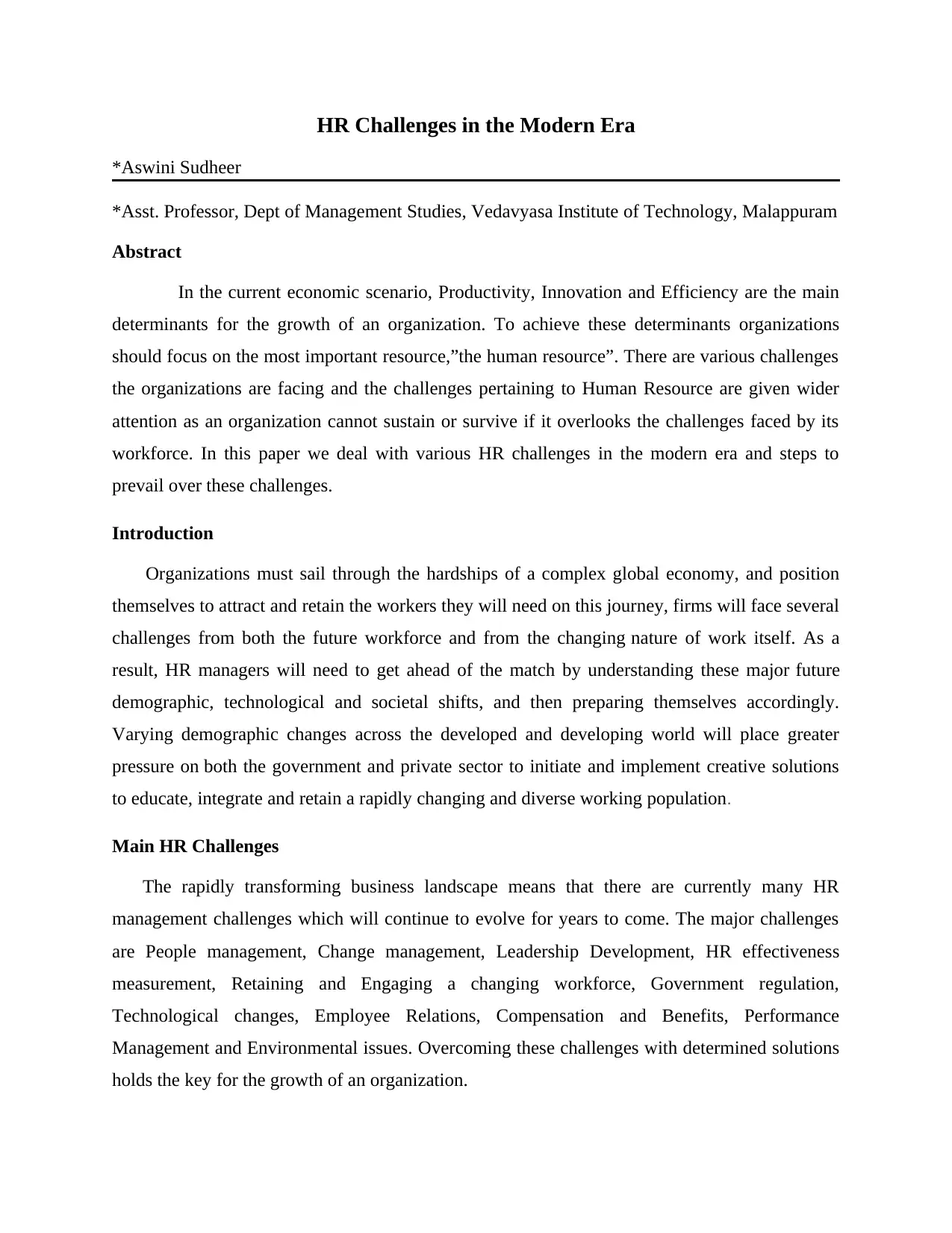
HR Challenges in the Modern Era
*Aswini Sudheer
*Asst. Professor, Dept of Management Studies, Vedavyasa Institute of Technology, Malappuram
Abstract
In the current economic scenario, Productivity, Innovation and Efficiency are the main
determinants for the growth of an organization. To achieve these determinants organizations
should focus on the most important resource,”the human resource”. There are various challenges
the organizations are facing and the challenges pertaining to Human Resource are given wider
attention as an organization cannot sustain or survive if it overlooks the challenges faced by its
workforce. In this paper we deal with various HR challenges in the modern era and steps to
prevail over these challenges.
Introduction
Organizations must sail through the hardships of a complex global economy, and position
themselves to attract and retain the workers they will need on this journey, firms will face several
challenges from both the future workforce and from the changing nature of work itself. As a
result, HR managers will need to get ahead of the match by understanding these major future
demographic, technological and societal shifts, and then preparing themselves accordingly.
Varying demographic changes across the developed and developing world will place greater
pressure on both the government and private sector to initiate and implement creative solutions
to educate, integrate and retain a rapidly changing and diverse working population.
Main HR Challenges
The rapidly transforming business landscape means that there are currently many HR
management challenges which will continue to evolve for years to come. The major challenges
are People management, Change management, Leadership Development, HR effectiveness
measurement, Retaining and Engaging a changing workforce, Government regulation,
Technological changes, Employee Relations, Compensation and Benefits, Performance
Management and Environmental issues. Overcoming these challenges with determined solutions
holds the key for the growth of an organization.
*Aswini Sudheer
*Asst. Professor, Dept of Management Studies, Vedavyasa Institute of Technology, Malappuram
Abstract
In the current economic scenario, Productivity, Innovation and Efficiency are the main
determinants for the growth of an organization. To achieve these determinants organizations
should focus on the most important resource,”the human resource”. There are various challenges
the organizations are facing and the challenges pertaining to Human Resource are given wider
attention as an organization cannot sustain or survive if it overlooks the challenges faced by its
workforce. In this paper we deal with various HR challenges in the modern era and steps to
prevail over these challenges.
Introduction
Organizations must sail through the hardships of a complex global economy, and position
themselves to attract and retain the workers they will need on this journey, firms will face several
challenges from both the future workforce and from the changing nature of work itself. As a
result, HR managers will need to get ahead of the match by understanding these major future
demographic, technological and societal shifts, and then preparing themselves accordingly.
Varying demographic changes across the developed and developing world will place greater
pressure on both the government and private sector to initiate and implement creative solutions
to educate, integrate and retain a rapidly changing and diverse working population.
Main HR Challenges
The rapidly transforming business landscape means that there are currently many HR
management challenges which will continue to evolve for years to come. The major challenges
are People management, Change management, Leadership Development, HR effectiveness
measurement, Retaining and Engaging a changing workforce, Government regulation,
Technological changes, Employee Relations, Compensation and Benefits, Performance
Management and Environmental issues. Overcoming these challenges with determined solutions
holds the key for the growth of an organization.
Paraphrase This Document
Need a fresh take? Get an instant paraphrase of this document with our AI Paraphraser

People Management
Organizations across the globe have always had to manage a multigenerational workforce.
While that is true, India’s demographics are creating some unique challenges. Even as the world
is graying, India is getting younger. By 2020, the average Indian will be only 29 years of age
compared with 37 in China and the U.S., 45 in Western Europe and 48 in Japan. Currently, more
than half of India’s population is less than 25 years of age. Diversity and inclusion have
been steadily gaining attraction in corporate India in recent years. Much of this is
centered on people management, and companies are beginning to realize the
business imperative of hiring efficiently and creating an equitable work
environment. Therefore the need to build skills and competencies, and freedom
and empowerment are the topmost priorities for the organizations followed by
recognition and appreciation to effectively manage people.
Change Management
Change Management is cited as the foremost issue as HR continues to attempt to help
business move forward. In this dynamic and fast changing environment, change management
skills are paramount if we wish to succeed. The need for employees to make decisions and act
quickly within the parameters of their jobs increases as customer demands the need for a flexible
workplace increase; hence an intensified focus on training is needed to develop added
competencies to deal with change management.
Leadership Development
Being one of the biggest challenges for human resource management,leadership
development needs to be a critical strategic initiative.HR professionals are faced with being
expected to provide the essential structures, processes and tools to make the best selection and
develop the future leaders of the organization.Leadership development has been identified as
critical strategic initiative in ensuring the right employees are retained and managers are well
equipped to take on leadership roles of the future so that organization is viable in the long term.
HR Effectiveness Measurement
Organizations across the globe have always had to manage a multigenerational workforce.
While that is true, India’s demographics are creating some unique challenges. Even as the world
is graying, India is getting younger. By 2020, the average Indian will be only 29 years of age
compared with 37 in China and the U.S., 45 in Western Europe and 48 in Japan. Currently, more
than half of India’s population is less than 25 years of age. Diversity and inclusion have
been steadily gaining attraction in corporate India in recent years. Much of this is
centered on people management, and companies are beginning to realize the
business imperative of hiring efficiently and creating an equitable work
environment. Therefore the need to build skills and competencies, and freedom
and empowerment are the topmost priorities for the organizations followed by
recognition and appreciation to effectively manage people.
Change Management
Change Management is cited as the foremost issue as HR continues to attempt to help
business move forward. In this dynamic and fast changing environment, change management
skills are paramount if we wish to succeed. The need for employees to make decisions and act
quickly within the parameters of their jobs increases as customer demands the need for a flexible
workplace increase; hence an intensified focus on training is needed to develop added
competencies to deal with change management.
Leadership Development
Being one of the biggest challenges for human resource management,leadership
development needs to be a critical strategic initiative.HR professionals are faced with being
expected to provide the essential structures, processes and tools to make the best selection and
develop the future leaders of the organization.Leadership development has been identified as
critical strategic initiative in ensuring the right employees are retained and managers are well
equipped to take on leadership roles of the future so that organization is viable in the long term.
HR Effectiveness Measurement

Like other businesses, HR also needs to be able to measure results in terms of positive influence
on business. Utilizing metrics to determine effectiveness is the beginning of a shift from
perceiving HR’s role as an administrative function to viewing HR as a strategic partner within
the organization. HR departments have traditionally focused on measuring their own
effectiveness, there is an evolving recognition that they can provide organizational value by
measuring the effectiveness of the entire business organization.
Retaining and engaging a changing workforce
As the demographic composition of the workforce changes, their motivations and expectations
evolve too. It is imperative that HR understands what is most valued by these workers. Is it
compensation, or prestige, or perhaps autonomy at work? In many cases, HR will have to adapt
their incentives, benefits policies, and retention strategies for workers that are not just driven by
financial compensation. It is not enough simply to recruit able staff. Companies have to make
sure that their people are committed, productive, and do not leave after a short period, incurring
substantial turnover costs and wasting all previous training invested in them.
Technological Changes
In the last 20 years, new communication technology, such as email, mobile phones and web and
videoconferencing has not only facilitated closer contact with clients in distant lands, it has
allowed multinational companies to form cross-border teams, where colleagues can
communicate with each other constantly, despite not being located in the same place. In short,
technology has enabled the international expansion that companies seek. Virtual teams
also significantly enlarge the pool of available knowledge. Individual team members can offer
extensive experience with different markets and an understanding of geographically disparate
customer demands and sensitivities. Technology’s evolving role in redefining what work means
will require firms to come up with new and innovative strategies to manage their increasingly
mobile workforce. These strategies will need to help mobile workers remain engaged and
connected to the wider organization they serve.
Employee Relations
on business. Utilizing metrics to determine effectiveness is the beginning of a shift from
perceiving HR’s role as an administrative function to viewing HR as a strategic partner within
the organization. HR departments have traditionally focused on measuring their own
effectiveness, there is an evolving recognition that they can provide organizational value by
measuring the effectiveness of the entire business organization.
Retaining and engaging a changing workforce
As the demographic composition of the workforce changes, their motivations and expectations
evolve too. It is imperative that HR understands what is most valued by these workers. Is it
compensation, or prestige, or perhaps autonomy at work? In many cases, HR will have to adapt
their incentives, benefits policies, and retention strategies for workers that are not just driven by
financial compensation. It is not enough simply to recruit able staff. Companies have to make
sure that their people are committed, productive, and do not leave after a short period, incurring
substantial turnover costs and wasting all previous training invested in them.
Technological Changes
In the last 20 years, new communication technology, such as email, mobile phones and web and
videoconferencing has not only facilitated closer contact with clients in distant lands, it has
allowed multinational companies to form cross-border teams, where colleagues can
communicate with each other constantly, despite not being located in the same place. In short,
technology has enabled the international expansion that companies seek. Virtual teams
also significantly enlarge the pool of available knowledge. Individual team members can offer
extensive experience with different markets and an understanding of geographically disparate
customer demands and sensitivities. Technology’s evolving role in redefining what work means
will require firms to come up with new and innovative strategies to manage their increasingly
mobile workforce. These strategies will need to help mobile workers remain engaged and
connected to the wider organization they serve.
Employee Relations
⊘ This is a preview!⊘
Do you want full access?
Subscribe today to unlock all pages.

Trusted by 1+ million students worldwide

Strengthening the employer-employee relationship is an important goal for human resources
departments in any organization. Employee relations are the section of human resources that
addresses employee concerns and complaints. Other issues the employee relations specialist
concerns himself with are conducting department audits, coordinating the performance
management system and creating policies on employee behavior and conduct. The issues
employee relations specialists face are employee attitudes that reflect low employee morale, high
voluntary and involuntary turnover, and investigating employee complaints filed with federal or
state enforcement agencies. Employee relations specialists are also responsible for managing
diversity issues and partly responsible for diversity management.
Compensation and Benefits
The human resources department is charged with the responsibility of ensuring the company
pays competitive wages and offers an attractive, comprehensive benefits package. One of the
ways to accomplish this is through regular surveys of comparable employers in the same
geographic area or the same industry. In addition, compensation specialists maintain networking
ties with their counterparts and competitors. These types of relationships encourage the exchange
of information that helps to determining how competitive your organizations wages and benefits
are. Compensation specialists often face challenges that require them to justify budget increases
to remain competitive and attract the best, most talented job candidates.
Performance Management
Developing a performance management system is a challenge for most human resources
departments, because there are so many elements critical to the process. Performance
management is the system wherein an employer can determine job fit, individual and team
productivity, aptitude, professional expertise and technical skills. A relatively new small business
with an inexperienced workforce is especially challenging--human resources training specialists
can develop curriculum that improves supervisory and management skills. HR are responsible
for conducting employee performance appraisals; therefore, they must be fully competent and
comfortable with evaluating employees in a thorough and objective manner. In addition,
employees need to be aware of how the performance management system works and how best
they can meet job expectations to enhance their job performance.
departments in any organization. Employee relations are the section of human resources that
addresses employee concerns and complaints. Other issues the employee relations specialist
concerns himself with are conducting department audits, coordinating the performance
management system and creating policies on employee behavior and conduct. The issues
employee relations specialists face are employee attitudes that reflect low employee morale, high
voluntary and involuntary turnover, and investigating employee complaints filed with federal or
state enforcement agencies. Employee relations specialists are also responsible for managing
diversity issues and partly responsible for diversity management.
Compensation and Benefits
The human resources department is charged with the responsibility of ensuring the company
pays competitive wages and offers an attractive, comprehensive benefits package. One of the
ways to accomplish this is through regular surveys of comparable employers in the same
geographic area or the same industry. In addition, compensation specialists maintain networking
ties with their counterparts and competitors. These types of relationships encourage the exchange
of information that helps to determining how competitive your organizations wages and benefits
are. Compensation specialists often face challenges that require them to justify budget increases
to remain competitive and attract the best, most talented job candidates.
Performance Management
Developing a performance management system is a challenge for most human resources
departments, because there are so many elements critical to the process. Performance
management is the system wherein an employer can determine job fit, individual and team
productivity, aptitude, professional expertise and technical skills. A relatively new small business
with an inexperienced workforce is especially challenging--human resources training specialists
can develop curriculum that improves supervisory and management skills. HR are responsible
for conducting employee performance appraisals; therefore, they must be fully competent and
comfortable with evaluating employees in a thorough and objective manner. In addition,
employees need to be aware of how the performance management system works and how best
they can meet job expectations to enhance their job performance.
Paraphrase This Document
Need a fresh take? Get an instant paraphrase of this document with our AI Paraphraser

Conclusion
The HR department plays a vital role in the growth and development of an organization. In this
ever changing dynamic environment organizations will face several challenges from both the
future workforce and from the changing nature of work itself. As a result, HR needs to get ahead
of the game by understanding these challenges and preparing themselves to face major future
demographic, technological and societal shifts.
References:
1. HR issues and Challenges by Ruth Mayhew (http://smallbusiness.chron.com/hr-issues-
challenges-4557.html)
2. Challenges for human resource management and global business strategy
(http://futurehrtrends.eiu.com/report-2014/challenges-human-resource-management/)
3. The Top Ten Hardest Things About Managing People By Bruce Tulgan (2013),
(http://rainmakerthinking.com/assets/uploads/2013/10/Top-10-Hardest-Things.pdf)
4. Challenges facing HR over next ten years, (http:/
www.shrm.org/research/surveyfindings/articles/pages/challengesfacinghroverthenext10yea
rs.aspx)
The HR department plays a vital role in the growth and development of an organization. In this
ever changing dynamic environment organizations will face several challenges from both the
future workforce and from the changing nature of work itself. As a result, HR needs to get ahead
of the game by understanding these challenges and preparing themselves to face major future
demographic, technological and societal shifts.
References:
1. HR issues and Challenges by Ruth Mayhew (http://smallbusiness.chron.com/hr-issues-
challenges-4557.html)
2. Challenges for human resource management and global business strategy
(http://futurehrtrends.eiu.com/report-2014/challenges-human-resource-management/)
3. The Top Ten Hardest Things About Managing People By Bruce Tulgan (2013),
(http://rainmakerthinking.com/assets/uploads/2013/10/Top-10-Hardest-Things.pdf)
4. Challenges facing HR over next ten years, (http:/
www.shrm.org/research/surveyfindings/articles/pages/challengesfacinghroverthenext10yea
rs.aspx)
1 out of 5
Related Documents
Your All-in-One AI-Powered Toolkit for Academic Success.
+13062052269
info@desklib.com
Available 24*7 on WhatsApp / Email
Unlock your academic potential
Copyright © 2020–2025 A2Z Services. All Rights Reserved. Developed and managed by ZUCOL.