Modular Construction: Benefits and Future in Project Management
VerifiedAdded on 2023/06/14
|31
|8690
|181
Thesis and Dissertation
AI Summary
This research thesis delves into the realm of modular construction, investigating its potential benefits and drawbacks within the context of project management and future urban development. It begins by introducing the concept of modular building systems and their relevance to addressing sustainability concerns and the challenges of rapidly growing urban populations. The literature review examines the advantages of modular construction, such as its environmentally friendly nature, high quality, speed of construction, cost-effectiveness, and acoustic performance. It also addresses the disadvantages, including financial constraints, reduced perceived value, lack of customization, and potential risks. Furthermore, the thesis explores solutions to these limitations, such as monocoque technology and hybrid modular construction, while also analyzing market trends and future developments in modular building systems. The research methodology outlines the approach used to gather and analyze data, ultimately aiming to assess the contribution of modular building systems to sustainability, particularly in the context of future cities. This document is available on Desklib, a platform offering a range of study tools for students.
Project Management 1
PROJECT MANAGEMENT
By Name
Course
Instructor
Institution
Location
Date
PROJECT MANAGEMENT
By Name
Course
Instructor
Institution
Location
Date

Paraphrase This Document
Need a fresh take? Get an instant paraphrase of this document with our AI Paraphraser
Project Management 2
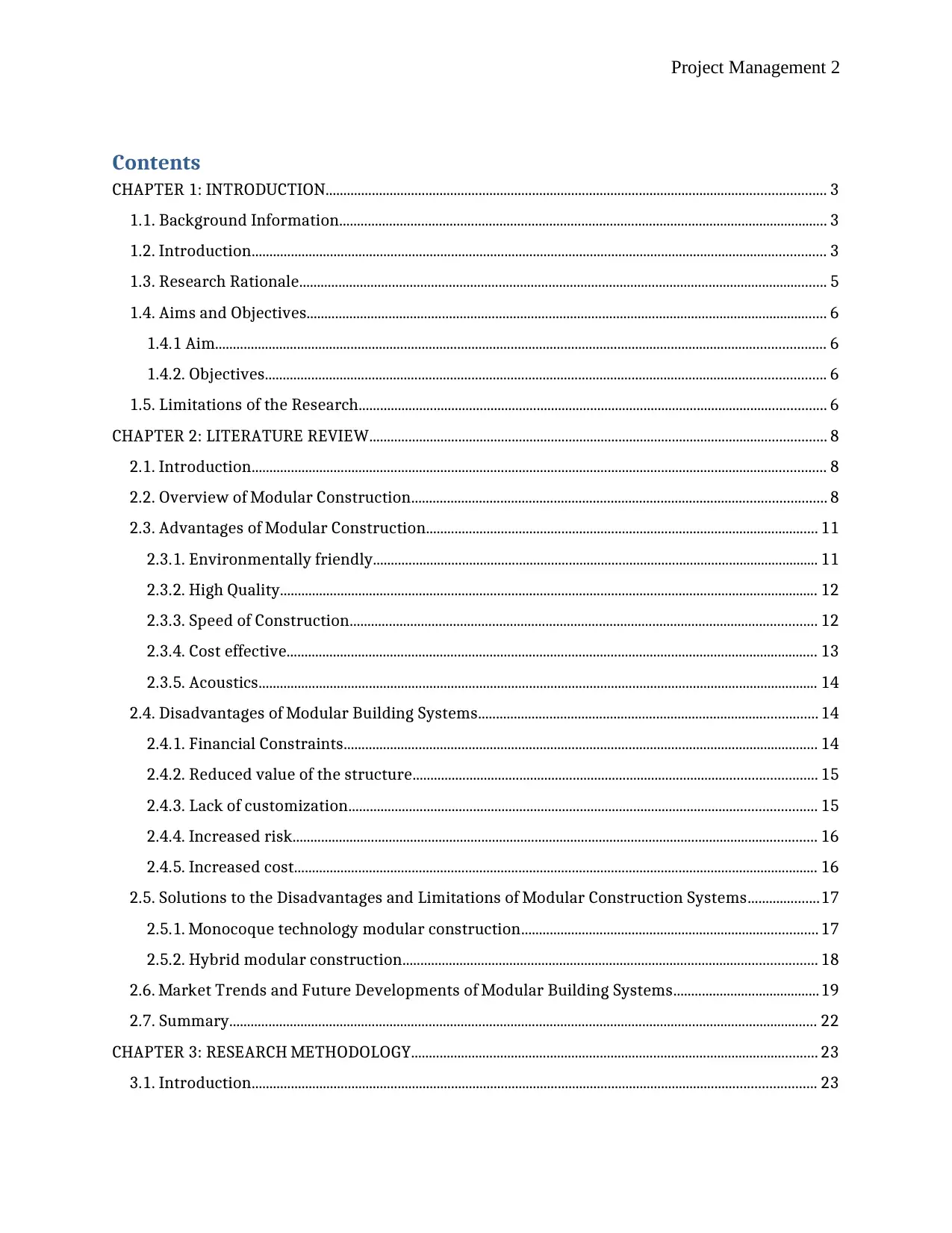
Contents
CHAPTER 1: INTRODUCTION............................................................................................................................................ 3
1.1. Background Information......................................................................................................................................... 3
1.2. Introduction................................................................................................................................................................. 3
1.3. Research Rationale.................................................................................................................................................... 5
1.4. Aims and Objectives.................................................................................................................................................. 6
1.4.1 Aim........................................................................................................................................................................... 6
1.4.2. Objectives............................................................................................................................................................. 6
1.5. Limitations of the Research................................................................................................................................... 6
CHAPTER 2: LITERATURE REVIEW................................................................................................................................ 8
2.1. Introduction................................................................................................................................................................. 8
2.2. Overview of Modular Construction.................................................................................................................... 8
2.3. Advantages of Modular Construction.............................................................................................................. 11
2.3.1. Environmentally friendly............................................................................................................................. 11
2.3.2. High Quality....................................................................................................................................................... 12
2.3.3. Speed of Construction................................................................................................................................... 12
2.3.4. Cost effective..................................................................................................................................................... 13
2.3.5. Acoustics............................................................................................................................................................. 14
2.4. Disadvantages of Modular Building Systems............................................................................................... 14
2.4.1. Financial Constraints..................................................................................................................................... 14
2.4.2. Reduced value of the structure................................................................................................................. 15
2.4.3. Lack of customization................................................................................................................................... 15
2.4.4. Increased risk................................................................................................................................................... 16
2.4.5. Increased cost................................................................................................................................................... 16
2.5. Solutions to the Disadvantages and Limitations of Modular Construction Systems....................17
2.5.1. Monocoque technology modular construction...................................................................................17
2.5.2. Hybrid modular construction.................................................................................................................... 18
2.6. Market Trends and Future Developments of Modular Building Systems.........................................19
2.7. Summary..................................................................................................................................................................... 22
CHAPTER 3: RESEARCH METHODOLOGY.................................................................................................................. 23
3.1. Introduction.............................................................................................................................................................. 23
Contents
CHAPTER 1: INTRODUCTION............................................................................................................................................ 3
1.1. Background Information......................................................................................................................................... 3
1.2. Introduction................................................................................................................................................................. 3
1.3. Research Rationale.................................................................................................................................................... 5
1.4. Aims and Objectives.................................................................................................................................................. 6
1.4.1 Aim........................................................................................................................................................................... 6
1.4.2. Objectives............................................................................................................................................................. 6
1.5. Limitations of the Research................................................................................................................................... 6
CHAPTER 2: LITERATURE REVIEW................................................................................................................................ 8
2.1. Introduction................................................................................................................................................................. 8
2.2. Overview of Modular Construction.................................................................................................................... 8
2.3. Advantages of Modular Construction.............................................................................................................. 11
2.3.1. Environmentally friendly............................................................................................................................. 11
2.3.2. High Quality....................................................................................................................................................... 12
2.3.3. Speed of Construction................................................................................................................................... 12
2.3.4. Cost effective..................................................................................................................................................... 13
2.3.5. Acoustics............................................................................................................................................................. 14
2.4. Disadvantages of Modular Building Systems............................................................................................... 14
2.4.1. Financial Constraints..................................................................................................................................... 14
2.4.2. Reduced value of the structure................................................................................................................. 15
2.4.3. Lack of customization................................................................................................................................... 15
2.4.4. Increased risk................................................................................................................................................... 16
2.4.5. Increased cost................................................................................................................................................... 16
2.5. Solutions to the Disadvantages and Limitations of Modular Construction Systems....................17
2.5.1. Monocoque technology modular construction...................................................................................17
2.5.2. Hybrid modular construction.................................................................................................................... 18
2.6. Market Trends and Future Developments of Modular Building Systems.........................................19
2.7. Summary..................................................................................................................................................................... 22
CHAPTER 3: RESEARCH METHODOLOGY.................................................................................................................. 23
3.1. Introduction.............................................................................................................................................................. 23

Project Management 3
3.2. Research Methodology.......................................................................................................................................... 23
3.3. Research Methods and Data Sources............................................................................................................... 24
3.4. Summary..................................................................................................................................................................... 26
References............................................................................................................................................................................... 28
3.2. Research Methodology.......................................................................................................................................... 23
3.3. Research Methods and Data Sources............................................................................................................... 24
3.4. Summary..................................................................................................................................................................... 26
References............................................................................................................................................................................... 28
⊘ This is a preview!⊘
Do you want full access?
Subscribe today to unlock all pages.

Trusted by 1+ million students worldwide
Project Management 4
CHAPTER 1: INTRODUCTION
1.1. Background Information
Due to the immense changes in the technology experienced in almost all the sectors in the world
today, it is least expected that the cities of the future will be comparable to the cities of today.
Extreme changes in the climate and weather are expected due to the increasing variability in the
climate and this is expected even with greater frequency and even the areas that have always
remained virtually silent are expected to respond. There will be introduced new materials and
process that will serve as gates to opportunities to design and configure structures of buildings to
tolerate these changes (Koones, 2013, p.135). This calls for the need to consider multiple and
carried aspects during planning, construction and building stages of operation. This is only
achievable and feasible in the future through a thorough interplay of architecture, urban
planning, structural engineering and building services. Modular building systems in one such
technique that tends to build these various aspects together to create a building that is not only
sustainable but also meets the functionality and aesthetic needs of the users of the spaces within
the structure.
1.2. Introduction
In the words of Roland Busch who is a member of the managing board of Siemens AG and the
CEO of the infrastructure and Cities Sector, the cities are the pivot of global development. It is
from the cities that the future of the human race takes shape, the point of springing of economic
growth from the numerous activities of the more than half of the population of the world. It is in
these very cities that most challenging environmental concerns are most evident.
The look, as well as the feel of the cities of the future, will be quite different from the one of
today due to the very rising need to improve the quality of life, the viability of the environment
CHAPTER 1: INTRODUCTION
1.1. Background Information
Due to the immense changes in the technology experienced in almost all the sectors in the world
today, it is least expected that the cities of the future will be comparable to the cities of today.
Extreme changes in the climate and weather are expected due to the increasing variability in the
climate and this is expected even with greater frequency and even the areas that have always
remained virtually silent are expected to respond. There will be introduced new materials and
process that will serve as gates to opportunities to design and configure structures of buildings to
tolerate these changes (Koones, 2013, p.135). This calls for the need to consider multiple and
carried aspects during planning, construction and building stages of operation. This is only
achievable and feasible in the future through a thorough interplay of architecture, urban
planning, structural engineering and building services. Modular building systems in one such
technique that tends to build these various aspects together to create a building that is not only
sustainable but also meets the functionality and aesthetic needs of the users of the spaces within
the structure.
1.2. Introduction
In the words of Roland Busch who is a member of the managing board of Siemens AG and the
CEO of the infrastructure and Cities Sector, the cities are the pivot of global development. It is
from the cities that the future of the human race takes shape, the point of springing of economic
growth from the numerous activities of the more than half of the population of the world. It is in
these very cities that most challenging environmental concerns are most evident.
The look, as well as the feel of the cities of the future, will be quite different from the one of
today due to the very rising need to improve the quality of life, the viability of the environment
Paraphrase This Document
Need a fresh take? Get an instant paraphrase of this document with our AI Paraphraser
Project Management 5
as well as the economic competitively that will serve to drive a new way of living (Kruger, 2012,
p.233). It is anticipated that the high-rise buildings that are currently in the cities and towns be
like small towns that have shops, workshops and home and even inclusive of farm and gardens
which will all be placed under one roof. The spaces around human beings will have high degrees
of flexibility and thus adjustable in a way that matches the needs of the occupants of the region.
The changes will happen in such a way that people will not own things and instead, they will
have to pay in order to use an item or space after which they give it back, hand it off or even
recycle it after using it.
The advancements in technology will enable people to live efficient lives with numerous people
working from homes, able to change between business and leisure, the real and the imaginary or
virtual. These new life systems will bring together the neighbors forming a vibrant and highly
dynamic community. Another important expected change will be experienced in buildings in
which the buildings will be expected to get smart. The buildings in the current cities of the work
are responsible for the major consumption of energy by a city as well as the greenhouse
emissions. Such buildings are thus a representative of a large potential for saving energy and thus
the key to sustainable developments in the cities (Lawson, 2014, p.238).
A building is anticipated to be self-sufficient, able to yield surplus energy, recycling their own
wastes collecting rainwater, minimizing the use of water and recycling or reusing gray water.
The buildings are as well expected to be fully intelligent and automated having numerous sensors
that will facilitate switching off and on of the lights. Rooms will only be optimally heated when
they are occupied and remain unheated in unoccupied states.
as well as the economic competitively that will serve to drive a new way of living (Kruger, 2012,
p.233). It is anticipated that the high-rise buildings that are currently in the cities and towns be
like small towns that have shops, workshops and home and even inclusive of farm and gardens
which will all be placed under one roof. The spaces around human beings will have high degrees
of flexibility and thus adjustable in a way that matches the needs of the occupants of the region.
The changes will happen in such a way that people will not own things and instead, they will
have to pay in order to use an item or space after which they give it back, hand it off or even
recycle it after using it.
The advancements in technology will enable people to live efficient lives with numerous people
working from homes, able to change between business and leisure, the real and the imaginary or
virtual. These new life systems will bring together the neighbors forming a vibrant and highly
dynamic community. Another important expected change will be experienced in buildings in
which the buildings will be expected to get smart. The buildings in the current cities of the work
are responsible for the major consumption of energy by a city as well as the greenhouse
emissions. Such buildings are thus a representative of a large potential for saving energy and thus
the key to sustainable developments in the cities (Lawson, 2014, p.238).
A building is anticipated to be self-sufficient, able to yield surplus energy, recycling their own
wastes collecting rainwater, minimizing the use of water and recycling or reusing gray water.
The buildings are as well expected to be fully intelligent and automated having numerous sensors
that will facilitate switching off and on of the lights. Rooms will only be optimally heated when
they are occupied and remain unheated in unoccupied states.
Project Management 6
The scarcity of resource as well as the changes in the human demographics are among the main
challenges that are experienced in the 21st century moving forward. There is thus the need to
address the fundamental questions on the character of future buildings, settlements, and
infrastructure so as to ensure readiness in facing the changes that will accompany the future
cities. Advance and far-sighted planning are integral when it comes to creating future cities
(Emmitt, 2014, p.314).
As a result of the ever-increasing concern towards an environmentally sustainable future
especially in the cities, the development in the 21st century will mainly be influenced by growth
and transformation that is experienced in the cities. It is estimated that to the tune of 3 billion
people will be living on the surface of the earth by the year 2050, all of whom will require a
place to refer to as home. 67% of the population of the world is expected to be living in the cities
by 2025. Similarly, there are extrapolations that there will be a 50% increase in the energy
demand by the same time within will translate to an increase in the levels of emissions of carbon
dioxide (Koones, 2013, p.330).
1.3. Research Rationale
Sustainability is a growing concern and is ever gaining national and internal attention and
interest. Emission of carbon dioxide among other greenhouse gases remains a serious challenge
in most of the cities around the globe and this is projected to continue even to the future cities.
As the human population increases, every day and more people migrating to the cities in search
of improved quality of life, the levels of emissions of carbon dioxide are found to increase
raising sustainability concerns.
Various sustainability approaches have been proposed to help contain the situation. Maybe the
use of modular building systems may be one of the best methods. Modular building systems
The scarcity of resource as well as the changes in the human demographics are among the main
challenges that are experienced in the 21st century moving forward. There is thus the need to
address the fundamental questions on the character of future buildings, settlements, and
infrastructure so as to ensure readiness in facing the changes that will accompany the future
cities. Advance and far-sighted planning are integral when it comes to creating future cities
(Emmitt, 2014, p.314).
As a result of the ever-increasing concern towards an environmentally sustainable future
especially in the cities, the development in the 21st century will mainly be influenced by growth
and transformation that is experienced in the cities. It is estimated that to the tune of 3 billion
people will be living on the surface of the earth by the year 2050, all of whom will require a
place to refer to as home. 67% of the population of the world is expected to be living in the cities
by 2025. Similarly, there are extrapolations that there will be a 50% increase in the energy
demand by the same time within will translate to an increase in the levels of emissions of carbon
dioxide (Koones, 2013, p.330).
1.3. Research Rationale
Sustainability is a growing concern and is ever gaining national and internal attention and
interest. Emission of carbon dioxide among other greenhouse gases remains a serious challenge
in most of the cities around the globe and this is projected to continue even to the future cities.
As the human population increases, every day and more people migrating to the cities in search
of improved quality of life, the levels of emissions of carbon dioxide are found to increase
raising sustainability concerns.
Various sustainability approaches have been proposed to help contain the situation. Maybe the
use of modular building systems may be one of the best methods. Modular building systems
⊘ This is a preview!⊘
Do you want full access?
Subscribe today to unlock all pages.
Trusted by 1+ million students worldwide
Project Management 7
involve constructions of building using modules, techniques that have been found to be
environmentally friendly and hence a significant player in meeting sustainability needs. Modular
building systems have numerous advantages that may see the future cities more sustainable and
tolerable to the rapidly changing technology (McGuerty, 2017, p.160).
1.4. Aims and Objectives
1.4.1 Aim
The aim of this study is to find out the advantages and benefits that accrue when modular
construction practices are adapted for cities
1.4.2. Objectives
The objectives of the study include:
Doing an extensive study on modular building practices and systems that are used in
contemporary construction
Investigating the impacts of modular building systems in the cities of the future
Carrying out research on the technological changes that are expected of the future cities
Investigating the contribution to the sustainability by modular building systems especially
in the future cities
1.5. Limitations of the Research
The scope of the research is one of the limitations of this study. While this research has a time
span for which it is to be submitted, the time provided is not long enough to allow very elaborate,
extensive and expansive study and production of academic paper of very large sizes as have been
produced by the previous experienced scholars. The scope and the depth of this discussion is thus
comprised in numerous levels so as to meet the various constraints among them time. Lack of
enough and elaborate information is yet another challenge with this study. Modular building
involve constructions of building using modules, techniques that have been found to be
environmentally friendly and hence a significant player in meeting sustainability needs. Modular
building systems have numerous advantages that may see the future cities more sustainable and
tolerable to the rapidly changing technology (McGuerty, 2017, p.160).
1.4. Aims and Objectives
1.4.1 Aim
The aim of this study is to find out the advantages and benefits that accrue when modular
construction practices are adapted for cities
1.4.2. Objectives
The objectives of the study include:
Doing an extensive study on modular building practices and systems that are used in
contemporary construction
Investigating the impacts of modular building systems in the cities of the future
Carrying out research on the technological changes that are expected of the future cities
Investigating the contribution to the sustainability by modular building systems especially
in the future cities
1.5. Limitations of the Research
The scope of the research is one of the limitations of this study. While this research has a time
span for which it is to be submitted, the time provided is not long enough to allow very elaborate,
extensive and expansive study and production of academic paper of very large sizes as have been
produced by the previous experienced scholars. The scope and the depth of this discussion is thus
comprised in numerous levels so as to meet the various constraints among them time. Lack of
enough and elaborate information is yet another challenge with this study. Modular building
Paraphrase This Document
Need a fresh take? Get an instant paraphrase of this document with our AI Paraphraser

Project Management 8
systems is a technology or technique that has not been in the field for a long time and as such
there is not so much literature about the study. This limits the depth of identification of the scope
of the study.
systems is a technology or technique that has not been in the field for a long time and as such
there is not so much literature about the study. This limits the depth of identification of the scope
of the study.
Project Management 9
CHAPTER 2: LITERATURE REVIEW
2.1. Introduction
This chapter presents a review of the modular construction, its advantages, disadvantages, the
solution to the disadvantages as well as the market trends and the future expectations. The
advantages may be classified into advantages and disadvantages that are common to any modular
project and those that are specific to a unique modular project. The common advantages include
quality control, improved safety, cost-effectiveness and environmental impact among other
advantages. The disadvantages that are applicable to all include among them the reduced value
of the building, financial constraints, increased risk as well as limited customization. Advantages
that are specific to a unique project are inclusive or reduced cost, increased quality, and reduced
schedule while an increase in the cost is a disadvantage to a unique specific project.
2.2. Overview of Modular Construction
Modular construction has formed one of the hottest topics in North America as at the moment
with the buzz being witnessed in sophisticated and interesting videos showing the various
concepts of tie technology all over social media (Trubiano, 2013, p.165). Modular construction is
an off-site type of production in which the buildings are built on the factories and then
transported to the sites. Modular construction defines the process through which the construction
of the building is done off the site of construction under conditions of regulated plants and
adopting the very materials and designing to the same standards and codes that are used for the
conventionally constructed facilities and structures though in approximately half the time. In
modular construction, the building is generated in modules which when assembled together on
the site illustrates the identical design intentions and specifications of the most complex facilities
that are have built on the site without comprising the quality.
CHAPTER 2: LITERATURE REVIEW
2.1. Introduction
This chapter presents a review of the modular construction, its advantages, disadvantages, the
solution to the disadvantages as well as the market trends and the future expectations. The
advantages may be classified into advantages and disadvantages that are common to any modular
project and those that are specific to a unique modular project. The common advantages include
quality control, improved safety, cost-effectiveness and environmental impact among other
advantages. The disadvantages that are applicable to all include among them the reduced value
of the building, financial constraints, increased risk as well as limited customization. Advantages
that are specific to a unique project are inclusive or reduced cost, increased quality, and reduced
schedule while an increase in the cost is a disadvantage to a unique specific project.
2.2. Overview of Modular Construction
Modular construction has formed one of the hottest topics in North America as at the moment
with the buzz being witnessed in sophisticated and interesting videos showing the various
concepts of tie technology all over social media (Trubiano, 2013, p.165). Modular construction is
an off-site type of production in which the buildings are built on the factories and then
transported to the sites. Modular construction defines the process through which the construction
of the building is done off the site of construction under conditions of regulated plants and
adopting the very materials and designing to the same standards and codes that are used for the
conventionally constructed facilities and structures though in approximately half the time. In
modular construction, the building is generated in modules which when assembled together on
the site illustrates the identical design intentions and specifications of the most complex facilities
that are have built on the site without comprising the quality.
⊘ This is a preview!⊘
Do you want full access?
Subscribe today to unlock all pages.
Trusted by 1+ million students worldwide
Project Management 10
The units or the modules are built to the satisfaction of the customers. Should a client decide to
use modular construction, the initial step would involve looking for a factory that is able and
willing to construct a modular unit that is in line with his intentions and specifications (Molinari-
Tosatti, 2012, p.258). This is because the factories involving in the modular construction build
units that are in correspondence with the specifications of the project as opposed to just
generating copies of a unit. The factories are able to manufacture both the interior and the
exterior besides other aspects of that are specific to a project. The task to be done by the site
crew in finishing a project done through modular construction is greatly reduced as up to 90% of
the construct modular is done as the factories. This is an aspect that is incorporated by all the
various types of modular construction. It is at this point that structural modular construction
begins to take a turn as there are both permanent and re-locatable modular units.
Permanent modular units are those units intended to remain at the point of their location for a
relatively long period of time. Such units are permanently installed when they are delivered to
the construction site. On the other hand, re-locatable modular units can be moved by the
[projects managers or the building managers before the end of the three-year mark. Permanent
modular units have been found to meet the International Building Codes requirements and are in
most cases not separable from the traditional built structures and facilities. The permanent
structures account for about 50% of the modular industry (Thompson, 2013, p.310).
The same materials as those of the traditional construction are used in both permanent and re-
locatable modular structures. This is despite the fact that not each company can offer every
option that in needed and instead the factories specialize in a single type so as to cut back on
costs and maintain efficiency. There are numerous ways in which traditional construction can
incorporate modular units, for example, the incorporation of specific units into traditional
The units or the modules are built to the satisfaction of the customers. Should a client decide to
use modular construction, the initial step would involve looking for a factory that is able and
willing to construct a modular unit that is in line with his intentions and specifications (Molinari-
Tosatti, 2012, p.258). This is because the factories involving in the modular construction build
units that are in correspondence with the specifications of the project as opposed to just
generating copies of a unit. The factories are able to manufacture both the interior and the
exterior besides other aspects of that are specific to a project. The task to be done by the site
crew in finishing a project done through modular construction is greatly reduced as up to 90% of
the construct modular is done as the factories. This is an aspect that is incorporated by all the
various types of modular construction. It is at this point that structural modular construction
begins to take a turn as there are both permanent and re-locatable modular units.
Permanent modular units are those units intended to remain at the point of their location for a
relatively long period of time. Such units are permanently installed when they are delivered to
the construction site. On the other hand, re-locatable modular units can be moved by the
[projects managers or the building managers before the end of the three-year mark. Permanent
modular units have been found to meet the International Building Codes requirements and are in
most cases not separable from the traditional built structures and facilities. The permanent
structures account for about 50% of the modular industry (Thompson, 2013, p.310).
The same materials as those of the traditional construction are used in both permanent and re-
locatable modular structures. This is despite the fact that not each company can offer every
option that in needed and instead the factories specialize in a single type so as to cut back on
costs and maintain efficiency. There are numerous ways in which traditional construction can
incorporate modular units, for example, the incorporation of specific units into traditional
Paraphrase This Document
Need a fresh take? Get an instant paraphrase of this document with our AI Paraphraser
Project Management 11
structures by a modular construction project. This is observable in places such as addition or
repairs. This illustrates that it is possible to build modular units to defined specifications and are
aimed at easing construction (Princiotta, 2011, p.354).
Modular construction demands an elaborate and intensive process in the design to make sure the
prefabrication pieces or units fit the project for which they are being manufactured. This is to
ensure that they are neither larger than space nor will some of them remain during fitting. From
this, the units are taken through a series of engineering requirements that are meant to ensure
they attain the state, local, federal as well as other building codes.
An assemblage of structural units is done in order to meet the needs of the project. The frame is
constructed and the subfloor insulated. Other activates that can be done to the structural units in
the assemblage include passing down the line the unit and installing the various parts from the
drywall to the finishing touches. Other services such as mechanical and electrical installations
can as well be made. The structure is then finally transported to the site. A delay in the
transportation of certain parts of the units may be done by the company depending on the size of
the project to ensure that the units are not idling on the site for days at the same time (Ng, 2009,
p.158). Completion of any finishes and connection of the utilities is the only activity that is
carried out at installation.
Modular construction has widely been applied in Europe where it has been in place for more than
a decade and applied in both temporary and permanent structures. North America is as well
gaining momentum in the adoption of this technology which has various applications among
them in hotels, hospitals, apartments among other similar buildings.
structures by a modular construction project. This is observable in places such as addition or
repairs. This illustrates that it is possible to build modular units to defined specifications and are
aimed at easing construction (Princiotta, 2011, p.354).
Modular construction demands an elaborate and intensive process in the design to make sure the
prefabrication pieces or units fit the project for which they are being manufactured. This is to
ensure that they are neither larger than space nor will some of them remain during fitting. From
this, the units are taken through a series of engineering requirements that are meant to ensure
they attain the state, local, federal as well as other building codes.
An assemblage of structural units is done in order to meet the needs of the project. The frame is
constructed and the subfloor insulated. Other activates that can be done to the structural units in
the assemblage include passing down the line the unit and installing the various parts from the
drywall to the finishing touches. Other services such as mechanical and electrical installations
can as well be made. The structure is then finally transported to the site. A delay in the
transportation of certain parts of the units may be done by the company depending on the size of
the project to ensure that the units are not idling on the site for days at the same time (Ng, 2009,
p.158). Completion of any finishes and connection of the utilities is the only activity that is
carried out at installation.
Modular construction has widely been applied in Europe where it has been in place for more than
a decade and applied in both temporary and permanent structures. North America is as well
gaining momentum in the adoption of this technology which has various applications among
them in hotels, hospitals, apartments among other similar buildings.
Project Management 12
The greenery nature of modular construction is part of the reason for which Europe embraced it.
Construction of the units at the factory leads to the production of less waste as well as reducing
the demand for raw materials. The amount of energy required for the creation of new building is
also minimized through modular constructions that enable easy relocate, refurbishment and
disassembly of units as unit parts (Pinkert, 2014, p.241).
2.3. Advantages of Modular Construction
2.3.1. Environmentally friendly
Modular construction comes into a picture of green, eco-friendly building in various ways:
The types of construction materials used: Modular construction uses the same materials
and the ones used in regular construction in most cases. However, a significant number of
factories are on the increase of adopting sustainable materials in a bid to reduce the
footprint of carbon. An example is mobile modular which makes use of carpet tiles that
are self-adhering in the construction of the portable buildings. Such materials do not emit
volatile compounds (Rondal, 2010, p.311). Still, these companies have been found to
either reuse their products or in other cases recycle a significant portion of the materials
that are utilized in the generation of the modular constructions.
Constructions that is energy-efficient: Due to the mass production procedure that is in
line with standard specifications in the generation of modular buildings, construction of
modular buildings is thus quickly. A reduction in the time of construction translates to
effectiveness and efficiency in the use of energy and other resources as well as reducing
the amount of construction waste. In as much as it is arguable that a significant amount of
energy may be required in building and manufacturing the modules or units especially on
a large scale, such an argument can be countered with the reasoning that the effort,
The greenery nature of modular construction is part of the reason for which Europe embraced it.
Construction of the units at the factory leads to the production of less waste as well as reducing
the demand for raw materials. The amount of energy required for the creation of new building is
also minimized through modular constructions that enable easy relocate, refurbishment and
disassembly of units as unit parts (Pinkert, 2014, p.241).
2.3. Advantages of Modular Construction
2.3.1. Environmentally friendly
Modular construction comes into a picture of green, eco-friendly building in various ways:
The types of construction materials used: Modular construction uses the same materials
and the ones used in regular construction in most cases. However, a significant number of
factories are on the increase of adopting sustainable materials in a bid to reduce the
footprint of carbon. An example is mobile modular which makes use of carpet tiles that
are self-adhering in the construction of the portable buildings. Such materials do not emit
volatile compounds (Rondal, 2010, p.311). Still, these companies have been found to
either reuse their products or in other cases recycle a significant portion of the materials
that are utilized in the generation of the modular constructions.
Constructions that is energy-efficient: Due to the mass production procedure that is in
line with standard specifications in the generation of modular buildings, construction of
modular buildings is thus quickly. A reduction in the time of construction translates to
effectiveness and efficiency in the use of energy and other resources as well as reducing
the amount of construction waste. In as much as it is arguable that a significant amount of
energy may be required in building and manufacturing the modules or units especially on
a large scale, such an argument can be countered with the reasoning that the effort,
⊘ This is a preview!⊘
Do you want full access?
Subscribe today to unlock all pages.
Trusted by 1+ million students worldwide

1 out of 31


Related Documents


Your All-in-One AI-Powered Toolkit for Academic Success.
+13062052269
info@desklib.com
Available 24*7 on WhatsApp / Email
![[object Object]](/_next/static/media/star-bottom.7253800d.svg)
Unlock your academic potential
Copyright © 2020–2026 A2Z Services. All Rights Reserved. Developed and managed by ZUCOL.