Molecular Basis of Ageing: Theories, Mechanisms, and Therapies
VerifiedAdded on 2022/08/11
|10
|3315
|31
Literature Review
AI Summary
This literature review examines the molecular basis of ageing, exploring various theories and mechanisms that contribute to the ageing process. The review delves into the continuity theory, biological bases of ageing, genomic instability, mitochondrial instability, and the role of telomeres. It discusses the influence of signaling pathways, epigenetic modifications, and the link between telomeres, mitochondria, and ageing. Furthermore, it highlights the potential therapeutic approaches based on the understanding of geroscience and the aim to enhance healthy longevity. The study provides insights into the complexities of ageing, emphasizing the potential for interventions to prevent or slow down the ageing process and enhance the quality of life.
Runninghead: MOLECULAR BASIS OF AGEING
MOLECULAR BASIS OF AGEING
Name of the student
Name of the university
Author Note
MOLECULAR BASIS OF AGEING
Name of the student
Name of the university
Author Note

Paraphrase This Document
Need a fresh take? Get an instant paraphrase of this document with our AI Paraphraser
MOLECULAR BASIS OF AGEING
Abstract
The ageing is a natural phenomenon of an individual to grow older with time. Ageing is
related to degrading physiological and psychological activity. There are several theories
related to the ageing process. The theories are based on the molecular mechanism of the cell,
genetic interaction, signalling pathway and epigenetic mechanisms. Many factors of the
regular molecular mechanism are found to be related to the ageing process. The study will
shed light on the different theories of ageing stressing on the continuity theory, biological
basis, genetic instability and the mitochondrial instability. The link between two major
factors of ageing will also be discussed in the dissertation. The study will give a vivid idea of
therapeutic approaches to prevent ageing or enhancing a healthy life.
1
Abstract
The ageing is a natural phenomenon of an individual to grow older with time. Ageing is
related to degrading physiological and psychological activity. There are several theories
related to the ageing process. The theories are based on the molecular mechanism of the cell,
genetic interaction, signalling pathway and epigenetic mechanisms. Many factors of the
regular molecular mechanism are found to be related to the ageing process. The study will
shed light on the different theories of ageing stressing on the continuity theory, biological
basis, genetic instability and the mitochondrial instability. The link between two major
factors of ageing will also be discussed in the dissertation. The study will give a vivid idea of
therapeutic approaches to prevent ageing or enhancing a healthy life.
1
MOLECULAR BASIS OF AGEING
Introduction:
Ageing is a biological process via which the physical, psychological and
physiological functional efficiency decreases, causing a loss of decline in survival and
fertility rates. The physical symptom of ageing can be visualized. Some symptoms of ageing
are visible fine lines, wrinkles, pores, blotchiness, age spots, uneven skin tone, rough and dry
skin. The average lifespan of human being was less in previous days, and the root cause was
infections, diseases. The development and improvement of antibiotics, vaccines and hygiene
knowledge, hygiene system laid down the rate of mortality, increasing the average life span
of the population. In 1990, three diseases pneumonia, diarrhoea and tuberculosis played the
chief cause of death, contributing one-third of the total death rate. Almost 30.4% of the died
individuals were children, aged below five years. After a few years, in the year of 1997, the
child death rate by those diseases dropped down to 1.4 % (cdc.gov, 2020).
The dissertation will focus on the different theories and molecular basis of ageing to
analyze, evaluate and develop therapeutic approaches to decrease the mortality rate and
increase the lifespan of the population. The external and internal theories of ageing will be
discussed vividly in the dissertation, stressing on the potential advancement of medical
practices based on the understanding of those theories. This dissertation will also shed light
on the relation between natural selection and reproductive age.
Discussion:
The continuity theory:
The theory is based on the continuity of maintaining the lifestyle of older people.
Older people adapt and change the strategies of lifestyle, which are connected to their past
experiences. The theory is based on the psychology of an individual. The other theories based
on psychology are disengagement theory and activity theory (Stjernborg, Wretstrand and
Tesfahuney 2015).
The Biological Basis of ageing:
The biological basis theory relates to the progressive declination of physiological
health with diseases and disabilities. The approach of treatment based on the biological basis
is focused on research and development of the pathways that slows down with the ageing
2
Introduction:
Ageing is a biological process via which the physical, psychological and
physiological functional efficiency decreases, causing a loss of decline in survival and
fertility rates. The physical symptom of ageing can be visualized. Some symptoms of ageing
are visible fine lines, wrinkles, pores, blotchiness, age spots, uneven skin tone, rough and dry
skin. The average lifespan of human being was less in previous days, and the root cause was
infections, diseases. The development and improvement of antibiotics, vaccines and hygiene
knowledge, hygiene system laid down the rate of mortality, increasing the average life span
of the population. In 1990, three diseases pneumonia, diarrhoea and tuberculosis played the
chief cause of death, contributing one-third of the total death rate. Almost 30.4% of the died
individuals were children, aged below five years. After a few years, in the year of 1997, the
child death rate by those diseases dropped down to 1.4 % (cdc.gov, 2020).
The dissertation will focus on the different theories and molecular basis of ageing to
analyze, evaluate and develop therapeutic approaches to decrease the mortality rate and
increase the lifespan of the population. The external and internal theories of ageing will be
discussed vividly in the dissertation, stressing on the potential advancement of medical
practices based on the understanding of those theories. This dissertation will also shed light
on the relation between natural selection and reproductive age.
Discussion:
The continuity theory:
The theory is based on the continuity of maintaining the lifestyle of older people.
Older people adapt and change the strategies of lifestyle, which are connected to their past
experiences. The theory is based on the psychology of an individual. The other theories based
on psychology are disengagement theory and activity theory (Stjernborg, Wretstrand and
Tesfahuney 2015).
The Biological Basis of ageing:
The biological basis theory relates to the progressive declination of physiological
health with diseases and disabilities. The approach of treatment based on the biological basis
is focused on research and development of the pathways that slows down with the ageing
2
⊘ This is a preview!⊘
Do you want full access?
Subscribe today to unlock all pages.

Trusted by 1+ million students worldwide
MOLECULAR BASIS OF AGEING
process. The theory states that ageing is a result of gradual functional changes in most of the
body systems. The study of human and animal model gives a detailed idea about factors
associated with ageing. The first factor identified is the telomere. The telomeres are found at
the end of the chromosome, and the length of it associates with the age (Zhang et al. 2016).
An experiment was done by implantation of nuclei of a senescent cell of bovine to nucleus
less egg cell then again transferring the egg cell with reactive nuclei to the bovine shows that
the species generated by the experiment is not biologically older than the normal offspring
(Maynard et al. 2015).
Genomic instability and ageing or External theory of ageing:
Genomic instability is considered as the major factor of ageing for a long time.
Somatic cells are exposed to natural mutagens like UV radiation and reactive oxygen species
that lead to DNA damage (Aunan et al. 2016). The DNA sequence, which is the genetic
blueprint of the cell, get disturbed by the mutations. However, the cell has its repair system to
correct the damages and put up the correct base sequences. The mutation and epimutations
occur when the repair system is erroneous or failed. The relation between the mutations and
epimutations can be justified by the example of cancer, an age-related diseases. In the cancer
cells, overaccumulation of the mutations and epimutations are observed. Point mutations
change a nucleotide genetic code via insertion or deletion of nucleotide. The DNA replication
process is also a mutation process other than the action of mutagens. The errors in replication
mainly result in point mutations. The errors occur during replication by escaping the
proofreading function of DNA polymerases. These alteration cause in loss of cellular
integrity (Pole, Dimri and Dimri 2016). Some mutagens such as ethidium bromide, widely
used reagent, looks like nucleotide bases and so get intercalated between the nucleotide
sequence of DNA, leading to the insertion or deletion of a base at the time of replication.
Mutation in two gene BRCA1 and BRCA2 are found to be associated with breast cancer.
These two genes functions in the cell cycle regulation. Rad51 gene has a nexus with the
BRCA proteins explains the interaction of BRCA in the DNA repair system. The deficiency
of the BRCA 2 gene leads to the irregularity in the homologous recombination also supports
its role in the DNA repair system. (Prakash et al. 2015). The exogenous factors associated
with the formation of mutagens like oxidative species are different type of ultraviolet
radiations. The G to T transversion is a result of this type of oxidative reaction. Oxidation of
guanine forms the 8-oxyguanine, which fails to form hydrogen bonding with adenine in the
3
process. The theory states that ageing is a result of gradual functional changes in most of the
body systems. The study of human and animal model gives a detailed idea about factors
associated with ageing. The first factor identified is the telomere. The telomeres are found at
the end of the chromosome, and the length of it associates with the age (Zhang et al. 2016).
An experiment was done by implantation of nuclei of a senescent cell of bovine to nucleus
less egg cell then again transferring the egg cell with reactive nuclei to the bovine shows that
the species generated by the experiment is not biologically older than the normal offspring
(Maynard et al. 2015).
Genomic instability and ageing or External theory of ageing:
Genomic instability is considered as the major factor of ageing for a long time.
Somatic cells are exposed to natural mutagens like UV radiation and reactive oxygen species
that lead to DNA damage (Aunan et al. 2016). The DNA sequence, which is the genetic
blueprint of the cell, get disturbed by the mutations. However, the cell has its repair system to
correct the damages and put up the correct base sequences. The mutation and epimutations
occur when the repair system is erroneous or failed. The relation between the mutations and
epimutations can be justified by the example of cancer, an age-related diseases. In the cancer
cells, overaccumulation of the mutations and epimutations are observed. Point mutations
change a nucleotide genetic code via insertion or deletion of nucleotide. The DNA replication
process is also a mutation process other than the action of mutagens. The errors in replication
mainly result in point mutations. The errors occur during replication by escaping the
proofreading function of DNA polymerases. These alteration cause in loss of cellular
integrity (Pole, Dimri and Dimri 2016). Some mutagens such as ethidium bromide, widely
used reagent, looks like nucleotide bases and so get intercalated between the nucleotide
sequence of DNA, leading to the insertion or deletion of a base at the time of replication.
Mutation in two gene BRCA1 and BRCA2 are found to be associated with breast cancer.
These two genes functions in the cell cycle regulation. Rad51 gene has a nexus with the
BRCA proteins explains the interaction of BRCA in the DNA repair system. The deficiency
of the BRCA 2 gene leads to the irregularity in the homologous recombination also supports
its role in the DNA repair system. (Prakash et al. 2015). The exogenous factors associated
with the formation of mutagens like oxidative species are different type of ultraviolet
radiations. The G to T transversion is a result of this type of oxidative reaction. Oxidation of
guanine forms the 8-oxyguanine, which fails to form hydrogen bonding with adenine in the
3
Paraphrase This Document
Need a fresh take? Get an instant paraphrase of this document with our AI Paraphraser
MOLECULAR BASIS OF AGEING
replication process. Instead, they form a bond with thymine, forming a wrong base pair
formation.
The mitochondrial theory and free radical theory or the internal theory of
ageing:
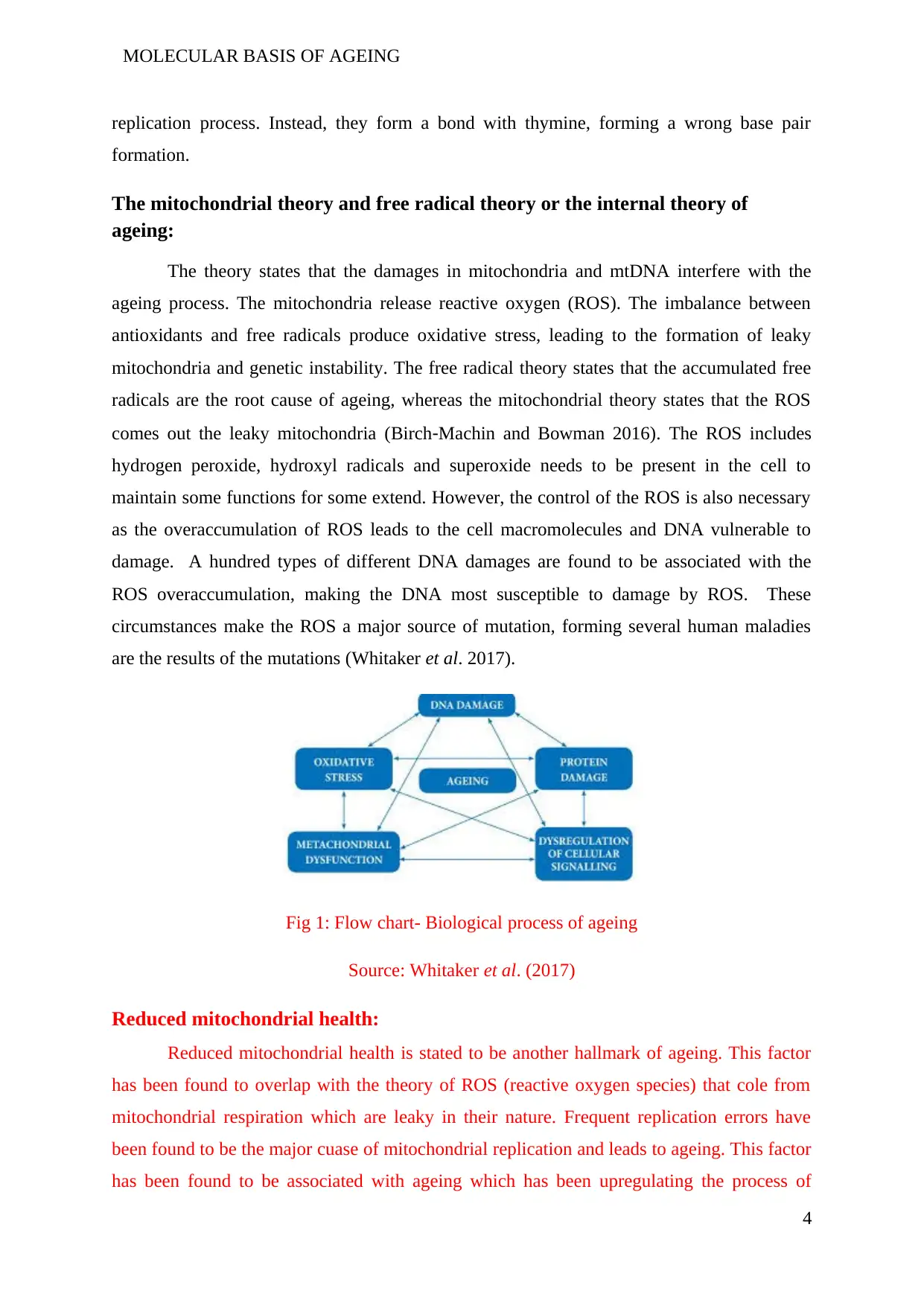
The theory states that the damages in mitochondria and mtDNA interfere with the
ageing process. The mitochondria release reactive oxygen (ROS). The imbalance between
antioxidants and free radicals produce oxidative stress, leading to the formation of leaky
mitochondria and genetic instability. The free radical theory states that the accumulated free
radicals are the root cause of ageing, whereas the mitochondrial theory states that the ROS
comes out the leaky mitochondria (Birch‐Machin and Bowman 2016). The ROS includes
hydrogen peroxide, hydroxyl radicals and superoxide needs to be present in the cell to
maintain some functions for some extend. However, the control of the ROS is also necessary
as the overaccumulation of ROS leads to the cell macromolecules and DNA vulnerable to
damage. A hundred types of different DNA damages are found to be associated with the
ROS overaccumulation, making the DNA most susceptible to damage by ROS. These
circumstances make the ROS a major source of mutation, forming several human maladies
are the results of the mutations (Whitaker et al. 2017).
Fig 1: Flow chart- Biological process of ageing
Source: Whitaker et al. (2017)
Reduced mitochondrial health:
Reduced mitochondrial health is stated to be another hallmark of ageing. This factor
has been found to overlap with the theory of ROS (reactive oxygen species) that cole from
mitochondrial respiration which are leaky in their nature. Frequent replication errors have
been found to be the major cuase of mitochondrial replication and leads to ageing. This factor
has been found to be associated with ageing which has been upregulating the process of
4
replication process. Instead, they form a bond with thymine, forming a wrong base pair
formation.
The mitochondrial theory and free radical theory or the internal theory of
ageing:
The theory states that the damages in mitochondria and mtDNA interfere with the
ageing process. The mitochondria release reactive oxygen (ROS). The imbalance between
antioxidants and free radicals produce oxidative stress, leading to the formation of leaky
mitochondria and genetic instability. The free radical theory states that the accumulated free
radicals are the root cause of ageing, whereas the mitochondrial theory states that the ROS
comes out the leaky mitochondria (Birch‐Machin and Bowman 2016). The ROS includes
hydrogen peroxide, hydroxyl radicals and superoxide needs to be present in the cell to
maintain some functions for some extend. However, the control of the ROS is also necessary
as the overaccumulation of ROS leads to the cell macromolecules and DNA vulnerable to
damage. A hundred types of different DNA damages are found to be associated with the
ROS overaccumulation, making the DNA most susceptible to damage by ROS. These
circumstances make the ROS a major source of mutation, forming several human maladies
are the results of the mutations (Whitaker et al. 2017).
Fig 1: Flow chart- Biological process of ageing
Source: Whitaker et al. (2017)
Reduced mitochondrial health:
Reduced mitochondrial health is stated to be another hallmark of ageing. This factor
has been found to overlap with the theory of ROS (reactive oxygen species) that cole from
mitochondrial respiration which are leaky in their nature. Frequent replication errors have
been found to be the major cuase of mitochondrial replication and leads to ageing. This factor
has been found to be associated with ageing which has been upregulating the process of
4
MOLECULAR BASIS OF AGEING
cellular senescence. Decreased expression of SOD (Super Oxide Dismutase) has been found
to increase the vulnerability of cells to oxidative stress. This factor has been altered
genetically with CuZn-SOD which led to the premature death of all the motor neurons of
cells (Abrahams et al., 2019).
Telomere length and the limit of cell division:
Shortening of telomere has been found to conmtribute directly to ageing and expoise
an individual towards ageing associated health disorders. Telomeres help protect the ends of
chromosomes by providing repetitive segments of DNA with the sequence TTAGGG. These
shorten after every cycle of replication. In de novo syhthesis of telomere, reverse
transcriptase enzyme has been found to add telomere sequences to the 3’ ends of the
chromosome. After several rounds of shortening of telomere, the cells fail to divide again
giving rise to the first signs of ageing (Giraudeau et al. 2019). Telomeres shorten due to a
variety of different reasons, including the replication problem of dna polymerase, processing
of telomeres during cell cycle, reactive oxygen species. Telomeres provide chromosome
stability, as they enable to distinguish between single and double stranded DNA breaks from
normal chromosome ends.
The link between telomere, mitochondria and ageing :
The telomeres damage by the genotoxic stress is associated with the declination of
functions of quiescent organs like liver or heart. The telomerase shortening in the ageing
process is found to be associated with the p53 activation, excess ROS production and
mitochondrial dysfunction. The activation of p53 is correlated with the concentration of ROS
in the time of DNA damage. The p53 activates the antioxidant formation at low oxidative
stress condition. However, the pro-oxidant genes get activated at the high ROS concentration.
The contrasting role played by p53 leads to the mitochondrial dysfunction in little DNA
damage, whereas at a high level of DNA damage the leads to functional declination or
atrophy of the tissue (Meiliana et al. 2017). A model of genotoxic stress claims the p53
telomerase association with all type of molecular ageing phenomena. The association of the
p53 with the ageing process can be supported by the observation of premature ageing of
experimental mice with telomerase dysfunction and hyperactive p53 germline cells (Roake
and Artandi 2017). The SIRT 1 and SIRT 6 are associated with p53. Mice lacking the SIRT
1 and SIRT 6 reduces the function of p53 leading premature ageing. The dysfunction of
mitochondria is also associated with the dysfunctional telomerase or hyperactive p53.
5
cellular senescence. Decreased expression of SOD (Super Oxide Dismutase) has been found
to increase the vulnerability of cells to oxidative stress. This factor has been altered
genetically with CuZn-SOD which led to the premature death of all the motor neurons of
cells (Abrahams et al., 2019).
Telomere length and the limit of cell division:
Shortening of telomere has been found to conmtribute directly to ageing and expoise
an individual towards ageing associated health disorders. Telomeres help protect the ends of
chromosomes by providing repetitive segments of DNA with the sequence TTAGGG. These
shorten after every cycle of replication. In de novo syhthesis of telomere, reverse
transcriptase enzyme has been found to add telomere sequences to the 3’ ends of the
chromosome. After several rounds of shortening of telomere, the cells fail to divide again
giving rise to the first signs of ageing (Giraudeau et al. 2019). Telomeres shorten due to a
variety of different reasons, including the replication problem of dna polymerase, processing
of telomeres during cell cycle, reactive oxygen species. Telomeres provide chromosome
stability, as they enable to distinguish between single and double stranded DNA breaks from
normal chromosome ends.
The link between telomere, mitochondria and ageing :
The telomeres damage by the genotoxic stress is associated with the declination of
functions of quiescent organs like liver or heart. The telomerase shortening in the ageing
process is found to be associated with the p53 activation, excess ROS production and
mitochondrial dysfunction. The activation of p53 is correlated with the concentration of ROS
in the time of DNA damage. The p53 activates the antioxidant formation at low oxidative
stress condition. However, the pro-oxidant genes get activated at the high ROS concentration.
The contrasting role played by p53 leads to the mitochondrial dysfunction in little DNA
damage, whereas at a high level of DNA damage the leads to functional declination or
atrophy of the tissue (Meiliana et al. 2017). A model of genotoxic stress claims the p53
telomerase association with all type of molecular ageing phenomena. The association of the
p53 with the ageing process can be supported by the observation of premature ageing of
experimental mice with telomerase dysfunction and hyperactive p53 germline cells (Roake
and Artandi 2017). The SIRT 1 and SIRT 6 are associated with p53. Mice lacking the SIRT
1 and SIRT 6 reduces the function of p53 leading premature ageing. The dysfunction of
mitochondria is also associated with the dysfunctional telomerase or hyperactive p53.
5
⊘ This is a preview!⊘
Do you want full access?
Subscribe today to unlock all pages.
Trusted by 1+ million students worldwide
MOLECULAR BASIS OF AGEING
Signalling pathway of ageing:
The first signalling pathway associated with the ageing process came into the light by
a detailed study of Caenorhabditis elegans. The life span of the adult worm is observed to be
extended by 100% with the reduces activity of insulin receptor DAF-2 or the
phosphoinositide-3-kinase (PI3K) AGE-1. The reduced activity is a result of mutations. The
activity of the insulin receptor is done by the activation of PI3K-AKT/SGK pathway of
signalling (Farhan et al. 2017). The signalling pathway further activates the negative
regulation of FOXO/DAF-16, which is a forkhead transcription factor. It is also found that
the mutation of insulin receptor extend the lifespan of female Drosophila by 85%, whereas
the mutation in the insulin-receptor substrate(IRS) extend the lifespan of the same species by
48%. FOXO gene extends the lifespan of the Drosophila by 15-52% when it gets
overexpressed. In mice, the deletion of the allele of the insulin-like growth factor leads to a
26% increase in the average age span. The mutation in the adipose tissue-specific insulin
receptor is also observed to be associated with an extended life span of mice by 18%,
whereas the knockout of IRS2 specific to the brain has the same effect as the adipose-specific
IRS.
Epigenetic modification :
Epigenetic modifications such as DNA methylation, histone modification, histone
acetylation and other epigenetic alteration plays a major role in the ageing process. The
chromatin was said to be the main factor of ageing among all the factors, but the recent
studies show the extensive role of histone modification in ageing. The loss of histone is
linked with cell division. The overexpression of histone in a particular species of yeast is
found to be extending the lifespan of them. Whereas, the loss of histone activate some
specific post-translational modifications like autophagy (Orioli and Dellambra 2018).
Prevent Ageing:
The geroscience is a stream which connects the ageing and chronic disease. The
researches of geroscience are focused on a long healthy life. The research of geroscience
aims to enhance the life of an individual by incorporating healthy habits to prevent
medication and enhance healthy long lifespan. The stream recommends approaching a
process that delays the ageing process rather than targeting any specific age-related disease.
Mammalian target of rapamycin or mTOR, a protein kinase that can sense the nutrients are
6
Signalling pathway of ageing:
The first signalling pathway associated with the ageing process came into the light by
a detailed study of Caenorhabditis elegans. The life span of the adult worm is observed to be
extended by 100% with the reduces activity of insulin receptor DAF-2 or the
phosphoinositide-3-kinase (PI3K) AGE-1. The reduced activity is a result of mutations. The
activity of the insulin receptor is done by the activation of PI3K-AKT/SGK pathway of
signalling (Farhan et al. 2017). The signalling pathway further activates the negative
regulation of FOXO/DAF-16, which is a forkhead transcription factor. It is also found that
the mutation of insulin receptor extend the lifespan of female Drosophila by 85%, whereas
the mutation in the insulin-receptor substrate(IRS) extend the lifespan of the same species by
48%. FOXO gene extends the lifespan of the Drosophila by 15-52% when it gets
overexpressed. In mice, the deletion of the allele of the insulin-like growth factor leads to a
26% increase in the average age span. The mutation in the adipose tissue-specific insulin
receptor is also observed to be associated with an extended life span of mice by 18%,
whereas the knockout of IRS2 specific to the brain has the same effect as the adipose-specific
IRS.
Epigenetic modification :
Epigenetic modifications such as DNA methylation, histone modification, histone
acetylation and other epigenetic alteration plays a major role in the ageing process. The
chromatin was said to be the main factor of ageing among all the factors, but the recent
studies show the extensive role of histone modification in ageing. The loss of histone is
linked with cell division. The overexpression of histone in a particular species of yeast is
found to be extending the lifespan of them. Whereas, the loss of histone activate some
specific post-translational modifications like autophagy (Orioli and Dellambra 2018).
Prevent Ageing:
The geroscience is a stream which connects the ageing and chronic disease. The
researches of geroscience are focused on a long healthy life. The research of geroscience
aims to enhance the life of an individual by incorporating healthy habits to prevent
medication and enhance healthy long lifespan. The stream recommends approaching a
process that delays the ageing process rather than targeting any specific age-related disease.
Mammalian target of rapamycin or mTOR, a protein kinase that can sense the nutrients are
6
Paraphrase This Document
Need a fresh take? Get an instant paraphrase of this document with our AI Paraphraser
MOLECULAR BASIS OF AGEING
targeted to prevent the ageing process (Stallone et al. 2019). Increasing the function of
telomerase and inhibiting apoptotic factors is another approach to prevent the ageing process.
Conclusion :
Ageing is a natural process and inevitable. The process is complex and involves
molecular and genetic mechanism to occur and control. According to a report of world health
organization, cardiovascular diseases cause the highest number of death worldwide, causing
17.9 million deaths worldwide every year. Heart attack and strokes cause one-fourth of the
total death among the total deaths by cardiovascular diseases (who.int, 2020). Death by non-
communicable and chronic diseases, like cancer and diabetes, contributes to 73% of death
globally (who.int, 2020). The total population of the world will increase from 12% to 22%,
nearly doubling the population number. WHO claims that the death rate of children will be
lesser than the number of death of older people with the age of 60 or above. Also, according
to a report of WHO the pace of ageing will increase than the previous pace (who.int, 2020).
Some popular age-related theories are based on molecular mechanism, genetics, signalling
pathway and epigenetic modifications are discussed here in details. Medical science aimed to
extend the average lifespan of the human being for a long time, which is not the aim of
medical science anymore. Modern science aims to increase the healthy disease-free lifespan
of the population. The findings of many research based on the ageing process lead to the
incorporation of different factors to prevent ageing. However, the ageing process cannot be
inhibited totally, though the healthy lifespan can be increased by eliminating diseases.
7
targeted to prevent the ageing process (Stallone et al. 2019). Increasing the function of
telomerase and inhibiting apoptotic factors is another approach to prevent the ageing process.
Conclusion :
Ageing is a natural process and inevitable. The process is complex and involves
molecular and genetic mechanism to occur and control. According to a report of world health
organization, cardiovascular diseases cause the highest number of death worldwide, causing
17.9 million deaths worldwide every year. Heart attack and strokes cause one-fourth of the
total death among the total deaths by cardiovascular diseases (who.int, 2020). Death by non-
communicable and chronic diseases, like cancer and diabetes, contributes to 73% of death
globally (who.int, 2020). The total population of the world will increase from 12% to 22%,
nearly doubling the population number. WHO claims that the death rate of children will be
lesser than the number of death of older people with the age of 60 or above. Also, according
to a report of WHO the pace of ageing will increase than the previous pace (who.int, 2020).
Some popular age-related theories are based on molecular mechanism, genetics, signalling
pathway and epigenetic modifications are discussed here in details. Medical science aimed to
extend the average lifespan of the human being for a long time, which is not the aim of
medical science anymore. Modern science aims to increase the healthy disease-free lifespan
of the population. The findings of many research based on the ageing process lead to the
incorporation of different factors to prevent ageing. However, the ageing process cannot be
inhibited totally, though the healthy lifespan can be increased by eliminating diseases.
7
MOLECULAR BASIS OF AGEING
Reference:
Aunan, J.R., Watson, M.M., Hagland, H.R. and Søreide, K., 2016. Molecular and biological
hallmarks of ageing. British Journal of Surgery, 103(2), pp.e29-e46.
Birch‐Machin, M.A. and Bowman, A., 2016. Oxidative stress and ageing. British Journal of
Dermatology, 175, pp.26-29.
cdc.gov (2020). Achievements in Public Health, 1900-1999: Control of Infectious Diseases.
[online] Cdc.gov. Available at:
https://www.cdc.gov/mmwr/preview/mmwrhtml/mm4829a1.htm/ [Accessed 24 Feb. 2020].
Farhan, M., Wang, H., Gaur, U., Little, P.J., Xu, J. and Zheng, W., 2017. FOXO signaling
pathways as therapeutic targets in cancer. International journal of biological sciences, 13(7),
p.815.
Maynard, S., Fang, E.F., Scheibye-Knudsen, M., Croteau, D.L. and Bohr, V.A., 2015. DNA
damage, DNA repair, aging, and neurodegeneration. Cold Spring Harbor perspectives in
medicine, 5(10), p.a025130.
Meiliana, A., Dewi, N.M. and Wijaya, A., 2017. Telomeres and Telomerase in The Aging
Heart. The Indonesian Biomedical Journal, 9(3), pp.129-42.
Orioli, D. and Dellambra, E., 2018. Epigenetic regulation of skin cells in natural aging and
premature aging diseases. Cells, 7(12), p.268.
Pole, A., Dimri, M. and Dimri, G.P., 2016. Oxidative stress, cellular senescence and
ageing. AIMS Molecular Science, 3(3).
Prakash, R., Zhang, Y., Feng, W. and Jasin, M., 2015. Homologous recombination and
human health: the roles of BRCA1, BRCA2, and associated proteins. Cold Spring Harbor
perspectives in biology, 7(4), p.a016600.
Roake, C.M. and Artandi, S.E., 2017. Control of cellular aging, tissue function, and cancer by
p53 downstream of telomeres. Cold Spring Harbor perspectives in medicine, 7(5), p.a026088.
Stallone, G., Infante, B., Prisciandaro, C. and Grandaliano, G., 2019. mtor and aging: An old
fashioned dress. International journal of molecular sciences, 20(11), p.2774.
8
Reference:
Aunan, J.R., Watson, M.M., Hagland, H.R. and Søreide, K., 2016. Molecular and biological
hallmarks of ageing. British Journal of Surgery, 103(2), pp.e29-e46.
Birch‐Machin, M.A. and Bowman, A., 2016. Oxidative stress and ageing. British Journal of
Dermatology, 175, pp.26-29.
cdc.gov (2020). Achievements in Public Health, 1900-1999: Control of Infectious Diseases.
[online] Cdc.gov. Available at:
https://www.cdc.gov/mmwr/preview/mmwrhtml/mm4829a1.htm/ [Accessed 24 Feb. 2020].
Farhan, M., Wang, H., Gaur, U., Little, P.J., Xu, J. and Zheng, W., 2017. FOXO signaling
pathways as therapeutic targets in cancer. International journal of biological sciences, 13(7),
p.815.
Maynard, S., Fang, E.F., Scheibye-Knudsen, M., Croteau, D.L. and Bohr, V.A., 2015. DNA
damage, DNA repair, aging, and neurodegeneration. Cold Spring Harbor perspectives in
medicine, 5(10), p.a025130.
Meiliana, A., Dewi, N.M. and Wijaya, A., 2017. Telomeres and Telomerase in The Aging
Heart. The Indonesian Biomedical Journal, 9(3), pp.129-42.
Orioli, D. and Dellambra, E., 2018. Epigenetic regulation of skin cells in natural aging and
premature aging diseases. Cells, 7(12), p.268.
Pole, A., Dimri, M. and Dimri, G.P., 2016. Oxidative stress, cellular senescence and
ageing. AIMS Molecular Science, 3(3).
Prakash, R., Zhang, Y., Feng, W. and Jasin, M., 2015. Homologous recombination and
human health: the roles of BRCA1, BRCA2, and associated proteins. Cold Spring Harbor
perspectives in biology, 7(4), p.a016600.
Roake, C.M. and Artandi, S.E., 2017. Control of cellular aging, tissue function, and cancer by
p53 downstream of telomeres. Cold Spring Harbor perspectives in medicine, 7(5), p.a026088.
Stallone, G., Infante, B., Prisciandaro, C. and Grandaliano, G., 2019. mtor and aging: An old
fashioned dress. International journal of molecular sciences, 20(11), p.2774.
8
⊘ This is a preview!⊘
Do you want full access?
Subscribe today to unlock all pages.
Trusted by 1+ million students worldwide
MOLECULAR BASIS OF AGEING
Stjernborg, V., Wretstrand, A. and Tesfahuney, M., 2015. Everyday life mobilities of older
persons–a case study of ageing in a suburban landscape in Sweden. Mobilities, 10(3), pp.383-
401.
Whitaker, A.M., Schaich, M.A., Smith, M.S., Flynn, T.S. and Freudenthal, B.D., 2017. Base
excision repair of oxidative DNA damage: from mechanism to disease. Frontiers in
bioscience (Landmark edition), 22, p.1493.
who.int (2020). [online] Who.int. Available at:
https://www.who.int/nmh/publications/ncd_report_full_en.pdf [Accessed 24 Feb. 2020].
who.int (2020). Ageing and health. [online] Who.int. Available at:
https://www.who.int/news-room/fact-sheets/detail/ageing-and-health [Accessed 24 Feb.
2020].
who.int (2020). Cardiovascular diseases. [online] Who.int. Available at:
https://www.who.int/health-topics/cardiovascular-diseases/#tab=tab_1 [Accessed 24 Feb.
2020].
Zhang, J., Rane, G., Dai, X., Shanmugam, M.K., Arfuso, F., Samy, R.P., Lai, M.K.P.,
Kappei, D., Kumar, A.P. and Sethi, G., 2016. Ageing and the telomere connection: An
intimate relationship with inflammation. Ageing research reviews, 25, pp.55-69.
Abrahams, S., Haylett, W.L., Johnson, G., Carr, J.A. and Bardien, S., 2019. Antioxidant
Effects of Curcumin in Models of Neurodegeneration, Ageing, Oxidative and
NITROSATIVE Stress: A Review. Neuroscience.
Giraudeau, M., Heidinger, B., Bonneaud, C. and Sepp, T., 2019. Telomere shortening as a
mechanism of long-term cost of infectious diseases in natural animal populations. Biology
letters, 15(5), p.20190190.
9
Stjernborg, V., Wretstrand, A. and Tesfahuney, M., 2015. Everyday life mobilities of older
persons–a case study of ageing in a suburban landscape in Sweden. Mobilities, 10(3), pp.383-
401.
Whitaker, A.M., Schaich, M.A., Smith, M.S., Flynn, T.S. and Freudenthal, B.D., 2017. Base
excision repair of oxidative DNA damage: from mechanism to disease. Frontiers in
bioscience (Landmark edition), 22, p.1493.
who.int (2020). [online] Who.int. Available at:
https://www.who.int/nmh/publications/ncd_report_full_en.pdf [Accessed 24 Feb. 2020].
who.int (2020). Ageing and health. [online] Who.int. Available at:
https://www.who.int/news-room/fact-sheets/detail/ageing-and-health [Accessed 24 Feb.
2020].
who.int (2020). Cardiovascular diseases. [online] Who.int. Available at:
https://www.who.int/health-topics/cardiovascular-diseases/#tab=tab_1 [Accessed 24 Feb.
2020].
Zhang, J., Rane, G., Dai, X., Shanmugam, M.K., Arfuso, F., Samy, R.P., Lai, M.K.P.,
Kappei, D., Kumar, A.P. and Sethi, G., 2016. Ageing and the telomere connection: An
intimate relationship with inflammation. Ageing research reviews, 25, pp.55-69.
Abrahams, S., Haylett, W.L., Johnson, G., Carr, J.A. and Bardien, S., 2019. Antioxidant
Effects of Curcumin in Models of Neurodegeneration, Ageing, Oxidative and
NITROSATIVE Stress: A Review. Neuroscience.
Giraudeau, M., Heidinger, B., Bonneaud, C. and Sepp, T., 2019. Telomere shortening as a
mechanism of long-term cost of infectious diseases in natural animal populations. Biology
letters, 15(5), p.20190190.
9

1 out of 10


Your All-in-One AI-Powered Toolkit for Academic Success.
+13062052269
info@desklib.com
Available 24*7 on WhatsApp / Email
![[object Object]](/_next/static/media/star-bottom.7253800d.svg)
Unlock your academic potential
Copyright © 2020–2026 A2Z Services. All Rights Reserved. Developed and managed by ZUCOL.