Analysis of Molecular Imaging Target Properties and Radio-labeling
VerifiedAdded on 2023/06/10
|6
|1035
|489
Report
AI Summary
This report provides a detailed overview of the properties of molecular imaging targets, emphasizing their significance in drug development and clinical applications. It discusses the factors influencing imaging target properties, such as size and lipophilicity, and categorizes imaging based on structural and functional aspects, including MRI and single emission tomography. The report also focuses on the properties a drug should possess for development into a radio-tracer, highlighting target modulation, druggability, and target expression. It further explores considerations for radio-labeling molecules, focusing on PET and SPECT imaging modalities, and emphasizes the importance of biocompatibility and safety in drug development. The report concludes by underscoring the role of PET imaging in visualizing brain tumors and understanding molecular targets.
Properity of molecular imaging target
1
1
Paraphrase This Document
Need a fresh take? Get an instant paraphrase of this document with our AI Paraphraser

Contents
Questions................................................................................................................................3
REFERENCES...........................................................................................................................6
2
Questions................................................................................................................................3
REFERENCES...........................................................................................................................6
2

Questions
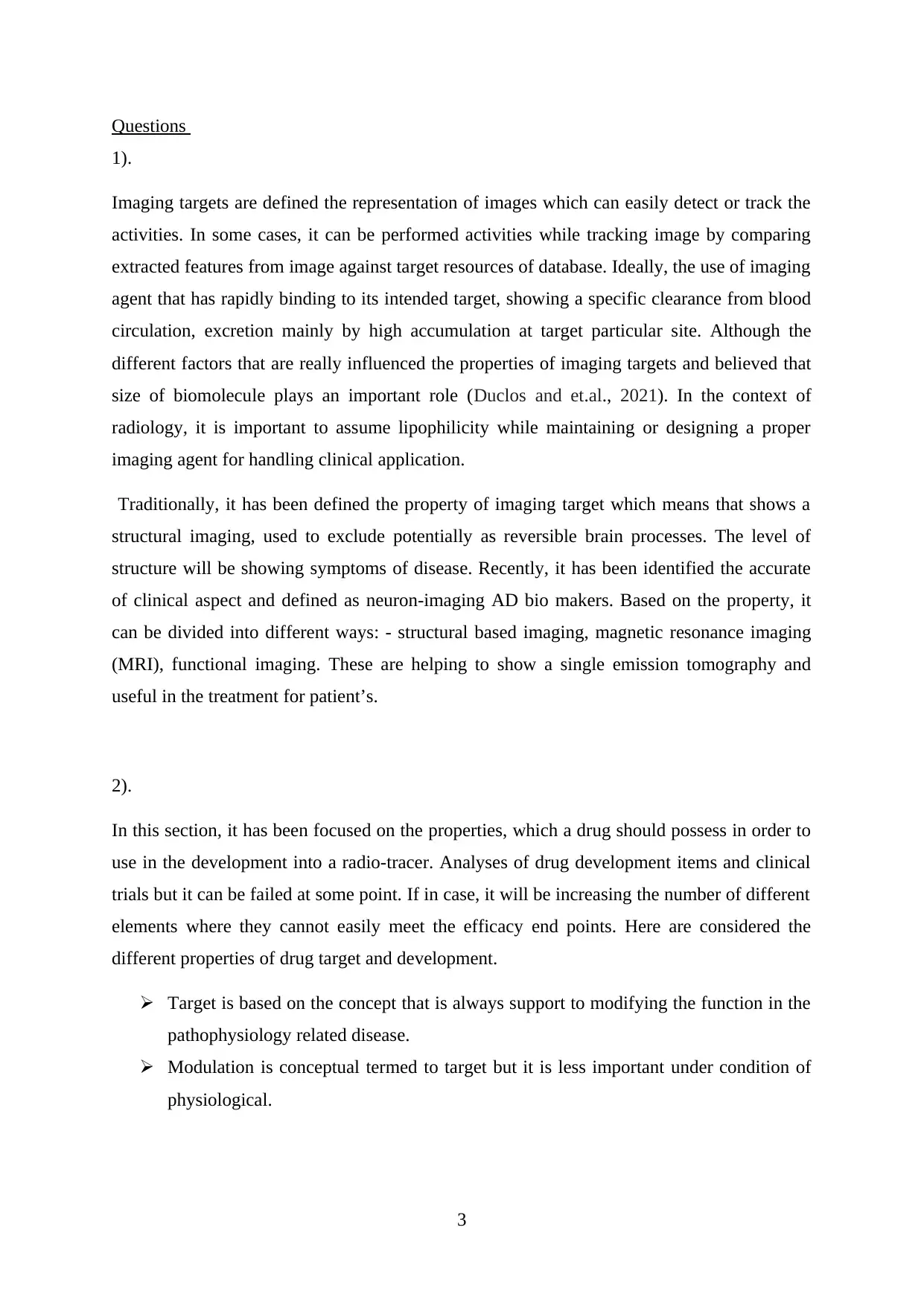
1).
Imaging targets are defined the representation of images which can easily detect or track the
activities. In some cases, it can be performed activities while tracking image by comparing
extracted features from image against target resources of database. Ideally, the use of imaging
agent that has rapidly binding to its intended target, showing a specific clearance from blood
circulation, excretion mainly by high accumulation at target particular site. Although the
different factors that are really influenced the properties of imaging targets and believed that
size of biomolecule plays an important role (Duclos and et.al., 2021). In the context of
radiology, it is important to assume lipophilicity while maintaining or designing a proper
imaging agent for handling clinical application.
Traditionally, it has been defined the property of imaging target which means that shows a
structural imaging, used to exclude potentially as reversible brain processes. The level of
structure will be showing symptoms of disease. Recently, it has been identified the accurate
of clinical aspect and defined as neuron-imaging AD bio makers. Based on the property, it
can be divided into different ways: - structural based imaging, magnetic resonance imaging
(MRI), functional imaging. These are helping to show a single emission tomography and
useful in the treatment for patient’s.
2).
In this section, it has been focused on the properties, which a drug should possess in order to
use in the development into a radio-tracer. Analyses of drug development items and clinical
trials but it can be failed at some point. If in case, it will be increasing the number of different
elements where they cannot easily meet the efficacy end points. Here are considered the
different properties of drug target and development.
Target is based on the concept that is always support to modifying the function in the
pathophysiology related disease.
Modulation is conceptual termed to target but it is less important under condition of
physiological.
3
1).
Imaging targets are defined the representation of images which can easily detect or track the
activities. In some cases, it can be performed activities while tracking image by comparing
extracted features from image against target resources of database. Ideally, the use of imaging
agent that has rapidly binding to its intended target, showing a specific clearance from blood
circulation, excretion mainly by high accumulation at target particular site. Although the
different factors that are really influenced the properties of imaging targets and believed that
size of biomolecule plays an important role (Duclos and et.al., 2021). In the context of
radiology, it is important to assume lipophilicity while maintaining or designing a proper
imaging agent for handling clinical application.
Traditionally, it has been defined the property of imaging target which means that shows a
structural imaging, used to exclude potentially as reversible brain processes. The level of
structure will be showing symptoms of disease. Recently, it has been identified the accurate
of clinical aspect and defined as neuron-imaging AD bio makers. Based on the property, it
can be divided into different ways: - structural based imaging, magnetic resonance imaging
(MRI), functional imaging. These are helping to show a single emission tomography and
useful in the treatment for patient’s.
2).
In this section, it has been focused on the properties, which a drug should possess in order to
use in the development into a radio-tracer. Analyses of drug development items and clinical
trials but it can be failed at some point. If in case, it will be increasing the number of different
elements where they cannot easily meet the efficacy end points. Here are considered the
different properties of drug target and development.
Target is based on the concept that is always support to modifying the function in the
pathophysiology related disease.
Modulation is conceptual termed to target but it is less important under condition of
physiological.
3
⊘ This is a preview!⊘
Do you want full access?
Subscribe today to unlock all pages.

Trusted by 1+ million students worldwide

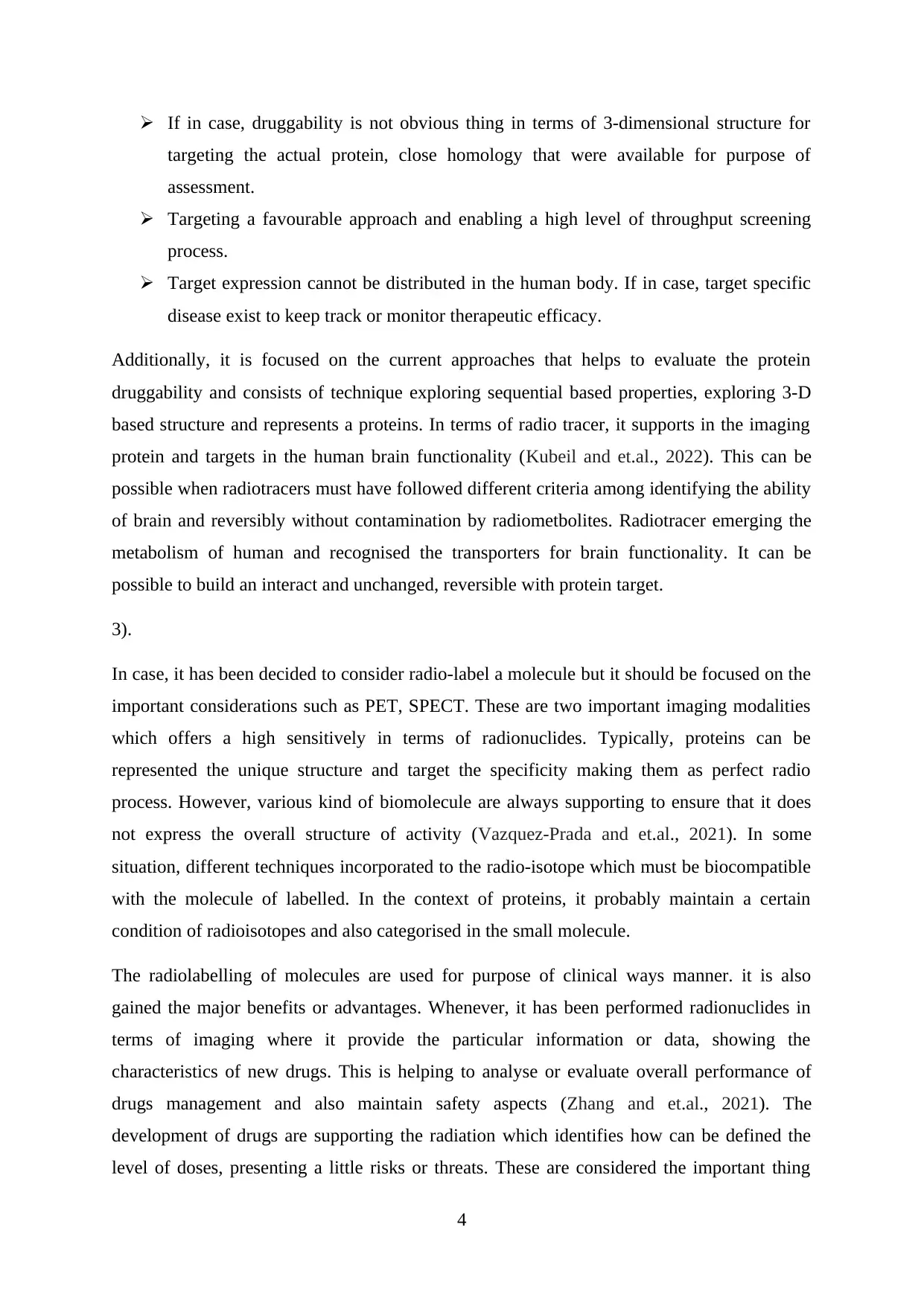
If in case, druggability is not obvious thing in terms of 3-dimensional structure for
targeting the actual protein, close homology that were available for purpose of
assessment.
Targeting a favourable approach and enabling a high level of throughput screening
process.
Target expression cannot be distributed in the human body. If in case, target specific
disease exist to keep track or monitor therapeutic efficacy.
Additionally, it is focused on the current approaches that helps to evaluate the protein
druggability and consists of technique exploring sequential based properties, exploring 3-D
based structure and represents a proteins. In terms of radio tracer, it supports in the imaging
protein and targets in the human brain functionality (Kubeil and et.al., 2022). This can be
possible when radiotracers must have followed different criteria among identifying the ability
of brain and reversibly without contamination by radiometbolites. Radiotracer emerging the
metabolism of human and recognised the transporters for brain functionality. It can be
possible to build an interact and unchanged, reversible with protein target.
3).
In case, it has been decided to consider radio-label a molecule but it should be focused on the
important considerations such as PET, SPECT. These are two important imaging modalities
which offers a high sensitively in terms of radionuclides. Typically, proteins can be
represented the unique structure and target the specificity making them as perfect radio
process. However, various kind of biomolecule are always supporting to ensure that it does
not express the overall structure of activity (Vazquez-Prada and et.al., 2021). In some
situation, different techniques incorporated to the radio-isotope which must be biocompatible
with the molecule of labelled. In the context of proteins, it probably maintain a certain
condition of radioisotopes and also categorised in the small molecule.
The radiolabelling of molecules are used for purpose of clinical ways manner. it is also
gained the major benefits or advantages. Whenever, it has been performed radionuclides in
terms of imaging where it provide the particular information or data, showing the
characteristics of new drugs. This is helping to analyse or evaluate overall performance of
drugs management and also maintain safety aspects (Zhang and et.al., 2021). The
development of drugs are supporting the radiation which identifies how can be defined the
level of doses, presenting a little risks or threats. These are considered the important thing
4
targeting the actual protein, close homology that were available for purpose of
assessment.
Targeting a favourable approach and enabling a high level of throughput screening
process.
Target expression cannot be distributed in the human body. If in case, target specific
disease exist to keep track or monitor therapeutic efficacy.
Additionally, it is focused on the current approaches that helps to evaluate the protein
druggability and consists of technique exploring sequential based properties, exploring 3-D
based structure and represents a proteins. In terms of radio tracer, it supports in the imaging
protein and targets in the human brain functionality (Kubeil and et.al., 2022). This can be
possible when radiotracers must have followed different criteria among identifying the ability
of brain and reversibly without contamination by radiometbolites. Radiotracer emerging the
metabolism of human and recognised the transporters for brain functionality. It can be
possible to build an interact and unchanged, reversible with protein target.
3).
In case, it has been decided to consider radio-label a molecule but it should be focused on the
important considerations such as PET, SPECT. These are two important imaging modalities
which offers a high sensitively in terms of radionuclides. Typically, proteins can be
represented the unique structure and target the specificity making them as perfect radio
process. However, various kind of biomolecule are always supporting to ensure that it does
not express the overall structure of activity (Vazquez-Prada and et.al., 2021). In some
situation, different techniques incorporated to the radio-isotope which must be biocompatible
with the molecule of labelled. In the context of proteins, it probably maintain a certain
condition of radioisotopes and also categorised in the small molecule.
The radiolabelling of molecules are used for purpose of clinical ways manner. it is also
gained the major benefits or advantages. Whenever, it has been performed radionuclides in
terms of imaging where it provide the particular information or data, showing the
characteristics of new drugs. This is helping to analyse or evaluate overall performance of
drugs management and also maintain safety aspects (Zhang and et.al., 2021). The
development of drugs are supporting the radiation which identifies how can be defined the
level of doses, presenting a little risks or threats. These are considered the important thing
4
Paraphrase This Document
Need a fresh take? Get an instant paraphrase of this document with our AI Paraphraser

that needs to be targeting the entire system and provide invaluable knowledge about the
targets molecular. In order to use the PET imaging that can be utilised positrons, emitted by
rich level of nuclei based protein. These are directly interacted to create two gamma photons,
produced at 180 degree angle. PET is considered the most important tool in terms of imaging
the brain tumors.
5
targets molecular. In order to use the PET imaging that can be utilised positrons, emitted by
rich level of nuclei based protein. These are directly interacted to create two gamma photons,
produced at 180 degree angle. PET is considered the most important tool in terms of imaging
the brain tumors.
5

REFERENCES
Book and Journals
Duclos, V. and et.al., 2021. PET molecular imaging: A holistic review of current practice and
emerging perspectives for diagnosis, therapeutic evaluation and prognosis in clinical
oncology. International journal of molecular sciences. 22(8). p.4159.
Kubeil, M. and et.al., 2022. Dual-Labelling Strategies for Nuclear and Fluorescence
Molecular Imaging: Current Status and Future Perspectives. Pharmaceuticals. 15(4).
p.432.
Vazquez-Prada, K.X. and et.al., 2021. Targeted molecular imaging of cardiovascular
diseases by iron oxide nanoparticles. Arteriosclerosis, Thrombosis, and Vascular
Biology. 41(2). pp.601-613.
Zhang, C. and et.al., 2021. Biological utility of fluorinated compounds: from materials
design to molecular imaging, therapeutics and environmental remediation. Chemical
Reviews. 122(1). pp.167-208.
6
Book and Journals
Duclos, V. and et.al., 2021. PET molecular imaging: A holistic review of current practice and
emerging perspectives for diagnosis, therapeutic evaluation and prognosis in clinical
oncology. International journal of molecular sciences. 22(8). p.4159.
Kubeil, M. and et.al., 2022. Dual-Labelling Strategies for Nuclear and Fluorescence
Molecular Imaging: Current Status and Future Perspectives. Pharmaceuticals. 15(4).
p.432.
Vazquez-Prada, K.X. and et.al., 2021. Targeted molecular imaging of cardiovascular
diseases by iron oxide nanoparticles. Arteriosclerosis, Thrombosis, and Vascular
Biology. 41(2). pp.601-613.
Zhang, C. and et.al., 2021. Biological utility of fluorinated compounds: from materials
design to molecular imaging, therapeutics and environmental remediation. Chemical
Reviews. 122(1). pp.167-208.
6
⊘ This is a preview!⊘
Do you want full access?
Subscribe today to unlock all pages.

Trusted by 1+ million students worldwide
1 out of 6
Related Documents
Your All-in-One AI-Powered Toolkit for Academic Success.
+13062052269
info@desklib.com
Available 24*7 on WhatsApp / Email
Unlock your academic potential
Copyright © 2020–2026 A2Z Services. All Rights Reserved. Developed and managed by ZUCOL.