UAE Monetary Policies: Impact on Bank Borrowing in Banking Sector
VerifiedAdded on 2023/06/10
|45
|14833
|82
Thesis and Dissertation
AI Summary
This dissertation investigates the impact of UAE monetary policies and procedures on bank borrowing within the banking industry, specifically focusing on Emirates National Bank of Dubai. The study examines the influence of various policies, including reserve requirements, discount rates, open market operations, inflation, and interest rates. The research employs both qualitative and quantitative methods, including questionnaires and interviews, to gather data and analyze the relationships between these policies and bank borrowing practices. The literature review explores the contributions and drawbacks of UAE monetary policy, assessing its impact on the banking sector. The dissertation aims to provide recommendations to the UAE government to mitigate any negative impacts and promote a more stable and effective banking environment. The findings highlight the strengths and weaknesses of UAE monetary policies, offering valuable insights into the dynamics of bank borrowing within the context of the UAE's financial landscape.
Dissertation: Impact of using monetary UAE policies and
procedures on bank borrowing within the banking industry
procedures on bank borrowing within the banking industry

Paraphrase This Document
Need a fresh take? Get an instant paraphrase of this document with our AI Paraphraser
EXECUTIVE SUMMARY
It has been analysed from the dissertation that dissertation aims to investigate the impact of
using different UAE policies and procedures on bank borrowing within the banking industry: A
study on Emirates National Bank of Dubai.
The Aim and Scope of the study are determined by analysing the impact of using different
UAE policies and procedures on Bank borrowing within the banking industry. This has been
performed by understanding the scope of what the dissertation is delivering. The significance of
the research is that it helps in knowing and gathering information about the impact of using
different policies on Bank borrowing within the Banking System.
Limitations of the study have been found and addressed as idealising the points and aspects
identified as having less time for the research to be completed.
It has been analysed from the dissertation that all details have been gathered with specific
knowledge and understanding at a large scale. This has helped to evaluate the purpose of the
research being directed appropriately and at a large scale. A detailed analysis of all the aspects
used within the research has been done correctly. The results have gained significant data, and
analysis through the interpretation of the data was done appropriately in graphs. This is the
manner which helps in signifying that the research has been framed by focusing on step by step
formation of the study being framed appropriately. This primary concern has helped illustrate
that the research aims to produce the plans and procedures by working appropriately. This has
been more significant and indicative of the large-scale conclusions and findings.
It has been analysed from the dissertation that dissertation aims to investigate the impact of
using different UAE policies and procedures on bank borrowing within the banking industry: A
study on Emirates National Bank of Dubai.
The Aim and Scope of the study are determined by analysing the impact of using different
UAE policies and procedures on Bank borrowing within the banking industry. This has been
performed by understanding the scope of what the dissertation is delivering. The significance of
the research is that it helps in knowing and gathering information about the impact of using
different policies on Bank borrowing within the Banking System.
Limitations of the study have been found and addressed as idealising the points and aspects
identified as having less time for the research to be completed.
It has been analysed from the dissertation that all details have been gathered with specific
knowledge and understanding at a large scale. This has helped to evaluate the purpose of the
research being directed appropriately and at a large scale. A detailed analysis of all the aspects
used within the research has been done correctly. The results have gained significant data, and
analysis through the interpretation of the data was done appropriately in graphs. This is the
manner which helps in signifying that the research has been framed by focusing on step by step
formation of the study being framed appropriately. This primary concern has helped illustrate
that the research aims to produce the plans and procedures by working appropriately. This has
been more significant and indicative of the large-scale conclusions and findings.
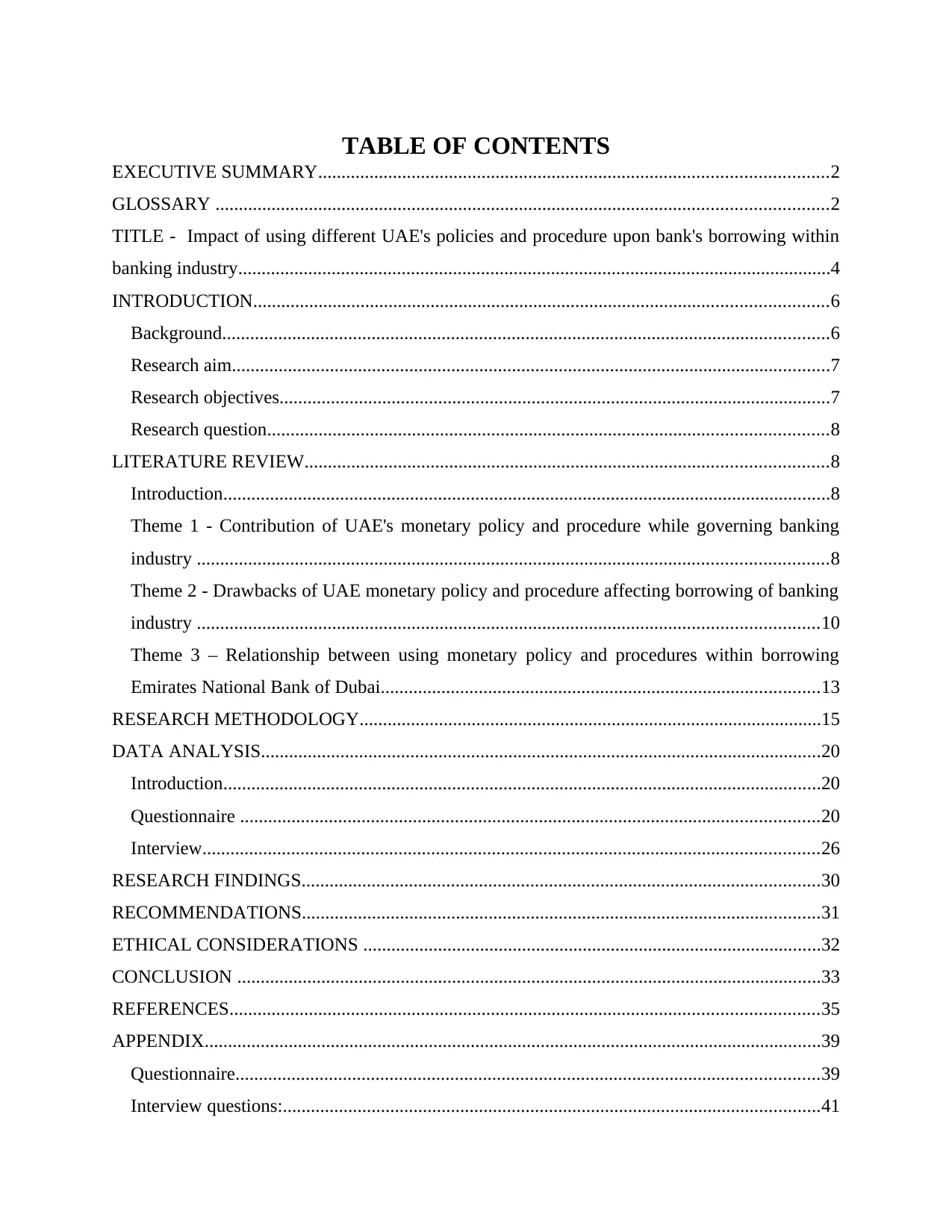
TABLE OF CONTENTS
EXECUTIVE SUMMARY.............................................................................................................2
GLOSSARY ...................................................................................................................................2
TITLE - Impact of using different UAE's policies and procedure upon bank's borrowing within
banking industry...............................................................................................................................4
INTRODUCTION...........................................................................................................................6
Background..................................................................................................................................6
Research aim................................................................................................................................7
Research objectives......................................................................................................................7
Research question........................................................................................................................8
LITERATURE REVIEW................................................................................................................8
Introduction..................................................................................................................................8
Theme 1 - Contribution of UAE's monetary policy and procedure while governing banking
industry .......................................................................................................................................8
Theme 2 - Drawbacks of UAE monetary policy and procedure affecting borrowing of banking
industry .....................................................................................................................................10
Theme 3 – Relationship between using monetary policy and procedures within borrowing
Emirates National Bank of Dubai..............................................................................................13
RESEARCH METHODOLOGY...................................................................................................15
DATA ANALYSIS........................................................................................................................20
Introduction................................................................................................................................20
Questionnaire ............................................................................................................................20
Interview....................................................................................................................................26
RESEARCH FINDINGS...............................................................................................................30
RECOMMENDATIONS...............................................................................................................31
ETHICAL CONSIDERATIONS ..................................................................................................32
CONCLUSION .............................................................................................................................33
REFERENCES..............................................................................................................................35
APPENDIX....................................................................................................................................39
Questionnaire.............................................................................................................................39
Interview questions:...................................................................................................................41
EXECUTIVE SUMMARY.............................................................................................................2
GLOSSARY ...................................................................................................................................2
TITLE - Impact of using different UAE's policies and procedure upon bank's borrowing within
banking industry...............................................................................................................................4
INTRODUCTION...........................................................................................................................6
Background..................................................................................................................................6
Research aim................................................................................................................................7
Research objectives......................................................................................................................7
Research question........................................................................................................................8
LITERATURE REVIEW................................................................................................................8
Introduction..................................................................................................................................8
Theme 1 - Contribution of UAE's monetary policy and procedure while governing banking
industry .......................................................................................................................................8
Theme 2 - Drawbacks of UAE monetary policy and procedure affecting borrowing of banking
industry .....................................................................................................................................10
Theme 3 – Relationship between using monetary policy and procedures within borrowing
Emirates National Bank of Dubai..............................................................................................13
RESEARCH METHODOLOGY...................................................................................................15
DATA ANALYSIS........................................................................................................................20
Introduction................................................................................................................................20
Questionnaire ............................................................................................................................20
Interview....................................................................................................................................26
RESEARCH FINDINGS...............................................................................................................30
RECOMMENDATIONS...............................................................................................................31
ETHICAL CONSIDERATIONS ..................................................................................................32
CONCLUSION .............................................................................................................................33
REFERENCES..............................................................................................................................35
APPENDIX....................................................................................................................................39
Questionnaire.............................................................................................................................39
Interview questions:...................................................................................................................41
⊘ This is a preview!⊘
Do you want full access?
Subscribe today to unlock all pages.

Trusted by 1+ million students worldwide
INTRODUCTION
Higher authorities in the United Arab Emirates have assured keen focus on making
different UAE policies that have impacted the bank's borrowing within the banking industry
(Osmanovica et al., 2020). The banking sector significantly impacts the country's economy (Al
Ali, 2021). Thus, the impact that has been created on the bank directly impacts the country's
economy. Therefore, the policies taken into consideration must be taken in such a way that they
help add effectiveness to the nation's economy. However, the impacts of the selected policies can
be positive and negative (Alhosani et al., 2019). The same might goes with the impact of the
UAE's policies... Various policies have been taken in the UAE to assure fluent economic growth.
For example- Monetary policies in UK are the main policy which is stablilising the economic
growth within mainraining the cash flow in economy. (Ashok and Baskaran, 2022). However,
the banking sector plays a vital role in driving the economy as the banking sector mainly
determines the cash flow in the economy withing depositing and crediting fund to the public.
An outlook of the UAE banking sector has revealed that banks have experienced the
impact of UAE's policies in positive and negative ways. UAE's banking system mainly operates
within a sustainable gross debt position of 23%. (Darayseh and Alsharari, 2022). This has been
determined as the significant amount that can be used for external liquid assets. However, it can
only be used when the bank's access to external funding is not restricted. Support of the
government to the banking sector by reducing restrictions can be proven effective (Naimy and
Kattan, 2020). Thus, support has been created for implementing policies. Sometimes, access has
been assured, and sometimes, restrictions have been made within implementing UAE's policies.
Thus, different UAE policies impacted banks and influenced the banking industry's borrowing
procedure. In this manner, an impact has also been created on the economy. The research
outcomes will show the strengths and weaknesses of UAE monetary policy while governing the
banking industry.
Background
The UAE's banking sector has to deal with less stability regarding the economy's positive
outlook. Lowering oil prices and higher interest rates has become a significant hurdle for UAE's
banking sector as it impacts the return on assets and equity (Muhammad, Basha and AlHafidh,
2019). The real estate sector has been undergoing a correction, and the debt level among
Higher authorities in the United Arab Emirates have assured keen focus on making
different UAE policies that have impacted the bank's borrowing within the banking industry
(Osmanovica et al., 2020). The banking sector significantly impacts the country's economy (Al
Ali, 2021). Thus, the impact that has been created on the bank directly impacts the country's
economy. Therefore, the policies taken into consideration must be taken in such a way that they
help add effectiveness to the nation's economy. However, the impacts of the selected policies can
be positive and negative (Alhosani et al., 2019). The same might goes with the impact of the
UAE's policies... Various policies have been taken in the UAE to assure fluent economic growth.
For example- Monetary policies in UK are the main policy which is stablilising the economic
growth within mainraining the cash flow in economy. (Ashok and Baskaran, 2022). However,
the banking sector plays a vital role in driving the economy as the banking sector mainly
determines the cash flow in the economy withing depositing and crediting fund to the public.
An outlook of the UAE banking sector has revealed that banks have experienced the
impact of UAE's policies in positive and negative ways. UAE's banking system mainly operates
within a sustainable gross debt position of 23%. (Darayseh and Alsharari, 2022). This has been
determined as the significant amount that can be used for external liquid assets. However, it can
only be used when the bank's access to external funding is not restricted. Support of the
government to the banking sector by reducing restrictions can be proven effective (Naimy and
Kattan, 2020). Thus, support has been created for implementing policies. Sometimes, access has
been assured, and sometimes, restrictions have been made within implementing UAE's policies.
Thus, different UAE policies impacted banks and influenced the banking industry's borrowing
procedure. In this manner, an impact has also been created on the economy. The research
outcomes will show the strengths and weaknesses of UAE monetary policy while governing the
banking industry.
Background
The UAE's banking sector has to deal with less stability regarding the economy's positive
outlook. Lowering oil prices and higher interest rates has become a significant hurdle for UAE's
banking sector as it impacts the return on assets and equity (Muhammad, Basha and AlHafidh,
2019). The real estate sector has been undergoing a correction, and the debt level among
Paraphrase This Document
Need a fresh take? Get an instant paraphrase of this document with our AI Paraphraser
government-related entities has remained high. Banks have strengthened sustainability in the
context of financial position since 2012 (Alhosani et al., 2019). However, the impact of UAE's
policies on the banking industry has influenced bank borrowings in past years. The banking
sector regarding credit and liquidity risks shows their response to the response made to them by
UAE's policies (Bechri and Mohamed, 2021). The banking sector has the capability in terms of
dealing with the adverse economic scenario. The UAE banking sector is adequate strength that
manages drastic economic conditions. However, some measures are still required by the
government for the banking sector in making policies in favour of the banking sector (Mrad and
Mateev, 2020). The particular risk created from the negative impact of UAE's policies damaging
the banking sector's outlook. The decline in oil prices affects the economy and public finance,
which leads to a rise in interest rates.
The current study investigates the impact of using different UAE policies and procedures
on the bank's borrowing. The research outcomes clear the extent to which the positive and
negative impacts of the UAE's policies on the banking sector can be known. The research will
perform a helpful literature review and critically analyse the contribution of UAE's monetary
policy and its procedure while governing the banking industry, along with the drawbacks of
UAE monetary policy and its procedure that impacts the borrowing of the banking industry. It
will assess the relationship between using monetary policies and procedures within borrowing
Emirates National Bank of Dubai. Furthermore, appropriate research methodologies are being
highlighted. Data will be analysed, and final findings will be aligned with practical outcomes.
Research aim
To investigate the impact of using UAE's monetary policies and procedure upon bank's
borrowing within banking industry: A study on Emirates National Bank of Dubai.
Research objectives
To identify the contribution of UAE's monetary policy and procedure in governing the
banking industry.
To evaluate the drawbacks of UAE monetary policy and procedure that affect the
borrowing of the banking industry
context of financial position since 2012 (Alhosani et al., 2019). However, the impact of UAE's
policies on the banking industry has influenced bank borrowings in past years. The banking
sector regarding credit and liquidity risks shows their response to the response made to them by
UAE's policies (Bechri and Mohamed, 2021). The banking sector has the capability in terms of
dealing with the adverse economic scenario. The UAE banking sector is adequate strength that
manages drastic economic conditions. However, some measures are still required by the
government for the banking sector in making policies in favour of the banking sector (Mrad and
Mateev, 2020). The particular risk created from the negative impact of UAE's policies damaging
the banking sector's outlook. The decline in oil prices affects the economy and public finance,
which leads to a rise in interest rates.
The current study investigates the impact of using different UAE policies and procedures
on the bank's borrowing. The research outcomes clear the extent to which the positive and
negative impacts of the UAE's policies on the banking sector can be known. The research will
perform a helpful literature review and critically analyse the contribution of UAE's monetary
policy and its procedure while governing the banking industry, along with the drawbacks of
UAE monetary policy and its procedure that impacts the borrowing of the banking industry. It
will assess the relationship between using monetary policies and procedures within borrowing
Emirates National Bank of Dubai. Furthermore, appropriate research methodologies are being
highlighted. Data will be analysed, and final findings will be aligned with practical outcomes.
Research aim
To investigate the impact of using UAE's monetary policies and procedure upon bank's
borrowing within banking industry: A study on Emirates National Bank of Dubai.
Research objectives
To identify the contribution of UAE's monetary policy and procedure in governing the
banking industry.
To evaluate the drawbacks of UAE monetary policy and procedure that affect the
borrowing of the banking industry
Assess the relationship between using monetary policies and procedures and borrowing
from Emirates National Bank of Dubai.
To recommend policies to the UAE government to reduce the drawback to the banking
sector.
Research question
Q1. What are the impacts of using UAE's monetary policies and procedures on Bank borrowing
within the banking industry?
LITERATURE REVIEW
Theme 1 - Contribution of UAE's monetary policy and procedure while governing the banking
industry
Jumaa and Tawdrous (2019) Elucidate that monetary policy plays a vital role in the growth of the
economy in a country as it directly impacts the money supply in the economy by influencing the
banking sector. The UAE has an effective economy, and one of the primary reasons behind this
is aligned with the impact of monetary policy. The UAE monetary policies manage the
government banking industry. The government uses monetary policy to control the market's
interest rate, which further affects the borrowing rate. Fasano (2020) empirically examined the
relationship between UAE monetary policy and the procedure of the government banking
industry. In order to keep the economy on track and manage inflation, the central bank increases
and decreases the amount of credit in the market which influences public purchasing power and
manages the economic condition.
If prices rise, UAE monetary policy has been tightened by increasing the interest rate. As
a result, higher interest rates made borrowings expensive. In such a situation, the public makes
fewer borrowings. Nakibullah (2019) revealed significant strengths of UAE monetary policy,
causing aggregate demand in the economy. Borrowing is cheaper when the interest rate is
reduced using the monetary instrument. As a result, many borrowings have been made by the
public. The presented theme has been divided into sub-themes in analysing the significant
contribution of UAE's monetary policy and procedure for governing the banking industry.
from Emirates National Bank of Dubai.
To recommend policies to the UAE government to reduce the drawback to the banking
sector.
Research question
Q1. What are the impacts of using UAE's monetary policies and procedures on Bank borrowing
within the banking industry?
LITERATURE REVIEW
Theme 1 - Contribution of UAE's monetary policy and procedure while governing the banking
industry
Jumaa and Tawdrous (2019) Elucidate that monetary policy plays a vital role in the growth of the
economy in a country as it directly impacts the money supply in the economy by influencing the
banking sector. The UAE has an effective economy, and one of the primary reasons behind this
is aligned with the impact of monetary policy. The UAE monetary policies manage the
government banking industry. The government uses monetary policy to control the market's
interest rate, which further affects the borrowing rate. Fasano (2020) empirically examined the
relationship between UAE monetary policy and the procedure of the government banking
industry. In order to keep the economy on track and manage inflation, the central bank increases
and decreases the amount of credit in the market which influences public purchasing power and
manages the economic condition.
If prices rise, UAE monetary policy has been tightened by increasing the interest rate. As
a result, higher interest rates made borrowings expensive. In such a situation, the public makes
fewer borrowings. Nakibullah (2019) revealed significant strengths of UAE monetary policy,
causing aggregate demand in the economy. Borrowing is cheaper when the interest rate is
reduced using the monetary instrument. As a result, many borrowings have been made by the
public. The presented theme has been divided into sub-themes in analysing the significant
contribution of UAE's monetary policy and procedure for governing the banking industry.
⊘ This is a preview!⊘
Do you want full access?
Subscribe today to unlock all pages.
Trusted by 1+ million students worldwide
Theme 1.1 Reserve requirement ratio
In the opinion of Hassan et al. (2021) Reserve requirement ratio has been considered one
of the essential tools of UAE's monetary policy. It is crucial for the central bank that regulates
commercial banks to keep some percentage of their total deposits under the reserves. However, if
the significant goals of the Central Bank are aligned with boosting the money supply growth in
the economy, then the reserve ratio has decreased. Al Ali (2022) stated that the ratio increases
when the objective is aligned with dampening the money supply in the economy. Thus, this
monetary policy tool plays a vital role in expanding the financial institution and smoothing the
demand and supply of money in the market within the governing banking industry. Thus, in the
opinion of Menassa and Dagher (2019), this monetary policy tool increases and reduces the
reserve ratio to ensure stability in the economy.
Theme 1.2 Discount rate tool
Jarociński and Karadi (2020) shed light on the discount rate tool. They said this is one of
the important tools of UAE policy employed by the Central Bank to sustain an appropriate funds
level. This tool is mainly based on the monetary authority's willingness to discount the bank
loans when they run out of the liquidity zone. Also, this tool increases the money demand in the
country, further increasing the banking sector's borrowing rate. The rate is mainly lower than the
rates that are prevailing in the market. In case the objective of UAE monetary authorities is to
decrease the money circulation in the economy, the discount rate has been increased, which
results in discouraging fund injections. On the other hand, if the aim is entitled to extend the
money supply, then the discount rates have been decreased, which plays a vital role in funding
growth that increases the borrowing rate within the banking industry.
Theme 1.3 Open market operations
Rocheteau, Wright and Xiao (2018) Elucidate that open market operations have been
determined as the selling and purchasing of treasury bills along with government securities by
the Central Bank in the context of regulating the money supply to increase the effectiveness of
the economy. When the central Bank purchases securities from the state bank, it provides a high
rate of money for holding as reserves on its balance sheet. Ahmed et al. (2021) elucidate that
when the central bank sells securities to a state bank, it reduces the money supply in the market.
In the opinion of Hassan et al. (2021) Reserve requirement ratio has been considered one
of the essential tools of UAE's monetary policy. It is crucial for the central bank that regulates
commercial banks to keep some percentage of their total deposits under the reserves. However, if
the significant goals of the Central Bank are aligned with boosting the money supply growth in
the economy, then the reserve ratio has decreased. Al Ali (2022) stated that the ratio increases
when the objective is aligned with dampening the money supply in the economy. Thus, this
monetary policy tool plays a vital role in expanding the financial institution and smoothing the
demand and supply of money in the market within the governing banking industry. Thus, in the
opinion of Menassa and Dagher (2019), this monetary policy tool increases and reduces the
reserve ratio to ensure stability in the economy.
Theme 1.2 Discount rate tool
Jarociński and Karadi (2020) shed light on the discount rate tool. They said this is one of
the important tools of UAE policy employed by the Central Bank to sustain an appropriate funds
level. This tool is mainly based on the monetary authority's willingness to discount the bank
loans when they run out of the liquidity zone. Also, this tool increases the money demand in the
country, further increasing the banking sector's borrowing rate. The rate is mainly lower than the
rates that are prevailing in the market. In case the objective of UAE monetary authorities is to
decrease the money circulation in the economy, the discount rate has been increased, which
results in discouraging fund injections. On the other hand, if the aim is entitled to extend the
money supply, then the discount rates have been decreased, which plays a vital role in funding
growth that increases the borrowing rate within the banking industry.
Theme 1.3 Open market operations
Rocheteau, Wright and Xiao (2018) Elucidate that open market operations have been
determined as the selling and purchasing of treasury bills along with government securities by
the Central Bank in the context of regulating the money supply to increase the effectiveness of
the economy. When the central Bank purchases securities from the state bank, it provides a high
rate of money for holding as reserves on its balance sheet. Ahmed et al. (2021) elucidate that
when the central bank sells securities to a state bank, it reduces the money supply in the market.
Paraphrase This Document
Need a fresh take? Get an instant paraphrase of this document with our AI Paraphraser
Ibrahim (2020) stated that the banking industry had been governed by UAE monetary policy.
When the securities have been purchased, the money supply needs to be increased in the market.
Whereas, when the securities are sold, the money supply needs to be reduced in the economy.
Theme 1.4 Inflation rate and interest rate
As per Andrade et al. (2018), UAE monetary policy impacts the money supply in the
market, mainly impacting the interest and inflation rates. The financial arrangements have been
made in the nation's monetary policy to keep the inflation and interest rate fixed. The financial
strategy depends on the interest rate in the economy and the total cash that has been supplied.
UAE monetary policy governs the banking industry in terms of increasing and decreasing
interest rates to control the situation of inflation. According to Zulkhibri (2019), When the
interest rate has been increased, the borrowing rate has been reduced, whereas when the interest
rate has been reduced, the borrowing rate of the bank is increased.
Theme 2 - Drawbacks of UAE monetary policy and procedure affecting borrowing of the
banking industry
El Hamiani Khatat et al. (2020) analysed that there are certain drawbacks of the UAE monetary
policy that is impacting the banking procedure in negative terms. Also, it is impacting the
borrowing rate of the banking industry. However, the bank plays a vital role in stabilising the
economy. When negative impacts have been created on banks, it automatically impacts the
country's economy. The functions of the banking industry in the UAE are mainly driven by
monetary policy (Masiha, 2022). Thus, the UAE monetary policy has the complete potential to
impact the banking industry. The key role of the Central Bank is to conduct monetary policy,
mainly achieving price stability and assuring help in managing economic fluctuations (Davis,
2020).
In the views of Pfäuti (2021), it has been said that open market operations which is the
major tool of monetary policy, creates a negative impact on the banking sector as when the
government securities have been sold to state bank then, it reduced the power of money supply in
the market. As a result, the public made fewer borrowings creating a loss for the bank. The major
purpose of a Bank is to lend money and earn profit. Higher borrowings by the public assure a
higher profit for the banking industry; therefore, the public must make higher borrowings so that
When the securities have been purchased, the money supply needs to be increased in the market.
Whereas, when the securities are sold, the money supply needs to be reduced in the economy.
Theme 1.4 Inflation rate and interest rate
As per Andrade et al. (2018), UAE monetary policy impacts the money supply in the
market, mainly impacting the interest and inflation rates. The financial arrangements have been
made in the nation's monetary policy to keep the inflation and interest rate fixed. The financial
strategy depends on the interest rate in the economy and the total cash that has been supplied.
UAE monetary policy governs the banking industry in terms of increasing and decreasing
interest rates to control the situation of inflation. According to Zulkhibri (2019), When the
interest rate has been increased, the borrowing rate has been reduced, whereas when the interest
rate has been reduced, the borrowing rate of the bank is increased.
Theme 2 - Drawbacks of UAE monetary policy and procedure affecting borrowing of the
banking industry
El Hamiani Khatat et al. (2020) analysed that there are certain drawbacks of the UAE monetary
policy that is impacting the banking procedure in negative terms. Also, it is impacting the
borrowing rate of the banking industry. However, the bank plays a vital role in stabilising the
economy. When negative impacts have been created on banks, it automatically impacts the
country's economy. The functions of the banking industry in the UAE are mainly driven by
monetary policy (Masiha, 2022). Thus, the UAE monetary policy has the complete potential to
impact the banking industry. The key role of the Central Bank is to conduct monetary policy,
mainly achieving price stability and assuring help in managing economic fluctuations (Davis,
2020).
In the views of Pfäuti (2021), it has been said that open market operations which is the
major tool of monetary policy, creates a negative impact on the banking sector as when the
government securities have been sold to state bank then, it reduced the power of money supply in
the market. As a result, the public made fewer borrowings creating a loss for the bank. The major
purpose of a Bank is to lend money and earn profit. Higher borrowings by the public assure a
higher profit for the banking industry; therefore, the public must make higher borrowings so that
the profit can be earned by Bank (Malova and Pivovarova, 2018). However, it is not always
possible for the banking industry to increase the economy's stability and open market operations
when security has been sold. This negatively impacts banks' borrowings in UAE (Bhattacharyay,
2021). The presented theme will explore the major drawbacks of the UAE monetary policy and
procedure that impact the banking industry's borrowing rate.
Theme 2.1 Low-interest rate
As stated by Altavilla et al. (2018), a low-interest rate refers to the situation in which
bank has to lower their interest rates to maintain the money supply in the economy. UAE
monetary policy lowers the bank's interest rate when the money supply needs to be increased in
the market. However, persistently low rates of interest lead to depressing the profitability of the
bank by sapping the interest rate margins. The bank deposits are generally made at the market
rate, which often reflects the oligopolistic power.
According to Rubio and Yao (2020), low-interest rates mainly reduce the banking
industry's profitability, impacting other banking sector functions. In such a condition, the
banking industry is forced to cut its targets for lending money and earning profit. This leads to
creating a massive loss for the banking industry. Thus, the major disadvantage of UAE monetary
policy on the banking sector is that bank needs to lower their interest rate to increase the money
supply in the market, which impacts banks' profitability. However, the higher borrowings have
been made by the public but at a low-interest rate that impacts the targets of the bank. (Presbitero
and Wiriadinata, 2020).
Theme 2.2 Discouragement in the business to expand
As per Lee, Mitchell and Lederer (2019), significant challenges and issues are hindering
growth and development on a large scale due to the challenges and problems faced by the
banking sector in borrowing the banking industry. Discouragement is also observed within the
banking industry's business on a large scale (Neville et al., 2018). Due to UAE monetary policies
and procedures, the banks' business is decreased as financial stability is hindered. The banking
industry's business is lowered, creating problems and issues within the UAE monetary policies
and procedures as they keep changing per the requirements and needs (Farraj, Yousafzai and
Sheikh, 2021). There are concerns related to how the business of banks is trying to expand at a
possible for the banking industry to increase the economy's stability and open market operations
when security has been sold. This negatively impacts banks' borrowings in UAE (Bhattacharyay,
2021). The presented theme will explore the major drawbacks of the UAE monetary policy and
procedure that impact the banking industry's borrowing rate.
Theme 2.1 Low-interest rate
As stated by Altavilla et al. (2018), a low-interest rate refers to the situation in which
bank has to lower their interest rates to maintain the money supply in the economy. UAE
monetary policy lowers the bank's interest rate when the money supply needs to be increased in
the market. However, persistently low rates of interest lead to depressing the profitability of the
bank by sapping the interest rate margins. The bank deposits are generally made at the market
rate, which often reflects the oligopolistic power.
According to Rubio and Yao (2020), low-interest rates mainly reduce the banking
industry's profitability, impacting other banking sector functions. In such a condition, the
banking industry is forced to cut its targets for lending money and earning profit. This leads to
creating a massive loss for the banking industry. Thus, the major disadvantage of UAE monetary
policy on the banking sector is that bank needs to lower their interest rate to increase the money
supply in the market, which impacts banks' profitability. However, the higher borrowings have
been made by the public but at a low-interest rate that impacts the targets of the bank. (Presbitero
and Wiriadinata, 2020).
Theme 2.2 Discouragement in the business to expand
As per Lee, Mitchell and Lederer (2019), significant challenges and issues are hindering
growth and development on a large scale due to the challenges and problems faced by the
banking sector in borrowing the banking industry. Discouragement is also observed within the
banking industry's business on a large scale (Neville et al., 2018). Due to UAE monetary policies
and procedures, the banks' business is decreased as financial stability is hindered. The banking
industry's business is lowered, creating problems and issues within the UAE monetary policies
and procedures as they keep changing per the requirements and needs (Farraj, Yousafzai and
Sheikh, 2021). There are concerns related to how the business of banks is trying to expand at a
⊘ This is a preview!⊘
Do you want full access?
Subscribe today to unlock all pages.
Trusted by 1+ million students worldwide
large scale, but there are problems in the financial aspects, which address the problems and
issues arising in the business at a large scale.
As denoted by Neville et al. (2018), problems and issues in the monetary policy and
procedures are lowering the business concerns related to the UAE monetary policy and creating
problems and issues on a large scale. Due to discouragement in the monetary policy, aspects are
denoted and considerate of the weakness the banking industry faces on a large scale. The bank's
business is being affected as low growth and development measures are being analysed at a large
scale in a manner affecting the whole industry.
Theme 2.3 No guarantee of economic recovery
According to Chen, Mrkaic and Nabar (2019), There is no guarantee of economic
recovery, and this is the major problem the banking industry faces, which is the major drawback
of UAE policies and procedures, which are changed and implemented at a large scale. During the
recession, not all the banking industries know how effectively there are concerns addressed to
effectively contribute to the perspectives of economic growth and development on a large scale
(Paul et al., 2018). There are concerns about how economic disbalance is created due to the
large-scale monetary policies and procedures.
As denoted by Tcherneva (2020), Due to this balance in the economic growth and
development, it becomes difficult for UAE monetary policy to regain the conscious efforts to
maintain the banking industry. The UAE monetary policy has the significant drawback that it
does not take responsibility for economic recovery and is neither concerned with the changes and
disbalance it creates on a large scale (Chicherins, 2018). Due to no guarantee of economic
recovery, significant problems and issues are addressed concerning the aspect of economic
balance through the banking industry. This is the major problem as there is economic disbalance.
This helps constitute the concerns related to the aspects of monetary policy being analysed and
known on a large scale. This is the major problem the UAE monetary policies and procedure is
addressing on a large scale. (Chen, Mrkaic and Nabar, 2019).
Theme 3 – Relationship between using monetary policy and procedures within borrowing
Emirates National Bank of Dubai
Theme 3.1 Monetary policy within borrowing Emirates National Bank of Dubai
issues arising in the business at a large scale.
As denoted by Neville et al. (2018), problems and issues in the monetary policy and
procedures are lowering the business concerns related to the UAE monetary policy and creating
problems and issues on a large scale. Due to discouragement in the monetary policy, aspects are
denoted and considerate of the weakness the banking industry faces on a large scale. The bank's
business is being affected as low growth and development measures are being analysed at a large
scale in a manner affecting the whole industry.
Theme 2.3 No guarantee of economic recovery
According to Chen, Mrkaic and Nabar (2019), There is no guarantee of economic
recovery, and this is the major problem the banking industry faces, which is the major drawback
of UAE policies and procedures, which are changed and implemented at a large scale. During the
recession, not all the banking industries know how effectively there are concerns addressed to
effectively contribute to the perspectives of economic growth and development on a large scale
(Paul et al., 2018). There are concerns about how economic disbalance is created due to the
large-scale monetary policies and procedures.
As denoted by Tcherneva (2020), Due to this balance in the economic growth and
development, it becomes difficult for UAE monetary policy to regain the conscious efforts to
maintain the banking industry. The UAE monetary policy has the significant drawback that it
does not take responsibility for economic recovery and is neither concerned with the changes and
disbalance it creates on a large scale (Chicherins, 2018). Due to no guarantee of economic
recovery, significant problems and issues are addressed concerning the aspect of economic
balance through the banking industry. This is the major problem as there is economic disbalance.
This helps constitute the concerns related to the aspects of monetary policy being analysed and
known on a large scale. This is the major problem the UAE monetary policies and procedure is
addressing on a large scale. (Chen, Mrkaic and Nabar, 2019).
Theme 3 – Relationship between using monetary policy and procedures within borrowing
Emirates National Bank of Dubai
Theme 3.1 Monetary policy within borrowing Emirates National Bank of Dubai
Paraphrase This Document
Need a fresh take? Get an instant paraphrase of this document with our AI Paraphraser
According to Menassa and Dagher (2019), monetary policy is determined by how
effectively the monetary value is being placed and this is considered the primary concern on a
large scale. For accessing monetary policy, aspects are being considered appropriately within the
system as to how there are concerns related to monetary policy on a large scale. The money
supply is being analysed, which concerns how effectively the financial analysis is being done at a
large scale. There is an aspect of how effectively and appropriately the monetary terms are
considerate of utilising the major aspects of being considerate for the concerns of analysing the
relationship between the monetary policies and procedures appropriately.
As denoted by Banerjee (2018), the government has put a large scale of low-interest rates
on oil production and water desalination companies. Currently, the UAE has the largest aspect,
which concerns the formation of the monetary policy, which is framed on a large scale. 95%
interest rate is low compared to other significant airlines paying between 1-3%. This is the
central part that has been addressed to depict how monetary policies appropriately maintain the
balance between the policies and procedures.
Theme 3.2 Lower interest rates for large banking business
According to Bikker and Vervliet (2018), The banking industry is the major industry
concerned and is denoting the aspects of how effectively there are changes which can be
addressed and are required for knowing how the banking industry is being concerned at a large
scale. There are aspects of effectively being concerned. This is analysed to depict and display the
needs and demands placed in the market and changes in the inflation rates being considered on a
large scale. There are many analysts (Lopez, Rose and Spiegel, 2020). Those worried about the
inflation rates that may change are not being displayed within the context of how effectively the
significant concerns within the banking business are related at a large scale. There are concerns
about effectively being analysed within the banking industry, which has helped in understanding
the concepts analysed within the concerns at a large scale. There has been an analysis (Corbae
and D'Erasmo, 2019). of how effectively and properly the monetary policies and procedures are
being analysed and are concerned with the growth and development of the banking industry on a
large scale.
As denoted by Lucas, Schaumburg and Schwaab (2019), the banking business is the
primary business concern depicted and is concerned with the development of the business on a
effectively the monetary value is being placed and this is considered the primary concern on a
large scale. For accessing monetary policy, aspects are being considered appropriately within the
system as to how there are concerns related to monetary policy on a large scale. The money
supply is being analysed, which concerns how effectively the financial analysis is being done at a
large scale. There is an aspect of how effectively and appropriately the monetary terms are
considerate of utilising the major aspects of being considerate for the concerns of analysing the
relationship between the monetary policies and procedures appropriately.
As denoted by Banerjee (2018), the government has put a large scale of low-interest rates
on oil production and water desalination companies. Currently, the UAE has the largest aspect,
which concerns the formation of the monetary policy, which is framed on a large scale. 95%
interest rate is low compared to other significant airlines paying between 1-3%. This is the
central part that has been addressed to depict how monetary policies appropriately maintain the
balance between the policies and procedures.
Theme 3.2 Lower interest rates for large banking business
According to Bikker and Vervliet (2018), The banking industry is the major industry
concerned and is denoting the aspects of how effectively there are changes which can be
addressed and are required for knowing how the banking industry is being concerned at a large
scale. There are aspects of effectively being concerned. This is analysed to depict and display the
needs and demands placed in the market and changes in the inflation rates being considered on a
large scale. There are many analysts (Lopez, Rose and Spiegel, 2020). Those worried about the
inflation rates that may change are not being displayed within the context of how effectively the
significant concerns within the banking business are related at a large scale. There are concerns
about effectively being analysed within the banking industry, which has helped in understanding
the concepts analysed within the concerns at a large scale. There has been an analysis (Corbae
and D'Erasmo, 2019). of how effectively and properly the monetary policies and procedures are
being analysed and are concerned with the growth and development of the banking industry on a
large scale.
As denoted by Lucas, Schaumburg and Schwaab (2019), the banking business is the
primary business concern depicted and is concerned with the development of the business on a
large scale. This is the central issue, and the problem is the analysed lower interest rates. This
helps in knowing that if there is a high-interest rate, the banking industry will analyse the
concerns regarding business growth and development. There are aspects that concern business
growth with the changes accepted within monetary policies and procedures on a large scale.
There is also an increase in investments, which is helping to provide significant concern
regarding how effectively the loans within UAE are carried out. There is ample opportunity
which is helping the banking sector to analyse and depict the criteria being analysed within the
banking industry (al Serhan and Rahrouh, 2020).
Theme 3.3 Monetary policies and procedures and Emirates National Bank of Dubai
As per al Serhan and Rahrouh (2020), the monetary policies and procedures and Emirates
National Bank of Dubai are the major concerns which are related to effectively and in an
appropriate manner the banking industry is analysing and creating the aspects which are
managing and analysing the concerns regrading the monetary and financial aspects at large scale.
The policies and procedures are changing within the banking industry, which is determined by
growth and development on a large scale. This helps analyse and determine the concerns related
to managing the business perspectives determined and identified within the market. This is
helping to create value for how the concerns are keeping intact the monetary policies and
procedures that concern and analysing the aspects of how effectively the monetary measures and
policies are being addressed.
As stated by Al Ali (2021), the relationship between the monetary policies is being
analysed concerning how there are differences in the policies and procedures, which are in aspect
to how there are concerns regarding the banking rules and regulations at a large scale. Some
changes are being depicted and analysed, creating value for how the banking industry is
profitable (Ashraf and Shen, 2019). National Banking of Dubai has been analysed. There are
concerns about investment and loans the banks are providing at a large scale. This is denoted as
the critical primary concern related to how effectively the banking sector or industry is changing
the rules and regulations on a large scale.
As stated by Chotia and Pai (2019), monetary policies and procedures are keeping the
changes and modifications for making banking facilities available to the customers and
adequately fulfilling their needs and demands on a large scale. This has been the primary concern
helps in knowing that if there is a high-interest rate, the banking industry will analyse the
concerns regarding business growth and development. There are aspects that concern business
growth with the changes accepted within monetary policies and procedures on a large scale.
There is also an increase in investments, which is helping to provide significant concern
regarding how effectively the loans within UAE are carried out. There is ample opportunity
which is helping the banking sector to analyse and depict the criteria being analysed within the
banking industry (al Serhan and Rahrouh, 2020).
Theme 3.3 Monetary policies and procedures and Emirates National Bank of Dubai
As per al Serhan and Rahrouh (2020), the monetary policies and procedures and Emirates
National Bank of Dubai are the major concerns which are related to effectively and in an
appropriate manner the banking industry is analysing and creating the aspects which are
managing and analysing the concerns regrading the monetary and financial aspects at large scale.
The policies and procedures are changing within the banking industry, which is determined by
growth and development on a large scale. This helps analyse and determine the concerns related
to managing the business perspectives determined and identified within the market. This is
helping to create value for how the concerns are keeping intact the monetary policies and
procedures that concern and analysing the aspects of how effectively the monetary measures and
policies are being addressed.
As stated by Al Ali (2021), the relationship between the monetary policies is being
analysed concerning how there are differences in the policies and procedures, which are in aspect
to how there are concerns regarding the banking rules and regulations at a large scale. Some
changes are being depicted and analysed, creating value for how the banking industry is
profitable (Ashraf and Shen, 2019). National Banking of Dubai has been analysed. There are
concerns about investment and loans the banks are providing at a large scale. This is denoted as
the critical primary concern related to how effectively the banking sector or industry is changing
the rules and regulations on a large scale.
As stated by Chotia and Pai (2019), monetary policies and procedures are keeping the
changes and modifications for making banking facilities available to the customers and
adequately fulfilling their needs and demands on a large scale. This has been the primary concern
⊘ This is a preview!⊘
Do you want full access?
Subscribe today to unlock all pages.
Trusted by 1+ million students worldwide

1 out of 45


Related Documents


Your All-in-One AI-Powered Toolkit for Academic Success.
+13062052269
info@desklib.com
Available 24*7 on WhatsApp / Email
![[object Object]](/_next/static/media/star-bottom.7253800d.svg)
Unlock your academic potential
Copyright © 2020–2026 A2Z Services. All Rights Reserved. Developed and managed by ZUCOL.