Market Structures, Competition, and Housing Affordability in Australia
VerifiedAdded on 2023/06/13
|20
|4062
|363
Essay
AI Summary
This essay provides a comprehensive analysis of market structures, specifically monopolistic competition and oligopoly, and their implications for housing affordability in Australia. It differentiates between monopolistic competition and oligopoly by examining key characteristics such as product differentiation, number of sellers, and barriers to entry. The essay uses the Australian banking and wine industries as case studies to illustrate oligopoly and monopolistic competition, respectively, evaluating the efficiency of resource allocation in each market structure. Furthermore, the essay explores the issue of housing affordability in Australia, considering factors like income, housing prices, and government policies, and offers recommendations for addressing this challenge. Desklib offers a wealth of similar solved assignments and past papers to aid students in their studies.
Running head: PRINCIPLES OF ECONOMICS
PRINCIPLES OF ECONOMICS
Name of the Student
Name of the University
Author’s Note
PRINCIPLES OF ECONOMICS
Name of the Student
Name of the University
Author’s Note

Paraphrase This Document
Need a fresh take? Get an instant paraphrase of this document with our AI Paraphraser
1PRINCIPLES OF ECONOMICS
Table of Contents
Introduction......................................................................................................................................2
Discussion........................................................................................................................................2
Question a....................................................................................................................................2
Question b..................................................................................................................................11
Conclusion.................................................................................................................................16
References......................................................................................................................................17
Table of Contents
Introduction......................................................................................................................................2
Discussion........................................................................................................................................2
Question a....................................................................................................................................2
Question b..................................................................................................................................11
Conclusion.................................................................................................................................16
References......................................................................................................................................17
2PRINCIPLES OF ECONOMICS
Introduction
The present essay highlights on two parts, the first part focuses on differentiation between
two forms of market structure and the second part reflects on the issue of housing affordability in
Australia. Market structures signify to the degree as well as nature of competition for the
products and services in the market (Baldwin & Scott, 2013). There are four basic kinds of
market structures, which includes- perfect competition, oligopoly, monopolistic competition and
monopoly. The two forms of market structures that are differentiated in this first part are
monopolistic competition and oligopoly. The key characteristics and short run as well as long
run profits or losses of each of these market structures is discussed in this segment. This section
also focuses on the comparison between allocations of resources and efficiency in these two
market structures. The second section elucidates on the housing affordability issue in Australia.
Housing affordability basically relates to the relationship between income of households and
total expenditure on housing. Over the past few decades, housing affordability issue has been
continuously increasing in this nation. This housing affordability analysis in this nation is mainly
analyzed using various factors such as changes in income of consumer, prices of housing and so
on (Carraro, Katsoulacos & Xepapadeas, 2015). The measures or policies adopted by the
government of this nation to this issue of housing affordability are also outlined in this segment.
Furthermore, recommendations on this issue are also explained in this part.
Introduction
The present essay highlights on two parts, the first part focuses on differentiation between
two forms of market structure and the second part reflects on the issue of housing affordability in
Australia. Market structures signify to the degree as well as nature of competition for the
products and services in the market (Baldwin & Scott, 2013). There are four basic kinds of
market structures, which includes- perfect competition, oligopoly, monopolistic competition and
monopoly. The two forms of market structures that are differentiated in this first part are
monopolistic competition and oligopoly. The key characteristics and short run as well as long
run profits or losses of each of these market structures is discussed in this segment. This section
also focuses on the comparison between allocations of resources and efficiency in these two
market structures. The second section elucidates on the housing affordability issue in Australia.
Housing affordability basically relates to the relationship between income of households and
total expenditure on housing. Over the past few decades, housing affordability issue has been
continuously increasing in this nation. This housing affordability analysis in this nation is mainly
analyzed using various factors such as changes in income of consumer, prices of housing and so
on (Carraro, Katsoulacos & Xepapadeas, 2015). The measures or policies adopted by the
government of this nation to this issue of housing affordability are also outlined in this segment.
Furthermore, recommendations on this issue are also explained in this part.
⊘ This is a preview!⊘
Do you want full access?
Subscribe today to unlock all pages.

Trusted by 1+ million students worldwide
3PRINCIPLES OF ECONOMICS
Discussion
Question a
Monopolistic competition refers to the kind of imperfect competition in which several
manufacturers sells products which are differentiated from each other that are close substitutes of
one another (Baumol & Blinder, 2015). All the firms existing in this form of market structure
have relatively low extent of market power and hence are all price makers. The key features of
this kind of market structure are given below:
Product differentiation- The enterprises operating under this form of market structure
manufacture the products that are slightly differentiated from one another. The commodities
being slightly differentiated remain close substitutes of one another (Dhingra & Morrow, 2012).
The products are differentiated based on four types, which involve- physical features, marketing
activities, distribution methods and human capital.
Huge number of sellers- Large number of enterprises operates under this form of market
structures and hence rigid competition exists between these enterprises. Each enterprise acts
independently and thereby has limited market share. In fact, these firms have less control over
the price prevailing in the market.
No barriers to entry and exit- The firms have no barriers in entering or exiting the industry. The
firms incurring huge loss can exit the industry at any time while new entity can enter this market
freely provided that it produces different variety and unique feature products.
Product pricing decision- Firms operating under this market structure is neither a price- maker
nor price- taker. Therefore, each entity has partial control over product price by manufacturing
Discussion
Question a
Monopolistic competition refers to the kind of imperfect competition in which several
manufacturers sells products which are differentiated from each other that are close substitutes of
one another (Baumol & Blinder, 2015). All the firms existing in this form of market structure
have relatively low extent of market power and hence are all price makers. The key features of
this kind of market structure are given below:
Product differentiation- The enterprises operating under this form of market structure
manufacture the products that are slightly differentiated from one another. The commodities
being slightly differentiated remain close substitutes of one another (Dhingra & Morrow, 2012).
The products are differentiated based on four types, which involve- physical features, marketing
activities, distribution methods and human capital.
Huge number of sellers- Large number of enterprises operates under this form of market
structures and hence rigid competition exists between these enterprises. Each enterprise acts
independently and thereby has limited market share. In fact, these firms have less control over
the price prevailing in the market.
No barriers to entry and exit- The firms have no barriers in entering or exiting the industry. The
firms incurring huge loss can exit the industry at any time while new entity can enter this market
freely provided that it produces different variety and unique feature products.
Product pricing decision- Firms operating under this market structure is neither a price- maker
nor price- taker. Therefore, each entity has partial control over product price by manufacturing
Paraphrase This Document
Need a fresh take? Get an instant paraphrase of this document with our AI Paraphraser
4PRINCIPLES OF ECONOMICS
innovative products (Nicholson & Snyder, 2014). The degree of power for controlling price
mainly depends upon the customers attached with the specific brand.
Non- price competition- This refers to competition with other entities by offering gifts, favorable
credit terms without varying prices of commodities. The enterprises operating in this market uses
both non- price and price competition strategy for promoting sales and attracting large number of
customers.
Oligopoly signifies the, market structure in which few entities sells similar or
differentiated products. In fact, oligopoly occurs in a sector where there has been considerable
degree of market concentration (Taussig, 2013). The key characteristics of oligopoly market
structure are explained below:
Less number of entities- Few firms operates in this market structure and each firm manufactures
considerable amount of total output. As less firms exists in the market, action taken by one entity
likely impacts the rival entities.
Barriers to entry- New entities faces huge barrier in entering this market owing to some reasons
that involves- patents, control over raw materials, requirement of huge capital etc. However, the
existing entities can earn abnormal profits in long run.
Product nature- The entities operating in this market might manufacture similar or differentiated
commodity. However, the entities with differentiation of product comprise impure oligopoly.
Interdependence among the entities- Each entity treats the other one as its rivalries. Each entity
sets their product price by considering reaction of other entities.
innovative products (Nicholson & Snyder, 2014). The degree of power for controlling price
mainly depends upon the customers attached with the specific brand.
Non- price competition- This refers to competition with other entities by offering gifts, favorable
credit terms without varying prices of commodities. The enterprises operating in this market uses
both non- price and price competition strategy for promoting sales and attracting large number of
customers.
Oligopoly signifies the, market structure in which few entities sells similar or
differentiated products. In fact, oligopoly occurs in a sector where there has been considerable
degree of market concentration (Taussig, 2013). The key characteristics of oligopoly market
structure are explained below:
Less number of entities- Few firms operates in this market structure and each firm manufactures
considerable amount of total output. As less firms exists in the market, action taken by one entity
likely impacts the rival entities.
Barriers to entry- New entities faces huge barrier in entering this market owing to some reasons
that involves- patents, control over raw materials, requirement of huge capital etc. However, the
existing entities can earn abnormal profits in long run.
Product nature- The entities operating in this market might manufacture similar or differentiated
commodity. However, the entities with differentiation of product comprise impure oligopoly.
Interdependence among the entities- Each entity treats the other one as its rivalries. Each entity
sets their product price by considering reaction of other entities.
Q*
P*
AR
MR
MC
AC
Economic profit
MR=MC
Quantity
Price
5PRINCIPLES OF ECONOMICS
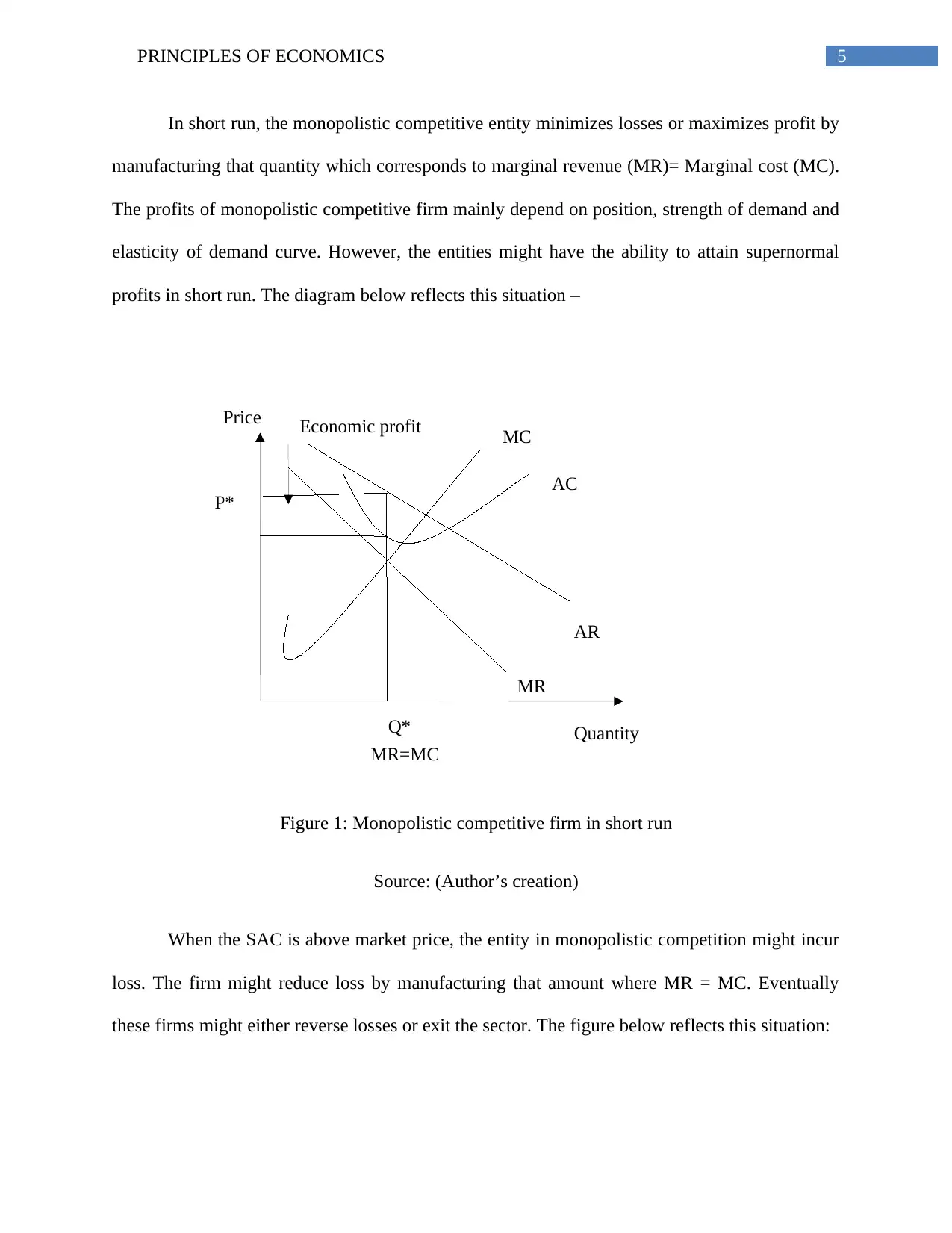
In short run, the monopolistic competitive entity minimizes losses or maximizes profit by
manufacturing that quantity which corresponds to marginal revenue (MR)= Marginal cost (MC).
The profits of monopolistic competitive firm mainly depend on position, strength of demand and
elasticity of demand curve. However, the entities might have the ability to attain supernormal
profits in short run. The diagram below reflects this situation –
Figure 1: Monopolistic competitive firm in short run
Source: (Author’s creation)
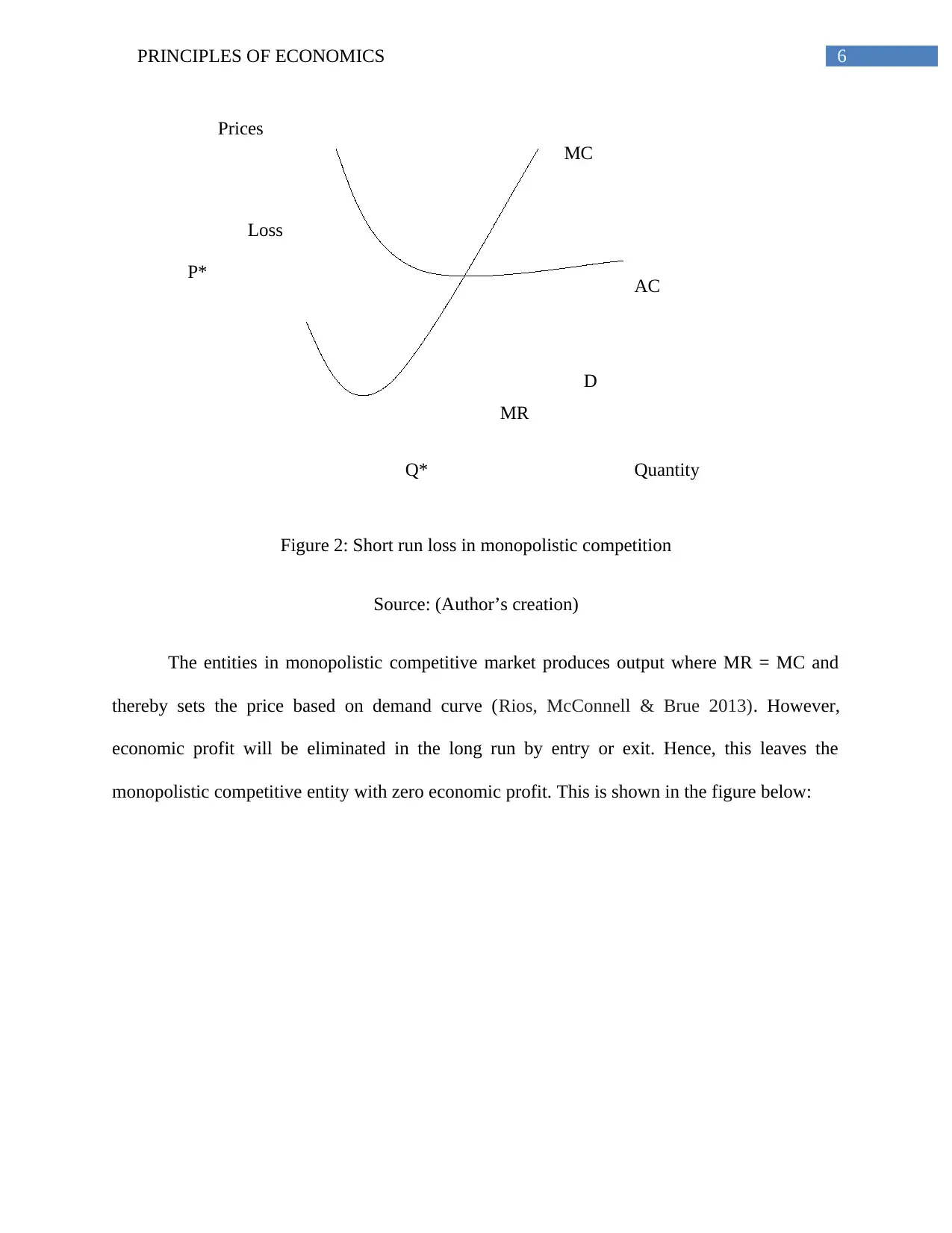
When the SAC is above market price, the entity in monopolistic competition might incur
loss. The firm might reduce loss by manufacturing that amount where MR = MC. Eventually
these firms might either reverse losses or exit the sector. The figure below reflects this situation:
P*
AR
MR
MC
AC
Economic profit
MR=MC
Quantity
Price
5PRINCIPLES OF ECONOMICS
In short run, the monopolistic competitive entity minimizes losses or maximizes profit by
manufacturing that quantity which corresponds to marginal revenue (MR)= Marginal cost (MC).
The profits of monopolistic competitive firm mainly depend on position, strength of demand and
elasticity of demand curve. However, the entities might have the ability to attain supernormal
profits in short run. The diagram below reflects this situation –
Figure 1: Monopolistic competitive firm in short run
Source: (Author’s creation)
When the SAC is above market price, the entity in monopolistic competition might incur
loss. The firm might reduce loss by manufacturing that amount where MR = MC. Eventually
these firms might either reverse losses or exit the sector. The figure below reflects this situation:
⊘ This is a preview!⊘
Do you want full access?
Subscribe today to unlock all pages.
Trusted by 1+ million students worldwide
6PRINCIPLES OF ECONOMICS
MC
AC
Q*
P*
D
MR
Loss
Quantity
Prices
Figure 2: Short run loss in monopolistic competition
Source: (Author’s creation)
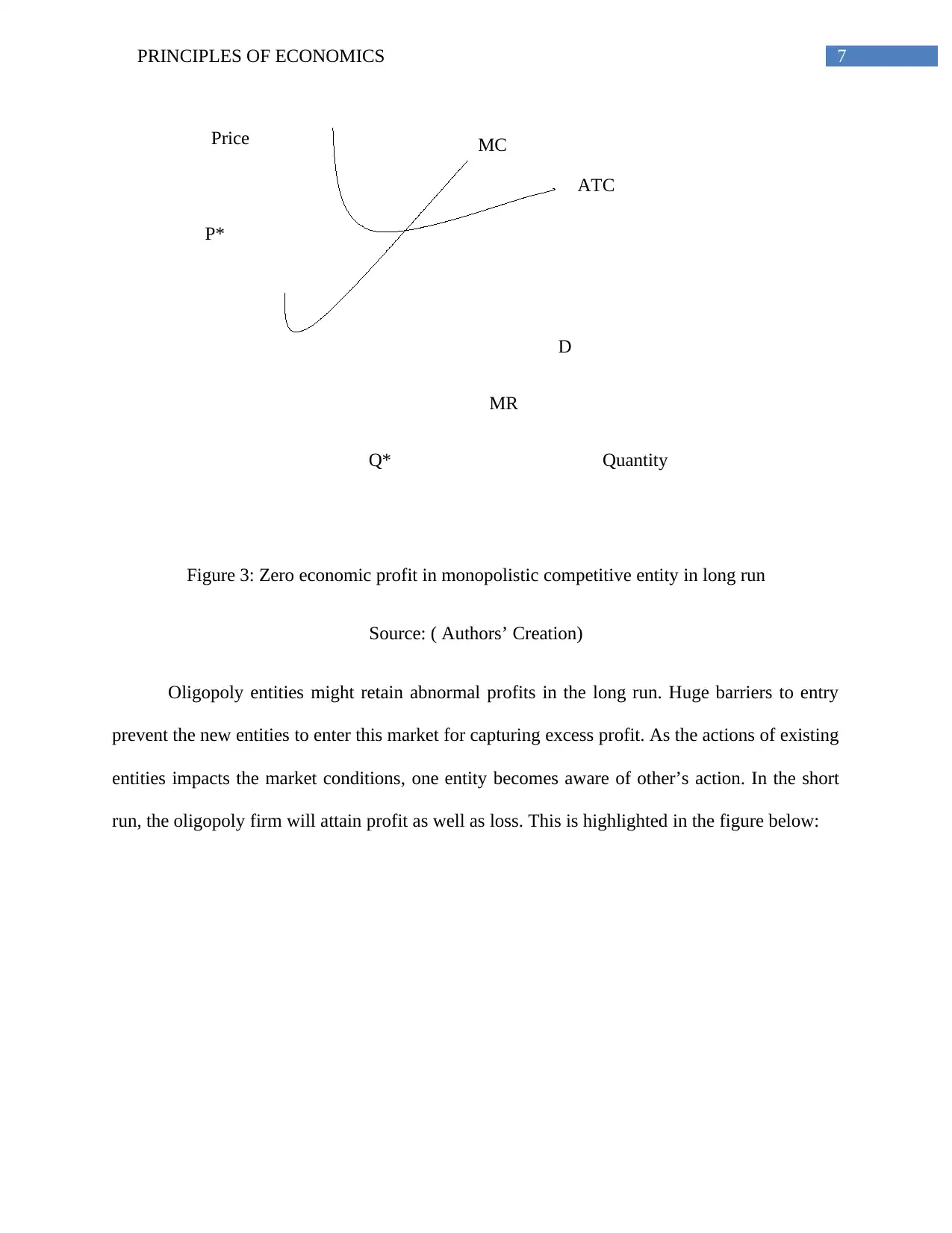
The entities in monopolistic competitive market produces output where MR = MC and
thereby sets the price based on demand curve (Rios, McConnell & Brue 2013). However,
economic profit will be eliminated in the long run by entry or exit. Hence, this leaves the
monopolistic competitive entity with zero economic profit. This is shown in the figure below:
MC
AC
Q*
P*
D
MR
Loss
Quantity
Prices
Figure 2: Short run loss in monopolistic competition
Source: (Author’s creation)
The entities in monopolistic competitive market produces output where MR = MC and
thereby sets the price based on demand curve (Rios, McConnell & Brue 2013). However,
economic profit will be eliminated in the long run by entry or exit. Hence, this leaves the
monopolistic competitive entity with zero economic profit. This is shown in the figure below:
Paraphrase This Document
Need a fresh take? Get an instant paraphrase of this document with our AI Paraphraser
7PRINCIPLES OF ECONOMICS
MR
D
MC
ATC
Q*
P*
Quantity
Price
Figure 3: Zero economic profit in monopolistic competitive entity in long run
Source: ( Authors’ Creation)
Oligopoly entities might retain abnormal profits in the long run. Huge barriers to entry
prevent the new entities to enter this market for capturing excess profit. As the actions of existing
entities impacts the market conditions, one entity becomes aware of other’s action. In the short
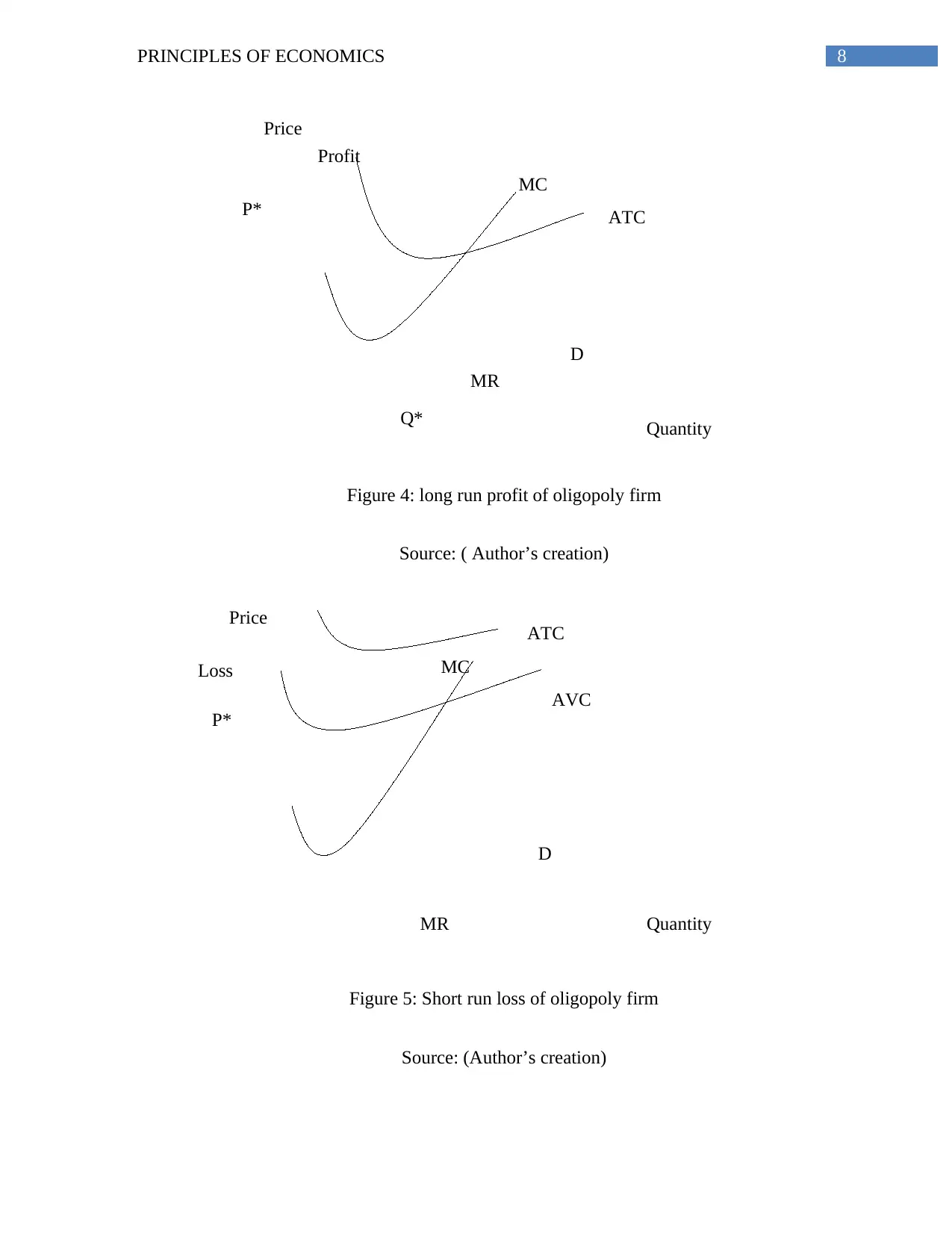
run, the oligopoly firm will attain profit as well as loss. This is highlighted in the figure below:
MR
D
MC
ATC
Q*
P*
Quantity
Price
Figure 3: Zero economic profit in monopolistic competitive entity in long run
Source: ( Authors’ Creation)
Oligopoly entities might retain abnormal profits in the long run. Huge barriers to entry
prevent the new entities to enter this market for capturing excess profit. As the actions of existing
entities impacts the market conditions, one entity becomes aware of other’s action. In the short
run, the oligopoly firm will attain profit as well as loss. This is highlighted in the figure below:
8PRINCIPLES OF ECONOMICS
MC
ATC
D
MR
Q*
P*
Price
Quantity
Profit
D
MR
ATC
AVC
MC
Quantity
Price
P*
Figure 4: long run profit of oligopoly firm
Source: ( Author’s creation)
Figure 5: Short run loss of oligopoly firm
Source: (Author’s creation)
Loss
MC
ATC
D
MR
Q*
P*
Price
Quantity
Profit
D
MR
ATC
AVC
MC
Quantity
Price
P*
Figure 4: long run profit of oligopoly firm
Source: ( Author’s creation)
Figure 5: Short run loss of oligopoly firm
Source: (Author’s creation)
Loss
⊘ This is a preview!⊘
Do you want full access?
Subscribe today to unlock all pages.
Trusted by 1+ million students worldwide
9PRINCIPLES OF ECONOMICS
Monopolistic competition and oligopoly are the two common forms of market structures
that prevail in the Australia. Banking industry is one of the vital sectors in Australia that exists in
the oligopoly market structure. Oligopoly basically exists in this sector as four enterprises
dominating this industry. The four main enterprises existing in this industry includes National
Australian Bank (NAB), Australian and New Zealand Banking group ( ANZ), Westpac (WBC)
and Commomnwealth Bank ( CBA). All these firms accounts to near about 85% of total
banking sector. In addition, the market capitalization of these enterprises is generally 5 times
market cap of remaining banks, other institutions and mutual funds. These four banks have
formed a cartel arrangement since majority of the shareholders of these banks are same and thus
have same interests. Owing to this cartel arrangement, barriers to entry prevail in this industry.
Moreover, the new entrant faces difficulty in competing with these players without minimum
risk as well as cost. Even the competition in this market is low, which facilitates these banks to
attain higher profit margin. Furthermore, the support received by these banks from the Australian
government helps to dominate this sector on regular basis.
The wine industry in Australia operates under the monopolistic competitive market
structure. The firms operating in this market are the price makers and sells slightly differentiated
wine. As there are no barriers to entry as well as exit in this industry, the enterprises operate
where MR becomes equal to or below the MC. Over the last few years, this industry has been
attaining short term profit where MR exceeds MC. This facilitated the wine sector in this nation
to attract large number of players . The forecasted impact of this was mainly that supply of wine
might exceed the demand to that level when the price based competition forcers the product price
down. It has been found by the some researcher that the wine industry in Australia has achieve
huge success in the global market over the last ten years. The main reason behind the success of
Monopolistic competition and oligopoly are the two common forms of market structures
that prevail in the Australia. Banking industry is one of the vital sectors in Australia that exists in
the oligopoly market structure. Oligopoly basically exists in this sector as four enterprises
dominating this industry. The four main enterprises existing in this industry includes National
Australian Bank (NAB), Australian and New Zealand Banking group ( ANZ), Westpac (WBC)
and Commomnwealth Bank ( CBA). All these firms accounts to near about 85% of total
banking sector. In addition, the market capitalization of these enterprises is generally 5 times
market cap of remaining banks, other institutions and mutual funds. These four banks have
formed a cartel arrangement since majority of the shareholders of these banks are same and thus
have same interests. Owing to this cartel arrangement, barriers to entry prevail in this industry.
Moreover, the new entrant faces difficulty in competing with these players without minimum
risk as well as cost. Even the competition in this market is low, which facilitates these banks to
attain higher profit margin. Furthermore, the support received by these banks from the Australian
government helps to dominate this sector on regular basis.
The wine industry in Australia operates under the monopolistic competitive market
structure. The firms operating in this market are the price makers and sells slightly differentiated
wine. As there are no barriers to entry as well as exit in this industry, the enterprises operate
where MR becomes equal to or below the MC. Over the last few years, this industry has been
attaining short term profit where MR exceeds MC. This facilitated the wine sector in this nation
to attract large number of players . The forecasted impact of this was mainly that supply of wine
might exceed the demand to that level when the price based competition forcers the product price
down. It has been found by the some researcher that the wine industry in Australia has achieve
huge success in the global market over the last ten years. The main reason behind the success of
Paraphrase This Document
Need a fresh take? Get an instant paraphrase of this document with our AI Paraphraser
10PRINCIPLES OF ECONOMICS
this industry is its ability to access appropriate external knowledge sources. Few investors still
believes that rapid growth of this industry insulated it against oversupply. At present, this
industry has been safeguarded from both success or failure that influences other products of the
farms.
The long term outcome of entry as well exit in the perfectly competitive form of market
structure is that each firm that sell their products at specific price level is basically determined by
lowest point on AC curve. This however displays that productive efficiency occurs under
perfectly competitive market structure since the products are being manufactured at lower
average cost. In the monopolistic competitive market, free entry as well as exit of enterprises
basically ends up with the price lying on downward sloping part of AC curve. However, the
monopolistic competitive market will not be efficient. Similarly, the oligopoly market structures
are also not productively and allocatively efficient. The main reason behind is that it mainly lead
to non- optimum output levels. The main reason behind is that the total output manufactured
under this market structure mainly depends on market share held by enterprises. Hence, the firms
in this market structure thereby fail to create optimum scales of economies as well as attain
optimum output. In fact, societal efficiency has been low in this market structure. Another reason
behind which this market structure is also not allocatively efficient since the firms manufacture
at Price> MC. Likewise, the producers in this sector are productively inefficient as they
manufactures at P> minimum ATC ( average total cost). But this market structure derives high
dynamic efficiency since they have the ability as well as incentive to do so.
In monopolistic competitive market, the entities do not allocate resources efficiently. The
main reason for inefficiency in resource allocation has been found with negatively sloped
demand curve and market control. However, this negative slope indicates that price charged by
this industry is its ability to access appropriate external knowledge sources. Few investors still
believes that rapid growth of this industry insulated it against oversupply. At present, this
industry has been safeguarded from both success or failure that influences other products of the
farms.
The long term outcome of entry as well exit in the perfectly competitive form of market
structure is that each firm that sell their products at specific price level is basically determined by
lowest point on AC curve. This however displays that productive efficiency occurs under
perfectly competitive market structure since the products are being manufactured at lower
average cost. In the monopolistic competitive market, free entry as well as exit of enterprises
basically ends up with the price lying on downward sloping part of AC curve. However, the
monopolistic competitive market will not be efficient. Similarly, the oligopoly market structures
are also not productively and allocatively efficient. The main reason behind is that it mainly lead
to non- optimum output levels. The main reason behind is that the total output manufactured
under this market structure mainly depends on market share held by enterprises. Hence, the firms
in this market structure thereby fail to create optimum scales of economies as well as attain
optimum output. In fact, societal efficiency has been low in this market structure. Another reason
behind which this market structure is also not allocatively efficient since the firms manufacture
at Price> MC. Likewise, the producers in this sector are productively inefficient as they
manufactures at P> minimum ATC ( average total cost). But this market structure derives high
dynamic efficiency since they have the ability as well as incentive to do so.
In monopolistic competitive market, the entities do not allocate resources efficiently. The
main reason for inefficiency in resource allocation has been found with negatively sloped
demand curve and market control. However, this negative slope indicates that price charged by
11PRINCIPLES OF ECONOMICS
entity in this market is higher than MR. As the price that the monopolistically competitive entity
charges is greater than MC, this inequality between MC and price makes it inefficient. In
addition, firms under oligopoly market also do not allocate resources efficiently. An oligopoly
firm charges higher price on the product and also manufactures less output in relation to
efficiency benchmark Taussig, (2013). This reflects that the actions taken by the entities in both
monopolistic competition and oligopoly market are similar in relation to resource allocation.
Question b
Housing affordability refers to the housing that is considered to be affordable to those
with median household income that is rated by government of nation with the help of
affordability index. It has been reflected from some research that affordable housing generally
has the ability to enhance health of residents, prospects of employment and access to education.
Conversely, increasing housing cost leads to adverse outcome in people’s life such as decrease in
parental enrichment expenditure, decrease in education among children and so on. It has been
opined by Burke (2012) that, housing affordability has become an important problem mainly in
developing nations where majority of population do not have the ability to purchase houses at
market prices. Disposable income of individuals is the crucial factor that determines
affordability. Owing to this, it has become the responsibility of government of specified nation to
meet the increasing demand for housing. Housing affordability is usually measured by varying
relationships between prices of houses and rents and also between people’s income and house
prices. The National housing affordability Housing Summit group in Australia has further
explained housing affordability as the housing that is adequate in location as well as standard for
middle or lower income people and do not cost so high that the household cannot cater their
other requirements on sustainable basis (Agarwal, Jain & Karamchandani, 2015).
entity in this market is higher than MR. As the price that the monopolistically competitive entity
charges is greater than MC, this inequality between MC and price makes it inefficient. In
addition, firms under oligopoly market also do not allocate resources efficiently. An oligopoly
firm charges higher price on the product and also manufactures less output in relation to
efficiency benchmark Taussig, (2013). This reflects that the actions taken by the entities in both
monopolistic competition and oligopoly market are similar in relation to resource allocation.
Question b
Housing affordability refers to the housing that is considered to be affordable to those
with median household income that is rated by government of nation with the help of
affordability index. It has been reflected from some research that affordable housing generally
has the ability to enhance health of residents, prospects of employment and access to education.
Conversely, increasing housing cost leads to adverse outcome in people’s life such as decrease in
parental enrichment expenditure, decrease in education among children and so on. It has been
opined by Burke (2012) that, housing affordability has become an important problem mainly in
developing nations where majority of population do not have the ability to purchase houses at
market prices. Disposable income of individuals is the crucial factor that determines
affordability. Owing to this, it has become the responsibility of government of specified nation to
meet the increasing demand for housing. Housing affordability is usually measured by varying
relationships between prices of houses and rents and also between people’s income and house
prices. The National housing affordability Housing Summit group in Australia has further
explained housing affordability as the housing that is adequate in location as well as standard for
middle or lower income people and do not cost so high that the household cannot cater their
other requirements on sustainable basis (Agarwal, Jain & Karamchandani, 2015).
⊘ This is a preview!⊘
Do you want full access?
Subscribe today to unlock all pages.
Trusted by 1+ million students worldwide

1 out of 20


Related Documents


Your All-in-One AI-Powered Toolkit for Academic Success.
+13062052269
info@desklib.com
Available 24*7 on WhatsApp / Email
![[object Object]](/_next/static/media/star-bottom.7253800d.svg)
Unlock your academic potential
Copyright © 2020–2026 A2Z Services. All Rights Reserved. Developed and managed by ZUCOL.