Financial Analysis Report: Montjeu Limited's Funding Alternatives

Verified

Added on  2023/06/03

|3
|520
|181
Report
AI Summary
This report provides a financial analysis of Montjeu Limited's funding options, specifically comparing a share issue versus a debenture issue to raise $3,500,000. It calculates the earnings per share (EPS) under each option, recommending the debenture-based funding due to the higher EPS. The report further determines the EBIT indifference point, which is the EBIT level at which the EPS is the same for both funding methods, calculating it to be $786,071.4. It then calculates the EPS for both options at this indifference point. The analysis highlights the benefit of calculating the indifference EBIT, as it guides decision-making regarding the appropriate funding method based on expected EBIT levels, with equity financing favored when expected EBIT is lower than the indifference point and debt financing preferred when it is higher. Desklib offers more solved assignments and study resources for students.
Document Page
ACCOUNTING FINANCIAL ANALYSIS REPORT
INDIFFERENCE EBIT
STUDENT ID:
[Pick the date]
tabler-icon-diamond-filled.svg

Paraphrase This Document

Need a fresh take? Get an instant paraphrase of this document with our AI Paraphraser
Document Page
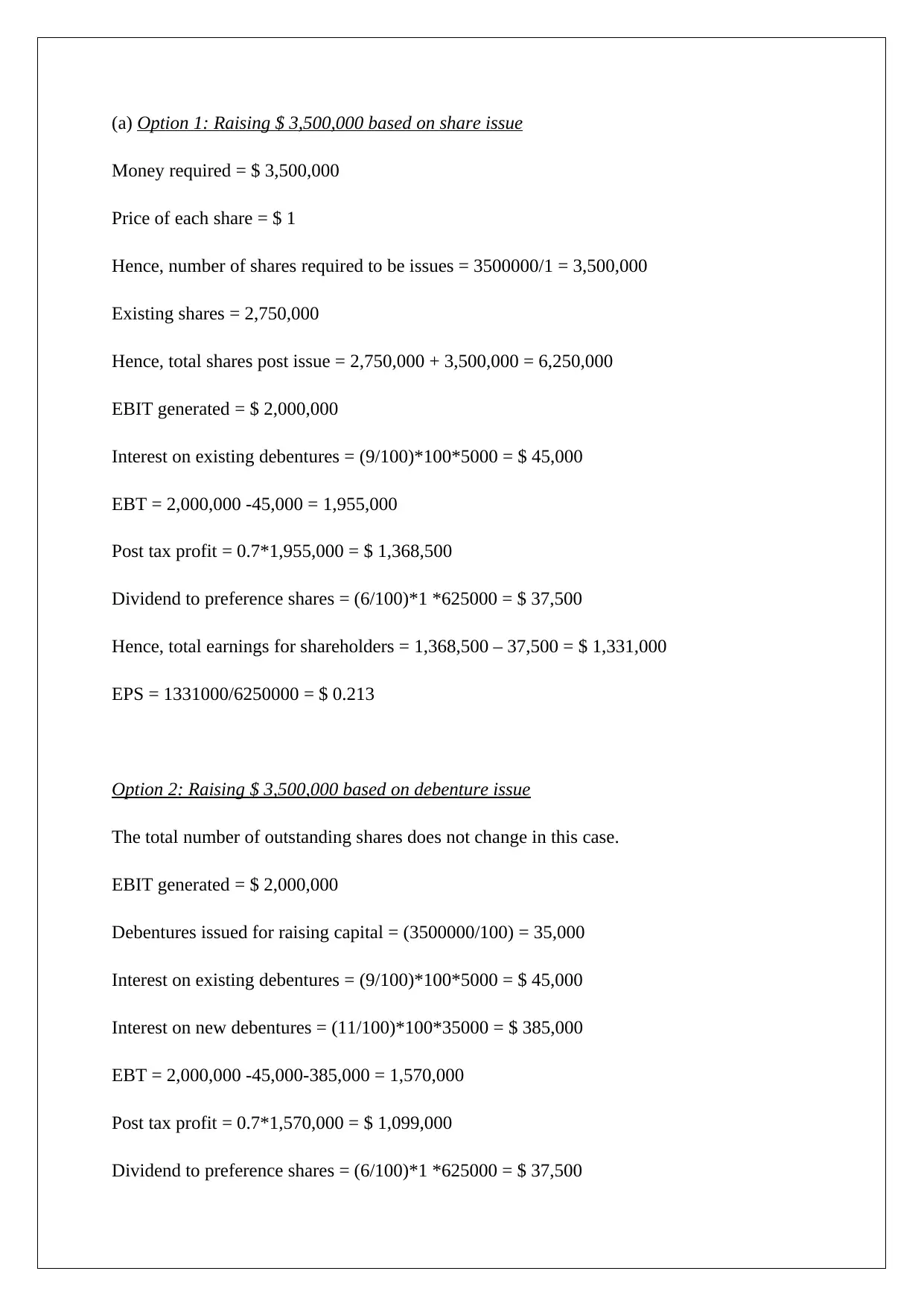
(a) Option 1: Raising $ 3,500,000 based on share issue
Money required = $ 3,500,000
Price of each share = $ 1
Hence, number of shares required to be issues = 3500000/1 = 3,500,000
Existing shares = 2,750,000
Hence, total shares post issue = 2,750,000 + 3,500,000 = 6,250,000
EBIT generated = $ 2,000,000
Interest on existing debentures = (9/100)*100*5000 = $ 45,000
EBT = 2,000,000 -45,000 = 1,955,000
Post tax profit = 0.7*1,955,000 = $ 1,368,500
Dividend to preference shares = (6/100)*1 *625000 = $ 37,500
Hence, total earnings for shareholders = 1,368,500 – 37,500 = $ 1,331,000
EPS = 1331000/6250000 = $ 0.213
Option 2: Raising $ 3,500,000 based on debenture issue
The total number of outstanding shares does not change in this case.
EBIT generated = $ 2,000,000
Debentures issued for raising capital = (3500000/100) = 35,000
Interest on existing debentures = (9/100)*100*5000 = $ 45,000
Interest on new debentures = (11/100)*100*35000 = $ 385,000
EBT = 2,000,000 -45,000-385,000 = 1,570,000
Post tax profit = 0.7*1,570,000 = $ 1,099,000
Dividend to preference shares = (6/100)*1 *625000 = $ 37,500
Document Page
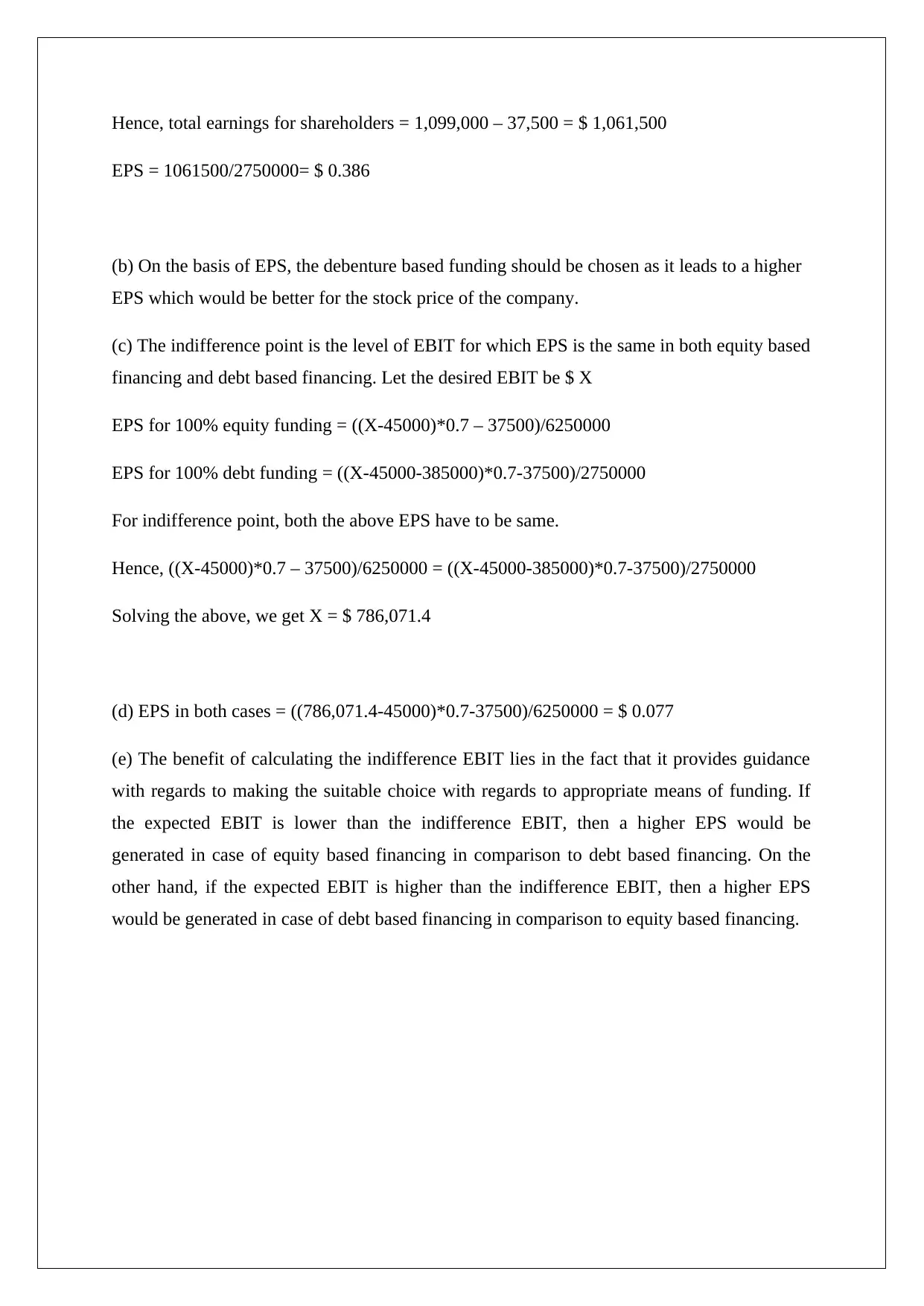
Hence, total earnings for shareholders = 1,099,000 – 37,500 = $ 1,061,500
EPS = 1061500/2750000= $ 0.386
(b) On the basis of EPS, the debenture based funding should be chosen as it leads to a higher
EPS which would be better for the stock price of the company.
(c) The indifference point is the level of EBIT for which EPS is the same in both equity based
financing and debt based financing. Let the desired EBIT be $ X
EPS for 100% equity funding = ((X-45000)*0.7 – 37500)/6250000
EPS for 100% debt funding = ((X-45000-385000)*0.7-37500)/2750000
For indifference point, both the above EPS have to be same.
Hence, ((X-45000)*0.7 – 37500)/6250000 = ((X-45000-385000)*0.7-37500)/2750000
Solving the above, we get X = $ 786,071.4
(d) EPS in both cases = ((786,071.4-45000)*0.7-37500)/6250000 = $ 0.077
(e) The benefit of calculating the indifference EBIT lies in the fact that it provides guidance
with regards to making the suitable choice with regards to appropriate means of funding. If
the expected EBIT is lower than the indifference EBIT, then a higher EPS would be
generated in case of equity based financing in comparison to debt based financing. On the
other hand, if the expected EBIT is higher than the indifference EBIT, then a higher EPS
would be generated in case of debt based financing in comparison to equity based financing.
chevron_up_icon
1 out of 3
circle_padding
hide_on_mobile
zoom_out_icon
[object Object]