Analysis of Moral Foundations and Political Orientation in Australia

Verified

Added on  2020/04/15

|6
|1290
|49
Report
AI Summary
This report analyzes the relationship between moral foundations and political orientations, focusing on the Australian context. It begins with an introduction to Moral Foundations Theory, outlining the five key foundations: harm/care, fairness/reciprocity, ingroup/loyalty, authority/respect, and purity/sanctity. The literature review explores how conservatives and liberals prioritize these foundations differently, influencing their political attitudes and voting behaviors. The study justifies its focus on Australia, where political parties may not neatly align with traditional liberal or conservative labels. The research questions investigate which moral foundations are relevant for individuals with liberal and conservative orientations, and the hypotheses propose that individualizing and binding foundations will be equally relevant. The methodology involves online surveys and meta-analysis using SPSS, with limitations including a potentially small sample size. The report concludes by emphasizing the study's potential to inform election candidates and contribute to the ongoing discussion of morality and political behavior. The references include key works by Graham, Haidt, Skitka, and others on moral foundations and political science.
Document Page
Institution you are in
ANALYSIS OF MORAL FOUNDATIONS AND POLITICAL ORIENTATION
SUBMITTED BY
Name of the student
[Pick the date]
tabler-icon-diamond-filled.svg

Paraphrase This Document

Need a fresh take? Get an instant paraphrase of this document with our AI Paraphraser
Document Page
1
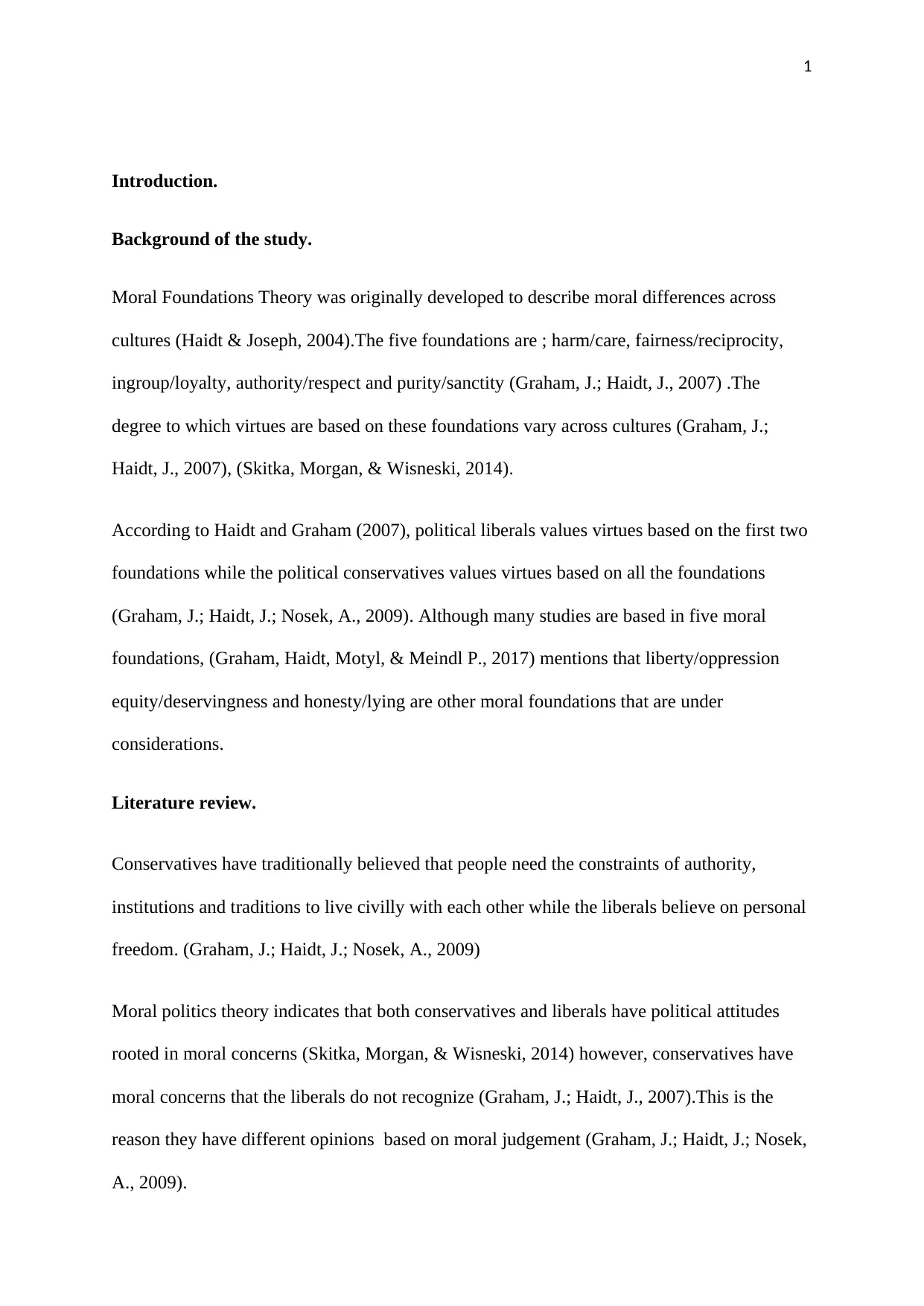
Introduction.
Background of the study.
Moral Foundations Theory was originally developed to describe moral differences across
cultures (Haidt & Joseph, 2004).The five foundations are ; harm/care, fairness/reciprocity,
ingroup/loyalty, authority/respect and purity/sanctity (Graham, J.; Haidt, J., 2007) .The
degree to which virtues are based on these foundations vary across cultures (Graham, J.;
Haidt, J., 2007), (Skitka, Morgan, & Wisneski, 2014).
According to Haidt and Graham (2007), political liberals values virtues based on the first two
foundations while the political conservatives values virtues based on all the foundations
(Graham, J.; Haidt, J.; Nosek, A., 2009). Although many studies are based in five moral
foundations, (Graham, Haidt, Motyl, & Meindl P., 2017) mentions that liberty/oppression
equity/deservingness and honesty/lying are other moral foundations that are under
considerations.
Literature review.
Conservatives have traditionally believed that people need the constraints of authority,
institutions and traditions to live civilly with each other while the liberals believe on personal
freedom. (Graham, J.; Haidt, J.; Nosek, A., 2009)
Moral politics theory indicates that both conservatives and liberals have political attitudes
rooted in moral concerns (Skitka, Morgan, & Wisneski, 2014) however, conservatives have
moral concerns that the liberals do not recognize (Graham, J.; Haidt, J., 2007).This is the
reason they have different opinions based on moral judgement (Graham, J.; Haidt, J.; Nosek,
A., 2009).
Document Page
2
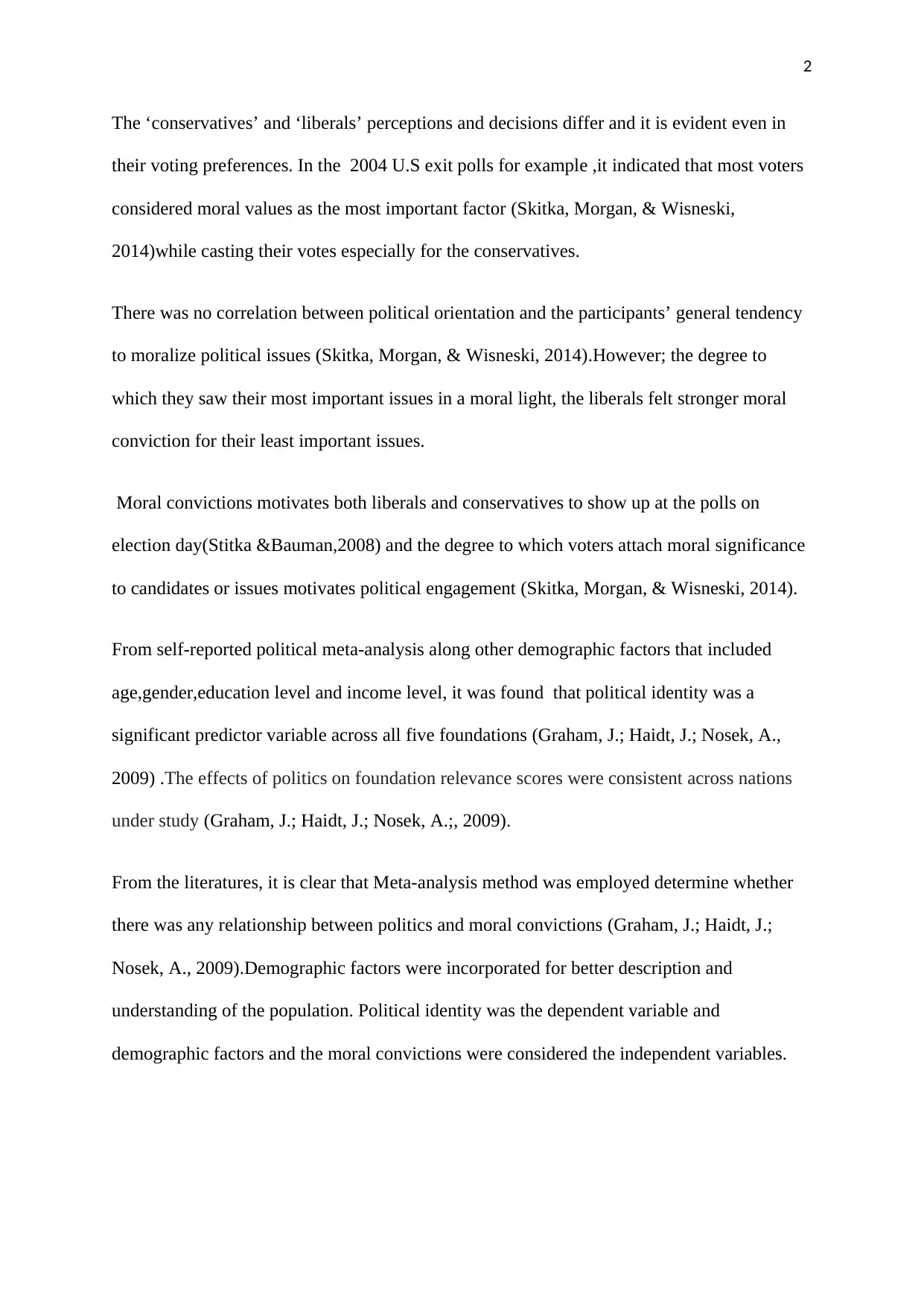
The ‘conservatives’ and ‘liberals’ perceptions and decisions differ and it is evident even in
their voting preferences. In the 2004 U.S exit polls for example ,it indicated that most voters
considered moral values as the most important factor (Skitka, Morgan, & Wisneski,
2014)while casting their votes especially for the conservatives.
There was no correlation between political orientation and the participants’ general tendency
to moralize political issues (Skitka, Morgan, & Wisneski, 2014).However; the degree to
which they saw their most important issues in a moral light, the liberals felt stronger moral
conviction for their least important issues.
Moral convictions motivates both liberals and conservatives to show up at the polls on
election day(Stitka &Bauman,2008) and the degree to which voters attach moral significance
to candidates or issues motivates political engagement (Skitka, Morgan, & Wisneski, 2014).
From self-reported political meta-analysis along other demographic factors that included
age,gender,education level and income level, it was found that political identity was a
significant predictor variable across all five foundations (Graham, J.; Haidt, J.; Nosek, A.,
2009) .The effects of politics on foundation relevance scores were consistent across nations
under study (Graham, J.; Haidt, J.; Nosek, A.;, 2009).
From the literatures, it is clear that Meta-analysis method was employed determine whether
there was any relationship between politics and moral convictions (Graham, J.; Haidt, J.;
Nosek, A., 2009).Demographic factors were incorporated for better description and
understanding of the population. Political identity was the dependent variable and
demographic factors and the moral convictions were considered the independent variables.
Document Page
3
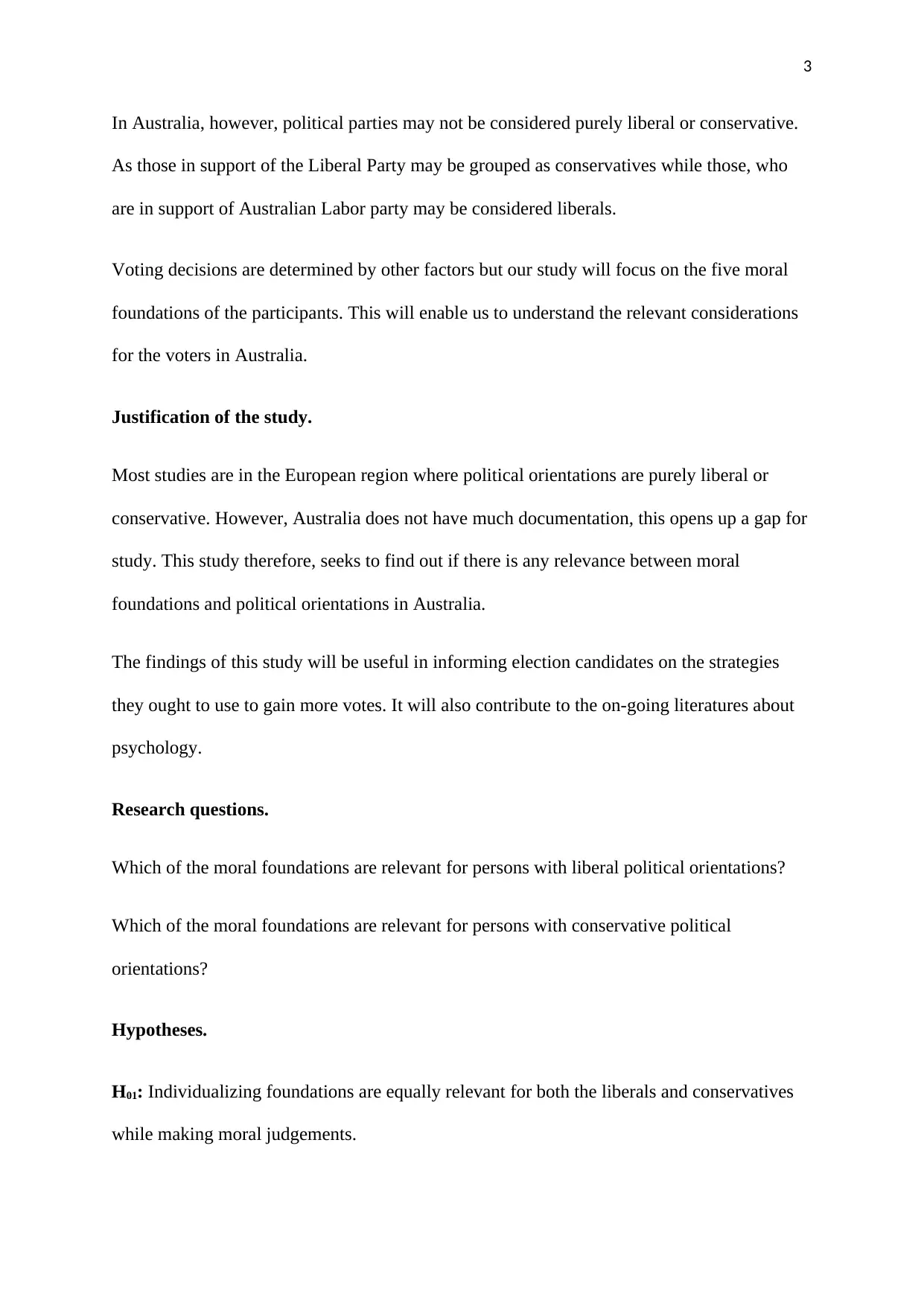
In Australia, however, political parties may not be considered purely liberal or conservative.
As those in support of the Liberal Party may be grouped as conservatives while those, who
are in support of Australian Labor party may be considered liberals.
Voting decisions are determined by other factors but our study will focus on the five moral
foundations of the participants. This will enable us to understand the relevant considerations
for the voters in Australia.
Justification of the study.
Most studies are in the European region where political orientations are purely liberal or
conservative. However, Australia does not have much documentation, this opens up a gap for
study. This study therefore, seeks to find out if there is any relevance between moral
foundations and political orientations in Australia.
The findings of this study will be useful in informing election candidates on the strategies
they ought to use to gain more votes. It will also contribute to the on-going literatures about
psychology.
Research questions.
Which of the moral foundations are relevant for persons with liberal political orientations?
Which of the moral foundations are relevant for persons with conservative political
orientations?
Hypotheses.
H01: Individualizing foundations are equally relevant for both the liberals and conservatives
while making moral judgements.
tabler-icon-diamond-filled.svg

Paraphrase This Document

Need a fresh take? Get an instant paraphrase of this document with our AI Paraphraser
Document Page
4
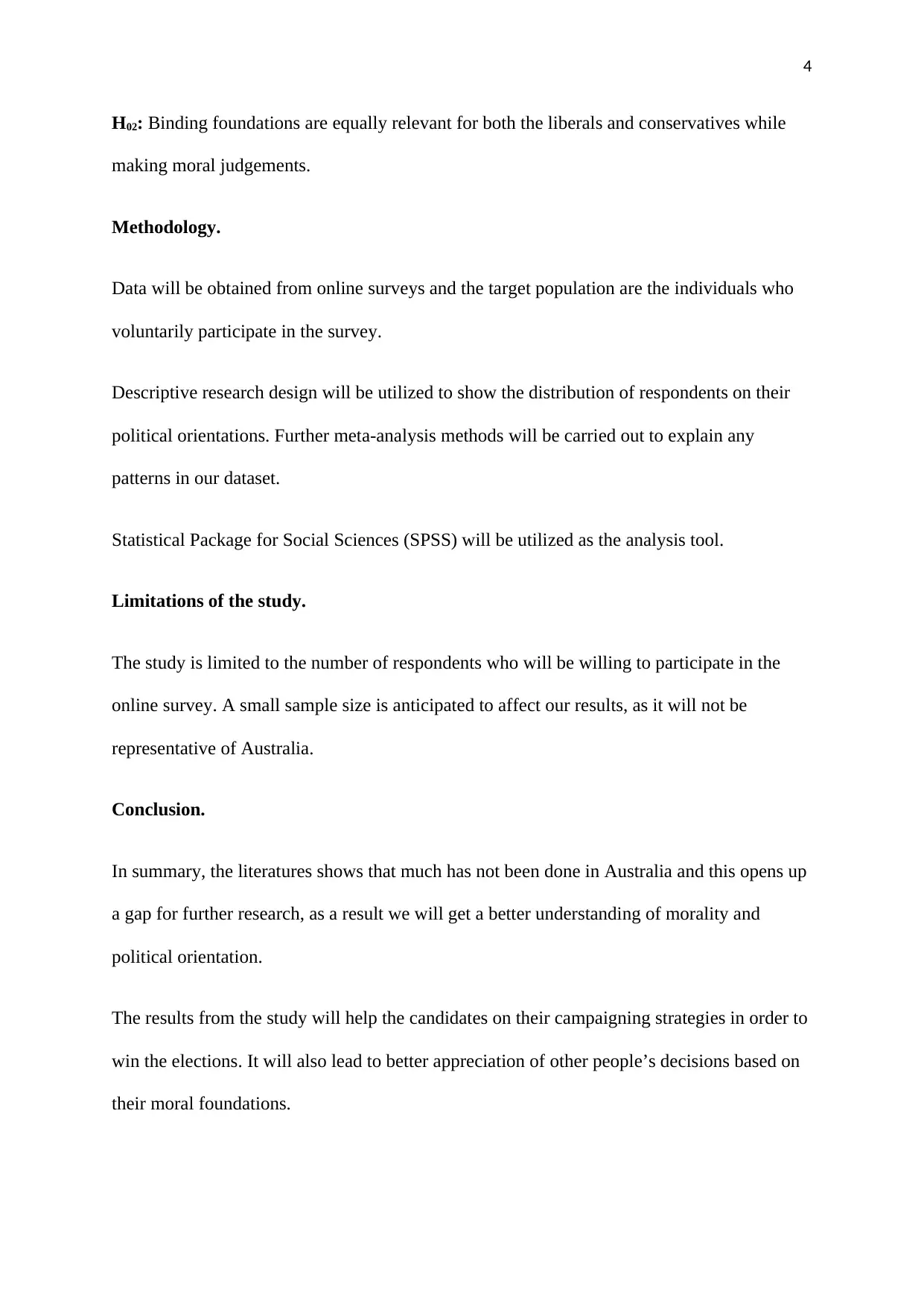
H02: Binding foundations are equally relevant for both the liberals and conservatives while
making moral judgements.
Methodology.
Data will be obtained from online surveys and the target population are the individuals who
voluntarily participate in the survey.
Descriptive research design will be utilized to show the distribution of respondents on their
political orientations. Further meta-analysis methods will be carried out to explain any
patterns in our dataset.
Statistical Package for Social Sciences (SPSS) will be utilized as the analysis tool.
Limitations of the study.
The study is limited to the number of respondents who will be willing to participate in the
online survey. A small sample size is anticipated to affect our results, as it will not be
representative of Australia.
Conclusion.
In summary, the literatures shows that much has not been done in Australia and this opens up
a gap for further research, as a result we will get a better understanding of morality and
political orientation.
The results from the study will help the candidates on their campaigning strategies in order to
win the elections. It will also lead to better appreciation of other people’s decisions based on
their moral foundations.
Document Page
5
References.
Graham, J., Haidt, J., Motyl, M., & Meindl P. (2017). Moral Foundations Theory:On the Advantages of
Moral Pluralism Over Moral Monism. Journal of Personality and Social Pyschology.
Graham, J., Iyar, R., Nosek, A., Haidt, J., Koleva, S., & Ditto, P. (2011). Mapping the moral domain.
Journal of Personality and Social Psychology, 366-385.
Graham, J.; Haidt, J. (2007). When Morality Opposes Justice:Conservatives Have Moral Intuitions
That Liberals may not Recognize. Social Justice Research.
Graham, J.; Haidt, J.; Nosek, A. (2009). Liberals and conservatives rely on different sets of moral
foundations. Personality processes and individual processes.
Haidt, J., & Joseph, C. (2004). How innately prepared intuitions generate culturally variable virtues.
Daedalus:Special Issue on Human Nature, 55-66.
Skitka, L., Morgan, G., & Wisneski, D. (2014). A conservative advantage or an equal opportunity
motivator of political engagement? Political orientation and moral conviction.
chevron_up_icon
1 out of 6
circle_padding
hide_on_mobile
zoom_out_icon
[object Object]