Analysis of Moral Foundations Theory in Psychological Research

Verified

Added on  2020/03/04

|6
|1456
|27
Report
AI Summary
This report provides an analysis of Moral Foundations Theory (MFT), exploring the psychological differences in moral intuitions between liberals and conservatives. The report examines key journal articles by Graham, Haidt, and others, focusing on the five moral foundations: Harm/care, Fairness/reciprocity, In-group/loyalty, Authority/respect, and Purity/sanctity. It discusses how liberals tend to prioritize Harm/care and Fairness/reciprocity, while conservatives consider all five foundations more equally. The report highlights the implications of these differences for understanding political polarization and the challenges in interpreting the moral reasoning of opposing groups. It also reviews the methodologies used in MFT research, including the development of moral foundations vignettes and the application of psychological variables to analyze moral judgment. The analysis covers the origins, assumptions, and empirical findings of the theory, including its relevance to social psychology and the broader understanding of morality. Finally, the report addresses how ideological narratives and individual life stories shape the relationship between political orientation and moral adaptation.
Document Page
Running head: MORAL FOUNDATIONS THEORY 1
Moral Foundation Theory
Name
Institution
tabler-icon-diamond-filled.svg

Paraphrase This Document

Need a fresh take? Get an instant paraphrase of this document with our AI Paraphraser
Document Page
MORAL FOUNDATIONS THEORY 2
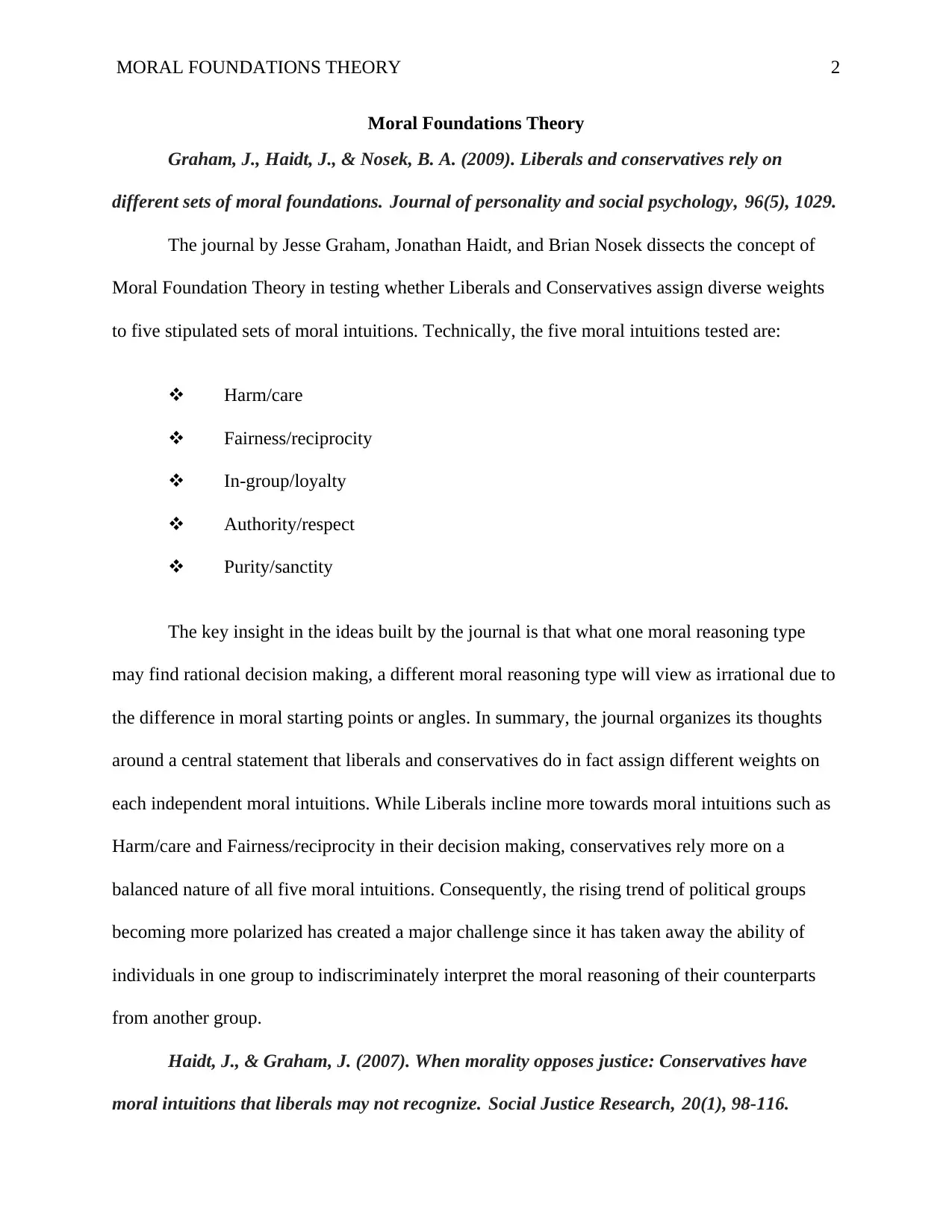
Moral Foundations Theory
Graham, J., Haidt, J., & Nosek, B. A. (2009). Liberals and conservatives rely on
different sets of moral foundations. Journal of personality and social psychology, 96(5), 1029.
The journal by Jesse Graham, Jonathan Haidt, and Brian Nosek dissects the concept of
Moral Foundation Theory in testing whether Liberals and Conservatives assign diverse weights
to five stipulated sets of moral intuitions. Technically, the five moral intuitions tested are:
Harm/care
Fairness/reciprocity
In-group/loyalty
Authority/respect
Purity/sanctity
The key insight in the ideas built by the journal is that what one moral reasoning type
may find rational decision making, a different moral reasoning type will view as irrational due to
the difference in moral starting points or angles. In summary, the journal organizes its thoughts
around a central statement that liberals and conservatives do in fact assign different weights on
each independent moral intuitions. While Liberals incline more towards moral intuitions such as
Harm/care and Fairness/reciprocity in their decision making, conservatives rely more on a
balanced nature of all five moral intuitions. Consequently, the rising trend of political groups
becoming more polarized has created a major challenge since it has taken away the ability of
individuals in one group to indiscriminately interpret the moral reasoning of their counterparts
from another group.
Haidt, J., & Graham, J. (2007). When morality opposes justice: Conservatives have
moral intuitions that liberals may not recognize. Social Justice Research, 20(1), 98-116.
Document Page
MORAL FOUNDATIONS THEORY 3
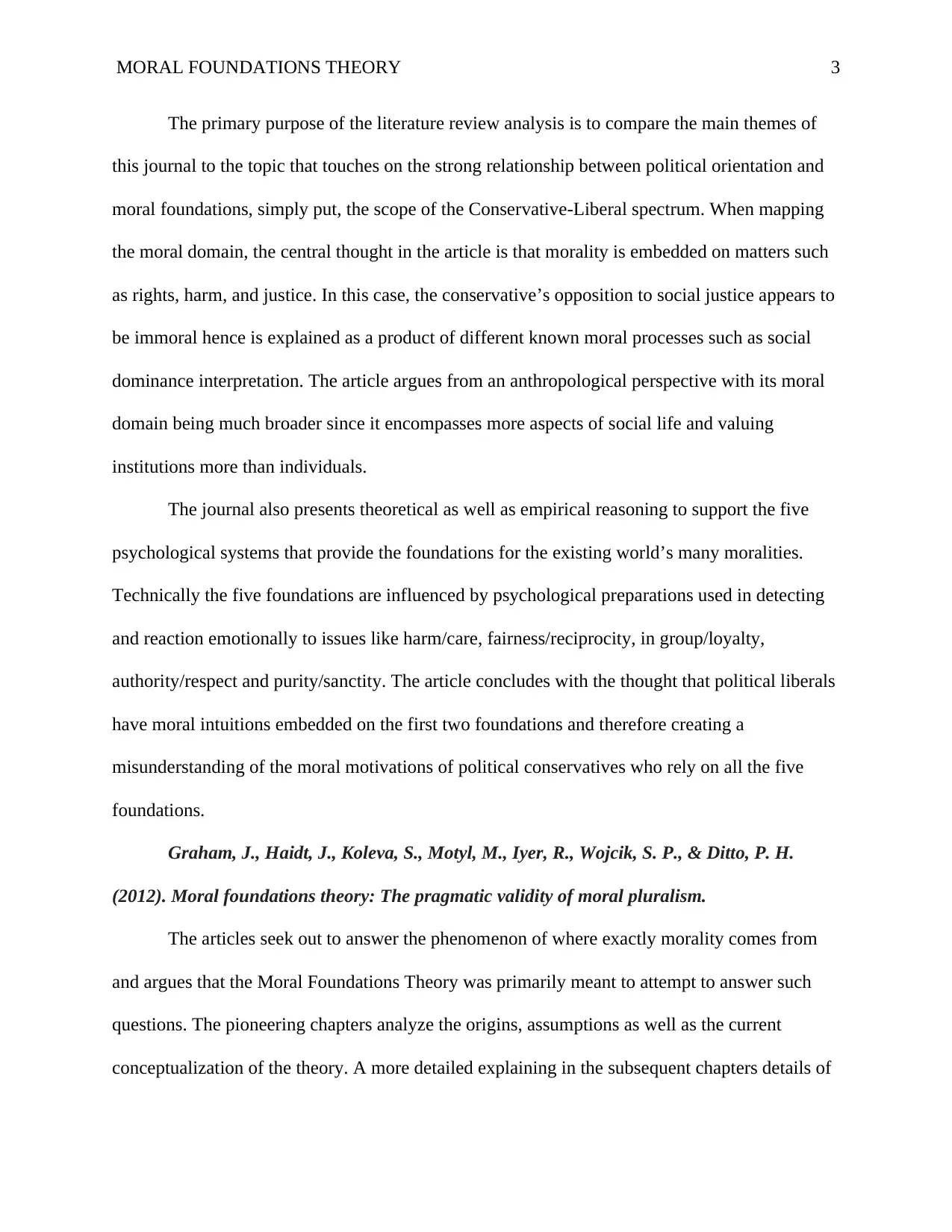
The primary purpose of the literature review analysis is to compare the main themes of
this journal to the topic that touches on the strong relationship between political orientation and
moral foundations, simply put, the scope of the Conservative-Liberal spectrum. When mapping
the moral domain, the central thought in the article is that morality is embedded on matters such
as rights, harm, and justice. In this case, the conservative’s opposition to social justice appears to
be immoral hence is explained as a product of different known moral processes such as social
dominance interpretation. The article argues from an anthropological perspective with its moral
domain being much broader since it encompasses more aspects of social life and valuing
institutions more than individuals.
The journal also presents theoretical as well as empirical reasoning to support the five
psychological systems that provide the foundations for the existing world’s many moralities.
Technically the five foundations are influenced by psychological preparations used in detecting
and reaction emotionally to issues like harm/care, fairness/reciprocity, in group/loyalty,
authority/respect and purity/sanctity. The article concludes with the thought that political liberals
have moral intuitions embedded on the first two foundations and therefore creating a
misunderstanding of the moral motivations of political conservatives who rely on all the five
foundations.
Graham, J., Haidt, J., Koleva, S., Motyl, M., Iyer, R., Wojcik, S. P., & Ditto, P. H.
(2012). Moral foundations theory: The pragmatic validity of moral pluralism.
The articles seek out to answer the phenomenon of where exactly morality comes from
and argues that the Moral Foundations Theory was primarily meant to attempt to answer such
questions. The pioneering chapters analyze the origins, assumptions as well as the current
conceptualization of the theory. A more detailed explaining in the subsequent chapters details of
Document Page
MORAL FOUNDATIONS THEORY 4
the empirical findings that the Moral Foundation Theory has made possible within the scope of
social psychology and beyond. To effectively analyses thoughts from counter arguments, the
article embraces critics from different sources. On the other hand, the articles use five distinctive
criteria to determine what should be considered a foundation of human morality. The foundations
in this are The Care/harm foundation, Fairness/Cheating, Loyalty/betrayal, Authority/subversion,
and Sanctity/degradation foundation. Finally, the article concludes with suggestions for a variety
of future directions for the Moral Foundation Theory as well as moral psychology.
Haidt, J., Graham, J., & Joseph, C. (2009). Above and below left–right: Ideological
narratives and moral foundations. Psychological Inquiry, 20(2-3), 110-119.
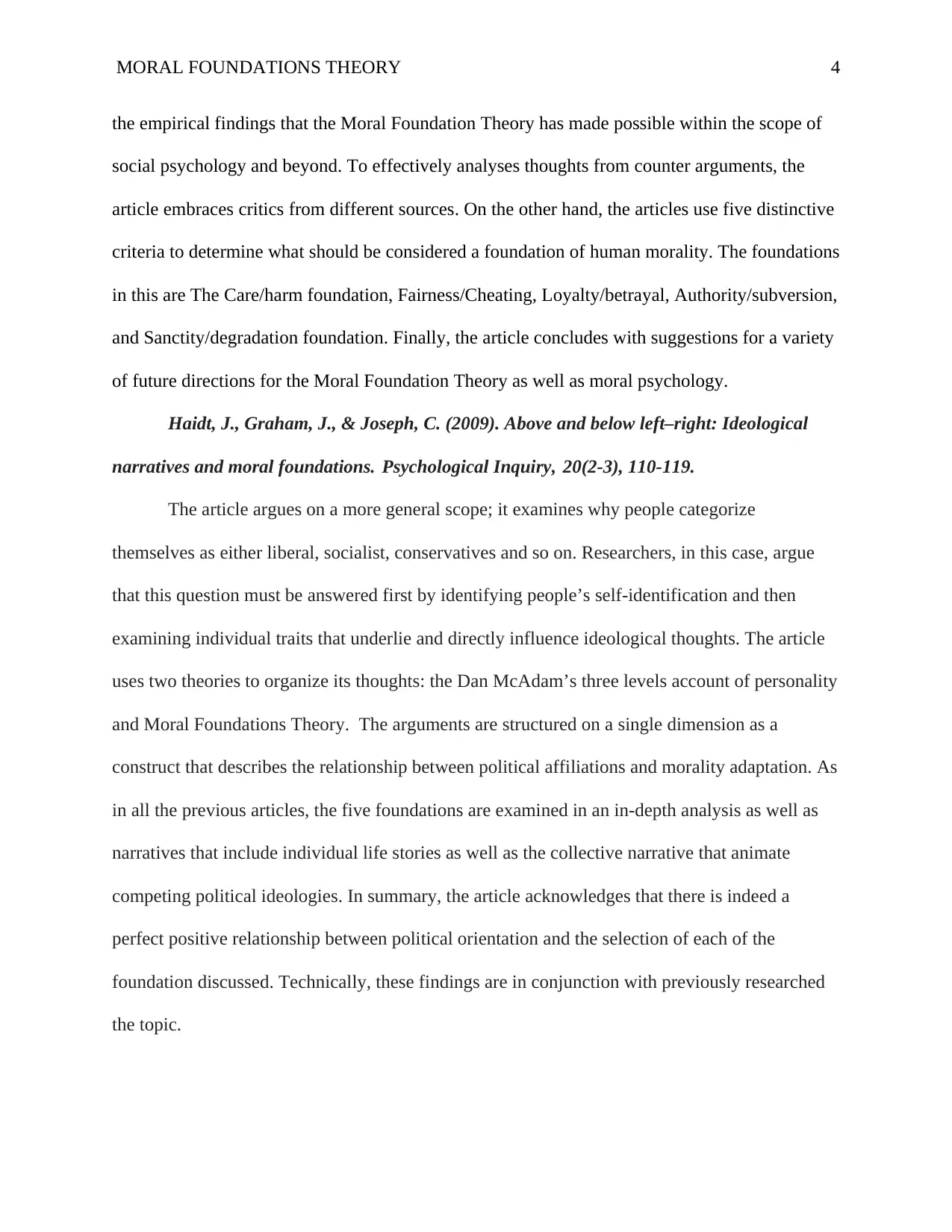
The article argues on a more general scope; it examines why people categorize
themselves as either liberal, socialist, conservatives and so on. Researchers, in this case, argue
that this question must be answered first by identifying people’s self-identification and then
examining individual traits that underlie and directly influence ideological thoughts. The article
uses two theories to organize its thoughts: the Dan McAdam’s three levels account of personality
and Moral Foundations Theory. The arguments are structured on a single dimension as a
construct that describes the relationship between political affiliations and morality adaptation. As
in all the previous articles, the five foundations are examined in an in-depth analysis as well as
narratives that include individual life stories as well as the collective narrative that animate
competing political ideologies. In summary, the article acknowledges that there is indeed a
perfect positive relationship between political orientation and the selection of each of the
foundation discussed. Technically, these findings are in conjunction with previously researched
the topic.
tabler-icon-diamond-filled.svg

Paraphrase This Document

Need a fresh take? Get an instant paraphrase of this document with our AI Paraphraser
Document Page
MORAL FOUNDATIONS THEORY 5
Clifford, S., Iyengar, V., Cabeza, R., & Sinnott-Armstrong, W. (2015). Moral
foundations vignettes: A standardized stimulus database of scenarios based on moral
foundations theory. Behavior research methods, 47(4), 1178-1198.
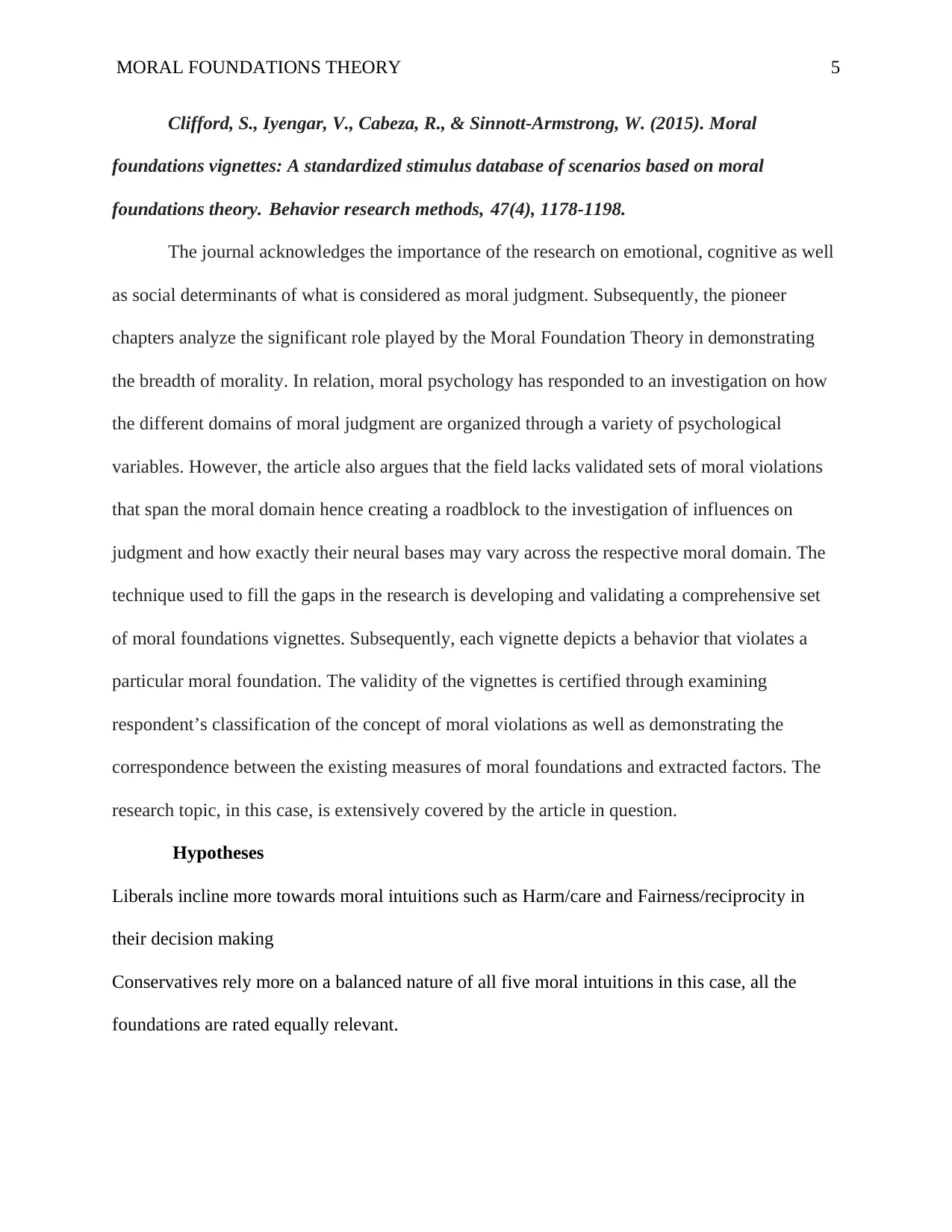
The journal acknowledges the importance of the research on emotional, cognitive as well
as social determinants of what is considered as moral judgment. Subsequently, the pioneer
chapters analyze the significant role played by the Moral Foundation Theory in demonstrating
the breadth of morality. In relation, moral psychology has responded to an investigation on how
the different domains of moral judgment are organized through a variety of psychological
variables. However, the article also argues that the field lacks validated sets of moral violations
that span the moral domain hence creating a roadblock to the investigation of influences on
judgment and how exactly their neural bases may vary across the respective moral domain. The
technique used to fill the gaps in the research is developing and validating a comprehensive set
of moral foundations vignettes. Subsequently, each vignette depicts a behavior that violates a
particular moral foundation. The validity of the vignettes is certified through examining
respondent’s classification of the concept of moral violations as well as demonstrating the
correspondence between the existing measures of moral foundations and extracted factors. The
research topic, in this case, is extensively covered by the article in question.
Hypotheses
Liberals incline more towards moral intuitions such as Harm/care and Fairness/reciprocity in
their decision making
Conservatives rely more on a balanced nature of all five moral intuitions in this case, all the
foundations are rated equally relevant.
Document Page
MORAL FOUNDATIONS THEORY 6
References
Clifford, S., Iyengar, V., Cabeza, R., & Sinnott-Armstrong, W. (2015). Moral foundations
vignettes: A standardized stimulus database of scenarios based on moral foundations
theory. Behavior research methods, 47(4), 1178-1198.
Graham, J., Haidt, J., & Nosek, B. A. (2009). Liberals and conservatives rely on different sets of
moral foundations. Journal of personality and social psychology, 96(5), 1029
Graham, J., Haidt, J., Koleva, S., Motyl, M., Iyer, R., Wojcik, S. P., & Ditto, P. H. (2012). Moral
foundations theory: The pragmatic validity of moral pluralism.
Haidt, J., & Graham, J. (2007). When morality opposes justice: Conservatives have moral
intuitions that liberals may not recognize. Social Justice Research, 20(1), 98-116.
Haidt, J., Graham, J., & Joseph, C. (2009). Above and below left–right: Ideological narratives
and moral foundations. Psychological Inquiry, 20(2-3), 110-119.
chevron_up_icon
1 out of 6
circle_padding
hide_on_mobile
zoom_out_icon
[object Object]