Financial and Non-Financial Incentive Effects on Staffs in Morocco
VerifiedAdded on 2023/04/08
|61
|14332
|54
Report
AI Summary
This research investigates the impact of financial and non-financial incentives on staff motivation and performance, focusing on actions managers can take to positively influence their employees. It highlights the crucial role of motivated employees in organizational productivity and emphasizes the need for human resource managers to prioritize employee motivation. The study reviews existing literature to identify gaps and conducts a survey of 50 staff members in Morocco to assess the effects of these incentives. Statistical tools are employed to analyze the data and draw conclusions that address the research questions. The report covers the importance of human resources, reward management, motivational theories, and different types of financial and non-financial incentives, ultimately aiming to provide insights into creating a more motivated and productive workforce.
Running head: FINANCIAL AND NON-FINANCIAL INCENTIVE EFFECTS ON STAFFS
FINANCIAL AND NON-FINANCIAL INCENTIVE EFFECTS ON STAFFS
Name of the Student
Name of the University
Author Note
FINANCIAL AND NON-FINANCIAL INCENTIVE EFFECTS ON STAFFS
Name of the Student
Name of the University
Author Note

Paraphrase This Document
Need a fresh take? Get an instant paraphrase of this document with our AI Paraphraser
1FINANCIAL AND NON-FINANCIAL INCENTIVE EFFECTS ON STAFFS
Abstract
The purpose of this research is to investigate the factors and level of motivation with the help
of the financial and the non financial incentives. The intention is to find out the actions
needed to be undertaken by the managers in motivating their staffs in order to assess the
positivity or the negativity of a particular incentive. The basic purpose is to assess the impacts
of the financial and the non-financial incentives on staff. The motivation of the employees
has positive relation with their performance level and their after their productivity within the
organisations. The reason for which the human resource managers must pay attention towards
the motivation of the employees is that employees are the most important part of the
organisation and their performance depends on the motivation level. The research paper has
clearly discussed all the concepts in these aspects and the previous literatures are reviewed
based on which the literature gap has been determined.
For this particular study, 50 staffs of Morocco have been selected and thereafter the survey
has been conducted in order to find out the impacts of the financial and the non-financial
incentives on the staffs. The statistical tools are used in the research process in order to come
to the conclusion that has answered the research questions clearly.
Abstract
The purpose of this research is to investigate the factors and level of motivation with the help
of the financial and the non financial incentives. The intention is to find out the actions
needed to be undertaken by the managers in motivating their staffs in order to assess the
positivity or the negativity of a particular incentive. The basic purpose is to assess the impacts
of the financial and the non-financial incentives on staff. The motivation of the employees
has positive relation with their performance level and their after their productivity within the
organisations. The reason for which the human resource managers must pay attention towards
the motivation of the employees is that employees are the most important part of the
organisation and their performance depends on the motivation level. The research paper has
clearly discussed all the concepts in these aspects and the previous literatures are reviewed
based on which the literature gap has been determined.
For this particular study, 50 staffs of Morocco have been selected and thereafter the survey
has been conducted in order to find out the impacts of the financial and the non-financial
incentives on the staffs. The statistical tools are used in the research process in order to come
to the conclusion that has answered the research questions clearly.
2FINANCIAL AND NON-FINANCIAL INCENTIVE EFFECTS ON STAFFS
Acknowledgement:
It would be an immense pleasure in expressing my sincere gratitude and thank the respectable
people for the immense support and help that have been provided to me. Without their
assistance, it would have not been possible for the research completion. I would thank
My supervisor for the constant guidance and advice that has enabled me to move
along with my research in an effective and diligent manner.
My family members as well as my close friends for their support, both financially and
emotionally.
All the respondents who listened to me and gave me their time for the survey
conduction.
I would like to express my thanks to all the teaching staffs and library staffs of my
college/university, who have helped me with several questions and articles.
Acknowledgement:
It would be an immense pleasure in expressing my sincere gratitude and thank the respectable
people for the immense support and help that have been provided to me. Without their
assistance, it would have not been possible for the research completion. I would thank
My supervisor for the constant guidance and advice that has enabled me to move
along with my research in an effective and diligent manner.
My family members as well as my close friends for their support, both financially and
emotionally.
All the respondents who listened to me and gave me their time for the survey
conduction.
I would like to express my thanks to all the teaching staffs and library staffs of my
college/university, who have helped me with several questions and articles.
⊘ This is a preview!⊘
Do you want full access?
Subscribe today to unlock all pages.

Trusted by 1+ million students worldwide
3FINANCIAL AND NON-FINANCIAL INCENTIVE EFFECTS ON STAFFS
Table of Contents
Chapter 1: Introduction..............................................................................................................5
1.1. Background of the Study.................................................................................................5
1.2. Statement Problem..........................................................................................................9
1.3. Research Aim and Objectives.......................................................................................10
1.4. Research Questions.......................................................................................................10
1.5. Structure of the Study....................................................................................................11
Chapter 2: Literature Review...................................................................................................12
2.1. Introduction...................................................................................................................12
2.2. Human Resource Importance........................................................................................14
2.3. Reward Management....................................................................................................15
2.4. Motivational Theories...................................................................................................15
2.5. Types of Financial Incentives.......................................................................................20
2.6. Types of Non-Financial Incentives...............................................................................23
2.7. Summary.......................................................................................................................27
Chapter 3: Research and Methodology....................................................................................27
3.1. Introduction...................................................................................................................27
3.2. Research Method Outline..............................................................................................28
3.3 Research Onion..............................................................................................................28
3.4 Research Philosophy......................................................................................................29
3.5 Research Approach........................................................................................................30
3.6 Research Design.............................................................................................................31
Table of Contents
Chapter 1: Introduction..............................................................................................................5
1.1. Background of the Study.................................................................................................5
1.2. Statement Problem..........................................................................................................9
1.3. Research Aim and Objectives.......................................................................................10
1.4. Research Questions.......................................................................................................10
1.5. Structure of the Study....................................................................................................11
Chapter 2: Literature Review...................................................................................................12
2.1. Introduction...................................................................................................................12
2.2. Human Resource Importance........................................................................................14
2.3. Reward Management....................................................................................................15
2.4. Motivational Theories...................................................................................................15
2.5. Types of Financial Incentives.......................................................................................20
2.6. Types of Non-Financial Incentives...............................................................................23
2.7. Summary.......................................................................................................................27
Chapter 3: Research and Methodology....................................................................................27
3.1. Introduction...................................................................................................................27
3.2. Research Method Outline..............................................................................................28
3.3 Research Onion..............................................................................................................28
3.4 Research Philosophy......................................................................................................29
3.5 Research Approach........................................................................................................30
3.6 Research Design.............................................................................................................31
Paraphrase This Document
Need a fresh take? Get an instant paraphrase of this document with our AI Paraphraser
4FINANCIAL AND NON-FINANCIAL INCENTIVE EFFECTS ON STAFFS
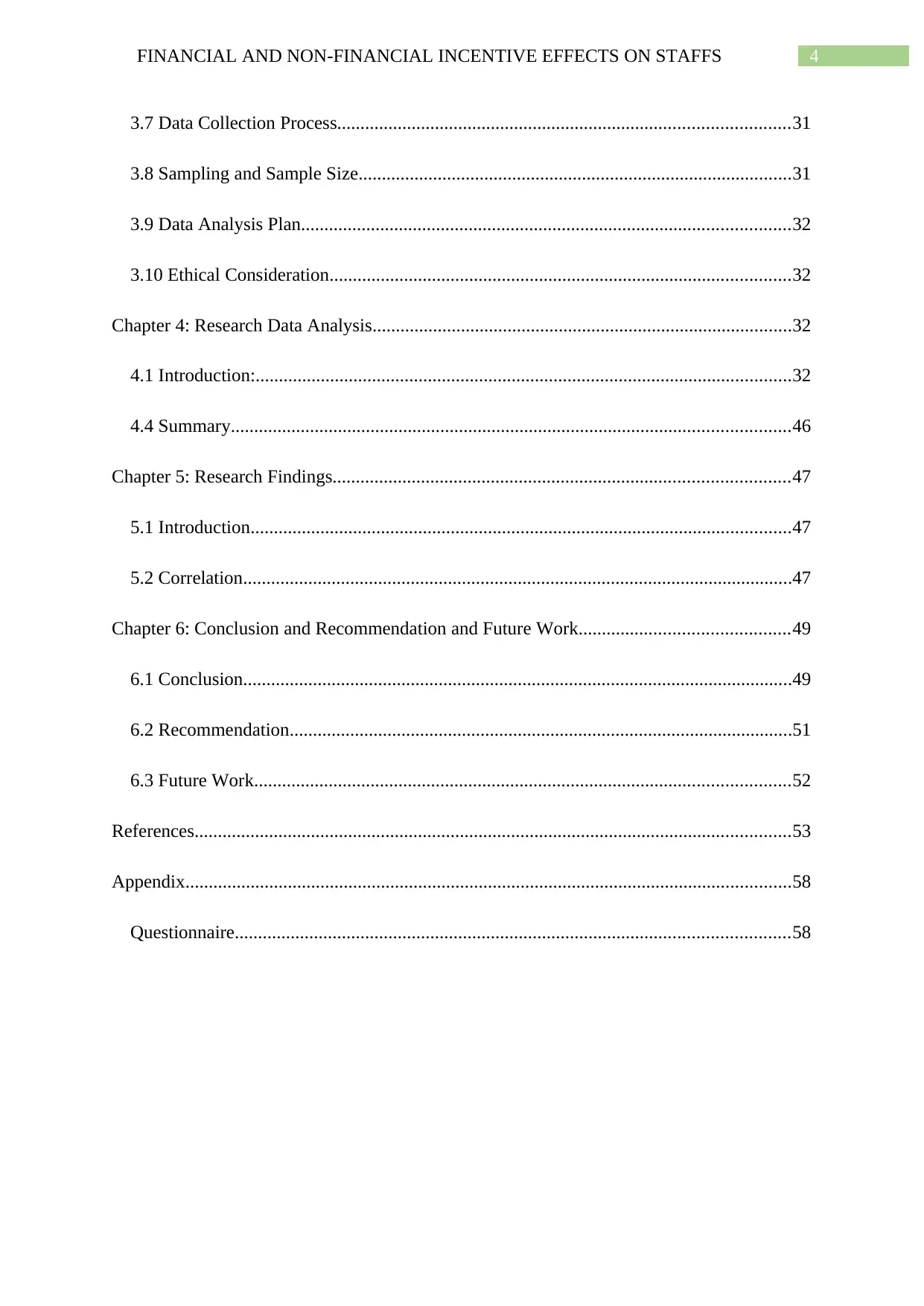
3.7 Data Collection Process.................................................................................................31
3.8 Sampling and Sample Size.............................................................................................31
3.9 Data Analysis Plan.........................................................................................................32
3.10 Ethical Consideration...................................................................................................32
Chapter 4: Research Data Analysis..........................................................................................32
4.1 Introduction:...................................................................................................................32
4.4 Summary........................................................................................................................46
Chapter 5: Research Findings..................................................................................................47
5.1 Introduction....................................................................................................................47
5.2 Correlation......................................................................................................................47
Chapter 6: Conclusion and Recommendation and Future Work.............................................49
6.1 Conclusion......................................................................................................................49
6.2 Recommendation............................................................................................................51
6.3 Future Work...................................................................................................................52
References................................................................................................................................53
Appendix..................................................................................................................................58
Questionnaire.......................................................................................................................58
3.7 Data Collection Process.................................................................................................31
3.8 Sampling and Sample Size.............................................................................................31
3.9 Data Analysis Plan.........................................................................................................32
3.10 Ethical Consideration...................................................................................................32
Chapter 4: Research Data Analysis..........................................................................................32
4.1 Introduction:...................................................................................................................32
4.4 Summary........................................................................................................................46
Chapter 5: Research Findings..................................................................................................47
5.1 Introduction....................................................................................................................47
5.2 Correlation......................................................................................................................47
Chapter 6: Conclusion and Recommendation and Future Work.............................................49
6.1 Conclusion......................................................................................................................49
6.2 Recommendation............................................................................................................51
6.3 Future Work...................................................................................................................52
References................................................................................................................................53
Appendix..................................................................................................................................58
Questionnaire.......................................................................................................................58
5FINANCIAL AND NON-FINANCIAL INCENTIVE EFFECTS ON STAFFS
Chapter 1: Introduction
Every organisation is concerned about their productivity and the profitability and that
can be done only by utilizing the resources properly. The higher level of the productivity is
attainable only through the staff motivation. The consequences of the financial rewards and
the non-financial rewards are a major concern for the human resource management. The
financial rewards are in the form of money and the non-financial rewards are in the form of
appreciation and other non-monetary rewards. Both these rewards are necessary for the
motivation of the employees that will lead to efficient performance, which in turn will
increase the productivity of the organisation. The report studies in details about the effect of
the financial and the non-financial rewards on the staffs.
1.1. Background of the Study
The main motive of all organisations is quality production at the cheapest cost. The
organisations are therefore concerned with achieving the best and the highest possible output
by utilising the given resources within the organisation. The ultimate resource in any
organisation is the human resource (Noe et al. 2017). The whole production process is
impossible with the human resource. The human resources pool all the other required
resources and integrates the whole process by ensuring cooperation and coordination inside
the organisation. The human resources therefore are needed to remain motivated and highly
associated with the organisation in order to maintain quality productivity throughout. This
can be only possible if there are some motivational incentives being provided to the
employees to increase their productivity.
The important function of the human resource management is to ensure the
implementation of certain practices within the organisation that will boost the employee
morale and enhance the employee satisfaction (Pak et al. 2018). A minimum financial or non-
Chapter 1: Introduction
Every organisation is concerned about their productivity and the profitability and that
can be done only by utilizing the resources properly. The higher level of the productivity is
attainable only through the staff motivation. The consequences of the financial rewards and
the non-financial rewards are a major concern for the human resource management. The
financial rewards are in the form of money and the non-financial rewards are in the form of
appreciation and other non-monetary rewards. Both these rewards are necessary for the
motivation of the employees that will lead to efficient performance, which in turn will
increase the productivity of the organisation. The report studies in details about the effect of
the financial and the non-financial rewards on the staffs.
1.1. Background of the Study
The main motive of all organisations is quality production at the cheapest cost. The
organisations are therefore concerned with achieving the best and the highest possible output
by utilising the given resources within the organisation. The ultimate resource in any
organisation is the human resource (Noe et al. 2017). The whole production process is
impossible with the human resource. The human resources pool all the other required
resources and integrates the whole process by ensuring cooperation and coordination inside
the organisation. The human resources therefore are needed to remain motivated and highly
associated with the organisation in order to maintain quality productivity throughout. This
can be only possible if there are some motivational incentives being provided to the
employees to increase their productivity.
The important function of the human resource management is to ensure the
implementation of certain practices within the organisation that will boost the employee
morale and enhance the employee satisfaction (Pak et al. 2018). A minimum financial or non-
⊘ This is a preview!⊘
Do you want full access?
Subscribe today to unlock all pages.
Trusted by 1+ million students worldwide
6FINANCIAL AND NON-FINANCIAL INCENTIVE EFFECTS ON STAFFS
financial reward is expected by all the employees because of the efforts and the services they
put in. If there are no proper organisational framework, training and development procedure,
equitable pay structure, appreciation system, opportunities and recognition, then the
employees will not be motivated to work properly within the organisation. There will be no
sense of belongingness rather there will prevail a sense of dissatisfaction. The dissatisfaction
that will arise because of the poor rewarding structure will increase the employee turnover of
the organisation and yield poor results. The minimum benefits expected by the employees
and that the employee foresees for their families and their own selves, stimulates the best
effort from the employees’ end.
There can be two kinds of incentives and they are the financial incentives and the
non-financial incentives. The financial rewards are termed as the extrinsic reward and the
non-financial rewards are termed as the intrinsic reward. The financial rewards include all
the benefits that can be measured in monetary terms, for example bonus, incentives,
promotions, allowances, share in the profits of the organisation, increase in the pay; whereas
the non-financial incentive refers to the appreciation and recognitions within the organisation,
the caring attitude and meeting the new challenges (Burns and Rothman 2018). A sound and
proper working condition of the organisation increases the employee satisfaction. Much
theory suggests that the financial incentives provided to the employees are effective only for
a limited period of time but they have a serious effect on the employee motivation. A
company may allow an individual to get a pay raise to a certain level after his long tenure in
the company but that individual have never been appreciated and recognised. This would not
increase the satisfaction level of that individual. The employee will be very much dissatisfied
after a few days again. It can be therefore said that a degree of non-financial incentive is
required to be added with the financial incentives in order to maintain a long term satisfaction
and motivation of the employees. Additional benefits along with the monetary benefits are
financial reward is expected by all the employees because of the efforts and the services they
put in. If there are no proper organisational framework, training and development procedure,
equitable pay structure, appreciation system, opportunities and recognition, then the
employees will not be motivated to work properly within the organisation. There will be no
sense of belongingness rather there will prevail a sense of dissatisfaction. The dissatisfaction
that will arise because of the poor rewarding structure will increase the employee turnover of
the organisation and yield poor results. The minimum benefits expected by the employees
and that the employee foresees for their families and their own selves, stimulates the best
effort from the employees’ end.
There can be two kinds of incentives and they are the financial incentives and the
non-financial incentives. The financial rewards are termed as the extrinsic reward and the
non-financial rewards are termed as the intrinsic reward. The financial rewards include all
the benefits that can be measured in monetary terms, for example bonus, incentives,
promotions, allowances, share in the profits of the organisation, increase in the pay; whereas
the non-financial incentive refers to the appreciation and recognitions within the organisation,
the caring attitude and meeting the new challenges (Burns and Rothman 2018). A sound and
proper working condition of the organisation increases the employee satisfaction. Much
theory suggests that the financial incentives provided to the employees are effective only for
a limited period of time but they have a serious effect on the employee motivation. A
company may allow an individual to get a pay raise to a certain level after his long tenure in
the company but that individual have never been appreciated and recognised. This would not
increase the satisfaction level of that individual. The employee will be very much dissatisfied
after a few days again. It can be therefore said that a degree of non-financial incentive is
required to be added with the financial incentives in order to maintain a long term satisfaction
and motivation of the employees. Additional benefits along with the monetary benefits are
Paraphrase This Document
Need a fresh take? Get an instant paraphrase of this document with our AI Paraphraser
7FINANCIAL AND NON-FINANCIAL INCENTIVE EFFECTS ON STAFFS
termed as Fringe benefits. The fringe benefits acts as a boost and helps in increasing the
motivation which in turn increases the productivity of the organisation, the overall sales and
then profitability (Clemens, Kahn and Meer 2018).
Now a day’s many employers takes a holistic approach. They ensure that the
employees are productive, loyal to the organisation and are motivated. They see whether the
employees are satisfied with their work post and if that particular post has matched with the
competency of the employees. Exceptional work performance and hard work are recognized
and appreciated, which in turn promotes a positive workplace culture. The policy of “total
reward” is often chosen by the employers that combines the financial rewards with the non-
financial rewards and incentives (Shields et al. 2015). Financial incentive like the Pay is
being provided to the employees on the basis of their proportionate knowledge, skills,
adaptability and expectations. This is ranked at the top because money is important for the
fulfilment of the basic needs of the life. It also fulfils the needs of belongingness and allows
the employees to build a sense of authority, create a status and maintain a rank and position.
Many organisations also provide their employees with insurance facilities. Health insurance
is one of the most motivational incentives provided to an employee because the employees
feel themselves to be valued by the organisation. Pension schemes are also provided by few
organisations by which a certain amount is kept aside with the company and after retirement
the amount is returned on a monthly basis (Hunt and Blake 2017).
Many organisations also provide transportation facilities, most of the employees stay
at far places and it takes time to avail a public transport facility. Under such circumstances,
there are many organisations that provide pick up and drop facilities. This reduces the burden
of the employees and the physical and mental stress of availing the transport facilities. This
increases the motivation of the employees. Many companies also provide the scope of
vacation with pay that the firm provides in order to increase the wellbeing of the employees.
termed as Fringe benefits. The fringe benefits acts as a boost and helps in increasing the
motivation which in turn increases the productivity of the organisation, the overall sales and
then profitability (Clemens, Kahn and Meer 2018).
Now a day’s many employers takes a holistic approach. They ensure that the
employees are productive, loyal to the organisation and are motivated. They see whether the
employees are satisfied with their work post and if that particular post has matched with the
competency of the employees. Exceptional work performance and hard work are recognized
and appreciated, which in turn promotes a positive workplace culture. The policy of “total
reward” is often chosen by the employers that combines the financial rewards with the non-
financial rewards and incentives (Shields et al. 2015). Financial incentive like the Pay is
being provided to the employees on the basis of their proportionate knowledge, skills,
adaptability and expectations. This is ranked at the top because money is important for the
fulfilment of the basic needs of the life. It also fulfils the needs of belongingness and allows
the employees to build a sense of authority, create a status and maintain a rank and position.
Many organisations also provide their employees with insurance facilities. Health insurance
is one of the most motivational incentives provided to an employee because the employees
feel themselves to be valued by the organisation. Pension schemes are also provided by few
organisations by which a certain amount is kept aside with the company and after retirement
the amount is returned on a monthly basis (Hunt and Blake 2017).
Many organisations also provide transportation facilities, most of the employees stay
at far places and it takes time to avail a public transport facility. Under such circumstances,
there are many organisations that provide pick up and drop facilities. This reduces the burden
of the employees and the physical and mental stress of availing the transport facilities. This
increases the motivation of the employees. Many companies also provide the scope of
vacation with pay that the firm provides in order to increase the wellbeing of the employees.
8FINANCIAL AND NON-FINANCIAL INCENTIVE EFFECTS ON STAFFS
Free meals and drinks, meal cards and other food benefits and offers are also given to the
employees. All these benefits facilitate performance. Non-financial reward like the training
and development is also being provided to the employees that help them increasing their
knowledge and skills and helps in boosting the employee morale. It helps the employees in
improving their performance and efficiency. Motivation of a person is dependent on the goals
and the objectives. When the expectations of the employees align with the accomplishment of
the organisational goals, the employees gets motivated to perform and give their best (Kian
and Yusoff 2015). Along with promotions and recognitions, all the employees also seek for
the development of their career. The careers development processes of the employees are
done by the process of the training and development programs.
The working condition and the environment of the organisation also play an important
role in the employee motivation. The employee morale is affected by the working condition,
Favourable working condition contains several issues like comfortable lighting structure,
comfortable furniture, proper seating arrangements, proper functional design, proper supplies
and availability of all the tools and office resources increases the attentiveness of the
employees. There is a common saying that individual does not only live by breads yet he is
unable to live without it. This means that the individuals want to avail several other needs
along with the basic needs. In the recent competitive market all the organizations are in a
competition in recruiting the highest talents at the cheapest cost and In order to do so several
strategies are being implemented by the organisations to attract the talents. The reward
structures and the reward management system help in increasing the attractiveness of the job,
which in turn attracts experienced and knowledgeable candidates. The organisation are facing
huge competition from the different other companies, in the various labour markets. The
demand and the supply condition of this market push the organisation to create attractive and
lucrative offers that would allow them capturing the most talented employees.
Free meals and drinks, meal cards and other food benefits and offers are also given to the
employees. All these benefits facilitate performance. Non-financial reward like the training
and development is also being provided to the employees that help them increasing their
knowledge and skills and helps in boosting the employee morale. It helps the employees in
improving their performance and efficiency. Motivation of a person is dependent on the goals
and the objectives. When the expectations of the employees align with the accomplishment of
the organisational goals, the employees gets motivated to perform and give their best (Kian
and Yusoff 2015). Along with promotions and recognitions, all the employees also seek for
the development of their career. The careers development processes of the employees are
done by the process of the training and development programs.
The working condition and the environment of the organisation also play an important
role in the employee motivation. The employee morale is affected by the working condition,
Favourable working condition contains several issues like comfortable lighting structure,
comfortable furniture, proper seating arrangements, proper functional design, proper supplies
and availability of all the tools and office resources increases the attentiveness of the
employees. There is a common saying that individual does not only live by breads yet he is
unable to live without it. This means that the individuals want to avail several other needs
along with the basic needs. In the recent competitive market all the organizations are in a
competition in recruiting the highest talents at the cheapest cost and In order to do so several
strategies are being implemented by the organisations to attract the talents. The reward
structures and the reward management system help in increasing the attractiveness of the job,
which in turn attracts experienced and knowledgeable candidates. The organisation are facing
huge competition from the different other companies, in the various labour markets. The
demand and the supply condition of this market push the organisation to create attractive and
lucrative offers that would allow them capturing the most talented employees.
⊘ This is a preview!⊘
Do you want full access?
Subscribe today to unlock all pages.
Trusted by 1+ million students worldwide
9FINANCIAL AND NON-FINANCIAL INCENTIVE EFFECTS ON STAFFS
The overall objective of any organisation is to reward all the people equally, fairly
and consistently as per their organisational values so that the strategic objectives of the
organisation are achieved easily. Reward management answers the two basic questions of
what is being valued and what the individuals are prepared to pay for (Rose 2018). The
reward management system has always been a challenging situation for the organisations.
The reward systems not only increase the motivation of the employees but it also increases
and maintains the industrial harmony. The selection of the proper reward system is also very
challenging for the organisation. The several reward alternatives and the cost associated with
it must be understood and analysed. The points to be considered while deciding upon it are
what type of rewards are to be given, the norms of providing the rewards, the criteria for the
distribution of the rewards and what can be the probable outcomes of the reward structure.
The research work will therefore enlighten the effects that the financial and the non-
financial rewards will have on the individuals working within the organisation and how this
motivates the individuals in improving their performance and thereafter stay committed
towards the organisational goals. The effects of these rewards can be negative as well as
positive in nature. The financial incentives involve the direct payment of cash over the
normal amount that is to be received by the employees whereas the non-financial incentives
do not involve direct cash payments and they can be either tangible or intangible.
1.2. Statement Problem
The continuous problems faced by the organisation leader at present are the difference
in the performance level of the customers. The employee performing poor might be
performing so because of inefficiency but there can also be a lack of motivation of the
employees. The performance of the employees also depend on the certain key variables such
as the family background, the age of the employee, the educational background, the
aspiration level and the understanding and interpretation ability. The organisations therefore
The overall objective of any organisation is to reward all the people equally, fairly
and consistently as per their organisational values so that the strategic objectives of the
organisation are achieved easily. Reward management answers the two basic questions of
what is being valued and what the individuals are prepared to pay for (Rose 2018). The
reward management system has always been a challenging situation for the organisations.
The reward systems not only increase the motivation of the employees but it also increases
and maintains the industrial harmony. The selection of the proper reward system is also very
challenging for the organisation. The several reward alternatives and the cost associated with
it must be understood and analysed. The points to be considered while deciding upon it are
what type of rewards are to be given, the norms of providing the rewards, the criteria for the
distribution of the rewards and what can be the probable outcomes of the reward structure.
The research work will therefore enlighten the effects that the financial and the non-
financial rewards will have on the individuals working within the organisation and how this
motivates the individuals in improving their performance and thereafter stay committed
towards the organisational goals. The effects of these rewards can be negative as well as
positive in nature. The financial incentives involve the direct payment of cash over the
normal amount that is to be received by the employees whereas the non-financial incentives
do not involve direct cash payments and they can be either tangible or intangible.
1.2. Statement Problem
The continuous problems faced by the organisation leader at present are the difference
in the performance level of the customers. The employee performing poor might be
performing so because of inefficiency but there can also be a lack of motivation of the
employees. The performance of the employees also depend on the certain key variables such
as the family background, the age of the employee, the educational background, the
aspiration level and the understanding and interpretation ability. The organisations therefore
Paraphrase This Document
Need a fresh take? Get an instant paraphrase of this document with our AI Paraphraser
10FINANCIAL AND NON-FINANCIAL INCENTIVE EFFECTS ON STAFFS
need to understand the exact cause of poor performance and thereafter decide how these poor
performances can be improved. The proper financial and the non-financial structure are
therefore needed to be determined accordingly, which is a complicated and complex task and
must be done carefully.
1.3. Research Aim and Objectives
The central objective of the study is to determine and examine the effect of the
financial and the non-financial incentives on the productivity of the staff. The study is
specifically set out to-
i. Understand whether the remuneration is based on incentive schemes that will
motivate the employees.
ii. Examine the financial incentive schemes and the effect of the same on the
productivity of the workers.
iii. Determine the non-financial incentives that can be provided and if that can retain
the employee motivation for a long time period.
iv. Understand if the reward system is equitable, fair and consistent.
v. Select the best and common reward system for the entire organisation.
vi. To understand what kind of reward system is provided by the organisations that
wants to attract the best talents.
vii. To understand if performance appraisal can also be a part of the non-financial
incentive structure.
1.4. Research Questions
The research questions addressed in this study are therefore:
i. Does the systematic implementation and administration of the motivators of
incentives have a positive effect and positive performance outcomes on the staffs?
need to understand the exact cause of poor performance and thereafter decide how these poor
performances can be improved. The proper financial and the non-financial structure are
therefore needed to be determined accordingly, which is a complicated and complex task and
must be done carefully.
1.3. Research Aim and Objectives
The central objective of the study is to determine and examine the effect of the
financial and the non-financial incentives on the productivity of the staff. The study is
specifically set out to-
i. Understand whether the remuneration is based on incentive schemes that will
motivate the employees.
ii. Examine the financial incentive schemes and the effect of the same on the
productivity of the workers.
iii. Determine the non-financial incentives that can be provided and if that can retain
the employee motivation for a long time period.
iv. Understand if the reward system is equitable, fair and consistent.
v. Select the best and common reward system for the entire organisation.
vi. To understand what kind of reward system is provided by the organisations that
wants to attract the best talents.
vii. To understand if performance appraisal can also be a part of the non-financial
incentive structure.
1.4. Research Questions
The research questions addressed in this study are therefore:
i. Does the systematic implementation and administration of the motivators of
incentives have a positive effect and positive performance outcomes on the staffs?
11FINANCIAL AND NON-FINANCIAL INCENTIVE EFFECTS ON STAFFS
ii. Are the financial and non-financial motivators having different effects on the
performance outcomes?
iii. Can the non-financial incentives maintain the motivation of the employees for a
longer period of time?
iv. Can performance appraisal be a part of the non-financial motivators?
v. What can be the best combination of the reward system for any organisation?
1.5. Structure of the Study
The report clearly discusses about the concept of the reward system and the types of
reward system that can enhance the motivation of the employees. The introductory chapter
discusses about the incentives in the background study. The problem statement has also been
analysed that is the problem related to the motivation of the employees in the organisation
and the performance level that can be improved with the help of incentives. The aims and the
objectives of the study are thereafter determined and thereafter the research questions have
been set accordingly. The following discussions would include about what the other scholars
have researched about the same topics and thereafter methods to attain the predetermined
objectives have been set. The type of data that has been analysed has also been mentioned
and the analysis has been done as per the requirements. The results are derived from the
analysis and discussions on the results are being done, which is then backed by conclusion
and recommendations.
ii. Are the financial and non-financial motivators having different effects on the
performance outcomes?
iii. Can the non-financial incentives maintain the motivation of the employees for a
longer period of time?
iv. Can performance appraisal be a part of the non-financial motivators?
v. What can be the best combination of the reward system for any organisation?
1.5. Structure of the Study
The report clearly discusses about the concept of the reward system and the types of
reward system that can enhance the motivation of the employees. The introductory chapter
discusses about the incentives in the background study. The problem statement has also been
analysed that is the problem related to the motivation of the employees in the organisation
and the performance level that can be improved with the help of incentives. The aims and the
objectives of the study are thereafter determined and thereafter the research questions have
been set accordingly. The following discussions would include about what the other scholars
have researched about the same topics and thereafter methods to attain the predetermined
objectives have been set. The type of data that has been analysed has also been mentioned
and the analysis has been done as per the requirements. The results are derived from the
analysis and discussions on the results are being done, which is then backed by conclusion
and recommendations.
⊘ This is a preview!⊘
Do you want full access?
Subscribe today to unlock all pages.
Trusted by 1+ million students worldwide

1 out of 61


Related Documents


Your All-in-One AI-Powered Toolkit for Academic Success.
+13062052269
info@desklib.com
Available 24*7 on WhatsApp / Email
![[object Object]](/_next/static/media/star-bottom.7253800d.svg)
Unlock your academic potential
Copyright © 2020–2026 A2Z Services. All Rights Reserved. Developed and managed by ZUCOL.