English Language Essay: Morphological Productivity and Word Formation
VerifiedAdded on 2022/08/16
|9
|2238
|12
Essay
AI Summary
This essay provides a comprehensive analysis of morphological productivity in the English language. It begins with an introduction to morphological productivity, emphasizing its role in word formation and the analysis of English words. The essay explores affixal productivity, detailing the processes involved in creating new words through affixation and other non-concatenative processes. It defines productivity in the context of word creativity and discusses Harvard Baayen's method for measuring affixal productivity, including the steps involved in analyzing morphemes and affixes. The essay also examines the forms of word formation, including compounding, and the role of suffixes in language evolution. It delves into the concept of P* to determine the expansion of productivity and addresses the factors limiting productivity, such as homonymy and synonymy restrictions. The conclusion highlights the importance of Baayen's methods for analyzing word formation processes. The essay references multiple sources, including Pierrehumbert and Granell, Gatt and Fabri, and Plag, to support its arguments.
1
ENGLISH LANGUAGE
ENGLISH LANGUAGE
Name of the Student
Name of the University
Author’s Note
ENGLISH LANGUAGE
ENGLISH LANGUAGE
Name of the Student
Name of the University
Author’s Note

Paraphrase This Document
Need a fresh take? Get an instant paraphrase of this document with our AI Paraphraser
2
ENGLISH LANGUAGE
Introduction:
Morphological productivity is a vital factor that plays a significant role in developing the
identification of the ideas regarding the analysis and the use of English words in a proper and
useful manner. Thus it motivates the identification of the factors that need to be analyzed based
on the understanding of the ethical use of morphology in the English language (Pierrehumbert
and Granell, 2018 October). Affixal productivity is a definite term regarding the association of
the facts of the production of words, giving shape to a new mode of productivity of words. The
“morphological process” can be understood and identified as the involvement of the factors that
influence the generation of ideas regarding the production of words (Gatt and Fabri 2018). This
includes the affixation of the various non- concatenative processes such as the ablaut the
conversion as well as the back formation mode of formation of words, which leads to the
formation type regarding the illustrated structure of words (Lieber 2005). The affixal processes
are one of the important, popular as well as one of the most used modes of word formation and
production style.
Formation process
Productivity is a concept that is not associated with a productive or non-productive
feature in the language. Productivity is equivalent to the word creativity in literature. Plag (2018)
defined the term productivity as generalizing any specific feature that can be measured by
numerous linguistic items of a particular class with which it can occur. The formation process of
affixal productivity, as mentioned by Harvard Baayen, is mentioned in the following section.
Firstly, divide the words with the accordance of their morphemes and gather or listing the
affixes. Secondly, writing the meaning of the morphemes with special stress on the affixes.
ENGLISH LANGUAGE
Introduction:
Morphological productivity is a vital factor that plays a significant role in developing the
identification of the ideas regarding the analysis and the use of English words in a proper and
useful manner. Thus it motivates the identification of the factors that need to be analyzed based
on the understanding of the ethical use of morphology in the English language (Pierrehumbert
and Granell, 2018 October). Affixal productivity is a definite term regarding the association of
the facts of the production of words, giving shape to a new mode of productivity of words. The
“morphological process” can be understood and identified as the involvement of the factors that
influence the generation of ideas regarding the production of words (Gatt and Fabri 2018). This
includes the affixation of the various non- concatenative processes such as the ablaut the
conversion as well as the back formation mode of formation of words, which leads to the
formation type regarding the illustrated structure of words (Lieber 2005). The affixal processes
are one of the important, popular as well as one of the most used modes of word formation and
production style.
Formation process
Productivity is a concept that is not associated with a productive or non-productive
feature in the language. Productivity is equivalent to the word creativity in literature. Plag (2018)
defined the term productivity as generalizing any specific feature that can be measured by
numerous linguistic items of a particular class with which it can occur. The formation process of
affixal productivity, as mentioned by Harvard Baayen, is mentioned in the following section.
Firstly, divide the words with the accordance of their morphemes and gather or listing the
affixes. Secondly, writing the meaning of the morphemes with special stress on the affixes.
3
ENGLISH LANGUAGE
Third, adding more words with each SET from own. Fourth, stating the class of the word and
identifying the ground for which the affixes are included. Fifth, identifying the set that provided
hard times for separating the ground and the affixes.
Deciding the method
The method selected by Harvard Baayen for measuring affixal productivity is measuring
the empirical validity of the productivity statistics. In this Regard, Baayen criticized the affixal
productivity measurement by Marle 1992. It is the most common English derivational model of
word formation; hence the idea of word formation is a fundamental idea that enhances a bulk of
examples regarding the production of words. The idea behind the affixal mode of word
formation is mostly found to be non-affixal word-formation. The concept of the involvement of
the productivity of words is a vital factor when it comes to compounding. Compounding
develops the idea of word formation, which motivates, word productivity which reflects a
particular purpose regarding the specific addressing to the theoretical literature (Lüdeling,
Hirschmann and Shadrova, 2017). Where an affix is a bound morpheme, an inflectional affix is
something that is known to modify a form or grammatical category of any word. Baayen’s model
of dual processing race of the morphological access is one such model that connects a link
between productivity and parsing. For attempting to model such a connection between parsing
and productivity explicitly, Baayen had to propose a psychologically motivated measure.
The forms of word formation
There are the pre-dominant approaches in the area of the simulations of language dealing
with the random vocabularies and focusing in the emergence of the compositionality and
meaning. The other people make sue of the game of theoretic assumptions that are modeling the
ENGLISH LANGUAGE
Third, adding more words with each SET from own. Fourth, stating the class of the word and
identifying the ground for which the affixes are included. Fifth, identifying the set that provided
hard times for separating the ground and the affixes.
Deciding the method
The method selected by Harvard Baayen for measuring affixal productivity is measuring
the empirical validity of the productivity statistics. In this Regard, Baayen criticized the affixal
productivity measurement by Marle 1992. It is the most common English derivational model of
word formation; hence the idea of word formation is a fundamental idea that enhances a bulk of
examples regarding the production of words. The idea behind the affixal mode of word
formation is mostly found to be non-affixal word-formation. The concept of the involvement of
the productivity of words is a vital factor when it comes to compounding. Compounding
develops the idea of word formation, which motivates, word productivity which reflects a
particular purpose regarding the specific addressing to the theoretical literature (Lüdeling,
Hirschmann and Shadrova, 2017). Where an affix is a bound morpheme, an inflectional affix is
something that is known to modify a form or grammatical category of any word. Baayen’s model
of dual processing race of the morphological access is one such model that connects a link
between productivity and parsing. For attempting to model such a connection between parsing
and productivity explicitly, Baayen had to propose a psychologically motivated measure.
The forms of word formation
There are the pre-dominant approaches in the area of the simulations of language dealing
with the random vocabularies and focusing in the emergence of the compositionality and
meaning. The other people make sue of the game of theoretic assumptions that are modeling the
⊘ This is a preview!⊘
Do you want full access?
Subscribe today to unlock all pages.

Trusted by 1+ million students worldwide
4
ENGLISH LANGUAGE
strategies of the human communication. This is accomplished for stimulating the language
emergence having controlled the various parameters. Language has considerably achieved a
specific state of the development. It is to be noted that the suffixes have some function which are
supposed to be competing at the time of the language evolution. There can be related to the fact
that productivity is a gradual process aimed at measuring the development.
The specific word-formation process
For the consideration of the factors for productivity due to the varied perspectives is that
the identification of the P* which attempts to determine the expansion of the productivity
(referring to the potential productivity of P), for which Baayen stated- “the primary use of P is to
distinguish between productive and unproductive word-formation processes as such, whereas
P*… [is] particularly suited to ranking productive processes according to their degree of
productivity” (Endresen and Janda, 2018).
Baayen argued that the ideas and the factors that, “given a suitable text corpus the
productivity of a morphological process is the quotient of the number of hapax legomena n1 with
a given affix and the total number of tokens N of all words with that affix”. The approach
towards the assumption towards the hapaxes and the correlation of the neologisms needs to be
considered for the productive formations.
The typological adequacy is a very important factor that has impacted greatly upon word-
formation; the typological adequacy may be understood as a filter and elaboration on universal
naturalness/markedness, and language-specific system adequacy as a filter and elaboration of
various such typological adequacies (Plag 2018). For e.g. - wordster = word + ster. Therefore
ENGLISH LANGUAGE
strategies of the human communication. This is accomplished for stimulating the language
emergence having controlled the various parameters. Language has considerably achieved a
specific state of the development. It is to be noted that the suffixes have some function which are
supposed to be competing at the time of the language evolution. There can be related to the fact
that productivity is a gradual process aimed at measuring the development.
The specific word-formation process
For the consideration of the factors for productivity due to the varied perspectives is that
the identification of the P* which attempts to determine the expansion of the productivity
(referring to the potential productivity of P), for which Baayen stated- “the primary use of P is to
distinguish between productive and unproductive word-formation processes as such, whereas
P*… [is] particularly suited to ranking productive processes according to their degree of
productivity” (Endresen and Janda, 2018).
Baayen argued that the ideas and the factors that, “given a suitable text corpus the
productivity of a morphological process is the quotient of the number of hapax legomena n1 with
a given affix and the total number of tokens N of all words with that affix”. The approach
towards the assumption towards the hapaxes and the correlation of the neologisms needs to be
considered for the productive formations.
The typological adequacy is a very important factor that has impacted greatly upon word-
formation; the typological adequacy may be understood as a filter and elaboration on universal
naturalness/markedness, and language-specific system adequacy as a filter and elaboration of
various such typological adequacies (Plag 2018). For e.g. - wordster = word + ster. Therefore
Paraphrase This Document
Need a fresh take? Get an instant paraphrase of this document with our AI Paraphraser
5
ENGLISH LANGUAGE
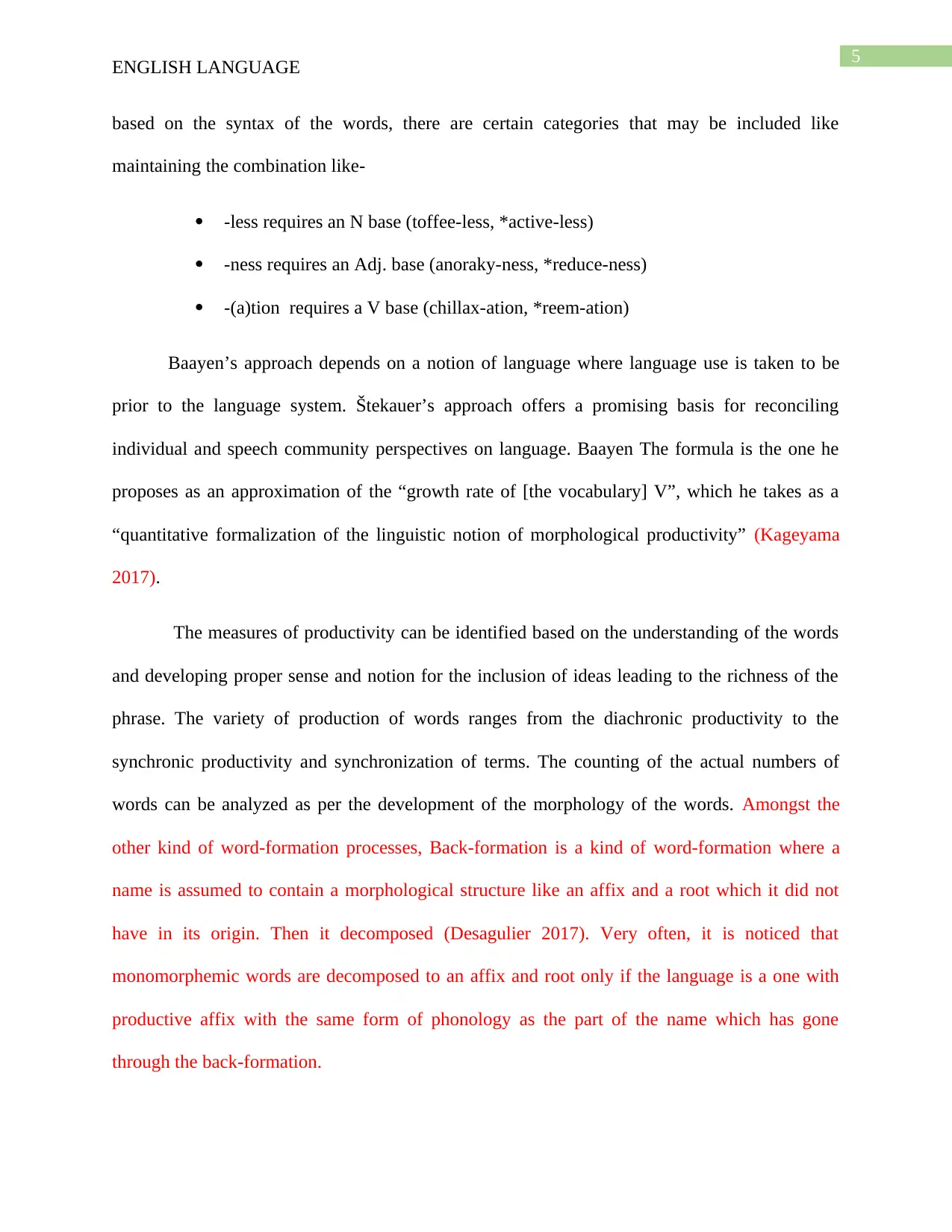
based on the syntax of the words, there are certain categories that may be included like
maintaining the combination like-
-less requires an N base (toffee-less, *active-less)
-ness requires an Adj. base (anoraky-ness, *reduce-ness)
-(a)tion requires a V base (chillax-ation, *reem-ation)
Baayen’s approach depends on a notion of language where language use is taken to be
prior to the language system. Štekauer’s approach offers a promising basis for reconciling
individual and speech community perspectives on language. Baayen The formula is the one he
proposes as an approximation of the “growth rate of [the vocabulary] V”, which he takes as a
“quantitative formalization of the linguistic notion of morphological productivity” (Kageyama
2017).
The measures of productivity can be identified based on the understanding of the words
and developing proper sense and notion for the inclusion of ideas leading to the richness of the
phrase. The variety of production of words ranges from the diachronic productivity to the
synchronic productivity and synchronization of terms. The counting of the actual numbers of
words can be analyzed as per the development of the morphology of the words. Amongst the
other kind of word-formation processes, Back-formation is a kind of word-formation where a
name is assumed to contain a morphological structure like an affix and a root which it did not
have in its origin. Then it decomposed (Desagulier 2017). Very often, it is noticed that
monomorphemic words are decomposed to an affix and root only if the language is a one with
productive affix with the same form of phonology as the part of the name which has gone
through the back-formation.
ENGLISH LANGUAGE
based on the syntax of the words, there are certain categories that may be included like
maintaining the combination like-
-less requires an N base (toffee-less, *active-less)
-ness requires an Adj. base (anoraky-ness, *reduce-ness)
-(a)tion requires a V base (chillax-ation, *reem-ation)
Baayen’s approach depends on a notion of language where language use is taken to be
prior to the language system. Štekauer’s approach offers a promising basis for reconciling
individual and speech community perspectives on language. Baayen The formula is the one he
proposes as an approximation of the “growth rate of [the vocabulary] V”, which he takes as a
“quantitative formalization of the linguistic notion of morphological productivity” (Kageyama
2017).
The measures of productivity can be identified based on the understanding of the words
and developing proper sense and notion for the inclusion of ideas leading to the richness of the
phrase. The variety of production of words ranges from the diachronic productivity to the
synchronic productivity and synchronization of terms. The counting of the actual numbers of
words can be analyzed as per the development of the morphology of the words. Amongst the
other kind of word-formation processes, Back-formation is a kind of word-formation where a
name is assumed to contain a morphological structure like an affix and a root which it did not
have in its origin. Then it decomposed (Desagulier 2017). Very often, it is noticed that
monomorphemic words are decomposed to an affix and root only if the language is a one with
productive affix with the same form of phonology as the part of the name which has gone
through the back-formation.
6
ENGLISH LANGUAGE
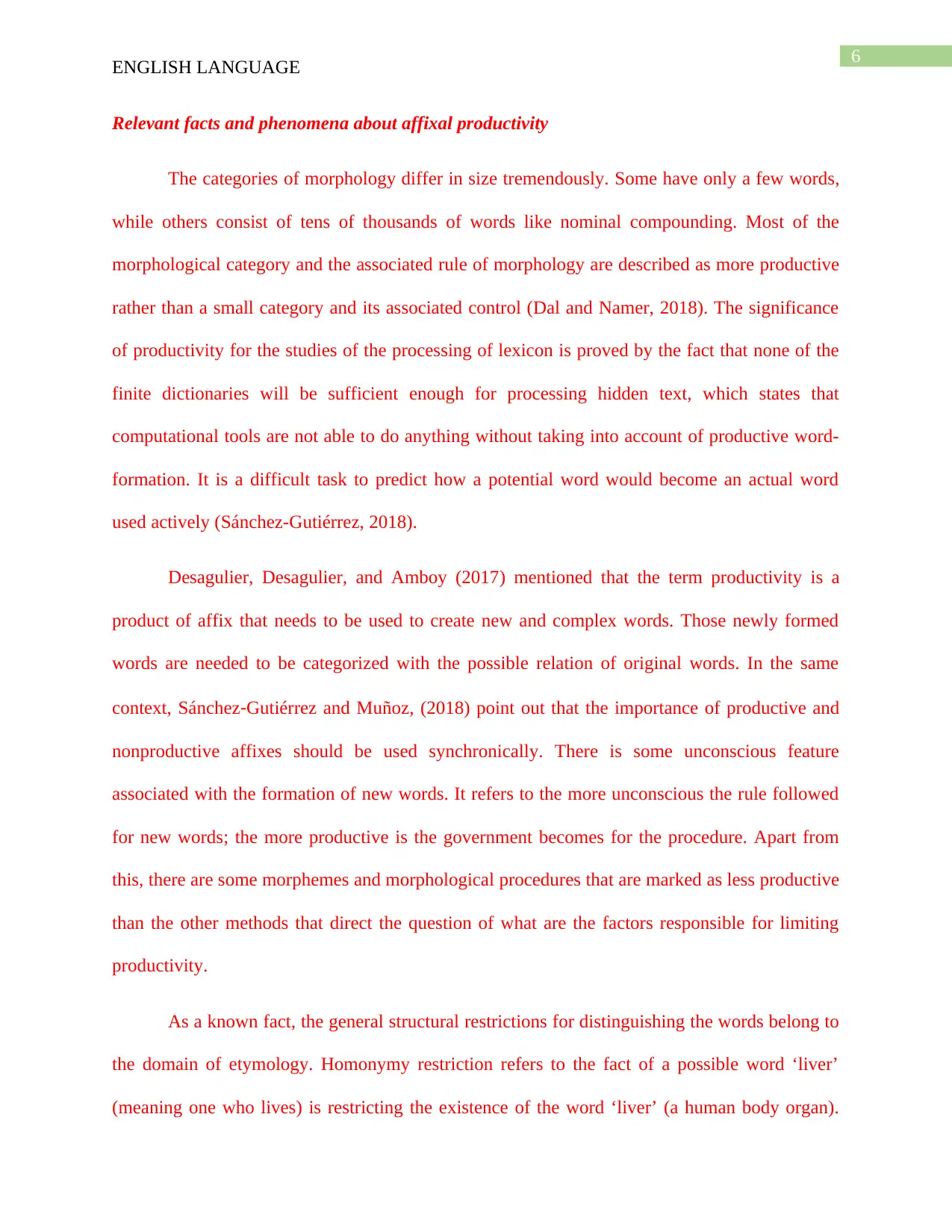
Relevant facts and phenomena about affixal productivity
The categories of morphology differ in size tremendously. Some have only a few words,
while others consist of tens of thousands of words like nominal compounding. Most of the
morphological category and the associated rule of morphology are described as more productive
rather than a small category and its associated control (Dal and Namer, 2018). The significance
of productivity for the studies of the processing of lexicon is proved by the fact that none of the
finite dictionaries will be sufficient enough for processing hidden text, which states that
computational tools are not able to do anything without taking into account of productive word-
formation. It is a difficult task to predict how a potential word would become an actual word
used actively (Sánchez-Gutiérrez, 2018).
Desagulier, Desagulier, and Amboy (2017) mentioned that the term productivity is a
product of affix that needs to be used to create new and complex words. Those newly formed
words are needed to be categorized with the possible relation of original words. In the same
context, Sánchez‐Gutiérrez and Muñoz, (2018) point out that the importance of productive and
nonproductive affixes should be used synchronically. There is some unconscious feature
associated with the formation of new words. It refers to the more unconscious the rule followed
for new words; the more productive is the government becomes for the procedure. Apart from
this, there are some morphemes and morphological procedures that are marked as less productive
than the other methods that direct the question of what are the factors responsible for limiting
productivity.
As a known fact, the general structural restrictions for distinguishing the words belong to
the domain of etymology. Homonymy restriction refers to the fact of a possible word ‘liver’
(meaning one who lives) is restricting the existence of the word ‘liver’ (a human body organ).
ENGLISH LANGUAGE
Relevant facts and phenomena about affixal productivity
The categories of morphology differ in size tremendously. Some have only a few words,
while others consist of tens of thousands of words like nominal compounding. Most of the
morphological category and the associated rule of morphology are described as more productive
rather than a small category and its associated control (Dal and Namer, 2018). The significance
of productivity for the studies of the processing of lexicon is proved by the fact that none of the
finite dictionaries will be sufficient enough for processing hidden text, which states that
computational tools are not able to do anything without taking into account of productive word-
formation. It is a difficult task to predict how a potential word would become an actual word
used actively (Sánchez-Gutiérrez, 2018).
Desagulier, Desagulier, and Amboy (2017) mentioned that the term productivity is a
product of affix that needs to be used to create new and complex words. Those newly formed
words are needed to be categorized with the possible relation of original words. In the same
context, Sánchez‐Gutiérrez and Muñoz, (2018) point out that the importance of productive and
nonproductive affixes should be used synchronically. There is some unconscious feature
associated with the formation of new words. It refers to the more unconscious the rule followed
for new words; the more productive is the government becomes for the procedure. Apart from
this, there are some morphemes and morphological procedures that are marked as less productive
than the other methods that direct the question of what are the factors responsible for limiting
productivity.
As a known fact, the general structural restrictions for distinguishing the words belong to
the domain of etymology. Homonymy restriction refers to the fact of a possible word ‘liver’
(meaning one who lives) is restricting the existence of the word ‘liver’ (a human body organ).
⊘ This is a preview!⊘
Do you want full access?
Subscribe today to unlock all pages.
Trusted by 1+ million students worldwide
7
ENGLISH LANGUAGE
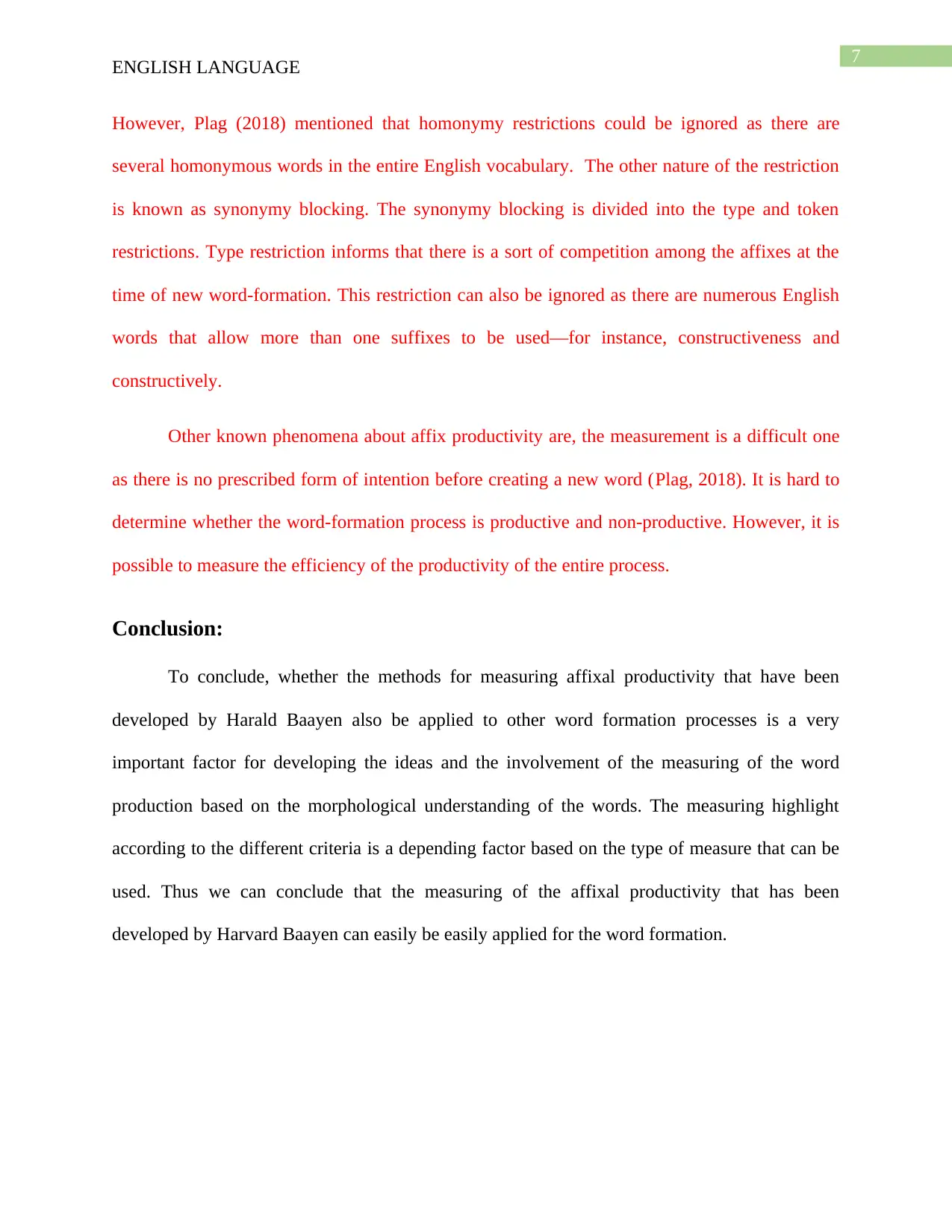
However, Plag (2018) mentioned that homonymy restrictions could be ignored as there are
several homonymous words in the entire English vocabulary. The other nature of the restriction
is known as synonymy blocking. The synonymy blocking is divided into the type and token
restrictions. Type restriction informs that there is a sort of competition among the affixes at the
time of new word-formation. This restriction can also be ignored as there are numerous English
words that allow more than one suffixes to be used—for instance, constructiveness and
constructively.
Other known phenomena about affix productivity are, the measurement is a difficult one
as there is no prescribed form of intention before creating a new word (Plag, 2018). It is hard to
determine whether the word-formation process is productive and non-productive. However, it is
possible to measure the efficiency of the productivity of the entire process.
Conclusion:
To conclude, whether the methods for measuring affixal productivity that have been
developed by Harald Baayen also be applied to other word formation processes is a very
important factor for developing the ideas and the involvement of the measuring of the word
production based on the morphological understanding of the words. The measuring highlight
according to the different criteria is a depending factor based on the type of measure that can be
used. Thus we can conclude that the measuring of the affixal productivity that has been
developed by Harvard Baayen can easily be easily applied for the word formation.
ENGLISH LANGUAGE
However, Plag (2018) mentioned that homonymy restrictions could be ignored as there are
several homonymous words in the entire English vocabulary. The other nature of the restriction
is known as synonymy blocking. The synonymy blocking is divided into the type and token
restrictions. Type restriction informs that there is a sort of competition among the affixes at the
time of new word-formation. This restriction can also be ignored as there are numerous English
words that allow more than one suffixes to be used—for instance, constructiveness and
constructively.
Other known phenomena about affix productivity are, the measurement is a difficult one
as there is no prescribed form of intention before creating a new word (Plag, 2018). It is hard to
determine whether the word-formation process is productive and non-productive. However, it is
possible to measure the efficiency of the productivity of the entire process.
Conclusion:
To conclude, whether the methods for measuring affixal productivity that have been
developed by Harald Baayen also be applied to other word formation processes is a very
important factor for developing the ideas and the involvement of the measuring of the word
production based on the morphological understanding of the words. The measuring highlight
according to the different criteria is a depending factor based on the type of measure that can be
used. Thus we can conclude that the measuring of the affixal productivity that has been
developed by Harvard Baayen can easily be easily applied for the word formation.
Paraphrase This Document
Need a fresh take? Get an instant paraphrase of this document with our AI Paraphraser
8
ENGLISH LANGUAGE
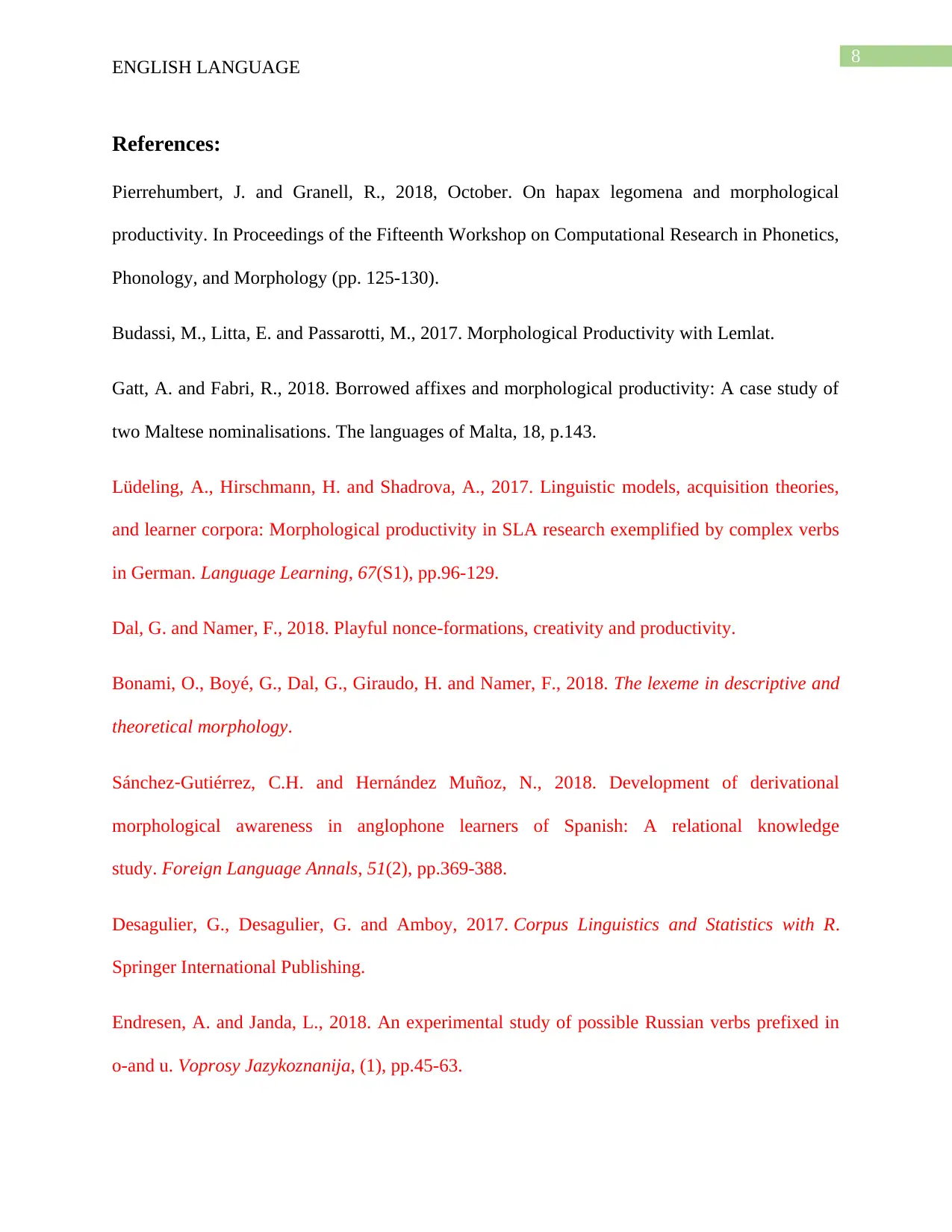
References:
Pierrehumbert, J. and Granell, R., 2018, October. On hapax legomena and morphological
productivity. In Proceedings of the Fifteenth Workshop on Computational Research in Phonetics,
Phonology, and Morphology (pp. 125-130).
Budassi, M., Litta, E. and Passarotti, M., 2017. Morphological Productivity with Lemlat.
Gatt, A. and Fabri, R., 2018. Borrowed affixes and morphological productivity: A case study of
two Maltese nominalisations. The languages of Malta, 18, p.143.
Lüdeling, A., Hirschmann, H. and Shadrova, A., 2017. Linguistic models, acquisition theories,
and learner corpora: Morphological productivity in SLA research exemplified by complex verbs
in German. Language Learning, 67(S1), pp.96-129.
Dal, G. and Namer, F., 2018. Playful nonce-formations, creativity and productivity.
Bonami, O., Boyé, G., Dal, G., Giraudo, H. and Namer, F., 2018. The lexeme in descriptive and
theoretical morphology.
Sánchez‐Gutiérrez, C.H. and Hernández Muñoz, N., 2018. Development of derivational
morphological awareness in anglophone learners of Spanish: A relational knowledge
study. Foreign Language Annals, 51(2), pp.369-388.
Desagulier, G., Desagulier, G. and Amboy, 2017. Corpus Linguistics and Statistics with R.
Springer International Publishing.
Endresen, A. and Janda, L., 2018. An experimental study of possible Russian verbs prefixed in
o-and u. Voprosy Jazykoznanija, (1), pp.45-63.
ENGLISH LANGUAGE
References:
Pierrehumbert, J. and Granell, R., 2018, October. On hapax legomena and morphological
productivity. In Proceedings of the Fifteenth Workshop on Computational Research in Phonetics,
Phonology, and Morphology (pp. 125-130).
Budassi, M., Litta, E. and Passarotti, M., 2017. Morphological Productivity with Lemlat.
Gatt, A. and Fabri, R., 2018. Borrowed affixes and morphological productivity: A case study of
two Maltese nominalisations. The languages of Malta, 18, p.143.
Lüdeling, A., Hirschmann, H. and Shadrova, A., 2017. Linguistic models, acquisition theories,
and learner corpora: Morphological productivity in SLA research exemplified by complex verbs
in German. Language Learning, 67(S1), pp.96-129.
Dal, G. and Namer, F., 2018. Playful nonce-formations, creativity and productivity.
Bonami, O., Boyé, G., Dal, G., Giraudo, H. and Namer, F., 2018. The lexeme in descriptive and
theoretical morphology.
Sánchez‐Gutiérrez, C.H. and Hernández Muñoz, N., 2018. Development of derivational
morphological awareness in anglophone learners of Spanish: A relational knowledge
study. Foreign Language Annals, 51(2), pp.369-388.
Desagulier, G., Desagulier, G. and Amboy, 2017. Corpus Linguistics and Statistics with R.
Springer International Publishing.
Endresen, A. and Janda, L., 2018. An experimental study of possible Russian verbs prefixed in
o-and u. Voprosy Jazykoznanija, (1), pp.45-63.
9
ENGLISH LANGUAGE
Baayen, H. and Ramscar, M., 2019. Abstraction, storage and naive discriminative
learning. Cognitive Linguistics-Foundations of Language, p.115.
Plag, I., 2018. Word-formation in English. Cambridge University Press.
Kageyama, T., 2017. Word formation. The handbook of Japanese linguistics, pp.297-325.
Lieber, R., 2005. English word-formation processes. In Handbook of word-formation (pp. 375-
427). Springer, Dordrecht.
ENGLISH LANGUAGE
Baayen, H. and Ramscar, M., 2019. Abstraction, storage and naive discriminative
learning. Cognitive Linguistics-Foundations of Language, p.115.
Plag, I., 2018. Word-formation in English. Cambridge University Press.
Kageyama, T., 2017. Word formation. The handbook of Japanese linguistics, pp.297-325.
Lieber, R., 2005. English word-formation processes. In Handbook of word-formation (pp. 375-
427). Springer, Dordrecht.
⊘ This is a preview!⊘
Do you want full access?
Subscribe today to unlock all pages.
Trusted by 1+ million students worldwide

1 out of 9


Your All-in-One AI-Powered Toolkit for Academic Success.
+13062052269
info@desklib.com
Available 24*7 on WhatsApp / Email
![[object Object]](/_next/static/media/star-bottom.7253800d.svg)
Unlock your academic potential
Copyright © 2020–2026 A2Z Services. All Rights Reserved. Developed and managed by ZUCOL.