A Research Paper: Morphology, Second Language Acquisition in Nigeria

Verified

Added on  2022/08/18

|6
|1691
|11
Report
AI Summary
This research paper delves into the core concepts of morphology, which is the study of word structure, and second language acquisition (SLA), exploring how individuals learn a second language. It examines the building blocks of words (morphemes), the processes involved in forming complex words, and the internal structure of words. The paper then transitions to SLA, discussing the theories and processes involved, including the role of comprehensible input and the distinction between language learning and acquisition. A significant portion of the paper focuses on the Nigerian context, analyzing the impact of English as a second language, its global status, and its influence on education, culture, and economic development. The paper highlights the historical context of English in Nigeria, the shift in language policies, and the implications of English proficiency for individual success and national development, while advocating for the preservation of indigenous languages. The research references several key sources in the fields of linguistics and SLA.
Document Page
Running head: RESEARCH PAPER
Research Paper
Name of the Student
Name of the University
Author Notes:
tabler-icon-diamond-filled.svg

Paraphrase This Document

Need a fresh take? Get an instant paraphrase of this document with our AI Paraphraser
Document Page
1RESEARCH PAPER
Definition of Morphology
It is actually the study of internal structure of words that forms a central part of the study
of linguistic. Morphology as a term is great and 'morph' means shape 'ology' means the study of
something. The morphology is also concerned with the linguistics which was named in 1859 and
it was used for the study of word formation. The morphemes are considered to be the building
blocks of what is morphology (Kurdi 2016). It is found that words are formed of smaller pieces
and those have internal structure. The simple words are not with the structure and the simple
words cannot be split into some smaller parts that have the meaning of the function. On the other
hand the complex words are those that have internal structure such as 'worker'. In this, affix '-er'
has been added to the main word in order to form noun. It can be said that in linguistics, the
morphology is the study of the words consisting of how the words are formed how the
connections of words occur in a similar language (LarsenFreeman 2018). Morphology also
analyses the form of words along with the parts of words as root words, suffixes and prefixes
stems. It also considers the intonation, the parts of speech, the contacts, the stress that come
across in the punctuation and meaning of word. Notably, the morphological typologies are
different from morphology that is the classification of the language on the usage of words along
with lexicology that is the word study related makeup and the vocabulary of a language. The
words are usually accepted to be the smallest units of the syntax and most of the languages,
many of the words can become connected to other word rules which described collectively the
grammar for the language (Sugioka 2018). For example, the English speakers identify that the
words 'dog' and 'dogs' are related closely but these are differentiated through plurality morpheme
that is ‘s’. The English speakers identify these connections from the innate knowledge of the
rules of English word formation. There is the orthographic and phonological modifications
Document Page
2RESEARCH PAPER
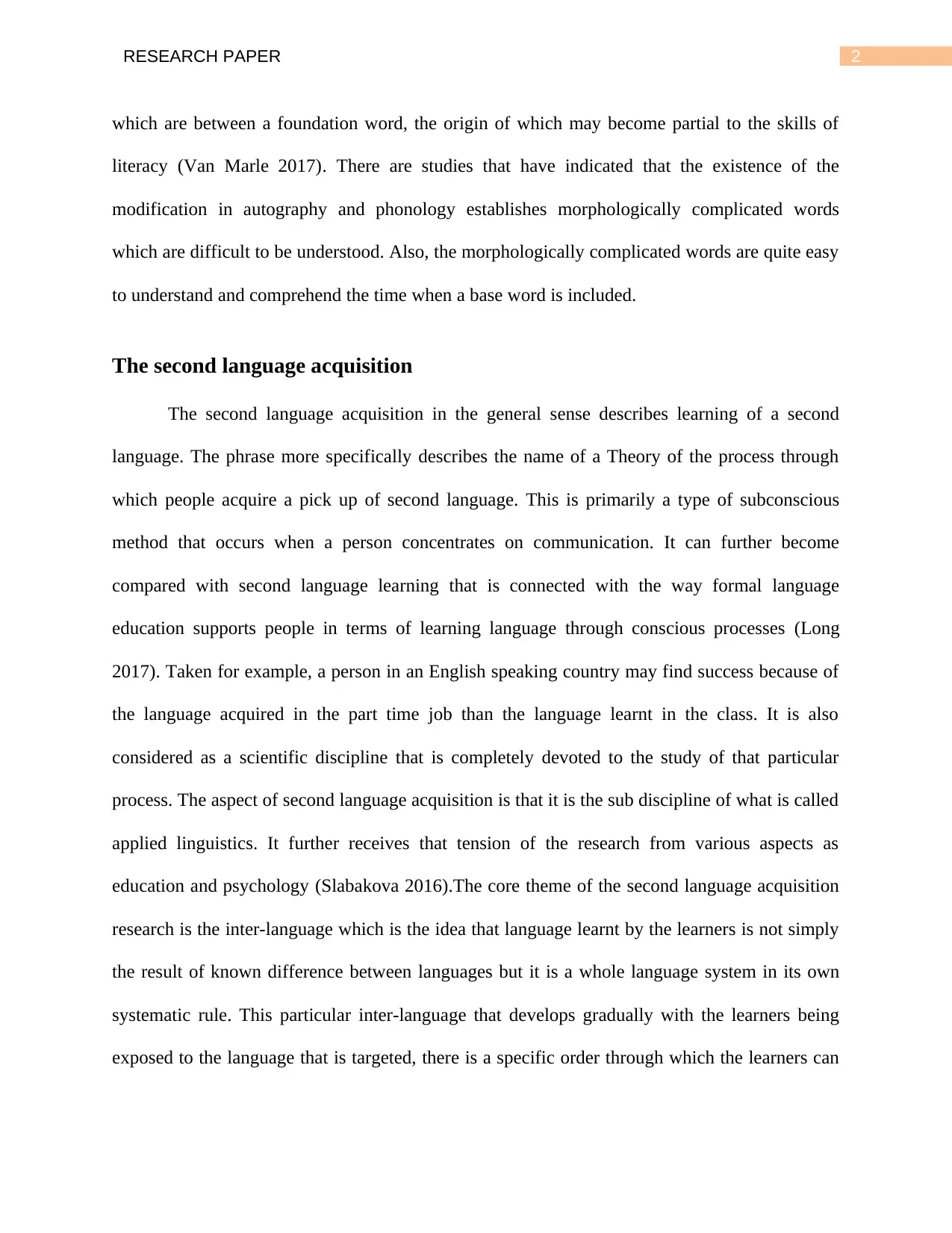
which are between a foundation word, the origin of which may become partial to the skills of
literacy (Van Marle 2017). There are studies that have indicated that the existence of the
modification in autography and phonology establishes morphologically complicated words
which are difficult to be understood. Also, the morphologically complicated words are quite easy
to understand and comprehend the time when a base word is included.
The second language acquisition
The second language acquisition in the general sense describes learning of a second
language. The phrase more specifically describes the name of a Theory of the process through
which people acquire a pick up of second language. This is primarily a type of subconscious
method that occurs when a person concentrates on communication. It can further become
compared with second language learning that is connected with the way formal language
education supports people in terms of learning language through conscious processes (Long
2017). Taken for example, a person in an English speaking country may find success because of
the language acquired in the part time job than the language learnt in the class. It is also
considered as a scientific discipline that is completely devoted to the study of that particular
process. The aspect of second language acquisition is that it is the sub discipline of what is called
applied linguistics. It further receives that tension of the research from various aspects as
education and psychology (Slabakova 2016).The core theme of the second language acquisition
research is the inter-language which is the idea that language learnt by the learners is not simply
the result of known difference between languages but it is a whole language system in its own
systematic rule. This particular inter-language that develops gradually with the learners being
exposed to the language that is targeted, there is a specific order through which the learners can
Document Page
3RESEARCH PAPER
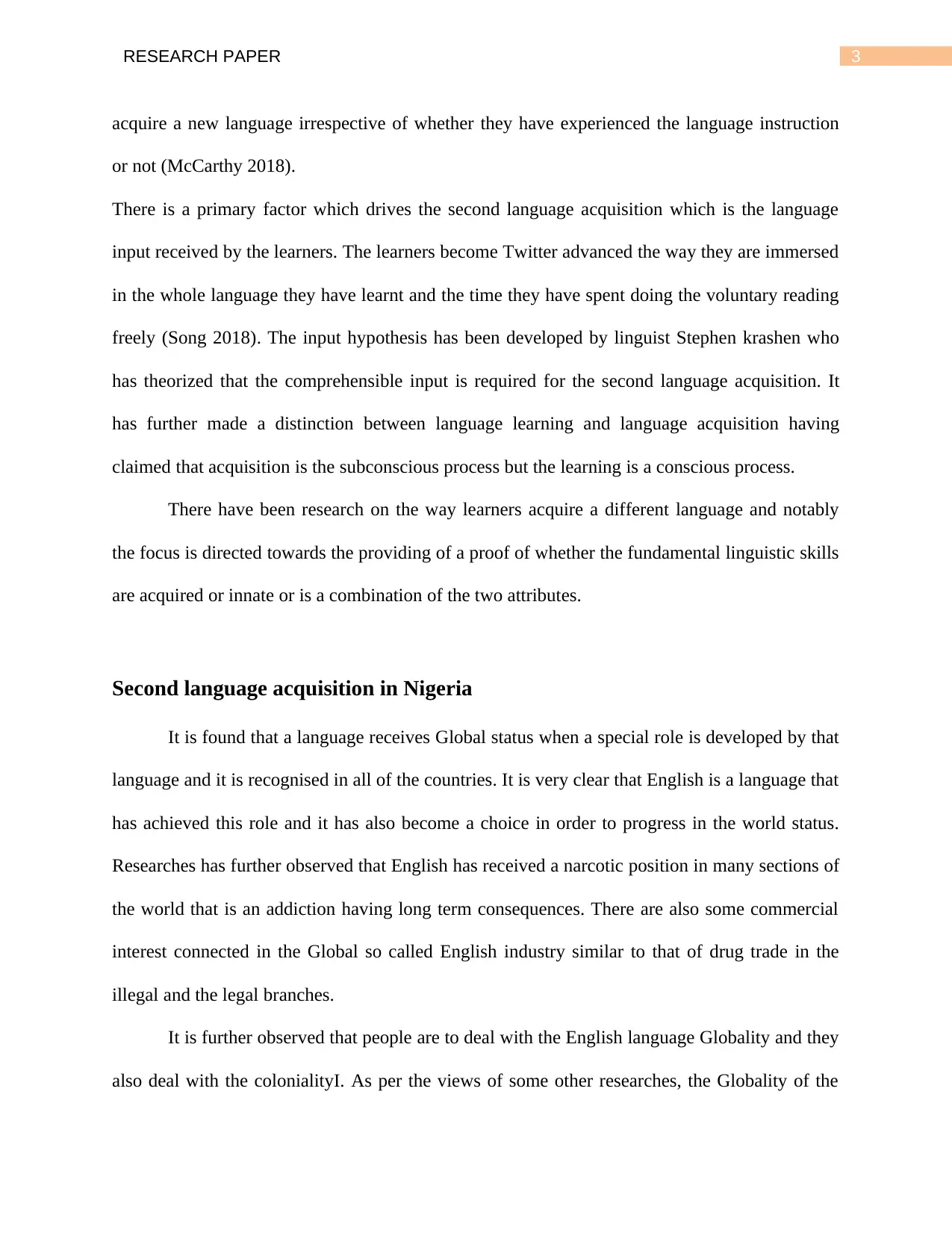
acquire a new language irrespective of whether they have experienced the language instruction
or not (McCarthy 2018).
There is a primary factor which drives the second language acquisition which is the language
input received by the learners. The learners become Twitter advanced the way they are immersed
in the whole language they have learnt and the time they have spent doing the voluntary reading
freely (Song 2018). The input hypothesis has been developed by linguist Stephen krashen who
has theorized that the comprehensible input is required for the second language acquisition. It
has further made a distinction between language learning and language acquisition having
claimed that acquisition is the subconscious process but the learning is a conscious process.
There have been research on the way learners acquire a different language and notably
the focus is directed towards the providing of a proof of whether the fundamental linguistic skills
are acquired or innate or is a combination of the two attributes.
Second language acquisition in Nigeria
It is found that a language receives Global status when a special role is developed by that
language and it is recognised in all of the countries. It is very clear that English is a language that
has achieved this role and it has also become a choice in order to progress in the world status.
Researches has further observed that English has received a narcotic position in many sections of
the world that is an addiction having long term consequences. There are also some commercial
interest connected in the Global so called English industry similar to that of drug trade in the
illegal and the legal branches.
It is further observed that people are to deal with the English language Globality and they
also deal with the colonialityI. As per the views of some other researches, the Globality of the
tabler-icon-diamond-filled.svg

Paraphrase This Document

Need a fresh take? Get an instant paraphrase of this document with our AI Paraphraser
Document Page
4RESEARCH PAPER
language English hasr rode on the colonialism. There was some incredible impact on the identity
of people around the whole world. In Nigeria the formal Western education had been introduced
by Christian missionaries and outcome lasted completely on the missionaries for more than four
decades. The missionaries believed that the African child has to be thought in the native
language and it will serve the purpose of Christian religion in the indigenous culture too. This
particular approach was accepted by the people who perceived these types of education were not
suitable for the job market those days. Also those people having reasonable command over the
English language were highly demanded. The outcome was that the government started to
intervene in the education of Nigeria with the aim of establishing the English language. Years
passed and the language education policy started by the government of Nigeria received much
success having shifted their interest in language that is away from indigenous language, the
language of the masters of colonialism. In this way the English as a language had gained the
second language status in the country in the official r language of all spheres. It can be said that
English has come over for symbolising success and wealth along with intellectual, political and
economic power for sure. The rapid decision making and speed used to characterize the new high
tech world and implied that economic success in global world needed people to acquire English
proficiently and quickly.This was the type of obsession that certainly have some other factors
leading to the economic success of the country traditionally. The acquisition of English for
economic success and the political development may come up as a reality. However, the
government should understand that English proficiency is required. The government should also
view the indigenous language more clearly with all their authentic identities that is also a
practical means of communication. In the year 1977 the national policy of Nigeria on education
got revived advocating the use age of language of immediate community being a medium of
Document Page
5RESEARCH PAPER
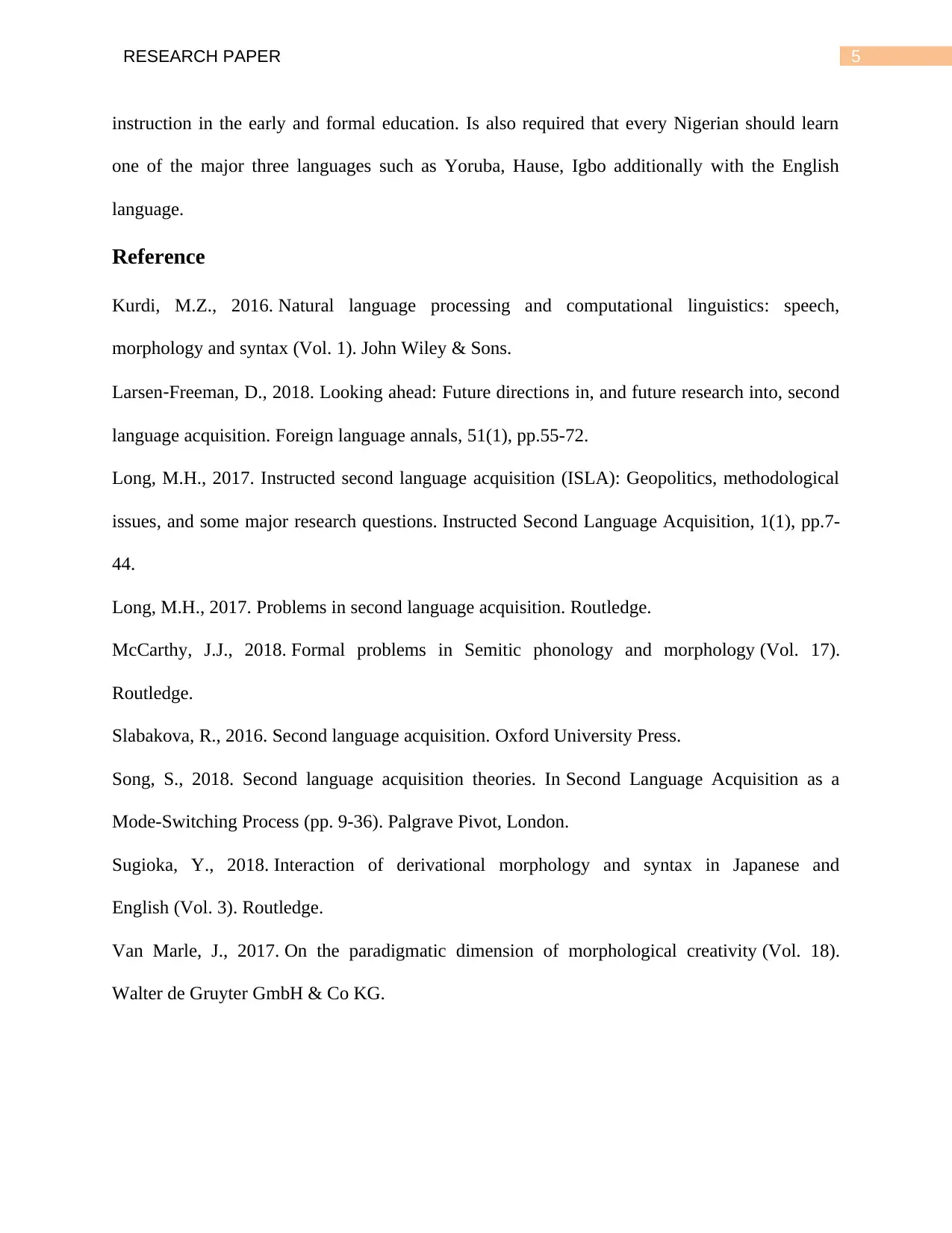
instruction in the early and formal education. Is also required that every Nigerian should learn
one of the major three languages such as Yoruba, Hause, Igbo additionally with the English
language.
Reference
Kurdi, M.Z., 2016. Natural language processing and computational linguistics: speech,
morphology and syntax (Vol. 1). John Wiley & Sons.
LarsenFreeman, D., 2018. Looking ahead: Future directions in, and future research into, second
language acquisition. Foreign language annals, 51(1), pp.55-72.
Long, M.H., 2017. Instructed second language acquisition (ISLA): Geopolitics, methodological
issues, and some major research questions. Instructed Second Language Acquisition, 1(1), pp.7-
44.
Long, M.H., 2017. Problems in second language acquisition. Routledge.
McCarthy, J.J., 2018. Formal problems in Semitic phonology and morphology (Vol. 17).
Routledge.
Slabakova, R., 2016. Second language acquisition. Oxford University Press.
Song, S., 2018. Second language acquisition theories. In Second Language Acquisition as a
Mode-Switching Process (pp. 9-36). Palgrave Pivot, London.
Sugioka, Y., 2018. Interaction of derivational morphology and syntax in Japanese and
English (Vol. 3). Routledge.
Van Marle, J., 2017. On the paradigmatic dimension of morphological creativity (Vol. 18).
Walter de Gruyter GmbH & Co KG.
chevron_up_icon
1 out of 6
circle_padding
hide_on_mobile
zoom_out_icon
[object Object]