Mother Teresa: Exploring Her Life, Work, and Lasting Impact

Verified

Added on  2021/04/21

|17
|1847
|117
Essay
AI Summary
This essay provides a comprehensive overview of the life and work of Mother Teresa, detailing her early life in Skopje, her calling to religious life, and her subsequent journey to India where she joined the Sisters of Loreto. It explores her shift towards serving the poorest of the poor, leading to the establishment of the Missionaries of Charity, which expanded globally to provide care for the sick, orphaned, and marginalized. The essay highlights her efforts in establishing schools, medical training, and orphanages, as well as her recognition with awards like the Nobel Peace Prize. It emphasizes her impact on the global stage, including her beatification and canonization by the Vatican, and her enduring legacy as a symbol of compassion and humanitarian service. The essay utilizes various sources to analyze her contributions to society and her influence on others.
Document Page
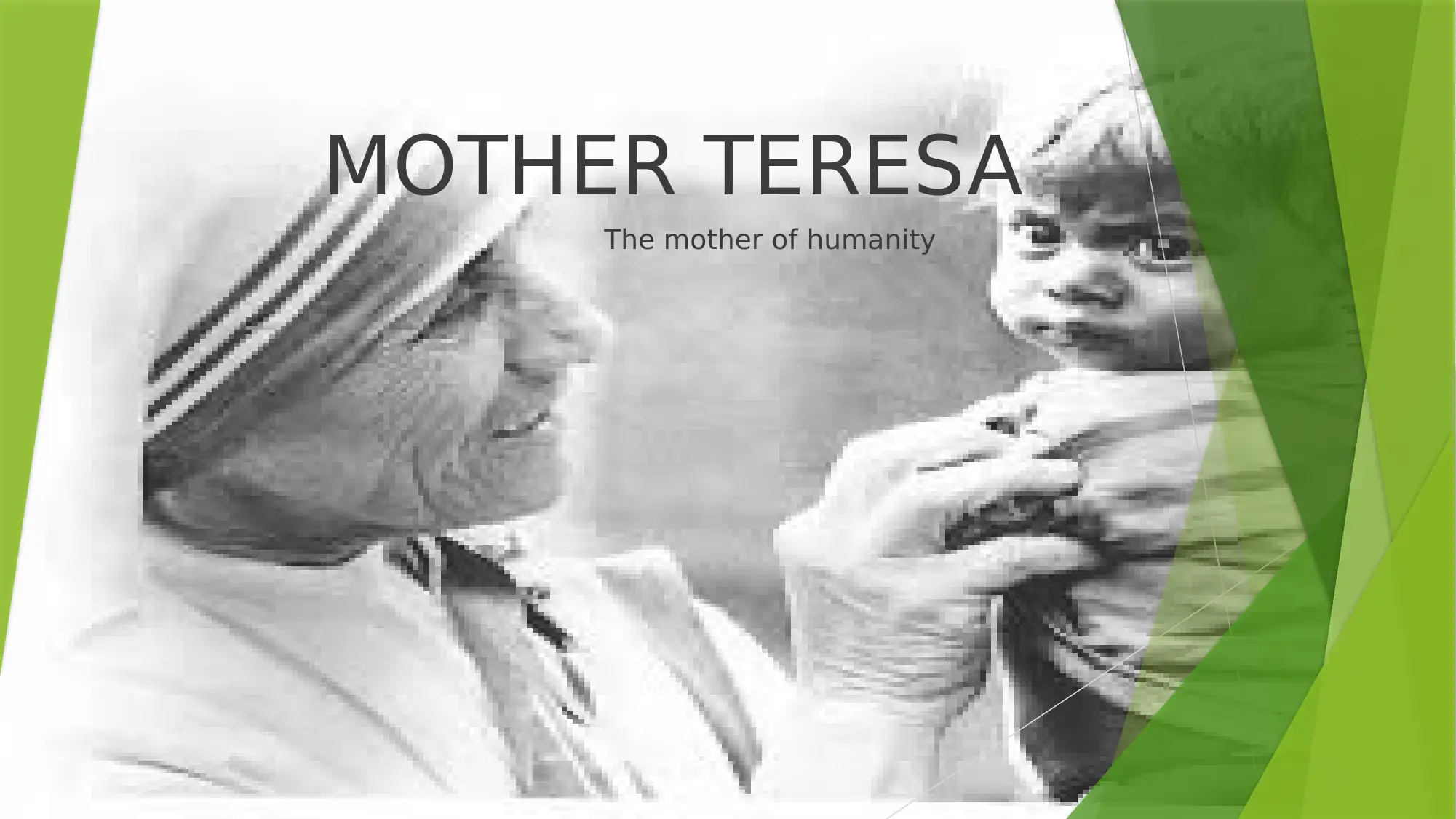
MOTHER TERESA
The mother of humanity
tabler-icon-diamond-filled.svg

Paraphrase This Document

Need a fresh take? Get an instant paraphrase of this document with our AI Paraphraser
Document Page
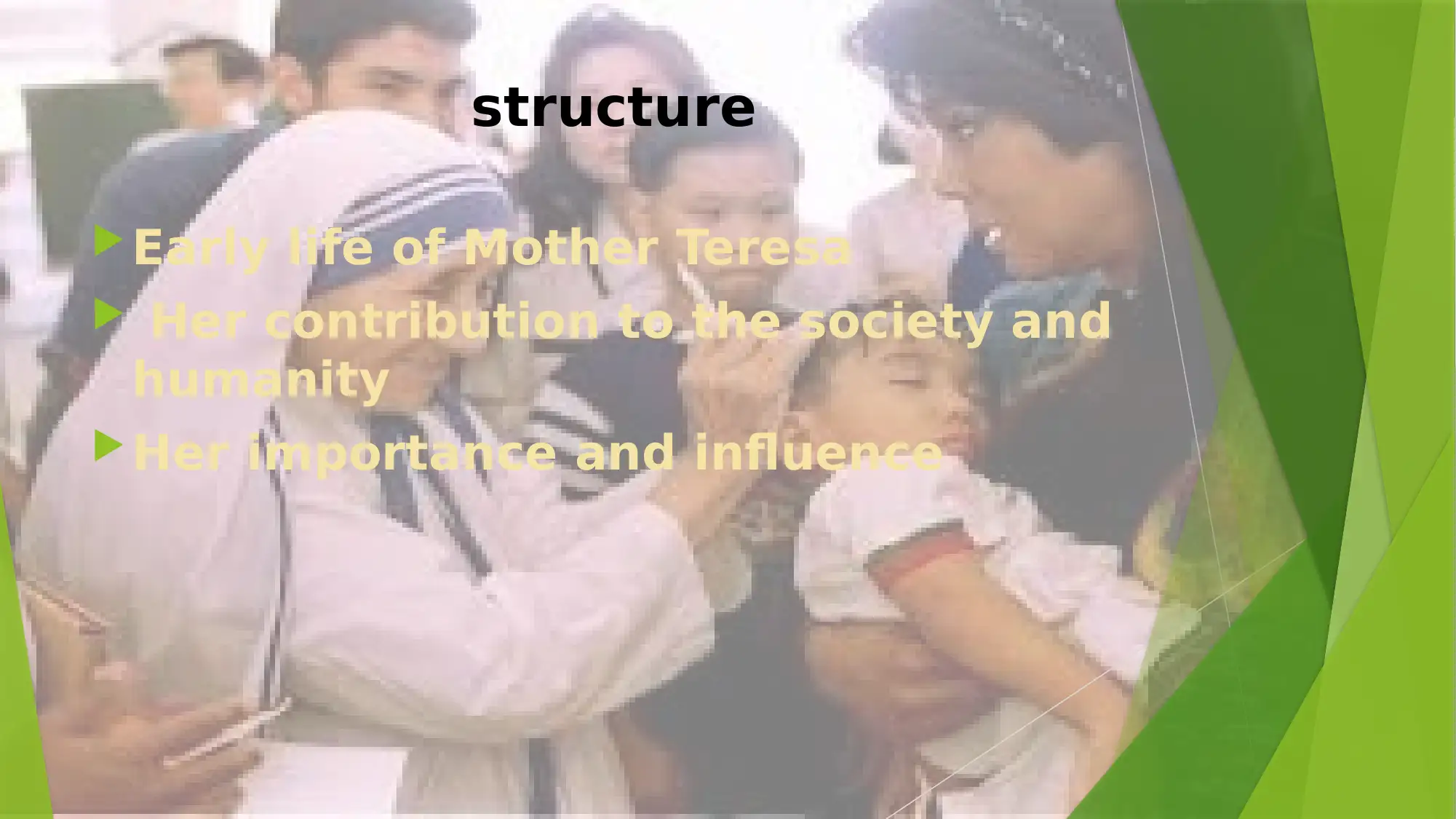
structure
Early life of Mother Teresa
Her contribution to the society and
humanity
Her importance and influence
Document Page
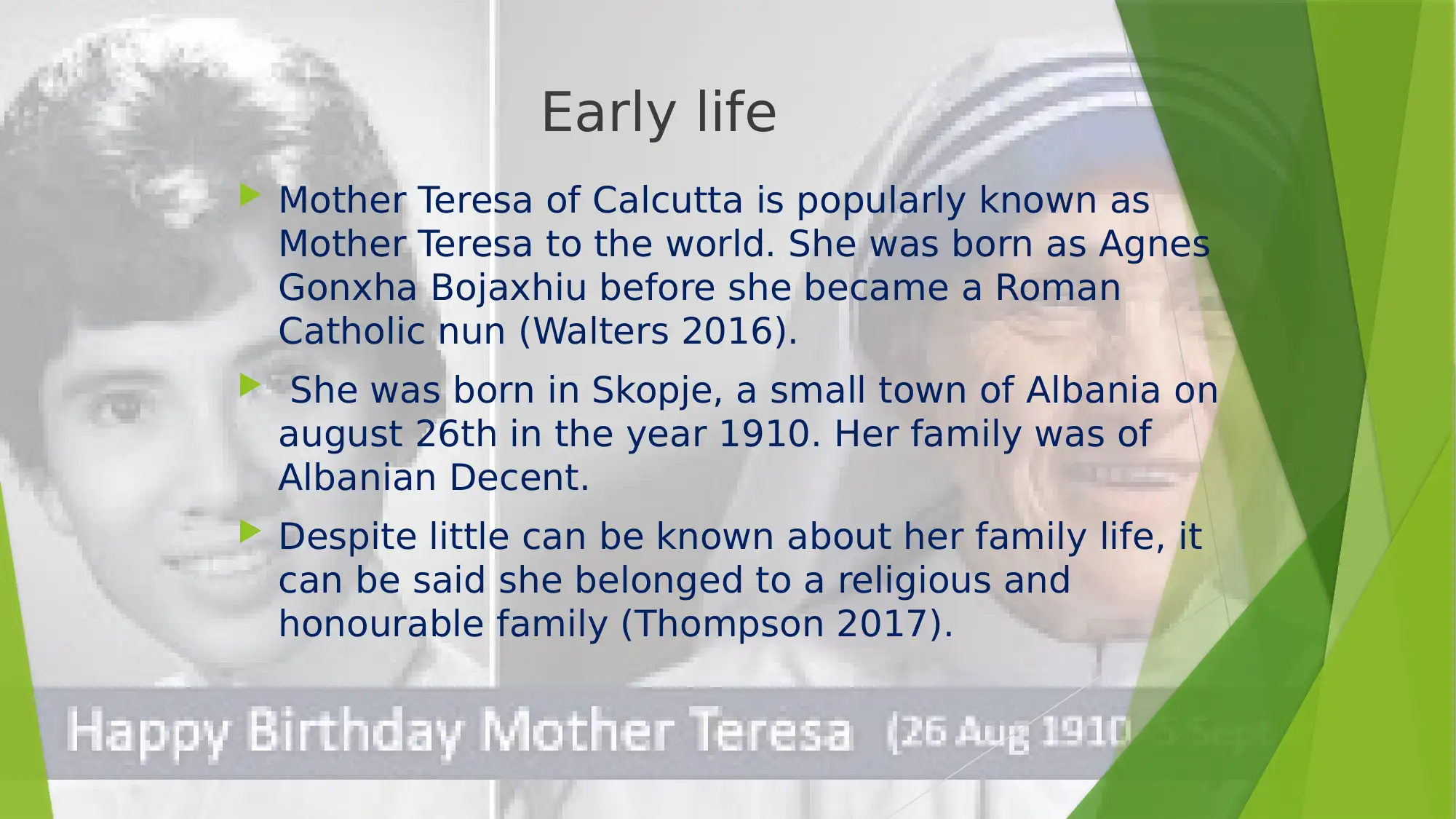
Early life
Mother Teresa of Calcutta is popularly known as
Mother Teresa to the world. She was born as Agnes
Gonxha Bojaxhiu before she became a Roman
Catholic nun (Walters 2016).
She was born in Skopje, a small town of Albania on
august 26th in the year 1910. Her family was of
Albanian Decent.
Despite little can be known about her family life, it
can be said she belonged to a religious and
honourable family (Thompson 2017).
Document Page
Contd.
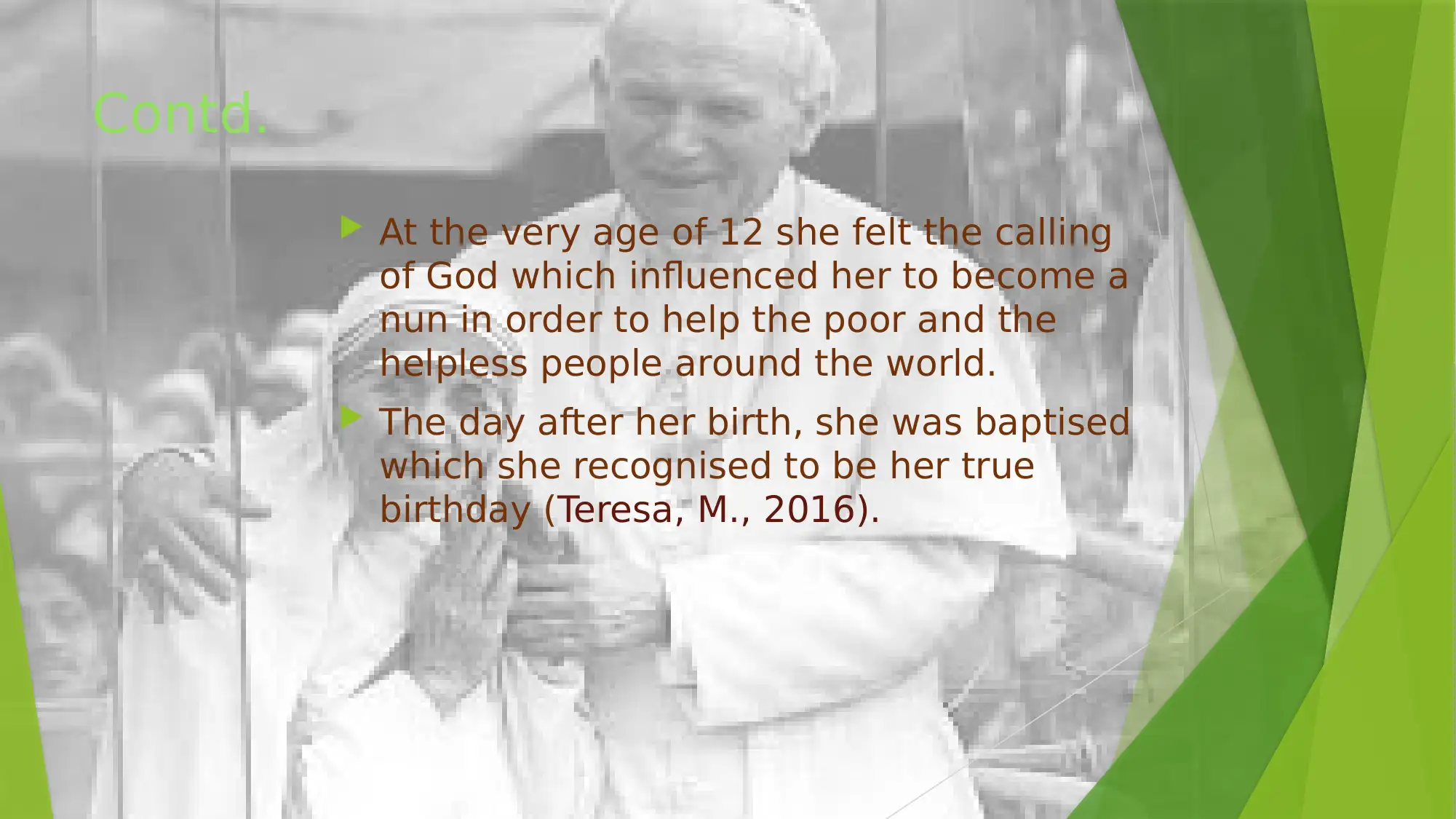
At the very age of 12 she felt the calling
of God which influenced her to become a
nun in order to help the poor and the
helpless people around the world.
The day after her birth, she was baptised
which she recognised to be her true
birthday (Teresa, M., 2016).
tabler-icon-diamond-filled.svg

Paraphrase This Document

Need a fresh take? Get an instant paraphrase of this document with our AI Paraphraser
Document Page
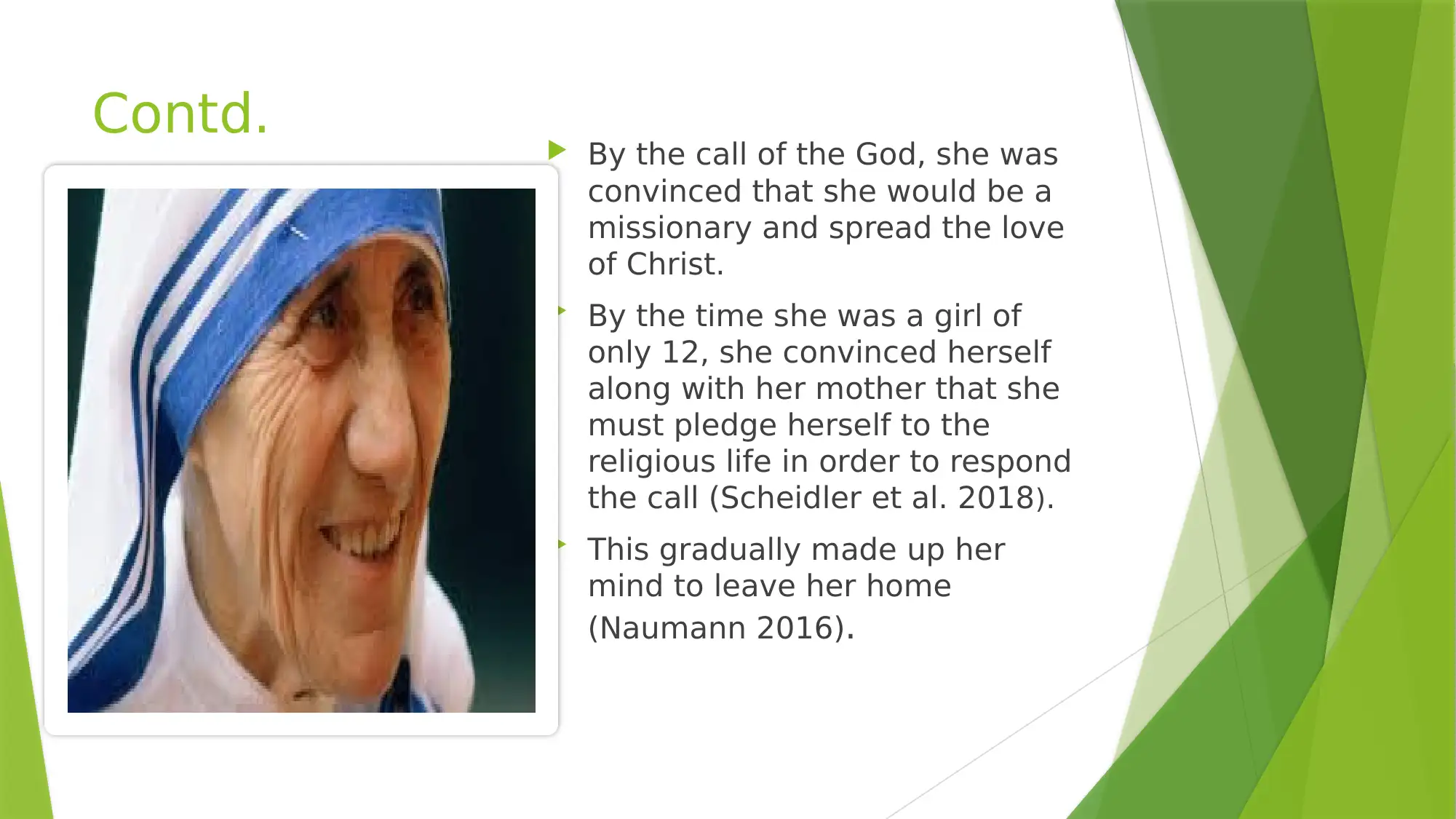
Contd. By the call of the God, she was
convinced that she would be a
missionary and spread the love
of Christ.
By the time she was a girl of
only 12, she convinced herself
along with her mother that she
must pledge herself to the
religious life in order to respond
the call (Scheidler et al. 2018).
This gradually made up her
mind to leave her home
(Naumann 2016).
Document Page
Contd.
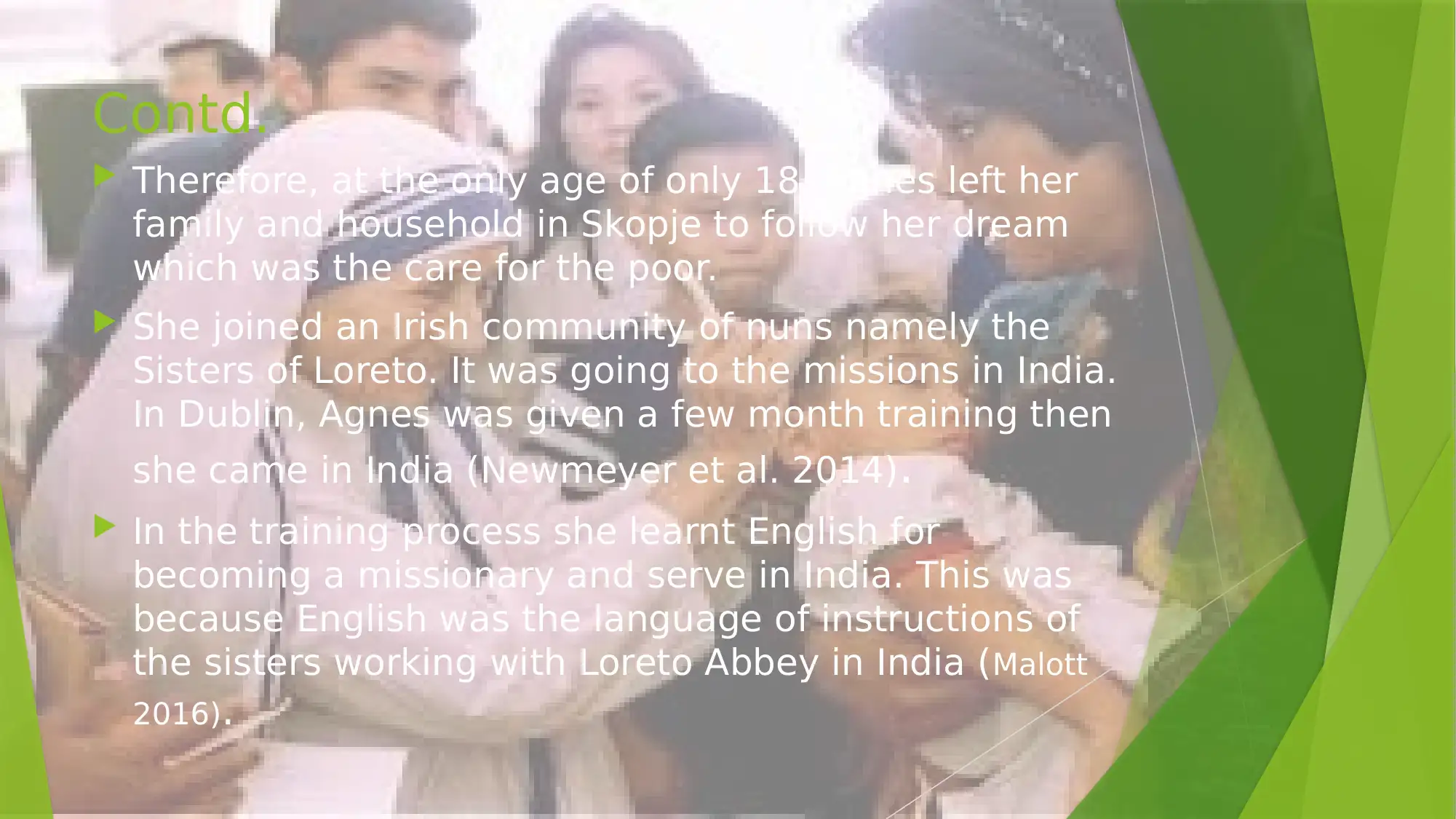
Therefore, at the only age of only 18, Agnes left her
family and household in Skopje to follow her dream
which was the care for the poor.
She joined an Irish community of nuns namely the
Sisters of Loreto. It was going to the missions in India.
In Dublin, Agnes was given a few month training then
she came in India (Newmeyer et al. 2014).
In the training process she learnt English for
becoming a missionary and serve in India. This was
because English was the language of instructions of
the sisters working with Loreto Abbey in India (Malott
2016).
Document Page
Working life
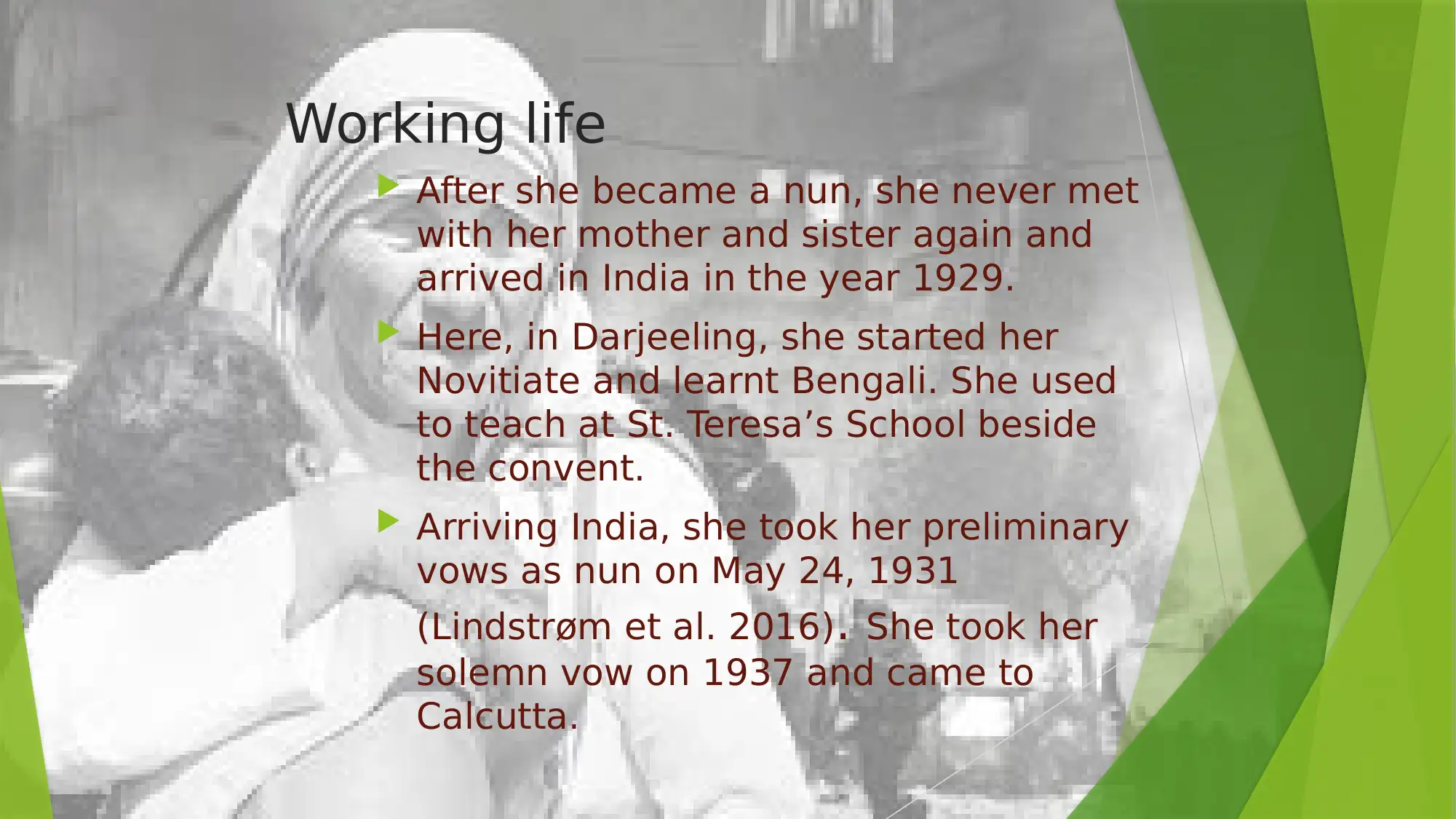
After she became a nun, she never met
with her mother and sister again and
arrived in India in the year 1929.
Here, in Darjeeling, she started her
Novitiate and learnt Bengali. She used
to teach at St. Teresa’s School beside
the convent.
Arriving India, she took her preliminary
vows as nun on May 24, 1931
(Lindstrøm et al. 2016). She took her
solemn vow on 1937 and came to
Calcutta.
tabler-icon-diamond-filled.svg

Paraphrase This Document

Need a fresh take? Get an instant paraphrase of this document with our AI Paraphraser
Document Page
Contd.
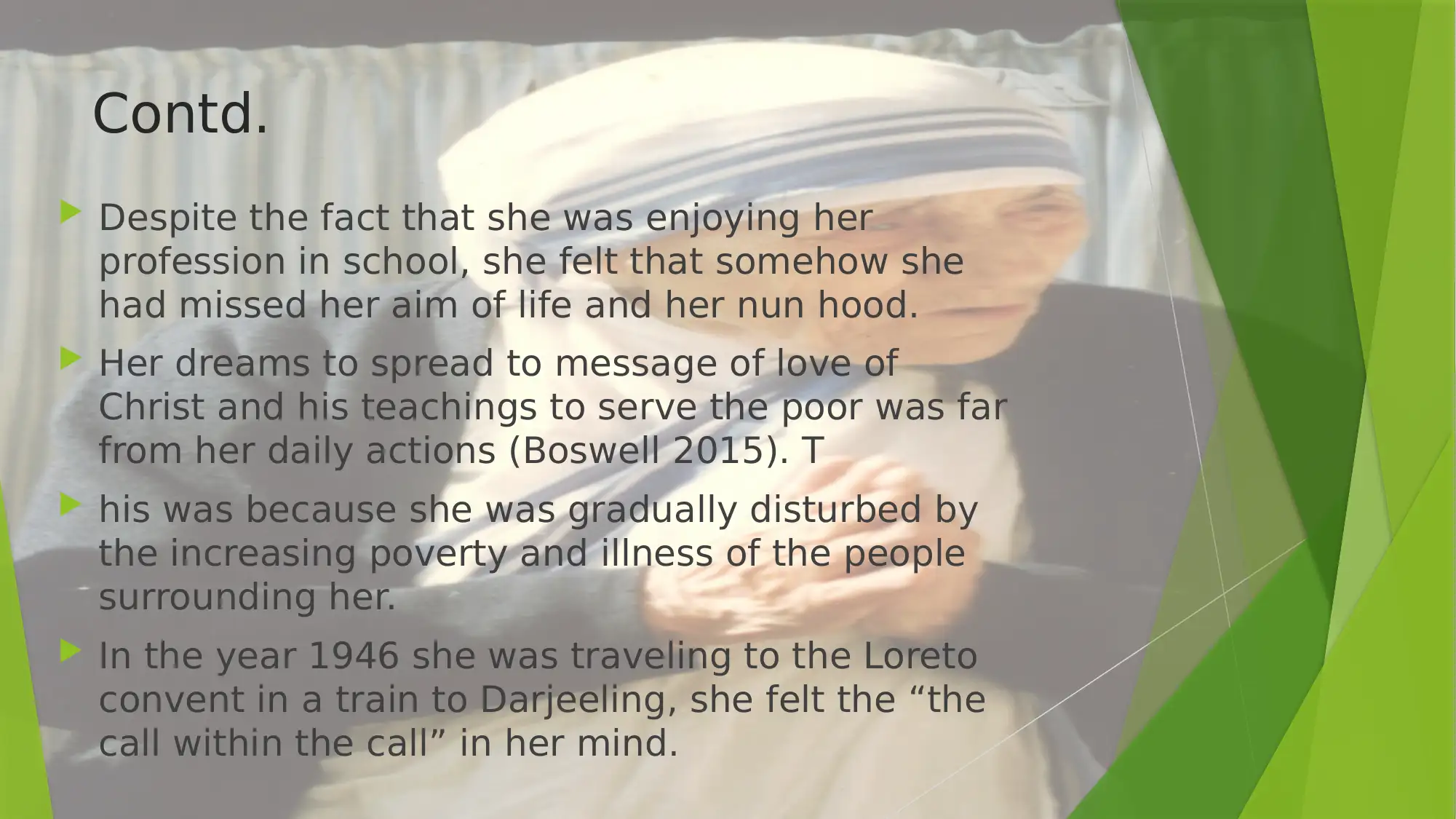
Despite the fact that she was enjoying her
profession in school, she felt that somehow she
had missed her aim of life and her nun hood.
Her dreams to spread to message of love of
Christ and his teachings to serve the poor was far
from her daily actions (Boswell 2015). T
his was because she was gradually disturbed by
the increasing poverty and illness of the people
surrounding her.
In the year 1946 she was traveling to the Loreto
convent in a train to Darjeeling, she felt the “the
call within the call” in her mind.
Document Page
Contd.
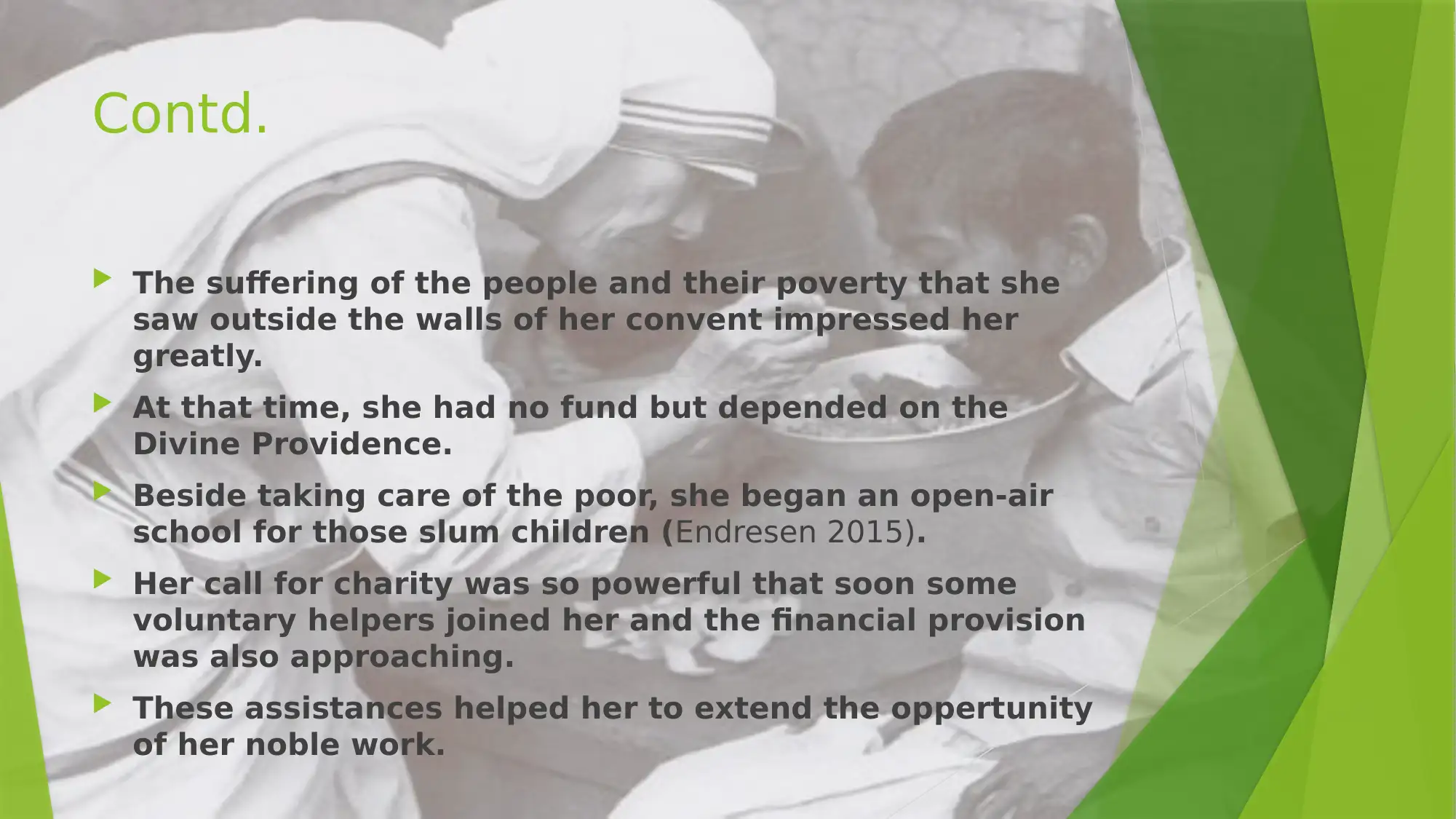
The suffering of the people and their poverty that she
saw outside the walls of her convent impressed her
greatly.
At that time, she had no fund but depended on the
Divine Providence.
Beside taking care of the poor, she began an open-air
school for those slum children (Endresen 2015).
Her call for charity was so powerful that soon some
voluntary helpers joined her and the financial provision
was also approaching.
These assistances helped her to extend the oppertunity
of her noble work.
Document Page
Contd.
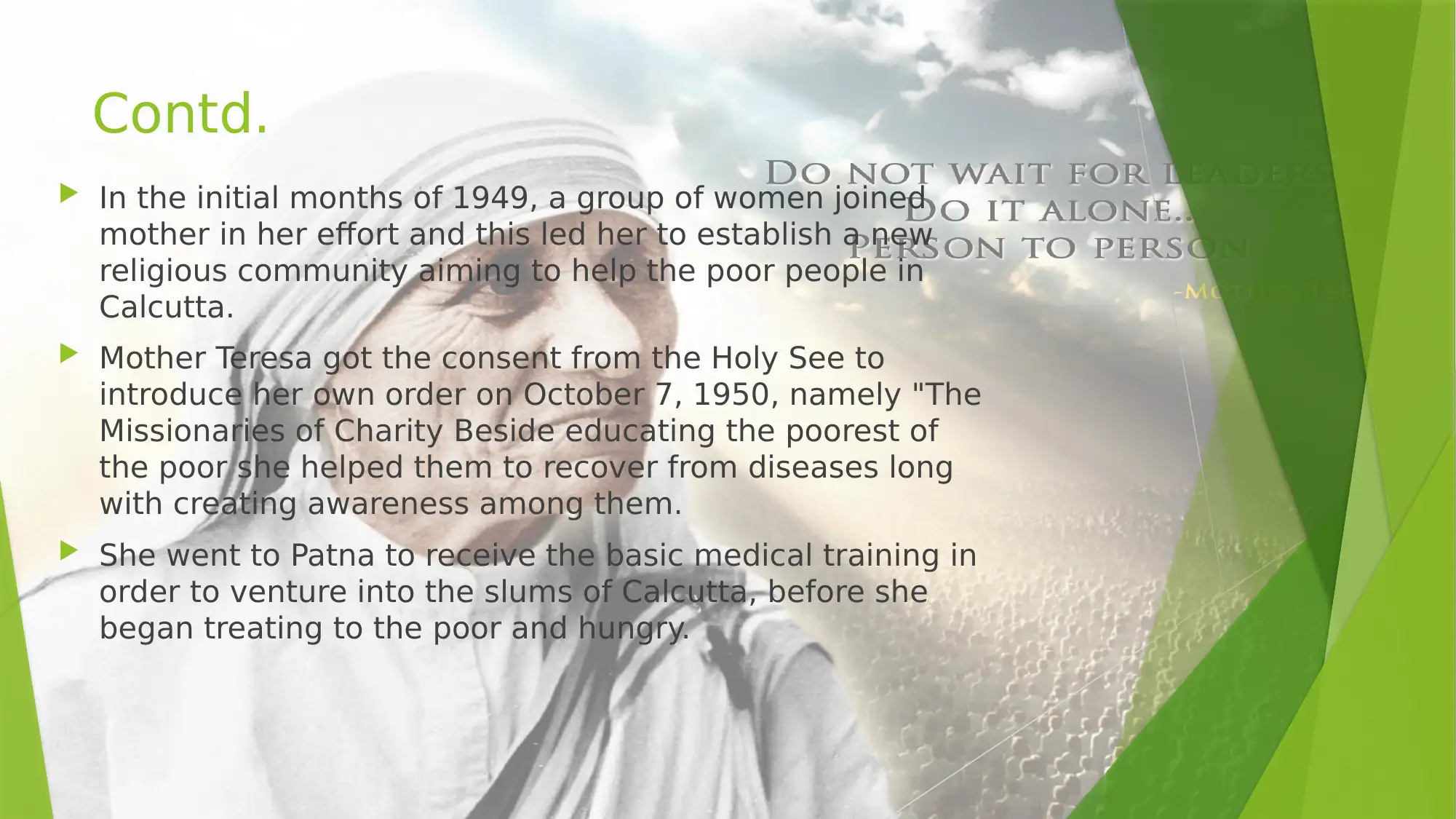
In the initial months of 1949, a group of women joined
mother in her effort and this led her to establish a new
religious community aiming to help the poor people in
Calcutta.
Mother Teresa got the consent from the Holy See to
introduce her own order on October 7, 1950, namely "The
Missionaries of Charity Beside educating the poorest of
the poor she helped them to recover from diseases long
with creating awareness among them.
She went to Patna to receive the basic medical training in
order to venture into the slums of Calcutta, before she
began treating to the poor and hungry.
tabler-icon-diamond-filled.svg

Paraphrase This Document

Need a fresh take? Get an instant paraphrase of this document with our AI Paraphraser
Document Page
Importance
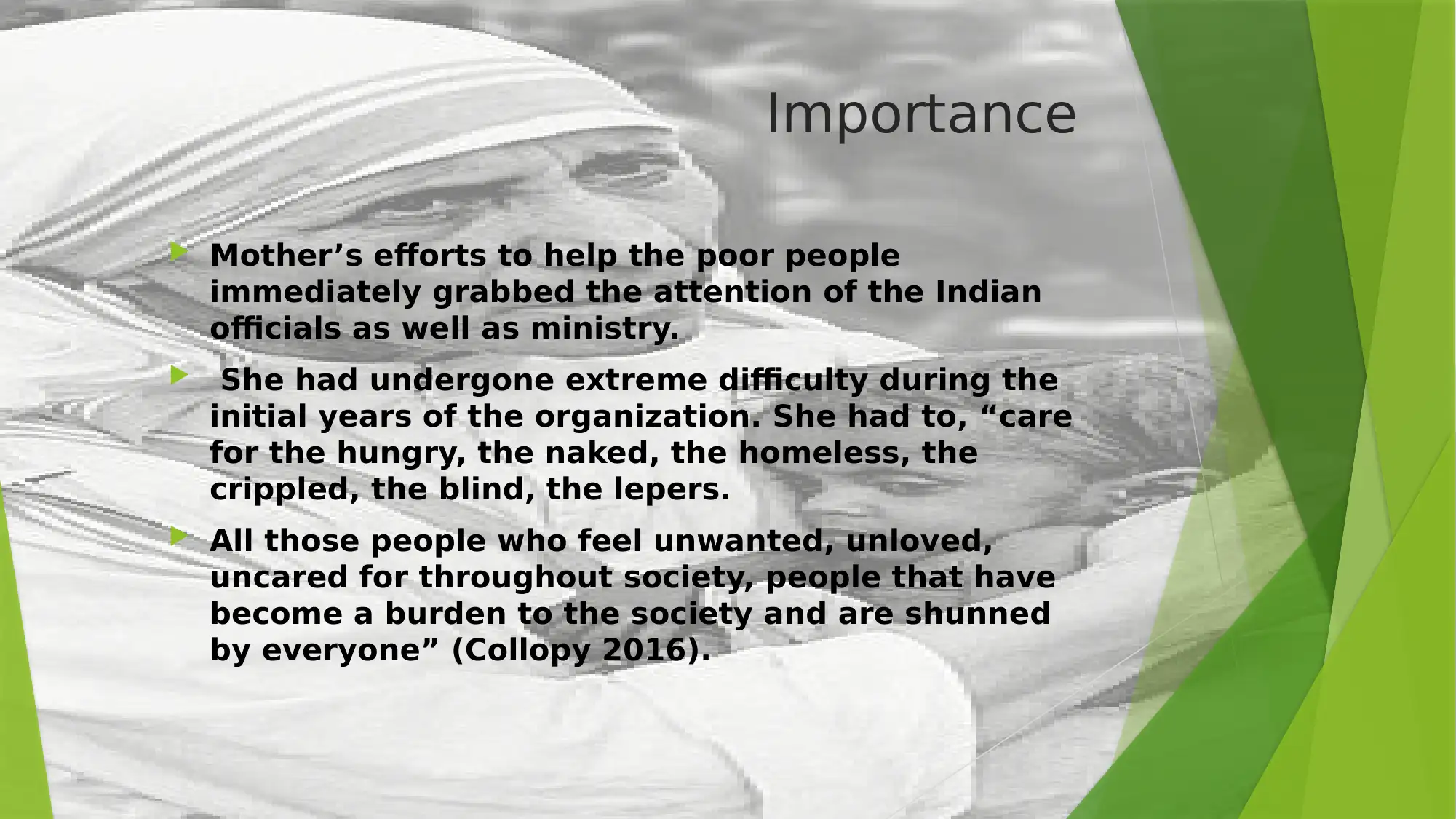
Mother’s efforts to help the poor people
immediately grabbed the attention of the Indian
officials as well as ministry.
She had undergone extreme difficulty during the
initial years of the organization. She had to, “care
for the hungry, the naked, the homeless, the
crippled, the blind, the lepers.
All those people who feel unwanted, unloved,
uncared for throughout society, people that have
become a burden to the society and are shunned
by everyone” (Collopy 2016).
Document Page
Contd.
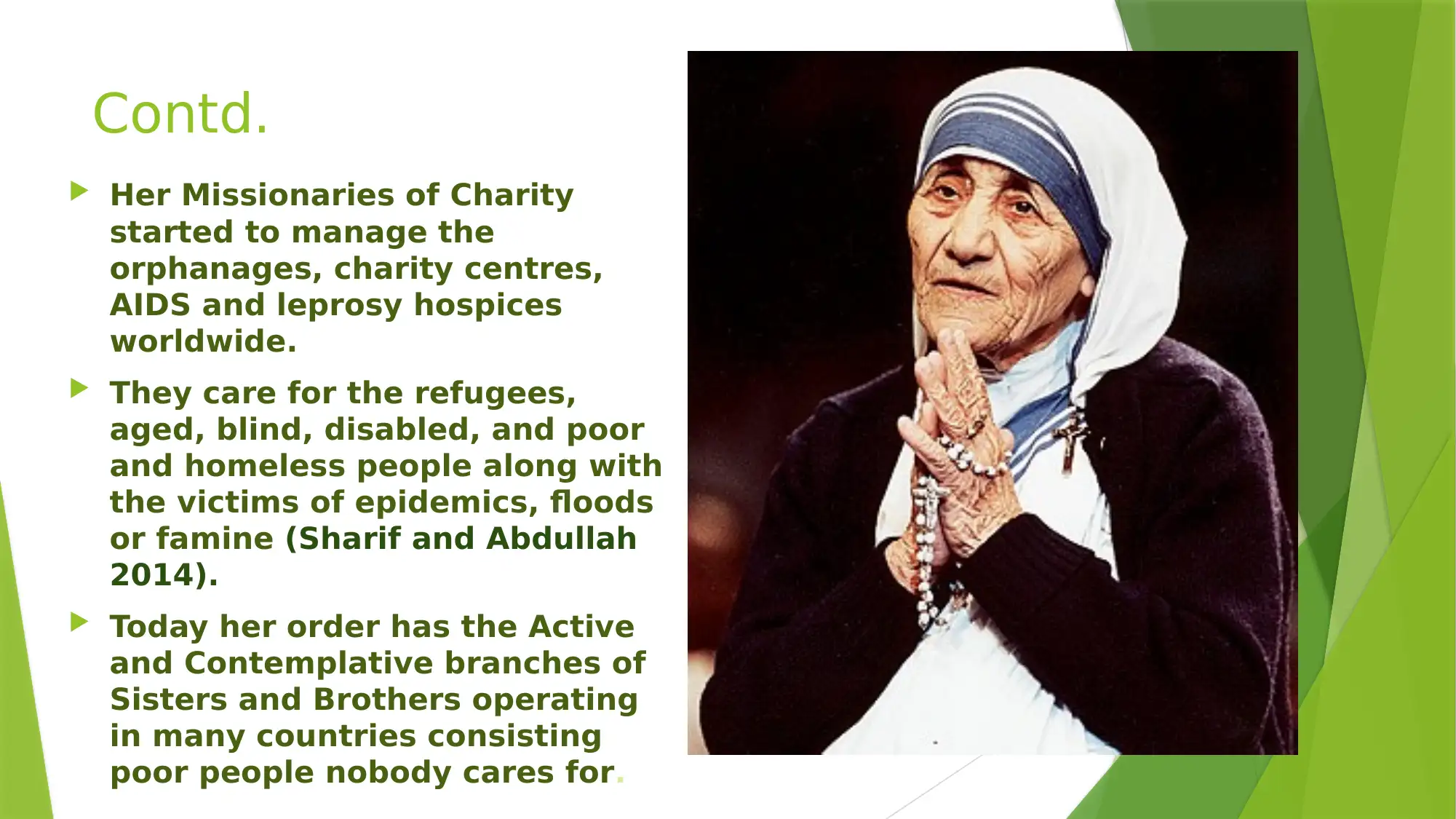
Her Missionaries of Charity
started to manage the
orphanages, charity centres,
AIDS and leprosy hospices
worldwide.
They care for the refugees,
aged, blind, disabled, and poor
and homeless people along with
the victims of epidemics, floods
or famine (Sharif and Abdullah
2014).
Today her order has the Active
and Contemplative branches of
Sisters and Brothers operating
in many countries consisting
poor people nobody cares for.
chevron_up_icon
1 out of 17
circle_padding
hide_on_mobile
zoom_out_icon
[object Object]