Analysis of Motivation Theories and Employee Engagement in Management
VerifiedAdded on 2019/12/04
|11
|4145
|36
Essay
AI Summary
This essay delves into the human side of enterprise, analyzing the importance of understanding both theoretical and practical aspects of managing people in the workplace. It begins by summarizing Douglas McGregor's work on the Human Side of Enterprise, focusing on Theory X and the need to leverage human capabilities for organizational success. The essay then examines the relationship between money and employee engagement, discussing Taylor's and Herzberg's motivational theories. Taylor's theory emphasizes the role of financial incentives, while Herzberg's theory distinguishes between hygiene and motivator factors. The essay concludes by exploring various motivational theories, including Maslow's Hierarchy of Needs and Alderfer's ERG theory, highlighting their relevance in understanding and influencing employee behavior and satisfaction. The essay underscores the significance of tailoring management approaches to meet diverse employee needs and foster a productive work environment.

ACADEMIC RESEARCH AND
WRITING
WRITING

Paraphrase This Document
Need a fresh take? Get an instant paraphrase of this document with our AI Paraphraser
The most interesting fact about understanding management is that it is all about gaining
deep in sight into both the theoretical as well as practical aspects associated with managing
people at work. Organisations are laying efforts to focus on human based approach through
which motivation, employee engagement, behaviour and attitude can be worked upon to gain the
fruitful results. The entire focus is on raising the considerable importance to create the business
environment for the individuals working at the respective organisation (Liao and Chuang, 2004).
The current essay has been presented with the intention to highlight the human side of enterprise.
For this, provided article by Douglas McGregor will be studied and interpreted. Further, the
work will elucidate the explanation of different motivation and management theories. Last
section is the comparative essay work on applying motivation theories and employee
engagement techniques.
TASK 1
Summarising the provided text in own words.
The provided work has been taken from the article written by Douglas McGregor. The
study is made on the Human side of Enterprise. In this, the objective is to understand the
relevance of Conventional theory which here has been studied as Theory X. The entire focus has
been given on using the human capability, knowledge and power to accomplish the
Organisational goals and objectives. However, there are various which are still lacking and hence
enterprises require planning a directed and suitable approach to work on same so that employee
working in the organisation can be made more effective and efficient. People are always
considered to be the greatest resource to every organisation (Sahay, 2003). However, there
always need an approach with the help of which it becomes imperative to drive and push them
towards work. The central idea behind the same is to assess the maximum use of their
knowledge, capabilities and skills in the success of the organisation. Top level managers who are
acting as a leader are therefore infusing substantial amount of ways and methods through which
more human efforts can be crux out.
Conventional approach is the management theory which underpins the concept of leading
people towards economic contribution of the firm. According to this approach, management of
the business enterprise makes human resources available with the major components such as
material, labour and equipments (Claassen and Van Raaij, 2008). Further, it states that there is
need to keep eye on their work through the management process of monitoring and controlling.
1
deep in sight into both the theoretical as well as practical aspects associated with managing
people at work. Organisations are laying efforts to focus on human based approach through
which motivation, employee engagement, behaviour and attitude can be worked upon to gain the
fruitful results. The entire focus is on raising the considerable importance to create the business
environment for the individuals working at the respective organisation (Liao and Chuang, 2004).
The current essay has been presented with the intention to highlight the human side of enterprise.
For this, provided article by Douglas McGregor will be studied and interpreted. Further, the
work will elucidate the explanation of different motivation and management theories. Last
section is the comparative essay work on applying motivation theories and employee
engagement techniques.
TASK 1
Summarising the provided text in own words.
The provided work has been taken from the article written by Douglas McGregor. The
study is made on the Human side of Enterprise. In this, the objective is to understand the
relevance of Conventional theory which here has been studied as Theory X. The entire focus has
been given on using the human capability, knowledge and power to accomplish the
Organisational goals and objectives. However, there are various which are still lacking and hence
enterprises require planning a directed and suitable approach to work on same so that employee
working in the organisation can be made more effective and efficient. People are always
considered to be the greatest resource to every organisation (Sahay, 2003). However, there
always need an approach with the help of which it becomes imperative to drive and push them
towards work. The central idea behind the same is to assess the maximum use of their
knowledge, capabilities and skills in the success of the organisation. Top level managers who are
acting as a leader are therefore infusing substantial amount of ways and methods through which
more human efforts can be crux out.
Conventional approach is the management theory which underpins the concept of leading
people towards economic contribution of the firm. According to this approach, management of
the business enterprise makes human resources available with the major components such as
material, labour and equipments (Claassen and Van Raaij, 2008). Further, it states that there is
need to keep eye on their work through the management process of monitoring and controlling.
1
However, there is requirement of keeping a pace on motivation and boosting the morale of
employees on time to time basis. In other way round, it is critically significant that people
working in the company vary from each others in terms of nature and working behaviour. Hence,
there is need to plan a strategy according to which, managers acting as leaders can take necessary
interventions of persuading and resisting employee to change behaviour and direct well to
accomplish their jobs.
However, the article also discusses the relevance of soft and hard approaches that are
adopted by the management with the employees (Hilton, 2012). This demonstrates the correct
view of developing people on the basis of situations. In this regards, understanding the needs and
desires of the people is crucial. On the basis of application of Maslow’s need hierarchy theory,
different levels of the individual needs are required to be analysed. This underlies on the fact that
human wants are unlimited and hence there is need to understand them so that success factor can
be applied to drive motivation in their attitude and behaviour.
Hence, on examining the conventional approach with the Maslow theory, individual
behaviour at work can be combined with their needs and satisfaction. When manager uses any
kind of approach with the employees to lead towards change through the use of conventional
approach, there is need to work of ways by which employee can be best available with the
psychological, safety and social needs (Littrell, 2007). Hence, on that basis only management
must then try to inculcate any kind of approaches either harsh or soft to make them work towards
achievement of gaol. The fact behind the same then proposes that employees become inclined to
work dedicatedly as they are already working with the needs and requirements which they expect
from the management.
TASK 2
Relation of statement to two motivational theories
Motivation has been regarded as the most significant aspect that drives people to
undertake different organisational objectives to achieve the objectives. Management
organisations are putting efforts in developing the interest and commitment of individuals
through different ways (Cook, 2008). This is to enhance the productivity over a period of time to
benefit the organisation. In this streamline, there use both intrinsic and extrinsic methods which
act as motivators factors. However, it has been identified that the major force that enable people
to gain the satisfaction is the money. Researchers have been evidenced that extrinsic type of
2
employees on time to time basis. In other way round, it is critically significant that people
working in the company vary from each others in terms of nature and working behaviour. Hence,
there is need to plan a strategy according to which, managers acting as leaders can take necessary
interventions of persuading and resisting employee to change behaviour and direct well to
accomplish their jobs.
However, the article also discusses the relevance of soft and hard approaches that are
adopted by the management with the employees (Hilton, 2012). This demonstrates the correct
view of developing people on the basis of situations. In this regards, understanding the needs and
desires of the people is crucial. On the basis of application of Maslow’s need hierarchy theory,
different levels of the individual needs are required to be analysed. This underlies on the fact that
human wants are unlimited and hence there is need to understand them so that success factor can
be applied to drive motivation in their attitude and behaviour.
Hence, on examining the conventional approach with the Maslow theory, individual
behaviour at work can be combined with their needs and satisfaction. When manager uses any
kind of approach with the employees to lead towards change through the use of conventional
approach, there is need to work of ways by which employee can be best available with the
psychological, safety and social needs (Littrell, 2007). Hence, on that basis only management
must then try to inculcate any kind of approaches either harsh or soft to make them work towards
achievement of gaol. The fact behind the same then proposes that employees become inclined to
work dedicatedly as they are already working with the needs and requirements which they expect
from the management.
TASK 2
Relation of statement to two motivational theories
Motivation has been regarded as the most significant aspect that drives people to
undertake different organisational objectives to achieve the objectives. Management
organisations are putting efforts in developing the interest and commitment of individuals
through different ways (Cook, 2008). This is to enhance the productivity over a period of time to
benefit the organisation. In this streamline, there use both intrinsic and extrinsic methods which
act as motivators factors. However, it has been identified that the major force that enable people
to gain the satisfaction is the money. Researchers have been evidenced that extrinsic type of
2
⊘ This is a preview!⊘
Do you want full access?
Subscribe today to unlock all pages.

Trusted by 1+ million students worldwide
motivation is more effective rather than intrinsic. Money has always been dominant driver that
influence people. As a result of same, employees feels highly influences and the impact of which
directly leads towards the key achievement of organisational objective and success.
Employee motivation has correlation with their engagement and participation in
management work and job processes. For managers, it has always been of great concern to
involve their manpower to yield or produce maximum productivity out from them. In this
regards, different theorists have shown their interest and have presented their work on fact that
“Money is the key to employee engagement” (Lux, Crook and Woehr, 2011). Significant
theories of Taylor and Herzberg are studied in regards to understand the contribution of money
in influencing more participation of the employees. With respect to the stated statements, two
significant theories of motivation have been reviewed. Hence, these theories are put to present
the effective analysis of money as key to engage manpower has been discussed in below given
explanation:
Taylor´s motivational theory
One of the works given by Frederick Taylor is in support of motivational theories.
According to his research and findings, individual is engaged in the process of job and work to
earn money. He, in align with scientific theory has stated that every worker must get the piece
rate of the contribution shared by him in the work process. This work of Taylor in 1911 is a
demonstration of approach which states that appropriate and correct result of what employee and
his efforts required must be paid (Chen and Mohamed, 2008). The central idea behind the
implementation of Taylor’s motivational theory is to make people engaged in for expanding
greater production. Hence, the entire work relies on the principle that payment of salary actually
enhances the employee’s morale, encouragement and thereby boosts them up for maximum
participation in the activities of the organisation. In this way, he was the first one who with the
help of his work and theory put the idea of influencing people through pay. However, there are
several ideas which were put in forth as well to state the arguments on the provided statement.
There are instances which are true as well that people are generally not found to be so worth and
true to the real picture of showing more dedication and commitment to work (Ha, 2004). In this
regards, the employee engagement may not be left as it is. Rather more close supervision and
monitoring are imparted on them so as to ensure completion of work with efficiency of
operations. The resultant of this approach of Taylor did not proved much successful as there
3
influence people. As a result of same, employees feels highly influences and the impact of which
directly leads towards the key achievement of organisational objective and success.
Employee motivation has correlation with their engagement and participation in
management work and job processes. For managers, it has always been of great concern to
involve their manpower to yield or produce maximum productivity out from them. In this
regards, different theorists have shown their interest and have presented their work on fact that
“Money is the key to employee engagement” (Lux, Crook and Woehr, 2011). Significant
theories of Taylor and Herzberg are studied in regards to understand the contribution of money
in influencing more participation of the employees. With respect to the stated statements, two
significant theories of motivation have been reviewed. Hence, these theories are put to present
the effective analysis of money as key to engage manpower has been discussed in below given
explanation:
Taylor´s motivational theory
One of the works given by Frederick Taylor is in support of motivational theories.
According to his research and findings, individual is engaged in the process of job and work to
earn money. He, in align with scientific theory has stated that every worker must get the piece
rate of the contribution shared by him in the work process. This work of Taylor in 1911 is a
demonstration of approach which states that appropriate and correct result of what employee and
his efforts required must be paid (Chen and Mohamed, 2008). The central idea behind the
implementation of Taylor’s motivational theory is to make people engaged in for expanding
greater production. Hence, the entire work relies on the principle that payment of salary actually
enhances the employee’s morale, encouragement and thereby boosts them up for maximum
participation in the activities of the organisation. In this way, he was the first one who with the
help of his work and theory put the idea of influencing people through pay. However, there are
several ideas which were put in forth as well to state the arguments on the provided statement.
There are instances which are true as well that people are generally not found to be so worth and
true to the real picture of showing more dedication and commitment to work (Ha, 2004). In this
regards, the employee engagement may not be left as it is. Rather more close supervision and
monitoring are imparted on them so as to ensure completion of work with efficiency of
operations. The resultant of this approach of Taylor did not proved much successful as there
3
Paraphrase This Document
Need a fresh take? Get an instant paraphrase of this document with our AI Paraphraser
were people who started disliking it due to repetition of tasks and boring elements that started
engrosses with the enhancement of engagement of people into work. Taylor as per the scientific
theory worked on principle of specifying that there is need to break tasks into small jobs. This is
the reason to assess the workers who can be imparted training properly (Long, Dowsin and
Craven, 2003). It has been believed that primary reason that makes people feel engaged and
participated in the organisation is due to money. Hence, through the entire discussion it can be
said that there is need to standardise the role of management so that more involvement can be
worked upon in order to deliver the balance of money provided to them as a result of salary,
wages, perks and incentives.
Frederick Herzberg motivational theory
As per two factor theory of Herzberg, employee in an organization is motivated through
hygiene and motivator factors. As a hygiene factor, salary is included whereas bonuses and perks
given to employees are part of motivator factor. According to his theory, salary provided to
employee may not act as factor of motivation however, when bonuses are given to them, they act
and thereby motivates to do more work (Lin, 2007). This theory also states that salary may or
may not causes satisfaction. However, the perks and other incentives always act as inspiring
factor.
According to the statement provided, “Money is the key to employee engagement”. On
analysing this assertion with the stated theory, it can be said that key defined factors are infused
just to see whether employee is driven towards the work or not. Along with this, satisfaction is
regarded as the parameter that demonstrates the inclined aspect of employee towards the
organisation. Hence, in all the salary and incentives offered to employees act as a motivation
factor that is almost related to the engagement with the organisation.
From the viewpoint of Herzberg, it has hence been stated that money can also be act as a
dissatisfying factor and may thereby leads to affect the engagement of the employees. It has been
stated for the staff members who think that money is not act as primary driving aspect. Apart
from this, there are employees in the organization for whom there are other sustaining factors as
well that are actually responsible for developing the morale of employees to work in an
organisation.
But on interpreting, the major outcome that has been evaluated is that pay occupies major
point that is responsible for engaging individuals to perform organisational activities for the
4
engrosses with the enhancement of engagement of people into work. Taylor as per the scientific
theory worked on principle of specifying that there is need to break tasks into small jobs. This is
the reason to assess the workers who can be imparted training properly (Long, Dowsin and
Craven, 2003). It has been believed that primary reason that makes people feel engaged and
participated in the organisation is due to money. Hence, through the entire discussion it can be
said that there is need to standardise the role of management so that more involvement can be
worked upon in order to deliver the balance of money provided to them as a result of salary,
wages, perks and incentives.
Frederick Herzberg motivational theory
As per two factor theory of Herzberg, employee in an organization is motivated through
hygiene and motivator factors. As a hygiene factor, salary is included whereas bonuses and perks
given to employees are part of motivator factor. According to his theory, salary provided to
employee may not act as factor of motivation however, when bonuses are given to them, they act
and thereby motivates to do more work (Lin, 2007). This theory also states that salary may or
may not causes satisfaction. However, the perks and other incentives always act as inspiring
factor.
According to the statement provided, “Money is the key to employee engagement”. On
analysing this assertion with the stated theory, it can be said that key defined factors are infused
just to see whether employee is driven towards the work or not. Along with this, satisfaction is
regarded as the parameter that demonstrates the inclined aspect of employee towards the
organisation. Hence, in all the salary and incentives offered to employees act as a motivation
factor that is almost related to the engagement with the organisation.
From the viewpoint of Herzberg, it has hence been stated that money can also be act as a
dissatisfying factor and may thereby leads to affect the engagement of the employees. It has been
stated for the staff members who think that money is not act as primary driving aspect. Apart
from this, there are employees in the organization for whom there are other sustaining factors as
well that are actually responsible for developing the morale of employees to work in an
organisation.
But on interpreting, the major outcome that has been evaluated is that pay occupies major
point that is responsible for engaging individuals to perform organisational activities for the
4
success of the company. But for majority of the people who are working in the company takes
money important and responsible for driving personal motivator (Srivastava, 2007). Hence, the
reason has been true that for employee money act as a sustainable motivator in itself.
TASK 3
Motivational theories
Motivation is a process that acts as a driving force to make people influence to carry out
work and operations. Needs and demands have always been significant to involve and engage
people in the activities of the organisation so that more and more productivity can be gained out.
Behaviour and satisfaction are key aspects which are reviewed in understanding customers and
thereby on that basis; decisions are made so that productivity and yielding can be enhanced.
There are different motivational theories which have been discussed as follows:
Maslow Hierarchy needs theory:
According to Maslow, the human wants are needed to be determined from the base level.
It has been interpreted that as soon as one human want accomplishes, another develops and
hence it is vital that there is need to provide employee every best way in which basic to higher
level need is required to be identified and hence worked upon (Yao, Evers and Dresner, 2007).
When employee came to the organisation, he aspires for psychological need and then gradually
there is need to work on safety and social needs to be identified and provided to them so that
appropriate satisfaction can be gained by them.
Alderfer's ERG theory
According to ERG model, there are three different needs identified of the individual who
are working and are classified as growth needs (development of competence and realization of
potential), relatedness needs (satisfactory relations with others) and existence needs (physical
well-being). This theory is somewhat related to the Maslow hierarchy needs theory. But it is
different in regards to the categories. In this theory, the classification has been made as per
individual’s need and requirement. The level is set so that fulfilment of need and demands can be
determined at purposive level. The existence, relatedness and development factors need to be
evaluated properly so that a satisfied human being can contribute the development of the
organization and its long term success.
Acquired Needs Theory (McClellan)
5
money important and responsible for driving personal motivator (Srivastava, 2007). Hence, the
reason has been true that for employee money act as a sustainable motivator in itself.
TASK 3
Motivational theories
Motivation is a process that acts as a driving force to make people influence to carry out
work and operations. Needs and demands have always been significant to involve and engage
people in the activities of the organisation so that more and more productivity can be gained out.
Behaviour and satisfaction are key aspects which are reviewed in understanding customers and
thereby on that basis; decisions are made so that productivity and yielding can be enhanced.
There are different motivational theories which have been discussed as follows:
Maslow Hierarchy needs theory:
According to Maslow, the human wants are needed to be determined from the base level.
It has been interpreted that as soon as one human want accomplishes, another develops and
hence it is vital that there is need to provide employee every best way in which basic to higher
level need is required to be identified and hence worked upon (Yao, Evers and Dresner, 2007).
When employee came to the organisation, he aspires for psychological need and then gradually
there is need to work on safety and social needs to be identified and provided to them so that
appropriate satisfaction can be gained by them.
Alderfer's ERG theory
According to ERG model, there are three different needs identified of the individual who
are working and are classified as growth needs (development of competence and realization of
potential), relatedness needs (satisfactory relations with others) and existence needs (physical
well-being). This theory is somewhat related to the Maslow hierarchy needs theory. But it is
different in regards to the categories. In this theory, the classification has been made as per
individual’s need and requirement. The level is set so that fulfilment of need and demands can be
determined at purposive level. The existence, relatedness and development factors need to be
evaluated properly so that a satisfied human being can contribute the development of the
organization and its long term success.
Acquired Needs Theory (McClellan)
5
⊘ This is a preview!⊘
Do you want full access?
Subscribe today to unlock all pages.
Trusted by 1+ million students worldwide
According to the viewpoint of McClellan, there is need to recognise the demand and need
of the people as per the life experiences of the people. The need for achievement,
accomplishment and encouragement are three key aspects which are recognised as factors
contributing to the success of the organisation (Zhu and Zhang, 2010). Given below are three
main elements of this theory which have been stated as follows:
Need for achievement, accomplish something difficult task.
Need for affiliation, form close personal relationships.
Need for power, control others.
Two Factor theories (Herzberg)
According to Herzberg, there are two factors which are identifies in motivating
employees. There are factors named as motivators and hygiene which play role of constituting
the elements that are responsible for providing satisfaction and dissatisfaction. These two factors
are stated and discussed as follows:
According to Herzberg, two kinds of factors affect motivation, and they do it in different ways:
Hygiene factors. These are inclusive of factors which contribute to dissatisfaction of
consumers in their absence. Presence and implementation of these factors plays very vital
role and thereby there is need to imbibe such components in motivating and involving
people towards work processes (Sherer, 2005). These are comprises of factors such as
security, benefits (like health insurance), company policies, working conditions,
interpersonal relationships etc.
Motivators. There are factors which are responsible for motivating the employees. It is
important to evaluate the same as theory presence is to motivate the people. However, the
application of these may not necessarily prove to be satisfaction factor. These are
inclusive of factors such as intrinsic motivators etc.
Employee engagement techniques used at the organisation
In the current section, the objective is to apply the employee engagement techniques. The
process of engaging employee refers to the vital tactic of attracting, influencing and retaining
staff members so that successful participation of employee for benefitting the organisation can be
made. For undertaking the present study, the organisation chosen is VoloMetrix, Inc. This is
subsidiary organisation of the Microsoft and is situated in Seattle, Washington (Margherita,
2014). They are engaged into the practices of selling analytics software in the market. These
6
of the people as per the life experiences of the people. The need for achievement,
accomplishment and encouragement are three key aspects which are recognised as factors
contributing to the success of the organisation (Zhu and Zhang, 2010). Given below are three
main elements of this theory which have been stated as follows:
Need for achievement, accomplish something difficult task.
Need for affiliation, form close personal relationships.
Need for power, control others.
Two Factor theories (Herzberg)
According to Herzberg, there are two factors which are identifies in motivating
employees. There are factors named as motivators and hygiene which play role of constituting
the elements that are responsible for providing satisfaction and dissatisfaction. These two factors
are stated and discussed as follows:
According to Herzberg, two kinds of factors affect motivation, and they do it in different ways:
Hygiene factors. These are inclusive of factors which contribute to dissatisfaction of
consumers in their absence. Presence and implementation of these factors plays very vital
role and thereby there is need to imbibe such components in motivating and involving
people towards work processes (Sherer, 2005). These are comprises of factors such as
security, benefits (like health insurance), company policies, working conditions,
interpersonal relationships etc.
Motivators. There are factors which are responsible for motivating the employees. It is
important to evaluate the same as theory presence is to motivate the people. However, the
application of these may not necessarily prove to be satisfaction factor. These are
inclusive of factors such as intrinsic motivators etc.
Employee engagement techniques used at the organisation
In the current section, the objective is to apply the employee engagement techniques. The
process of engaging employee refers to the vital tactic of attracting, influencing and retaining
staff members so that successful participation of employee for benefitting the organisation can be
made. For undertaking the present study, the organisation chosen is VoloMetrix, Inc. This is
subsidiary organisation of the Microsoft and is situated in Seattle, Washington (Margherita,
2014). They are engaged into the practices of selling analytics software in the market. These
6
Paraphrase This Document
Need a fresh take? Get an instant paraphrase of this document with our AI Paraphraser
packages are used for integrating the data at the collaboration platform so thatdashboard and
visualization can be created. The cited firm has been working in collaboration with several other
corporations in order to gain the understanding of the employee engagement techniques. For this
firm, employees are biggest strength and are well demonstrated from the data that shows low
attrition rates, high employee performance level, high level of partnership etc. Given below are
three different strategic techniques with the help of which employees working in the organization
are engaged and developed to gain the additional advantage and have been presented as follows
Facilitate Cross-Functional Events: This is the measure which supports on enhancing
the effective communication and collaboration. This is the reason why this firm engages
itself in activities such as informal and formal meetings, lunch and parties so that
discussion and interaction among members can be flourished and fostered. Every Friday,
VoloMetrix arranges lunch for all its employees (Keller and Brunner, 2003). Every staff
members join at the conference room and discuss about the entire week and enjoy their
time to the great extent. Encourage Collaboration Between Teams: There are various departments in the cited
firm where the proper interaction lacks due to gap. This is one of the reasons that
contribute the attrition issues and hence the interaction is lacking. This further leads to
disengagement of employees and thereby gap widens as well. Hence, VolMetrix plans
different activities and action plans so that people from different departments come and
generate a platform to share new platform to work through sharing of ideas that are
innovative as well as creative in nature (Goyal, 2015). This will also helps in gaining the
deep insight into assessing the solutions for the solutions which are helpful in gaining
good resultant and output. Get Feedback from Employees: There exist problems and issues in every organization
that arises due to any wrong conception and misunderstanding. The one significant basis
which is responsible for gaining the best of solution to the pertaining issue is the
manager. However, it is irrelevant till the manager is unaware about the issue and do not
get into the same. VoloMetrix conducts short survey every week through different
techniques such as TINYpulse. This is one of the methods which are applied in order to
know about the engagement level of employee (Dell, 2001). This is planned and
processed through the help of feedback methods and tactics.
7
visualization can be created. The cited firm has been working in collaboration with several other
corporations in order to gain the understanding of the employee engagement techniques. For this
firm, employees are biggest strength and are well demonstrated from the data that shows low
attrition rates, high employee performance level, high level of partnership etc. Given below are
three different strategic techniques with the help of which employees working in the organization
are engaged and developed to gain the additional advantage and have been presented as follows
Facilitate Cross-Functional Events: This is the measure which supports on enhancing
the effective communication and collaboration. This is the reason why this firm engages
itself in activities such as informal and formal meetings, lunch and parties so that
discussion and interaction among members can be flourished and fostered. Every Friday,
VoloMetrix arranges lunch for all its employees (Keller and Brunner, 2003). Every staff
members join at the conference room and discuss about the entire week and enjoy their
time to the great extent. Encourage Collaboration Between Teams: There are various departments in the cited
firm where the proper interaction lacks due to gap. This is one of the reasons that
contribute the attrition issues and hence the interaction is lacking. This further leads to
disengagement of employees and thereby gap widens as well. Hence, VolMetrix plans
different activities and action plans so that people from different departments come and
generate a platform to share new platform to work through sharing of ideas that are
innovative as well as creative in nature (Goyal, 2015). This will also helps in gaining the
deep insight into assessing the solutions for the solutions which are helpful in gaining
good resultant and output. Get Feedback from Employees: There exist problems and issues in every organization
that arises due to any wrong conception and misunderstanding. The one significant basis
which is responsible for gaining the best of solution to the pertaining issue is the
manager. However, it is irrelevant till the manager is unaware about the issue and do not
get into the same. VoloMetrix conducts short survey every week through different
techniques such as TINYpulse. This is one of the methods which are applied in order to
know about the engagement level of employee (Dell, 2001). This is planned and
processed through the help of feedback methods and tactics.
7
Similarities and differences between above stated motivational theories and employee
engagement techniques
The above section is a detail presentation of different motivational theories and employee
engagement techniques which are used by VolvoMetrix. ON studying different theories, it has
been acquired that the resultant of motivational theories in driving employees is to drive them to
understand about the organisational change. Along with this, the key to inculcate the application
of these theories in the company is to make people engaged in the organizational activities so
that people feel valued and influenced to participate in the organizational working and operations
through enthusiasm and commitment. In a similar fashion, there are studied and present different
employee engagement techniques in the organization by taking VolvolMetrix as an example.
The point of similarity which has been found is that both the theories and techniques
share common objective of involving and engaging employee towards undertaking the
organizational activities. Motivation is identified as the central reason through which people are
worked. However, in comparing and contrasting them, it has been found that people feel some
pros and cons aspect where impact of getting motivated may differ (Chiang and Hsieh, 2012).
The adverse impact leads to shape when people working in organization may get influenced
through change in negative way as well. According to theories, identification of employee need
and demand are crux of all the theories covered. However, as per employee engagement
techniques, the focus is always made on self determination and self engagement. However, as a
point of similarity, it has been evidenced that fulfilment of employee desires and demands are
crucially vital and are focused.
Hence, from the entire study, it can be concluded that both motivational theories
application and employee engagement techniques are correlated. It has been found that
motivational theories are applied to cover facets such as autonomy, competences and relatedness.
In the same vein, the employee engagement techniques revolve around three elements which are
namely psychological meaningfulness, safety and availability. Hence, it can be said that both the
aspects of motivation and employee engagement are interrelated and contribute vital role in the
success of building good human resource base.
8
engagement techniques
The above section is a detail presentation of different motivational theories and employee
engagement techniques which are used by VolvoMetrix. ON studying different theories, it has
been acquired that the resultant of motivational theories in driving employees is to drive them to
understand about the organisational change. Along with this, the key to inculcate the application
of these theories in the company is to make people engaged in the organizational activities so
that people feel valued and influenced to participate in the organizational working and operations
through enthusiasm and commitment. In a similar fashion, there are studied and present different
employee engagement techniques in the organization by taking VolvolMetrix as an example.
The point of similarity which has been found is that both the theories and techniques
share common objective of involving and engaging employee towards undertaking the
organizational activities. Motivation is identified as the central reason through which people are
worked. However, in comparing and contrasting them, it has been found that people feel some
pros and cons aspect where impact of getting motivated may differ (Chiang and Hsieh, 2012).
The adverse impact leads to shape when people working in organization may get influenced
through change in negative way as well. According to theories, identification of employee need
and demand are crux of all the theories covered. However, as per employee engagement
techniques, the focus is always made on self determination and self engagement. However, as a
point of similarity, it has been evidenced that fulfilment of employee desires and demands are
crucially vital and are focused.
Hence, from the entire study, it can be concluded that both motivational theories
application and employee engagement techniques are correlated. It has been found that
motivational theories are applied to cover facets such as autonomy, competences and relatedness.
In the same vein, the employee engagement techniques revolve around three elements which are
namely psychological meaningfulness, safety and availability. Hence, it can be said that both the
aspects of motivation and employee engagement are interrelated and contribute vital role in the
success of building good human resource base.
8
⊘ This is a preview!⊘
Do you want full access?
Subscribe today to unlock all pages.
Trusted by 1+ million students worldwide
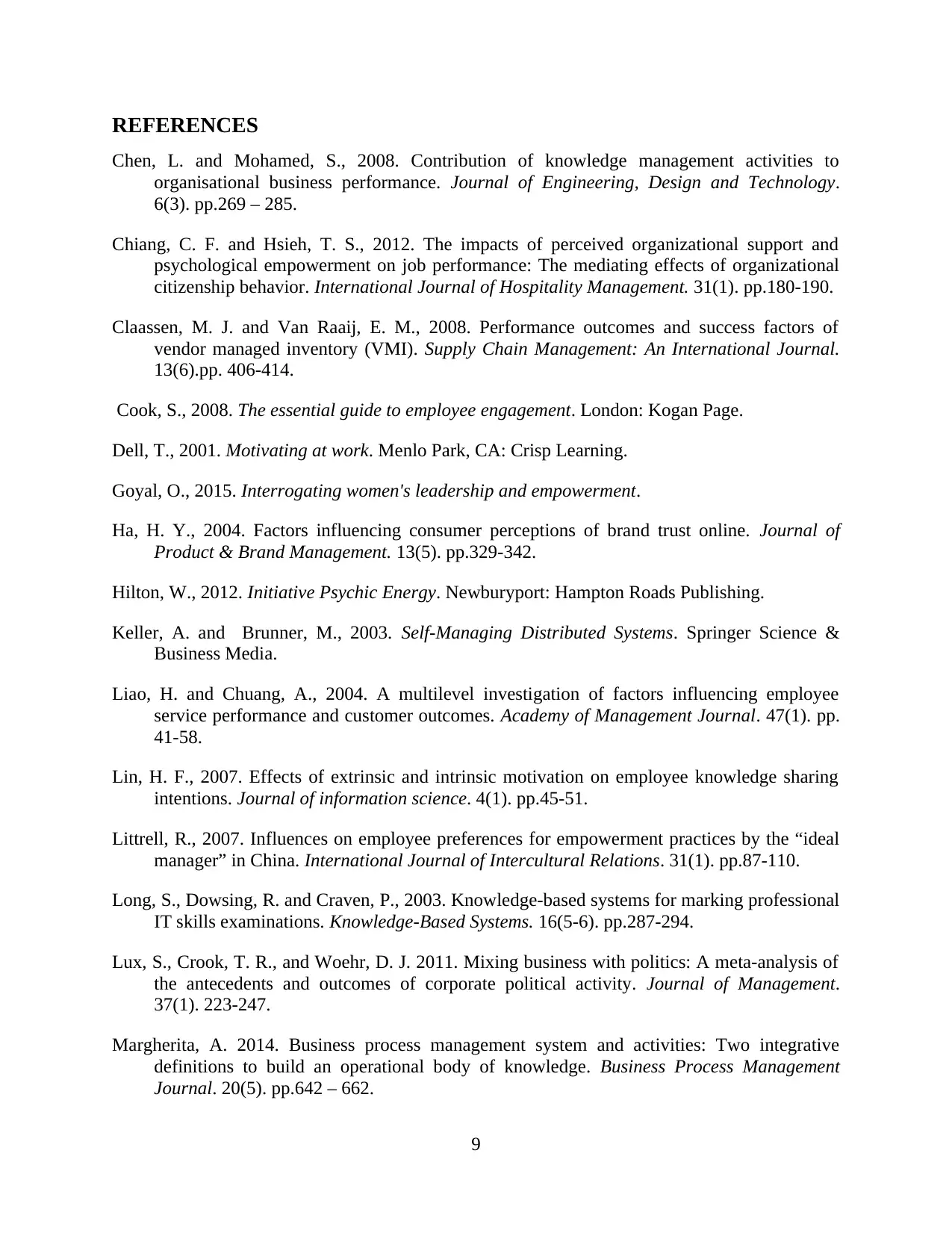
REFERENCES
Chen, L. and Mohamed, S., 2008. Contribution of knowledge management activities to
organisational business performance. Journal of Engineering, Design and Technology.
6(3). pp.269 – 285.
Chiang, C. F. and Hsieh, T. S., 2012. The impacts of perceived organizational support and
psychological empowerment on job performance: The mediating effects of organizational
citizenship behavior. International Journal of Hospitality Management. 31(1). pp.180-190.
Claassen, M. J. and Van Raaij, E. M., 2008. Performance outcomes and success factors of
vendor managed inventory (VMI). Supply Chain Management: An International Journal.
13(6).pp. 406-414.
Cook, S., 2008. The essential guide to employee engagement. London: Kogan Page.
Dell, T., 2001. Motivating at work. Menlo Park, CA: Crisp Learning.
Goyal, O., 2015. Interrogating women's leadership and empowerment.
Ha, H. Y., 2004. Factors influencing consumer perceptions of brand trust online. Journal of
Product & Brand Management. 13(5). pp.329-342.
Hilton, W., 2012. Initiative Psychic Energy. Newburyport: Hampton Roads Publishing.
Keller, A. and Brunner, M., 2003. Self-Managing Distributed Systems. Springer Science &
Business Media.
Liao, H. and Chuang, A., 2004. A multilevel investigation of factors influencing employee
service performance and customer outcomes. Academy of Management Journal. 47(1). pp.
41-58.
Lin, H. F., 2007. Effects of extrinsic and intrinsic motivation on employee knowledge sharing
intentions. Journal of information science. 4(1). pp.45-51.
Littrell, R., 2007. Influences on employee preferences for empowerment practices by the “ideal
manager” in China. International Journal of Intercultural Relations. 31(1). pp.87-110.
Long, S., Dowsing, R. and Craven, P., 2003. Knowledge-based systems for marking professional
IT skills examinations. Knowledge-Based Systems. 16(5-6). pp.287-294.
Lux, S., Crook, T. R., and Woehr, D. J. 2011. Mixing business with politics: A meta-analysis of
the antecedents and outcomes of corporate political activity. Journal of Management.
37(1). 223-247.
Margherita, A. 2014. Business process management system and activities: Two integrative
definitions to build an operational body of knowledge. Business Process Management
Journal. 20(5). pp.642 – 662.
9
Chen, L. and Mohamed, S., 2008. Contribution of knowledge management activities to
organisational business performance. Journal of Engineering, Design and Technology.
6(3). pp.269 – 285.
Chiang, C. F. and Hsieh, T. S., 2012. The impacts of perceived organizational support and
psychological empowerment on job performance: The mediating effects of organizational
citizenship behavior. International Journal of Hospitality Management. 31(1). pp.180-190.
Claassen, M. J. and Van Raaij, E. M., 2008. Performance outcomes and success factors of
vendor managed inventory (VMI). Supply Chain Management: An International Journal.
13(6).pp. 406-414.
Cook, S., 2008. The essential guide to employee engagement. London: Kogan Page.
Dell, T., 2001. Motivating at work. Menlo Park, CA: Crisp Learning.
Goyal, O., 2015. Interrogating women's leadership and empowerment.
Ha, H. Y., 2004. Factors influencing consumer perceptions of brand trust online. Journal of
Product & Brand Management. 13(5). pp.329-342.
Hilton, W., 2012. Initiative Psychic Energy. Newburyport: Hampton Roads Publishing.
Keller, A. and Brunner, M., 2003. Self-Managing Distributed Systems. Springer Science &
Business Media.
Liao, H. and Chuang, A., 2004. A multilevel investigation of factors influencing employee
service performance and customer outcomes. Academy of Management Journal. 47(1). pp.
41-58.
Lin, H. F., 2007. Effects of extrinsic and intrinsic motivation on employee knowledge sharing
intentions. Journal of information science. 4(1). pp.45-51.
Littrell, R., 2007. Influences on employee preferences for empowerment practices by the “ideal
manager” in China. International Journal of Intercultural Relations. 31(1). pp.87-110.
Long, S., Dowsing, R. and Craven, P., 2003. Knowledge-based systems for marking professional
IT skills examinations. Knowledge-Based Systems. 16(5-6). pp.287-294.
Lux, S., Crook, T. R., and Woehr, D. J. 2011. Mixing business with politics: A meta-analysis of
the antecedents and outcomes of corporate political activity. Journal of Management.
37(1). 223-247.
Margherita, A. 2014. Business process management system and activities: Two integrative
definitions to build an operational body of knowledge. Business Process Management
Journal. 20(5). pp.642 – 662.
9
Paraphrase This Document
Need a fresh take? Get an instant paraphrase of this document with our AI Paraphraser
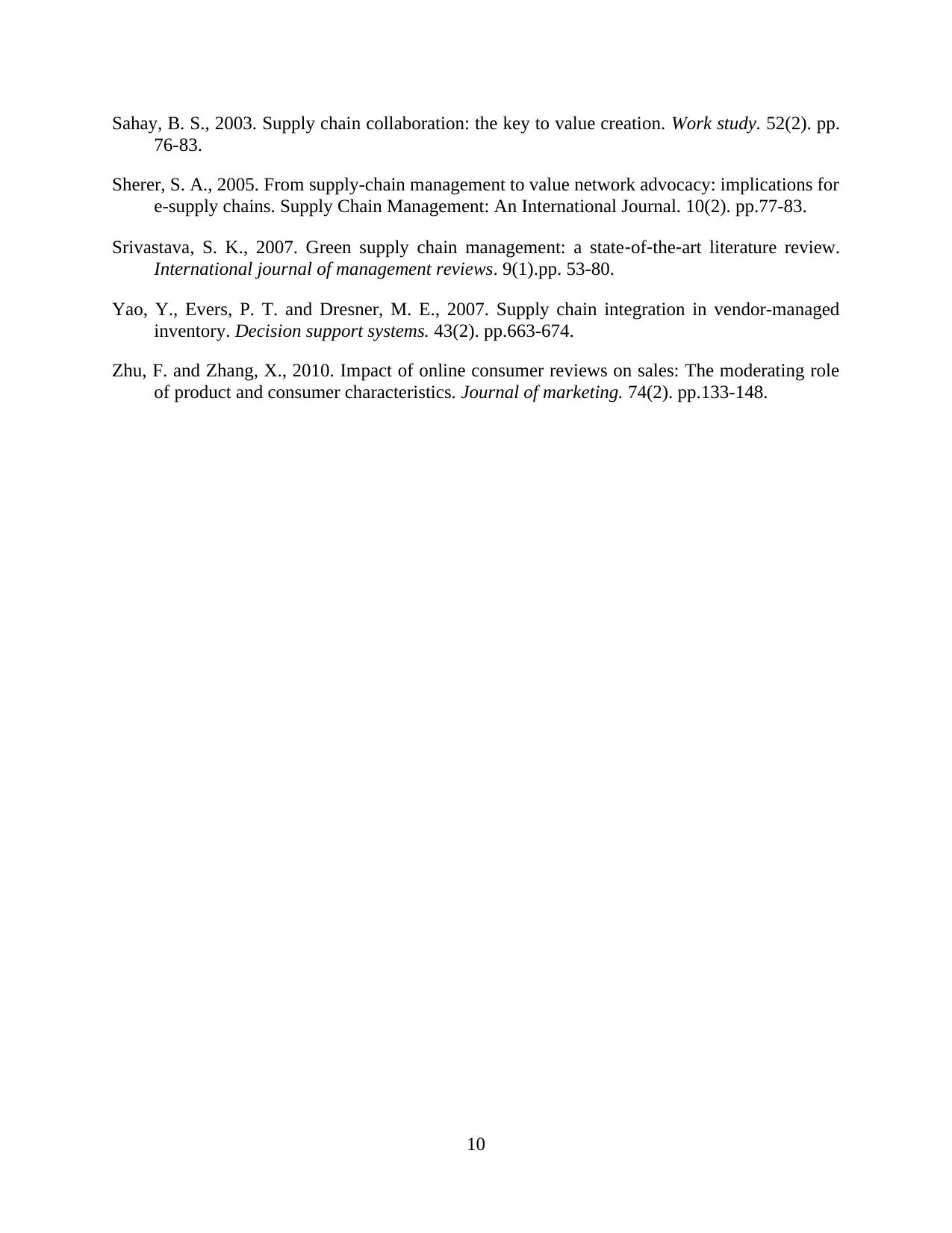
Sahay, B. S., 2003. Supply chain collaboration: the key to value creation. Work study. 52(2). pp.
76-83.
Sherer, S. A., 2005. From supply-chain management to value network advocacy: implications for
e-supply chains. Supply Chain Management: An International Journal. 10(2). pp.77-83.
Srivastava, S. K., 2007. Green supply chain management: a state‐of‐the‐art literature review.
International journal of management reviews. 9(1).pp. 53-80.
Yao, Y., Evers, P. T. and Dresner, M. E., 2007. Supply chain integration in vendor-managed
inventory. Decision support systems. 43(2). pp.663-674.
Zhu, F. and Zhang, X., 2010. Impact of online consumer reviews on sales: The moderating role
of product and consumer characteristics. Journal of marketing. 74(2). pp.133-148.
10
76-83.
Sherer, S. A., 2005. From supply-chain management to value network advocacy: implications for
e-supply chains. Supply Chain Management: An International Journal. 10(2). pp.77-83.
Srivastava, S. K., 2007. Green supply chain management: a state‐of‐the‐art literature review.
International journal of management reviews. 9(1).pp. 53-80.
Yao, Y., Evers, P. T. and Dresner, M. E., 2007. Supply chain integration in vendor-managed
inventory. Decision support systems. 43(2). pp.663-674.
Zhu, F. and Zhang, X., 2010. Impact of online consumer reviews on sales: The moderating role
of product and consumer characteristics. Journal of marketing. 74(2). pp.133-148.
10

1 out of 11


Related Documents


Your All-in-One AI-Powered Toolkit for Academic Success.
+13062052269
info@desklib.com
Available 24*7 on WhatsApp / Email
![[object Object]](/_next/static/media/star-bottom.7253800d.svg)
Unlock your academic potential
Copyright © 2020–2026 A2Z Services. All Rights Reserved. Developed and managed by ZUCOL.