The Effects of Motivation on Staff Retention at LSST College (UK)
VerifiedAdded on 2020/10/05
|33
|8070
|474
Report
AI Summary
This report investigates the impact of motivation on staff retention within the context of LSST Private College. It explores the organizational background, objectives, and significance of the study, including the methodologies employed. The literature review delves into the importance of motivation in educational settings, its effect on employee performance, and factors hindering employee capabilities. The research methodology encompasses the research design, sampling, ethical considerations, and data analysis techniques. The findings, evaluations, and critical evaluations are presented, followed by data analysis and conclusions. The report also offers recommendations for implementation, discusses future research implications, and acknowledges the study's limitations, ultimately aiming to provide insights into improving staff retention through effective motivational strategies. The report is a comprehensive analysis of the topic, providing valuable insights for those interested in leadership management, employee motivation, and staff retention within an educational setting.

The effects of Motivation on
staff retention within LSST
Private College setting
staff retention within LSST
Private College setting

Paraphrase This Document
Need a fresh take? Get an instant paraphrase of this document with our AI Paraphraser
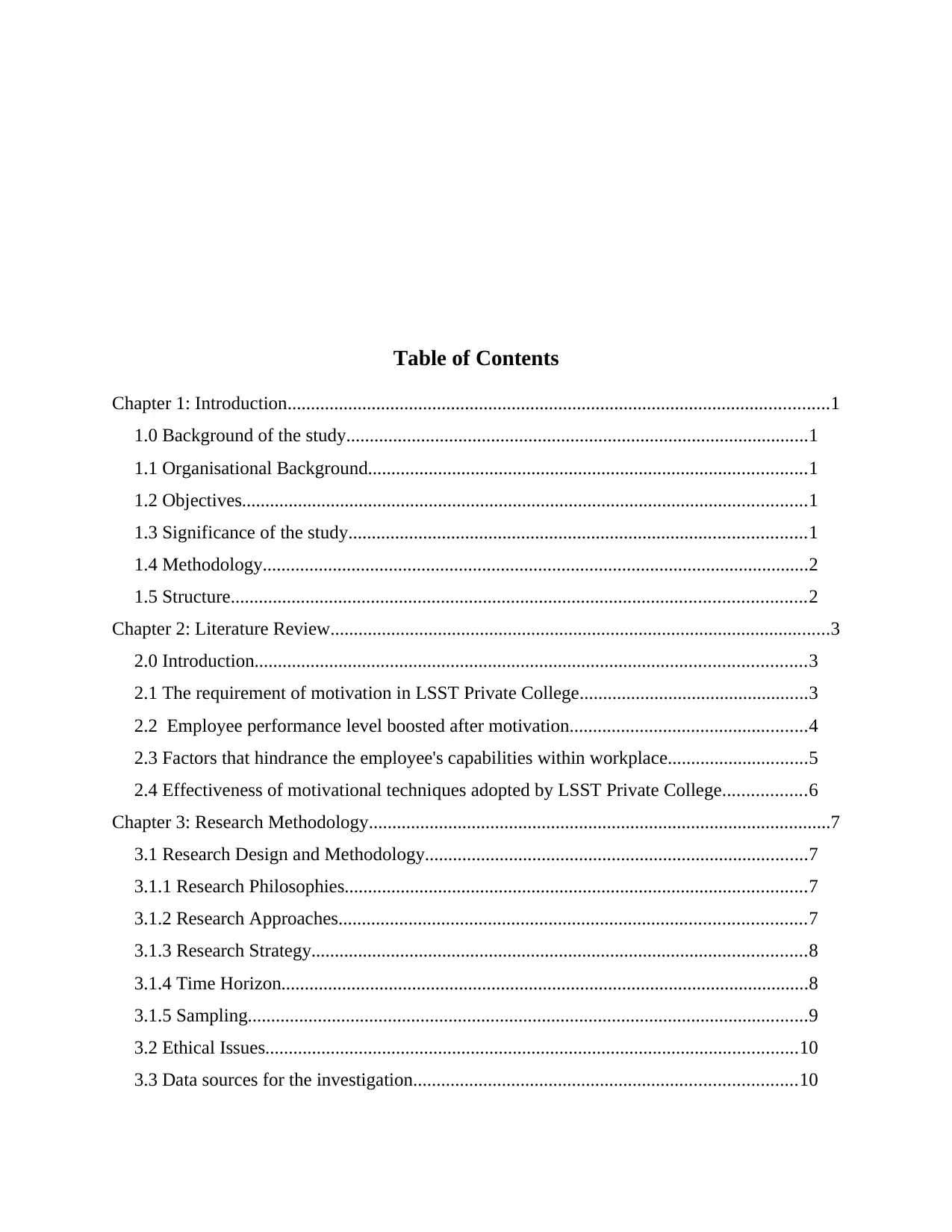
Table of Contents
Chapter 1: Introduction....................................................................................................................1
1.0 Background of the study...................................................................................................1
1.1 Organisational Background..............................................................................................1
1.2 Objectives.........................................................................................................................1
1.3 Significance of the study..................................................................................................1
1.4 Methodology.....................................................................................................................2
1.5 Structure...........................................................................................................................2
Chapter 2: Literature Review...........................................................................................................3
2.0 Introduction......................................................................................................................3
2.1 The requirement of motivation in LSST Private College.................................................3
2.2 Employee performance level boosted after motivation...................................................4
2.3 Factors that hindrance the employee's capabilities within workplace..............................5
2.4 Effectiveness of motivational techniques adopted by LSST Private College..................6
Chapter 3: Research Methodology...................................................................................................7
3.1 Research Design and Methodology..................................................................................7
3.1.1 Research Philosophies...................................................................................................7
3.1.2 Research Approaches....................................................................................................7
3.1.3 Research Strategy..........................................................................................................8
3.1.4 Time Horizon.................................................................................................................8
3.1.5 Sampling........................................................................................................................9
3.2 Ethical Issues..................................................................................................................10
3.3 Data sources for the investigation..................................................................................10
Chapter 1: Introduction....................................................................................................................1
1.0 Background of the study...................................................................................................1
1.1 Organisational Background..............................................................................................1
1.2 Objectives.........................................................................................................................1
1.3 Significance of the study..................................................................................................1
1.4 Methodology.....................................................................................................................2
1.5 Structure...........................................................................................................................2
Chapter 2: Literature Review...........................................................................................................3
2.0 Introduction......................................................................................................................3
2.1 The requirement of motivation in LSST Private College.................................................3
2.2 Employee performance level boosted after motivation...................................................4
2.3 Factors that hindrance the employee's capabilities within workplace..............................5
2.4 Effectiveness of motivational techniques adopted by LSST Private College..................6
Chapter 3: Research Methodology...................................................................................................7
3.1 Research Design and Methodology..................................................................................7
3.1.1 Research Philosophies...................................................................................................7
3.1.2 Research Approaches....................................................................................................7
3.1.3 Research Strategy..........................................................................................................8
3.1.4 Time Horizon.................................................................................................................8
3.1.5 Sampling........................................................................................................................9
3.2 Ethical Issues..................................................................................................................10
3.3 Data sources for the investigation..................................................................................10
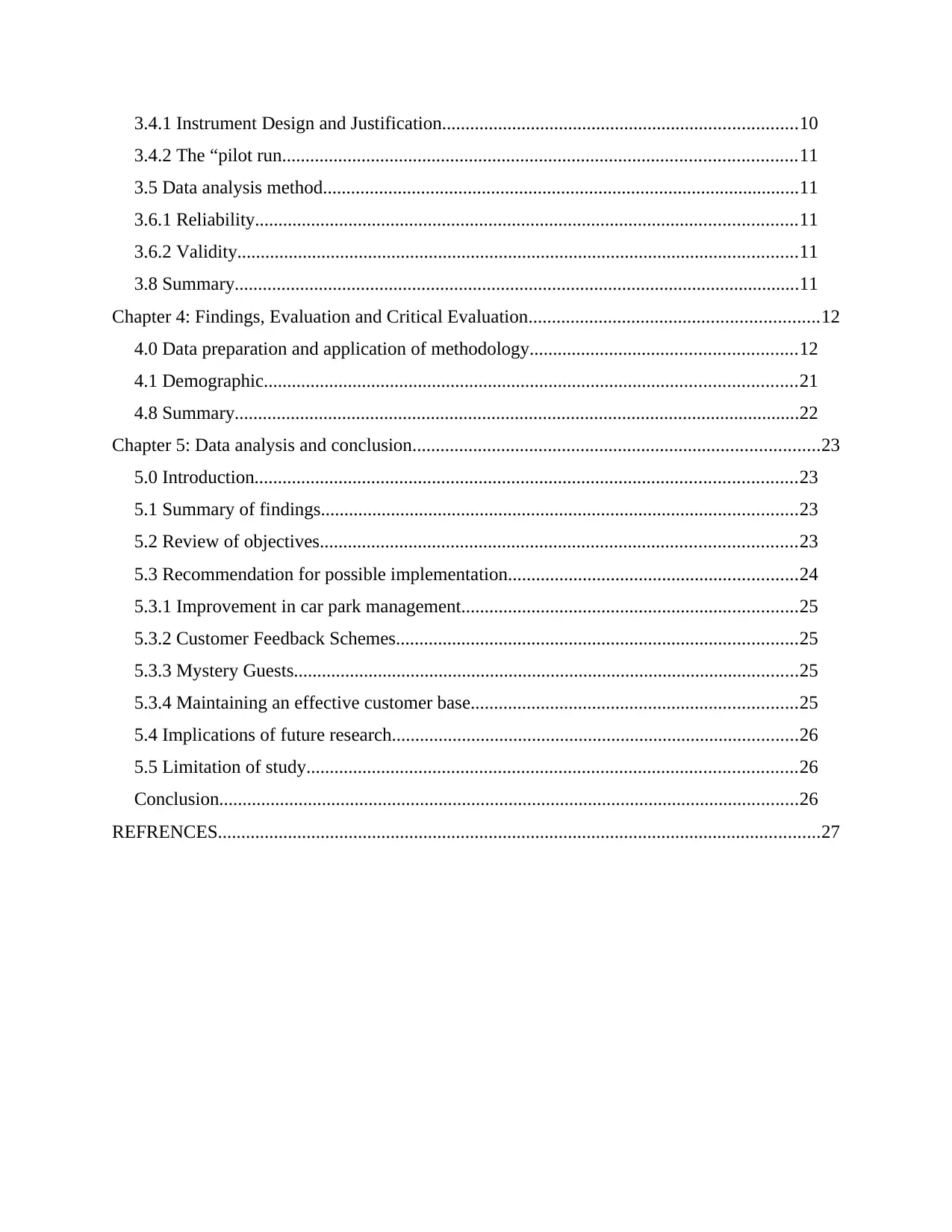
3.4.1 Instrument Design and Justification............................................................................10
3.4.2 The “pilot run..............................................................................................................11
3.5 Data analysis method......................................................................................................11
3.6.1 Reliability....................................................................................................................11
3.6.2 Validity........................................................................................................................11
3.8 Summary.........................................................................................................................11
Chapter 4: Findings, Evaluation and Critical Evaluation..............................................................12
4.0 Data preparation and application of methodology.........................................................12
4.1 Demographic..................................................................................................................21
4.8 Summary.........................................................................................................................22
Chapter 5: Data analysis and conclusion.......................................................................................23
5.0 Introduction....................................................................................................................23
5.1 Summary of findings......................................................................................................23
5.2 Review of objectives......................................................................................................23
5.3 Recommendation for possible implementation..............................................................24
5.3.1 Improvement in car park management........................................................................25
5.3.2 Customer Feedback Schemes......................................................................................25
5.3.3 Mystery Guests............................................................................................................25
5.3.4 Maintaining an effective customer base......................................................................25
5.4 Implications of future research.......................................................................................26
5.5 Limitation of study.........................................................................................................26
Conclusion............................................................................................................................26
REFRENCES.................................................................................................................................27
3.4.2 The “pilot run..............................................................................................................11
3.5 Data analysis method......................................................................................................11
3.6.1 Reliability....................................................................................................................11
3.6.2 Validity........................................................................................................................11
3.8 Summary.........................................................................................................................11
Chapter 4: Findings, Evaluation and Critical Evaluation..............................................................12
4.0 Data preparation and application of methodology.........................................................12
4.1 Demographic..................................................................................................................21
4.8 Summary.........................................................................................................................22
Chapter 5: Data analysis and conclusion.......................................................................................23
5.0 Introduction....................................................................................................................23
5.1 Summary of findings......................................................................................................23
5.2 Review of objectives......................................................................................................23
5.3 Recommendation for possible implementation..............................................................24
5.3.1 Improvement in car park management........................................................................25
5.3.2 Customer Feedback Schemes......................................................................................25
5.3.3 Mystery Guests............................................................................................................25
5.3.4 Maintaining an effective customer base......................................................................25
5.4 Implications of future research.......................................................................................26
5.5 Limitation of study.........................................................................................................26
Conclusion............................................................................................................................26
REFRENCES.................................................................................................................................27
⊘ This is a preview!⊘
Do you want full access?
Subscribe today to unlock all pages.

Trusted by 1+ million students worldwide

Paraphrase This Document
Need a fresh take? Get an instant paraphrase of this document with our AI Paraphraser
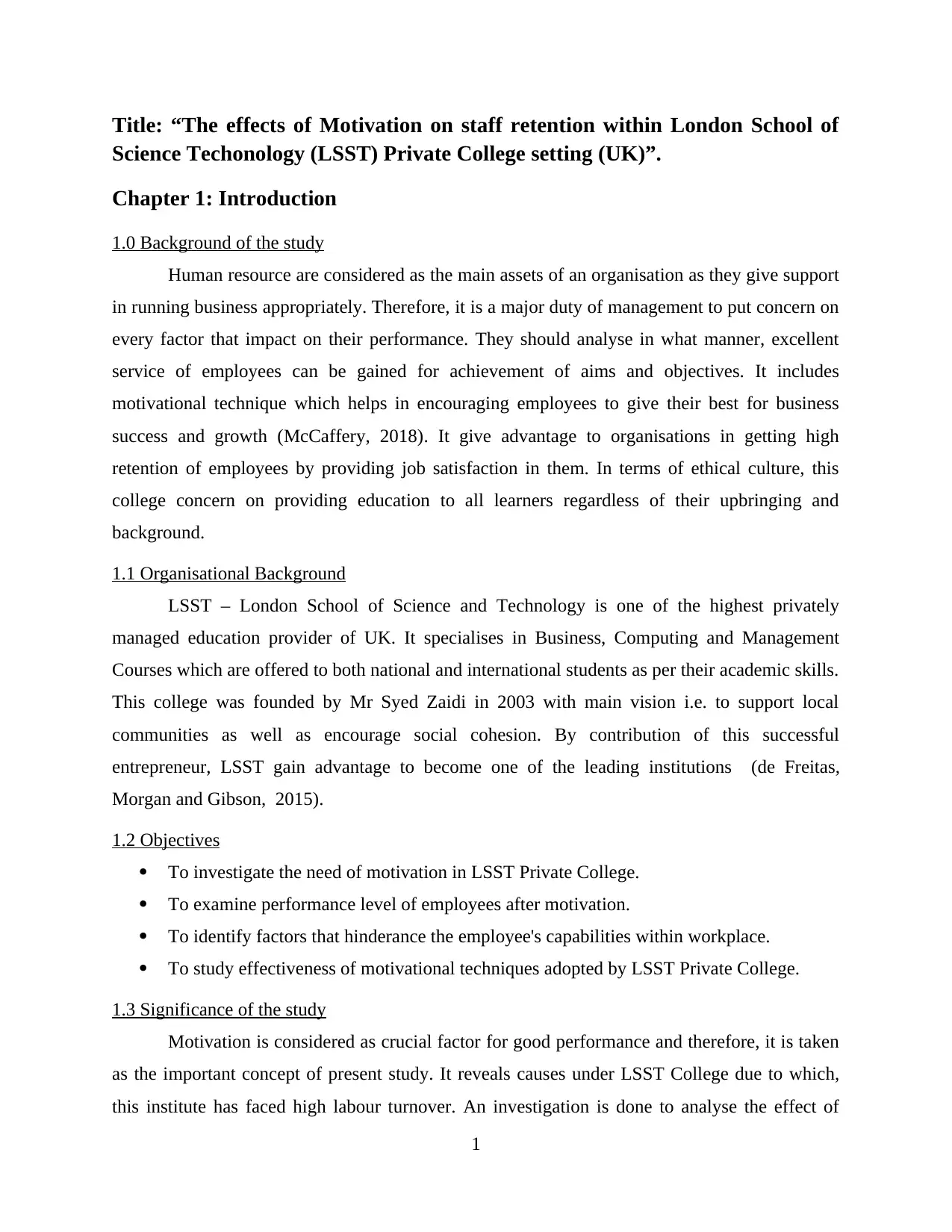
Title: “The effects of Motivation on staff retention within London School of
Science Techonology (LSST) Private College setting (UK)”.
Chapter 1: Introduction
1.0 Background of the study
Human resource are considered as the main assets of an organisation as they give support
in running business appropriately. Therefore, it is a major duty of management to put concern on
every factor that impact on their performance. They should analyse in what manner, excellent
service of employees can be gained for achievement of aims and objectives. It includes
motivational technique which helps in encouraging employees to give their best for business
success and growth (McCaffery, 2018). It give advantage to organisations in getting high
retention of employees by providing job satisfaction in them. In terms of ethical culture, this
college concern on providing education to all learners regardless of their upbringing and
background.
1.1 Organisational Background
LSST – London School of Science and Technology is one of the highest privately
managed education provider of UK. It specialises in Business, Computing and Management
Courses which are offered to both national and international students as per their academic skills.
This college was founded by Mr Syed Zaidi in 2003 with main vision i.e. to support local
communities as well as encourage social cohesion. By contribution of this successful
entrepreneur, LSST gain advantage to become one of the leading institutions (de Freitas,
Morgan and Gibson, 2015).
1.2 Objectives
To investigate the need of motivation in LSST Private College.
To examine performance level of employees after motivation.
To identify factors that hinderance the employee's capabilities within workplace.
To study effectiveness of motivational techniques adopted by LSST Private College.
1.3 Significance of the study
Motivation is considered as crucial factor for good performance and therefore, it is taken
as the important concept of present study. It reveals causes under LSST College due to which,
this institute has faced high labour turnover. An investigation is done to analyse the effect of
1
Science Techonology (LSST) Private College setting (UK)”.
Chapter 1: Introduction
1.0 Background of the study
Human resource are considered as the main assets of an organisation as they give support
in running business appropriately. Therefore, it is a major duty of management to put concern on
every factor that impact on their performance. They should analyse in what manner, excellent
service of employees can be gained for achievement of aims and objectives. It includes
motivational technique which helps in encouraging employees to give their best for business
success and growth (McCaffery, 2018). It give advantage to organisations in getting high
retention of employees by providing job satisfaction in them. In terms of ethical culture, this
college concern on providing education to all learners regardless of their upbringing and
background.
1.1 Organisational Background
LSST – London School of Science and Technology is one of the highest privately
managed education provider of UK. It specialises in Business, Computing and Management
Courses which are offered to both national and international students as per their academic skills.
This college was founded by Mr Syed Zaidi in 2003 with main vision i.e. to support local
communities as well as encourage social cohesion. By contribution of this successful
entrepreneur, LSST gain advantage to become one of the leading institutions (de Freitas,
Morgan and Gibson, 2015).
1.2 Objectives
To investigate the need of motivation in LSST Private College.
To examine performance level of employees after motivation.
To identify factors that hinderance the employee's capabilities within workplace.
To study effectiveness of motivational techniques adopted by LSST Private College.
1.3 Significance of the study
Motivation is considered as crucial factor for good performance and therefore, it is taken
as the important concept of present study. It reveals causes under LSST College due to which,
this institute has faced high labour turnover. An investigation is done to analyse the effect of
1
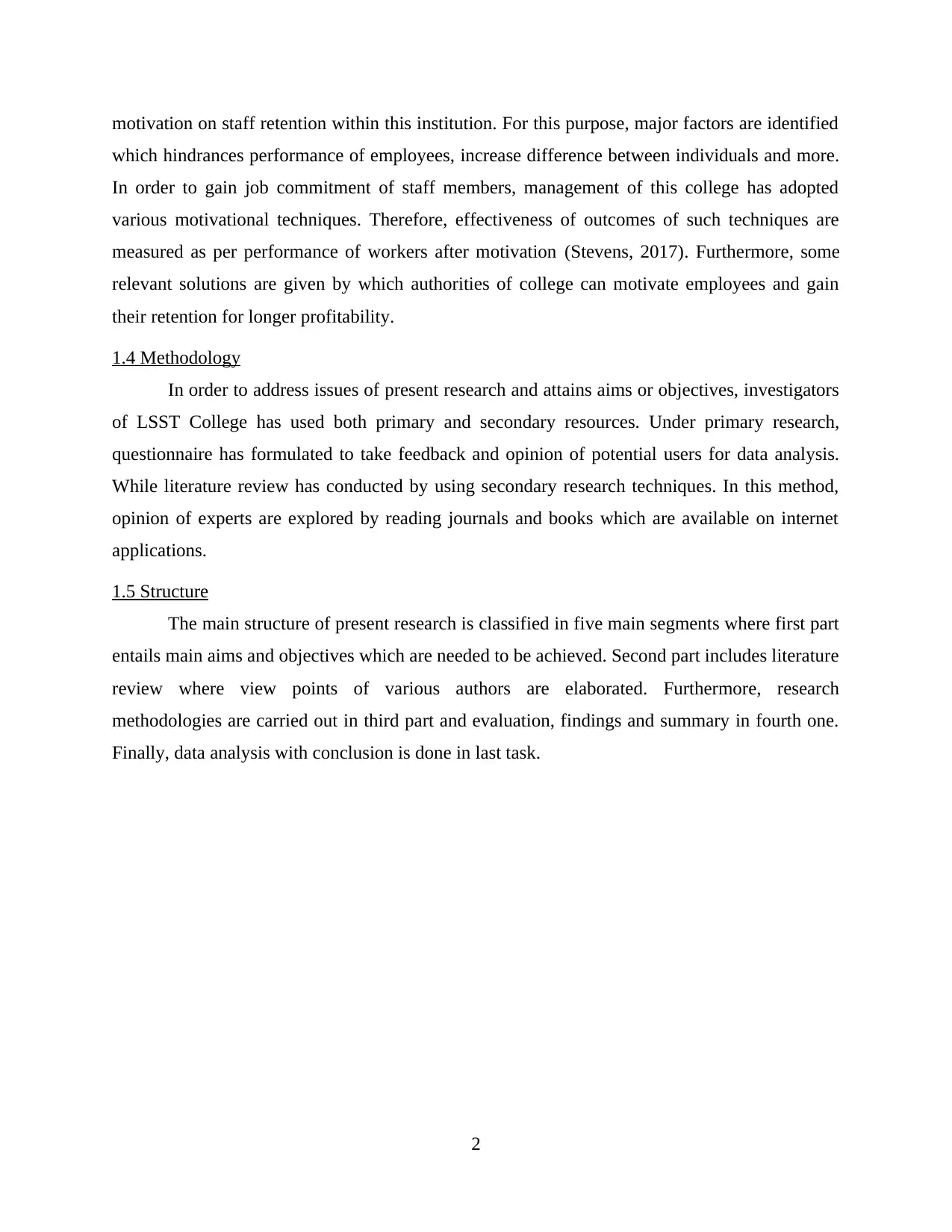
motivation on staff retention within this institution. For this purpose, major factors are identified
which hindrances performance of employees, increase difference between individuals and more.
In order to gain job commitment of staff members, management of this college has adopted
various motivational techniques. Therefore, effectiveness of outcomes of such techniques are
measured as per performance of workers after motivation (Stevens, 2017). Furthermore, some
relevant solutions are given by which authorities of college can motivate employees and gain
their retention for longer profitability.
1.4 Methodology
In order to address issues of present research and attains aims or objectives, investigators
of LSST College has used both primary and secondary resources. Under primary research,
questionnaire has formulated to take feedback and opinion of potential users for data analysis.
While literature review has conducted by using secondary research techniques. In this method,
opinion of experts are explored by reading journals and books which are available on internet
applications.
1.5 Structure
The main structure of present research is classified in five main segments where first part
entails main aims and objectives which are needed to be achieved. Second part includes literature
review where view points of various authors are elaborated. Furthermore, research
methodologies are carried out in third part and evaluation, findings and summary in fourth one.
Finally, data analysis with conclusion is done in last task.
2
which hindrances performance of employees, increase difference between individuals and more.
In order to gain job commitment of staff members, management of this college has adopted
various motivational techniques. Therefore, effectiveness of outcomes of such techniques are
measured as per performance of workers after motivation (Stevens, 2017). Furthermore, some
relevant solutions are given by which authorities of college can motivate employees and gain
their retention for longer profitability.
1.4 Methodology
In order to address issues of present research and attains aims or objectives, investigators
of LSST College has used both primary and secondary resources. Under primary research,
questionnaire has formulated to take feedback and opinion of potential users for data analysis.
While literature review has conducted by using secondary research techniques. In this method,
opinion of experts are explored by reading journals and books which are available on internet
applications.
1.5 Structure
The main structure of present research is classified in five main segments where first part
entails main aims and objectives which are needed to be achieved. Second part includes literature
review where view points of various authors are elaborated. Furthermore, research
methodologies are carried out in third part and evaluation, findings and summary in fourth one.
Finally, data analysis with conclusion is done in last task.
2
⊘ This is a preview!⊘
Do you want full access?
Subscribe today to unlock all pages.
Trusted by 1+ million students worldwide
Chapter 2: Literature Review
2.0 Introduction
Literature review refers to study to the study of one topic in which thoughts, views and
ideas of different of authors are considered. In this information is collected from secondary
sources in order to collect authentic and valuable data according to point of view of different
author. It basically clears concept over same topic as individual is placing its efforts in
understanding same topic from others point of view. It also shows that two different people have
different perception and thinking pattern on similar topic or case. As a result, it open up
understanding level and thinking capability of viewer in order to enhance their knowledge over
same topic. In context with present research, literature review helps in analysing the
effectiveness of motivational techniques for retention of workers.
2.1 The requirement of motivation in LSST Private College
According to the point of view of Bowen (2018), it has been analysed that motivation is
considered as basic requirements of every sector no matter they belongs to which sector, In
relation to education sector, it is essential for the management team to motivate its employees
that is faculty members to deliver knowledge to the college and school students in order to make
their future bright. It has been observed that LSST Private College is owning huge workforce
including faculty members. Therefore, it is important for the management team and top authority
to adopt different ways and strategies to motivate its employees. This also helps in encouraging
teachers to perform their job responsibility more effectively as earlier.
As per evaluation main requirement of motivation in LSST college felt by working staff
of this academic institutions as this college is giving learning opportunity to national as well as
international employees. This involvement of different culture creates problems for employees as
they are not able to handle students from different culture. This further results in decline of
faculty performance. It also develops need of motivation for faculty member of this colleges.
Along with this, it can be said motivation also helps in increasing employees commitment
towards their work responsibility. It has been evaluated that after motivating employees or
faculty members this college can improve working practices and deliver best class educational
services to students (Guerrero, Cunningham and Urbano, 2015). In order to motivate faculty
members, management team of college can adopt different motivational theories whose main
3
2.0 Introduction
Literature review refers to study to the study of one topic in which thoughts, views and
ideas of different of authors are considered. In this information is collected from secondary
sources in order to collect authentic and valuable data according to point of view of different
author. It basically clears concept over same topic as individual is placing its efforts in
understanding same topic from others point of view. It also shows that two different people have
different perception and thinking pattern on similar topic or case. As a result, it open up
understanding level and thinking capability of viewer in order to enhance their knowledge over
same topic. In context with present research, literature review helps in analysing the
effectiveness of motivational techniques for retention of workers.
2.1 The requirement of motivation in LSST Private College
According to the point of view of Bowen (2018), it has been analysed that motivation is
considered as basic requirements of every sector no matter they belongs to which sector, In
relation to education sector, it is essential for the management team to motivate its employees
that is faculty members to deliver knowledge to the college and school students in order to make
their future bright. It has been observed that LSST Private College is owning huge workforce
including faculty members. Therefore, it is important for the management team and top authority
to adopt different ways and strategies to motivate its employees. This also helps in encouraging
teachers to perform their job responsibility more effectively as earlier.
As per evaluation main requirement of motivation in LSST college felt by working staff
of this academic institutions as this college is giving learning opportunity to national as well as
international employees. This involvement of different culture creates problems for employees as
they are not able to handle students from different culture. This further results in decline of
faculty performance. It also develops need of motivation for faculty member of this colleges.
Along with this, it can be said motivation also helps in increasing employees commitment
towards their work responsibility. It has been evaluated that after motivating employees or
faculty members this college can improve working practices and deliver best class educational
services to students (Guerrero, Cunningham and Urbano, 2015). In order to motivate faculty
members, management team of college can adopt different motivational theories whose main
3
Paraphrase This Document
Need a fresh take? Get an instant paraphrase of this document with our AI Paraphraser
aim is to encourage employees for improving their performance and deliver best educational
knowledge to students. It can be said that usage of these motivational theories will be helpful for
LSST Private college in order to fulfil basic requirement of motivation. As a result, adoption of
these theories will be beneficial for improving working capability of faculty members.
2.2 Employee performance level boosted after motivation
As per the thoughts of Falk and Dierking (2016), it has been evaluated that there are
numerous of motivational theories which helps business organisation to improve working
capability to employees. This also helps in achieving their predetermined goals and objectives in
order to enhance their profitability as well. According to the deep study of author, it has been
realised that management team of LSST Private College can adopt financial incentives for
motivating its existing workforce. It can be said that monetary satisfaction is the only one which
motivates employees for long duration of time as they could fulfil their basic requirements with
the help of financial incentives. Apart from this, management team can also use Maslow's
Hierarchy of needs as a motivational theory for its employees. This motivational theory will be
beneficial for this college as it helps in satisfying employees needs according to stages of
hierarchy. According to this theory needs of employees are structured from lower to higher. The
theory also says if one need of employee is satisfied once then the same individual can not be
satisfied with the same thing. They requires some additional to get motivated further
(Wlodkowski and Ginsberg, 2017).
As per evaluation, it has been analysed that after adopting these two techniques that is
financial incentives and Maslow's motivational theory, Faculty members or employee of LSST
Private college will now work effectively as they are now motivated and wants to gain more
monetary benefits for satisfying their personal needs and wants. Along with this, faculty
members are now more focused towards their work as they feel that management team are
monitoring their performance so its better for them to place more efforts. HR department of
LSST College also use the concept of Hertzberg Two-factor theory. It is mainly concerns on
dissatisfaction factor for motivation. Therefore, administrators focuses on this factor and give
high appraisals for generating satisfaction among employees (Hearn and Rosinger, 2014).
Employees also feels boosted and energetic as they are getting something back for their hard
work (Role of Motivation in employee retention, 2018). These returns can be in any form that is
promotion, rewards, recognition, additional benefits, more opportunities and many other things
4
knowledge to students. It can be said that usage of these motivational theories will be helpful for
LSST Private college in order to fulfil basic requirement of motivation. As a result, adoption of
these theories will be beneficial for improving working capability of faculty members.
2.2 Employee performance level boosted after motivation
As per the thoughts of Falk and Dierking (2016), it has been evaluated that there are
numerous of motivational theories which helps business organisation to improve working
capability to employees. This also helps in achieving their predetermined goals and objectives in
order to enhance their profitability as well. According to the deep study of author, it has been
realised that management team of LSST Private College can adopt financial incentives for
motivating its existing workforce. It can be said that monetary satisfaction is the only one which
motivates employees for long duration of time as they could fulfil their basic requirements with
the help of financial incentives. Apart from this, management team can also use Maslow's
Hierarchy of needs as a motivational theory for its employees. This motivational theory will be
beneficial for this college as it helps in satisfying employees needs according to stages of
hierarchy. According to this theory needs of employees are structured from lower to higher. The
theory also says if one need of employee is satisfied once then the same individual can not be
satisfied with the same thing. They requires some additional to get motivated further
(Wlodkowski and Ginsberg, 2017).
As per evaluation, it has been analysed that after adopting these two techniques that is
financial incentives and Maslow's motivational theory, Faculty members or employee of LSST
Private college will now work effectively as they are now motivated and wants to gain more
monetary benefits for satisfying their personal needs and wants. Along with this, faculty
members are now more focused towards their work as they feel that management team are
monitoring their performance so its better for them to place more efforts. HR department of
LSST College also use the concept of Hertzberg Two-factor theory. It is mainly concerns on
dissatisfaction factor for motivation. Therefore, administrators focuses on this factor and give
high appraisals for generating satisfaction among employees (Hearn and Rosinger, 2014).
Employees also feels boosted and energetic as they are getting something back for their hard
work (Role of Motivation in employee retention, 2018). These returns can be in any form that is
promotion, rewards, recognition, additional benefits, more opportunities and many other things
4
which convinces them to achieve to more effectively. As a result, they work more harder as
compared to their earlier performance. This motivation not improves their performance but it
also enhances their decision making capabilities.
2.3 Factors that hindrance the employee's capabilities within workplace
As given by Barnett and et. al. (2014), it has been evaluated that employees cannot
reduce its working capability with the single factor but it is directly affected with numerous of
reasons. In relation to LSST Private College, it has been ascertained that employees or faculty
members of this institutions are generally facing numerous of issues which are directly impacting
negatively on working capabilities of employees at work place. As per evaluation it has been
identified that main factor which hinders employees performance is job security. This factor can
be seen in two ways that is if employees is getting job security then they will not work
effectively as they believes that whether they work properly or not they are getting their salary as
they are permanent in college. This reduces their working capability at workplace. On the other
hand, if employees are hired at contractual based then it creates in security among employees
because if any other employee work more effectively and there are possible chances they will be
terminated. This thinking process creates insecurity among working staff of LSST Private
College and becomes negative factors which reduces employees capability at workplace.
In addition to this, relationship with peers is the another factor that can be seen as
hindrance in employees capabilities at workplace (Why Employee Motivation is important?,
2018). As per evaluation, it has been observed that employees also feels demotivated because of
their colleagues which directly impacts negatively over their performance. It has been analysed
that there are faculty of LSST Private college are not feeling comfortable with their peers. This
may be because of different culture, language, attitude etc. of employees. As a result, it reduces
working capabilities of employees as they are not feeling comfortable with workforce. It also
creates chances of discrimination among workers as they gives more preference to their same
culture employees. This partiality also becomes reason for reducing working capability of
employees at workplace.
Apart from this, last but not the list hindrance factor which is impacting performance of
employees includes relationship with learners. These learners can be seen as the hindrance factor
for employees which affects their working capabilities. Along with this, it has been analysed that
there are numerous of issues which impacts negatively over the performance of working staff.
5
compared to their earlier performance. This motivation not improves their performance but it
also enhances their decision making capabilities.
2.3 Factors that hindrance the employee's capabilities within workplace
As given by Barnett and et. al. (2014), it has been evaluated that employees cannot
reduce its working capability with the single factor but it is directly affected with numerous of
reasons. In relation to LSST Private College, it has been ascertained that employees or faculty
members of this institutions are generally facing numerous of issues which are directly impacting
negatively on working capabilities of employees at work place. As per evaluation it has been
identified that main factor which hinders employees performance is job security. This factor can
be seen in two ways that is if employees is getting job security then they will not work
effectively as they believes that whether they work properly or not they are getting their salary as
they are permanent in college. This reduces their working capability at workplace. On the other
hand, if employees are hired at contractual based then it creates in security among employees
because if any other employee work more effectively and there are possible chances they will be
terminated. This thinking process creates insecurity among working staff of LSST Private
College and becomes negative factors which reduces employees capability at workplace.
In addition to this, relationship with peers is the another factor that can be seen as
hindrance in employees capabilities at workplace (Why Employee Motivation is important?,
2018). As per evaluation, it has been observed that employees also feels demotivated because of
their colleagues which directly impacts negatively over their performance. It has been analysed
that there are faculty of LSST Private college are not feeling comfortable with their peers. This
may be because of different culture, language, attitude etc. of employees. As a result, it reduces
working capabilities of employees as they are not feeling comfortable with workforce. It also
creates chances of discrimination among workers as they gives more preference to their same
culture employees. This partiality also becomes reason for reducing working capability of
employees at workplace.
Apart from this, last but not the list hindrance factor which is impacting performance of
employees includes relationship with learners. These learners can be seen as the hindrance factor
for employees which affects their working capabilities. Along with this, it has been analysed that
there are numerous of issues which impacts negatively over the performance of working staff.
5
⊘ This is a preview!⊘
Do you want full access?
Subscribe today to unlock all pages.
Trusted by 1+ million students worldwide
These problems basically arises having negative relationship with learners. It can be said that
faculty members are the one who spends much time with learners, these learner may belongs to
domestic or international geographic area (Gagné and et. al., 2015). This creates problem
regarding culture, languages, behaviour adapting capability etc. As a result, it affects negatively
over the performance of employees. Thus, to get best performance of workers, HR managers of
LSST College have used the concept of Goal-Setting Theory of Motivation. It increases the
capabilities of workers by getting their commitment for goal achievement. This theory also raises
incentives for staff if they work more quickly.
2.4 Effectiveness of motivational techniques adopted by LSST Private College
The main motive behind implementation of motivational techniques as per authorities of
LSST College is to gain retention of staff members. In this regard, they have adopted both
intrinsic and extrinsic motivational concepts. According to perceptions of Pinder, (2014), it has
evaluated that intrinsic motivation helps in encouraging workers to work at their level best. This
can be done by generating feeling of job satisfaction among staff members. While extrinsic
motivation defines as a force which directs or modifies the behaviour of human resource at
workplace. It also consider as gain support of employees for attainment of an outcome (Cameron
and Green, 2015). Thus, this kind of motivation is implemented by giving reward and
compensation, social approval and appreciation for hard work etc. In context with LSST Private
College, its authorities have adopted the concept of Maslow's Hierarchy of Needs, in order to
motivate staff members.
The main principle of this theory helps in attaining high employee satisfaction, their
retention and cohesive team as well. Its effectiveness can be classified as fulfilment of basic
needs, job security and personal safety, recognition and competence, etc. This theory also helps
in identifying those factors by which workers can be motivated. It includes improving working
culture and organising learning program to learn different languages so that staff members can
make conversation with others. Apart from this, goal-setting theory of motivation leads to get
better performance of employees, by motivating them to give best efforts. But this theory fails to
raise job satisfaction under staff also (Cerasoli and Ford, 2014). While Hertzberg theory of
motivation helps in providing job security under workers and improve their inter-personal
relationship as well.
6
faculty members are the one who spends much time with learners, these learner may belongs to
domestic or international geographic area (Gagné and et. al., 2015). This creates problem
regarding culture, languages, behaviour adapting capability etc. As a result, it affects negatively
over the performance of employees. Thus, to get best performance of workers, HR managers of
LSST College have used the concept of Goal-Setting Theory of Motivation. It increases the
capabilities of workers by getting their commitment for goal achievement. This theory also raises
incentives for staff if they work more quickly.
2.4 Effectiveness of motivational techniques adopted by LSST Private College
The main motive behind implementation of motivational techniques as per authorities of
LSST College is to gain retention of staff members. In this regard, they have adopted both
intrinsic and extrinsic motivational concepts. According to perceptions of Pinder, (2014), it has
evaluated that intrinsic motivation helps in encouraging workers to work at their level best. This
can be done by generating feeling of job satisfaction among staff members. While extrinsic
motivation defines as a force which directs or modifies the behaviour of human resource at
workplace. It also consider as gain support of employees for attainment of an outcome (Cameron
and Green, 2015). Thus, this kind of motivation is implemented by giving reward and
compensation, social approval and appreciation for hard work etc. In context with LSST Private
College, its authorities have adopted the concept of Maslow's Hierarchy of Needs, in order to
motivate staff members.
The main principle of this theory helps in attaining high employee satisfaction, their
retention and cohesive team as well. Its effectiveness can be classified as fulfilment of basic
needs, job security and personal safety, recognition and competence, etc. This theory also helps
in identifying those factors by which workers can be motivated. It includes improving working
culture and organising learning program to learn different languages so that staff members can
make conversation with others. Apart from this, goal-setting theory of motivation leads to get
better performance of employees, by motivating them to give best efforts. But this theory fails to
raise job satisfaction under staff also (Cerasoli and Ford, 2014). While Hertzberg theory of
motivation helps in providing job security under workers and improve their inter-personal
relationship as well.
6
Paraphrase This Document
Need a fresh take? Get an instant paraphrase of this document with our AI Paraphraser
Chapter 3: Research Methodology
3.1 Research Design and Methodology
Research design is an systematic arrangement of various conditions which is required to
make collection and proper analysis of data within which research is conducted. Whereas, on the
other hand design methodology is a development of system for any unique situation. There are
mainly two types of research designs that includes, descriptive and experimental research. This
method ensure choosing effective strategy from various different components. Research mainly
focus on end products whereas methodology focus on tools and procedures that are going to
require in research process. Thus, research design of present assignment is made in descriptive
manner.
3.1.1 Research Philosophies
This section of research involves nature, characteristics and improvement of knowledge.
It can also be termed as a method in which a information can be determined, gathered and
implemented. To have a research philosophy the basic step is to gather information from primary
data and secondary data to give answers to the questions asked in research philosophy. For
addressing this philosophy requires to have knowledge and implement assumptions and faith. It
is used by authors to indicate necessary assumptions and these assumptions are used by them to
treat as a base for research methodology. Research philosophies have mainly four main branches
which are Pragmatism, Positivism, Realism and Interpretivism (Interprevist). Choice of the best
research philosophy to be implemented depends upon practical implications of that philosophy
and choice is done between positivist and interpretivist philosophies or quantitative and
qualitative methods of research. But recently developments have lead to increased in popularity
of realism and pragmatism both. This research has chosen concept of interpretivism philosophy.
3.1.2 Research Approaches
It is an procedure which mainly consists of steps of assumptions and methods of various
data collection and their interpretations. There are two types of research approach that are
deductive research approach and inductive research approach. In Inductive research approach
researchers only collect those data which are relevant for their topic. In this researcher only
evaluate pattern in data and work towards developing a theory that can explain those patterns. In
this collected data is mainly use to evaluate phenomenon and develop a conceptual framework.
7
3.1 Research Design and Methodology
Research design is an systematic arrangement of various conditions which is required to
make collection and proper analysis of data within which research is conducted. Whereas, on the
other hand design methodology is a development of system for any unique situation. There are
mainly two types of research designs that includes, descriptive and experimental research. This
method ensure choosing effective strategy from various different components. Research mainly
focus on end products whereas methodology focus on tools and procedures that are going to
require in research process. Thus, research design of present assignment is made in descriptive
manner.
3.1.1 Research Philosophies
This section of research involves nature, characteristics and improvement of knowledge.
It can also be termed as a method in which a information can be determined, gathered and
implemented. To have a research philosophy the basic step is to gather information from primary
data and secondary data to give answers to the questions asked in research philosophy. For
addressing this philosophy requires to have knowledge and implement assumptions and faith. It
is used by authors to indicate necessary assumptions and these assumptions are used by them to
treat as a base for research methodology. Research philosophies have mainly four main branches
which are Pragmatism, Positivism, Realism and Interpretivism (Interprevist). Choice of the best
research philosophy to be implemented depends upon practical implications of that philosophy
and choice is done between positivist and interpretivist philosophies or quantitative and
qualitative methods of research. But recently developments have lead to increased in popularity
of realism and pragmatism both. This research has chosen concept of interpretivism philosophy.
3.1.2 Research Approaches
It is an procedure which mainly consists of steps of assumptions and methods of various
data collection and their interpretations. There are two types of research approach that are
deductive research approach and inductive research approach. In Inductive research approach
researchers only collect those data which are relevant for their topic. In this researcher only
evaluate pattern in data and work towards developing a theory that can explain those patterns. In
this collected data is mainly use to evaluate phenomenon and develop a conceptual framework.
7
Whereas, in deductive approach collected data generally use to explore propositions this research
revolves around theory generation and building. Thus, deductive approach has been taken to
address the issues of present research.
3.1.3 Research Strategy
It refers to a step by step plan of action which shows directions and certain path to
research team. With regards to present research, investigators of LSST College has used
strategies like experiment, survey, ethnography and more. For this purpose, data is collected on
the basis of interview, questionnaire and observations.
3.1.4 Time Horizon
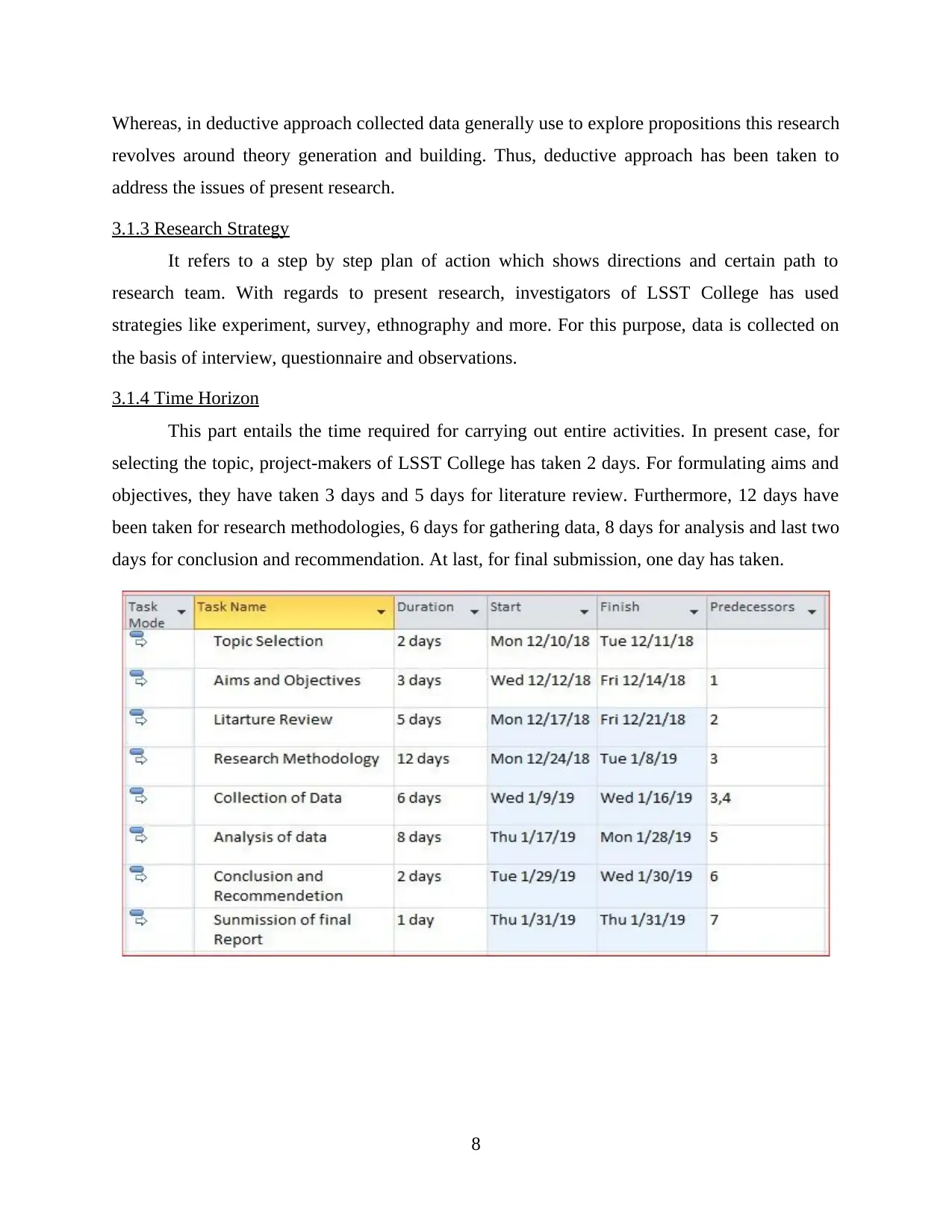
This part entails the time required for carrying out entire activities. In present case, for
selecting the topic, project-makers of LSST College has taken 2 days. For formulating aims and
objectives, they have taken 3 days and 5 days for literature review. Furthermore, 12 days have
been taken for research methodologies, 6 days for gathering data, 8 days for analysis and last two
days for conclusion and recommendation. At last, for final submission, one day has taken.
8
revolves around theory generation and building. Thus, deductive approach has been taken to
address the issues of present research.
3.1.3 Research Strategy
It refers to a step by step plan of action which shows directions and certain path to
research team. With regards to present research, investigators of LSST College has used
strategies like experiment, survey, ethnography and more. For this purpose, data is collected on
the basis of interview, questionnaire and observations.
3.1.4 Time Horizon
This part entails the time required for carrying out entire activities. In present case, for
selecting the topic, project-makers of LSST College has taken 2 days. For formulating aims and
objectives, they have taken 3 days and 5 days for literature review. Furthermore, 12 days have
been taken for research methodologies, 6 days for gathering data, 8 days for analysis and last two
days for conclusion and recommendation. At last, for final submission, one day has taken.
8
⊘ This is a preview!⊘
Do you want full access?
Subscribe today to unlock all pages.
Trusted by 1+ million students worldwide

1 out of 33


Related Documents


Your All-in-One AI-Powered Toolkit for Academic Success.
+13062052269
info@desklib.com
Available 24*7 on WhatsApp / Email
![[object Object]](/_next/static/media/star-bottom.7253800d.svg)
Unlock your academic potential
Copyright © 2020–2026 A2Z Services. All Rights Reserved. Developed and managed by ZUCOL.