Organisational Behaviour: Motivation, Teamwork, and Management
VerifiedAdded on 2023/06/04
|14
|5350
|270
Report
AI Summary
This report provides a detailed analysis of organisational behaviour, focusing on the impact of personality attributes and traits on company performance and management approaches. It evaluates the significance of personality and perception in fostering effective managerial relationships, and explains content and process theories of motivation for enhancing organisational staff effectiveness. The report also examines the creation and management of effective teamwork in a business context, reflecting on personal contributions to group behaviour and dynamics. It concludes by emphasizing the importance of group behaviour and team theory in developing and managing effective team-working within an organisation to achieve particular goals. Desklib offers a wealth of similar solved assignments and past papers for students.
Organisational
Behaviour
Behaviour

Paraphrase This Document
Need a fresh take? Get an instant paraphrase of this document with our AI Paraphraser
Contents
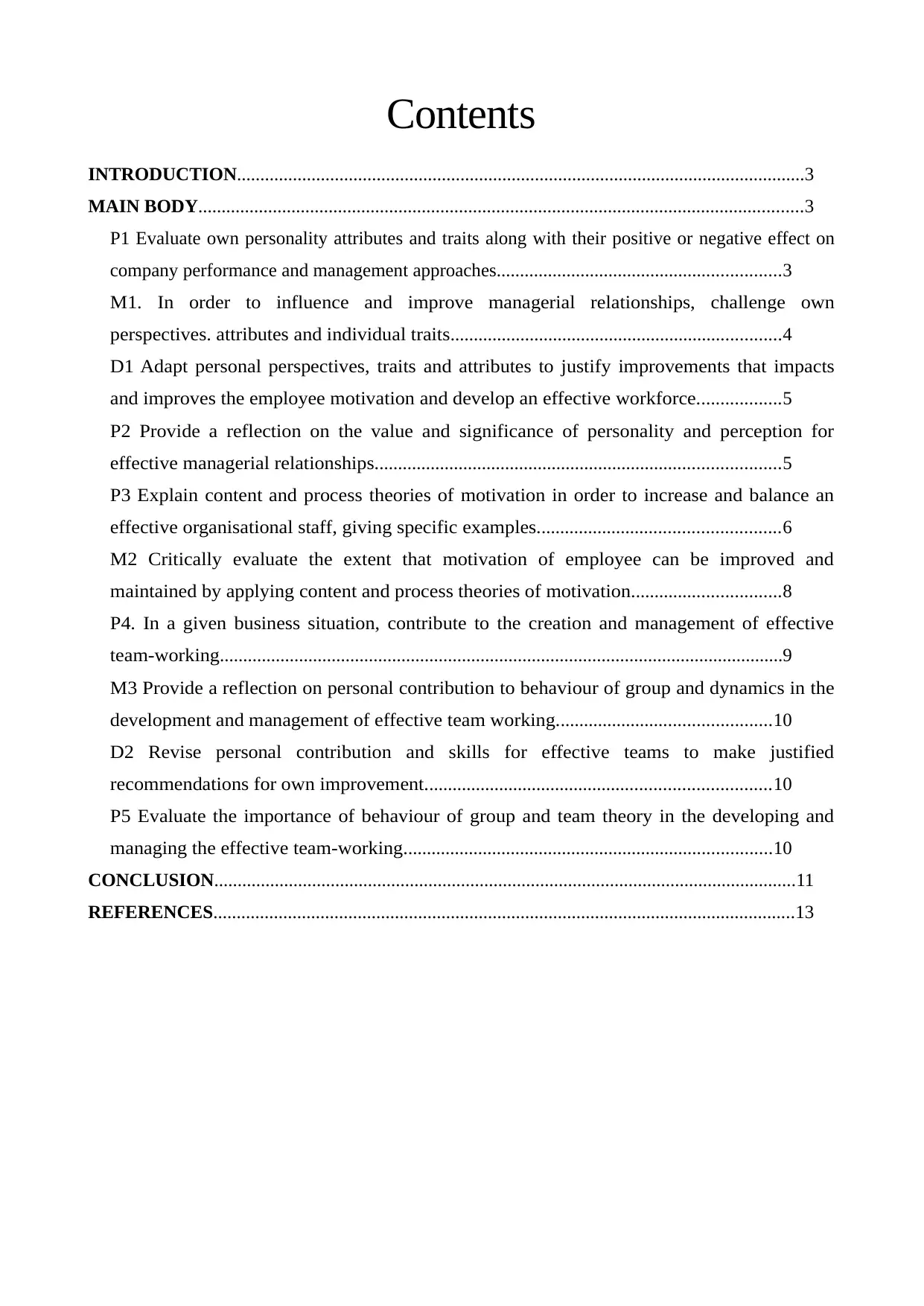
INTRODUCTION..........................................................................................................................3
MAIN BODY..................................................................................................................................3
P1 Evaluate own personality attributes and traits along with their positive or negative effect on
company performance and management approaches.............................................................3
M1. In order to influence and improve managerial relationships, challenge own
perspectives. attributes and individual traits.......................................................................4
D1 Adapt personal perspectives, traits and attributes to justify improvements that impacts
and improves the employee motivation and develop an effective workforce..................5
P2 Provide a reflection on the value and significance of personality and perception for
effective managerial relationships.......................................................................................5
P3 Explain content and process theories of motivation in order to increase and balance an
effective organisational staff, giving specific examples....................................................6
M2 Critically evaluate the extent that motivation of employee can be improved and
maintained by applying content and process theories of motivation................................8
P4. In a given business situation, contribute to the creation and management of effective
team-working.........................................................................................................................9
M3 Provide a reflection on personal contribution to behaviour of group and dynamics in the
development and management of effective team working..............................................10
D2 Revise personal contribution and skills for effective teams to make justified
recommendations for own improvement..........................................................................10
P5 Evaluate the importance of behaviour of group and team theory in the developing and
managing the effective team-working...............................................................................10
CONCLUSION.............................................................................................................................11
REFERENCES.............................................................................................................................13
INTRODUCTION..........................................................................................................................3
MAIN BODY..................................................................................................................................3
P1 Evaluate own personality attributes and traits along with their positive or negative effect on
company performance and management approaches.............................................................3
M1. In order to influence and improve managerial relationships, challenge own
perspectives. attributes and individual traits.......................................................................4
D1 Adapt personal perspectives, traits and attributes to justify improvements that impacts
and improves the employee motivation and develop an effective workforce..................5
P2 Provide a reflection on the value and significance of personality and perception for
effective managerial relationships.......................................................................................5
P3 Explain content and process theories of motivation in order to increase and balance an
effective organisational staff, giving specific examples....................................................6
M2 Critically evaluate the extent that motivation of employee can be improved and
maintained by applying content and process theories of motivation................................8
P4. In a given business situation, contribute to the creation and management of effective
team-working.........................................................................................................................9
M3 Provide a reflection on personal contribution to behaviour of group and dynamics in the
development and management of effective team working..............................................10
D2 Revise personal contribution and skills for effective teams to make justified
recommendations for own improvement..........................................................................10
P5 Evaluate the importance of behaviour of group and team theory in the developing and
managing the effective team-working...............................................................................10
CONCLUSION.............................................................................................................................11
REFERENCES.............................................................................................................................13
INTRODUCTION
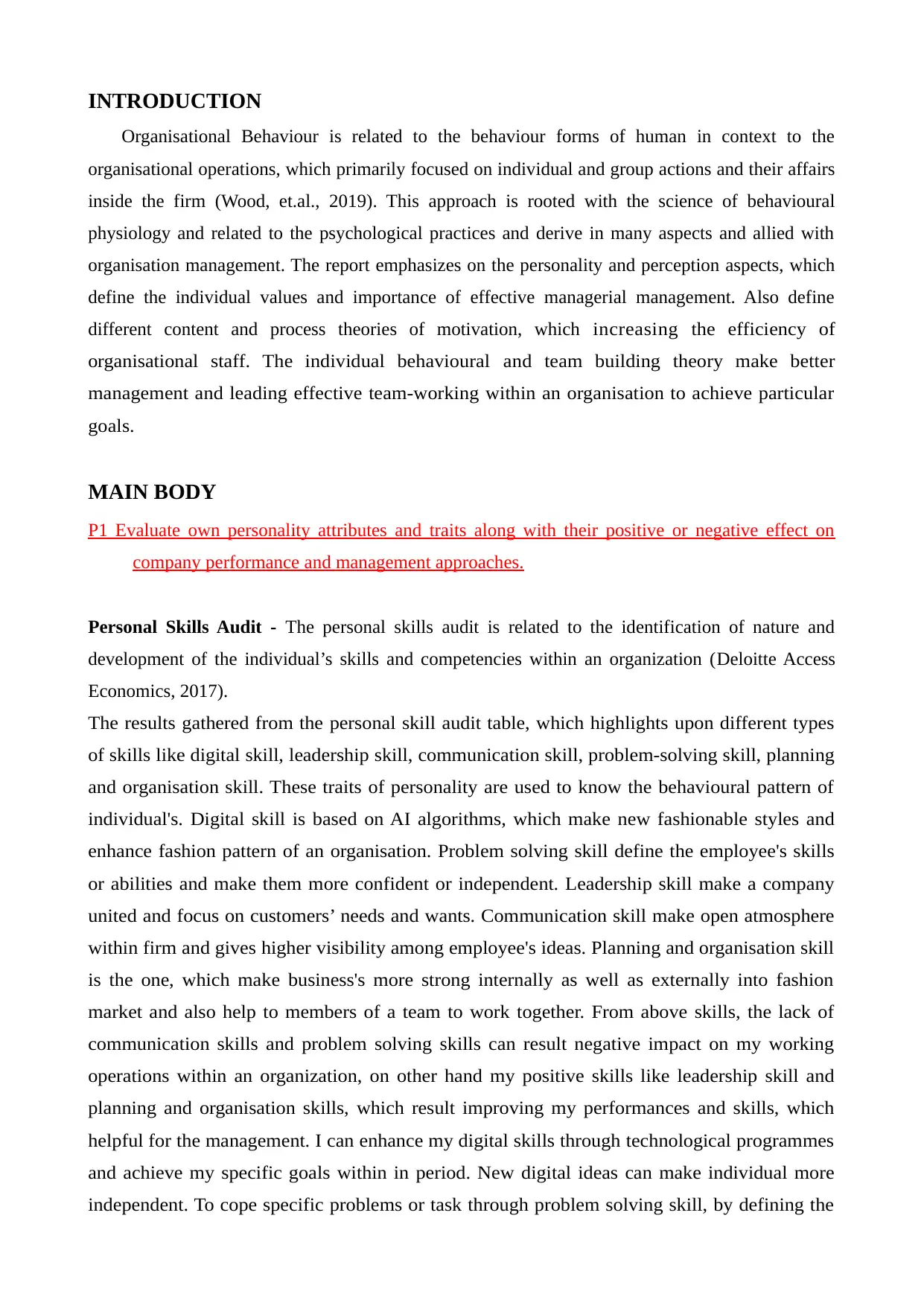
Organisational Behaviour is related to the behaviour forms of human in context to the
organisational operations, which primarily focused on individual and group actions and their affairs
inside the firm (Wood, et.al., 2019). This approach is rooted with the science of behavioural
physiology and related to the psychological practices and derive in many aspects and allied with
organisation management. The report emphasizes on the personality and perception aspects, which
define the individual values and importance of effective managerial management. Also define
different content and process theories of motivation, which increasing the efficiency of
organisational staff. The individual behavioural and team building theory make better
management and leading effective team-working within an organisation to achieve particular
goals.
MAIN BODY
P1 Evaluate own personality attributes and traits along with their positive or negative effect on
company performance and management approaches.
Personal Skills Audit - The personal skills audit is related to the identification of nature and
development of the individual’s skills and competencies within an organization (Deloitte Access
Economics, 2017).
The results gathered from the personal skill audit table, which highlights upon different types
of skills like digital skill, leadership skill, communication skill, problem-solving skill, planning
and organisation skill. These traits of personality are used to know the behavioural pattern of
individual's. Digital skill is based on AI algorithms, which make new fashionable styles and
enhance fashion pattern of an organisation. Problem solving skill define the employee's skills
or abilities and make them more confident or independent. Leadership skill make a company
united and focus on customers’ needs and wants. Communication skill make open atmosphere
within firm and gives higher visibility among employee's ideas. Planning and organisation skill
is the one, which make business's more strong internally as well as externally into fashion
market and also help to members of a team to work together. From above skills, the lack of
communication skills and problem solving skills can result negative impact on my working
operations within an organization, on other hand my positive skills like leadership skill and
planning and organisation skills, which result improving my performances and skills, which
helpful for the management. I can enhance my digital skills through technological programmes
and achieve my specific goals within in period. New digital ideas can make individual more
independent. To cope specific problems or task through problem solving skill, by defining the
Organisational Behaviour is related to the behaviour forms of human in context to the
organisational operations, which primarily focused on individual and group actions and their affairs
inside the firm (Wood, et.al., 2019). This approach is rooted with the science of behavioural
physiology and related to the psychological practices and derive in many aspects and allied with
organisation management. The report emphasizes on the personality and perception aspects, which
define the individual values and importance of effective managerial management. Also define
different content and process theories of motivation, which increasing the efficiency of
organisational staff. The individual behavioural and team building theory make better
management and leading effective team-working within an organisation to achieve particular
goals.
MAIN BODY
P1 Evaluate own personality attributes and traits along with their positive or negative effect on
company performance and management approaches.
Personal Skills Audit - The personal skills audit is related to the identification of nature and
development of the individual’s skills and competencies within an organization (Deloitte Access
Economics, 2017).
The results gathered from the personal skill audit table, which highlights upon different types
of skills like digital skill, leadership skill, communication skill, problem-solving skill, planning
and organisation skill. These traits of personality are used to know the behavioural pattern of
individual's. Digital skill is based on AI algorithms, which make new fashionable styles and
enhance fashion pattern of an organisation. Problem solving skill define the employee's skills
or abilities and make them more confident or independent. Leadership skill make a company
united and focus on customers’ needs and wants. Communication skill make open atmosphere
within firm and gives higher visibility among employee's ideas. Planning and organisation skill
is the one, which make business's more strong internally as well as externally into fashion
market and also help to members of a team to work together. From above skills, the lack of
communication skills and problem solving skills can result negative impact on my working
operations within an organization, on other hand my positive skills like leadership skill and
planning and organisation skills, which result improving my performances and skills, which
helpful for the management. I can enhance my digital skills through technological programmes
and achieve my specific goals within in period. New digital ideas can make individual more
independent. To cope specific problems or task through problem solving skill, by defining the
⊘ This is a preview!⊘
Do you want full access?
Subscribe today to unlock all pages.

Trusted by 1+ million students worldwide
clear solution for specific problem. The communication skill used to build an individual into
professional man to deal projects easily. It used to inter-change the ideas of employees with
others within an organisation. Planning make an organisation well by their operations as well
as management. It forms united organisation, with standard goals and eliminate the uncertainty
and ensure the optimistic use of organisation's resources.
The Big Five Personality Test – This test will helpful to understood the individual
behavioural structural pattern and their personality attributes.
Interpretation of The Big Five Personality Test
From the table, the scores should be calculated from zero to forty through each personality
attributes;
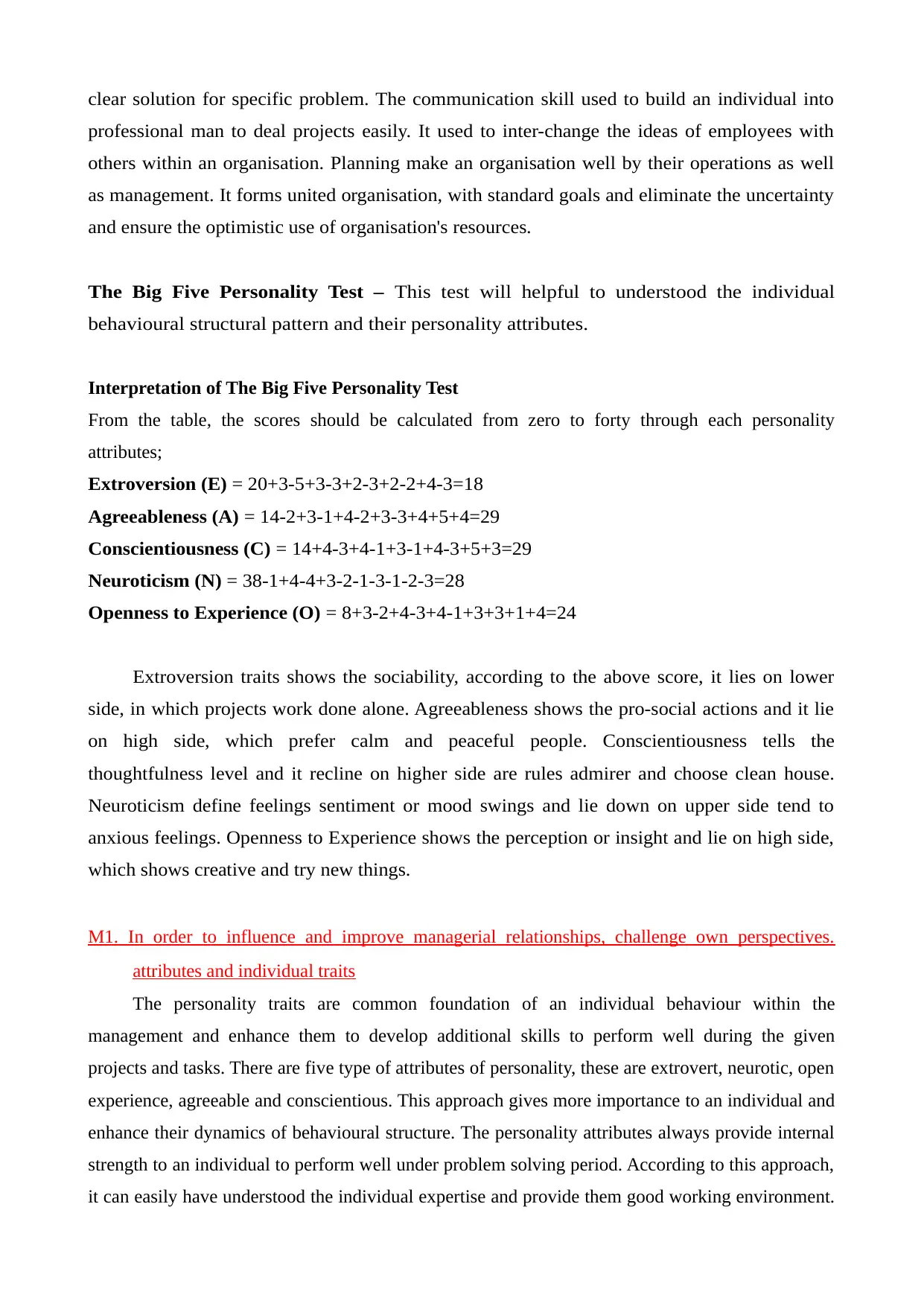
Extroversion (E) = 20+3-5+3-3+2-3+2-2+4-3=18
Agreeableness (A) = 14-2+3-1+4-2+3-3+4+5+4=29
Conscientiousness (C) = 14+4-3+4-1+3-1+4-3+5+3=29
Neuroticism (N) = 38-1+4-4+3-2-1-3-1-2-3=28
Openness to Experience (O) = 8+3-2+4-3+4-1+3+3+1+4=24
Extroversion traits shows the sociability, according to the above score, it lies on lower
side, in which projects work done alone. Agreeableness shows the pro-social actions and it lie
on high side, which prefer calm and peaceful people. Conscientiousness tells the
thoughtfulness level and it recline on higher side are rules admirer and choose clean house.
Neuroticism define feelings sentiment or mood swings and lie down on upper side tend to
anxious feelings. Openness to Experience shows the perception or insight and lie on high side,
which shows creative and try new things.
M1. In order to influence and improve managerial relationships, challenge own perspectives.
attributes and individual traits
The personality traits are common foundation of an individual behaviour within the
management and enhance them to develop additional skills to perform well during the given
projects and tasks. There are five type of attributes of personality, these are extrovert, neurotic, open
experience, agreeable and conscientious. This approach gives more importance to an individual and
enhance their dynamics of behavioural structure. The personality attributes always provide internal
strength to an individual to perform well under problem solving period. According to this approach,
it can easily have understood the individual expertise and provide them good working environment.
professional man to deal projects easily. It used to inter-change the ideas of employees with
others within an organisation. Planning make an organisation well by their operations as well
as management. It forms united organisation, with standard goals and eliminate the uncertainty
and ensure the optimistic use of organisation's resources.
The Big Five Personality Test – This test will helpful to understood the individual
behavioural structural pattern and their personality attributes.
Interpretation of The Big Five Personality Test
From the table, the scores should be calculated from zero to forty through each personality
attributes;
Extroversion (E) = 20+3-5+3-3+2-3+2-2+4-3=18
Agreeableness (A) = 14-2+3-1+4-2+3-3+4+5+4=29
Conscientiousness (C) = 14+4-3+4-1+3-1+4-3+5+3=29
Neuroticism (N) = 38-1+4-4+3-2-1-3-1-2-3=28
Openness to Experience (O) = 8+3-2+4-3+4-1+3+3+1+4=24
Extroversion traits shows the sociability, according to the above score, it lies on lower
side, in which projects work done alone. Agreeableness shows the pro-social actions and it lie
on high side, which prefer calm and peaceful people. Conscientiousness tells the
thoughtfulness level and it recline on higher side are rules admirer and choose clean house.
Neuroticism define feelings sentiment or mood swings and lie down on upper side tend to
anxious feelings. Openness to Experience shows the perception or insight and lie on high side,
which shows creative and try new things.
M1. In order to influence and improve managerial relationships, challenge own perspectives.
attributes and individual traits
The personality traits are common foundation of an individual behaviour within the
management and enhance them to develop additional skills to perform well during the given
projects and tasks. There are five type of attributes of personality, these are extrovert, neurotic, open
experience, agreeable and conscientious. This approach gives more importance to an individual and
enhance their dynamics of behavioural structure. The personality attributes always provide internal
strength to an individual to perform well under problem solving period. According to this approach,
it can easily have understood the individual expertise and provide them good working environment.
Paraphrase This Document
Need a fresh take? Get an instant paraphrase of this document with our AI Paraphraser
The perception aspects lead individual in positive ways, which make organisation good. In this,
things are organizing well according to task and individual perform well under group-task. In
organisation, the perception often grows and shape the personality of individual and enhance their
different skills according to the problem, which arise during the projects.
D1 Adapt personal perspectives, traits and attributes to justify improvements that impacts and
improves the employee motivation and develop an effective workforce.
The personal attributes make better and understand individual's personality
behavioural of in relation with cultural atmosphere. It helps of achieve self-actualisation.
It has optimistic and positive view of behavioural of individual in the company. The
employees are dependent and independent on their behavioural pattern because their
internal traits related to individual's personality. This approach become possible by
analysing the motivator. The pursuit of self-esteem and self-actualisation needs are
achieving by enhancement of personality and perception aspects. Hence, motivation are
states which enables different behaviour in many ways. In other words, motivation is one
of the considerations of behavioural. Both these aspects are needed to the firm, to
balanced their management operations and balance their productivity efficiency. But
undue rely on excessive efficiency without using efficient plan is not worthwhile. So,
both aspects are important organisation.
P2 Provide a reflection on the value and significance of personality and perception for effective
managerial relationships.
The personality word is the combination of different features or attributes, that make person's
unique from others comparison and provide new edge to its identity. Its role signifies that, how
person identity shown in society. Every person has different or unique identity, which provide some
determinates into their behavioural structural and define their personality traits (Lasswell, 2017).
There are two types of personality attributes, these are inherited features and learned features.
A perception knows as cognitive procedure, which change the tangible incentives to give additional
information. In this process, it interpreting related concepts, which we see or hear and give
something related statement according to the situation, people, category and many more. It concerns
over to better understanding the projects and how to perform them well. Also it understanding their
associated projects, which them allotted. There are total four types of perceptual process i.e.,
receiving, selecting, organizing and interpreting.
The personality and perception, both aspects have different values as well as importance,
which make better effective team and form good relationship with firm's managerial operations.
things are organizing well according to task and individual perform well under group-task. In
organisation, the perception often grows and shape the personality of individual and enhance their
different skills according to the problem, which arise during the projects.
D1 Adapt personal perspectives, traits and attributes to justify improvements that impacts and
improves the employee motivation and develop an effective workforce.
The personal attributes make better and understand individual's personality
behavioural of in relation with cultural atmosphere. It helps of achieve self-actualisation.
It has optimistic and positive view of behavioural of individual in the company. The
employees are dependent and independent on their behavioural pattern because their
internal traits related to individual's personality. This approach become possible by
analysing the motivator. The pursuit of self-esteem and self-actualisation needs are
achieving by enhancement of personality and perception aspects. Hence, motivation are
states which enables different behaviour in many ways. In other words, motivation is one
of the considerations of behavioural. Both these aspects are needed to the firm, to
balanced their management operations and balance their productivity efficiency. But
undue rely on excessive efficiency without using efficient plan is not worthwhile. So,
both aspects are important organisation.
P2 Provide a reflection on the value and significance of personality and perception for effective
managerial relationships.
The personality word is the combination of different features or attributes, that make person's
unique from others comparison and provide new edge to its identity. Its role signifies that, how
person identity shown in society. Every person has different or unique identity, which provide some
determinates into their behavioural structural and define their personality traits (Lasswell, 2017).
There are two types of personality attributes, these are inherited features and learned features.
A perception knows as cognitive procedure, which change the tangible incentives to give additional
information. In this process, it interpreting related concepts, which we see or hear and give
something related statement according to the situation, people, category and many more. It concerns
over to better understanding the projects and how to perform them well. Also it understanding their
associated projects, which them allotted. There are total four types of perceptual process i.e.,
receiving, selecting, organizing and interpreting.
The personality and perception, both aspects have different values as well as importance,
which make better effective team and form good relationship with firm's managerial operations.
There are many attributes of personality, which enduring many good things and define a
behavioural of individual (Buss and Larse, 2016). These traits are providing additional looks to the
individual identity. Each types of traits from individual personality by examining its certain types
patterns and features and it related to the pattern of behavioural, which make good organisation
environment regarding to working. The locus of control attribute is lie on the control centre of code
of conduct process of individual. Individual can be classified into internal and external (Pautz,
2021). Internally, people consider own fates and have own master but contrary, it related to the
outsider, which controlled their lives. Self-esteem are the approach in which the effective team
make better into positive ways. It is directly related to the reality and approach of success and
satisfaction on job role. The individual has lower self-esteem rather than group, because group have
different members which have different beliefs which make good team structure. On contrary,
individual have lower self-esteem because of more inclined approach. The perception approach can
enhance the managerial management through clarifying job role pattern.
P3 Explain content and process theories of motivation in order to increase and balance an effective
organisational staff, giving specific examples.
The approach of motivation related to behaviour moves of individual. The word motivation
is derived from the Latin word, ''mover'', which related to activity movement (Herzberg, 2017).
Motivation classified into two types i.e., Intrinsic Motivation and Extrinsic Motivation.
Content Theories Related to The Motivation
Maslow's Hierarchy of Needs
His prospecting regarding motivation is very much popular because of its theoretical and value
which is applied called as the ''Theory of Self-actualisation” (Fallatah and Syed, 2018).
Physiological Needs – It content all the essential commodities like food, water and
many more for living. Once they are adequately satisfied, the higher needs occupy the
individual's attention and effort.
Safety Needs – After providing physical needs like medical insurance, working
machines, etc., a person concerns about needs related to safety, which comprise secure
and safe atmosphere within an organisation.
Social or Belongingness Needs – In this types needs, it includes love, fondness and
cooperation with peoples. This types of needs are also called as Affiliation needs. Social
needs are more essential for humans so they do not feel isolated and depressed.
Esteem Needs – These type needs are classified into two aspects i.e., self-esteem and
self-respect through personal attainment and esteem related to social aspects by respect
and acknowledgment from another.
behavioural of individual (Buss and Larse, 2016). These traits are providing additional looks to the
individual identity. Each types of traits from individual personality by examining its certain types
patterns and features and it related to the pattern of behavioural, which make good organisation
environment regarding to working. The locus of control attribute is lie on the control centre of code
of conduct process of individual. Individual can be classified into internal and external (Pautz,
2021). Internally, people consider own fates and have own master but contrary, it related to the
outsider, which controlled their lives. Self-esteem are the approach in which the effective team
make better into positive ways. It is directly related to the reality and approach of success and
satisfaction on job role. The individual has lower self-esteem rather than group, because group have
different members which have different beliefs which make good team structure. On contrary,
individual have lower self-esteem because of more inclined approach. The perception approach can
enhance the managerial management through clarifying job role pattern.
P3 Explain content and process theories of motivation in order to increase and balance an effective
organisational staff, giving specific examples.
The approach of motivation related to behaviour moves of individual. The word motivation
is derived from the Latin word, ''mover'', which related to activity movement (Herzberg, 2017).
Motivation classified into two types i.e., Intrinsic Motivation and Extrinsic Motivation.
Content Theories Related to The Motivation
Maslow's Hierarchy of Needs
His prospecting regarding motivation is very much popular because of its theoretical and value
which is applied called as the ''Theory of Self-actualisation” (Fallatah and Syed, 2018).
Physiological Needs – It content all the essential commodities like food, water and
many more for living. Once they are adequately satisfied, the higher needs occupy the
individual's attention and effort.
Safety Needs – After providing physical needs like medical insurance, working
machines, etc., a person concerns about needs related to safety, which comprise secure
and safe atmosphere within an organisation.
Social or Belongingness Needs – In this types needs, it includes love, fondness and
cooperation with peoples. This types of needs are also called as Affiliation needs. Social
needs are more essential for humans so they do not feel isolated and depressed.
Esteem Needs – These type needs are classified into two aspects i.e., self-esteem and
self-respect through personal attainment and esteem related to social aspects by respect
and acknowledgment from another.
⊘ This is a preview!⊘
Do you want full access?
Subscribe today to unlock all pages.
Trusted by 1+ million students worldwide
Self-Actualisation Needs – This types of needs are never fully satisfied the needs
unpaid to the enhancement of advance opportunities to people. It depends upon the
individual to individual.
For instance, the management of Primark can use this theory to ensure the satisfaction of its
employees. This theory of motivation helps the HRM department of company in knowing exactly
how to manage company’s workforce. Application of this theory will enhance the overall working
satisfaction of employees as they will feel secure and safe at work, it will also improve the overall
productivity and employee retention rate. In order to fulfils the needs, the company is providing fair
wages, job security, health and accidental insurance, perks like provident fund and retirement
benefits.
Alderfer's ERG Theory
Existence Needs – It is related with survival of physical and including the basic needs
or requirement such likes, water, food, security and physical protection needs. In order
to satisfy these needs, Primark can provide fair wages, good working atmosphere, etc.
Relatedness Needs – It related with bonding with another people and associated with
internal attainment in terms of emotional beliefs, gratitude, favour, regard and
appreciation.
Growth Needs - There are those related to the attainment of one’s potential. These
needs can be satisfied by using our skills and abilities to the fullest. It related to the
attainment of potential of individual.
As an example, the managers of Primark may apply this theory to recognize that there are
multiple needs of employees that needs to be fulfilled by organization in order to maintain their
satisfaction. As this theory is considered as more consistent, it can cover those needs which are
not covered in Maslow’s Theory of motivation. Implication of this theory may fulfil the desired
needs of employees and the firm is providing benefits like work-life balance, skill development
programs, growth opportunities, reward and fair appraisal etc.
Process (Or Cognitive) Theories Related to The Motivation
Theory of Vroom's Expectancy
Expectancy – It believes that, the expectancy is related that person's doing probability,
which linked with job efforts and enhance the performance level of employee’s (Baumann
and Bonner, 2017). It rages varies from 0 to 1. e.g., the rewards increasing employee's
motivation to work and helps in achieving the goals.
Instrumentality – The instrumentality represents an employee's related to the
probability, which achieved at performance against task to lead into different result or
unpaid to the enhancement of advance opportunities to people. It depends upon the
individual to individual.
For instance, the management of Primark can use this theory to ensure the satisfaction of its
employees. This theory of motivation helps the HRM department of company in knowing exactly
how to manage company’s workforce. Application of this theory will enhance the overall working
satisfaction of employees as they will feel secure and safe at work, it will also improve the overall
productivity and employee retention rate. In order to fulfils the needs, the company is providing fair
wages, job security, health and accidental insurance, perks like provident fund and retirement
benefits.
Alderfer's ERG Theory
Existence Needs – It is related with survival of physical and including the basic needs
or requirement such likes, water, food, security and physical protection needs. In order
to satisfy these needs, Primark can provide fair wages, good working atmosphere, etc.
Relatedness Needs – It related with bonding with another people and associated with
internal attainment in terms of emotional beliefs, gratitude, favour, regard and
appreciation.
Growth Needs - There are those related to the attainment of one’s potential. These
needs can be satisfied by using our skills and abilities to the fullest. It related to the
attainment of potential of individual.
As an example, the managers of Primark may apply this theory to recognize that there are
multiple needs of employees that needs to be fulfilled by organization in order to maintain their
satisfaction. As this theory is considered as more consistent, it can cover those needs which are
not covered in Maslow’s Theory of motivation. Implication of this theory may fulfil the desired
needs of employees and the firm is providing benefits like work-life balance, skill development
programs, growth opportunities, reward and fair appraisal etc.
Process (Or Cognitive) Theories Related to The Motivation
Theory of Vroom's Expectancy
Expectancy – It believes that, the expectancy is related that person's doing probability,
which linked with job efforts and enhance the performance level of employee’s (Baumann
and Bonner, 2017). It rages varies from 0 to 1. e.g., the rewards increasing employee's
motivation to work and helps in achieving the goals.
Instrumentality – The instrumentality represents an employee's related to the
probability, which achieved at performance against task to lead into different result or
Paraphrase This Document
Need a fresh take? Get an instant paraphrase of this document with our AI Paraphraser
outcomes. Their range lies between from 0 to 1. e.g., the willingness given to
employee's by the company's manager, increasing their performance.
Valence – It related with the employee's strength and their preferences according to
specific rewards or bonus. the valence can perform some times positive and somewhere
negative. e.g., by this needs, the company boost the employee's emotional orientation,
which leads into better result.
This theory focuses mainly on the output which an individual associated with the firm expects
while working rather than demanding for basic needs. For instance, implementation of this
theory may help the employees of Primark to be motivated as they will feel that the company is
supporting their needs and expectations. This will lead them to work harder and with honesty,
thus leading to achievement of organizational objectives. In order to fulfil the needs displayed
by this theory, the company periodically praise and celebrate occasional success to keep the
motivation of employees higher and they feel that they are contributing in right way.
The Equity Theory
Inputs – It classified into two types.
Self-Inside – In this stage, an employee's get different experiences at a different job role
within the current firm of an employee (Polk, 2022).
Self-Outside – In this stage, an employee's experiencing different job role aside the current
firm of an employee.
Output – It also classified into two types.
Other Inside – These stage, tells that different group or individuals working within in
employee's firm.
Other Outside – This stage, explain the different group or individual work aside the
employee's firm.
The example of this theory in context with Primark - Through application of this theory, the
management of Primark may get to know about the right balance between the input and the output
of an individual in organization. This will help in enhancing the productive relationship between
management and employees. The company is may take appropriate steps to ensure that there should
not be any case of unequal treatment or biasness within the organization.
M2 Critically evaluate the extent that motivation of employee can be improved and maintained by
applying content and process theories of motivation.
The theory of motivation is related with the psychological or socially process. There are
several ways related to individual behaviour, related in terms of motives. The biological motives are
employee's by the company's manager, increasing their performance.
Valence – It related with the employee's strength and their preferences according to
specific rewards or bonus. the valence can perform some times positive and somewhere
negative. e.g., by this needs, the company boost the employee's emotional orientation,
which leads into better result.
This theory focuses mainly on the output which an individual associated with the firm expects
while working rather than demanding for basic needs. For instance, implementation of this
theory may help the employees of Primark to be motivated as they will feel that the company is
supporting their needs and expectations. This will lead them to work harder and with honesty,
thus leading to achievement of organizational objectives. In order to fulfil the needs displayed
by this theory, the company periodically praise and celebrate occasional success to keep the
motivation of employees higher and they feel that they are contributing in right way.
The Equity Theory
Inputs – It classified into two types.
Self-Inside – In this stage, an employee's get different experiences at a different job role
within the current firm of an employee (Polk, 2022).
Self-Outside – In this stage, an employee's experiencing different job role aside the current
firm of an employee.
Output – It also classified into two types.
Other Inside – These stage, tells that different group or individuals working within in
employee's firm.
Other Outside – This stage, explain the different group or individual work aside the
employee's firm.
The example of this theory in context with Primark - Through application of this theory, the
management of Primark may get to know about the right balance between the input and the output
of an individual in organization. This will help in enhancing the productive relationship between
management and employees. The company is may take appropriate steps to ensure that there should
not be any case of unequal treatment or biasness within the organization.
M2 Critically evaluate the extent that motivation of employee can be improved and maintained by
applying content and process theories of motivation.
The theory of motivation is related with the psychological or socially process. There are
several ways related to individual behaviour, related in terms of motives. The biological motives are
also called as psychological motives as theory are guide mostly through the socially techniques of
the body (Kuvaas, et.al., 2017). These motives are primarily concerned with the various
environment related factors. However, all types of motives are independent or dependent on each
other. The motivation method relied on the intrinsic concepts, which lead in better environment to
make good for employee's work atmosphere. This approach adhering the concepts of adaptive or
optimistic that organise the needs to individual's. It denotes the pattern of individual behavioural,
which transform into additional skills to achieve goals.
P4. In a given business situation, contribute to the creation and management of effective team-
working
An effective team always related to team or group behaviour. A group behaviour always lead
team into two ways i.e., positive or negative. The management looking towards to blend the ideas
and beliefs among the team members, to transform a team into effective team. Effective team
always gives canvas edge to a firm to achieve their goals in effective manner (Davison and
Ekelund, 2017). Whenever effective team working well within an organisation, it helpful for the
firm to explore their strength, which increasing its brand value. Nowadays, it becoming important
for a for an organisation to work as better team, which enhance the management operations and lead
creation of new products. Effective team lead different characteristics, which helpful for achieving
the goals related tasks. The management took steps related to goal-oriented method.
The company continuously working towards achieving their specific goals related new fashion
stores in the world through better creation of management by effective team working. The effective
team always provide positive edge to fashion industry because they mainly rely on creative or
skilled talent and build strong managerial relationships, which gives better outputs. The company
accomplished their particular goals or objectives by understanding the important part of the team
and participate all team members in different group activities which enhance collaboration,
creativity, communication and many more. and blend each employee with each other, by which they
transform into effective workforce.
Effective team change the individual perspectives, traits and attributes, which contributes individual
performance in group activities (Scholl, 2018). But fashion sector contains different subordinates,
which perform single tasks, which arise different opinion or beliefs within in team. Now the firm
individuals process all the particular projects aspects by providing special skills and expertise.
Effective team based on to make all subordinates into single structure management to enhance their
operation management. It forms joint organisation, which work towards their goals. An effective
team, lead a firm's management particularly focused on producing more goods with lower resources
means to lower down the goods price to achieve the production target or profit-margin. It is
the body (Kuvaas, et.al., 2017). These motives are primarily concerned with the various
environment related factors. However, all types of motives are independent or dependent on each
other. The motivation method relied on the intrinsic concepts, which lead in better environment to
make good for employee's work atmosphere. This approach adhering the concepts of adaptive or
optimistic that organise the needs to individual's. It denotes the pattern of individual behavioural,
which transform into additional skills to achieve goals.
P4. In a given business situation, contribute to the creation and management of effective team-
working
An effective team always related to team or group behaviour. A group behaviour always lead
team into two ways i.e., positive or negative. The management looking towards to blend the ideas
and beliefs among the team members, to transform a team into effective team. Effective team
always gives canvas edge to a firm to achieve their goals in effective manner (Davison and
Ekelund, 2017). Whenever effective team working well within an organisation, it helpful for the
firm to explore their strength, which increasing its brand value. Nowadays, it becoming important
for a for an organisation to work as better team, which enhance the management operations and lead
creation of new products. Effective team lead different characteristics, which helpful for achieving
the goals related tasks. The management took steps related to goal-oriented method.
The company continuously working towards achieving their specific goals related new fashion
stores in the world through better creation of management by effective team working. The effective
team always provide positive edge to fashion industry because they mainly rely on creative or
skilled talent and build strong managerial relationships, which gives better outputs. The company
accomplished their particular goals or objectives by understanding the important part of the team
and participate all team members in different group activities which enhance collaboration,
creativity, communication and many more. and blend each employee with each other, by which they
transform into effective workforce.
Effective team change the individual perspectives, traits and attributes, which contributes individual
performance in group activities (Scholl, 2018). But fashion sector contains different subordinates,
which perform single tasks, which arise different opinion or beliefs within in team. Now the firm
individuals process all the particular projects aspects by providing special skills and expertise.
Effective team based on to make all subordinates into single structure management to enhance their
operation management. It forms joint organisation, which work towards their goals. An effective
team, lead a firm's management particularly focused on producing more goods with lower resources
means to lower down the goods price to achieve the production target or profit-margin. It is
⊘ This is a preview!⊘
Do you want full access?
Subscribe today to unlock all pages.
Trusted by 1+ million students worldwide
important so that individuals gives their best contribution towards group target. The management
contain several types of functions, which performed by the group-leaders. The company's
management, all the time planning or implementing the task or projects. However, for the
management, it is important to be both effective and efficient.
M3 Provide a reflection on personal contribution to behaviour of group and dynamics in the
development and management of effective team working.
The effective team always lead the company into better side against the competition in the
market. The firm's management make effective team within the organisation, according to the
employee's skills and expertise. The organisation formed team to achieve their specific goals
through the effective manner. It enhances the internal productivity of a firm. The company enhance
the behavioural pattern of an employees to form a better team and achieve goals within given period
of time. This team enhance the profitability of an organisation and increasing their products in
market. Effective team run multi-dimensional activities inside or outside the company. Therefore, it
is important for management to attainment their specific goals through effectively approach and
optimization of resources.
D2 Revise personal contribution and skills for effective teams to make justified recommendations
for own improvement.
Effective team involves by different steps, which needed to be taken in order to attain the
specific goals. Effective team always identify and divide their task into division, it helps to
organizing the plans in effective manner. The work of group divided into manageable activities, so
easily eliminates the issues and gives better result. They set different facilitating according to task
or projects. It is essential for to make better performance of a team. Each members of the team
should lead their expertise, to create coordination among the team. Performance can be enhancing
through organizing the effective team within an organisation. Effective team balancing the
employee's internal harmony and working environment.
P5 Evaluate the importance of behaviour of group and team theory in the developing and managing
the effective team-working.
There are many theories or models, which enhance the behaviour of group and team related
theory within the organisation and it enhance the efficiency and effectiveness, which make team as
productive.
Bruce Tuckman's Team Building Model
This theory developed by the Dr. Bruce Tuckman, which is related with the aspects, to perform well
contain several types of functions, which performed by the group-leaders. The company's
management, all the time planning or implementing the task or projects. However, for the
management, it is important to be both effective and efficient.
M3 Provide a reflection on personal contribution to behaviour of group and dynamics in the
development and management of effective team working.
The effective team always lead the company into better side against the competition in the
market. The firm's management make effective team within the organisation, according to the
employee's skills and expertise. The organisation formed team to achieve their specific goals
through the effective manner. It enhances the internal productivity of a firm. The company enhance
the behavioural pattern of an employees to form a better team and achieve goals within given period
of time. This team enhance the profitability of an organisation and increasing their products in
market. Effective team run multi-dimensional activities inside or outside the company. Therefore, it
is important for management to attainment their specific goals through effectively approach and
optimization of resources.
D2 Revise personal contribution and skills for effective teams to make justified recommendations
for own improvement.
Effective team involves by different steps, which needed to be taken in order to attain the
specific goals. Effective team always identify and divide their task into division, it helps to
organizing the plans in effective manner. The work of group divided into manageable activities, so
easily eliminates the issues and gives better result. They set different facilitating according to task
or projects. It is essential for to make better performance of a team. Each members of the team
should lead their expertise, to create coordination among the team. Performance can be enhancing
through organizing the effective team within an organisation. Effective team balancing the
employee's internal harmony and working environment.
P5 Evaluate the importance of behaviour of group and team theory in the developing and managing
the effective team-working.
There are many theories or models, which enhance the behaviour of group and team related
theory within the organisation and it enhance the efficiency and effectiveness, which make team as
productive.
Bruce Tuckman's Team Building Model
This theory developed by the Dr. Bruce Tuckman, which is related with the aspects, to perform well
Paraphrase This Document
Need a fresh take? Get an instant paraphrase of this document with our AI Paraphraser
and superior the organisational structure or team-based working system (Bang and Midelfart, 2021).
The model defines the factors, which turn out into effective workforce by different techniques like
clear specific objectives, collaboration between team member, cope from working challenges and
many more.
Forming – In this stage, each members of the team, mainly focused on the specific goals
and internal relationship are known by vulnerability. The members of the team depend on
the secure, acquired behavioural and look upon the leader of group for leading towards goals
and administration.
Storming – The second stage of this theory, called Storming. This stage is pose the difficult
situation for all team members. Because it deals with tough competition and dispute with the
dimensions of personal relation within an organisation under dimensions of task-related
function.
Norming – The members of team are engaged into different types of activities like all
member’s acceptance, allowances, building society, blend ideas to solve group affairs. Then
members of team easily identify individual expertise, which make strong team. Also
enhance trust among them and lead cohesive group development.
Performing – This stage makes individual to work independent, in which subordinates they
work and provide equal facilities to make them equally potential against particular task.
Individuals roles and responsibilities are dynamically change according to the change in
team member’s needs.
Adjourning – This stage involves with the task behaviours, which expiry and form the
process of disconnection among team member’s relationship. The company apply this stage
to maintain the collective cultural remembrance and important to maintain the coordination
between members of team.
CONCLUSION
As per the above analyses, the organisational behavioural are the aspects, which related to
individual's behaviour within an organisation and the group leader enhance their employee's skills
and expertise to make an effective team. The personality and perception attributes are the degrees,
which grow the behavioural of individual within the organization and make employee's more strong
by develop their skills to handle specific tasks. By the help of motivation method, the firm apply
different content and process theories, which enhance the productive and efficiency of employee's.
It improves the relationships between employees and management. Effective management is crucial
part for the motivating workforce. It determines the work of different members of groups and then
divide their work accordingly to proficiency of employees.
The model defines the factors, which turn out into effective workforce by different techniques like
clear specific objectives, collaboration between team member, cope from working challenges and
many more.
Forming – In this stage, each members of the team, mainly focused on the specific goals
and internal relationship are known by vulnerability. The members of the team depend on
the secure, acquired behavioural and look upon the leader of group for leading towards goals
and administration.
Storming – The second stage of this theory, called Storming. This stage is pose the difficult
situation for all team members. Because it deals with tough competition and dispute with the
dimensions of personal relation within an organisation under dimensions of task-related
function.
Norming – The members of team are engaged into different types of activities like all
member’s acceptance, allowances, building society, blend ideas to solve group affairs. Then
members of team easily identify individual expertise, which make strong team. Also
enhance trust among them and lead cohesive group development.
Performing – This stage makes individual to work independent, in which subordinates they
work and provide equal facilities to make them equally potential against particular task.
Individuals roles and responsibilities are dynamically change according to the change in
team member’s needs.
Adjourning – This stage involves with the task behaviours, which expiry and form the
process of disconnection among team member’s relationship. The company apply this stage
to maintain the collective cultural remembrance and important to maintain the coordination
between members of team.
CONCLUSION
As per the above analyses, the organisational behavioural are the aspects, which related to
individual's behaviour within an organisation and the group leader enhance their employee's skills
and expertise to make an effective team. The personality and perception attributes are the degrees,
which grow the behavioural of individual within the organization and make employee's more strong
by develop their skills to handle specific tasks. By the help of motivation method, the firm apply
different content and process theories, which enhance the productive and efficiency of employee's.
It improves the relationships between employees and management. Effective management is crucial
part for the motivating workforce. It determines the work of different members of groups and then
divide their work accordingly to proficiency of employees.
REFERENCES
Books and Journals
Bang, H. and Midelfart, T.N., 2021. Effective management teams and organizational behavior: A
research-based model for team development. Routledge.
Baumann, M.R. and Bonner, B.L., 2017. An expectancy theory approach to group coordination:
Expertise, task features, and member behavior. Journal of Behavioral Decision
Making, 30(2), pp.407-419.
Buss, D. and Larsen, R., 2016. Personality.
Davison, S.C. and Ekelund, B.Z., 2017. Effective team processes for global teams. The blackwell
handbook of global management, pp.227-249.
Deloitte Access Economics, 2017. Soft skills for business success. DeakinCo.
Fallatah, R.H.M. and Syed, J., 2018. A critical review of Maslow’s hierarchy of needs. Employee
Motivation in Saudi Arabia, pp.19-59.
Herzberg, F., 2017. Motivation to work. Routledge.
Kuvaas, B., Buch, R., Weibel, A., Dysvik, A. and Nerstad, C.G., 2017. Do intrinsic and extrinsic
motivation relate differently to employee outcomes?. Journal of Economic Psychology, 61,
pp.244-258.
Lasswell, H.D., 2017. Power and personality. Routledge.
Pautz, A., 2021. Perception. Routledge.
Polk, D.M., 2022. Equity Theory: Evaluating Fairness. Theories in Social Psychology, p.217.
Scholl, W., 2018. Effective teamwork—A theoretical model and a test in the field. In Understanding
group behavior (pp. 127-146). Psychology Press.
Wood, J., Zeffane, R., Fromholtz, M., Wiesner, R., Morrison, R.R., Factor, A. and McKeown, T.,
2019. Organisational behaviour: Core concepts and applications. John Wiley & Sons
Australia, Ltd..
Books and Journals
Bang, H. and Midelfart, T.N., 2021. Effective management teams and organizational behavior: A
research-based model for team development. Routledge.
Baumann, M.R. and Bonner, B.L., 2017. An expectancy theory approach to group coordination:
Expertise, task features, and member behavior. Journal of Behavioral Decision
Making, 30(2), pp.407-419.
Buss, D. and Larsen, R., 2016. Personality.
Davison, S.C. and Ekelund, B.Z., 2017. Effective team processes for global teams. The blackwell
handbook of global management, pp.227-249.
Deloitte Access Economics, 2017. Soft skills for business success. DeakinCo.
Fallatah, R.H.M. and Syed, J., 2018. A critical review of Maslow’s hierarchy of needs. Employee
Motivation in Saudi Arabia, pp.19-59.
Herzberg, F., 2017. Motivation to work. Routledge.
Kuvaas, B., Buch, R., Weibel, A., Dysvik, A. and Nerstad, C.G., 2017. Do intrinsic and extrinsic
motivation relate differently to employee outcomes?. Journal of Economic Psychology, 61,
pp.244-258.
Lasswell, H.D., 2017. Power and personality. Routledge.
Pautz, A., 2021. Perception. Routledge.
Polk, D.M., 2022. Equity Theory: Evaluating Fairness. Theories in Social Psychology, p.217.
Scholl, W., 2018. Effective teamwork—A theoretical model and a test in the field. In Understanding
group behavior (pp. 127-146). Psychology Press.
Wood, J., Zeffane, R., Fromholtz, M., Wiesner, R., Morrison, R.R., Factor, A. and McKeown, T.,
2019. Organisational behaviour: Core concepts and applications. John Wiley & Sons
Australia, Ltd..
⊘ This is a preview!⊘
Do you want full access?
Subscribe today to unlock all pages.
Trusted by 1+ million students worldwide

1 out of 14


Related Documents


Your All-in-One AI-Powered Toolkit for Academic Success.
+13062052269
info@desklib.com
Available 24*7 on WhatsApp / Email
![[object Object]](/_next/static/media/star-bottom.7253800d.svg)
Unlock your academic potential
Copyright © 2020–2026 A2Z Services. All Rights Reserved. Developed and managed by ZUCOL.