Motivation Theories and Their Impact on Business Management
VerifiedAdded on 2023/06/12
|7
|2041
|325
Essay
AI Summary
This essay delves into the concept of business management, focusing on the crucial role of motivation in enhancing organizational performance. It explores various motivation theories, including Maslow's Hierarchy of Needs, McClelland's Theory of Motivation, and Herzberg's Two-Factor Theory, and their application within the workplace. The essay highlights how these theories can assist managers in understanding and driving employee behavior towards achieving specific business goals. It emphasizes the importance of providing job satisfaction and opportunities for personal development to human resources. By understanding and applying these motivational theories, organizations can improve their overall efficiency, productivity, and the quality of work performed by their employees.

Assessment 2

Paraphrase This Document
Need a fresh take? Get an instant paraphrase of this document with our AI Paraphraser
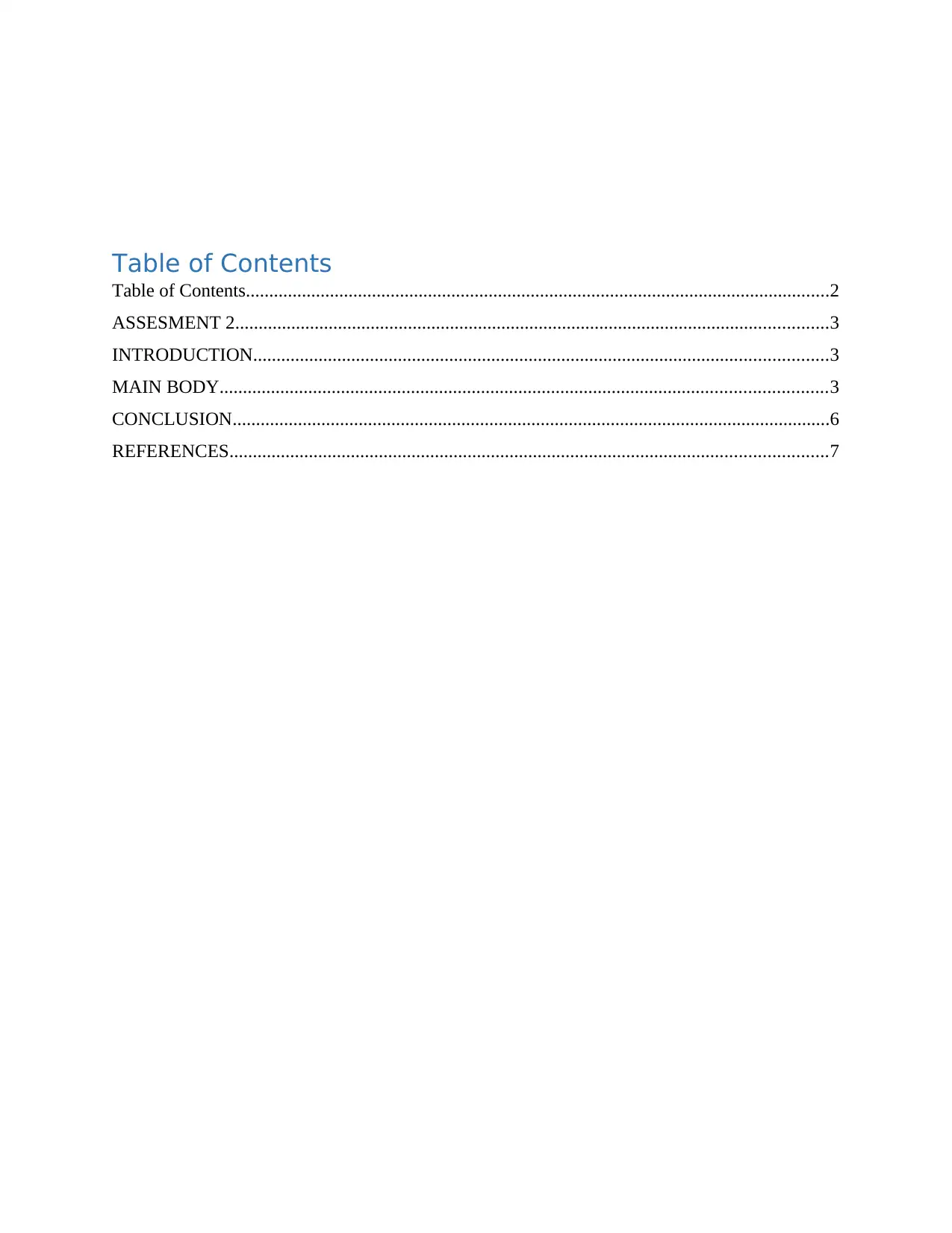
Table of Contents
Table of Contents.............................................................................................................................2
ASSESMENT 2...............................................................................................................................3
INTRODUCTION...........................................................................................................................3
MAIN BODY..................................................................................................................................3
CONCLUSION................................................................................................................................6
REFERENCES................................................................................................................................7
Table of Contents.............................................................................................................................2
ASSESMENT 2...............................................................................................................................3
INTRODUCTION...........................................................................................................................3
MAIN BODY..................................................................................................................................3
CONCLUSION................................................................................................................................6
REFERENCES................................................................................................................................7
ASSESMENT 2
INTRODUCTION
The concept of business management includes the process of managing and maintaining
the organisation as well as coordination of the various business activities. It is the principle of
coordinating all the stages of business that starts from planning and ends with controlling. The
process of motivation is considered as an inspiration which facilitates to utilise the skills,
knowledge of the manpower for the development as well as growth of the business. This
assessment is based on an essay that is concerned with the aspect of business management.
Motivation is the chosen topic within this assessment and different aspects of the respective topic
are going to be explained (Breaugh, Ritz and Alfes, 2018). This essay includes various theories
of motivation and their application within the workplace that helps an organisation in increasing
the level of its productivity as well as efficiency within the workplace.
MAIN BODY
Motivation is the process of inspiring, stimulating, initiating and guiding human
resources within an organisation so that they can do more hard work towards attainment of goals
and objectives of the business. This is the process that can help the managers of a company in
driving the employees of the workplace for achieving the goals of an organisation as a whole.
Motivation helps in providing job satisfaction to the human resources of a business and helps an
individual in its personal development. There are various theories of motivation that helps the
managers of an organisation in understanding the process or approach of driving an individual to
function towards a specific objective or goal of a business. Some of these motivational theories
are discussed as under:
Maslow’s Hierarchy of Needs theory of motivation:
This theory of motivation is related to the theory of organisation as both of these theories
are associated with the motivation of human resources. It is introduced by Abraham Maslow’s
hierarchy of needs and is considered as one of the best theory of motivation (Dörnyei, 2019). The
personnel states that actions of an individual get motivated by specific psychological needs. This
theory includes a pyramid of different levels of needs in which the most basic needs of a person
are at the bottom while the complex needs are at the top. The hierarchy of this pyramid expresses
that human resources get motivated in order to fulfil the basic and essential needs before shifting
INTRODUCTION
The concept of business management includes the process of managing and maintaining
the organisation as well as coordination of the various business activities. It is the principle of
coordinating all the stages of business that starts from planning and ends with controlling. The
process of motivation is considered as an inspiration which facilitates to utilise the skills,
knowledge of the manpower for the development as well as growth of the business. This
assessment is based on an essay that is concerned with the aspect of business management.
Motivation is the chosen topic within this assessment and different aspects of the respective topic
are going to be explained (Breaugh, Ritz and Alfes, 2018). This essay includes various theories
of motivation and their application within the workplace that helps an organisation in increasing
the level of its productivity as well as efficiency within the workplace.
MAIN BODY
Motivation is the process of inspiring, stimulating, initiating and guiding human
resources within an organisation so that they can do more hard work towards attainment of goals
and objectives of the business. This is the process that can help the managers of a company in
driving the employees of the workplace for achieving the goals of an organisation as a whole.
Motivation helps in providing job satisfaction to the human resources of a business and helps an
individual in its personal development. There are various theories of motivation that helps the
managers of an organisation in understanding the process or approach of driving an individual to
function towards a specific objective or goal of a business. Some of these motivational theories
are discussed as under:
Maslow’s Hierarchy of Needs theory of motivation:
This theory of motivation is related to the theory of organisation as both of these theories
are associated with the motivation of human resources. It is introduced by Abraham Maslow’s
hierarchy of needs and is considered as one of the best theory of motivation (Dörnyei, 2019). The
personnel states that actions of an individual get motivated by specific psychological needs. This
theory includes a pyramid of different levels of needs in which the most basic needs of a person
are at the bottom while the complex needs are at the top. The hierarchy of this pyramid expresses
that human resources get motivated in order to fulfil the basic and essential needs before shifting
⊘ This is a preview!⊘
Do you want full access?
Subscribe today to unlock all pages.

Trusted by 1+ million students worldwide
on to the other advanced needs. Maslow believed that these requirements are identical to
instincts as well as play a great role in motivating the behaviour of a person. There are five
different stages within the Maslow’s Hierarchy of needs and starts with the lowest level needs
which are known as psychological needs.
Psychological needs: Such type of need is fairly apparent and consists of those needs
that are significant for our survival (Gilal and et.al., 2020). For instance, it includes three
main basic needs and these are food, clothing and shelter. Within an organisation,
managers are required to give these basic amenities to their employees so that they feel
motivated and do more hard work towards accomplishment of organisational goals.
Security and safety needs: This is the second stage of Maslow’s hierarchy of needs and
at this level the needs for the safety as well as security becomes the main component.
Employees within the workplace want control and order in their lives and therefore, the
needs for security and safety contributes greatly to the behaviours of manpower at this
level. Some of the security and safety needs that should be provided by the supervisors of
an organisation to their human resources include financial security, health and wellness,
safety against injury as well as accidents.
Social needs: These needs in hierarchy of Maslow involve love, belongings, affection
and acceptance. At this stage, the requirement for emotional relationships helps in driving
the behaviours of human resources. For instance, friendships, family, romantic
attachments, social groups, community groups, community groups and religious groups
are all examples of social needs. Managers of an organisation should consider these needs
of their employees to avoid their problems of depression, loneliness and anxiety.
Esteem needs: At this stage it becomes significantly crucial to acquire the respect and
appreciation of others (Hirsh, Lu and Galinsky, 2018). Human resources within a
workplace have a need to complete things and after that having their efforts recognised.
Additionally, for feelings of prestige and accomplishment, esteem needs consist of self-
esteem as well as personal worth.
Self-actualisation needs: These needs are at the top of hierarchy and include self-
awareness of people, concerns with self-growth and development, less concern with
other’s opinions and having keen interests in satisfying their potential. People within
instincts as well as play a great role in motivating the behaviour of a person. There are five
different stages within the Maslow’s Hierarchy of needs and starts with the lowest level needs
which are known as psychological needs.
Psychological needs: Such type of need is fairly apparent and consists of those needs
that are significant for our survival (Gilal and et.al., 2020). For instance, it includes three
main basic needs and these are food, clothing and shelter. Within an organisation,
managers are required to give these basic amenities to their employees so that they feel
motivated and do more hard work towards accomplishment of organisational goals.
Security and safety needs: This is the second stage of Maslow’s hierarchy of needs and
at this level the needs for the safety as well as security becomes the main component.
Employees within the workplace want control and order in their lives and therefore, the
needs for security and safety contributes greatly to the behaviours of manpower at this
level. Some of the security and safety needs that should be provided by the supervisors of
an organisation to their human resources include financial security, health and wellness,
safety against injury as well as accidents.
Social needs: These needs in hierarchy of Maslow involve love, belongings, affection
and acceptance. At this stage, the requirement for emotional relationships helps in driving
the behaviours of human resources. For instance, friendships, family, romantic
attachments, social groups, community groups, community groups and religious groups
are all examples of social needs. Managers of an organisation should consider these needs
of their employees to avoid their problems of depression, loneliness and anxiety.
Esteem needs: At this stage it becomes significantly crucial to acquire the respect and
appreciation of others (Hirsh, Lu and Galinsky, 2018). Human resources within a
workplace have a need to complete things and after that having their efforts recognised.
Additionally, for feelings of prestige and accomplishment, esteem needs consist of self-
esteem as well as personal worth.
Self-actualisation needs: These needs are at the top of hierarchy and include self-
awareness of people, concerns with self-growth and development, less concern with
other’s opinions and having keen interests in satisfying their potential. People within
Paraphrase This Document
Need a fresh take? Get an instant paraphrase of this document with our AI Paraphraser
organisation have desires to develop their overall personality at this level in order to
become an effective human resource.
Mcclelland’s Theory of Motivation: Such type of motivational theory helps an organisation
in understanding the approach or way in which the individuals fulfil their needs and wants. It
was discovered by David McClelland and as per the personality; human resources within an
organisation have motivating drivers which are directly connected o need irrespective of gender,
age, race or culture (Hiver, Kim and Kim, 2018). There are four kinds of motivational needs
within this theory and these are explained below:
Need for achievement: In this need, there are four characteristics that are consistent and
these include responsibility for own performance, use of innovation or creativity, striving
for an average task complexity and need for feedback.
Need for power: Employees with this need contributed to great value to reputation,
status and recognition and have a requirement to be perceived as crucial. Human
resources of an organisation also have a need to influence and direct other people and
enjoy winning and competition.
Need for affiliation: According to this need, employees are socially attached and want to
belong to the group. When this need is high with them then they desire to be liked and
will conform to behaviours and wishes of group and helps in cooperating over
competition.
Need for avoidance: When workforce doesn’t wish to function ay forefront and choose
to avoid unpleasant situations, such need will surface. At this need, employees have fear
of rejection, failure and even success. By avoiding such consequences that may trigger
these fears, human resources think to have identified a safe solution.
Herzberg’s Two-Factor Theory: This motivational theory was introduced by Frederick
Herzberg in the year 1959 and as per this theory there are certain job factors that lead to
satisfaction while there are other job factors that prevent from dissatisfaction. This kind of theory
of motivation implies that the administrators of an organisation must stress on guaranteeing the
appropriate hygiene factors in order to avoid the dissatisfaction of manpower (Mitchall and
Jaeger, 2018). In addition to it, the supervisors of the business must ensure that task is inspiring
and rewarding so that workforce get motivated to work and make more efforts. This motivational
theory focuses on job-enrichment for motivating its human resources. Organisation must
become an effective human resource.
Mcclelland’s Theory of Motivation: Such type of motivational theory helps an organisation
in understanding the approach or way in which the individuals fulfil their needs and wants. It
was discovered by David McClelland and as per the personality; human resources within an
organisation have motivating drivers which are directly connected o need irrespective of gender,
age, race or culture (Hiver, Kim and Kim, 2018). There are four kinds of motivational needs
within this theory and these are explained below:
Need for achievement: In this need, there are four characteristics that are consistent and
these include responsibility for own performance, use of innovation or creativity, striving
for an average task complexity and need for feedback.
Need for power: Employees with this need contributed to great value to reputation,
status and recognition and have a requirement to be perceived as crucial. Human
resources of an organisation also have a need to influence and direct other people and
enjoy winning and competition.
Need for affiliation: According to this need, employees are socially attached and want to
belong to the group. When this need is high with them then they desire to be liked and
will conform to behaviours and wishes of group and helps in cooperating over
competition.
Need for avoidance: When workforce doesn’t wish to function ay forefront and choose
to avoid unpleasant situations, such need will surface. At this need, employees have fear
of rejection, failure and even success. By avoiding such consequences that may trigger
these fears, human resources think to have identified a safe solution.
Herzberg’s Two-Factor Theory: This motivational theory was introduced by Frederick
Herzberg in the year 1959 and as per this theory there are certain job factors that lead to
satisfaction while there are other job factors that prevent from dissatisfaction. This kind of theory
of motivation implies that the administrators of an organisation must stress on guaranteeing the
appropriate hygiene factors in order to avoid the dissatisfaction of manpower (Mitchall and
Jaeger, 2018). In addition to it, the supervisors of the business must ensure that task is inspiring
and rewarding so that workforce get motivated to work and make more efforts. This motivational
theory focuses on job-enrichment for motivating its human resources. Organisation must
optimally use the skills as well as abilities and competencies of the employees. When managers
of an organisation will focus on the motivational factors of this theory then it will help them in
improving the quality of work and the performance of business as a whole. The personnel divide
such job factors into two categories and these are hygiene factors as well as motivational factors.
The description of these job factors is given as follows:
Hygiene factors: Such factors are necessary for presence of motivation within the
workplace and not result in favourable satisfaction for long-term (Richardson and Watt,
2018). Absence of these factors leads to dissatisfaction among employees of the
organisation. Hence, these are the factors which when accurate in a job, pacify human
resources and do not make them dissatisfied. Such kinds of factors are extrinsic to work
and describe job environment as well as symbolise physiological needs required by
people to get fulfilled. These factors involve pay, administrative or company policies,
fringe benefits, physical working conditions, status, job security and interpersonal
relations.
Motivational factors: These factors give favourable satisfaction to employees and are
inherent to work as well as motivate human resources of an organisation in order to do
more hard work. Such factors are known as satisfiers and are engaged in functioning of
the job role (Schunk and DiBenedetto, 2020). Manpower finds these factors intrinsically
rewarding and symbolised psychological needs which were perceived in the form of extra
benefits. Motivational factors of employees include sense of achievement, recognition,
growth as well as promotional opportunities, meaningfulness of the work and
responsibility.
CONCLUSION
From above explanation, it has been concluded that motivation is an act of convincing or
persuading the workforce who work in organisation and is a psychological process that facilitates
in enhancing the will to do more work. This process facilitates a business in improving its
performance as a whole and also enhances the efficiency of workplace. Within this assessment,
an essay has been presented which is based on the process of motivation and its theories along
with their application. The different theories of motivation have been explained within the essay
that will help an organisation in motivating its employees in order to make more efforts towards
accomplishment of goals and objectives.
of an organisation will focus on the motivational factors of this theory then it will help them in
improving the quality of work and the performance of business as a whole. The personnel divide
such job factors into two categories and these are hygiene factors as well as motivational factors.
The description of these job factors is given as follows:
Hygiene factors: Such factors are necessary for presence of motivation within the
workplace and not result in favourable satisfaction for long-term (Richardson and Watt,
2018). Absence of these factors leads to dissatisfaction among employees of the
organisation. Hence, these are the factors which when accurate in a job, pacify human
resources and do not make them dissatisfied. Such kinds of factors are extrinsic to work
and describe job environment as well as symbolise physiological needs required by
people to get fulfilled. These factors involve pay, administrative or company policies,
fringe benefits, physical working conditions, status, job security and interpersonal
relations.
Motivational factors: These factors give favourable satisfaction to employees and are
inherent to work as well as motivate human resources of an organisation in order to do
more hard work. Such factors are known as satisfiers and are engaged in functioning of
the job role (Schunk and DiBenedetto, 2020). Manpower finds these factors intrinsically
rewarding and symbolised psychological needs which were perceived in the form of extra
benefits. Motivational factors of employees include sense of achievement, recognition,
growth as well as promotional opportunities, meaningfulness of the work and
responsibility.
CONCLUSION
From above explanation, it has been concluded that motivation is an act of convincing or
persuading the workforce who work in organisation and is a psychological process that facilitates
in enhancing the will to do more work. This process facilitates a business in improving its
performance as a whole and also enhances the efficiency of workplace. Within this assessment,
an essay has been presented which is based on the process of motivation and its theories along
with their application. The different theories of motivation have been explained within the essay
that will help an organisation in motivating its employees in order to make more efforts towards
accomplishment of goals and objectives.
⊘ This is a preview!⊘
Do you want full access?
Subscribe today to unlock all pages.
Trusted by 1+ million students worldwide
REFERENCES
Books and Journals
Breaugh, J., Ritz, A. and Alfes, K., 2018. Work motivation and public service motivation:
disentangling varieties of motivation and job satisfaction. Public Management
Review. 20(10). pp.1423-1443.
Dörnyei, Z., 2019. From integrative motivation to directed motivational currents: The evolution
of the understanding of L2 motivation over three decades. In The Palgrave handbook of
motivation for language learning (pp. 39-69). Palgrave Macmillan, Cham.
Gilal and et.al., 2020. Linking motivational regulation to brand passion in a moderated model of
customer gender and age: an organismic integration theory perspective. Review of
Managerial Science. 14(1). pp.87-113.
Hirsh, J. B., Lu, J. G. and Galinsky, A. D., 2018. Moral utility theory: Understanding the
motivation to behave (un) ethically. Research in Organizational Behavior. 38. pp.43-59.
Hiver, P., Kim, T. Y. and Kim, Y., 2018. Language teacher motivation. Language teacher
psychology, pp.18-33.
Mitchall, A. M. and Jaeger, A. J., 2018. Parental influences on low-income, first-generation
students’ motivation on the path to college. The Journal of Higher Education. 89(4).
pp.582-609.
Richardson, P. W. and Watt, H. M., 2018. Teacher professional identity and career motivation: A
lifespan perspective. In Research on teacher identity (pp. 37-48). Springer, Cham.
Schunk, D. H. and DiBenedetto, M. K., 2020. Motivation and social cognitive
theory. Contemporary Educational Psychology. 60. p.101832.
Books and Journals
Breaugh, J., Ritz, A. and Alfes, K., 2018. Work motivation and public service motivation:
disentangling varieties of motivation and job satisfaction. Public Management
Review. 20(10). pp.1423-1443.
Dörnyei, Z., 2019. From integrative motivation to directed motivational currents: The evolution
of the understanding of L2 motivation over three decades. In The Palgrave handbook of
motivation for language learning (pp. 39-69). Palgrave Macmillan, Cham.
Gilal and et.al., 2020. Linking motivational regulation to brand passion in a moderated model of
customer gender and age: an organismic integration theory perspective. Review of
Managerial Science. 14(1). pp.87-113.
Hirsh, J. B., Lu, J. G. and Galinsky, A. D., 2018. Moral utility theory: Understanding the
motivation to behave (un) ethically. Research in Organizational Behavior. 38. pp.43-59.
Hiver, P., Kim, T. Y. and Kim, Y., 2018. Language teacher motivation. Language teacher
psychology, pp.18-33.
Mitchall, A. M. and Jaeger, A. J., 2018. Parental influences on low-income, first-generation
students’ motivation on the path to college. The Journal of Higher Education. 89(4).
pp.582-609.
Richardson, P. W. and Watt, H. M., 2018. Teacher professional identity and career motivation: A
lifespan perspective. In Research on teacher identity (pp. 37-48). Springer, Cham.
Schunk, D. H. and DiBenedetto, M. K., 2020. Motivation and social cognitive
theory. Contemporary Educational Psychology. 60. p.101832.

1 out of 7


Related Documents


Your All-in-One AI-Powered Toolkit for Academic Success.
+13062052269
info@desklib.com
Available 24*7 on WhatsApp / Email
![[object Object]](/_next/static/media/star-bottom.7253800d.svg)
Unlock your academic potential
Copyright © 2020–2026 A2Z Services. All Rights Reserved. Developed and managed by ZUCOL.