Motivation Theories and Application in the Modern Workplace Essay
VerifiedAdded on 2023/06/18
|10
|2391
|62
Essay
AI Summary
This essay provides a comprehensive overview of motivation, exploring various theories such as Maslow's hierarchy of needs, Herzberg's two-factor theory, and expectancy theory. It discusses the characteristics of a modern workplace, emphasizing the importance of open spaces, flexibility, and technology integration. The essay then applies Maslow's theory to the modern workplace, highlighting how organizations can fulfill employees' physiological, safety, social, self-esteem, and self-actualization needs to enhance motivation and productivity. The conclusion underscores the significance of motivation in retaining employees, increasing productivity, and fostering a positive work environment.
Managing people and
systems
systems

Paraphrase This Document
Need a fresh take? Get an instant paraphrase of this document with our AI Paraphraser
Table of Contents
EXECUTIVE SUMMARY.............................................................................................................1
INTRODUCTION...........................................................................................................................2
MAIN BODY...................................................................................................................................2
What is motivation. Give examples............................................................................................2
Explain different theories of motivation.....................................................................................2
Explain one motivational theory.................................................................................................3
Discuss modern workplace.........................................................................................................4
Apply theory of motivation in modern workplace......................................................................5
CONCLUSION................................................................................................................................6
REFERENCES................................................................................................................................7
EXECUTIVE SUMMARY.............................................................................................................1
INTRODUCTION...........................................................................................................................2
MAIN BODY...................................................................................................................................2
What is motivation. Give examples............................................................................................2
Explain different theories of motivation.....................................................................................2
Explain one motivational theory.................................................................................................3
Discuss modern workplace.........................................................................................................4
Apply theory of motivation in modern workplace......................................................................5
CONCLUSION................................................................................................................................6
REFERENCES................................................................................................................................7
EXECUTIVE SUMMARY
Motivation is one of the major factor which can enhance the workings of the organisation and
can also improve the performance of the employees. It will help the organisation in retaining
employees and will decrease the employee turnover ratio of the organisation. The needs of
employees are needed to be fulfilled by the organisation so that they can create a positive
working environment and can also encourage employees to work hard.
1
Motivation is one of the major factor which can enhance the workings of the organisation and
can also improve the performance of the employees. It will help the organisation in retaining
employees and will decrease the employee turnover ratio of the organisation. The needs of
employees are needed to be fulfilled by the organisation so that they can create a positive
working environment and can also encourage employees to work hard.
1
⊘ This is a preview!⊘
Do you want full access?
Subscribe today to unlock all pages.

Trusted by 1+ million students worldwide
INTRODUCTION
Motivation is an way through which the anyone can initiate, guide and enhance goal
oriented behaviour of a person. Motivation is a process through which the company can
encourage their employees to work effectively and efficiently (Ghisellini and Ulgiati., 2020) .
They can make sure that the employees of the company are working on optimum capacity and on
highest productivity. There are different types of motivational theories provided in order to
understand the reason behind motivation. There can be various reason which can influence the
motivation level of employees and it is important for the organisation to find that motivational
factor so that they can enhance the motivation level of employees.
MAIN BODY
What is motivation. Give examples
Motivation refers to the behaviour of people which can be activated through biological,
emotional, cognitive and social forces. Motivation is one of the major factor which can influence
people to perform better and will make sure that the employees of the company are working on
their optimum efficiency (Ahmed, Valle and Wilkinson., 2019). It will help the organisation in
increasing the motivational level of employees and will also make sure that the employees of the
company are continuously moving towards goals and objectives of the company. There are two
types of motivation which is intrinsic and extrinsic.
Intrinsic motivation: It refers to the motivation which drives from the inside of an
individual which is solely for personal gratification. It is related to the tasks which is done by the
individual of solving a problem. It often includes completing a complicated project or winning a
game.
Extrinsic motivation: The driving forces of this motivation is external. These
motivations are often arises from outside world and some of the examples of extrinsic motivation
are trophies, rewards, praise or social recognition.
Explain different theories of motivation
There are several different types of motivational theories which according
to psychologists can drive or guide behaviour of people (Ananchenkova., 2018). Motivation is
important in employees as a more a more productive employee is more profitable and is
beneficial for the organisation. It has been observed that a motivated and happy employees is
2
Motivation is an way through which the anyone can initiate, guide and enhance goal
oriented behaviour of a person. Motivation is a process through which the company can
encourage their employees to work effectively and efficiently (Ghisellini and Ulgiati., 2020) .
They can make sure that the employees of the company are working on optimum capacity and on
highest productivity. There are different types of motivational theories provided in order to
understand the reason behind motivation. There can be various reason which can influence the
motivation level of employees and it is important for the organisation to find that motivational
factor so that they can enhance the motivation level of employees.
MAIN BODY
What is motivation. Give examples
Motivation refers to the behaviour of people which can be activated through biological,
emotional, cognitive and social forces. Motivation is one of the major factor which can influence
people to perform better and will make sure that the employees of the company are working on
their optimum efficiency (Ahmed, Valle and Wilkinson., 2019). It will help the organisation in
increasing the motivational level of employees and will also make sure that the employees of the
company are continuously moving towards goals and objectives of the company. There are two
types of motivation which is intrinsic and extrinsic.
Intrinsic motivation: It refers to the motivation which drives from the inside of an
individual which is solely for personal gratification. It is related to the tasks which is done by the
individual of solving a problem. It often includes completing a complicated project or winning a
game.
Extrinsic motivation: The driving forces of this motivation is external. These
motivations are often arises from outside world and some of the examples of extrinsic motivation
are trophies, rewards, praise or social recognition.
Explain different theories of motivation
There are several different types of motivational theories which according
to psychologists can drive or guide behaviour of people (Ananchenkova., 2018). Motivation is
important in employees as a more a more productive employee is more profitable and is
beneficial for the organisation. It has been observed that a motivated and happy employees is
2
Paraphrase This Document
Need a fresh take? Get an instant paraphrase of this document with our AI Paraphraser
12% more productive than a unhappy or demotivated employee. Some of motivational theories
are given below:
Maslow's Hierarchy of needs theory:
It is one of the most popular theory of motivation and was proposed in the year 1943 by
Abraham Maslow. The theory states the 5 needs of human which can be the driving forces of
motivation. The theory states that there are several level of needs which are needed to be fulfilled
step by step so that an individual can feel motivated to reach to the top.
Herzberg’s Two-Factor Theory:
Developed by Fredrick Herzberg in 1959, the theory focuses on motivation provided by
the workplace. This theory is also known as motivation hygiene theory and is clearly centred on
the employee's job satisfaction and dissatisfaction (Baldry and et. al., 2018). Motivating factors
will lead to positive feeling and will lead to job satisfaction whereas negative feelings will lead
to job dissatisfaction and only positive feeling can be the motivating factor for an employee.
Hygiene factors include salary, status, benefits and working conditions.
Expectancy theory:
According to this theory the motivation level of individual depends up on their beliefs. If
an individual believes that he or she will get satisfaction from a particular activity or task then
they will be motivated towards doing that task but if they believe that a certain activity is not
good or beneficial for them then they will be demotivated to do that task (Martins and et. al.,
2019). It depend up on how much value a person gives to a particular task as it will decide the
motivation level of the employees. This theory includes three elements which are Expectancy,
instrumentality and valence.
Explain one motivational theory
Maslow's hierarchy of need theory
This theory is based on psychological needs of individual and outlines types of needs
which provides motivation to the employees (Yozcu and Cetin., 2019). The needs are placed in
a pyramid shape and according to the complexity of needs the pyramid moves upward. The
needs specified in this theory includes 5 levels of hierarchy which is:
Physiological needs: These are the most basic needs of an individual which includes air,
water, shelter, food, clothes, etc. these are essential needs which are needed to be fulfilled. In
3
are given below:
Maslow's Hierarchy of needs theory:
It is one of the most popular theory of motivation and was proposed in the year 1943 by
Abraham Maslow. The theory states the 5 needs of human which can be the driving forces of
motivation. The theory states that there are several level of needs which are needed to be fulfilled
step by step so that an individual can feel motivated to reach to the top.
Herzberg’s Two-Factor Theory:
Developed by Fredrick Herzberg in 1959, the theory focuses on motivation provided by
the workplace. This theory is also known as motivation hygiene theory and is clearly centred on
the employee's job satisfaction and dissatisfaction (Baldry and et. al., 2018). Motivating factors
will lead to positive feeling and will lead to job satisfaction whereas negative feelings will lead
to job dissatisfaction and only positive feeling can be the motivating factor for an employee.
Hygiene factors include salary, status, benefits and working conditions.
Expectancy theory:
According to this theory the motivation level of individual depends up on their beliefs. If
an individual believes that he or she will get satisfaction from a particular activity or task then
they will be motivated towards doing that task but if they believe that a certain activity is not
good or beneficial for them then they will be demotivated to do that task (Martins and et. al.,
2019). It depend up on how much value a person gives to a particular task as it will decide the
motivation level of the employees. This theory includes three elements which are Expectancy,
instrumentality and valence.
Explain one motivational theory
Maslow's hierarchy of need theory
This theory is based on psychological needs of individual and outlines types of needs
which provides motivation to the employees (Yozcu and Cetin., 2019). The needs are placed in
a pyramid shape and according to the complexity of needs the pyramid moves upward. The
needs specified in this theory includes 5 levels of hierarchy which is:
Physiological needs: These are the most basic needs of an individual which includes air,
water, shelter, food, clothes, etc. these are essential needs which are needed to be fulfilled. In
3
case of organisational setting, if the salary provided by the company is not enough for the
employee to fulfil their basic needs then the employees will be demotivated towards the job.
Safety needs: This is the second level of theory which states that it is the need of
individual to feel protected. It is important for the organisation to make sure that the employees
have a feeling of job security in order to keep them motivated towards the job (Koohang,
Paliszkiewicz and Goluchowski., 2017). If there is no job security then the employees will never
feel motivated towards the specific job and will always try to find better options.
Social needs: It is an essential need of a individual to socialize and make friends. It helps
the individual in performing better in groups and will also give them a sense of respect and
recognition. The company can fulfil these needs of employees by hosting team building activities
or by hosting team lunches.
Self esteem needs: It refers to the needs of employees for social recognition. When an
employee receives appreciation for his or her handwork in front of colleagues, juniors or seniors
then they feel motivated and will work with more productivity (Goodman., 2019). It is important
for the organisation to make sure that they are providing rewards to employees in public setting.
Self actualisation needs: These are long term and complex goals which are needed to be
achieved by the employees in order to feel motivated. These are personal goals and the need
occurs only after all the below stated needs are fulfilled.
All these needs plays an important role in deciding the motivation level of an individual. In case
of organisation, it is important for them to make sure that they are providing enough benefits to
the employees which can fulfil the needs of employees.
Discuss modern workplace
Modern workplaces are designed with a concept to promote activity based workings in an
organisation. Modern workplaces consists of open spaces as well as with personal spaces which
consist of rooms that can be used as private spaces for conferences, meetings, etc. the
workspaces with open area concept are quite like libraries and will provide a positive working
environment to the employees (Banerjee, Roychoudhury and Gogoi., 2021). It is important for an
organisation to make sure to provide area of working to the employee on the basis of what suits
best to them. It will encourage them to work and will also create a positive working environment
for the employees which will help in motivating the employees and will also increase the
productivity of the employees.
4
employee to fulfil their basic needs then the employees will be demotivated towards the job.
Safety needs: This is the second level of theory which states that it is the need of
individual to feel protected. It is important for the organisation to make sure that the employees
have a feeling of job security in order to keep them motivated towards the job (Koohang,
Paliszkiewicz and Goluchowski., 2017). If there is no job security then the employees will never
feel motivated towards the specific job and will always try to find better options.
Social needs: It is an essential need of a individual to socialize and make friends. It helps
the individual in performing better in groups and will also give them a sense of respect and
recognition. The company can fulfil these needs of employees by hosting team building activities
or by hosting team lunches.
Self esteem needs: It refers to the needs of employees for social recognition. When an
employee receives appreciation for his or her handwork in front of colleagues, juniors or seniors
then they feel motivated and will work with more productivity (Goodman., 2019). It is important
for the organisation to make sure that they are providing rewards to employees in public setting.
Self actualisation needs: These are long term and complex goals which are needed to be
achieved by the employees in order to feel motivated. These are personal goals and the need
occurs only after all the below stated needs are fulfilled.
All these needs plays an important role in deciding the motivation level of an individual. In case
of organisation, it is important for them to make sure that they are providing enough benefits to
the employees which can fulfil the needs of employees.
Discuss modern workplace
Modern workplaces are designed with a concept to promote activity based workings in an
organisation. Modern workplaces consists of open spaces as well as with personal spaces which
consist of rooms that can be used as private spaces for conferences, meetings, etc. the
workspaces with open area concept are quite like libraries and will provide a positive working
environment to the employees (Banerjee, Roychoudhury and Gogoi., 2021). It is important for an
organisation to make sure to provide area of working to the employee on the basis of what suits
best to them. It will encourage them to work and will also create a positive working environment
for the employees which will help in motivating the employees and will also increase the
productivity of the employees.
4
⊘ This is a preview!⊘
Do you want full access?
Subscribe today to unlock all pages.
Trusted by 1+ million students worldwide
Modern workplace do not provide personal desks to employees rather a long single table
is provided which will be shared by 3 or 4 employees. In these office spaces a soundproof room
is provided where employees can make phone calls also a room with all technical requirements
and other necessities where employees can have meetings and can gather in small groups so that
other team members does not get disturbed (Mansour, Obeidat and Abdallah., 2021, April).
These workplaces are highly flexible and provide choices to the employees to choose where,
when and how they want to work.
Their is a need of technology to be incorporated in the company which includes high
speed internet for everyone which will help the organisation in attracting and retaining talented
employees and will also help in increasing the efficiency and effectiveness of employees.
Apply theory of motivation in modern workplace
Maslow's theory of motivation in modern workplaces:
There are several different needs of employees that are needed to be fulfilled by the
organisation in order to retain them and to increase their productivity. It is importation for the
organisation to make sure that they are creating a workspace for employees where they are happy
and satisfied with their job. Job satisfaction plays a major role in decreasing employee turnover
rate which helps the company in saving costs as well. There are five stages of needs which are
given below:
Physiological needs: These are basic needs which are needed to be fulfilled and are
essential for the employees (Rogers and et. al., 2018). It includes air, clean drinking water,
shelter, etc. In case of organisation they must provide efficient regular monthly salaries,
comfortable working environment, etc to their employees.
Safety needs: In order to fulfil safety needs of employees it is important for the
organisation to put emphasis on health and safety in the organisation and must also provide
benefits such as pension scheme or sick pay to the employees.
Social needs: These needs can be fulfilled if the company encourage team building
activities in the management of the company. If the company is providing work from home to
their employees then they must communicate their employees through zoom calls, skype, etc.
Self esteem: It refers to the respect and praise that employees get in their workplace
(Holton., 2020). A 360 degree feedback can help the organisation in rewarding employees and in
satisfying their self esteem needs.
5
is provided which will be shared by 3 or 4 employees. In these office spaces a soundproof room
is provided where employees can make phone calls also a room with all technical requirements
and other necessities where employees can have meetings and can gather in small groups so that
other team members does not get disturbed (Mansour, Obeidat and Abdallah., 2021, April).
These workplaces are highly flexible and provide choices to the employees to choose where,
when and how they want to work.
Their is a need of technology to be incorporated in the company which includes high
speed internet for everyone which will help the organisation in attracting and retaining talented
employees and will also help in increasing the efficiency and effectiveness of employees.
Apply theory of motivation in modern workplace
Maslow's theory of motivation in modern workplaces:
There are several different needs of employees that are needed to be fulfilled by the
organisation in order to retain them and to increase their productivity. It is importation for the
organisation to make sure that they are creating a workspace for employees where they are happy
and satisfied with their job. Job satisfaction plays a major role in decreasing employee turnover
rate which helps the company in saving costs as well. There are five stages of needs which are
given below:
Physiological needs: These are basic needs which are needed to be fulfilled and are
essential for the employees (Rogers and et. al., 2018). It includes air, clean drinking water,
shelter, etc. In case of organisation they must provide efficient regular monthly salaries,
comfortable working environment, etc to their employees.
Safety needs: In order to fulfil safety needs of employees it is important for the
organisation to put emphasis on health and safety in the organisation and must also provide
benefits such as pension scheme or sick pay to the employees.
Social needs: These needs can be fulfilled if the company encourage team building
activities in the management of the company. If the company is providing work from home to
their employees then they must communicate their employees through zoom calls, skype, etc.
Self esteem: It refers to the respect and praise that employees get in their workplace
(Holton., 2020). A 360 degree feedback can help the organisation in rewarding employees and in
satisfying their self esteem needs.
5
Paraphrase This Document
Need a fresh take? Get an instant paraphrase of this document with our AI Paraphraser
Self actualisation: This need can be fulfilled if the company provide training and
mentoring opportunities. It will help the employee in getting a sense of value.
CONCLUSION
From the above report it is concluded that, in order to retain the employee in the
workplace it is important for the organisation to provide motivation. It will help the organisation
in increasing the productivity of employees and will also increase the efficiency of employees.
By fulfilling the needs of the employees they can create a positive working environment and will
also promote healthy competition in the company.
6
mentoring opportunities. It will help the employee in getting a sense of value.
CONCLUSION
From the above report it is concluded that, in order to retain the employee in the
workplace it is important for the organisation to provide motivation. It will help the organisation
in increasing the productivity of employees and will also increase the efficiency of employees.
By fulfilling the needs of the employees they can create a positive working environment and will
also promote healthy competition in the company.
6
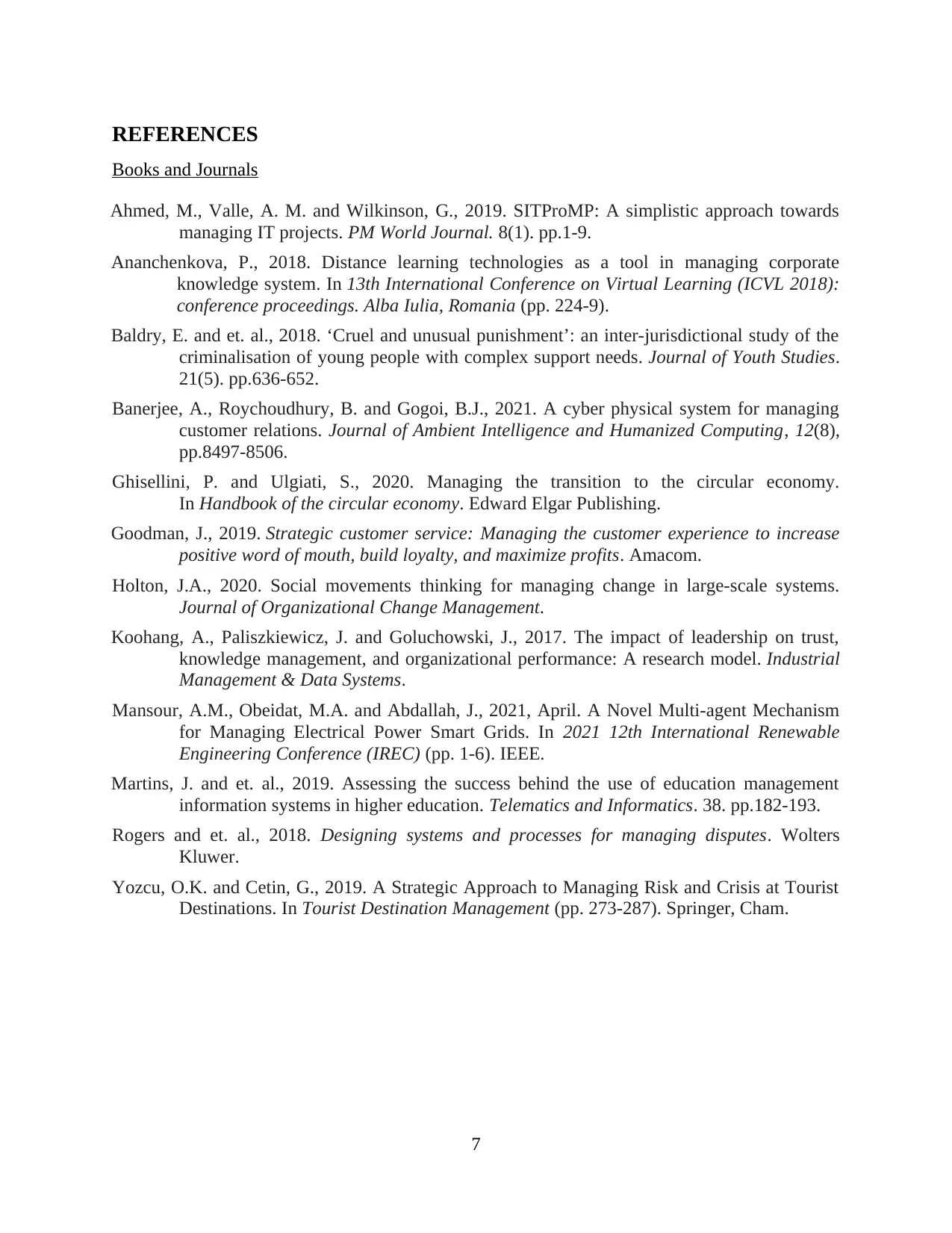
REFERENCES
Books and Journals
Ahmed, M., Valle, A. M. and Wilkinson, G., 2019. SITProMP: A simplistic approach towards
managing IT projects. PM World Journal. 8(1). pp.1-9.
Ananchenkova, P., 2018. Distance learning technologies as a tool in managing corporate
knowledge system. In 13th International Conference on Virtual Learning (ICVL 2018):
conference proceedings. Alba Iulia, Romania (pp. 224-9).
Baldry, E. and et. al., 2018. ‘Cruel and unusual punishment’: an inter-jurisdictional study of the
criminalisation of young people with complex support needs. Journal of Youth Studies.
21(5). pp.636-652.
Banerjee, A., Roychoudhury, B. and Gogoi, B.J., 2021. A cyber physical system for managing
customer relations. Journal of Ambient Intelligence and Humanized Computing, 12(8),
pp.8497-8506.
Ghisellini, P. and Ulgiati, S., 2020. Managing the transition to the circular economy.
In Handbook of the circular economy. Edward Elgar Publishing.
Goodman, J., 2019. Strategic customer service: Managing the customer experience to increase
positive word of mouth, build loyalty, and maximize profits. Amacom.
Holton, J.A., 2020. Social movements thinking for managing change in large-scale systems.
Journal of Organizational Change Management.
Koohang, A., Paliszkiewicz, J. and Goluchowski, J., 2017. The impact of leadership on trust,
knowledge management, and organizational performance: A research model. Industrial
Management & Data Systems.
Mansour, A.M., Obeidat, M.A. and Abdallah, J., 2021, April. A Novel Multi-agent Mechanism
for Managing Electrical Power Smart Grids. In 2021 12th International Renewable
Engineering Conference (IREC) (pp. 1-6). IEEE.
Martins, J. and et. al., 2019. Assessing the success behind the use of education management
information systems in higher education. Telematics and Informatics. 38. pp.182-193.
Rogers and et. al., 2018. Designing systems and processes for managing disputes. Wolters
Kluwer.
Yozcu, O.K. and Cetin, G., 2019. A Strategic Approach to Managing Risk and Crisis at Tourist
Destinations. In Tourist Destination Management (pp. 273-287). Springer, Cham.
7
Books and Journals
Ahmed, M., Valle, A. M. and Wilkinson, G., 2019. SITProMP: A simplistic approach towards
managing IT projects. PM World Journal. 8(1). pp.1-9.
Ananchenkova, P., 2018. Distance learning technologies as a tool in managing corporate
knowledge system. In 13th International Conference on Virtual Learning (ICVL 2018):
conference proceedings. Alba Iulia, Romania (pp. 224-9).
Baldry, E. and et. al., 2018. ‘Cruel and unusual punishment’: an inter-jurisdictional study of the
criminalisation of young people with complex support needs. Journal of Youth Studies.
21(5). pp.636-652.
Banerjee, A., Roychoudhury, B. and Gogoi, B.J., 2021. A cyber physical system for managing
customer relations. Journal of Ambient Intelligence and Humanized Computing, 12(8),
pp.8497-8506.
Ghisellini, P. and Ulgiati, S., 2020. Managing the transition to the circular economy.
In Handbook of the circular economy. Edward Elgar Publishing.
Goodman, J., 2019. Strategic customer service: Managing the customer experience to increase
positive word of mouth, build loyalty, and maximize profits. Amacom.
Holton, J.A., 2020. Social movements thinking for managing change in large-scale systems.
Journal of Organizational Change Management.
Koohang, A., Paliszkiewicz, J. and Goluchowski, J., 2017. The impact of leadership on trust,
knowledge management, and organizational performance: A research model. Industrial
Management & Data Systems.
Mansour, A.M., Obeidat, M.A. and Abdallah, J., 2021, April. A Novel Multi-agent Mechanism
for Managing Electrical Power Smart Grids. In 2021 12th International Renewable
Engineering Conference (IREC) (pp. 1-6). IEEE.
Martins, J. and et. al., 2019. Assessing the success behind the use of education management
information systems in higher education. Telematics and Informatics. 38. pp.182-193.
Rogers and et. al., 2018. Designing systems and processes for managing disputes. Wolters
Kluwer.
Yozcu, O.K. and Cetin, G., 2019. A Strategic Approach to Managing Risk and Crisis at Tourist
Destinations. In Tourist Destination Management (pp. 273-287). Springer, Cham.
7
⊘ This is a preview!⊘
Do you want full access?
Subscribe today to unlock all pages.
Trusted by 1+ million students worldwide

8

1 out of 10


Related Documents


Your All-in-One AI-Powered Toolkit for Academic Success.
+13062052269
info@desklib.com
Available 24*7 on WhatsApp / Email
![[object Object]](/_next/static/media/star-bottom.7253800d.svg)
Unlock your academic potential
Copyright © 2020–2026 A2Z Services. All Rights Reserved. Developed and managed by ZUCOL.