The Relation Between Motivational Orientation and Regulatory Focus
VerifiedAdded on 2021/04/21
|13
|2284
|54
Report
AI Summary
This report presents an experimental study investigating the relationship between motivational orientation and regulatory focus. Conducted at the University of Roehampton, the study involved 135 undergraduate psychology students who completed questionnaires assessing their behavioral approach system (BAS) and regulatory focus. The research aimed to determine if motivational orientation, as measured by the BAS, significantly impacts regulatory focus, specifically promotion and prevention focus. Statistical analyses, including correlation and regression analyses, were performed on the data. The results indicated a very weak positive correlation between BAS and regulatory focus, contradicting previous research that suggested a stronger relationship. The report discusses the study's methodology, findings, limitations, and implications, including the need for alternative approaches to understanding the hedonic principle in psychology. The report concludes that the impact of motivational orientation on regulatory focus is almost negligible, as the study was conducted on a small sample.
Running Head: THE RELATION BETWEEN MOTIVATIONAL ORIENTATION AND
REGULATORY FOCUS
The Relation Between Motivational Orientation and Regulatory Focus
Name of the Student
Name of the University
Author Note
REGULATORY FOCUS
The Relation Between Motivational Orientation and Regulatory Focus
Name of the Student
Name of the University
Author Note

Paraphrase This Document
Need a fresh take? Get an instant paraphrase of this document with our AI Paraphraser
1
THE RELATION BETWEEN MOTIVATIONAL ORIENTATION AND REGULATORY
FOCUS
Abstract
Hedonic principle has been considered as one of the most important approach towards
regulatory focus in individuals. This principle is extremely important and thus, it is important
to find any alternate approach towards increasing the regulatory focus in individuals. On
account of this, it is to be tested whether motivational orientation has any significant impact
on regulatory focus. 135 participants between the age group of 18 and 51 years have been
considered for this study. All the participants were students of the University of Roehampton.
Several qualities on behavioural approach system and regulatory focus were asked to each
participant and their response scores were considered as the data. It has been observed from
the analysis that motivational approach has a positive impact on regulatory focus, though the
impact is extremely weak.
THE RELATION BETWEEN MOTIVATIONAL ORIENTATION AND REGULATORY
FOCUS
Abstract
Hedonic principle has been considered as one of the most important approach towards
regulatory focus in individuals. This principle is extremely important and thus, it is important
to find any alternate approach towards increasing the regulatory focus in individuals. On
account of this, it is to be tested whether motivational orientation has any significant impact
on regulatory focus. 135 participants between the age group of 18 and 51 years have been
considered for this study. All the participants were students of the University of Roehampton.
Several qualities on behavioural approach system and regulatory focus were asked to each
participant and their response scores were considered as the data. It has been observed from
the analysis that motivational approach has a positive impact on regulatory focus, though the
impact is extremely weak.
2
THE RELATION BETWEEN MOTIVATIONAL ORIENTATION AND REGULATORY
FOCUS
Table of Contents
Introduction................................................................................................................................3
Method.......................................................................................................................................5
Design....................................................................................................................................5
Participants.............................................................................................................................5
Materials.................................................................................................................................5
Procedure................................................................................................................................6
Results........................................................................................................................................7
Discussion..................................................................................................................................9
THE RELATION BETWEEN MOTIVATIONAL ORIENTATION AND REGULATORY
FOCUS
Table of Contents
Introduction................................................................................................................................3
Method.......................................................................................................................................5
Design....................................................................................................................................5
Participants.............................................................................................................................5
Materials.................................................................................................................................5
Procedure................................................................................................................................6
Results........................................................................................................................................7
Discussion..................................................................................................................................9
⊘ This is a preview!⊘
Do you want full access?
Subscribe today to unlock all pages.

Trusted by 1+ million students worldwide
3
THE RELATION BETWEEN MOTIVATIONAL ORIENTATION AND REGULATORY
FOCUS
Introduction
The basic principle which has been the motivation throughout the history of
psychology is the hedonic principle. The principle states that people always try to avoid pain
and approach pleasure. A lot of motivational psychological models have been developed
based on this theory. The hedonic principle is thus one of the most important principles in
psychology (Higgins, 1997). Alternate ways to operate this principle is thus important to
identify. Two different ways of operating the hedonic principle is discussed in this research.
The promotion focus and the prevention focus are the aspects that will be discussed in this
research paper (Higgins, 1998).
It has been found out that regulation of pain and pleasure with the help of the
promotion focus and the prevention focus, known as the regulatory focus impacts the
feelings, actions and thoughts of people. It is important for every human being to adapt to the
surrounding environment socially. Children are provided with security and encouragement
and also by defending them. It is important for the children to maintain good relation with
their supervisors in order to survive (Förster & Higgins, 2005). The caretakers on account of
taking care of their children sometimes have to be pleasurable and sometimes have to be
painful to the children. The children have to adopt the ways to avoid the pain and approach
pleasure.
It has been observed from some studies that there are impacts of regulatory focus on
the intrinsic motivation of people (Carver, Sutton & Scheier, 2000). According to some other
studies, motivational approach is influenced by regulatory focus (Pintrich, 1999). When
success feedback is received by individuals who are focussed towards promotion, there is
increase in their motivational approach. On the other hand, when failure feedback is received
THE RELATION BETWEEN MOTIVATIONAL ORIENTATION AND REGULATORY
FOCUS
Introduction
The basic principle which has been the motivation throughout the history of
psychology is the hedonic principle. The principle states that people always try to avoid pain
and approach pleasure. A lot of motivational psychological models have been developed
based on this theory. The hedonic principle is thus one of the most important principles in
psychology (Higgins, 1997). Alternate ways to operate this principle is thus important to
identify. Two different ways of operating the hedonic principle is discussed in this research.
The promotion focus and the prevention focus are the aspects that will be discussed in this
research paper (Higgins, 1998).
It has been found out that regulation of pain and pleasure with the help of the
promotion focus and the prevention focus, known as the regulatory focus impacts the
feelings, actions and thoughts of people. It is important for every human being to adapt to the
surrounding environment socially. Children are provided with security and encouragement
and also by defending them. It is important for the children to maintain good relation with
their supervisors in order to survive (Förster & Higgins, 2005). The caretakers on account of
taking care of their children sometimes have to be pleasurable and sometimes have to be
painful to the children. The children have to adopt the ways to avoid the pain and approach
pleasure.
It has been observed from some studies that there are impacts of regulatory focus on
the intrinsic motivation of people (Carver, Sutton & Scheier, 2000). According to some other
studies, motivational approach is influenced by regulatory focus (Pintrich, 1999). When
success feedback is received by individuals who are focussed towards promotion, there is
increase in their motivational approach. On the other hand, when failure feedback is received
Paraphrase This Document
Need a fresh take? Get an instant paraphrase of this document with our AI Paraphraser
4
THE RELATION BETWEEN MOTIVATIONAL ORIENTATION AND REGULATORY
FOCUS
by individuals who are focussed towards prevention, there is increase in their motivational
avoidance.
Thus, depending on the above stated literature, the following research questions can
be framed:
Is there a correlation between behavioural activation system and promotional self-
regulation focus?
Can behavioural activation system scores explain variance and predict changes in
promotional self-regulation focus?
Using appropriate statistical techniques, the research questions will be answered.
THE RELATION BETWEEN MOTIVATIONAL ORIENTATION AND REGULATORY
FOCUS
by individuals who are focussed towards prevention, there is increase in their motivational
avoidance.
Thus, depending on the above stated literature, the following research questions can
be framed:
Is there a correlation between behavioural activation system and promotional self-
regulation focus?
Can behavioural activation system scores explain variance and predict changes in
promotional self-regulation focus?
Using appropriate statistical techniques, the research questions will be answered.
5
THE RELATION BETWEEN MOTIVATIONAL ORIENTATION AND REGULATORY
FOCUS
Method
The study conducted is an experimental study. Two different questionnaires were
made for the study. One with the Behavioural Approach System subscale and the other with
the Regulatory focus questionnaire. The study is aimed to evaluate the relationship between
the motivational orientation and the regulatory focus. To evaluate the relationship between
these two factors, the above mentioned information are required. The experiment was
completed by the participants in the computer lab of the university.
Design
The research done here is quantitative research. Thus appropriate statistical techniques will
be applied to conduct this research. The research is aimed at how the Behavioural System
Approach explains the variability in the regulatory focus. Thus, the independent variable is
Behavioural System Approach and the dependent variable is regulatory focus.
Participants
The number of participants taking part in this research were 135 and they were between 18
and 51 years old. The average age of the participants were 21 years with a standard deviation
of 6.07, which is less. Thus, it can be said that most participants were aged near 21 years. The
participants were undergraduate psychology students of the University of Roehampton. The
participants were informed about the aims of the research and why this study was conducted.
Materials
Two different questionnaires have been filled up for the purposes of this research.
These are the Behavioural Approach System (BAS) subscale from the BIS/BAS scale and the
subscale of promotion which has been obtained from the Regulatory Focus Questionnaire
(RFQ).
THE RELATION BETWEEN MOTIVATIONAL ORIENTATION AND REGULATORY
FOCUS
Method
The study conducted is an experimental study. Two different questionnaires were
made for the study. One with the Behavioural Approach System subscale and the other with
the Regulatory focus questionnaire. The study is aimed to evaluate the relationship between
the motivational orientation and the regulatory focus. To evaluate the relationship between
these two factors, the above mentioned information are required. The experiment was
completed by the participants in the computer lab of the university.
Design
The research done here is quantitative research. Thus appropriate statistical techniques will
be applied to conduct this research. The research is aimed at how the Behavioural System
Approach explains the variability in the regulatory focus. Thus, the independent variable is
Behavioural System Approach and the dependent variable is regulatory focus.
Participants
The number of participants taking part in this research were 135 and they were between 18
and 51 years old. The average age of the participants were 21 years with a standard deviation
of 6.07, which is less. Thus, it can be said that most participants were aged near 21 years. The
participants were undergraduate psychology students of the University of Roehampton. The
participants were informed about the aims of the research and why this study was conducted.
Materials
Two different questionnaires have been filled up for the purposes of this research.
These are the Behavioural Approach System (BAS) subscale from the BIS/BAS scale and the
subscale of promotion which has been obtained from the Regulatory Focus Questionnaire
(RFQ).
⊘ This is a preview!⊘
Do you want full access?
Subscribe today to unlock all pages.
Trusted by 1+ million students worldwide
6
THE RELATION BETWEEN MOTIVATIONAL ORIENTATION AND REGULATORY
FOCUS
For the questionnaire on Behavioural Approach System (BAS), the scale used are 1 –
4, where 1 indicates very false, 2 indicates somewhat false, 3 indicates somewhat true and 4
indicates very true. For example, the first question for the BAS subscale is “A person’s
family is the most important thing in life”. The participants filling up the questionnaire will be
rating the statement according to the scale mentioned (Higgins, 1998).
For the regulatory focus questionnaire, there are three different types of scales. For
one scale, 1 indicates never or seldom, 3 indicates sometimes and 5 indicates very often. In
another type of scale, 1 indicates never true, 3 indicates sometimes true and 5 indicates very
often true. For the third type of scale, 1 indicates certainly false and 5 indicates certainly true.
For example, one question in the questionnaire is “How often have you accomplished things
that got you “psyched” to work even harder?”. The responses to this questionnaire will be
scaled according to the first scale (Carver, Sutton & Scheier, 2000).
Procedure
The participants were assigned two different questionnaires, one on Behavioural
System Approach and the other on regulatory focus. They were asked to fill in the
questionnaires as per the scaling criterion mentioned at the beginning of each of the
questionnaires. After filling in the questionnaires the responses were submitted to the
researchers for further study.
THE RELATION BETWEEN MOTIVATIONAL ORIENTATION AND REGULATORY
FOCUS
For the questionnaire on Behavioural Approach System (BAS), the scale used are 1 –
4, where 1 indicates very false, 2 indicates somewhat false, 3 indicates somewhat true and 4
indicates very true. For example, the first question for the BAS subscale is “A person’s
family is the most important thing in life”. The participants filling up the questionnaire will be
rating the statement according to the scale mentioned (Higgins, 1998).
For the regulatory focus questionnaire, there are three different types of scales. For
one scale, 1 indicates never or seldom, 3 indicates sometimes and 5 indicates very often. In
another type of scale, 1 indicates never true, 3 indicates sometimes true and 5 indicates very
often true. For the third type of scale, 1 indicates certainly false and 5 indicates certainly true.
For example, one question in the questionnaire is “How often have you accomplished things
that got you “psyched” to work even harder?”. The responses to this questionnaire will be
scaled according to the first scale (Carver, Sutton & Scheier, 2000).
Procedure
The participants were assigned two different questionnaires, one on Behavioural
System Approach and the other on regulatory focus. They were asked to fill in the
questionnaires as per the scaling criterion mentioned at the beginning of each of the
questionnaires. After filling in the questionnaires the responses were submitted to the
researchers for further study.
Paraphrase This Document
Need a fresh take? Get an instant paraphrase of this document with our AI Paraphraser
7
THE RELATION BETWEEN MOTIVATIONAL ORIENTATION AND REGULATORY
FOCUS
Results
The dataset contained information about 13 Behavioural System Approach qualities
and 6 regulatory focus qualities. The regulatory focus qualities have been considered as the
dependent variables. Thus, the total of all the 13 quality measures of Behavioural System
Approach have been considered as the independent variable and 6 regulatory focus qualities
have been considered as the dependent variable. This has been done for the simplicity of the
research.
From the analysis, it has been seen that the skewness value for Behavioural Approach
System and Regulatory Focus lies between -1 and 1. Thus, it satisfies the condition of
symmetricity. It can also be seen that value of kurtosis for Behavioural Approach System and
Regulatory Focus lies between -2 and 2. This indicates that the values mesokurtic and hence,
normality assumptions are satisfied. Thus the variable scores of Behavioural Approach
System and Regulatory Focus are normally distributed. Hence, the data is parametric and
parametric tests can be applied to these variables.
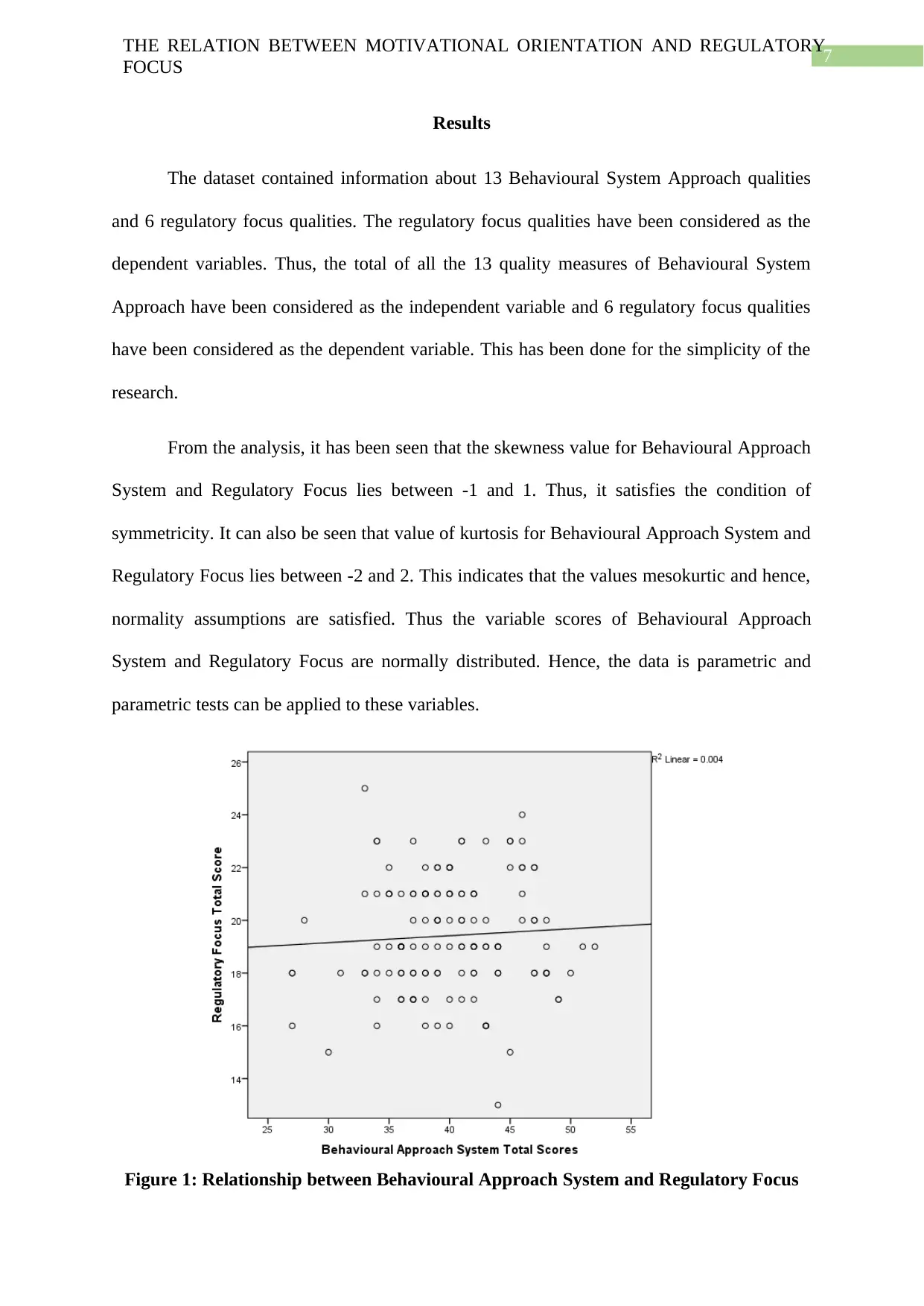
Figure 1: Relationship between Behavioural Approach System and Regulatory Focus
THE RELATION BETWEEN MOTIVATIONAL ORIENTATION AND REGULATORY
FOCUS
Results
The dataset contained information about 13 Behavioural System Approach qualities
and 6 regulatory focus qualities. The regulatory focus qualities have been considered as the
dependent variables. Thus, the total of all the 13 quality measures of Behavioural System
Approach have been considered as the independent variable and 6 regulatory focus qualities
have been considered as the dependent variable. This has been done for the simplicity of the
research.
From the analysis, it has been seen that the skewness value for Behavioural Approach
System and Regulatory Focus lies between -1 and 1. Thus, it satisfies the condition of
symmetricity. It can also be seen that value of kurtosis for Behavioural Approach System and
Regulatory Focus lies between -2 and 2. This indicates that the values mesokurtic and hence,
normality assumptions are satisfied. Thus the variable scores of Behavioural Approach
System and Regulatory Focus are normally distributed. Hence, the data is parametric and
parametric tests can be applied to these variables.
Figure 1: Relationship between Behavioural Approach System and Regulatory Focus
8
THE RELATION BETWEEN MOTIVATIONAL ORIENTATION AND REGULATORY
FOCUS
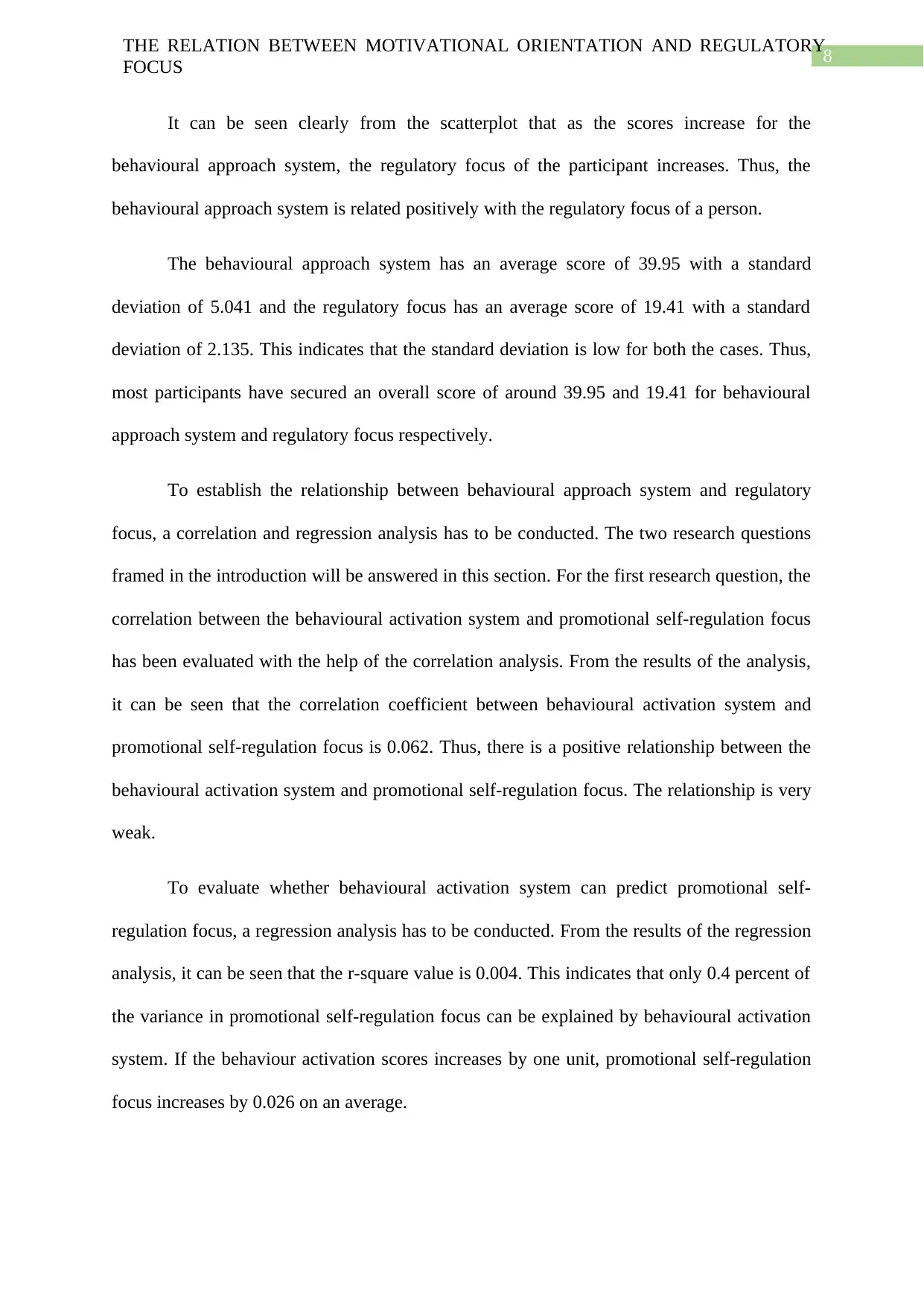
It can be seen clearly from the scatterplot that as the scores increase for the
behavioural approach system, the regulatory focus of the participant increases. Thus, the
behavioural approach system is related positively with the regulatory focus of a person.
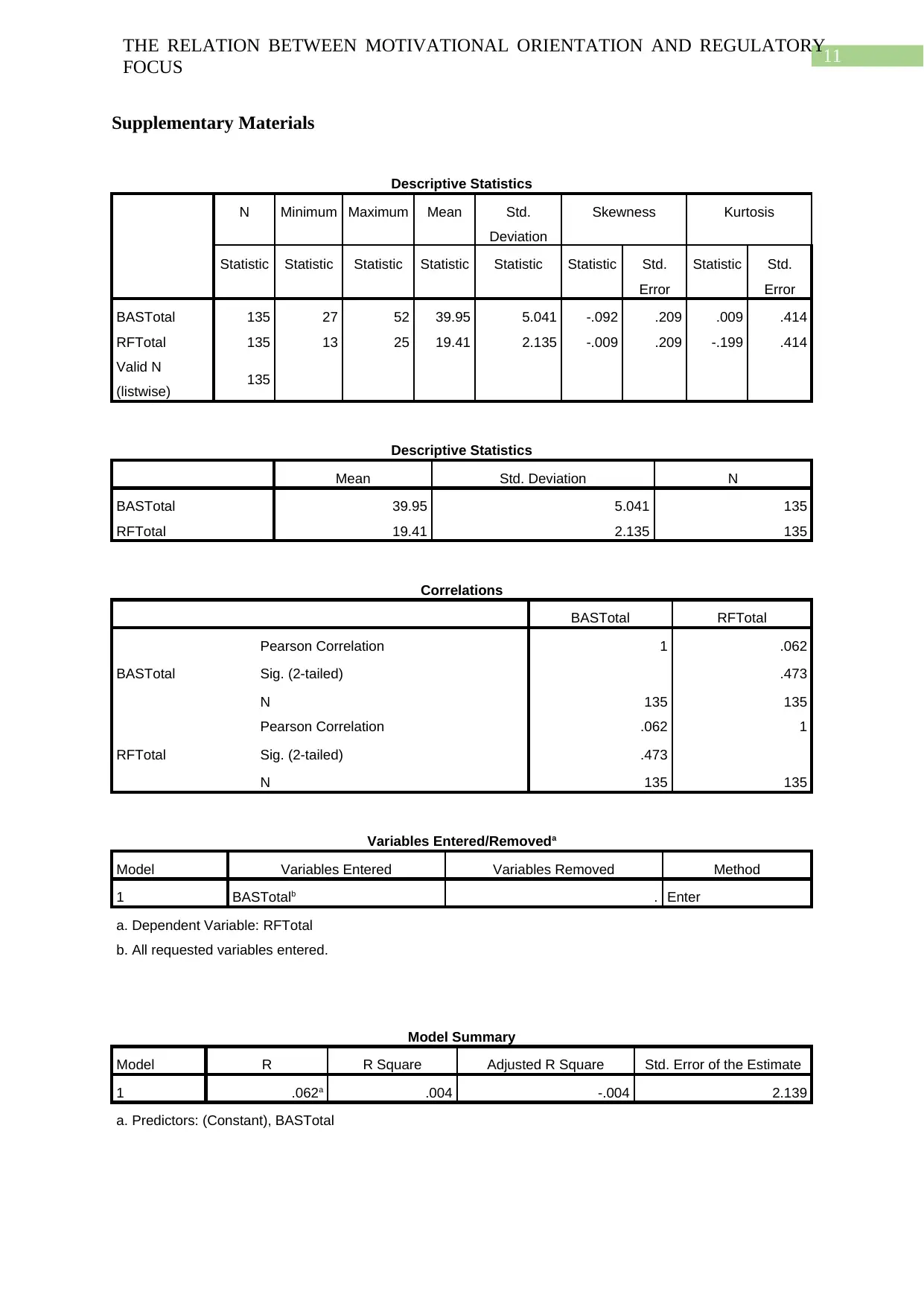
The behavioural approach system has an average score of 39.95 with a standard
deviation of 5.041 and the regulatory focus has an average score of 19.41 with a standard
deviation of 2.135. This indicates that the standard deviation is low for both the cases. Thus,
most participants have secured an overall score of around 39.95 and 19.41 for behavioural
approach system and regulatory focus respectively.
To establish the relationship between behavioural approach system and regulatory
focus, a correlation and regression analysis has to be conducted. The two research questions
framed in the introduction will be answered in this section. For the first research question, the
correlation between the behavioural activation system and promotional self-regulation focus
has been evaluated with the help of the correlation analysis. From the results of the analysis,
it can be seen that the correlation coefficient between behavioural activation system and
promotional self-regulation focus is 0.062. Thus, there is a positive relationship between the
behavioural activation system and promotional self-regulation focus. The relationship is very
weak.
To evaluate whether behavioural activation system can predict promotional self-
regulation focus, a regression analysis has to be conducted. From the results of the regression
analysis, it can be seen that the r-square value is 0.004. This indicates that only 0.4 percent of
the variance in promotional self-regulation focus can be explained by behavioural activation
system. If the behaviour activation scores increases by one unit, promotional self-regulation
focus increases by 0.026 on an average.
THE RELATION BETWEEN MOTIVATIONAL ORIENTATION AND REGULATORY
FOCUS
It can be seen clearly from the scatterplot that as the scores increase for the
behavioural approach system, the regulatory focus of the participant increases. Thus, the
behavioural approach system is related positively with the regulatory focus of a person.
The behavioural approach system has an average score of 39.95 with a standard
deviation of 5.041 and the regulatory focus has an average score of 19.41 with a standard
deviation of 2.135. This indicates that the standard deviation is low for both the cases. Thus,
most participants have secured an overall score of around 39.95 and 19.41 for behavioural
approach system and regulatory focus respectively.
To establish the relationship between behavioural approach system and regulatory
focus, a correlation and regression analysis has to be conducted. The two research questions
framed in the introduction will be answered in this section. For the first research question, the
correlation between the behavioural activation system and promotional self-regulation focus
has been evaluated with the help of the correlation analysis. From the results of the analysis,
it can be seen that the correlation coefficient between behavioural activation system and
promotional self-regulation focus is 0.062. Thus, there is a positive relationship between the
behavioural activation system and promotional self-regulation focus. The relationship is very
weak.
To evaluate whether behavioural activation system can predict promotional self-
regulation focus, a regression analysis has to be conducted. From the results of the regression
analysis, it can be seen that the r-square value is 0.004. This indicates that only 0.4 percent of
the variance in promotional self-regulation focus can be explained by behavioural activation
system. If the behaviour activation scores increases by one unit, promotional self-regulation
focus increases by 0.026 on an average.
⊘ This is a preview!⊘
Do you want full access?
Subscribe today to unlock all pages.
Trusted by 1+ million students worldwide
9
THE RELATION BETWEEN MOTIVATIONAL ORIENTATION AND REGULATORY
FOCUS
Discussion
From the analysis conducted above, it can be seen that the relationship between
behavioural approach system and regulatory focus is very weak. The effect of motivational
orientation on regulatory focus is almost negligible. According to the previous studies, there
is a significant relationship between these two psychological factors. This has not been
achieved in this research. Thus, the previous studies have been contradicted with the results
obtained from this research.
This research has been conducted on a very small sample. A sample size this small
might not be sufficient in referring the whole population. This might be one of the reasons
that the results obtained is contradicting the results of the peer researches. In this research,
behavioural approach system has been considered as the only measure of motivational
orientation. There are a lot other factors that can represent the motivational orientation of an
individual. Considering these factors might also give a result different from what has been
obtained in this research.
With reference to the hedonic principle, it has been observed that there have been
variations across people and situations on the regulatory focus. Positive and negative
motivational states control the regulatory focus of an individual. Thus, it is time for the
psychologists to opt an alternative way of hedonic principle. Regulatory focus is considered
as an alternative to improve the motivational principle in individuals.
THE RELATION BETWEEN MOTIVATIONAL ORIENTATION AND REGULATORY
FOCUS
Discussion
From the analysis conducted above, it can be seen that the relationship between
behavioural approach system and regulatory focus is very weak. The effect of motivational
orientation on regulatory focus is almost negligible. According to the previous studies, there
is a significant relationship between these two psychological factors. This has not been
achieved in this research. Thus, the previous studies have been contradicted with the results
obtained from this research.
This research has been conducted on a very small sample. A sample size this small
might not be sufficient in referring the whole population. This might be one of the reasons
that the results obtained is contradicting the results of the peer researches. In this research,
behavioural approach system has been considered as the only measure of motivational
orientation. There are a lot other factors that can represent the motivational orientation of an
individual. Considering these factors might also give a result different from what has been
obtained in this research.
With reference to the hedonic principle, it has been observed that there have been
variations across people and situations on the regulatory focus. Positive and negative
motivational states control the regulatory focus of an individual. Thus, it is time for the
psychologists to opt an alternative way of hedonic principle. Regulatory focus is considered
as an alternative to improve the motivational principle in individuals.
Paraphrase This Document
Need a fresh take? Get an instant paraphrase of this document with our AI Paraphraser
10
THE RELATION BETWEEN MOTIVATIONAL ORIENTATION AND REGULATORY
FOCUS
References
Higgins, E. T. (1997). Beyond pleasure and pain. American psychologist, 52(12), 1280-1300.
Higgins, E. T. (1998). Promotion and prevention: Regulatory focus as a motivational
principle. In Advances in experimental social psychology (Vol. 30, pp. 1-46). Academic
Press.
Carver, C. S., Sutton, S. K., & Scheier, M. F. (2000). Action, emotion, and personality:
Emerging conceptual integration. Personality and social psychology bulletin, 26(6), 741-751.
Förster, J., & Higgins, E. T. (2005). How global versus local perception fits regulatory
focus. Psychological science, 16(8), 631-636.
Pintrich, P. R. (1999). The role of motivation in promoting and sustaining self-regulated
learning. International journal of educational research, 31(6), 459-470.
THE RELATION BETWEEN MOTIVATIONAL ORIENTATION AND REGULATORY
FOCUS
References
Higgins, E. T. (1997). Beyond pleasure and pain. American psychologist, 52(12), 1280-1300.
Higgins, E. T. (1998). Promotion and prevention: Regulatory focus as a motivational
principle. In Advances in experimental social psychology (Vol. 30, pp. 1-46). Academic
Press.
Carver, C. S., Sutton, S. K., & Scheier, M. F. (2000). Action, emotion, and personality:
Emerging conceptual integration. Personality and social psychology bulletin, 26(6), 741-751.
Förster, J., & Higgins, E. T. (2005). How global versus local perception fits regulatory
focus. Psychological science, 16(8), 631-636.
Pintrich, P. R. (1999). The role of motivation in promoting and sustaining self-regulated
learning. International journal of educational research, 31(6), 459-470.
11
THE RELATION BETWEEN MOTIVATIONAL ORIENTATION AND REGULATORY
FOCUS
Supplementary Materials
Descriptive Statistics
N Minimum Maximum Mean Std.
Deviation
Skewness Kurtosis
Statistic Statistic Statistic Statistic Statistic Statistic Std.
Error
Statistic Std.
Error
BASTotal 135 27 52 39.95 5.041 -.092 .209 .009 .414
RFTotal 135 13 25 19.41 2.135 -.009 .209 -.199 .414
Valid N
(listwise) 135
Descriptive Statistics
Mean Std. Deviation N
BASTotal 39.95 5.041 135
RFTotal 19.41 2.135 135
Correlations
BASTotal RFTotal
BASTotal
Pearson Correlation 1 .062
Sig. (2-tailed) .473
N 135 135
RFTotal
Pearson Correlation .062 1
Sig. (2-tailed) .473
N 135 135
Variables Entered/Removeda
Model Variables Entered Variables Removed Method
1 BASTotalb . Enter
a. Dependent Variable: RFTotal
b. All requested variables entered.
Model Summary
Model R R Square Adjusted R Square Std. Error of the Estimate
1 .062a .004 -.004 2.139
a. Predictors: (Constant), BASTotal
THE RELATION BETWEEN MOTIVATIONAL ORIENTATION AND REGULATORY
FOCUS
Supplementary Materials
Descriptive Statistics
N Minimum Maximum Mean Std.
Deviation
Skewness Kurtosis
Statistic Statistic Statistic Statistic Statistic Statistic Std.
Error
Statistic Std.
Error
BASTotal 135 27 52 39.95 5.041 -.092 .209 .009 .414
RFTotal 135 13 25 19.41 2.135 -.009 .209 -.199 .414
Valid N
(listwise) 135
Descriptive Statistics
Mean Std. Deviation N
BASTotal 39.95 5.041 135
RFTotal 19.41 2.135 135
Correlations
BASTotal RFTotal
BASTotal
Pearson Correlation 1 .062
Sig. (2-tailed) .473
N 135 135
RFTotal
Pearson Correlation .062 1
Sig. (2-tailed) .473
N 135 135
Variables Entered/Removeda
Model Variables Entered Variables Removed Method
1 BASTotalb . Enter
a. Dependent Variable: RFTotal
b. All requested variables entered.
Model Summary
Model R R Square Adjusted R Square Std. Error of the Estimate
1 .062a .004 -.004 2.139
a. Predictors: (Constant), BASTotal
⊘ This is a preview!⊘
Do you want full access?
Subscribe today to unlock all pages.
Trusted by 1+ million students worldwide

1 out of 13


Related Documents


Your All-in-One AI-Powered Toolkit for Academic Success.
+13062052269
info@desklib.com
Available 24*7 on WhatsApp / Email
![[object Object]](/_next/static/media/star-bottom.7253800d.svg)
Unlock your academic potential
Copyright © 2020–2026 A2Z Services. All Rights Reserved. Developed and managed by ZUCOL.