Critical Evaluation of Motivational Theories for Employee Engagement
VerifiedAdded on 2020/03/04
|13
|3698
|54
Essay
AI Summary
This essay critically evaluates several key motivational theories, including Maslow's Hierarchy of Needs, Herzberg's Two-Factor Theory, and Vroom's Expectancy Theory, to assess their impact on employee engagement. The paper delves into each theory, explaining its core principles and how it can be applied within an organizational context to foster a more motivated and productive workforce. It provides detailed examples, such as how Apple Inc. and Tesco have implemented these theories. The essay also explores the interconnectedness of these theories, highlighting how they collectively contribute to creating a work environment that meets employees' diverse needs and aspirations, thereby enhancing their overall engagement. The Four Motivators, including identified, intrinsic, introjected, and extrinsic motivation, are also discussed. The essay concludes by comparing and contrasting the different theories, emphasizing their practical implications for improving employee engagement. This assignment showcases the practical application of these theories in real-world business settings to increase employee engagement.
Motivational Theories 1
USING MOTIVATIONAL THEORIES TO IMPROVE EMPLOYEE ENGAGEMENT
By (Name)
Course Title
Professor
University Affiliation
Date
USING MOTIVATIONAL THEORIES TO IMPROVE EMPLOYEE ENGAGEMENT
By (Name)
Course Title
Professor
University Affiliation
Date

Paraphrase This Document
Need a fresh take? Get an instant paraphrase of this document with our AI Paraphraser

Motivational Theories 2
Motivational Theories 3
Table of Contents
1. Introduction..............................................................................................................3
2. Maslow’s Hierarchy of Needs........................................................................................3
3. Two-Factor Theory.....................................................................................................5
4. Expectancy Theory of Motivation..................................................................................7
5. The Four motivators...................................................................................................8
6. Comparison of the Theories..........................................................................................9
7. Conclusion................................................................................................................9
8. References...............................................................................................................11
Table of Contents
1. Introduction..............................................................................................................3
2. Maslow’s Hierarchy of Needs........................................................................................3
3. Two-Factor Theory.....................................................................................................5
4. Expectancy Theory of Motivation..................................................................................7
5. The Four motivators...................................................................................................8
6. Comparison of the Theories..........................................................................................9
7. Conclusion................................................................................................................9
8. References...............................................................................................................11
⊘ This is a preview!⊘
Do you want full access?
Subscribe today to unlock all pages.

Trusted by 1+ million students worldwide
Motivational Theories 4
1. Introduction
Using Motivational Theories to Improve Employee Engagement
Motivating company employees’ makes them have an interest in the future of the
company, and therefore, will always exploit their full potentials at work. Motivated people are
always full of the desire to accomplish given tasks. When employees are working in harmony,
and mutual cooperation is observed, then it can be described as good employee engagement.
Employees give their best to achieve the goals and ambitions of the organization. The extent at
which the employees are motivated is directly reflected on their engagement. Therefore, for a
company to increase the engagement of their employees, they need to find means of motivating
them accordingly (Macey and Schneider, 2008). This paper examines various motivational
theories that can be used in improving employee engagement. The various theories will be
discussed as well as how they boost the employee engagement. The paper also discusses the
relationship between the theories. There is close relationship between all the motivation theories
in that, in all of them, the employees must meet regardless of their different levels or stages or
ranks in the workplace.
2. Maslow’s Hierarchy of Needs
It is attributed to Abraham Maslow, a Jewish, whose parents had migrated to Russia.
According to Maslow, the basic needs of an individual must be met for one to be motivated to
achieve their maximum potentials in their endeavors. In this hierarchy of needs, he translated it
into a triangular design, where the bottom or base of the triangle represent the most basic need,
to the top most, where an individual realizes their self-actualization (Miner, 2015). According to
his believes, individuals are always motivated to satisfy their basic and general needs. The needs
should be met, one after the other, which means that one cannot satisfy the upper needs before
satisfying the lower or bottom needs in the hierarchy (Elliot, Dweck and Yeager, 2017). The
needs on a particular level of the pyramid must be completely met, otherwise there will be a
possible stagnation or fallback to the initial needs in the pyramid.
1. Introduction
Using Motivational Theories to Improve Employee Engagement
Motivating company employees’ makes them have an interest in the future of the
company, and therefore, will always exploit their full potentials at work. Motivated people are
always full of the desire to accomplish given tasks. When employees are working in harmony,
and mutual cooperation is observed, then it can be described as good employee engagement.
Employees give their best to achieve the goals and ambitions of the organization. The extent at
which the employees are motivated is directly reflected on their engagement. Therefore, for a
company to increase the engagement of their employees, they need to find means of motivating
them accordingly (Macey and Schneider, 2008). This paper examines various motivational
theories that can be used in improving employee engagement. The various theories will be
discussed as well as how they boost the employee engagement. The paper also discusses the
relationship between the theories. There is close relationship between all the motivation theories
in that, in all of them, the employees must meet regardless of their different levels or stages or
ranks in the workplace.
2. Maslow’s Hierarchy of Needs
It is attributed to Abraham Maslow, a Jewish, whose parents had migrated to Russia.
According to Maslow, the basic needs of an individual must be met for one to be motivated to
achieve their maximum potentials in their endeavors. In this hierarchy of needs, he translated it
into a triangular design, where the bottom or base of the triangle represent the most basic need,
to the top most, where an individual realizes their self-actualization (Miner, 2015). According to
his believes, individuals are always motivated to satisfy their basic and general needs. The needs
should be met, one after the other, which means that one cannot satisfy the upper needs before
satisfying the lower or bottom needs in the hierarchy (Elliot, Dweck and Yeager, 2017). The
needs on a particular level of the pyramid must be completely met, otherwise there will be a
possible stagnation or fallback to the initial needs in the pyramid.
Paraphrase This Document
Need a fresh take? Get an instant paraphrase of this document with our AI Paraphraser
Motivational Theories 5
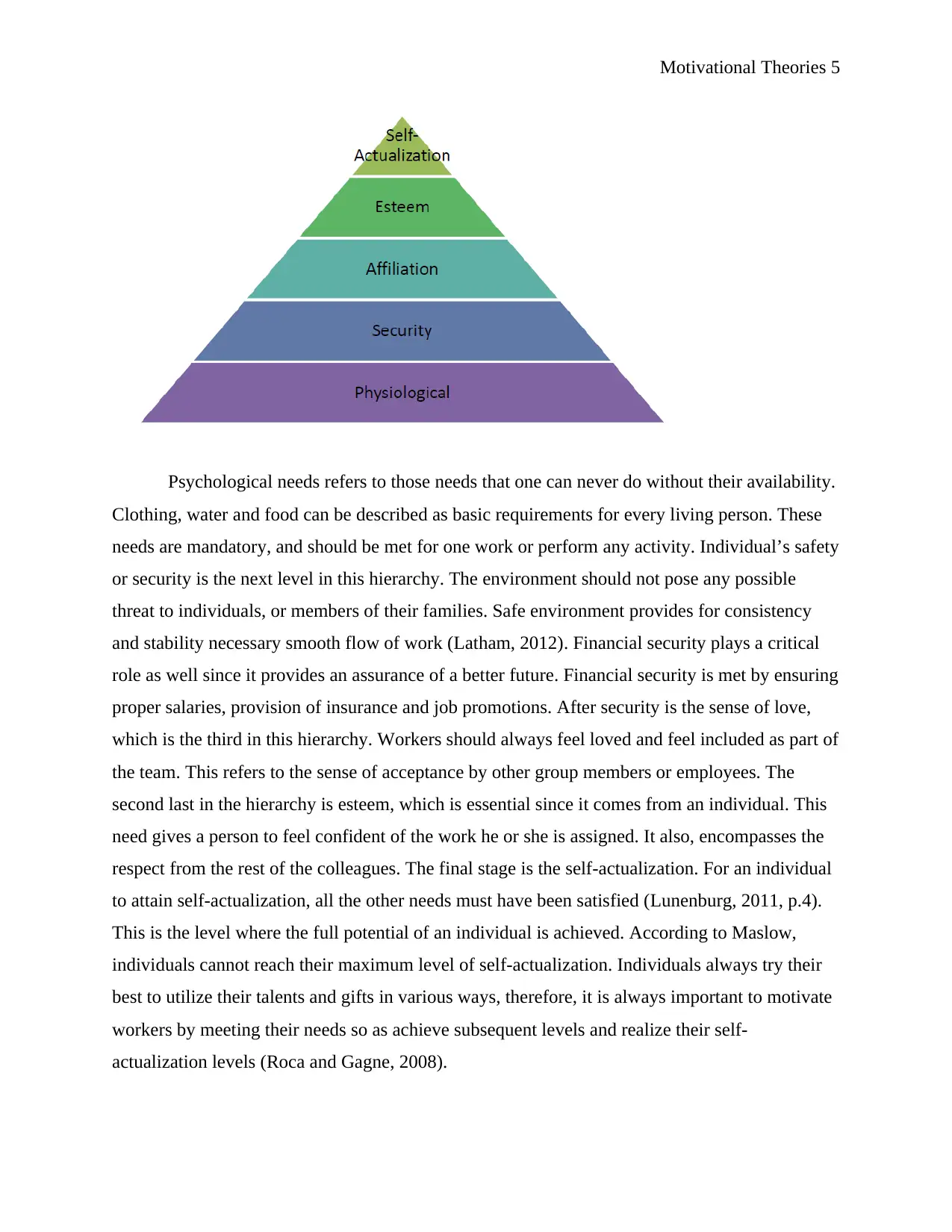
Psychological needs refers to those needs that one can never do without their availability.
Clothing, water and food can be described as basic requirements for every living person. These
needs are mandatory, and should be met for one work or perform any activity. Individual’s safety
or security is the next level in this hierarchy. The environment should not pose any possible
threat to individuals, or members of their families. Safe environment provides for consistency
and stability necessary smooth flow of work (Latham, 2012). Financial security plays a critical
role as well since it provides an assurance of a better future. Financial security is met by ensuring
proper salaries, provision of insurance and job promotions. After security is the sense of love,
which is the third in this hierarchy. Workers should always feel loved and feel included as part of
the team. This refers to the sense of acceptance by other group members or employees. The
second last in the hierarchy is esteem, which is essential since it comes from an individual. This
need gives a person to feel confident of the work he or she is assigned. It also, encompasses the
respect from the rest of the colleagues. The final stage is the self-actualization. For an individual
to attain self-actualization, all the other needs must have been satisfied (Lunenburg, 2011, p.4).
This is the level where the full potential of an individual is achieved. According to Maslow,
individuals cannot reach their maximum level of self-actualization. Individuals always try their
best to utilize their talents and gifts in various ways, therefore, it is always important to motivate
workers by meeting their needs so as achieve subsequent levels and realize their self-
actualization levels (Roca and Gagne, 2008).
Psychological needs refers to those needs that one can never do without their availability.
Clothing, water and food can be described as basic requirements for every living person. These
needs are mandatory, and should be met for one work or perform any activity. Individual’s safety
or security is the next level in this hierarchy. The environment should not pose any possible
threat to individuals, or members of their families. Safe environment provides for consistency
and stability necessary smooth flow of work (Latham, 2012). Financial security plays a critical
role as well since it provides an assurance of a better future. Financial security is met by ensuring
proper salaries, provision of insurance and job promotions. After security is the sense of love,
which is the third in this hierarchy. Workers should always feel loved and feel included as part of
the team. This refers to the sense of acceptance by other group members or employees. The
second last in the hierarchy is esteem, which is essential since it comes from an individual. This
need gives a person to feel confident of the work he or she is assigned. It also, encompasses the
respect from the rest of the colleagues. The final stage is the self-actualization. For an individual
to attain self-actualization, all the other needs must have been satisfied (Lunenburg, 2011, p.4).
This is the level where the full potential of an individual is achieved. According to Maslow,
individuals cannot reach their maximum level of self-actualization. Individuals always try their
best to utilize their talents and gifts in various ways, therefore, it is always important to motivate
workers by meeting their needs so as achieve subsequent levels and realize their self-
actualization levels (Roca and Gagne, 2008).
Motivational Theories 6
Chip Conley, who started the Joie Vivre chain of hotels applied the hierarchy of needs to
its management. This led to an enormous growth of his business, where he saw the need of
helping his employees to perform their individual roles. He valued the individual contribution of
the employees, and therefore, team members realized that they are being respected and
recognized. The employees were motivated, and thus, worked hard.
For every business to succeed, they need to organize their employees and offer full
support. Employees need to be supported either in their respective work places or outside work
place. All their needs, such as flexible working hours, among other basic needs should be served.
By meeting their needs, the engagement at work will subsequently increase (Meyer and Gagne,
2008, p.61).
Apple Inc. also, applied the Maslow’s theory in their management. Most of the
company’s focus is to meet the needs of their individual workers, from the most basic, up to the
higher level needs. The company offers good salary to their works, and apart from this, the
employees are acknowledged in form of rewards such as percentage of up to 5 of their monthly
salaries. This gives the employees a greater motivation as well as a feeling of recognition of the
work they are doing for the organization. Other rewards includes giving them material products
of the company such as iPhone or mac gadgets.
3. Two-Factor Theory
This theory of motivation was developed in 1950s by Fredrick Herzberg, who was a
psychologist. From the research he conducted, he concluded that performance of employees is
directly connected to their mental health (Lundberg, Gudmundson and Andersson, 2009, p.892).
The theory is closely related to Maslow’s theory of the hierarchy of needs. The data used in the
research was obtained from two hundred individuals who were engineers and accountants by
profession. They were asked about their feelings (either positive or negative) about their work.
The outstanding factors that he concluded from the research were the motivator and hygiene
factors.
Motivators focuses on work, where satisfaction is realized. It includes several factors
such as recognition, growth or progression and work itself. Hygiene factors are those that may
lead to the general dissatisfaction as well as lack of motivation is they unavailable. Business
policies, salaries, working conditions, mutual relationship between management and the
employees, benefits and personal life are some of the examples. The organization have partial
Chip Conley, who started the Joie Vivre chain of hotels applied the hierarchy of needs to
its management. This led to an enormous growth of his business, where he saw the need of
helping his employees to perform their individual roles. He valued the individual contribution of
the employees, and therefore, team members realized that they are being respected and
recognized. The employees were motivated, and thus, worked hard.
For every business to succeed, they need to organize their employees and offer full
support. Employees need to be supported either in their respective work places or outside work
place. All their needs, such as flexible working hours, among other basic needs should be served.
By meeting their needs, the engagement at work will subsequently increase (Meyer and Gagne,
2008, p.61).
Apple Inc. also, applied the Maslow’s theory in their management. Most of the
company’s focus is to meet the needs of their individual workers, from the most basic, up to the
higher level needs. The company offers good salary to their works, and apart from this, the
employees are acknowledged in form of rewards such as percentage of up to 5 of their monthly
salaries. This gives the employees a greater motivation as well as a feeling of recognition of the
work they are doing for the organization. Other rewards includes giving them material products
of the company such as iPhone or mac gadgets.
3. Two-Factor Theory
This theory of motivation was developed in 1950s by Fredrick Herzberg, who was a
psychologist. From the research he conducted, he concluded that performance of employees is
directly connected to their mental health (Lundberg, Gudmundson and Andersson, 2009, p.892).
The theory is closely related to Maslow’s theory of the hierarchy of needs. The data used in the
research was obtained from two hundred individuals who were engineers and accountants by
profession. They were asked about their feelings (either positive or negative) about their work.
The outstanding factors that he concluded from the research were the motivator and hygiene
factors.
Motivators focuses on work, where satisfaction is realized. It includes several factors
such as recognition, growth or progression and work itself. Hygiene factors are those that may
lead to the general dissatisfaction as well as lack of motivation is they unavailable. Business
policies, salaries, working conditions, mutual relationship between management and the
employees, benefits and personal life are some of the examples. The organization have partial
⊘ This is a preview!⊘
Do you want full access?
Subscribe today to unlock all pages.
Trusted by 1+ million students worldwide
Motivational Theories 7
control over these factors. Factors such as individual’s behavior and personal relationships are
out of control of the organization (Albrech, 2011).
According to Herzberg, there is a clear distinction between the job satisfaction factors
and the job dissatisfaction factors. From his studies, he found that progression needs are the main
real motivators of the workers. The workers only feed dissatisfied by the hygiene motivators, bur
are motivated the rest of the motivating factors. According to Stone and Ryan, (2009, p.80) if a
manager desires to fully motivate their employees, then they should create a conducive working
environment where all the employees are entitled to equal recognition, growth in terms of job
promotion and stimulation. Employees get motivated if they are allowed to feel responsible for
the output of the production process or any product produced from the work done. When
managers encourage such kind of recognition, the employees will be motivated to attain their
individual success, and also, the organization’s targets. Most of the workers are encouraged,
especially when the work that they are doing are seen by the management and other colleagues
as meaningful (Zhang and Bartol, 2010, p.122).
Apple Inc., for example applied the Two-Factor Theory in their management. The
employees are always recognized for their efforts in producing the quality product that the
company produces. They praise and recognize their employees by offering then bonuses, as well
as job promotions in different departments within the company. These are examples of the
motivating factors. The workers finds their environment to be challenging and interesting at the
same time. In terms of hygiene factors, the salaries of the Apple Inc. employees are appropriate
and satisfies the needs of most of their workers. Apart from the good salary that the employees
receive, the management offers to all their workers a health care plans. This ensures that the
employees feel secure, work in a conducive environment and up to-date equipment that makes
their work efficient (Stone, Deci and Ryan, 2009, p.79).
Tesco Company in their practice have adopted this two factor theory in their practice,
where the employees’ dissatisfactions are completely dealt with by the management. The
management pays attention to all factors that possibly cause satisfaction as well as
dissatisfaction. In this manner, the employees feel motivated due to timely response to their
communication.
The managers should offer a total job freedom to the employees, provide periodic reports
on the employees’ progress and provide specialization to workers as they prove to be achieving
control over these factors. Factors such as individual’s behavior and personal relationships are
out of control of the organization (Albrech, 2011).
According to Herzberg, there is a clear distinction between the job satisfaction factors
and the job dissatisfaction factors. From his studies, he found that progression needs are the main
real motivators of the workers. The workers only feed dissatisfied by the hygiene motivators, bur
are motivated the rest of the motivating factors. According to Stone and Ryan, (2009, p.80) if a
manager desires to fully motivate their employees, then they should create a conducive working
environment where all the employees are entitled to equal recognition, growth in terms of job
promotion and stimulation. Employees get motivated if they are allowed to feel responsible for
the output of the production process or any product produced from the work done. When
managers encourage such kind of recognition, the employees will be motivated to attain their
individual success, and also, the organization’s targets. Most of the workers are encouraged,
especially when the work that they are doing are seen by the management and other colleagues
as meaningful (Zhang and Bartol, 2010, p.122).
Apple Inc., for example applied the Two-Factor Theory in their management. The
employees are always recognized for their efforts in producing the quality product that the
company produces. They praise and recognize their employees by offering then bonuses, as well
as job promotions in different departments within the company. These are examples of the
motivating factors. The workers finds their environment to be challenging and interesting at the
same time. In terms of hygiene factors, the salaries of the Apple Inc. employees are appropriate
and satisfies the needs of most of their workers. Apart from the good salary that the employees
receive, the management offers to all their workers a health care plans. This ensures that the
employees feel secure, work in a conducive environment and up to-date equipment that makes
their work efficient (Stone, Deci and Ryan, 2009, p.79).
Tesco Company in their practice have adopted this two factor theory in their practice,
where the employees’ dissatisfactions are completely dealt with by the management. The
management pays attention to all factors that possibly cause satisfaction as well as
dissatisfaction. In this manner, the employees feel motivated due to timely response to their
communication.
The managers should offer a total job freedom to the employees, provide periodic reports
on the employees’ progress and provide specialization to workers as they prove to be achieving
Paraphrase This Document
Need a fresh take? Get an instant paraphrase of this document with our AI Paraphraser
Motivational Theories 8
best in their respective production sections. Through application of this Two-Factor motivational
theory, the employees get motivated and subsequently, there will be an increased employee
engagement.
4. Expectancy Theory of Motivation
The theory was first initiated by Victor Vroom back in the year 1964. This theory stresses
on the final outcomes unlike the Herzberg and Maslow theories that dwells on the needs.
According to this theory, the motivation that an individual employee has is as a result of the
individual’s desire of the reward ahead after completing the assigned task.
Once enlisted, keeping in mind the end goal to hold able representatives, administration
can utilize many instruments. One of the instruments available to them is Expectancy Theory
hypothesis recommends that a person's apparent perspective of a result will decide the level of
inspiration (Chiang and Jang, 2008, p.317). A few workers are roused by cash, while others
incline toward acknowledgment for a vocation well done, a corner office, or the parking spot
nearest to the building. Every individual is unique. In this manner, nobody measure fits all
arrangement will work.
There are three key parts to Expectancy Theory, hope, instrumentality, and valence.
Anticipation can be depicted as the conviction a man has that the more exertion they put into an
undertaking, the good the result will be (Chalofsky and Krishna, 2009, p.195).
The theory relies on individual perceptions of individuals. The senior staff may feel that
the workers are motivated due to the service and improved working environment, this will never
mean that the junior staff will equally recognize it. This theory requires management of the
valence, instrumentality and expectancy in equal measures to ensure that the working
environment is suitable for general operations by all the employed workers.
Hallmark, which is one of the leading company in manufacturing cards applies this
Vroom’s theory in motivating their company workers. Their employees are motivated to achieve
their tasks through instilling of confidence to individual employees. This results in high
performance in terms of the outputs of the company’s products. The company is concern on their
employees’ abilities, whereby, they improve their expectancies in their abilities to perform better
in accomplishing their tasks. The resources, as well as all the necessary training skills are
provided by the company hence creating a positive valance among the employees which will be
subsequently translated into success and quality performance.
best in their respective production sections. Through application of this Two-Factor motivational
theory, the employees get motivated and subsequently, there will be an increased employee
engagement.
4. Expectancy Theory of Motivation
The theory was first initiated by Victor Vroom back in the year 1964. This theory stresses
on the final outcomes unlike the Herzberg and Maslow theories that dwells on the needs.
According to this theory, the motivation that an individual employee has is as a result of the
individual’s desire of the reward ahead after completing the assigned task.
Once enlisted, keeping in mind the end goal to hold able representatives, administration
can utilize many instruments. One of the instruments available to them is Expectancy Theory
hypothesis recommends that a person's apparent perspective of a result will decide the level of
inspiration (Chiang and Jang, 2008, p.317). A few workers are roused by cash, while others
incline toward acknowledgment for a vocation well done, a corner office, or the parking spot
nearest to the building. Every individual is unique. In this manner, nobody measure fits all
arrangement will work.
There are three key parts to Expectancy Theory, hope, instrumentality, and valence.
Anticipation can be depicted as the conviction a man has that the more exertion they put into an
undertaking, the good the result will be (Chalofsky and Krishna, 2009, p.195).
The theory relies on individual perceptions of individuals. The senior staff may feel that
the workers are motivated due to the service and improved working environment, this will never
mean that the junior staff will equally recognize it. This theory requires management of the
valence, instrumentality and expectancy in equal measures to ensure that the working
environment is suitable for general operations by all the employed workers.
Hallmark, which is one of the leading company in manufacturing cards applies this
Vroom’s theory in motivating their company workers. Their employees are motivated to achieve
their tasks through instilling of confidence to individual employees. This results in high
performance in terms of the outputs of the company’s products. The company is concern on their
employees’ abilities, whereby, they improve their expectancies in their abilities to perform better
in accomplishing their tasks. The resources, as well as all the necessary training skills are
provided by the company hence creating a positive valance among the employees which will be
subsequently translated into success and quality performance.
Motivational Theories 9
5. The Four motivators
The four motivators can also be included as part of the theories that defines motivation.
Identified motivation, intrinsic, introjected and extrinsic (external) motivation are the key
motivators discussed. These motivators are well known in increasing the employee engagement.
In external motivations, it is predominantly dependent on the environmental characteristics such
as rewards given after doing certain given or assigned work (Hsu and Wang, 2010, p.410). In
most cases, people work hard just because they are being paid. This means that the better the
salaries, the more the effort individuals will apply. As opposed to external motivations, in the
intrinsic motivations, people are motivated from within, whereby, they do not require external or
material rewards to be provided. In the introjected, a person feels self-motivated to achieve the
goals of the organization or individual goals, but, in the event that the person fails to explore or
exploit their potential, guilt arises. This feeling of guilty separates the intrinsic and introjected
motivation. For the case of identified motivation, an individual neglects what he/she understands
it should be accomplished.
All these for motivators needs to be identified for the various individuals working in each
organization. They are crucial in dictating the employee engagement in the work place.
Individuals have varying triggers of motivators which needs to be critically analyzed, and that is
the work of the management (Lin and Lu, 2011, p.1156).
According to Schunk and Zimmerman, (2012) all the theories of motivation are in
harmony, and if the management is keen in observing them, then the engagement of the workers
is greatly improved. For workers to be motivated, management need to provide a constant
feedback to the rest of the employees, which is essential as it enables to evaluate their
performance. Workers will be updated on their progress, understand their strengths and
weaknesses and subsequently use the feedback in their subsequent tasks. Their achievements
needs to be recognized by the through various means such as rewards (Elliot, Dweck and
Yeager, 2017). This boosts their morale and makes them to exploit their full potentials in
providing future services to the organization. Effective management motivates individuals and
triggers quality engagement of the employees. The employees requires privacy and periods of
minimum interruptions which makes them more productive. Minimum interruptions increases
the employees’ concentrations in their respective assigned duties. Providing open periods to
5. The Four motivators
The four motivators can also be included as part of the theories that defines motivation.
Identified motivation, intrinsic, introjected and extrinsic (external) motivation are the key
motivators discussed. These motivators are well known in increasing the employee engagement.
In external motivations, it is predominantly dependent on the environmental characteristics such
as rewards given after doing certain given or assigned work (Hsu and Wang, 2010, p.410). In
most cases, people work hard just because they are being paid. This means that the better the
salaries, the more the effort individuals will apply. As opposed to external motivations, in the
intrinsic motivations, people are motivated from within, whereby, they do not require external or
material rewards to be provided. In the introjected, a person feels self-motivated to achieve the
goals of the organization or individual goals, but, in the event that the person fails to explore or
exploit their potential, guilt arises. This feeling of guilty separates the intrinsic and introjected
motivation. For the case of identified motivation, an individual neglects what he/she understands
it should be accomplished.
All these for motivators needs to be identified for the various individuals working in each
organization. They are crucial in dictating the employee engagement in the work place.
Individuals have varying triggers of motivators which needs to be critically analyzed, and that is
the work of the management (Lin and Lu, 2011, p.1156).
According to Schunk and Zimmerman, (2012) all the theories of motivation are in
harmony, and if the management is keen in observing them, then the engagement of the workers
is greatly improved. For workers to be motivated, management need to provide a constant
feedback to the rest of the employees, which is essential as it enables to evaluate their
performance. Workers will be updated on their progress, understand their strengths and
weaknesses and subsequently use the feedback in their subsequent tasks. Their achievements
needs to be recognized by the through various means such as rewards (Elliot, Dweck and
Yeager, 2017). This boosts their morale and makes them to exploit their full potentials in
providing future services to the organization. Effective management motivates individuals and
triggers quality engagement of the employees. The employees requires privacy and periods of
minimum interruptions which makes them more productive. Minimum interruptions increases
the employees’ concentrations in their respective assigned duties. Providing open periods to
⊘ This is a preview!⊘
Do you want full access?
Subscribe today to unlock all pages.
Trusted by 1+ million students worldwide
Motivational Theories 10
employees makes them free to communicate with each other and share ideas (Halbesleben and
Bowler, 2007). This interaction of employees boosts their engagement.
Google, for example, offers multiple types of rewards to their employees in their quest to
boost the motivation of their employees. They offer benefits such as reimbursements for
expenses in legal affairs, financial support and medical care support to all of their employees.
They also listen to their employees, and at the same time offer flexible working schedules. All
these offers motivation, and subsequent improved employee engagement in the work place.
6. Comparison of the Theories
All the motivation theories discussed here are similar in the fact that, all create motivation for
workers or employees. The Herzberg and Maslow theories have a close similarities as the safety
and psychological needs that Maslow’s theory focuses are equally the same as Herzberg’s
hygiene factors. Both needs are basic to every living individual. For one to attain or obtain safety
status outlined in the Maslow’s hierarchy, money, hygiene factor (according to Herzberg) must
be used or earned in terms of salary. Both theories maintains that certain needs are responsible
for boosting individual’s behavior.
Expectancy theory on the other hand, describes the engagement of employees on certain
actions or behavior in their quest to come up with a desirable outcome, which is concurrent to the
extrinsic motivation. Expectancy theory explains the reason behind particular approach that the
employees use in completing assigned tasks, and extrinsic theory is a basic reason for employee
performance in the work place.
7. Conclusion
Motivation is the key to employee engagement in every working place. The management,
in this case, plays critical role in ensuring that there is good engagement of employees for work
to flow smoothly. Motivation ensures flexibility of staff members and general workers. Working
hours that are favorable to all employees motivates them, and makes them accountable on every
task. The theories also, explains that there should be good flow of communication which is key
employees makes them free to communicate with each other and share ideas (Halbesleben and
Bowler, 2007). This interaction of employees boosts their engagement.
Google, for example, offers multiple types of rewards to their employees in their quest to
boost the motivation of their employees. They offer benefits such as reimbursements for
expenses in legal affairs, financial support and medical care support to all of their employees.
They also listen to their employees, and at the same time offer flexible working schedules. All
these offers motivation, and subsequent improved employee engagement in the work place.
6. Comparison of the Theories
All the motivation theories discussed here are similar in the fact that, all create motivation for
workers or employees. The Herzberg and Maslow theories have a close similarities as the safety
and psychological needs that Maslow’s theory focuses are equally the same as Herzberg’s
hygiene factors. Both needs are basic to every living individual. For one to attain or obtain safety
status outlined in the Maslow’s hierarchy, money, hygiene factor (according to Herzberg) must
be used or earned in terms of salary. Both theories maintains that certain needs are responsible
for boosting individual’s behavior.
Expectancy theory on the other hand, describes the engagement of employees on certain
actions or behavior in their quest to come up with a desirable outcome, which is concurrent to the
extrinsic motivation. Expectancy theory explains the reason behind particular approach that the
employees use in completing assigned tasks, and extrinsic theory is a basic reason for employee
performance in the work place.
7. Conclusion
Motivation is the key to employee engagement in every working place. The management,
in this case, plays critical role in ensuring that there is good engagement of employees for work
to flow smoothly. Motivation ensures flexibility of staff members and general workers. Working
hours that are favorable to all employees motivates them, and makes them accountable on every
task. The theories also, explains that there should be good flow of communication which is key
Paraphrase This Document
Need a fresh take? Get an instant paraphrase of this document with our AI Paraphraser
Motivational Theories 11
motivator to the company staff and all the employees. When the senior staff uses appropriate
language and other means of communication to the junior staff, all workers feel motivated, and
in return, the engagement is greatly improved. Listening to employees and adopting their ideas
increases productivity. The motivation theories suggests to the management to be an example to
the rest of the junior employees. Employees works and adopts a culture that is set by the senior
staff. A kind of management that acts a good role model will motivate the employees to achieve
the best, while at the same time improving their engagement in the work place.
motivator to the company staff and all the employees. When the senior staff uses appropriate
language and other means of communication to the junior staff, all workers feel motivated, and
in return, the engagement is greatly improved. Listening to employees and adopting their ideas
increases productivity. The motivation theories suggests to the management to be an example to
the rest of the junior employees. Employees works and adopts a culture that is set by the senior
staff. A kind of management that acts a good role model will motivate the employees to achieve
the best, while at the same time improving their engagement in the work place.
Motivational Theories 12
8. References
Albrech, S.L., (2011). Handbook of employee engagement: Perspectives, issues, research and
practice. Human Resource Management International Digest, 19(7).
Chalofsky, N. and Krishna, V., (2009). Meaningfulness, commitment, and engagement: The
intersection of a deeper level of intrinsic motivation. Advances in Developing Human
Resources, 11(2), pp.189-203.
Chiang, C.F. and Jang, S.S., (2008). An expectancy theory model for hotel employee motivation.
International Journal of Hospitality Management, 27(2), pp.313-322.
Elliot, A.J., Dweck, C.S. and Yeager, D.S. eds., (2017). Handbook of Competence and
Motivation: Theory and Application. Guilford Publications.
Halbesleben, J.R. and Bowler, W.M., (2007). Emotional exhaustion and job performance: the
mediating role of motivation. Journal of applied psychology, 92(1), p.93.
Hsu, H.Y. and Wang, S.K., (2010). Using gaming literacies to cultivate new literacies.
Simulation & Gaming, 41(3), pp.400-417.
Latham, G.P., (2012). Work motivation: History, theory, research, and practice. Sage.
Lin, K.Y. and Lu, H.P., (2011). Why people use social networking sites: An empirical study
integrating network externalities and motivation theory. Computers in human behavior,
27(3), pp.1152-1161.
Lundberg, C., Gudmundson, A. and Andersson, T.D., (2009). Herzberg's Two-Factor Theory of
work motivation tested empirically on seasonal workers in hospitality and tourism.
Tourism management, 30(6), pp.890-899.
Lunenburg, F.C., (2011). Self-efficacy in the workplace: implications for motivation and
performance. International journal of management, business, and administration, 14(1),
pp.1-6.
Macey, W.H. and Schneider, B., (2008). The meaning of employee engagement. Industrial and
organizational Psychology, 1(1), pp.3-30.
Meyer, J.P. and Gagnè, M., (2008). Employee engagement from a self-determination theory
perspective. Industrial and Organizational Psychology, 1(1), pp.60-62.
Miner, J.B., (2015). Organizational behavior 1: Essential theories of motivation and leadership.
Routledge.
8. References
Albrech, S.L., (2011). Handbook of employee engagement: Perspectives, issues, research and
practice. Human Resource Management International Digest, 19(7).
Chalofsky, N. and Krishna, V., (2009). Meaningfulness, commitment, and engagement: The
intersection of a deeper level of intrinsic motivation. Advances in Developing Human
Resources, 11(2), pp.189-203.
Chiang, C.F. and Jang, S.S., (2008). An expectancy theory model for hotel employee motivation.
International Journal of Hospitality Management, 27(2), pp.313-322.
Elliot, A.J., Dweck, C.S. and Yeager, D.S. eds., (2017). Handbook of Competence and
Motivation: Theory and Application. Guilford Publications.
Halbesleben, J.R. and Bowler, W.M., (2007). Emotional exhaustion and job performance: the
mediating role of motivation. Journal of applied psychology, 92(1), p.93.
Hsu, H.Y. and Wang, S.K., (2010). Using gaming literacies to cultivate new literacies.
Simulation & Gaming, 41(3), pp.400-417.
Latham, G.P., (2012). Work motivation: History, theory, research, and practice. Sage.
Lin, K.Y. and Lu, H.P., (2011). Why people use social networking sites: An empirical study
integrating network externalities and motivation theory. Computers in human behavior,
27(3), pp.1152-1161.
Lundberg, C., Gudmundson, A. and Andersson, T.D., (2009). Herzberg's Two-Factor Theory of
work motivation tested empirically on seasonal workers in hospitality and tourism.
Tourism management, 30(6), pp.890-899.
Lunenburg, F.C., (2011). Self-efficacy in the workplace: implications for motivation and
performance. International journal of management, business, and administration, 14(1),
pp.1-6.
Macey, W.H. and Schneider, B., (2008). The meaning of employee engagement. Industrial and
organizational Psychology, 1(1), pp.3-30.
Meyer, J.P. and Gagnè, M., (2008). Employee engagement from a self-determination theory
perspective. Industrial and Organizational Psychology, 1(1), pp.60-62.
Miner, J.B., (2015). Organizational behavior 1: Essential theories of motivation and leadership.
Routledge.
⊘ This is a preview!⊘
Do you want full access?
Subscribe today to unlock all pages.
Trusted by 1+ million students worldwide

1 out of 13


Related Documents


Your All-in-One AI-Powered Toolkit for Academic Success.
+13062052269
info@desklib.com
Available 24*7 on WhatsApp / Email
![[object Object]](/_next/static/media/star-bottom.7253800d.svg)
Unlock your academic potential
Copyright © 2020–2026 A2Z Services. All Rights Reserved. Developed and managed by ZUCOL.