Core Loss Measurement of Electrical Motor: Analysis and Results

Verified

Added on  2021/04/19

|4
|614
|102
Report
AI Summary
This report delves into the core loss measurement of electrical motors, specifically focusing on three-phase induction motors. It outlines the conventional no-load test procedure used to determine rotational losses, including core, friction, and windage losses, along with stator copper loss calculations. The report details the process of deriving key parameters such as no-load resistance, reactance, and impedance, and also addresses the calculation of per-phase magnetizing and core loss currents. It provides a practical guide for conducting the experiment and highlights the importance of understanding motor efficiency. The report also discusses the limitations of the IEEE 112 method and suggests the use of the more advanced IEC 60034-2-1 standard for more accurate motor efficiency calculations and loss component determination. This document provides a comprehensive overview of the technical aspects of electrical machines, their efficiency, and the methods used to assess their performance.
Document Page
Running head: CORE LOSS MEASUREMENT OF ELECTRICAL MOTOR
CORE LOSS MEASUREMENT OF ELECTRICAL MOTOR
Name of the student:
Name of the university:
Author note:
tabler-icon-diamond-filled.svg

Paraphrase This Document

Need a fresh take? Get an instant paraphrase of this document with our AI Paraphraser
Document Page
1
CORE LOSS MEASUREMENT OF ELECTRICAL MOTOR
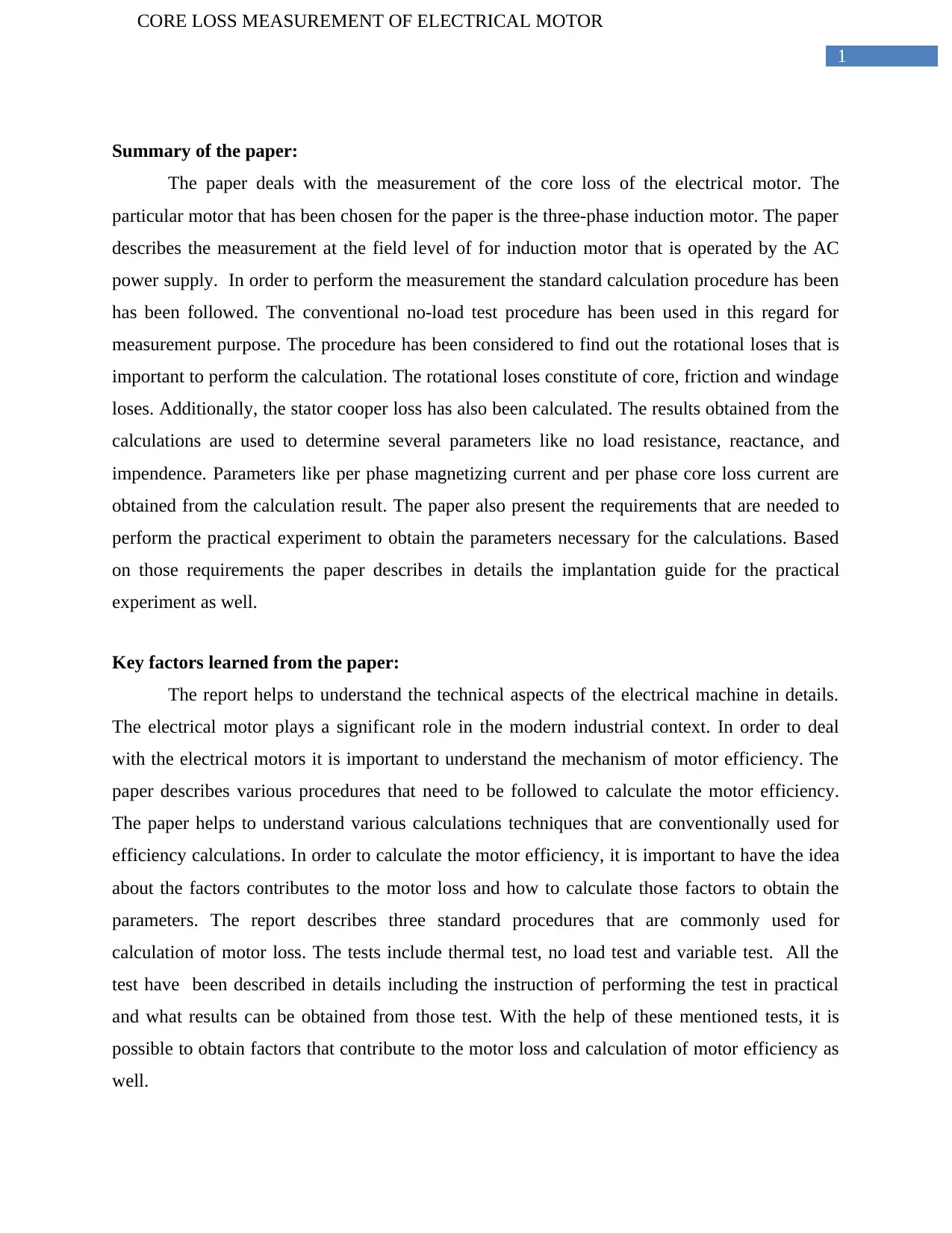
Summary of the paper:
The paper deals with the measurement of the core loss of the electrical motor. The
particular motor that has been chosen for the paper is the three-phase induction motor. The paper
describes the measurement at the field level of for induction motor that is operated by the AC
power supply. In order to perform the measurement the standard calculation procedure has been
has been followed. The conventional no-load test procedure has been used in this regard for
measurement purpose. The procedure has been considered to find out the rotational loses that is
important to perform the calculation. The rotational loses constitute of core, friction and windage
loses. Additionally, the stator cooper loss has also been calculated. The results obtained from the
calculations are used to determine several parameters like no load resistance, reactance, and
impendence. Parameters like per phase magnetizing current and per phase core loss current are
obtained from the calculation result. The paper also present the requirements that are needed to
perform the practical experiment to obtain the parameters necessary for the calculations. Based
on those requirements the paper describes in details the implantation guide for the practical
experiment as well.
Key factors learned from the paper:
The report helps to understand the technical aspects of the electrical machine in details.
The electrical motor plays a significant role in the modern industrial context. In order to deal
with the electrical motors it is important to understand the mechanism of motor efficiency. The
paper describes various procedures that need to be followed to calculate the motor efficiency.
The paper helps to understand various calculations techniques that are conventionally used for
efficiency calculations. In order to calculate the motor efficiency, it is important to have the idea
about the factors contributes to the motor loss and how to calculate those factors to obtain the
parameters. The report describes three standard procedures that are commonly used for
calculation of motor loss. The tests include thermal test, no load test and variable test. All the
test have been described in details including the instruction of performing the test in practical
and what results can be obtained from those test. With the help of these mentioned tests, it is
possible to obtain factors that contribute to the motor loss and calculation of motor efficiency as
well.
Document Page
2
CORE LOSS MEASUREMENT OF ELECTRICAL MOTOR
Future issues raised by the authors:
The test described in this paper to determine the motor efficiency is performed using the
IEE 112 method. The authors has only considered this particular method for conducting the test.
However, the IEC standard 60034-2-1, a more improved and recent version has been in practice
recently. has not been considered in this regard. The new standard is much more improved and
also provides more accurate result in determining motor efficiency by calculating the motor loss
component [1]. This is the issue raised by the authors in the paper.
Document Page
3
CORE LOSS MEASUREMENT OF ELECTRICAL MOTOR
References:
[1]"Uncertainty Issues in Direct and Indirect Efficiency Determination for Three-Phase
Induction Motors: Remarks About the IEC 60034-2-1 Standard - IEEE Journals &
Magazine", Ieeexplore.ieee.org, 2018. [Online]. Available:
http://ieeexplore.ieee.org/abstract/document/7551206/?reload=true. [Accessed: 27- Mar- 2018].
chevron_up_icon
1 out of 4
circle_padding
hide_on_mobile
zoom_out_icon
[object Object]