Environmental Consequences of Mountaintop Removal Mining: A Report

Verified

Added on  2023/03/21

|4
|772
|78
Report
AI Summary
This report analyzes the environmental and social impacts of mountaintop removal mining. It describes the process, which involves removing mountain tops to access coal deposits, using explosives and draglines, and dumping waste into valley fills. The report highlights the concerns of local communities regarding environmental degradation, including water contamination, dust pollution, and the risk of flash flooding. It also discusses the dangers of coal slurry impoundments and their potential for catastrophic failures, referencing specific incidents like the Brushy Fork Slurry Impoundment in West Virginia and the Martin County spill. The report emphasizes the need for regulations and community protection in areas affected by mountaintop removal mining.

Document Page
FABRICANT CAMPING ASSIGNMENTS
By Name
Course
Instructor
Institution
Location
Date
tabler-icon-diamond-filled.svg

Paraphrase This Document

Need a fresh take? Get an instant paraphrase of this document with our AI Paraphraser
Document Page
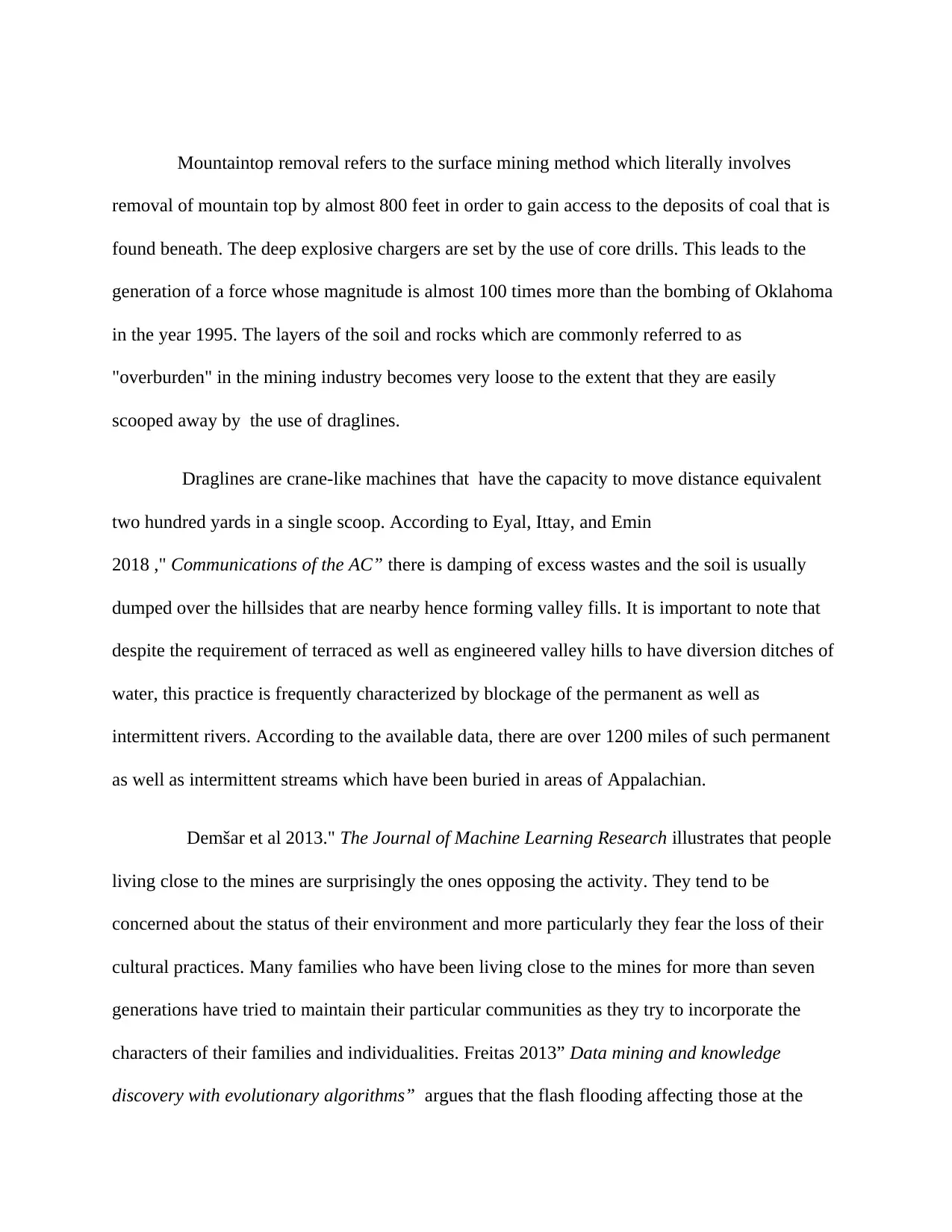
Mountaintop removal refers to the surface mining method which literally involves
removal of mountain top by almost 800 feet in order to gain access to the deposits of coal that is
found beneath. The deep explosive chargers are set by the use of core drills. This leads to the
generation of a force whose magnitude is almost 100 times more than the bombing of Oklahoma
in the year 1995. The layers of the soil and rocks which are commonly referred to as
"overburden" in the mining industry becomes very loose to the extent that they are easily
scooped away by the use of draglines.
Draglines are crane-like machines that have the capacity to move distance equivalent
two hundred yards in a single scoop. According to Eyal, Ittay, and Emin
2018 ," Communications of the AC” there is damping of excess wastes and the soil is usually
dumped over the hillsides that are nearby hence forming valley fills. It is important to note that
despite the requirement of terraced as well as engineered valley hills to have diversion ditches of
water, this practice is frequently characterized by blockage of the permanent as well as
intermittent rivers. According to the available data, there are over 1200 miles of such permanent
as well as intermittent streams which have been buried in areas of Appalachian.
Demšar et al 2013." The Journal of Machine Learning Research illustrates that people
living close to the mines are surprisingly the ones opposing the activity. They tend to be
concerned about the status of their environment and more particularly they fear the loss of their
cultural practices. Many families who have been living close to the mines for more than seven
generations have tried to maintain their particular communities as they try to incorporate the
characters of their families and individualities. Freitas 2013” Data mining and knowledge
discovery with evolutionary algorithms” argues that the flash flooding affecting those at the
Document Page
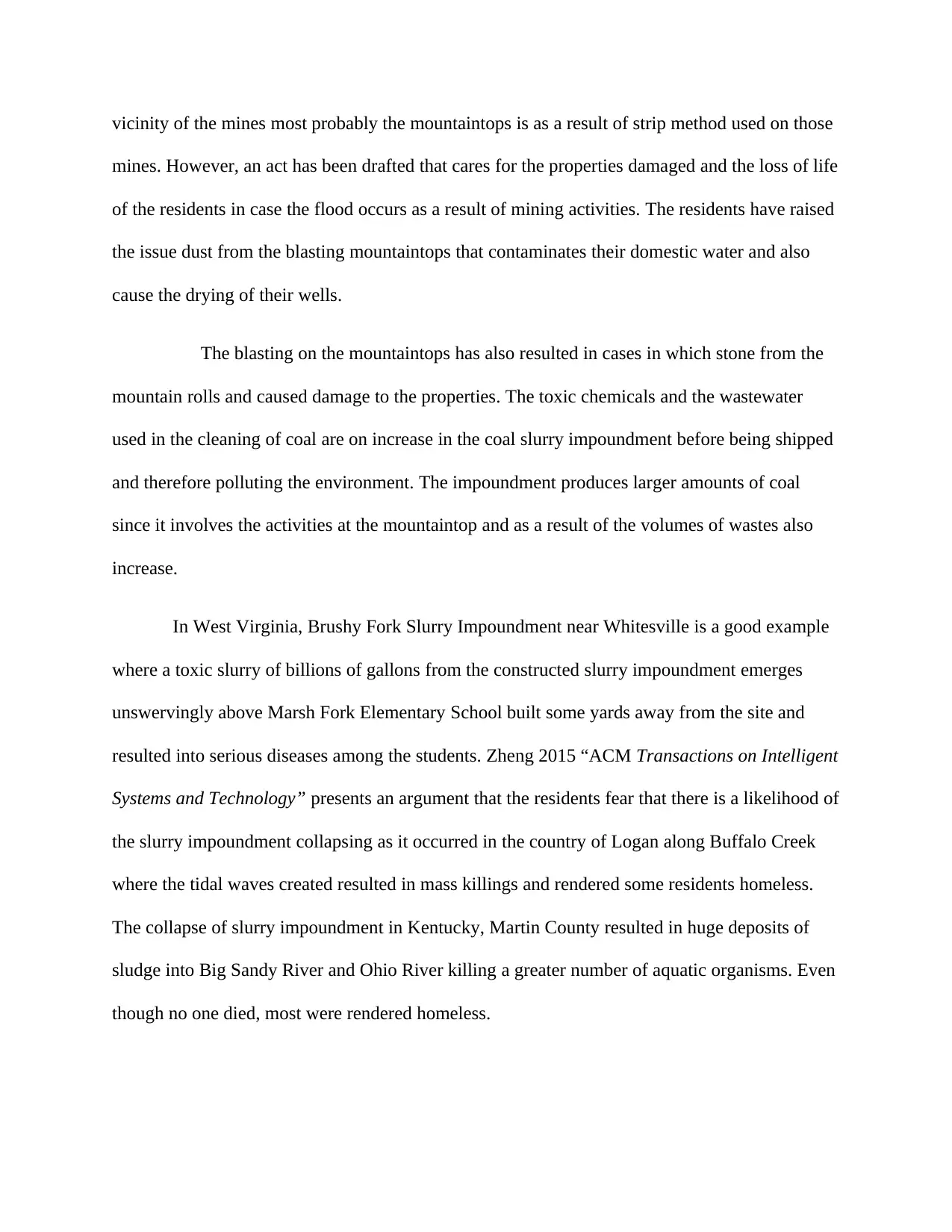
vicinity of the mines most probably the mountaintops is as a result of strip method used on those
mines. However, an act has been drafted that cares for the properties damaged and the loss of life
of the residents in case the flood occurs as a result of mining activities. The residents have raised
the issue dust from the blasting mountaintops that contaminates their domestic water and also
cause the drying of their wells.
The blasting on the mountaintops has also resulted in cases in which stone from the
mountain rolls and caused damage to the properties. The toxic chemicals and the wastewater
used in the cleaning of coal are on increase in the coal slurry impoundment before being shipped
and therefore polluting the environment. The impoundment produces larger amounts of coal
since it involves the activities at the mountaintop and as a result of the volumes of wastes also
increase.
In West Virginia, Brushy Fork Slurry Impoundment near Whitesville is a good example
where a toxic slurry of billions of gallons from the constructed slurry impoundment emerges
unswervingly above Marsh Fork Elementary School built some yards away from the site and
resulted into serious diseases among the students. Zheng 2015 “ACM Transactions on Intelligent
Systems and Technology” presents an argument that the residents fear that there is a likelihood of
the slurry impoundment collapsing as it occurred in the country of Logan along Buffalo Creek
where the tidal waves created resulted in mass killings and rendered some residents homeless.
The collapse of slurry impoundment in Kentucky, Martin County resulted in huge deposits of
sludge into Big Sandy River and Ohio River killing a greater number of aquatic organisms. Even
though no one died, most were rendered homeless.
Document Page
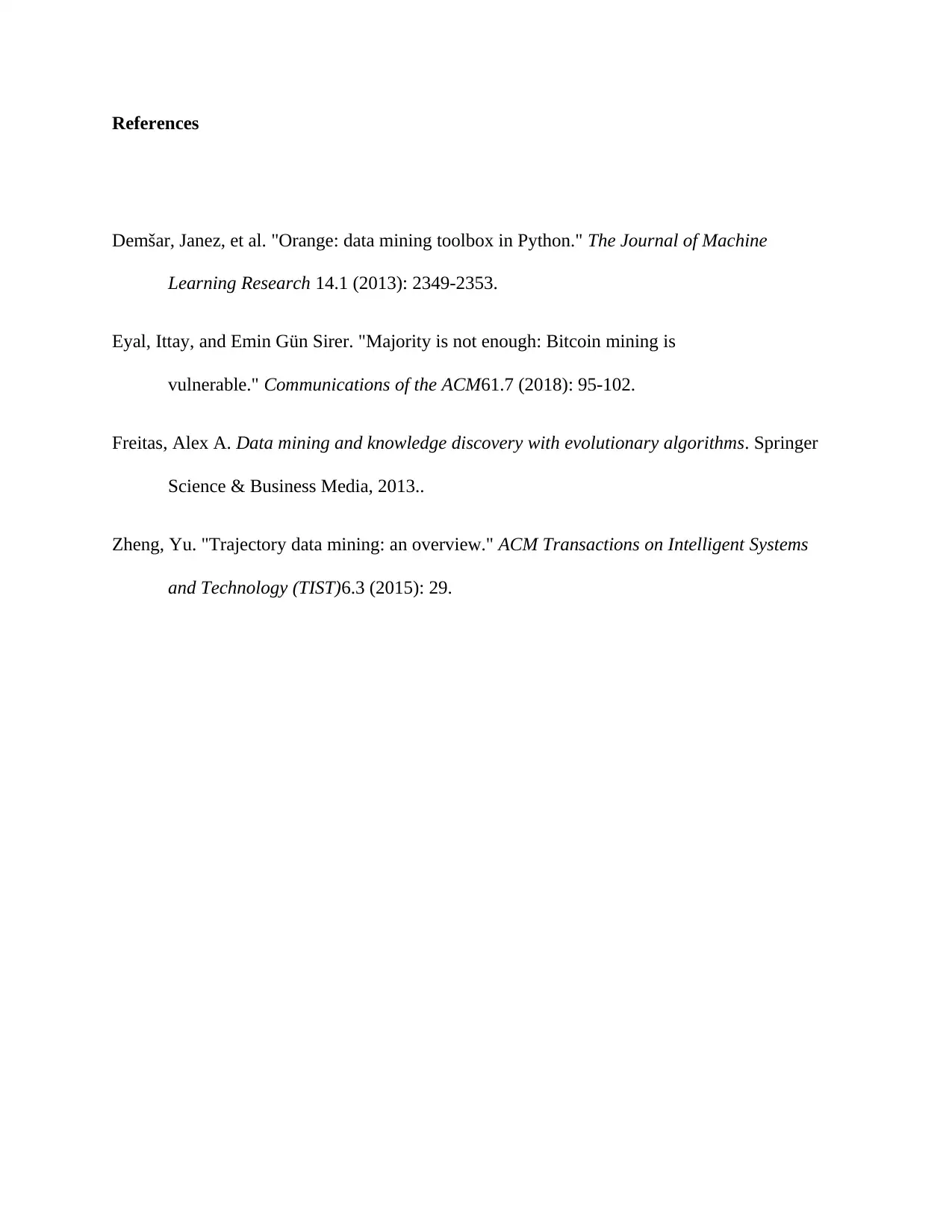
References
Demšar, Janez, et al. "Orange: data mining toolbox in Python." The Journal of Machine
Learning Research 14.1 (2013): 2349-2353.
Eyal, Ittay, and Emin Gün Sirer. "Majority is not enough: Bitcoin mining is
vulnerable." Communications of the ACM61.7 (2018): 95-102.
Freitas, Alex A. Data mining and knowledge discovery with evolutionary algorithms. Springer
Science & Business Media, 2013..
Zheng, Yu. "Trajectory data mining: an overview." ACM Transactions on Intelligent Systems
and Technology (TIST)6.3 (2015): 29.
chevron_up_icon
1 out of 4
circle_padding
hide_on_mobile
zoom_out_icon
[object Object]