MPA Case Study Analysis
VerifiedAdded on 2020/02/24
|7
|1941
|319
Case Study
AI Summary
This case study examines two legal scenarios involving contracts and guarantors. The first scenario discusses the breach of contract between two friends, Rahul and Saurav, where Saurav withdraws from an agreement to buy a plane. The second scenario involves a mother who guaranteed her son's business loan with her home, highlighting the legal implications of guarantor obligations and the necessity for clear communication from banks. The study emphasizes the importance of understanding legal rights in contractual agreements and the potential consequences of breaches.
Running head: MPA 1
MPA
Name:
Institutional Affiliation:
MPA
Name:
Institutional Affiliation:

Paraphrase This Document
Need a fresh take? Get an instant paraphrase of this document with our AI Paraphraser
MPA 2
MPA
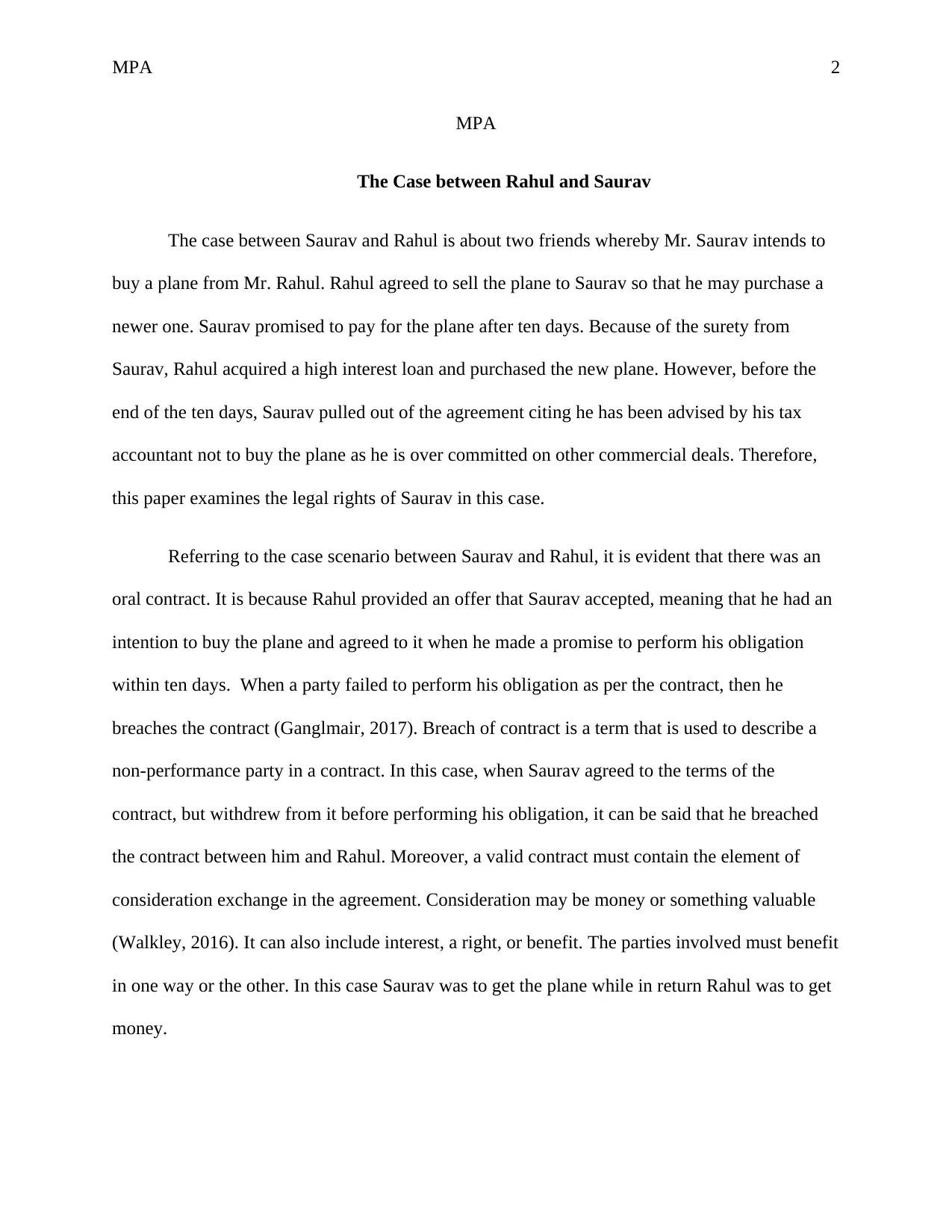
The Case between Rahul and Saurav
The case between Saurav and Rahul is about two friends whereby Mr. Saurav intends to
buy a plane from Mr. Rahul. Rahul agreed to sell the plane to Saurav so that he may purchase a
newer one. Saurav promised to pay for the plane after ten days. Because of the surety from
Saurav, Rahul acquired a high interest loan and purchased the new plane. However, before the
end of the ten days, Saurav pulled out of the agreement citing he has been advised by his tax
accountant not to buy the plane as he is over committed on other commercial deals. Therefore,
this paper examines the legal rights of Saurav in this case.
Referring to the case scenario between Saurav and Rahul, it is evident that there was an
oral contract. It is because Rahul provided an offer that Saurav accepted, meaning that he had an
intention to buy the plane and agreed to it when he made a promise to perform his obligation
within ten days. When a party failed to perform his obligation as per the contract, then he
breaches the contract (Ganglmair, 2017). Breach of contract is a term that is used to describe a
non-performance party in a contract. In this case, when Saurav agreed to the terms of the
contract, but withdrew from it before performing his obligation, it can be said that he breached
the contract between him and Rahul. Moreover, a valid contract must contain the element of
consideration exchange in the agreement. Consideration may be money or something valuable
(Walkley, 2016). It can also include interest, a right, or benefit. The parties involved must benefit
in one way or the other. In this case Saurav was to get the plane while in return Rahul was to get
money.
MPA
The Case between Rahul and Saurav
The case between Saurav and Rahul is about two friends whereby Mr. Saurav intends to
buy a plane from Mr. Rahul. Rahul agreed to sell the plane to Saurav so that he may purchase a
newer one. Saurav promised to pay for the plane after ten days. Because of the surety from
Saurav, Rahul acquired a high interest loan and purchased the new plane. However, before the
end of the ten days, Saurav pulled out of the agreement citing he has been advised by his tax
accountant not to buy the plane as he is over committed on other commercial deals. Therefore,
this paper examines the legal rights of Saurav in this case.
Referring to the case scenario between Saurav and Rahul, it is evident that there was an
oral contract. It is because Rahul provided an offer that Saurav accepted, meaning that he had an
intention to buy the plane and agreed to it when he made a promise to perform his obligation
within ten days. When a party failed to perform his obligation as per the contract, then he
breaches the contract (Ganglmair, 2017). Breach of contract is a term that is used to describe a
non-performance party in a contract. In this case, when Saurav agreed to the terms of the
contract, but withdrew from it before performing his obligation, it can be said that he breached
the contract between him and Rahul. Moreover, a valid contract must contain the element of
consideration exchange in the agreement. Consideration may be money or something valuable
(Walkley, 2016). It can also include interest, a right, or benefit. The parties involved must benefit
in one way or the other. In this case Saurav was to get the plane while in return Rahul was to get
money.
MPA 3
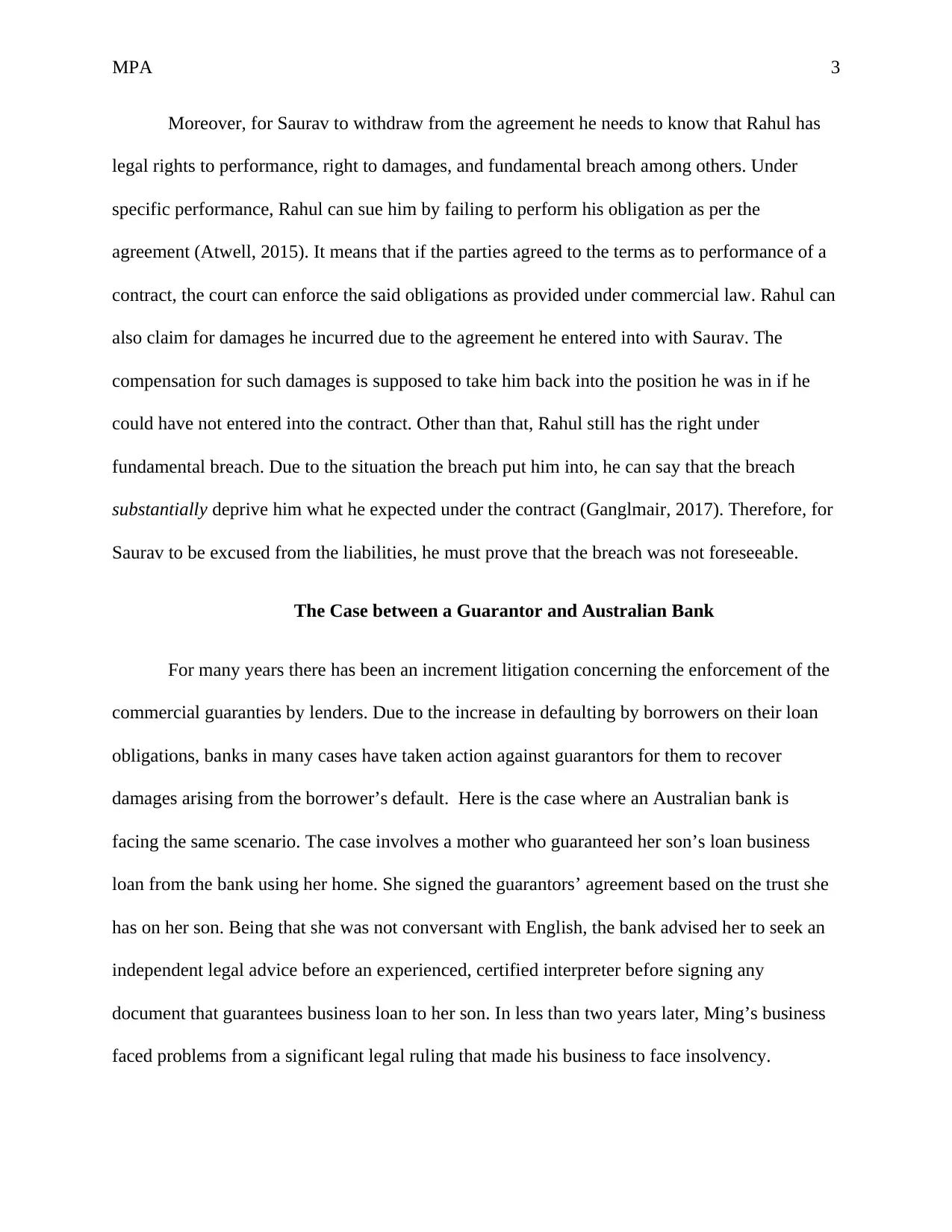
Moreover, for Saurav to withdraw from the agreement he needs to know that Rahul has
legal rights to performance, right to damages, and fundamental breach among others. Under
specific performance, Rahul can sue him by failing to perform his obligation as per the
agreement (Atwell, 2015). It means that if the parties agreed to the terms as to performance of a
contract, the court can enforce the said obligations as provided under commercial law. Rahul can
also claim for damages he incurred due to the agreement he entered into with Saurav. The
compensation for such damages is supposed to take him back into the position he was in if he
could have not entered into the contract. Other than that, Rahul still has the right under
fundamental breach. Due to the situation the breach put him into, he can say that the breach
substantially deprive him what he expected under the contract (Ganglmair, 2017). Therefore, for
Saurav to be excused from the liabilities, he must prove that the breach was not foreseeable.
The Case between a Guarantor and Australian Bank
For many years there has been an increment litigation concerning the enforcement of the
commercial guaranties by lenders. Due to the increase in defaulting by borrowers on their loan
obligations, banks in many cases have taken action against guarantors for them to recover
damages arising from the borrower’s default. Here is the case where an Australian bank is
facing the same scenario. The case involves a mother who guaranteed her son’s loan business
loan from the bank using her home. She signed the guarantors’ agreement based on the trust she
has on her son. Being that she was not conversant with English, the bank advised her to seek an
independent legal advice before an experienced, certified interpreter before signing any
document that guarantees business loan to her son. In less than two years later, Ming’s business
faced problems from a significant legal ruling that made his business to face insolvency.
Moreover, for Saurav to withdraw from the agreement he needs to know that Rahul has
legal rights to performance, right to damages, and fundamental breach among others. Under
specific performance, Rahul can sue him by failing to perform his obligation as per the
agreement (Atwell, 2015). It means that if the parties agreed to the terms as to performance of a
contract, the court can enforce the said obligations as provided under commercial law. Rahul can
also claim for damages he incurred due to the agreement he entered into with Saurav. The
compensation for such damages is supposed to take him back into the position he was in if he
could have not entered into the contract. Other than that, Rahul still has the right under
fundamental breach. Due to the situation the breach put him into, he can say that the breach
substantially deprive him what he expected under the contract (Ganglmair, 2017). Therefore, for
Saurav to be excused from the liabilities, he must prove that the breach was not foreseeable.
The Case between a Guarantor and Australian Bank
For many years there has been an increment litigation concerning the enforcement of the
commercial guaranties by lenders. Due to the increase in defaulting by borrowers on their loan
obligations, banks in many cases have taken action against guarantors for them to recover
damages arising from the borrower’s default. Here is the case where an Australian bank is
facing the same scenario. The case involves a mother who guaranteed her son’s loan business
loan from the bank using her home. She signed the guarantors’ agreement based on the trust she
has on her son. Being that she was not conversant with English, the bank advised her to seek an
independent legal advice before an experienced, certified interpreter before signing any
document that guarantees business loan to her son. In less than two years later, Ming’s business
faced problems from a significant legal ruling that made his business to face insolvency.
⊘ This is a preview!⊘
Do you want full access?
Subscribe today to unlock all pages.

Trusted by 1+ million students worldwide
MPA 4
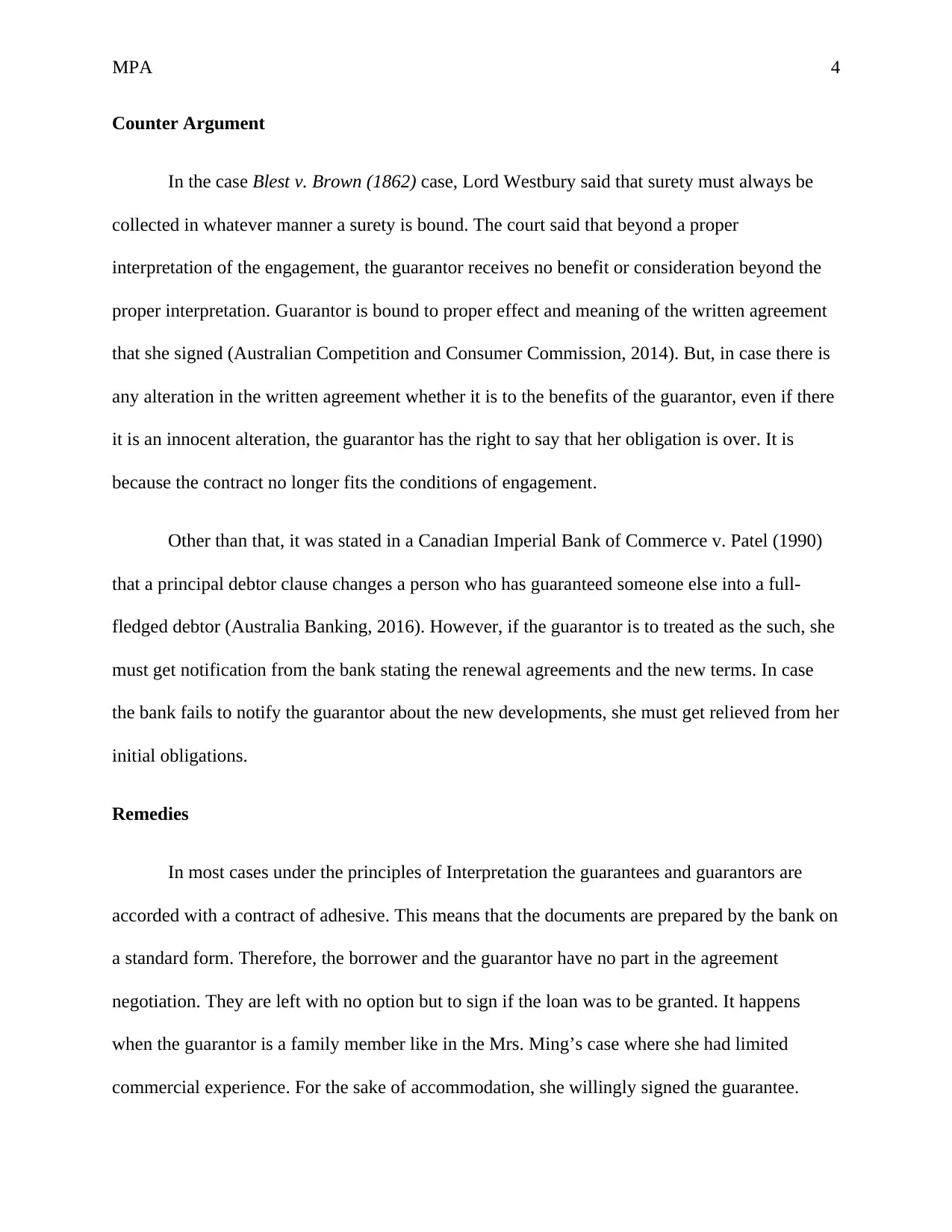
Counter Argument
In the case Blest v. Brown (1862) case, Lord Westbury said that surety must always be
collected in whatever manner a surety is bound. The court said that beyond a proper
interpretation of the engagement, the guarantor receives no benefit or consideration beyond the
proper interpretation. Guarantor is bound to proper effect and meaning of the written agreement
that she signed (Australian Competition and Consumer Commission, 2014). But, in case there is
any alteration in the written agreement whether it is to the benefits of the guarantor, even if there
it is an innocent alteration, the guarantor has the right to say that her obligation is over. It is
because the contract no longer fits the conditions of engagement.
Other than that, it was stated in a Canadian Imperial Bank of Commerce v. Patel (1990)
that a principal debtor clause changes a person who has guaranteed someone else into a full-
fledged debtor (Australia Banking, 2016). However, if the guarantor is to treated as the such, she
must get notification from the bank stating the renewal agreements and the new terms. In case
the bank fails to notify the guarantor about the new developments, she must get relieved from her
initial obligations.
Remedies
In most cases under the principles of Interpretation the guarantees and guarantors are
accorded with a contract of adhesive. This means that the documents are prepared by the bank on
a standard form. Therefore, the borrower and the guarantor have no part in the agreement
negotiation. They are left with no option but to sign if the loan was to be granted. It happens
when the guarantor is a family member like in the Mrs. Ming’s case where she had limited
commercial experience. For the sake of accommodation, she willingly signed the guarantee.
Counter Argument
In the case Blest v. Brown (1862) case, Lord Westbury said that surety must always be
collected in whatever manner a surety is bound. The court said that beyond a proper
interpretation of the engagement, the guarantor receives no benefit or consideration beyond the
proper interpretation. Guarantor is bound to proper effect and meaning of the written agreement
that she signed (Australian Competition and Consumer Commission, 2014). But, in case there is
any alteration in the written agreement whether it is to the benefits of the guarantor, even if there
it is an innocent alteration, the guarantor has the right to say that her obligation is over. It is
because the contract no longer fits the conditions of engagement.
Other than that, it was stated in a Canadian Imperial Bank of Commerce v. Patel (1990)
that a principal debtor clause changes a person who has guaranteed someone else into a full-
fledged debtor (Australia Banking, 2016). However, if the guarantor is to treated as the such, she
must get notification from the bank stating the renewal agreements and the new terms. In case
the bank fails to notify the guarantor about the new developments, she must get relieved from her
initial obligations.
Remedies
In most cases under the principles of Interpretation the guarantees and guarantors are
accorded with a contract of adhesive. This means that the documents are prepared by the bank on
a standard form. Therefore, the borrower and the guarantor have no part in the agreement
negotiation. They are left with no option but to sign if the loan was to be granted. It happens
when the guarantor is a family member like in the Mrs. Ming’s case where she had limited
commercial experience. For the sake of accommodation, she willingly signed the guarantee.
Paraphrase This Document
Need a fresh take? Get an instant paraphrase of this document with our AI Paraphraser
MPA 5
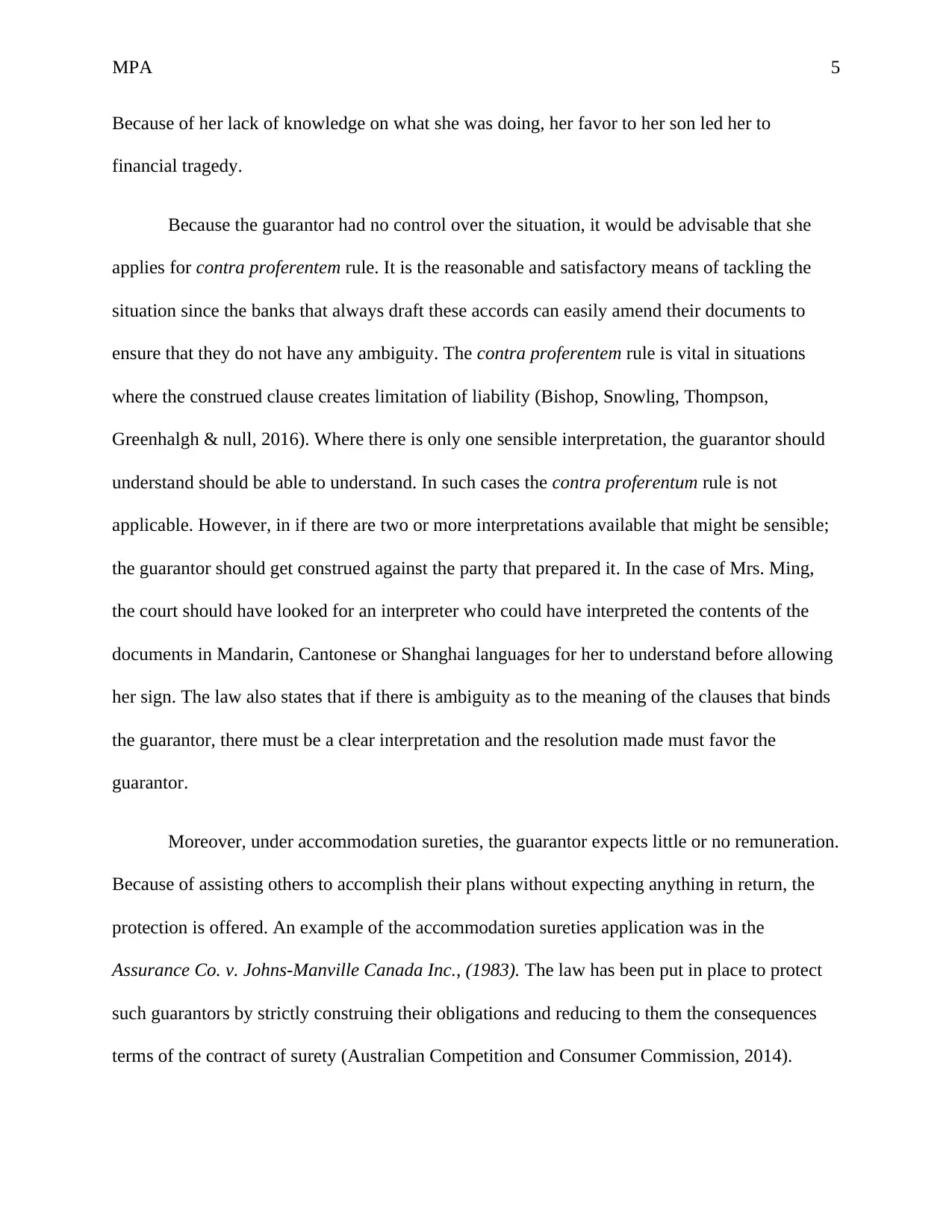
Because of her lack of knowledge on what she was doing, her favor to her son led her to
financial tragedy.
Because the guarantor had no control over the situation, it would be advisable that she
applies for contra proferentem rule. It is the reasonable and satisfactory means of tackling the
situation since the banks that always draft these accords can easily amend their documents to
ensure that they do not have any ambiguity. The contra proferentem rule is vital in situations
where the construed clause creates limitation of liability (Bishop, Snowling, Thompson,
Greenhalgh & null, 2016). Where there is only one sensible interpretation, the guarantor should
understand should be able to understand. In such cases the contra proferentum rule is not
applicable. However, in if there are two or more interpretations available that might be sensible;
the guarantor should get construed against the party that prepared it. In the case of Mrs. Ming,
the court should have looked for an interpreter who could have interpreted the contents of the
documents in Mandarin, Cantonese or Shanghai languages for her to understand before allowing
her sign. The law also states that if there is ambiguity as to the meaning of the clauses that binds
the guarantor, there must be a clear interpretation and the resolution made must favor the
guarantor.
Moreover, under accommodation sureties, the guarantor expects little or no remuneration.
Because of assisting others to accomplish their plans without expecting anything in return, the
protection is offered. An example of the accommodation sureties application was in the
Assurance Co. v. Johns-Manville Canada Inc., (1983). The law has been put in place to protect
such guarantors by strictly construing their obligations and reducing to them the consequences
terms of the contract of surety (Australian Competition and Consumer Commission, 2014).
Because of her lack of knowledge on what she was doing, her favor to her son led her to
financial tragedy.
Because the guarantor had no control over the situation, it would be advisable that she
applies for contra proferentem rule. It is the reasonable and satisfactory means of tackling the
situation since the banks that always draft these accords can easily amend their documents to
ensure that they do not have any ambiguity. The contra proferentem rule is vital in situations
where the construed clause creates limitation of liability (Bishop, Snowling, Thompson,
Greenhalgh & null, 2016). Where there is only one sensible interpretation, the guarantor should
understand should be able to understand. In such cases the contra proferentum rule is not
applicable. However, in if there are two or more interpretations available that might be sensible;
the guarantor should get construed against the party that prepared it. In the case of Mrs. Ming,
the court should have looked for an interpreter who could have interpreted the contents of the
documents in Mandarin, Cantonese or Shanghai languages for her to understand before allowing
her sign. The law also states that if there is ambiguity as to the meaning of the clauses that binds
the guarantor, there must be a clear interpretation and the resolution made must favor the
guarantor.
Moreover, under accommodation sureties, the guarantor expects little or no remuneration.
Because of assisting others to accomplish their plans without expecting anything in return, the
protection is offered. An example of the accommodation sureties application was in the
Assurance Co. v. Johns-Manville Canada Inc., (1983). The law has been put in place to protect
such guarantors by strictly construing their obligations and reducing to them the consequences
terms of the contract of surety (Australian Competition and Consumer Commission, 2014).
MPA 6
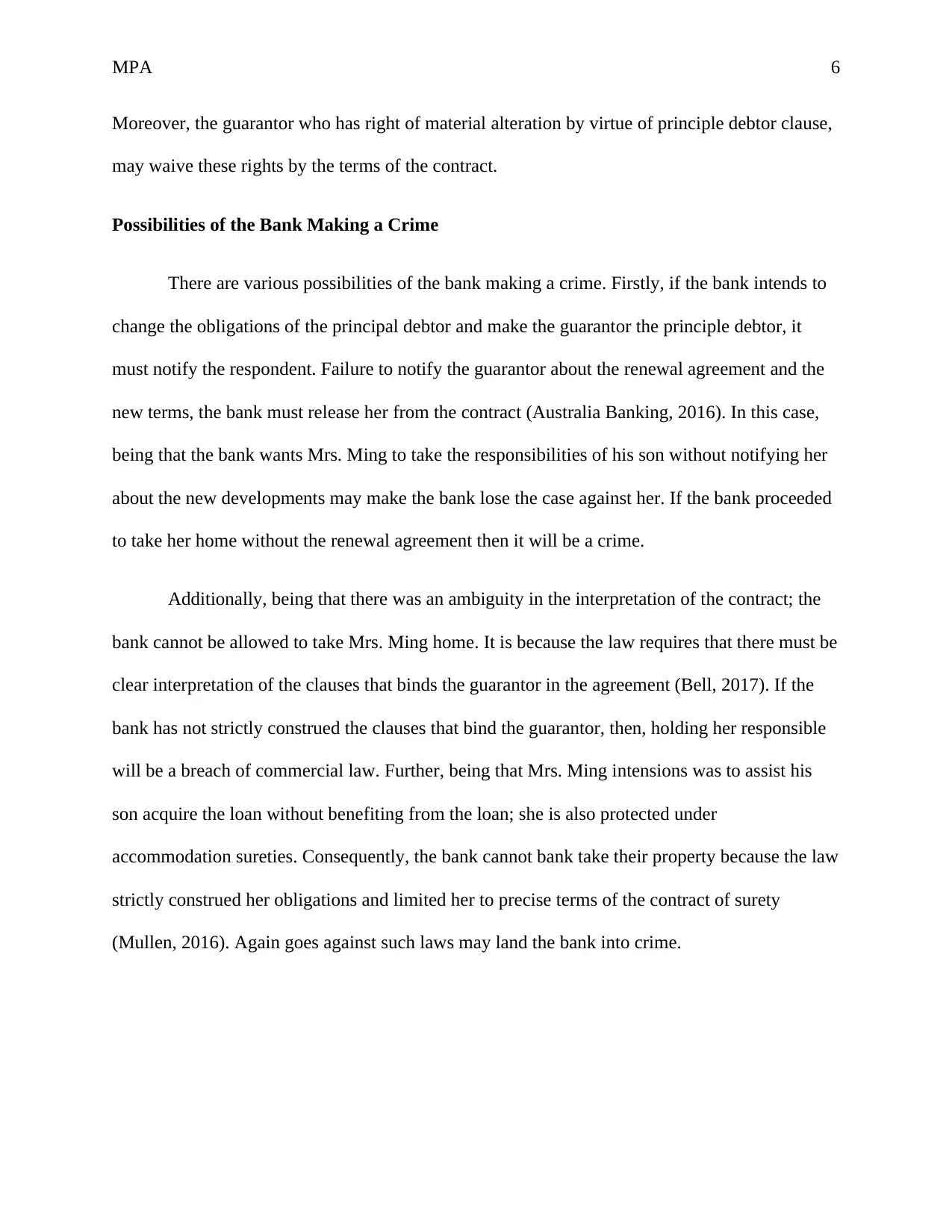
Moreover, the guarantor who has right of material alteration by virtue of principle debtor clause,
may waive these rights by the terms of the contract.
Possibilities of the Bank Making a Crime
There are various possibilities of the bank making a crime. Firstly, if the bank intends to
change the obligations of the principal debtor and make the guarantor the principle debtor, it
must notify the respondent. Failure to notify the guarantor about the renewal agreement and the
new terms, the bank must release her from the contract (Australia Banking, 2016). In this case,
being that the bank wants Mrs. Ming to take the responsibilities of his son without notifying her
about the new developments may make the bank lose the case against her. If the bank proceeded
to take her home without the renewal agreement then it will be a crime.
Additionally, being that there was an ambiguity in the interpretation of the contract; the
bank cannot be allowed to take Mrs. Ming home. It is because the law requires that there must be
clear interpretation of the clauses that binds the guarantor in the agreement (Bell, 2017). If the
bank has not strictly construed the clauses that bind the guarantor, then, holding her responsible
will be a breach of commercial law. Further, being that Mrs. Ming intensions was to assist his
son acquire the loan without benefiting from the loan; she is also protected under
accommodation sureties. Consequently, the bank cannot bank take their property because the law
strictly construed her obligations and limited her to precise terms of the contract of surety
(Mullen, 2016). Again goes against such laws may land the bank into crime.
Moreover, the guarantor who has right of material alteration by virtue of principle debtor clause,
may waive these rights by the terms of the contract.
Possibilities of the Bank Making a Crime
There are various possibilities of the bank making a crime. Firstly, if the bank intends to
change the obligations of the principal debtor and make the guarantor the principle debtor, it
must notify the respondent. Failure to notify the guarantor about the renewal agreement and the
new terms, the bank must release her from the contract (Australia Banking, 2016). In this case,
being that the bank wants Mrs. Ming to take the responsibilities of his son without notifying her
about the new developments may make the bank lose the case against her. If the bank proceeded
to take her home without the renewal agreement then it will be a crime.
Additionally, being that there was an ambiguity in the interpretation of the contract; the
bank cannot be allowed to take Mrs. Ming home. It is because the law requires that there must be
clear interpretation of the clauses that binds the guarantor in the agreement (Bell, 2017). If the
bank has not strictly construed the clauses that bind the guarantor, then, holding her responsible
will be a breach of commercial law. Further, being that Mrs. Ming intensions was to assist his
son acquire the loan without benefiting from the loan; she is also protected under
accommodation sureties. Consequently, the bank cannot bank take their property because the law
strictly construed her obligations and limited her to precise terms of the contract of surety
(Mullen, 2016). Again goes against such laws may land the bank into crime.
⊘ This is a preview!⊘
Do you want full access?
Subscribe today to unlock all pages.
Trusted by 1+ million students worldwide
MPA 7
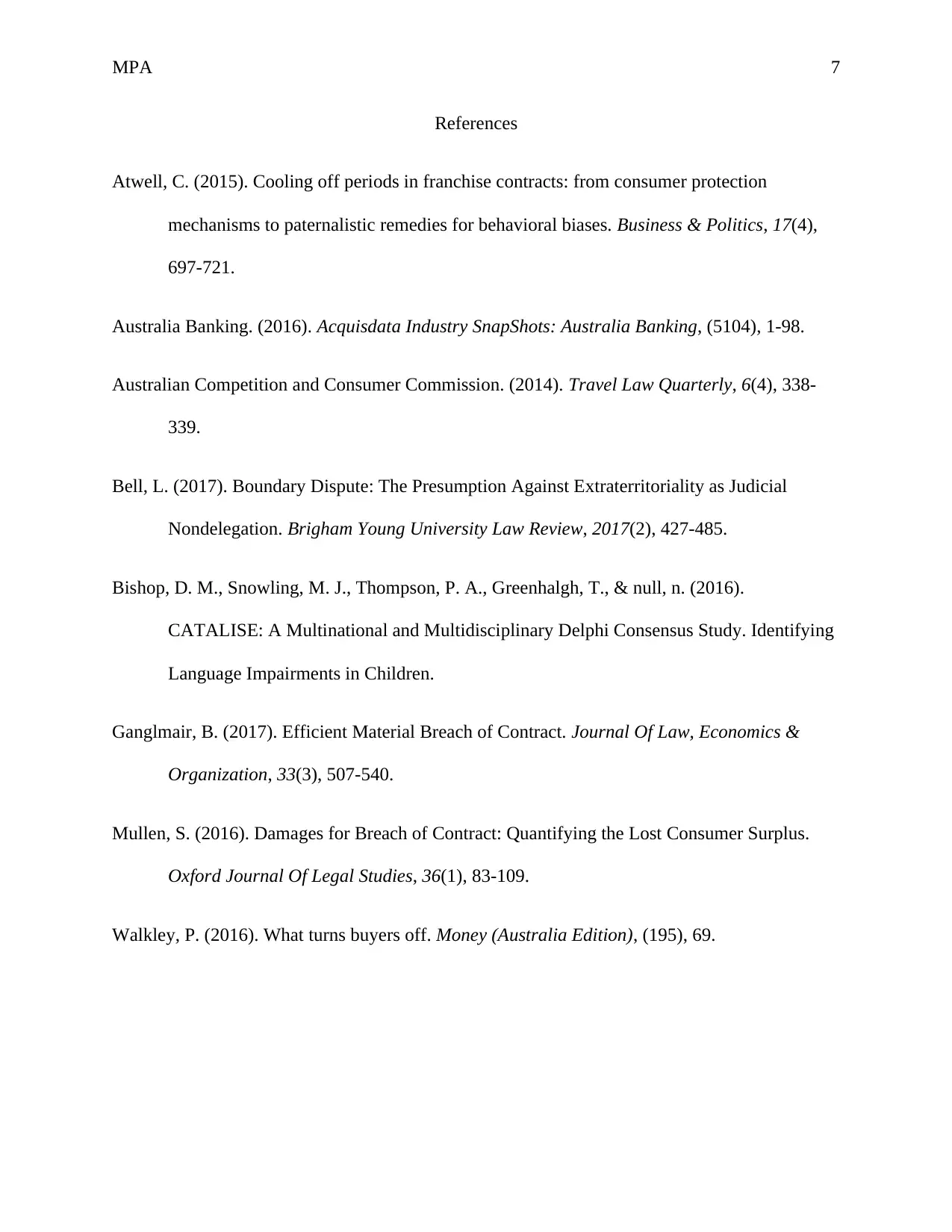
References
Atwell, C. (2015). Cooling off periods in franchise contracts: from consumer protection
mechanisms to paternalistic remedies for behavioral biases. Business & Politics, 17(4),
697-721.
Australia Banking. (2016). Acquisdata Industry SnapShots: Australia Banking, (5104), 1-98.
Australian Competition and Consumer Commission. (2014). Travel Law Quarterly, 6(4), 338-
339.
Bell, L. (2017). Boundary Dispute: The Presumption Against Extraterritoriality as Judicial
Nondelegation. Brigham Young University Law Review, 2017(2), 427-485.
Bishop, D. M., Snowling, M. J., Thompson, P. A., Greenhalgh, T., & null, n. (2016).
CATALISE: A Multinational and Multidisciplinary Delphi Consensus Study. Identifying
Language Impairments in Children.
Ganglmair, B. (2017). Efficient Material Breach of Contract. Journal Of Law, Economics &
Organization, 33(3), 507-540.
Mullen, S. (2016). Damages for Breach of Contract: Quantifying the Lost Consumer Surplus.
Oxford Journal Of Legal Studies, 36(1), 83-109.
Walkley, P. (2016). What turns buyers off. Money (Australia Edition), (195), 69.
References
Atwell, C. (2015). Cooling off periods in franchise contracts: from consumer protection
mechanisms to paternalistic remedies for behavioral biases. Business & Politics, 17(4),
697-721.
Australia Banking. (2016). Acquisdata Industry SnapShots: Australia Banking, (5104), 1-98.
Australian Competition and Consumer Commission. (2014). Travel Law Quarterly, 6(4), 338-
339.
Bell, L. (2017). Boundary Dispute: The Presumption Against Extraterritoriality as Judicial
Nondelegation. Brigham Young University Law Review, 2017(2), 427-485.
Bishop, D. M., Snowling, M. J., Thompson, P. A., Greenhalgh, T., & null, n. (2016).
CATALISE: A Multinational and Multidisciplinary Delphi Consensus Study. Identifying
Language Impairments in Children.
Ganglmair, B. (2017). Efficient Material Breach of Contract. Journal Of Law, Economics &
Organization, 33(3), 507-540.
Mullen, S. (2016). Damages for Breach of Contract: Quantifying the Lost Consumer Surplus.
Oxford Journal Of Legal Studies, 36(1), 83-109.
Walkley, P. (2016). What turns buyers off. Money (Australia Edition), (195), 69.

1 out of 7


Related Documents


Your All-in-One AI-Powered Toolkit for Academic Success.
+13062052269
info@desklib.com
Available 24*7 on WhatsApp / Email
![[object Object]](/_next/static/media/star-bottom.7253800d.svg)
Unlock your academic potential
Copyright © 2020–2026 A2Z Services. All Rights Reserved. Developed and managed by ZUCOL.