NUR341 Case Study: Assessment, Planning, and Bio-psychosocial Approach
VerifiedAdded on 2023/01/07
|9
|2668
|96
Case Study
AI Summary
This case study, focusing on a 71-year-old man named Mr. Jungala, details his health challenges following a fall, including alcohol withdrawal risks, cognitive and functional assessments, and nutritional needs. The assignment provides a comprehensive analysis of his condition, including assessments for falls, cognition, and nutrition, and the development of a care plan. It emphasizes the importance of a bio-psychosocial approach, considering his perception, support systems, and coping mechanisms. The plan involves addressing his alcohol consumption, promoting physical activity, and ensuring a balanced diet. The rationale for the assessment highlights the need for managing patient well-being, planning for a healthy lifestyle, and considering the patient's mental, physical, and social well-being. The case study underscores the necessity of a holistic approach to patient care, emphasizing the interconnectedness of physical, psychological, and social factors in promoting recovery and a healthy lifestyle.
Case study NUR341

Paraphrase This Document
Need a fresh take? Get an instant paraphrase of this document with our AI Paraphraser
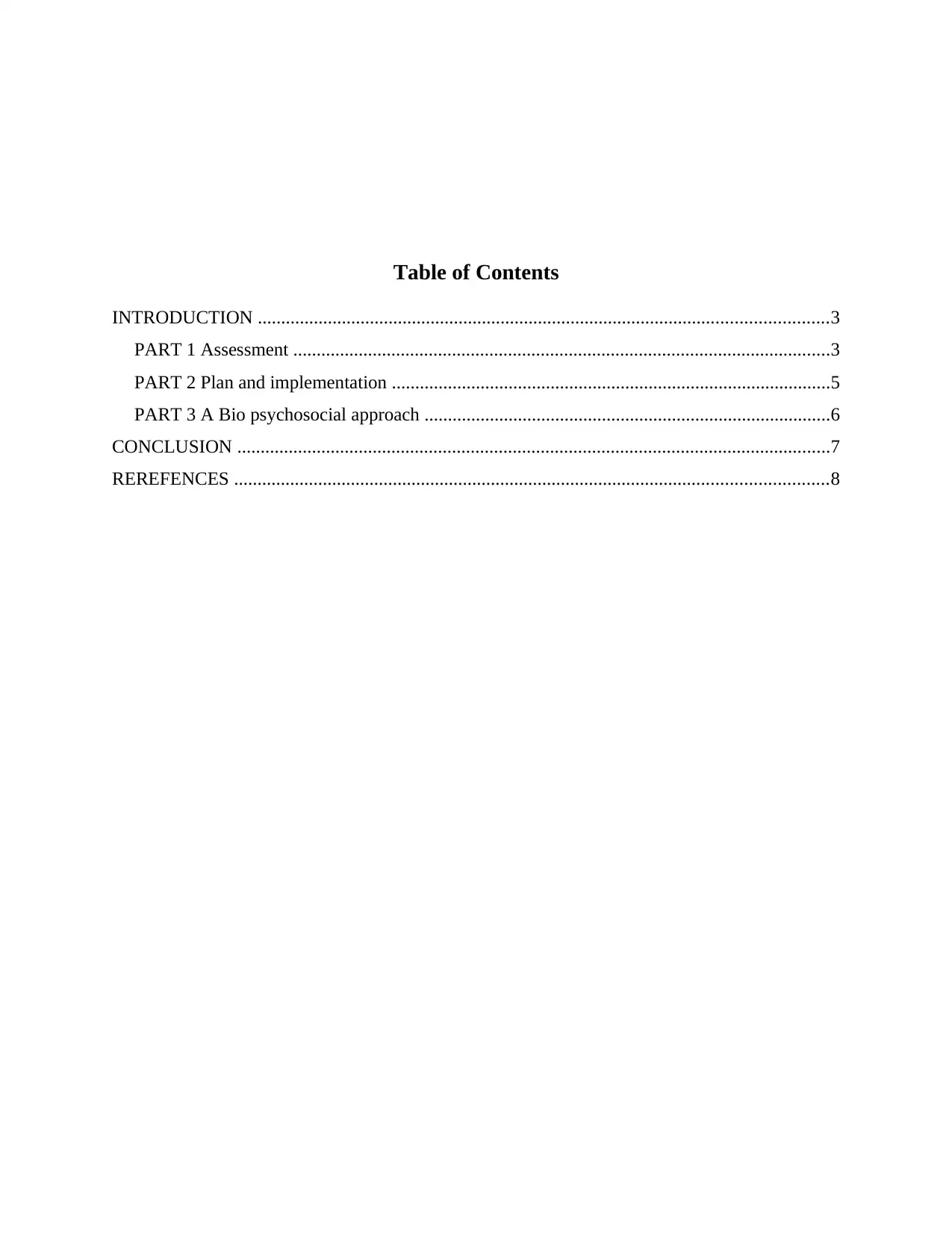
Table of Contents
INTRODUCTION ..........................................................................................................................3
PART 1 Assessment ...................................................................................................................3
PART 2 Plan and implementation ..............................................................................................5
PART 3 A Bio psychosocial approach .......................................................................................6
CONCLUSION ...............................................................................................................................7
REREFENCES ...............................................................................................................................8
INTRODUCTION ..........................................................................................................................3
PART 1 Assessment ...................................................................................................................3
PART 2 Plan and implementation ..............................................................................................5
PART 3 A Bio psychosocial approach .......................................................................................6
CONCLUSION ...............................................................................................................................7
REREFENCES ...............................................................................................................................8
INTRODUCTION
There are different health conditions from which people suffer. This is important for
nurses to analyse the health condition properly so that patients will be treated effectively. There
is need for managing the patient and provide him best care and treatment. In the following
project, there are three tasks (Balmer, 2020)). First is related with assessment of Mr Jungala who
is a 71 year old man having problem in hip as he fell down because of Tonker Truck. Second
assessment is about cause of fall and third is about Bio psychosocial approach.
PART 1 Assessment
After analysing the situation of Mr Jungala, it is concluded by hospital that there are
following problems diagnosed. Some of the issues are to be managed properly so that Mr.
Jungala is doing fine in his life.
Alcohol withdrawal risk assessment – Alcohol is a global problem and it affects lives of
different individuals. There is need for hospital management to provide awareness so that Mr
Jungala will not consume excessive alcohol. The symptoms of alcohol withdrawal occurs as
alcohol is known as a depressant for central nervous system. This also enhances inhibitory tone
that is used in the initial diagnose of alcohol dependence (Salthouse, 2010). Mr Jungala is
suffering from alcohol syndrome and thus there is constant presence of ethanol preserves
homoeostasis. Gamma aminobutyric acid is the inhibitory neurotransmitter in brain and it is
required for maintaining alcohol naïve individuals like Mr Jungala. There are few syndromes
present within alcohol withdrawal that includes insomnia, diaphoresis, palpitations, mild anxiety,
headache, etc. These symptoms are determined from typical onset of withdrawal seizures. It is
essential for hospital management that they are treating Mr Jungala effectively and they are able
to help him stay away from alcohol (Farota-Romejko, and Ferry, 2020)).It is concluded that Mr
Jungala is drinking more than his capacity. He is a 71 year old man and still he drinks 2 or 3
beers every week. This has negative impact on health of Mr. Jungala and it results in his flipping
and falls.
Cognitive assessment – These are known as individuals who are having memory concerns or any
other cognitive complaints. There are some non memory triggers such as depression, personality
change, deterioration of chronic disease. It is seen that Mr Jungala is not having any cognitive
There are different health conditions from which people suffer. This is important for
nurses to analyse the health condition properly so that patients will be treated effectively. There
is need for managing the patient and provide him best care and treatment. In the following
project, there are three tasks (Balmer, 2020)). First is related with assessment of Mr Jungala who
is a 71 year old man having problem in hip as he fell down because of Tonker Truck. Second
assessment is about cause of fall and third is about Bio psychosocial approach.
PART 1 Assessment
After analysing the situation of Mr Jungala, it is concluded by hospital that there are
following problems diagnosed. Some of the issues are to be managed properly so that Mr.
Jungala is doing fine in his life.
Alcohol withdrawal risk assessment – Alcohol is a global problem and it affects lives of
different individuals. There is need for hospital management to provide awareness so that Mr
Jungala will not consume excessive alcohol. The symptoms of alcohol withdrawal occurs as
alcohol is known as a depressant for central nervous system. This also enhances inhibitory tone
that is used in the initial diagnose of alcohol dependence (Salthouse, 2010). Mr Jungala is
suffering from alcohol syndrome and thus there is constant presence of ethanol preserves
homoeostasis. Gamma aminobutyric acid is the inhibitory neurotransmitter in brain and it is
required for maintaining alcohol naïve individuals like Mr Jungala. There are few syndromes
present within alcohol withdrawal that includes insomnia, diaphoresis, palpitations, mild anxiety,
headache, etc. These symptoms are determined from typical onset of withdrawal seizures. It is
essential for hospital management that they are treating Mr Jungala effectively and they are able
to help him stay away from alcohol (Farota-Romejko, and Ferry, 2020)).It is concluded that Mr
Jungala is drinking more than his capacity. He is a 71 year old man and still he drinks 2 or 3
beers every week. This has negative impact on health of Mr. Jungala and it results in his flipping
and falls.
Cognitive assessment – These are known as individuals who are having memory concerns or any
other cognitive complaints. There are some non memory triggers such as depression, personality
change, deterioration of chronic disease. It is seen that Mr Jungala is not having any cognitive
⊘ This is a preview!⊘
Do you want full access?
Subscribe today to unlock all pages.

Trusted by 1+ million students worldwide
problem. As it is seen there is no problem with this person. He is not having any problem with
memory loss or Alzheimer. There are some cognitive assessment tools which are used by
hospital management for identifying the need of additional evaluation. Dementia evaluation is
conducted on Mr. Jungala for knowing whether he is safe or not. A mini-cog test is conducted
for Mr Jungala. This includes recalling test for memory and a scored clock drawing test. This is
effectively used after brief training by the health provider. There are no problems of memory
with this person and he is totally fine.
Falls assessment – This is done in case where patient has fallen and having problem. This is not
required if the person is unconscious or he is unable to move independently in bed. If Mr Jungala
was at high risk, nurses have to take proper care and provide effective service. There is need of
creating a document care plan within 24 hours and this is developed for maintaining safety and
reducing risk (He, and et.al 2020). A care plan is developed when there is fall or near miss. This
is also considered when there is significant change in physical health of Mr. Jungala. As there is
no cognition or mental problem with this person, he is fine and proper medication is appropriate
for Mr Jungala's health. Within one week of assessment, the plan is developed and this is used
for providing assistance and maintaining safety at the time of treatment. There is re-assessment
which is used during a fall. As Mr Jungala is more than 65 years then he should be assessed
immediately (Burkhardt, and et.al, 2020). If he is unable to move independently, it signifies great
problem. Within the hospital management, it is seen that services are provided effectively for
assessing the cognitive behaviour of Mr. Jungala. This is dependent upon the nature of
intervention, which means there is an exercise program which is reviewed and implemented in
proper manner. Mr Jungala is advised to manage the scenario and take care in future while
walking. Precautions have to be taken in order to stay fit again.
Functional assessment – This is defined as an objective of reviewing mobility, transferring of
skills, activities of daily living of an individual. These are associated with locomotion,
communication, self care, etc. As Mr Jungala is an adult person, it is concluded that there are
various screening techniques used for providing valuable clinical as well as psychosocial
information. This will help nurse for expediting efficient assessment of patients when there is
proper analysis of routine. Some of the instruments are assessed and caregiver has the
responsibility of analysing problem with Mr Jungala. He should be given good care and
treatment so that he can walk properly. A functional assessment is defined as multidimensional
memory loss or Alzheimer. There are some cognitive assessment tools which are used by
hospital management for identifying the need of additional evaluation. Dementia evaluation is
conducted on Mr. Jungala for knowing whether he is safe or not. A mini-cog test is conducted
for Mr Jungala. This includes recalling test for memory and a scored clock drawing test. This is
effectively used after brief training by the health provider. There are no problems of memory
with this person and he is totally fine.
Falls assessment – This is done in case where patient has fallen and having problem. This is not
required if the person is unconscious or he is unable to move independently in bed. If Mr Jungala
was at high risk, nurses have to take proper care and provide effective service. There is need of
creating a document care plan within 24 hours and this is developed for maintaining safety and
reducing risk (He, and et.al 2020). A care plan is developed when there is fall or near miss. This
is also considered when there is significant change in physical health of Mr. Jungala. As there is
no cognition or mental problem with this person, he is fine and proper medication is appropriate
for Mr Jungala's health. Within one week of assessment, the plan is developed and this is used
for providing assistance and maintaining safety at the time of treatment. There is re-assessment
which is used during a fall. As Mr Jungala is more than 65 years then he should be assessed
immediately (Burkhardt, and et.al, 2020). If he is unable to move independently, it signifies great
problem. Within the hospital management, it is seen that services are provided effectively for
assessing the cognitive behaviour of Mr. Jungala. This is dependent upon the nature of
intervention, which means there is an exercise program which is reviewed and implemented in
proper manner. Mr Jungala is advised to manage the scenario and take care in future while
walking. Precautions have to be taken in order to stay fit again.
Functional assessment – This is defined as an objective of reviewing mobility, transferring of
skills, activities of daily living of an individual. These are associated with locomotion,
communication, self care, etc. As Mr Jungala is an adult person, it is concluded that there are
various screening techniques used for providing valuable clinical as well as psychosocial
information. This will help nurse for expediting efficient assessment of patients when there is
proper analysis of routine. Some of the instruments are assessed and caregiver has the
responsibility of analysing problem with Mr Jungala. He should be given good care and
treatment so that he can walk properly. A functional assessment is defined as multidimensional
Paraphrase This Document
Need a fresh take? Get an instant paraphrase of this document with our AI Paraphraser
diagnostic process which is used for assessing medical condition of Mr Jungala. Information is
gathered and collected for developing a comprehensive plan which will affect future care
decisions. Self care is needed by Mr Jungala and he should be given information about different
ways to protect himself from any further pain or fall.
Nutritional assessment - It is very important for elder people to take balanced diet for managing
their good lifestyle (Burkhardt and et.al, 2020). Nutrition is one of the most important factor
which helps in developing the ability to bear pain and do the daily life activities. The
management of hospital has prepared diet chart that has to be followed by Mr Jungala in order to
stay fit and healthy. As he is not having cognitive problem, it is taken care that less oily food is
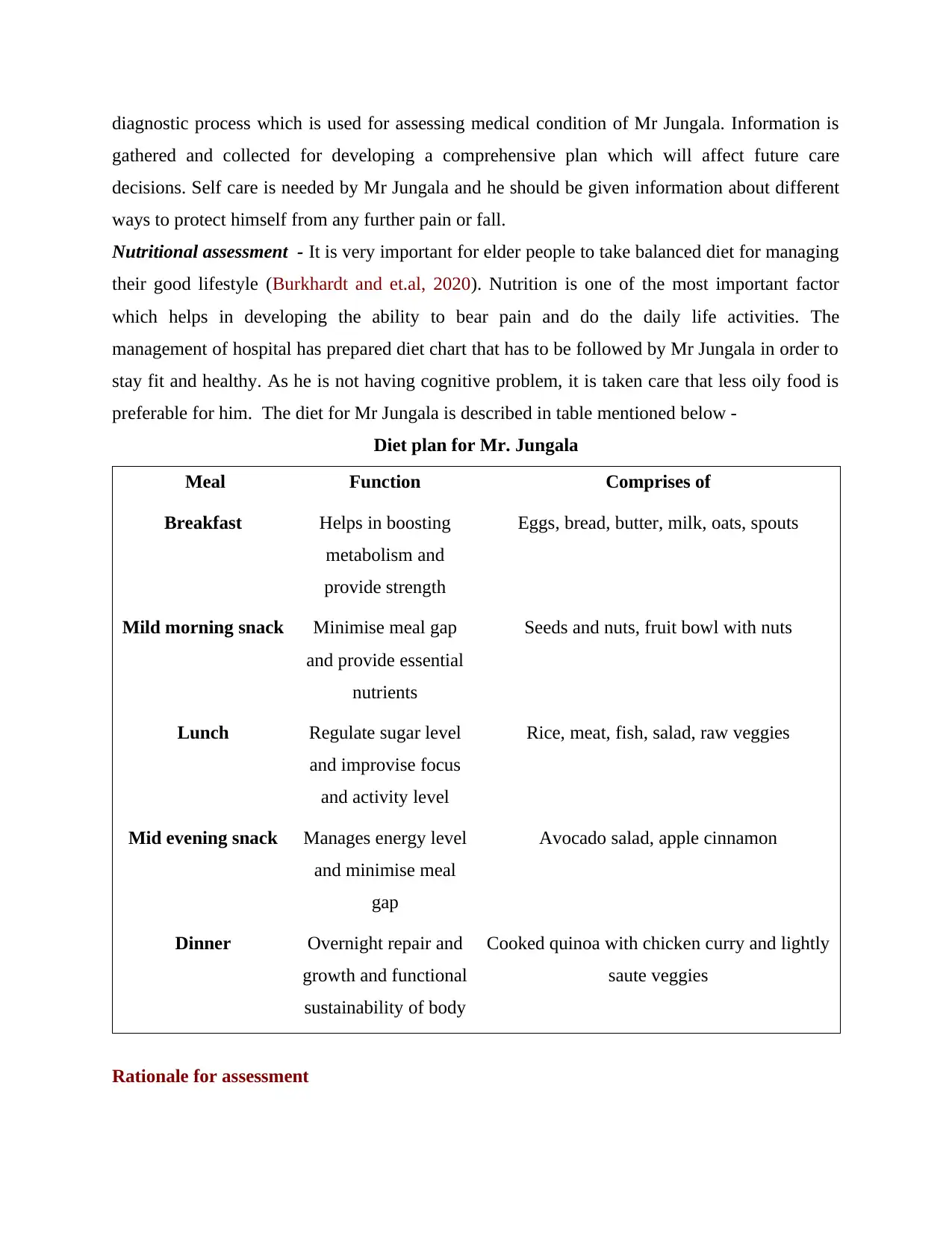
preferable for him. The diet for Mr Jungala is described in table mentioned below -
Diet plan for Mr. Jungala
Meal Function Comprises of
Breakfast Helps in boosting
metabolism and
provide strength
Eggs, bread, butter, milk, oats, spouts
Mild morning snack Minimise meal gap
and provide essential
nutrients
Seeds and nuts, fruit bowl with nuts
Lunch Regulate sugar level
and improvise focus
and activity level
Rice, meat, fish, salad, raw veggies
Mid evening snack Manages energy level
and minimise meal
gap
Avocado salad, apple cinnamon
Dinner Overnight repair and
growth and functional
sustainability of body
Cooked quinoa with chicken curry and lightly
saute veggies
Rationale for assessment
gathered and collected for developing a comprehensive plan which will affect future care
decisions. Self care is needed by Mr Jungala and he should be given information about different
ways to protect himself from any further pain or fall.
Nutritional assessment - It is very important for elder people to take balanced diet for managing
their good lifestyle (Burkhardt and et.al, 2020). Nutrition is one of the most important factor
which helps in developing the ability to bear pain and do the daily life activities. The
management of hospital has prepared diet chart that has to be followed by Mr Jungala in order to
stay fit and healthy. As he is not having cognitive problem, it is taken care that less oily food is
preferable for him. The diet for Mr Jungala is described in table mentioned below -
Diet plan for Mr. Jungala
Meal Function Comprises of
Breakfast Helps in boosting
metabolism and
provide strength
Eggs, bread, butter, milk, oats, spouts
Mild morning snack Minimise meal gap
and provide essential
nutrients
Seeds and nuts, fruit bowl with nuts
Lunch Regulate sugar level
and improvise focus
and activity level
Rice, meat, fish, salad, raw veggies
Mid evening snack Manages energy level
and minimise meal
gap
Avocado salad, apple cinnamon
Dinner Overnight repair and
growth and functional
sustainability of body
Cooked quinoa with chicken curry and lightly
saute veggies
Rationale for assessment
This part includes different assessment including falls assessment, Functional assessment,
cognitive assessment and Nutritional assessment. Mr Jungala must be provided guidance for
living a safe and secure life. It is important for him to keep his diet healthy and live a good life.
Positive thinking is also needed by Mr Jungala in order to have positive perception towards
different aspects of life.
PART 2 Plan and implementation
The reason for fall of Mr. Jungala is considered to be normal age related changes. The
plan for his health benefits will be prepared based on his diagnosis that the fall could not be
related to any acute disease or medications (Kiss, Simpson, and Smith, 2020). However, the
recovery after fall for Mr. Jungala is a time taking process as he is also suffering from diabetes
and acute renal failure. It is necessary that he is kept under strict observation and all his
medications are provided to him on time. It is better if he is provided with a nurse who can take
care of him 24*7 and take responsibilities of all his medications, diet and heath. The
responsibility of nurse is that they should provide proper care to Mr. Jungala so that he will get
well soon. For a person like him who is of 71 years old, it is important that managing and caring
of own health is more important.
There are a number of problems that Mr. Jungala might be facing due to his age. This
includes weakness in bones , coronary artery disease, slight forgetfulness, constipation, slow
digestive system and so on. It is necessary to provide him physiotherapy sessions once his wound
start healing. Mr. Jungala is suggested to stay active physically as well as socially. It is necessary
that he spends time with his family and friends. After this a schedule for his routine check up is
to be prepared which is necessary to be followed in order to keep a regular tap on any health
issue that might occur in future (Burkhardt and et.al, 2020)). Mr. Jungala is also suggested to
reduce alcohol consumption. He should avoid strong beer and have any other form of alcohol
that too limited to one drink per day. Mr. Jungala is a person who needs support and help as his
hip is hurt. He is having problem in managing day to day activities. He is already a weak person
because his age is 71 years old. This is very essential for Mr Jungala to take special care for
avoiding any kind of problem in future. Balanced diet must be taken for building strength and
muscles. It is very important that Mr Jungala is focusing more upon his health (Thompson, and
et. al 2020). He is advised to stop drinking and eat healthy food. This will help to avoid risk and
maintain healthy life style.
cognitive assessment and Nutritional assessment. Mr Jungala must be provided guidance for
living a safe and secure life. It is important for him to keep his diet healthy and live a good life.
Positive thinking is also needed by Mr Jungala in order to have positive perception towards
different aspects of life.
PART 2 Plan and implementation
The reason for fall of Mr. Jungala is considered to be normal age related changes. The
plan for his health benefits will be prepared based on his diagnosis that the fall could not be
related to any acute disease or medications (Kiss, Simpson, and Smith, 2020). However, the
recovery after fall for Mr. Jungala is a time taking process as he is also suffering from diabetes
and acute renal failure. It is necessary that he is kept under strict observation and all his
medications are provided to him on time. It is better if he is provided with a nurse who can take
care of him 24*7 and take responsibilities of all his medications, diet and heath. The
responsibility of nurse is that they should provide proper care to Mr. Jungala so that he will get
well soon. For a person like him who is of 71 years old, it is important that managing and caring
of own health is more important.
There are a number of problems that Mr. Jungala might be facing due to his age. This
includes weakness in bones , coronary artery disease, slight forgetfulness, constipation, slow
digestive system and so on. It is necessary to provide him physiotherapy sessions once his wound
start healing. Mr. Jungala is suggested to stay active physically as well as socially. It is necessary
that he spends time with his family and friends. After this a schedule for his routine check up is
to be prepared which is necessary to be followed in order to keep a regular tap on any health
issue that might occur in future (Burkhardt and et.al, 2020)). Mr. Jungala is also suggested to
reduce alcohol consumption. He should avoid strong beer and have any other form of alcohol
that too limited to one drink per day. Mr. Jungala is a person who needs support and help as his
hip is hurt. He is having problem in managing day to day activities. He is already a weak person
because his age is 71 years old. This is very essential for Mr Jungala to take special care for
avoiding any kind of problem in future. Balanced diet must be taken for building strength and
muscles. It is very important that Mr Jungala is focusing more upon his health (Thompson, and
et. al 2020). He is advised to stop drinking and eat healthy food. This will help to avoid risk and
maintain healthy life style.
⊘ This is a preview!⊘
Do you want full access?
Subscribe today to unlock all pages.
Trusted by 1+ million students worldwide
Rationale for assessment
It is important to analyse and manage the patient's wellbeing. In the present scenario
reason for choosing planning and implementing assessment is that it helps in knowing about the
way by which Mr Jungala can live a healthy life. This planning will include the ways for
managing the different activities that can be adopted by Mr. Jungala for conducting the busienss
operations.
PART 3 A Bio psychosocial approach
Healthy ageing is involved in promoting an individual's mental, physical and social well
being. There are some psychosocial vital signs of Mr Jungala and it has effected live of Mr
Jungala. Some of the factors are mentioned below -
Perception - Mr Jungala is having diabetes and chronic renal failure. He recently got problem of
agina and this pain is bearable. He takes medication fro all these problems. It was his bad luck
that he fell from Tonker truck and hurt his lip. Mr. Jungala is feeling unfortunate as he is not
understanding that why he fell from that Tonker Truck. It is important for this person to take
more care while walking. He is 71 year old adult and hence, quick healing is not possible. It
takes time and thus, extra care must be taken.
Support - Mr Jungala is not able to drive nowadays and thus, he asks his relatives to drive him if
he want to go somewhere (.Benítez-Andrades, and et.al, (2020)). Now as he has fallen and broke
his hip, he has to visit doctors. He can take help from relatives for dropping him at the hospital.
This accident has created problem for Mr Jungala in managing the day to day work activities.
Coping - There are times when Mr Jungala is feeling low and he want to stay alone. He took out
few beers and drink them to relax. In this time, he gives time to himself and heals his pain. This
is now a problem for Mr Jungala as he do not know what he will be doing in free time. He is
injured and thus, drinking is not allowed. He will be facing problem in enjoying free time.
Rationale for assessment
Mr. Jungala is having issues with anxiety and thus, there is need of managing this
problem as it limits a person to have stable mind and managing healthy life. The anxiety level
has to be controlled at this age as it is important to stay fit (Flor, and Gakidou, 2020). Main
objective of nursing professional is to manage the anxiety level and provide proper guidance to
Mr. Jungala for how to keep himself motivated and control anger.
It is important to analyse and manage the patient's wellbeing. In the present scenario
reason for choosing planning and implementing assessment is that it helps in knowing about the
way by which Mr Jungala can live a healthy life. This planning will include the ways for
managing the different activities that can be adopted by Mr. Jungala for conducting the busienss
operations.
PART 3 A Bio psychosocial approach
Healthy ageing is involved in promoting an individual's mental, physical and social well
being. There are some psychosocial vital signs of Mr Jungala and it has effected live of Mr
Jungala. Some of the factors are mentioned below -
Perception - Mr Jungala is having diabetes and chronic renal failure. He recently got problem of
agina and this pain is bearable. He takes medication fro all these problems. It was his bad luck
that he fell from Tonker truck and hurt his lip. Mr. Jungala is feeling unfortunate as he is not
understanding that why he fell from that Tonker Truck. It is important for this person to take
more care while walking. He is 71 year old adult and hence, quick healing is not possible. It
takes time and thus, extra care must be taken.
Support - Mr Jungala is not able to drive nowadays and thus, he asks his relatives to drive him if
he want to go somewhere (.Benítez-Andrades, and et.al, (2020)). Now as he has fallen and broke
his hip, he has to visit doctors. He can take help from relatives for dropping him at the hospital.
This accident has created problem for Mr Jungala in managing the day to day work activities.
Coping - There are times when Mr Jungala is feeling low and he want to stay alone. He took out
few beers and drink them to relax. In this time, he gives time to himself and heals his pain. This
is now a problem for Mr Jungala as he do not know what he will be doing in free time. He is
injured and thus, drinking is not allowed. He will be facing problem in enjoying free time.
Rationale for assessment
Mr. Jungala is having issues with anxiety and thus, there is need of managing this
problem as it limits a person to have stable mind and managing healthy life. The anxiety level
has to be controlled at this age as it is important to stay fit (Flor, and Gakidou, 2020). Main
objective of nursing professional is to manage the anxiety level and provide proper guidance to
Mr. Jungala for how to keep himself motivated and control anger.
Paraphrase This Document
Need a fresh take? Get an instant paraphrase of this document with our AI Paraphraser
CONCLUSION
From the above discussion, it is concluded that nursing roles and responsibilities are very
important as nurses and care taker have to treat patients. This is a challenging and emotionally
demanding role. Skills have to be developed in right manner for doing the job role effectively.
Communication is also important within nurses as it is helpful for providing good treatment and
care.
From the above discussion, it is concluded that nursing roles and responsibilities are very
important as nurses and care taker have to treat patients. This is a challenging and emotionally
demanding role. Skills have to be developed in right manner for doing the job role effectively.
Communication is also important within nurses as it is helpful for providing good treatment and
care.
REREFENCES
Books and Journals
Balmer, J. T. (2020). Nursing Professional Development Practitioners in Leadership Roles:
Interprofessional Teams and Collaboration. Journal for Nurses in Professional
Development, 36(3), 167-169.
Benítez-Andrades, J. A., and et.al(2020). Social network analysis for personalized
characterization and risk assessment of alcohol use disorders in adolescents using
semantic technologies. Future Generation Computer Systems, 106, 154-170.
Burkhardt, G., and et.al (2020). A machine learning approach to risk assessment for alcohol
withdrawal syndrome. European Neuropsychopharmacology.
Farota-Romejko, I., & Ferry, A. (2020). Research work on nursing roles in MPCT. Revue de
L'infirmiere, 69(259), 39-40.
Flor, L. S., & Gakidou, E. (2020). The burden of alcohol use: better data and strong policies
towards a sustainable development. The Lancet Public Health, 5(1), e10-e11.
He, Q., & et.al (2020). Understanding Chinese Nursing Education and Practice for Developing
International Nursing Partnerships. Journal of Transcultural Nursing, 31(4), 406-412.
Kiss, E., Simpson, A., & Smith, C. M. (2020). Nursing Professional Development Practitioners
in Leadership Roles: Leading Academic–Practice Partnerships. Journal for Nurses in
Professional Development, 36(2), 99-103.
Kitajima, T. and et.al (2020). it is not all about Pretransplant Factors: Posttransplant
Complications alter the risk of alcohol relapse. Clinical Liver Disease, 15(6), 239.
Salthouse, T. (2010). Major issues in cognitive aging (Vol. 49). Oxford University Press.
Thompson, G., & et. al (2020). Clarifying the information and support needs of family
caregivers of nursing home residents with advancing dementia. Dementia,
1471301220927617.
Books and Journals
Balmer, J. T. (2020). Nursing Professional Development Practitioners in Leadership Roles:
Interprofessional Teams and Collaboration. Journal for Nurses in Professional
Development, 36(3), 167-169.
Benítez-Andrades, J. A., and et.al(2020). Social network analysis for personalized
characterization and risk assessment of alcohol use disorders in adolescents using
semantic technologies. Future Generation Computer Systems, 106, 154-170.
Burkhardt, G., and et.al (2020). A machine learning approach to risk assessment for alcohol
withdrawal syndrome. European Neuropsychopharmacology.
Farota-Romejko, I., & Ferry, A. (2020). Research work on nursing roles in MPCT. Revue de
L'infirmiere, 69(259), 39-40.
Flor, L. S., & Gakidou, E. (2020). The burden of alcohol use: better data and strong policies
towards a sustainable development. The Lancet Public Health, 5(1), e10-e11.
He, Q., & et.al (2020). Understanding Chinese Nursing Education and Practice for Developing
International Nursing Partnerships. Journal of Transcultural Nursing, 31(4), 406-412.
Kiss, E., Simpson, A., & Smith, C. M. (2020). Nursing Professional Development Practitioners
in Leadership Roles: Leading Academic–Practice Partnerships. Journal for Nurses in
Professional Development, 36(2), 99-103.
Kitajima, T. and et.al (2020). it is not all about Pretransplant Factors: Posttransplant
Complications alter the risk of alcohol relapse. Clinical Liver Disease, 15(6), 239.
Salthouse, T. (2010). Major issues in cognitive aging (Vol. 49). Oxford University Press.
Thompson, G., & et. al (2020). Clarifying the information and support needs of family
caregivers of nursing home residents with advancing dementia. Dementia,
1471301220927617.
⊘ This is a preview!⊘
Do you want full access?
Subscribe today to unlock all pages.
Trusted by 1+ million students worldwide

1 out of 9


Related Documents


Your All-in-One AI-Powered Toolkit for Academic Success.
+13062052269
info@desklib.com
Available 24*7 on WhatsApp / Email
![[object Object]](/_next/static/media/star-bottom.7253800d.svg)
Unlock your academic potential
Copyright © 2020–2026 A2Z Services. All Rights Reserved. Developed and managed by ZUCOL.