Organisational Behaviour Report: M&S, Motivation, and Team Performance
VerifiedAdded on 2023/01/05
|16
|3338
|69
Report
AI Summary
This report provides a comprehensive analysis of organisational behaviour within Marks & Spencer (M&S). It begins by defining organisational behaviour and then delves into the analysis of M&S's organisational culture, politics, and power dynamics. The report explores various motivational theories, including extrinsic and intrinsic motivation, content theories (Maslow's Hierarchy, Herzberg's Two-Factor Theory, and Alderfer's ERG theory), and process theories (Vroom's Expectancy Theory and Adam's Equity Theory). It examines how these theories influence behaviours within organisations, considering cultural differences using Hofstede's dimensions. The report then discusses how to influence behaviour through effective application of motivational theories, including the role of emotional intelligence and leadership styles (task and relationship leadership). Furthermore, it provides recommendations on how M&S could improve staff performance and highlights the benefits of effective teamwork, including different types of teams, their risks, and benefits. Finally, the report concludes with a discussion on how effective teams relate to concepts of OB and explores team and group development theories.
Organisational Behaviour

Paraphrase This Document
Need a fresh take? Get an instant paraphrase of this document with our AI Paraphraser
Table of Contents
INTRODUCTION...........................................................................................................................3
Analysis of various organisation’s culture, politics and power...................................................3
Various theories of motivation....................................................................................................4
How the above-mentioned theories influence behaviours within organisations.........................7
How to influence the behaviour of others through the effective application of behavioural
motivational theories...................................................................................................................8
Recommendations on how organisation could improve the performance of their staff to meet
goals.............................................................................................................................................9
Benefits of working in an effective team.....................................................................................9
How effective teams relates to at least one concepts or models of OB.....................................10
Team and group development theories......................................................................................11
Concepts and philosophies of OB..............................................................................................12
CONCLUSION..............................................................................................................................13
REFERENCES..............................................................................................................................14
INTRODUCTION...........................................................................................................................3
Analysis of various organisation’s culture, politics and power...................................................3
Various theories of motivation....................................................................................................4
How the above-mentioned theories influence behaviours within organisations.........................7
How to influence the behaviour of others through the effective application of behavioural
motivational theories...................................................................................................................8
Recommendations on how organisation could improve the performance of their staff to meet
goals.............................................................................................................................................9
Benefits of working in an effective team.....................................................................................9
How effective teams relates to at least one concepts or models of OB.....................................10
Team and group development theories......................................................................................11
Concepts and philosophies of OB..............................................................................................12
CONCLUSION..............................................................................................................................13
REFERENCES..............................................................................................................................14
INTRODUCTION
Organisational behaviour as defined by Fred Luthans is directly concerned with the
understanding, production and control of human behaviour in organisation. This report aims at
discussing and analysing different elements of organisational behaviour in context of M&S.
Marks and Spencer British multinational retail organisation. M&S was founded in 1884 and its
headquarter is situated at London, England, UK. M&S has its operations at 1463 locations
worldwide and employs 80000 employees. Report will discuss culture, politics and power and its
influence and will discuss about motivational theories. Further, report will discuss about benefits
of working in effective teams and concept and philosophies of organisational behaviour.
Analysis of various organisation’s culture, politics and power
Organisational culture can be defined as collection of expectations, values and processes
that guide and direct actions and decisions of members of Tesco. There are different types of
organisational culture and these cultures are-
Power culture- In power culture power is held by certain individuals in organisation and these
are able to spread their influence throughout the organisation.
Role culture- This culture of organisation is based on regulations and rules and is highly
controlled and individuals in such organisation are aware of their roles and responsibility
(Laforet, 2016).
Task culture- This is culture which is formed in organisation to address specific problem or task
carried out to achieve certain objectives.
Person culture- This type of culture is formed in organisation in which individuals in
organisation consider them superior to organisation. Firms of professionals often have this type
of organisational culture.
Every type of culture has different impact and influence on individuals within
organisation. This means that power culture require individuals to do what people with power
ask them to and role culture require people to do what their position within organisation requires
them to do. This way every organisational culture has different impact and influence.
Organisational behaviour as defined by Fred Luthans is directly concerned with the
understanding, production and control of human behaviour in organisation. This report aims at
discussing and analysing different elements of organisational behaviour in context of M&S.
Marks and Spencer British multinational retail organisation. M&S was founded in 1884 and its
headquarter is situated at London, England, UK. M&S has its operations at 1463 locations
worldwide and employs 80000 employees. Report will discuss culture, politics and power and its
influence and will discuss about motivational theories. Further, report will discuss about benefits
of working in effective teams and concept and philosophies of organisational behaviour.
Analysis of various organisation’s culture, politics and power
Organisational culture can be defined as collection of expectations, values and processes
that guide and direct actions and decisions of members of Tesco. There are different types of
organisational culture and these cultures are-
Power culture- In power culture power is held by certain individuals in organisation and these
are able to spread their influence throughout the organisation.
Role culture- This culture of organisation is based on regulations and rules and is highly
controlled and individuals in such organisation are aware of their roles and responsibility
(Laforet, 2016).
Task culture- This is culture which is formed in organisation to address specific problem or task
carried out to achieve certain objectives.
Person culture- This type of culture is formed in organisation in which individuals in
organisation consider them superior to organisation. Firms of professionals often have this type
of organisational culture.
Every type of culture has different impact and influence on individuals within
organisation. This means that power culture require individuals to do what people with power
ask them to and role culture require people to do what their position within organisation requires
them to do. This way every organisational culture has different impact and influence.
⊘ This is a preview!⊘
Do you want full access?
Subscribe today to unlock all pages.

Trusted by 1+ million students worldwide
Organisational political can be defined as self–serving behaviour of employees to increase
probability of obtaining positive outcomes in organisation. Organisational politics is often
considered in negative sense as however sometimes politics in organisation is formal and is done
on organisational level.
Organisational power can be defined as ability of individuals within organisation to impact and
influence decisions and actions of others in organisation. There are different types of power in
organisation that are individual, relationship and involved in organisational structure.
Expert power is an example of individual power, in which power is based on individual
knowledge and expertise of individual (Mahroof, 2019).
Connection power is example of relationship power which comes from relation with powerful
person and related to networking.
Legitimate power is based on organisational structure. This power comes from position that one
holds in organisational hierarchy and related to organisational structure.
Other than these, sources of power involves-
Formal power- This power is based on position and comes from ability of one to coerce or
reward
Referent power- This is concerned with identification with a person who has desirable resources
Coercive power- This is derived from ability to other by means of threats
Reward power- Individuals comply to order and directions of other because doing so involves
positive benefits (Lam and Xu, 2019).
Every type of power has different impact and influence on individuals and groups within
organisation and influence actions and decisions on the basis of power. This also influence work
motivation and relationship with others in organisation.
Various theories of motivation
Extrinsic motivation
probability of obtaining positive outcomes in organisation. Organisational politics is often
considered in negative sense as however sometimes politics in organisation is formal and is done
on organisational level.
Organisational power can be defined as ability of individuals within organisation to impact and
influence decisions and actions of others in organisation. There are different types of power in
organisation that are individual, relationship and involved in organisational structure.
Expert power is an example of individual power, in which power is based on individual
knowledge and expertise of individual (Mahroof, 2019).
Connection power is example of relationship power which comes from relation with powerful
person and related to networking.
Legitimate power is based on organisational structure. This power comes from position that one
holds in organisational hierarchy and related to organisational structure.
Other than these, sources of power involves-
Formal power- This power is based on position and comes from ability of one to coerce or
reward
Referent power- This is concerned with identification with a person who has desirable resources
Coercive power- This is derived from ability to other by means of threats
Reward power- Individuals comply to order and directions of other because doing so involves
positive benefits (Lam and Xu, 2019).
Every type of power has different impact and influence on individuals and groups within
organisation and influence actions and decisions on the basis of power. This also influence work
motivation and relationship with others in organisation.
Various theories of motivation
Extrinsic motivation
Paraphrase This Document
Need a fresh take? Get an instant paraphrase of this document with our AI Paraphraser
Extrinsic motivation can be defined as motivation in which individual perform certain
task or activity and adopt a certain behaviour with a desire to earn a reward or avoid a
punishment. Monetary motivation, reward and recognition are examples of extrinsic motivation.
Intrinsic motivation
Intrinsic motivation is one in which individual perform certain task or activity and adopt
certain behaviour because they find is rewarding (de Almeida, Lesca and Canton, 2016). Job
satisfaction and job itself is an intrinsic motivation.
Theories of motivation are of two types-
Content Theories
This involves theories like-
Maslow Hierarchy of needs- This is one of the motivation theory that has been developed
containing 5 needs that can contribute in motivating employees. These needs are-
Physiological needs
Safety needs
Social needs
Self-esteem needs
Self-actualisation needs
It is believed that fulfilling one need leads to generating of another and higher order need and
fulfilling this motivates individuals (Sahito and Vaisanen, 2017).
Herzberg two factor theory
task or activity and adopt a certain behaviour with a desire to earn a reward or avoid a
punishment. Monetary motivation, reward and recognition are examples of extrinsic motivation.
Intrinsic motivation
Intrinsic motivation is one in which individual perform certain task or activity and adopt
certain behaviour because they find is rewarding (de Almeida, Lesca and Canton, 2016). Job
satisfaction and job itself is an intrinsic motivation.
Theories of motivation are of two types-
Content Theories
This involves theories like-
Maslow Hierarchy of needs- This is one of the motivation theory that has been developed
containing 5 needs that can contribute in motivating employees. These needs are-
Physiological needs
Safety needs
Social needs
Self-esteem needs
Self-actualisation needs
It is believed that fulfilling one need leads to generating of another and higher order need and
fulfilling this motivates individuals (Sahito and Vaisanen, 2017).
Herzberg two factor theory
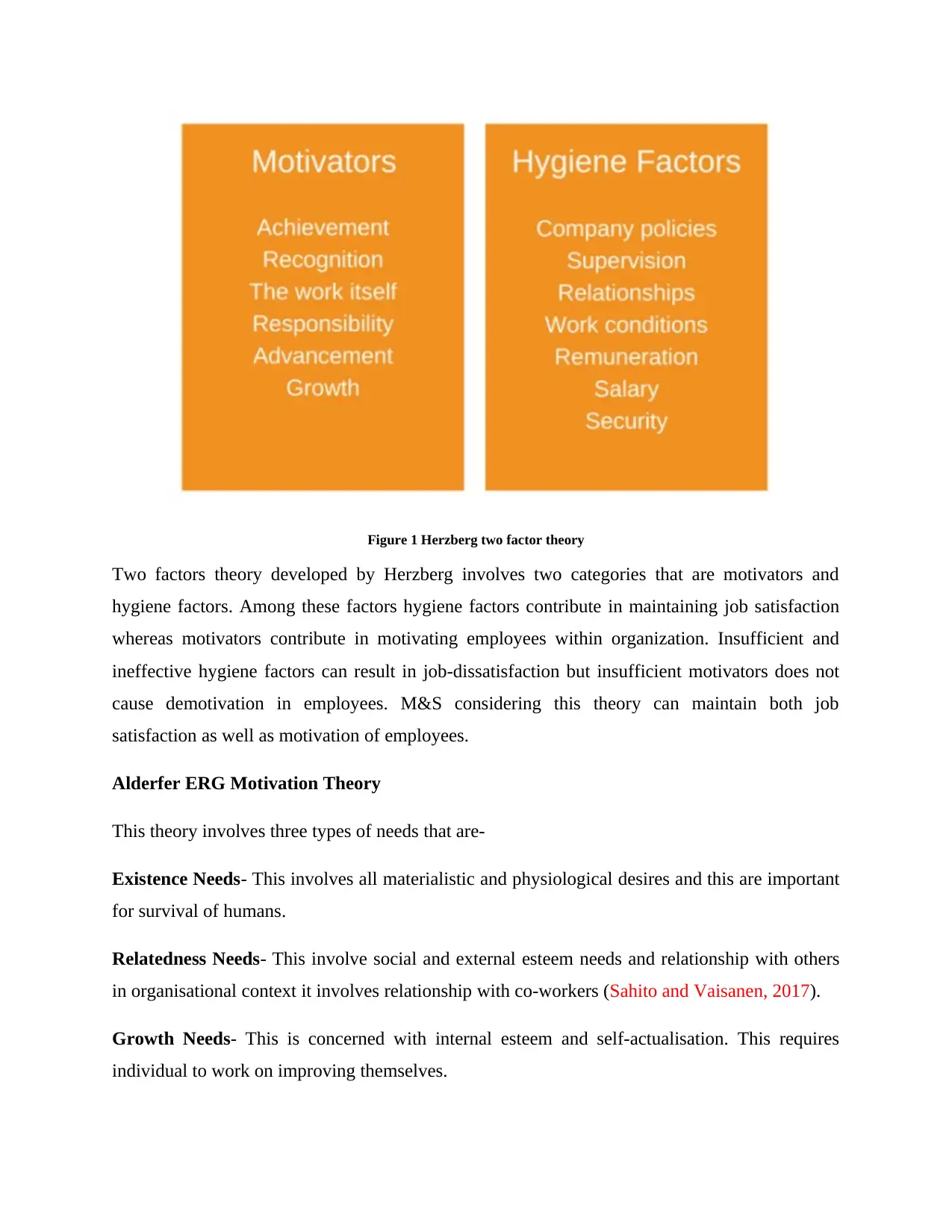
Figure 1 Herzberg two factor theory
Two factors theory developed by Herzberg involves two categories that are motivators and
hygiene factors. Among these factors hygiene factors contribute in maintaining job satisfaction
whereas motivators contribute in motivating employees within organization. Insufficient and
ineffective hygiene factors can result in job-dissatisfaction but insufficient motivators does not
cause demotivation in employees. M&S considering this theory can maintain both job
satisfaction as well as motivation of employees.
Alderfer ERG Motivation Theory
This theory involves three types of needs that are-
Existence Needs- This involves all materialistic and physiological desires and this are important
for survival of humans.
Relatedness Needs- This involve social and external esteem needs and relationship with others
in organisational context it involves relationship with co-workers (Sahito and Vaisanen, 2017).
Growth Needs- This is concerned with internal esteem and self-actualisation. This requires
individual to work on improving themselves.
Two factors theory developed by Herzberg involves two categories that are motivators and
hygiene factors. Among these factors hygiene factors contribute in maintaining job satisfaction
whereas motivators contribute in motivating employees within organization. Insufficient and
ineffective hygiene factors can result in job-dissatisfaction but insufficient motivators does not
cause demotivation in employees. M&S considering this theory can maintain both job
satisfaction as well as motivation of employees.
Alderfer ERG Motivation Theory
This theory involves three types of needs that are-
Existence Needs- This involves all materialistic and physiological desires and this are important
for survival of humans.
Relatedness Needs- This involve social and external esteem needs and relationship with others
in organisational context it involves relationship with co-workers (Sahito and Vaisanen, 2017).
Growth Needs- This is concerned with internal esteem and self-actualisation. This requires
individual to work on improving themselves.
⊘ This is a preview!⊘
Do you want full access?
Subscribe today to unlock all pages.
Trusted by 1+ million students worldwide
Process Theories
Vroom Theory
This theory involves a process and three elements in process of motivation. These elements
involve-
Expectancy- This is expectancy in which individuals believe that their advanced efforts will lead
to improvement in performance
Instrumentality- This is belief of employees that effective performance will lead to desired
rewards and results
Valance- valance refers to importance that individual gives to desired and expected results and
rewards
Adams
This motivation theory involves that motivation of employees is based in equality in inputs and
outputs. This means that employees should perceive that reward that they will receive is fair in
comparison with their contribution (Schjoedt and Shaver, 2020). Employees also compare their
reward with reward received by peers.
Motivational theories have significant impact and influence on management and
leadership within organisation. This means that motivating employees is integral part of
leadership and ensuring that employees have all required factors to remain motivated employees
while working.
How the above-mentioned theories influence behaviours within organisations
Behaviour within organisation gets highly influenced by application of certain theories of
motivation. This means that organisation that does not provide much scope for intrinsic
motivation needs to ensure that employees can be motivated through means of extrinsic
motivation. In order to understand and ensure effectiveness of motivational theory it is important
that they are aware of cultural difference, cultural difference play important role in perception of
individuals regarding motivational practices of M&S. In order to understand cultural difference
Hofstede’s dimensions of culture can be utilised. Hofstede’s dimensions of culture involves-
Vroom Theory
This theory involves a process and three elements in process of motivation. These elements
involve-
Expectancy- This is expectancy in which individuals believe that their advanced efforts will lead
to improvement in performance
Instrumentality- This is belief of employees that effective performance will lead to desired
rewards and results
Valance- valance refers to importance that individual gives to desired and expected results and
rewards
Adams
This motivation theory involves that motivation of employees is based in equality in inputs and
outputs. This means that employees should perceive that reward that they will receive is fair in
comparison with their contribution (Schjoedt and Shaver, 2020). Employees also compare their
reward with reward received by peers.
Motivational theories have significant impact and influence on management and
leadership within organisation. This means that motivating employees is integral part of
leadership and ensuring that employees have all required factors to remain motivated employees
while working.
How the above-mentioned theories influence behaviours within organisations
Behaviour within organisation gets highly influenced by application of certain theories of
motivation. This means that organisation that does not provide much scope for intrinsic
motivation needs to ensure that employees can be motivated through means of extrinsic
motivation. In order to understand and ensure effectiveness of motivational theory it is important
that they are aware of cultural difference, cultural difference play important role in perception of
individuals regarding motivational practices of M&S. In order to understand cultural difference
Hofstede’s dimensions of culture can be utilised. Hofstede’s dimensions of culture involves-
Paraphrase This Document
Need a fresh take? Get an instant paraphrase of this document with our AI Paraphraser
Power distance
Masculinity vs. femininity
Uncertainty avoidance
Long vs. Short term orientation
Individualism ad collectivism
Indulgence vs. Restraint
All these cultural dimensions has different characteristics and this gets affect the way perceive
different motivational practices of M&S (Beugelsdijk and Welzel, 2018). It has become very
important for M&S to consider cultural differences and this can be done on the basis of above
discussed dimensions. Elements like globalisation have caused significant difference in
employees of M&S. Further technology has also influenced cultures of organisation and M&S
have also influenced through this. This means that there are different ways in which employs can
work virtually and still be employee of M&S. This involves employees with different cultures
and M&S requires to understand their culture in order to ensure they can be effectively
motivated.
How to influence the behaviour of others through the effective application of behavioural
motivational theories
Emotional intelligence can be defined as capability of an individual to manage and
control their emotions and also being able to control the emotions of others as well. Emotional
intelligence is one of the soft skill and other than this, it is very important that managers and
teams within M&S. Certain things that make it important for managers and teams to have soft
skills involves managing people and solving their problems, building and maintaining positive
working environment, and leading to efficiency in workplace. This is also an element in
behavioural psychology, this is because behavioural psychology is study of relation between
behaviour and mind of individual. Application of behavioural psychology can bring very
effective results in M&S. For example- using behavioural psychology managers can effectively
resolve conflicts and disputes within employees. Motivation of employees in M&S also affects
on the basis of approach of leadership that is task leadership and relationship leadership. In
relationship leadership leaders ensure effective relationship with subordinates in M&S and
ensures that they are supported well in order to attain effective results for M&S. Task leadership
Masculinity vs. femininity
Uncertainty avoidance
Long vs. Short term orientation
Individualism ad collectivism
Indulgence vs. Restraint
All these cultural dimensions has different characteristics and this gets affect the way perceive
different motivational practices of M&S (Beugelsdijk and Welzel, 2018). It has become very
important for M&S to consider cultural differences and this can be done on the basis of above
discussed dimensions. Elements like globalisation have caused significant difference in
employees of M&S. Further technology has also influenced cultures of organisation and M&S
have also influenced through this. This means that there are different ways in which employs can
work virtually and still be employee of M&S. This involves employees with different cultures
and M&S requires to understand their culture in order to ensure they can be effectively
motivated.
How to influence the behaviour of others through the effective application of behavioural
motivational theories
Emotional intelligence can be defined as capability of an individual to manage and
control their emotions and also being able to control the emotions of others as well. Emotional
intelligence is one of the soft skill and other than this, it is very important that managers and
teams within M&S. Certain things that make it important for managers and teams to have soft
skills involves managing people and solving their problems, building and maintaining positive
working environment, and leading to efficiency in workplace. This is also an element in
behavioural psychology, this is because behavioural psychology is study of relation between
behaviour and mind of individual. Application of behavioural psychology can bring very
effective results in M&S. For example- using behavioural psychology managers can effectively
resolve conflicts and disputes within employees. Motivation of employees in M&S also affects
on the basis of approach of leadership that is task leadership and relationship leadership. In
relationship leadership leaders ensure effective relationship with subordinates in M&S and
ensures that they are supported well in order to attain effective results for M&S. Task leadership
on the other hand focuses on task completion and monetary benefits are given to employees and
this is why employees have single-minded focus on completion of task in order to achieve
reward or to avoid punishments (Schjoedt and Shaver, 2020). Relationship orientated leaders
also utilised psychodynamic approach in which they identify and understand human functioning
based on drives and forces and work accordingly.
Recommendations on how organisation could improve the performance of their staff to meet
goals
Above discussion regarding different elements of organisation outlines how different
elements within organisation functions and how they are linked with other elements of
organisation. In order to improve its performance M&S should ensure that it has a culture of
sharing and support because relationship of individuals within organisation plays very important
role in motivating employees. For example- in case one new employee is not able to perform
effectively as a new employee others help them in performing their work effectively. This will
motivate ad encourage individuals to learn effectively and will also restrain any kind of negative
feeling associated with underperformance. M&S requires making it an cultural element.
Benefits of working in an effective team
There are different types of teams that are formed within M&S and these teams are-
Functional work teams- Members in teams belong to same functional area and respond to
single manager
Inter-working teams- In this team, members of team belongs to different areas of work within
organisation
Troubleshooting team- Teams are formed to identify and solve problems being faced within
M&S
Project team- This team is formed to complete particular project and members within team
perform work regarding their respective areas of work (Evertsz, Thangarajah and Papasimeon,
2017).
Task Force team- This is a team that is formed only when some kind of emergency within M&S
this is why employees have single-minded focus on completion of task in order to achieve
reward or to avoid punishments (Schjoedt and Shaver, 2020). Relationship orientated leaders
also utilised psychodynamic approach in which they identify and understand human functioning
based on drives and forces and work accordingly.
Recommendations on how organisation could improve the performance of their staff to meet
goals
Above discussion regarding different elements of organisation outlines how different
elements within organisation functions and how they are linked with other elements of
organisation. In order to improve its performance M&S should ensure that it has a culture of
sharing and support because relationship of individuals within organisation plays very important
role in motivating employees. For example- in case one new employee is not able to perform
effectively as a new employee others help them in performing their work effectively. This will
motivate ad encourage individuals to learn effectively and will also restrain any kind of negative
feeling associated with underperformance. M&S requires making it an cultural element.
Benefits of working in an effective team
There are different types of teams that are formed within M&S and these teams are-
Functional work teams- Members in teams belong to same functional area and respond to
single manager
Inter-working teams- In this team, members of team belongs to different areas of work within
organisation
Troubleshooting team- Teams are formed to identify and solve problems being faced within
M&S
Project team- This team is formed to complete particular project and members within team
perform work regarding their respective areas of work (Evertsz, Thangarajah and Papasimeon,
2017).
Task Force team- This is a team that is formed only when some kind of emergency within M&S
⊘ This is a preview!⊘
Do you want full access?
Subscribe today to unlock all pages.
Trusted by 1+ million students worldwide
Risk of teams involves-
Conflict and disputes within team members
Ineffective coordination when team members are from different work areas
Benefits of teams involves-
Shared responsibilities
Collection of different types of knowledge and skills
Effective achievements of results
Teams are effective when there are least risks involved and benefits of teams are comparatively
higher than risks involved in teams processing.
Technology has made significant impact in organisational teams and virtual teams are involved
in this. Virtual teams involves members of teams are connected to each other through
technology. This has different benefits like cost efficiency and effective knowledge and skills
available for organisation. However team working can get affected due to physical differences
and differences in time and languages.
Difference in Effective Teams and Ineffective Teams
Basis Effective teams Ineffective teams
Understanding of
goals
Effective understanding of goals and
desired results
Ineffective teams do not
understand goals and objectives
effectively.
Contribution of
members
Everyone contribute through
discussion and suggestions but remain
pertinent to task
Few people dominant team
discussion and contribution is not
related to tasks
Listening Every idea is considered and accepted
in teams
People do not consider opinion of
others and ideas are often over-
ridden
Decision making Decisions are formed by consensus of
every team member
Actions are taken prematurely
before proper discussion
Leadership Situation leadership is in effective Leadership in ineffective teams
Conflict and disputes within team members
Ineffective coordination when team members are from different work areas
Benefits of teams involves-
Shared responsibilities
Collection of different types of knowledge and skills
Effective achievements of results
Teams are effective when there are least risks involved and benefits of teams are comparatively
higher than risks involved in teams processing.
Technology has made significant impact in organisational teams and virtual teams are involved
in this. Virtual teams involves members of teams are connected to each other through
technology. This has different benefits like cost efficiency and effective knowledge and skills
available for organisation. However team working can get affected due to physical differences
and differences in time and languages.
Difference in Effective Teams and Ineffective Teams
Basis Effective teams Ineffective teams
Understanding of
goals
Effective understanding of goals and
desired results
Ineffective teams do not
understand goals and objectives
effectively.
Contribution of
members
Everyone contribute through
discussion and suggestions but remain
pertinent to task
Few people dominant team
discussion and contribution is not
related to tasks
Listening Every idea is considered and accepted
in teams
People do not consider opinion of
others and ideas are often over-
ridden
Decision making Decisions are formed by consensus of
every team member
Actions are taken prematurely
before proper discussion
Leadership Situation leadership is in effective Leadership in ineffective teams
Paraphrase This Document
Need a fresh take? Get an instant paraphrase of this document with our AI Paraphraser
teams and leaders do not dominate
teams
remain with chairperson of the
person
How effective teams relates to at least one concepts or models of OB
Path-goal leadership involves process in which leaders are required to select certain
behaviours that are best suits for employees in order to achieve goals and objectives. This theory
is based on three elements that are-
Identifying characteristics of employee and environmental
Selecting of leadership style
Focusing on factors of motivational that help employees succeed
Figure 2 Path-goal Theory
Above figure outlines path-goal theory and how path-goal theory is utilized by organizations
(Sadegur and Marr, 2020).
teams
remain with chairperson of the
person
How effective teams relates to at least one concepts or models of OB
Path-goal leadership involves process in which leaders are required to select certain
behaviours that are best suits for employees in order to achieve goals and objectives. This theory
is based on three elements that are-
Identifying characteristics of employee and environmental
Selecting of leadership style
Focusing on factors of motivational that help employees succeed
Figure 2 Path-goal Theory
Above figure outlines path-goal theory and how path-goal theory is utilized by organizations
(Sadegur and Marr, 2020).
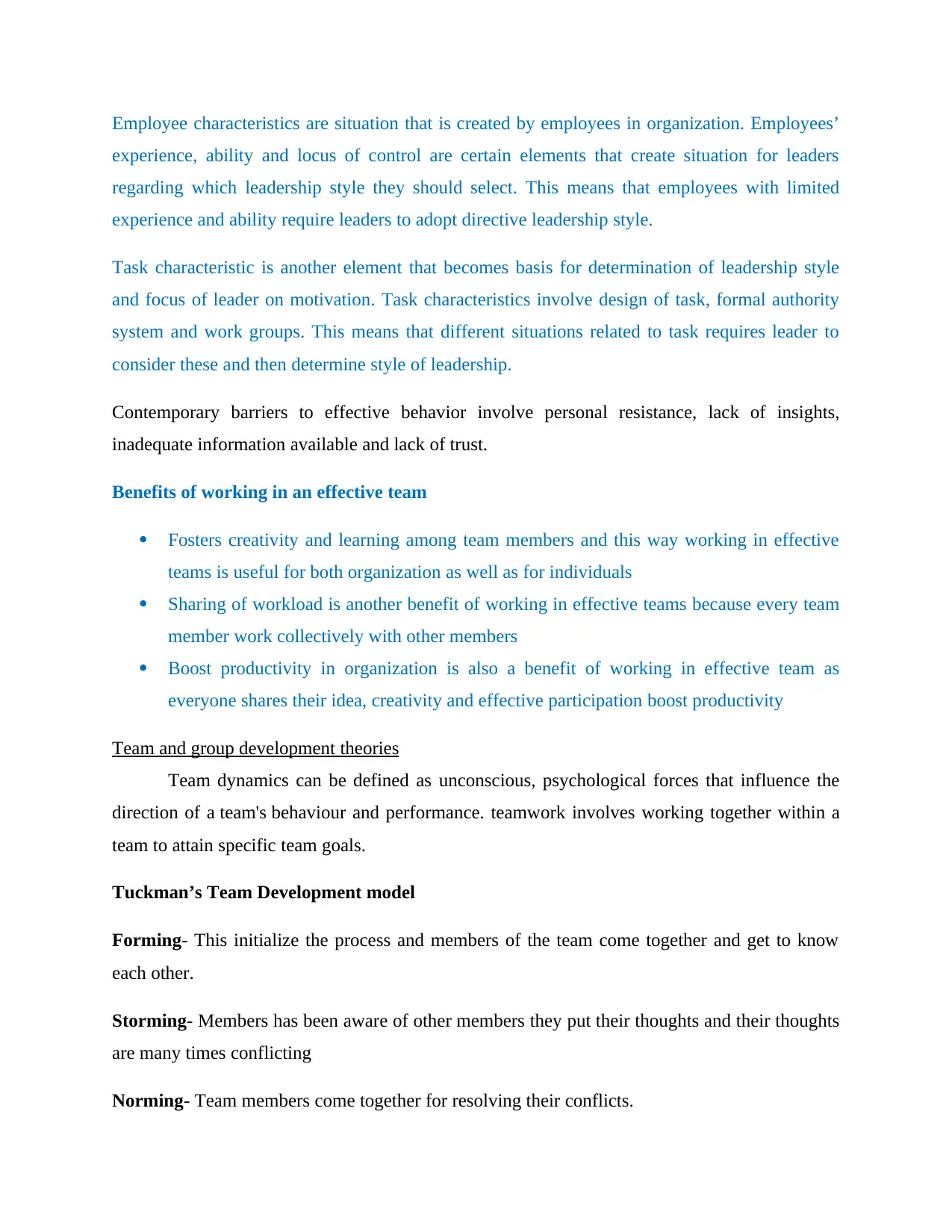
Employee characteristics are situation that is created by employees in organization. Employees’
experience, ability and locus of control are certain elements that create situation for leaders
regarding which leadership style they should select. This means that employees with limited
experience and ability require leaders to adopt directive leadership style.
Task characteristic is another element that becomes basis for determination of leadership style
and focus of leader on motivation. Task characteristics involve design of task, formal authority
system and work groups. This means that different situations related to task requires leader to
consider these and then determine style of leadership.
Contemporary barriers to effective behavior involve personal resistance, lack of insights,
inadequate information available and lack of trust.
Benefits of working in an effective team
Fosters creativity and learning among team members and this way working in effective
teams is useful for both organization as well as for individuals
Sharing of workload is another benefit of working in effective teams because every team
member work collectively with other members
Boost productivity in organization is also a benefit of working in effective team as
everyone shares their idea, creativity and effective participation boost productivity
Team and group development theories
Team dynamics can be defined as unconscious, psychological forces that influence the
direction of a team's behaviour and performance. teamwork involves working together within a
team to attain specific team goals.
Tuckman’s Team Development model
Forming- This initialize the process and members of the team come together and get to know
each other.
Storming- Members has been aware of other members they put their thoughts and their thoughts
are many times conflicting
Norming- Team members come together for resolving their conflicts.
experience, ability and locus of control are certain elements that create situation for leaders
regarding which leadership style they should select. This means that employees with limited
experience and ability require leaders to adopt directive leadership style.
Task characteristic is another element that becomes basis for determination of leadership style
and focus of leader on motivation. Task characteristics involve design of task, formal authority
system and work groups. This means that different situations related to task requires leader to
consider these and then determine style of leadership.
Contemporary barriers to effective behavior involve personal resistance, lack of insights,
inadequate information available and lack of trust.
Benefits of working in an effective team
Fosters creativity and learning among team members and this way working in effective
teams is useful for both organization as well as for individuals
Sharing of workload is another benefit of working in effective teams because every team
member work collectively with other members
Boost productivity in organization is also a benefit of working in effective team as
everyone shares their idea, creativity and effective participation boost productivity
Team and group development theories
Team dynamics can be defined as unconscious, psychological forces that influence the
direction of a team's behaviour and performance. teamwork involves working together within a
team to attain specific team goals.
Tuckman’s Team Development model
Forming- This initialize the process and members of the team come together and get to know
each other.
Storming- Members has been aware of other members they put their thoughts and their thoughts
are many times conflicting
Norming- Team members come together for resolving their conflicts.
⊘ This is a preview!⊘
Do you want full access?
Subscribe today to unlock all pages.
Trusted by 1+ million students worldwide

1 out of 16


Related Documents


Your All-in-One AI-Powered Toolkit for Academic Success.
+13062052269
info@desklib.com
Available 24*7 on WhatsApp / Email
![[object Object]](/_next/static/media/star-bottom.7253800d.svg)
Unlock your academic potential
Copyright © 2020–2025 A2Z Services. All Rights Reserved. Developed and managed by ZUCOL.