MS7SL82O - Business Ethics: Ethical Issues in Mass Media
VerifiedAdded on 2023/06/04
|12
|2973
|396
Essay
AI Summary
This essay provides a comprehensive analysis of ethical issues within the mass media industry, focusing on privacy violations, stereotypes, media femininity, conflicts of interest, and payola. It examines these issues through the lens of normative theories such as utilitarianism, virtue ethics, and libertarianism, applying these theories to real-world examples like Facebook's emotional research. The essay also discusses the social responsibility and authoritarian theories of media, as well as the uses and gratification theory. Ultimately, it offers recommendations for improving ethical conduct in mass media, highlighting the importance of ethical codes and responsible journalism. Desklib provides similar solved assignments and resources for students.
ETHICAL ISSUES IN MASS MEDIA 1
ETHICAL ISSUES IN MASS MEDIA
Student’s Name
Code + Course Name
Professor’s Name
University Name
City, State
Date
ETHICAL ISSUES IN MASS MEDIA
Student’s Name
Code + Course Name
Professor’s Name
University Name
City, State
Date

Paraphrase This Document
Need a fresh take? Get an instant paraphrase of this document with our AI Paraphraser
ETHICAL ISSUES IN MASS MEDIA 2
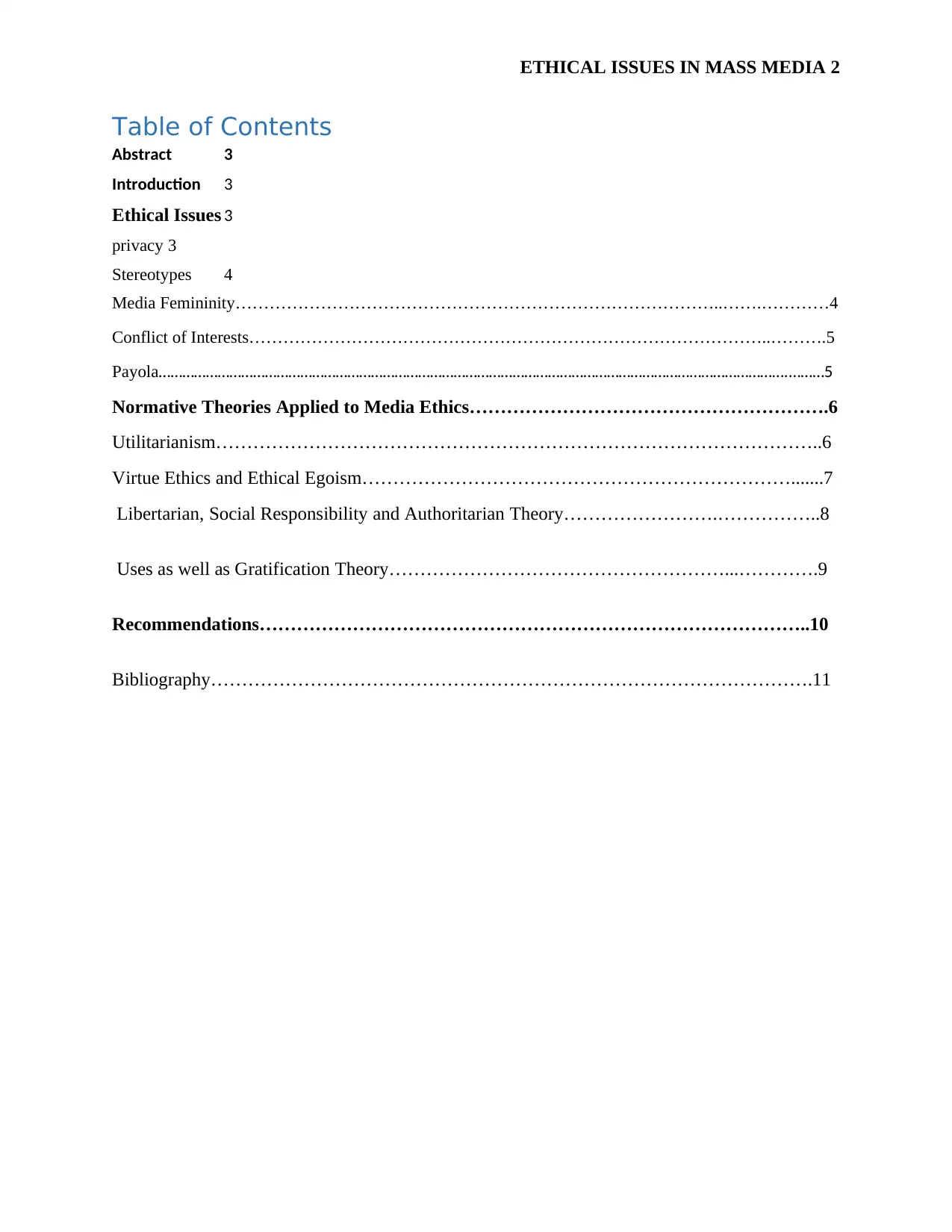
Table of Contents
Abstract 3
Introduction 3
Ethical Issues 3
privacy 3
Stereotypes 4
Media Femininity…………………………………………………………………………..…….…………4
Conflict of Interests………………………………………………………………………………..……….5
Payola…………………………………………………………………………………………………………………………………………….………5
Normative Theories Applied to Media Ethics………………………………………………….6
Utilitarianism……………………………………………………………………………………..6
Virtue Ethics and Ethical Egoism…………………………………………………………….......7
Libertarian, Social Responsibility and Authoritarian Theory…………………….……………..8
Uses as well as Gratification Theory………………………………………………...………….9
Recommendations……………………………………………………………………………..10
Bibliography…………………………………………………………………………………….11
Table of Contents
Abstract 3
Introduction 3
Ethical Issues 3
privacy 3
Stereotypes 4
Media Femininity…………………………………………………………………………..…….…………4
Conflict of Interests………………………………………………………………………………..……….5
Payola…………………………………………………………………………………………………………………………………………….………5
Normative Theories Applied to Media Ethics………………………………………………….6
Utilitarianism……………………………………………………………………………………..6
Virtue Ethics and Ethical Egoism…………………………………………………………….......7
Libertarian, Social Responsibility and Authoritarian Theory…………………….……………..8
Uses as well as Gratification Theory………………………………………………...………….9
Recommendations……………………………………………………………………………..10
Bibliography…………………………………………………………………………………….11
ETHICAL ISSUES IN MASS MEDIA 3
Abstract
In the rapidly changing and competitive situation of mass-media connections, media
specialists are overcome by targets, bottom-line imperatives, as well as corporate interests and
might easily lose focus of ethical effects of their profession. This report is aimed to address
significant ethical issues within the Mass Broadcasting business. Their distinctive practices will
critically be analyzed, highlighting vital ethical issues. It will as well compare it with normative
theories useful in Media Ethics through real-time application and offer policy recommendations.
The report is directed by the social responsibility theory and libertarian concept of the media.
1.0 Introduction
With the number of mass media platforms as well as increasing skills in the current
world, it is open that several ethical issues about the media are there. According to several
studies the most prevailing issues all over the world include stereotypes, inaccuracy and invasion
of people’s privacy, conflict of interest, payola, media femininity and media dishonesty as well
as bias (Fairclough, 2013). These ethical concerns appear through several media platforms like
journalism, advertising, the internet and public relations.
Ethical Responsibility and Mass Media have a compound association among them. Mass
media might simply be well-defined as routes of Communication aimed to spread to the Public
thru various coded, visual and verbal platforms and means. Some platforms are; 1) Books/
Newspaper 2) Internet 3) Motion Picture/Television 4) Social Media 5) Radio 6) Gaming. Media
corporations generate a lot of revenues throughout the world (Boyd and Crawford, 2012).
2.0 Ethical Issues
2.1 Privacy
Abstract
In the rapidly changing and competitive situation of mass-media connections, media
specialists are overcome by targets, bottom-line imperatives, as well as corporate interests and
might easily lose focus of ethical effects of their profession. This report is aimed to address
significant ethical issues within the Mass Broadcasting business. Their distinctive practices will
critically be analyzed, highlighting vital ethical issues. It will as well compare it with normative
theories useful in Media Ethics through real-time application and offer policy recommendations.
The report is directed by the social responsibility theory and libertarian concept of the media.
1.0 Introduction
With the number of mass media platforms as well as increasing skills in the current
world, it is open that several ethical issues about the media are there. According to several
studies the most prevailing issues all over the world include stereotypes, inaccuracy and invasion
of people’s privacy, conflict of interest, payola, media femininity and media dishonesty as well
as bias (Fairclough, 2013). These ethical concerns appear through several media platforms like
journalism, advertising, the internet and public relations.
Ethical Responsibility and Mass Media have a compound association among them. Mass
media might simply be well-defined as routes of Communication aimed to spread to the Public
thru various coded, visual and verbal platforms and means. Some platforms are; 1) Books/
Newspaper 2) Internet 3) Motion Picture/Television 4) Social Media 5) Radio 6) Gaming. Media
corporations generate a lot of revenues throughout the world (Boyd and Crawford, 2012).
2.0 Ethical Issues
2.1 Privacy
⊘ This is a preview!⊘
Do you want full access?
Subscribe today to unlock all pages.

Trusted by 1+ million students worldwide
ETHICAL ISSUES IN MASS MEDIA 4
As technology advances, it has brought about bigger invasions of people’s privacy. The
technologies comprises of long ranging cameras, helicopters as well as monitoring emails. It
appears that confidentiality is an issue that is simply broken into whenever the media as well as
its audiences are referred to. It is challenging for people’s information to be kept private, which
makes this such a significant ethical concern (Zeng and Gerritsen, 2014). For example, Facebook
changed the privacy settings of the people in the year 2014 and has allowed accessibility of
consumers’ smartphone microphones for songs, analyze, television shows as well as other
interests.
2.2 Stereotypes
The choice of which story to cover as well as how frequently particular stories should be
covered might influence the perception of the society on particular groups of individuals,
including ethnic and racial group. Regardless of these changes as well as greater people’s
attention about diversity concerns, minority groups’ underrepresentation is up to now a concern
in every area of the media (Potter, 2013). As a matter of fact, the development in recent time has
been deteriorating. According to a recent research, the NAACP stated that the sum of minority
artists on network TV has essentially reduced, from 334 during the season of 2002–2003 to 308
four years from then. Stereotypes based on races are not a concern in only entertainment media,
but they as well penetrate into the news reporting that is a method of storytelling. Reporters,
Journalists, and editors are still in the majority when it comes to stereotypes.
2.3 Media Femininity
Stereotyping gender characters is still thriving in the media platforms. Women are time
and again characterized as minor to their counterparts who are male. They are as well
As technology advances, it has brought about bigger invasions of people’s privacy. The
technologies comprises of long ranging cameras, helicopters as well as monitoring emails. It
appears that confidentiality is an issue that is simply broken into whenever the media as well as
its audiences are referred to. It is challenging for people’s information to be kept private, which
makes this such a significant ethical concern (Zeng and Gerritsen, 2014). For example, Facebook
changed the privacy settings of the people in the year 2014 and has allowed accessibility of
consumers’ smartphone microphones for songs, analyze, television shows as well as other
interests.
2.2 Stereotypes
The choice of which story to cover as well as how frequently particular stories should be
covered might influence the perception of the society on particular groups of individuals,
including ethnic and racial group. Regardless of these changes as well as greater people’s
attention about diversity concerns, minority groups’ underrepresentation is up to now a concern
in every area of the media (Potter, 2013). As a matter of fact, the development in recent time has
been deteriorating. According to a recent research, the NAACP stated that the sum of minority
artists on network TV has essentially reduced, from 334 during the season of 2002–2003 to 308
four years from then. Stereotypes based on races are not a concern in only entertainment media,
but they as well penetrate into the news reporting that is a method of storytelling. Reporters,
Journalists, and editors are still in the majority when it comes to stereotypes.
2.3 Media Femininity
Stereotyping gender characters is still thriving in the media platforms. Women are time
and again characterized as minor to their counterparts who are male. They are as well
Paraphrase This Document
Need a fresh take? Get an instant paraphrase of this document with our AI Paraphraser
ETHICAL ISSUES IN MASS MEDIA 5
represented as emotional, sweet natured, noncompetitive, and domestic (Lippi-Green, 2012).
Different from these types of women, others are characterized as cruel, crazy, or unattractively
masculine. In television sitcoms and dramas, women are still filling traditional parts such as
nurses, mothers, secretaries, as well as housewives.
2.4 Conflict of interest
Different people’s concern in the mass media differs, Therefore it is difficult to decide
the correct thing that one should do. News operators are often afraid of reporting stories
concerning advertisers because they may lose business they get from them. In current's
competitive journalistic atmosphere, clashes of interest among news channels and the subjects
are very common (Lupton, 2013). Even though most establishments have a well-known code of
ethics, they are not mandatory or enforced. Due to this, it is more justifiable and easier for
Medias not to follow these rules that just compromises their reporting credibility and integrity.
2.5 Payola
Bribing people to be given air time might as well employ reverse payola that often
comprises threats. Parties paying radio stations so that they play a particular artist (both in cash
and in goods). This exercise has obvious consequences: when radio play is bought with money,
some artists receive more publicity than other does (Ball, 2012). Exposure is fundamental for an
artist to succeed in music industry, as well as in a model world, the people's response to songs
and artists themselves should dictates who get the big share of the mass media exposure.
3.0 Normative Theories Applied to Media Principles
The ethical code for media overcomes choice for ethical conduct in the business. The
efficiency of the ethical code of behavior put in place by the companies determine dominance of
represented as emotional, sweet natured, noncompetitive, and domestic (Lippi-Green, 2012).
Different from these types of women, others are characterized as cruel, crazy, or unattractively
masculine. In television sitcoms and dramas, women are still filling traditional parts such as
nurses, mothers, secretaries, as well as housewives.
2.4 Conflict of interest
Different people’s concern in the mass media differs, Therefore it is difficult to decide
the correct thing that one should do. News operators are often afraid of reporting stories
concerning advertisers because they may lose business they get from them. In current's
competitive journalistic atmosphere, clashes of interest among news channels and the subjects
are very common (Lupton, 2013). Even though most establishments have a well-known code of
ethics, they are not mandatory or enforced. Due to this, it is more justifiable and easier for
Medias not to follow these rules that just compromises their reporting credibility and integrity.
2.5 Payola
Bribing people to be given air time might as well employ reverse payola that often
comprises threats. Parties paying radio stations so that they play a particular artist (both in cash
and in goods). This exercise has obvious consequences: when radio play is bought with money,
some artists receive more publicity than other does (Ball, 2012). Exposure is fundamental for an
artist to succeed in music industry, as well as in a model world, the people's response to songs
and artists themselves should dictates who get the big share of the mass media exposure.
3.0 Normative Theories Applied to Media Principles
The ethical code for media overcomes choice for ethical conduct in the business. The
efficiency of the ethical code of behavior put in place by the companies determine dominance of
ETHICAL ISSUES IN MASS MEDIA 6
intricate ethical concerns (Liyanagunawardena, Adams and Williams, 2013). They include the
internal choices, being impartial, presenting proofs rather than views, and other things of this
nature. How real codes of conduct applied by media groups will openly be determined by the
certainty of the reporter concerning just how significant principles in journalism are for the
people.
3.1 Utilitarianism: Were steps taken with an aim of welfare, practicality as well as increasing
happiness?
The most persuading policy on media principles is the ethical concept of utilitarianism.
This significant concept details that the measurements of right as well as wrong is subject to the
greatest group of individuals. Its values match with the ethical code of behavior convoluted
within Mass media business practices as well as responsibilities. Major consequences of
utilitarianism’s prevalent is the critical thought that is missing when deciding for compound
ethical issues, like individual rights against greatest population (Crane and Matten, 2016). The
weakness experienced within utilitarianism have got mass media industries seek ethical
importance by observing a code of conduct directed by the business to which was considered
moral.
A very ideal example in latest Ethical Concerns faced by businesses is the instance of
Facebook International, who did a research on consumers' emotions, igniting soul-searches
amongst mass media platforms in the year 2014 while being referred for better moral strategies
in the connected world (Marcuse, 2013). It created various serious ethical concerns for the
corporation regarding approval of the consumers and their confidentiality, Probability that the
consumers have been affected by the research in a psychological and emotional state as well as
Security of Customers’ Information and Data.
intricate ethical concerns (Liyanagunawardena, Adams and Williams, 2013). They include the
internal choices, being impartial, presenting proofs rather than views, and other things of this
nature. How real codes of conduct applied by media groups will openly be determined by the
certainty of the reporter concerning just how significant principles in journalism are for the
people.
3.1 Utilitarianism: Were steps taken with an aim of welfare, practicality as well as increasing
happiness?
The most persuading policy on media principles is the ethical concept of utilitarianism.
This significant concept details that the measurements of right as well as wrong is subject to the
greatest group of individuals. Its values match with the ethical code of behavior convoluted
within Mass media business practices as well as responsibilities. Major consequences of
utilitarianism’s prevalent is the critical thought that is missing when deciding for compound
ethical issues, like individual rights against greatest population (Crane and Matten, 2016). The
weakness experienced within utilitarianism have got mass media industries seek ethical
importance by observing a code of conduct directed by the business to which was considered
moral.
A very ideal example in latest Ethical Concerns faced by businesses is the instance of
Facebook International, who did a research on consumers' emotions, igniting soul-searches
amongst mass media platforms in the year 2014 while being referred for better moral strategies
in the connected world (Marcuse, 2013). It created various serious ethical concerns for the
corporation regarding approval of the consumers and their confidentiality, Probability that the
consumers have been affected by the research in a psychological and emotional state as well as
Security of Customers’ Information and Data.
⊘ This is a preview!⊘
Do you want full access?
Subscribe today to unlock all pages.
Trusted by 1+ million students worldwide
ETHICAL ISSUES IN MASS MEDIA 7
3.2 Virtue Ethics and Ethical Egoism
Egoism is a different viewpoint of a normative concept, which states that any act is
referred to as ethical when it assists in obtaining an anticipated goal, anything avoiding to attain
that objective is unprincipled in nature (Baker and Hesmondhalgh, 2013). An immediate analysis
is there with the point that says, we must be concerned about other persons only when it profits
us. The challenge is that all acts might be safeguarded by simply saying that you did so for your
best interest.
Nevertheless, the moral character is significantly highly recommended within the mass
media profession. The perception of personality focused as well as morality based theory is the
thing that is provided from the Golden mean of Aristotle (Boyd and Crawford, 2012). The
editorial idea of fairness shows the impression of compromise and moderation, or as it is stated
by Aristotle, virtues as the means between two different extremes. Further extending this might
be realized in Kant’s definite authoritative “Act on the maxim that you will to come to be a
common law. The model enforces to choose activities by probing the query, what would come
about when everybody acted in this manner. Because of the Decent code of conducts in the
media industry, objectivity as well as an ethical good character must have been established over
time. However in latest years the business has been disappearing far from it (Goetsch and Davis,
2014). The significance in relation to ethical teaching and morals is the thing that is absent in the
mass media business and current society.
Ethical Theory is referred to as Normative when it purpose to advise the morally upright
approach of acting. According to the volume “Four theories of the media”, the writers define 4
3.2 Virtue Ethics and Ethical Egoism
Egoism is a different viewpoint of a normative concept, which states that any act is
referred to as ethical when it assists in obtaining an anticipated goal, anything avoiding to attain
that objective is unprincipled in nature (Baker and Hesmondhalgh, 2013). An immediate analysis
is there with the point that says, we must be concerned about other persons only when it profits
us. The challenge is that all acts might be safeguarded by simply saying that you did so for your
best interest.
Nevertheless, the moral character is significantly highly recommended within the mass
media profession. The perception of personality focused as well as morality based theory is the
thing that is provided from the Golden mean of Aristotle (Boyd and Crawford, 2012). The
editorial idea of fairness shows the impression of compromise and moderation, or as it is stated
by Aristotle, virtues as the means between two different extremes. Further extending this might
be realized in Kant’s definite authoritative “Act on the maxim that you will to come to be a
common law. The model enforces to choose activities by probing the query, what would come
about when everybody acted in this manner. Because of the Decent code of conducts in the
media industry, objectivity as well as an ethical good character must have been established over
time. However in latest years the business has been disappearing far from it (Goetsch and Davis,
2014). The significance in relation to ethical teaching and morals is the thing that is absent in the
mass media business and current society.
Ethical Theory is referred to as Normative when it purpose to advise the morally upright
approach of acting. According to the volume “Four theories of the media”, the writers define 4
Paraphrase This Document
Need a fresh take? Get an instant paraphrase of this document with our AI Paraphraser
ETHICAL ISSUES IN MASS MEDIA 8
normative concepts that quote “mostly expressing ideas of the way the media can be or should be
anticipated to work under an available set of values and conditions." The following frameworks
and theories have been set in the recent fast growing media business in reaction to ethical
problems (Theaker, 2017).
3.3 Libertarian, Social Responsibility and Authoritarian Theory
Libertarian theory defines that people are coherent and the rational point of view makes them to
choose what are bad and what are good (Thompson, 2013). The press must not limit anything
even if it is an adverse content might offer knowledge and might make better choice whilst worst
circumstances. Nevertheless, implications like the WikiLeaks network publishing restricted and
confidential collections to the people, operating against the government and the authority, have
made many states to not tolerate such activities.
Authoritarian theory inflicts an egoistic model, which every form of communications is
under the regulation of the ruling authorities or elite or influential administrators (Boyd and
Crawford, 2012). Censorship is a good example that suppresses all contents that may be thought
detrimental to the nation, people, or the government. Netflix was started in the year 2016 in India
having all their unique content. Editing is an extremely sensitive matter within India, whereby
Netflix a main multimedia distribution company disregarded such issue made them to encounter
legal challenge down the course (Silverman, 2016).
The Societal responsibility theory permits free media without any restriction, however at
the similar time the detail of the mass media must be deliberated in media and public panel. They
must receive any requirement from professional self-regulations or public interference or both of
normative concepts that quote “mostly expressing ideas of the way the media can be or should be
anticipated to work under an available set of values and conditions." The following frameworks
and theories have been set in the recent fast growing media business in reaction to ethical
problems (Theaker, 2017).
3.3 Libertarian, Social Responsibility and Authoritarian Theory
Libertarian theory defines that people are coherent and the rational point of view makes them to
choose what are bad and what are good (Thompson, 2013). The press must not limit anything
even if it is an adverse content might offer knowledge and might make better choice whilst worst
circumstances. Nevertheless, implications like the WikiLeaks network publishing restricted and
confidential collections to the people, operating against the government and the authority, have
made many states to not tolerate such activities.
Authoritarian theory inflicts an egoistic model, which every form of communications is
under the regulation of the ruling authorities or elite or influential administrators (Boyd and
Crawford, 2012). Censorship is a good example that suppresses all contents that may be thought
detrimental to the nation, people, or the government. Netflix was started in the year 2016 in India
having all their unique content. Editing is an extremely sensitive matter within India, whereby
Netflix a main multimedia distribution company disregarded such issue made them to encounter
legal challenge down the course (Silverman, 2016).
The Societal responsibility theory permits free media without any restriction, however at
the similar time the detail of the mass media must be deliberated in media and public panel. They
must receive any requirement from professional self-regulations or public interference or both of
ETHICAL ISSUES IN MASS MEDIA 9
them (McDaniel and Gates, 2013). It has assisted to create competence in the mass media
business permitting Consumer action, Community opinions, as well as expert ethics.
3.4 Uses as well as Gratification Theory
Uses as well as Gratification concept advocated by Katz, is focused on the way people apply
media for fulfilment of their requirements. The result of the Abraham Maslow's Order of
Requirements, it proposes the point that people select what they need to read or see as well as the
diverse media strive to satisfy everybody’s desires (Vaismoradi, Turunen, and Bondas, 2013). A
very ideal model of its current application might be seen in several Social Media platforms such
as Instagram and Facebook where necessity to vent destructive feelings, recognition, as well as
cognitive necessities inspire contents from several individuals.
Likewise the Market of concepts model have an opinion that concepts must be tabled before
the people who will select the superlative marketplace. It confines Government regulation as
well as putting faith in the people to make choices of what gratification they deserve to get. The
Internet might be reflected as an open sphere maintaining the ideal of “Open market of
Concepts”. Applying the stand, the line between Consumers and Media Producers have been
distorted (McLaren, 2015). Sites like WordPress, BlogSpot and Facebook have employed
internet statistics to draw their consumers in a great scale.
4.0 Recommendations
It is significant to differentiate what material the people has the right to receive, needs to
receive and wishes to receive.
them (McDaniel and Gates, 2013). It has assisted to create competence in the mass media
business permitting Consumer action, Community opinions, as well as expert ethics.
3.4 Uses as well as Gratification Theory
Uses as well as Gratification concept advocated by Katz, is focused on the way people apply
media for fulfilment of their requirements. The result of the Abraham Maslow's Order of
Requirements, it proposes the point that people select what they need to read or see as well as the
diverse media strive to satisfy everybody’s desires (Vaismoradi, Turunen, and Bondas, 2013). A
very ideal model of its current application might be seen in several Social Media platforms such
as Instagram and Facebook where necessity to vent destructive feelings, recognition, as well as
cognitive necessities inspire contents from several individuals.
Likewise the Market of concepts model have an opinion that concepts must be tabled before
the people who will select the superlative marketplace. It confines Government regulation as
well as putting faith in the people to make choices of what gratification they deserve to get. The
Internet might be reflected as an open sphere maintaining the ideal of “Open market of
Concepts”. Applying the stand, the line between Consumers and Media Producers have been
distorted (McLaren, 2015). Sites like WordPress, BlogSpot and Facebook have employed
internet statistics to draw their consumers in a great scale.
4.0 Recommendations
It is significant to differentiate what material the people has the right to receive, needs to
receive and wishes to receive.
⊘ This is a preview!⊘
Do you want full access?
Subscribe today to unlock all pages.
Trusted by 1+ million students worldwide
ETHICAL ISSUES IN MASS MEDIA 10
Women should be given more strong characters in the production of the television show
and movies. It is also known that we as well get more strong female roles on TVs,
womenfolk who are multi-dimensional and more real.
Credibility of the journalists is a very important issue. One cannot expect to be fruitful if
they let their editorial honesty to suffer for they might not escape conflict of interests.
As it is currently, payola is illegal but still widespread. The Governments ought to impose
tough rules to make sure that just the mass media training institutes, which meet the
necessary principles are permitted to operate.
Media owners must appraise the prevailing salary structures as well as improving
remuneration to prevent journalists from being manipulated by monetary rewards in order
to sacrifice expert standards.
Bibliography
Women should be given more strong characters in the production of the television show
and movies. It is also known that we as well get more strong female roles on TVs,
womenfolk who are multi-dimensional and more real.
Credibility of the journalists is a very important issue. One cannot expect to be fruitful if
they let their editorial honesty to suffer for they might not escape conflict of interests.
As it is currently, payola is illegal but still widespread. The Governments ought to impose
tough rules to make sure that just the mass media training institutes, which meet the
necessary principles are permitted to operate.
Media owners must appraise the prevailing salary structures as well as improving
remuneration to prevent journalists from being manipulated by monetary rewards in order
to sacrifice expert standards.
Bibliography
Paraphrase This Document
Need a fresh take? Get an instant paraphrase of this document with our AI Paraphraser
ETHICAL ISSUES IN MASS MEDIA 11
Baker, S. and Hesmondhalgh, D., 2013. Creative labour: Media work in three cultural
industries. London: Routledge.
Ball, S.J., 2012. Micro-politics of the School. London: Routledge.
Boyd, D. and Crawford, K., 2012. Critical questions for big data: Provocations for a cultural,
technological, and scholarly phenomenon. Information, communication & society, 15(5), pp.662-
679. Milton Park: Taylor & Francis Online.
Crane, A. and Matten, D., 2016. Business ethics: Managing corporate citizenship and
sustainability in the age of globalization. New York, NY: Oxford University Press.
Fairclough, N., 2013. Critical discourse analysis: The critical study of language. London:
Routledge.
Goetsch, D.L. and Davis, S.B., 2014. Quality management for organizational excellence. Upper
Saddle River, NJ: pearson.
Lippi-Green, R., 2012. English with an accent: Language, ideology and discrimination in the
United States. London: Routledge.
Liyanagunawardena, T.R., Adams, A.A. and Williams, S.A., 2013. MOOCs: A systematic study
of the published literature 2008-2012. The International Review of Research in Open and
Distributed Learning, 14(3), pp.202-227. London: University of Reading.
Lupton, D., 2013. Moral threats and dangerous desires: AIDS in the news media. London:
Routledge.
Marcuse, H., 2013. One-dimensional man: Studies in the ideology of advanced industrial society.
Routledge.
Baker, S. and Hesmondhalgh, D., 2013. Creative labour: Media work in three cultural
industries. London: Routledge.
Ball, S.J., 2012. Micro-politics of the School. London: Routledge.
Boyd, D. and Crawford, K., 2012. Critical questions for big data: Provocations for a cultural,
technological, and scholarly phenomenon. Information, communication & society, 15(5), pp.662-
679. Milton Park: Taylor & Francis Online.
Crane, A. and Matten, D., 2016. Business ethics: Managing corporate citizenship and
sustainability in the age of globalization. New York, NY: Oxford University Press.
Fairclough, N., 2013. Critical discourse analysis: The critical study of language. London:
Routledge.
Goetsch, D.L. and Davis, S.B., 2014. Quality management for organizational excellence. Upper
Saddle River, NJ: pearson.
Lippi-Green, R., 2012. English with an accent: Language, ideology and discrimination in the
United States. London: Routledge.
Liyanagunawardena, T.R., Adams, A.A. and Williams, S.A., 2013. MOOCs: A systematic study
of the published literature 2008-2012. The International Review of Research in Open and
Distributed Learning, 14(3), pp.202-227. London: University of Reading.
Lupton, D., 2013. Moral threats and dangerous desires: AIDS in the news media. London:
Routledge.
Marcuse, H., 2013. One-dimensional man: Studies in the ideology of advanced industrial society.
Routledge.
ETHICAL ISSUES IN MASS MEDIA 12
McDaniel, C. and Gates, R., 2013. Marketing research. Singapore: John Wiley & Sons, Inc.
McLaren, P., 2015. Life in schools: An introduction to critical pedagogy in the foundations of
education. London: Routledge.
Potter, W.J., 2013. An analysis of thinking and research about qualitative methods. Routledge.
Silverman, D. ed., 2016. Qualitative research. Newbury Park, California: Sage.
Theaker, A., 2017. What is public relations?. In The Public Relations Strategic Toolkit (pp. 17-
27). Routledge.
Thompson, J.B., 2013. Ideology and modern culture: Critical social theory in the era of mass
communication. New Jersey NJ: John Wiley & Sons Inc.
Vaismoradi, M., Turunen, H. and Bondas, T., 2013. Content analysis and thematic analysis:
Implications for conducting a qualitative descriptive study. Nursing & health sciences, 15(3),
pp.398-405. Hoboken, New Jersey: Wiley Online Library.
Zeng, B. and Gerritsen, R., 2014. What do we know about social media in tourism? A
review. Tourism Management Perspectives, 10, Amsterdam: Elsevier Publishers.
McDaniel, C. and Gates, R., 2013. Marketing research. Singapore: John Wiley & Sons, Inc.
McLaren, P., 2015. Life in schools: An introduction to critical pedagogy in the foundations of
education. London: Routledge.
Potter, W.J., 2013. An analysis of thinking and research about qualitative methods. Routledge.
Silverman, D. ed., 2016. Qualitative research. Newbury Park, California: Sage.
Theaker, A., 2017. What is public relations?. In The Public Relations Strategic Toolkit (pp. 17-
27). Routledge.
Thompson, J.B., 2013. Ideology and modern culture: Critical social theory in the era of mass
communication. New Jersey NJ: John Wiley & Sons Inc.
Vaismoradi, M., Turunen, H. and Bondas, T., 2013. Content analysis and thematic analysis:
Implications for conducting a qualitative descriptive study. Nursing & health sciences, 15(3),
pp.398-405. Hoboken, New Jersey: Wiley Online Library.
Zeng, B. and Gerritsen, R., 2014. What do we know about social media in tourism? A
review. Tourism Management Perspectives, 10, Amsterdam: Elsevier Publishers.
⊘ This is a preview!⊘
Do you want full access?
Subscribe today to unlock all pages.
Trusted by 1+ million students worldwide

1 out of 12


Your All-in-One AI-Powered Toolkit for Academic Success.
+13062052269
info@desklib.com
Available 24*7 on WhatsApp / Email
![[object Object]](/_next/static/media/star-bottom.7253800d.svg)
Unlock your academic potential
Copyright © 2020–2026 A2Z Services. All Rights Reserved. Developed and managed by ZUCOL.