MSc Medical Imaging: Evidence-Based Change, Leadership & Radiology

Verified

Added on  2022/09/14

|7
|1414
|22
Report
AI Summary
This report addresses the critical need for evidence-based change within the field of radiology, examining the shift from traditional practices to those supported by empirical data. It highlights the impact of technological advancements, such as cross-sectional MRI, digital ultrasound, and interventional radiology, on the global radiology landscape. The report emphasizes that these advancements are primarily evidence-based, advocating for the integration of clinical expertise with the best available clinical evidence. Furthermore, it assesses aptitude for clinical and team leadership, focusing on the ability to communicate a clear vision and foster shared ownership of ideas within a team. The report underscores the importance of evidence-based decision-making in radiology to enhance patient care and adapt to the rapidly evolving healthcare environment. It also examines the role of leadership in fostering cohesion and achieving organizational goals.
Document Page
MSc Medical Imaging
Advanced Practice – Negotiated Independent Work Based learning
(Course work activity #4)
Activity Number: SQ 5
In relation to your specified are of practice justify the need for an evidence based change. Assess
your aptitude for clinical and team leadership, particularly with respect to communicating the
vision and developing shared ownership of ideas.
Total words: 1000
Table of Contents
Page 1 of 7
tabler-icon-diamond-filled.svg

Paraphrase This Document

Need a fresh take? Get an instant paraphrase of this document with our AI Paraphraser
Document Page
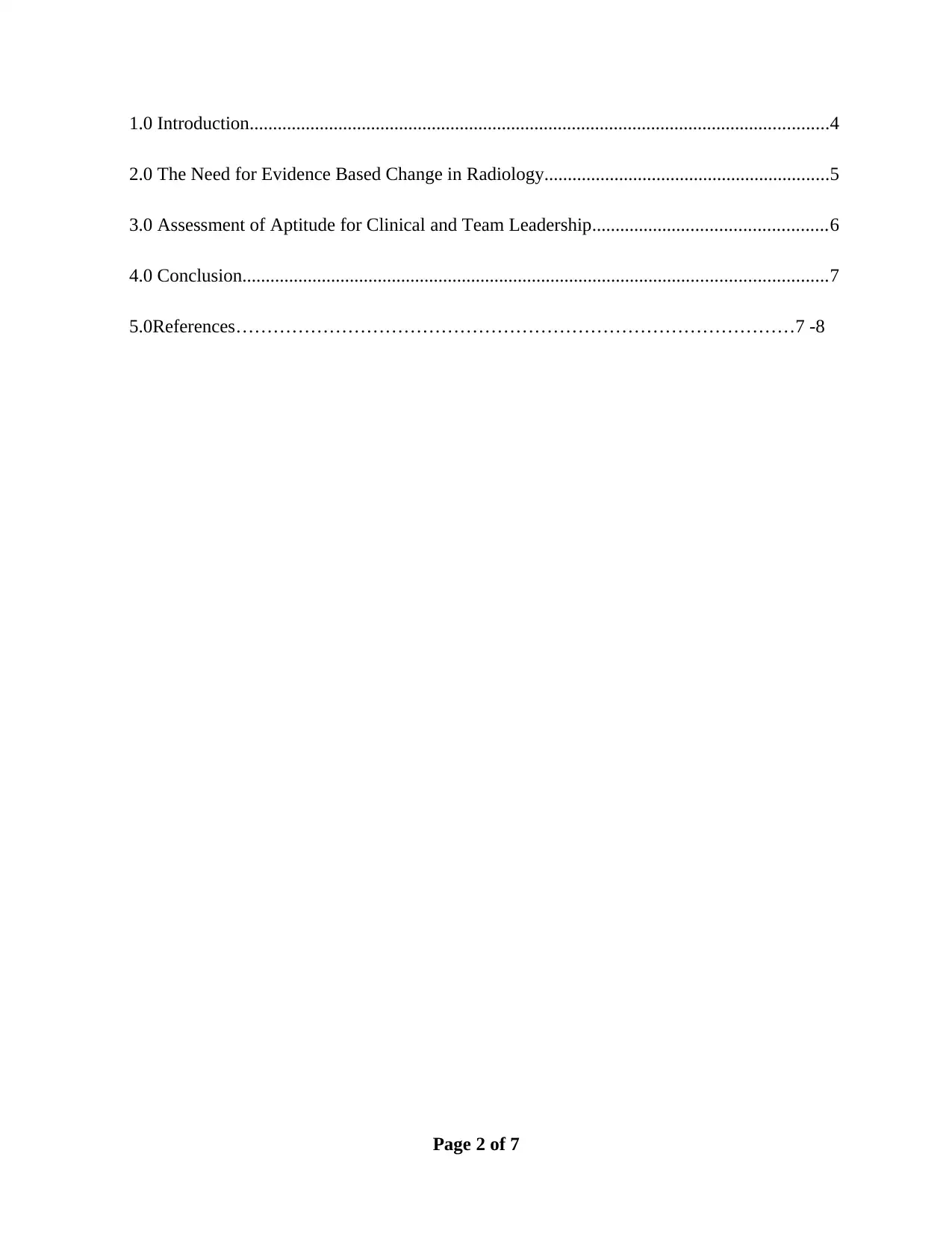
1.0 Introduction............................................................................................................................4
2.0 The Need for Evidence Based Change in Radiology.............................................................5
3.0 Assessment of Aptitude for Clinical and Team Leadership..................................................6
4.0 Conclusion.............................................................................................................................7
5.0References………………………………………………………………………………7 -8
Page 2 of 7
Document Page
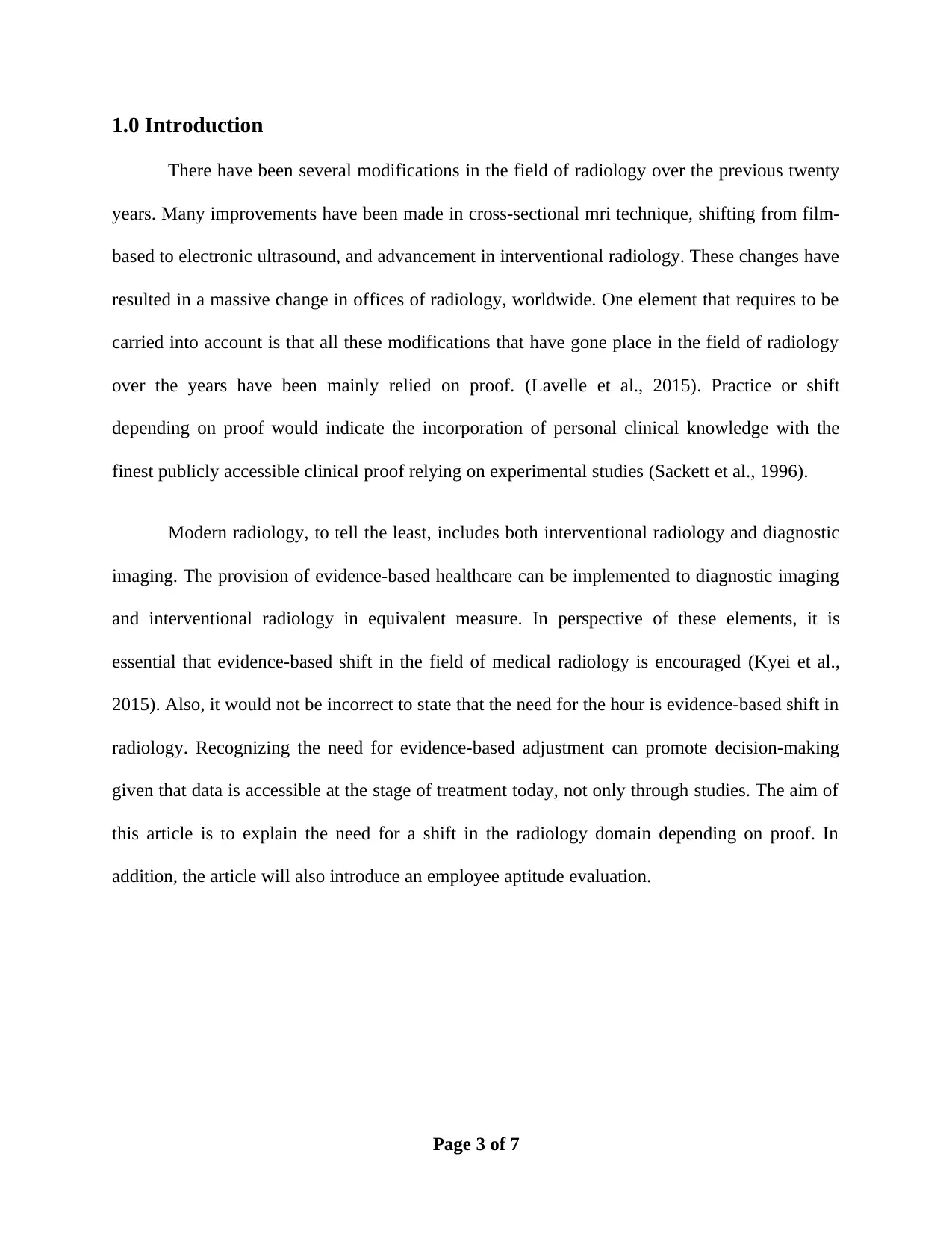
1.0 Introduction
There have been several modifications in the field of radiology over the previous twenty
years. Many improvements have been made in cross-sectional mri technique, shifting from film-
based to electronic ultrasound, and advancement in interventional radiology. These changes have
resulted in a massive change in offices of radiology, worldwide. One element that requires to be
carried into account is that all these modifications that have gone place in the field of radiology
over the years have been mainly relied on proof. (Lavelle et al., 2015). Practice or shift
depending on proof would indicate the incorporation of personal clinical knowledge with the
finest publicly accessible clinical proof relying on experimental studies (Sackett et al., 1996).
Modern radiology, to tell the least, includes both interventional radiology and diagnostic
imaging. The provision of evidence-based healthcare can be implemented to diagnostic imaging
and interventional radiology in equivalent measure. In perspective of these elements, it is
essential that evidence-based shift in the field of medical radiology is encouraged (Kyei et al.,
2015). Also, it would not be incorrect to state that the need for the hour is evidence-based shift in
radiology. Recognizing the need for evidence-based adjustment can promote decision-making
given that data is accessible at the stage of treatment today, not only through studies. The aim of
this article is to explain the need for a shift in the radiology domain depending on proof. In
addition, the article will also introduce an employee aptitude evaluation.
Page 3 of 7
Document Page
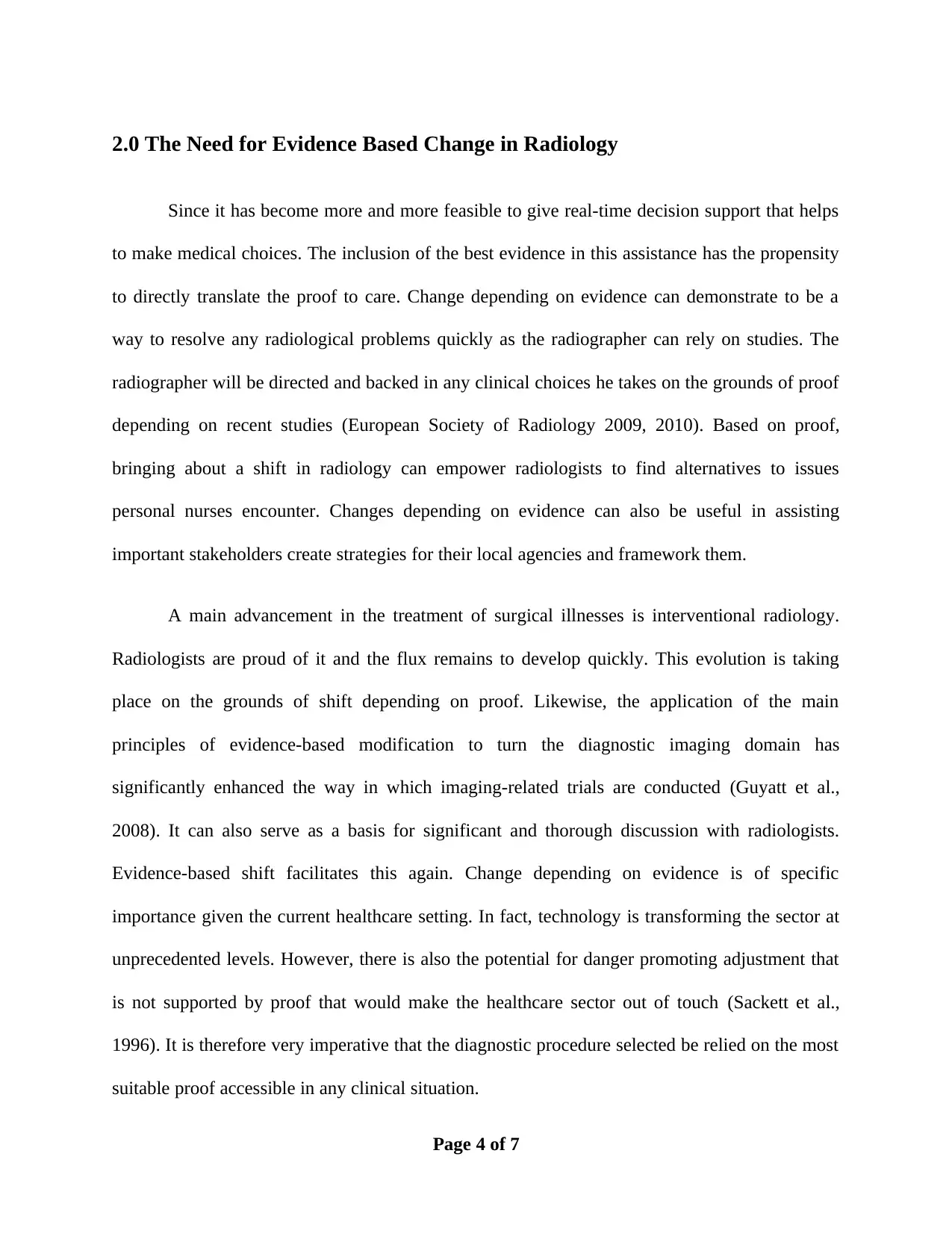
2.0 The Need for Evidence Based Change in Radiology
Since it has become more and more feasible to give real-time decision support that helps
to make medical choices. The inclusion of the best evidence in this assistance has the propensity
to directly translate the proof to care. Change depending on evidence can demonstrate to be a
way to resolve any radiological problems quickly as the radiographer can rely on studies. The
radiographer will be directed and backed in any clinical choices he takes on the grounds of proof
depending on recent studies (European Society of Radiology 2009, 2010). Based on proof,
bringing about a shift in radiology can empower radiologists to find alternatives to issues
personal nurses encounter. Changes depending on evidence can also be useful in assisting
important stakeholders create strategies for their local agencies and framework them.
A main advancement in the treatment of surgical illnesses is interventional radiology.
Radiologists are proud of it and the flux remains to develop quickly. This evolution is taking
place on the grounds of shift depending on proof. Likewise, the application of the main
principles of evidence-based modification to turn the diagnostic imaging domain has
significantly enhanced the way in which imaging-related trials are conducted (Guyatt et al.,
2008). It can also serve as a basis for significant and thorough discussion with radiologists.
Evidence-based shift facilitates this again. Change depending on evidence is of specific
importance given the current healthcare setting. In fact, technology is transforming the sector at
unprecedented levels. However, there is also the potential for danger promoting adjustment that
is not supported by proof that would make the healthcare sector out of touch (Sackett et al.,
1996). It is therefore very imperative that the diagnostic procedure selected be relied on the most
suitable proof accessible in any clinical situation.
Page 4 of 7
tabler-icon-diamond-filled.svg

Paraphrase This Document

Need a fresh take? Get an instant paraphrase of this document with our AI Paraphraser
Document Page
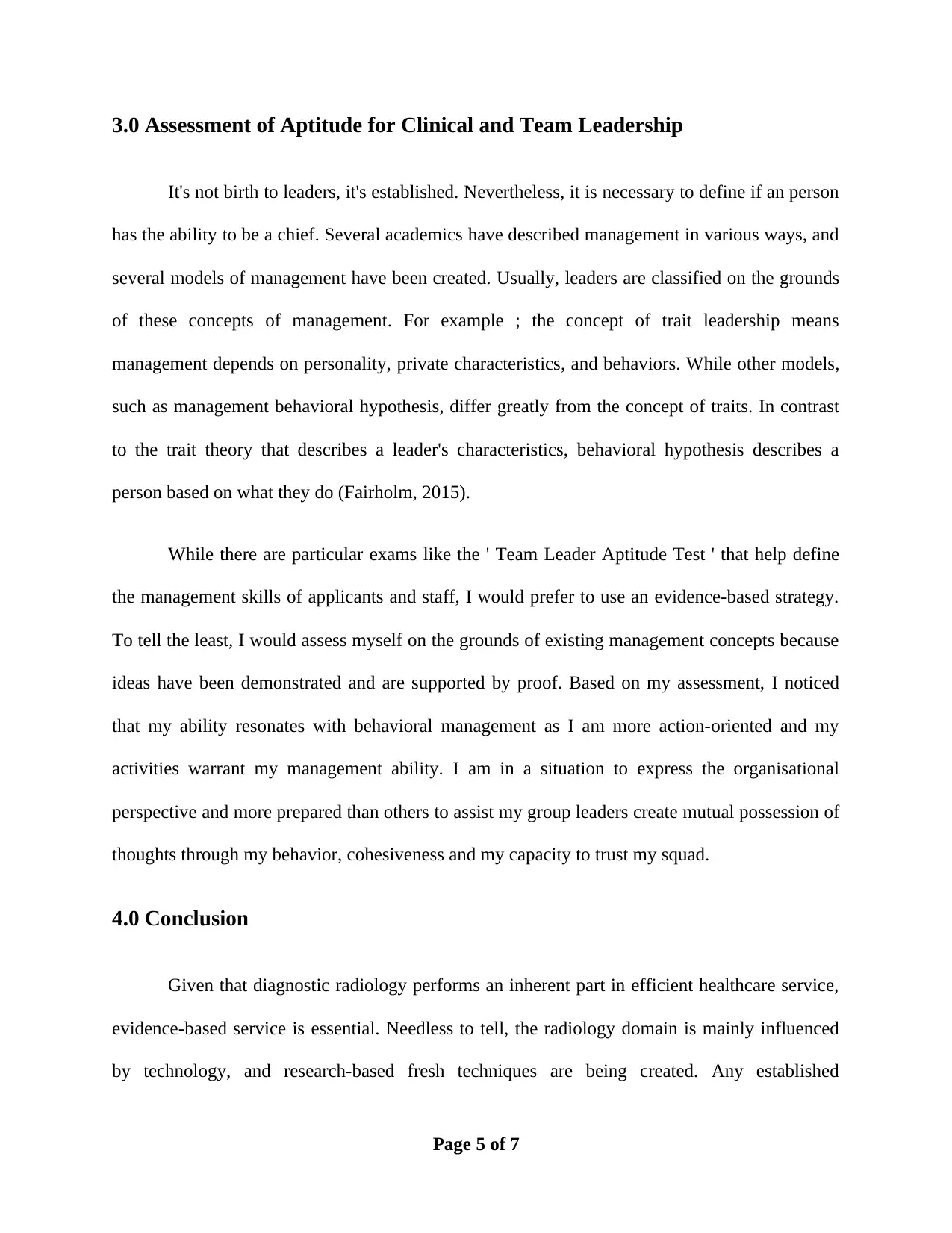
3.0 Assessment of Aptitude for Clinical and Team Leadership
It's not birth to leaders, it's established. Nevertheless, it is necessary to define if an person
has the ability to be a chief. Several academics have described management in various ways, and
several models of management have been created. Usually, leaders are classified on the grounds
of these concepts of management. For example ; the concept of trait leadership means
management depends on personality, private characteristics, and behaviors. While other models,
such as management behavioral hypothesis, differ greatly from the concept of traits. In contrast
to the trait theory that describes a leader's characteristics, behavioral hypothesis describes a
person based on what they do (Fairholm, 2015).
While there are particular exams like the ' Team Leader Aptitude Test ' that help define
the management skills of applicants and staff, I would prefer to use an evidence-based strategy.
To tell the least, I would assess myself on the grounds of existing management concepts because
ideas have been demonstrated and are supported by proof. Based on my assessment, I noticed
that my ability resonates with behavioral management as I am more action-oriented and my
activities warrant my management ability. I am in a situation to express the organisational
perspective and more prepared than others to assist my group leaders create mutual possession of
thoughts through my behavior, cohesiveness and my capacity to trust my squad.
4.0 Conclusion
Given that diagnostic radiology performs an inherent part in efficient healthcare service,
evidence-based service is essential. Needless to tell, the radiology domain is mainly influenced
by technology, and research-based fresh techniques are being created. Any established
Page 5 of 7
Document Page
technology is supported by proof, which is why evidence-based modification is needed. The
same applies to the radiology domain. Given that the sector of radiology is constantly evolving,
it is suggested that any shift in the domain should be focused on proof for greater effect and
superior outcomes.
In addition, team leaders perform a critical part in keeping a group together to ensure that
research is carried out in tandem so that each employee is on the same stage. This promotes the
achievement of organisational goals. However, it is very important to identify whether an person
is constructed to assume the leader's position. In order to communicate the view effectively, a
cohesive chief would exercise adequate communication.
Reference
ESR (Europian socity of Radiology) 2009 (2010). The future role of radiology in healthcare.
Insights into imaging. [Online]. 1 (1). pp. 2–11. Available from:
http://link.springer.com/10.1007/s13244-009-0007-x.
Fairholm, M. (2015). Defining Leadership. [Online]. Available from:
https://www.researchgate.net/publication/283048404_Defining_Leadership.
Guyatt, G., Rennie, D., Meade, M.O. & Cook, D.J. (2008). Users’ Guides to the Medical
Literature: Essentials of Evidence-Based Clinical Practice, Second Edition. McGraw-Hill
professional. [Online]. McGraw-Hill Education. Available from:
https://books.google.co.in/books?id=Kz3_36ejIv4C.
Kyei, K., Antwi, W.K. & JB, S. (2015). Evidence-Based Practice in Radiography: Attitudes,
Page 6 of 7
Document Page
Beliefs, Knowledge and Practices of Radiographers in Ghana. [Online]. Available from:
https://www.researchgate.net/publication/281935645_Evidence-
Based_Practice_in_Radiography_Attitudes_Beliefs_Knowledge_and_Practices_of_Radiogr
aphers_in_Ghana.
Lavelle, L.P., Dunne, R.M., Carroll, A.G. & Malone, D.E. (2015). Evidence-based Practice of
Radiology. RadioGraphics. [Online]. 35 (6). pp. 1802–1813. Available from:
http://pubs.rsna.org/doi/10.1148/rg.2015150027.
Sackett, D.L., Rosenberg, W.M.C., Gray, J.A.M., Haynes, R.B. & Richardson, W.S. (1996).
Evidence based medicine: what it is and what it isn’t. BMJ. [Online]. 312 (7023). pp. 71–
72. Available from: http://www.bmj.com/cgi/doi/10.1136/bmj.312.7023.71.
Page 7 of 7
chevron_up_icon
1 out of 7
circle_padding
hide_on_mobile
zoom_out_icon
[object Object]