MTH 1207 (Fundamental Mathematics 2) Assignment 1: Complete Solutions

Verified

Added on  2023/01/16

|4
|791
|47
Homework Assignment
AI Summary
This document presents a complete solution to Assignment 1 for the MTH 1207 (Fundamental Mathematics 2) course at the University of Guyana. The assignment covers several key calculus concepts. The solution begins with determining infinite limits using right and left-hand limits. It proceeds to solve differentiation problems using first principles and standard differentiation rules, including finding derivatives of various functions. The solution also addresses finding absolute maximum and minimum values of a function on a given interval. Furthermore, the document includes finding the equation of a tangent line to a curve at a specific point and analyzing the equation of motion of a particle, determining velocity and acceleration. Finally, the assignment concludes with definite integration problems. This assignment serves as a comprehensive resource for students studying calculus.
Document Page
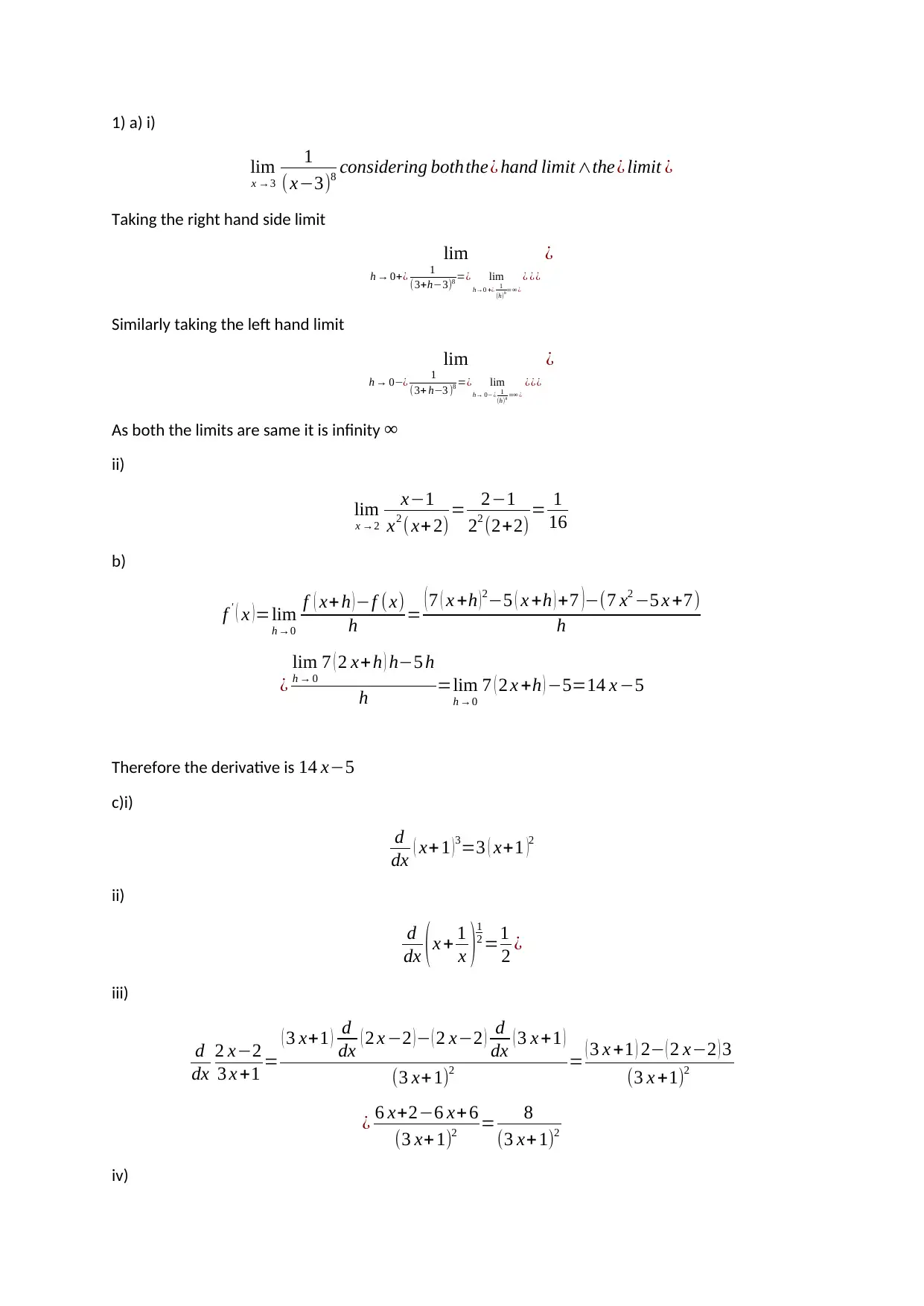
1) a) i)
lim
x 3
1
( x3)8 considering boththe¿ hand limit the¿ limit ¿
Taking the right hand side limit
lim
h 0+¿ 1
(3+h3)8 =¿ lim
h0 +¿ 1
(h)8 = ¿
¿ ¿¿
¿
Similarly taking the left hand limit
lim
h 0¿ 1
(3+ h3 )8 =¿ lim
h 0¿ 1
(h)8 = ¿
¿¿¿
¿
As both the limits are same it is infinity
ii)
lim
x 2
x1
x2 (x+ 2)= 21
22 (2+2) = 1
16
b)
f ' ( x )=lim
h 0
f ( x+ h )f (x)
h = (7 ( x +h )25 ( x +h ) +7 )(7 x2 5 x +7)
h
¿
lim
h 0
7 ( 2 x+h ) h5 h
h =lim
h 0
7 ( 2 x +h ) 5=14 x 5
Therefore the derivative is 14 x5
c)i)
d
dx ( x+ 1 )3=3 ( x+1 )2
ii)
d
dx ( x + 1
x ) 1
2 =1
2 ¿
iii)
d
dx
2 x2
3 x +1 =
( 3 x+1 ) d
dx ( 2 x 2 ) ( 2 x2 ) d
dx ( 3 x +1 )
(3 x+1)2 = ( 3 x +1 ) 2 ( 2 x2 ) 3
(3 x +1)2
¿ 6 x+26 x+6
(3 x+ 1)2 = 8
(3 x+ 1)2
iv)
tabler-icon-diamond-filled.svg

Paraphrase This Document

Need a fresh take? Get an instant paraphrase of this document with our AI Paraphraser
Document Page
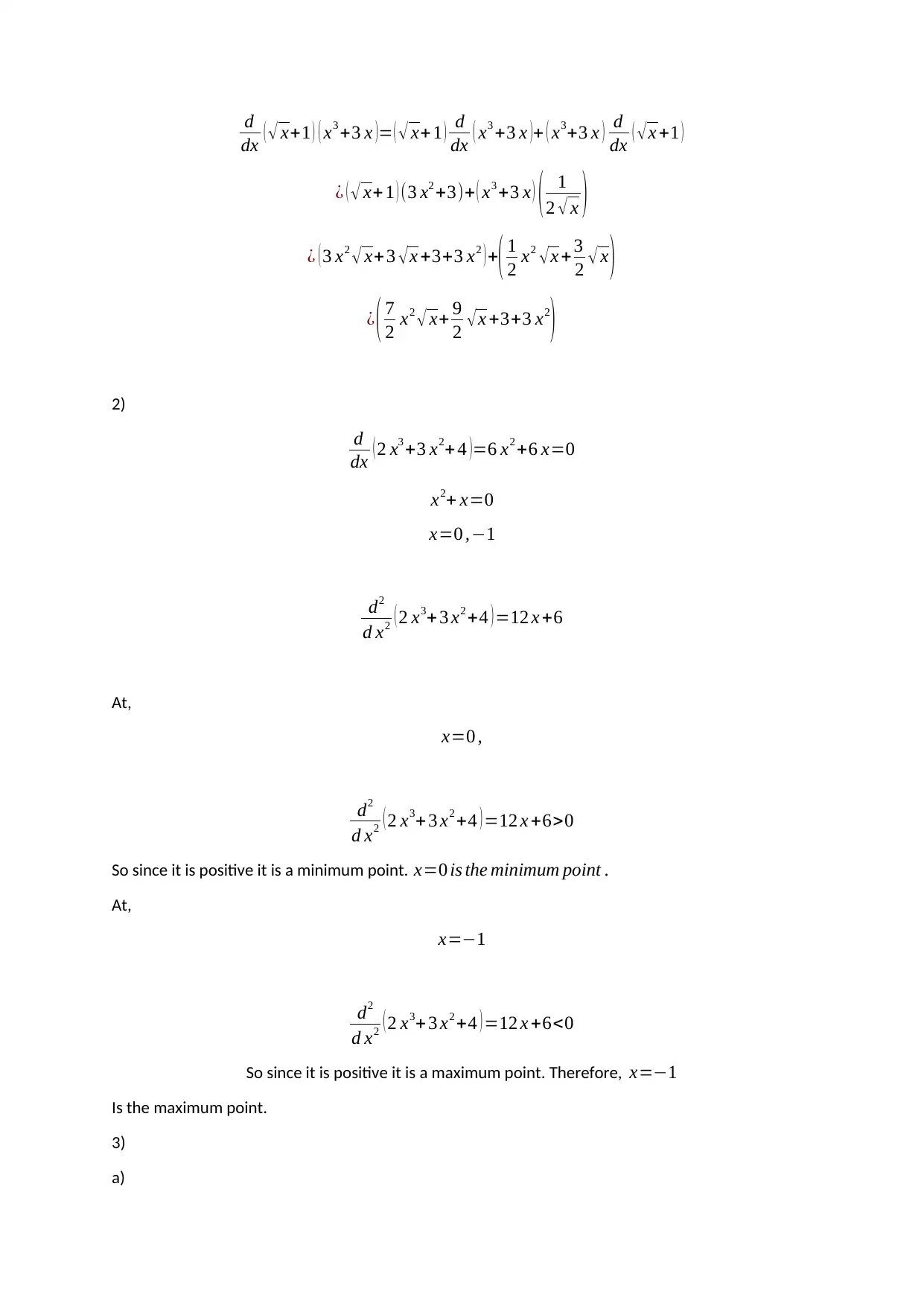
d
dx ( x+1 ) ( x3 +3 x )= ( x+ 1 ) d
dx ( x3 +3 x )+ ( x3+3 x ) d
dx ( x +1 )
¿ ( x+ 1 ) (3 x2 +3)+ ( x3 +3 x ) ( 1
2 x )
¿ ( 3 x2 x+ 3 x +3+3 x2 ) +( 1
2 x2 x + 3
2 x )
¿ ( 7
2 x2 x+ 9
2 x +3+3 x2
)
2)
d
dx (2 x3 +3 x2+ 4 )=6 x2 +6 x=0
x2+ x=0
x=0 ,1
d2
d x2 ( 2 x3+ 3 x2 +4 ) =12 x +6
At,
x=0 ,
d2
d x2 ( 2 x3+ 3 x2 +4 ) =12 x +6>0
So since it is positive it is a minimum point. x=0 is the minimum point .
At,
x=1
d2
d x2 ( 2 x3+ 3 x2 +4 ) =12 x +6<0
So since it is positive it is a maximum point. Therefore, x=1
Is the maximum point.
3)
a)
Document Page
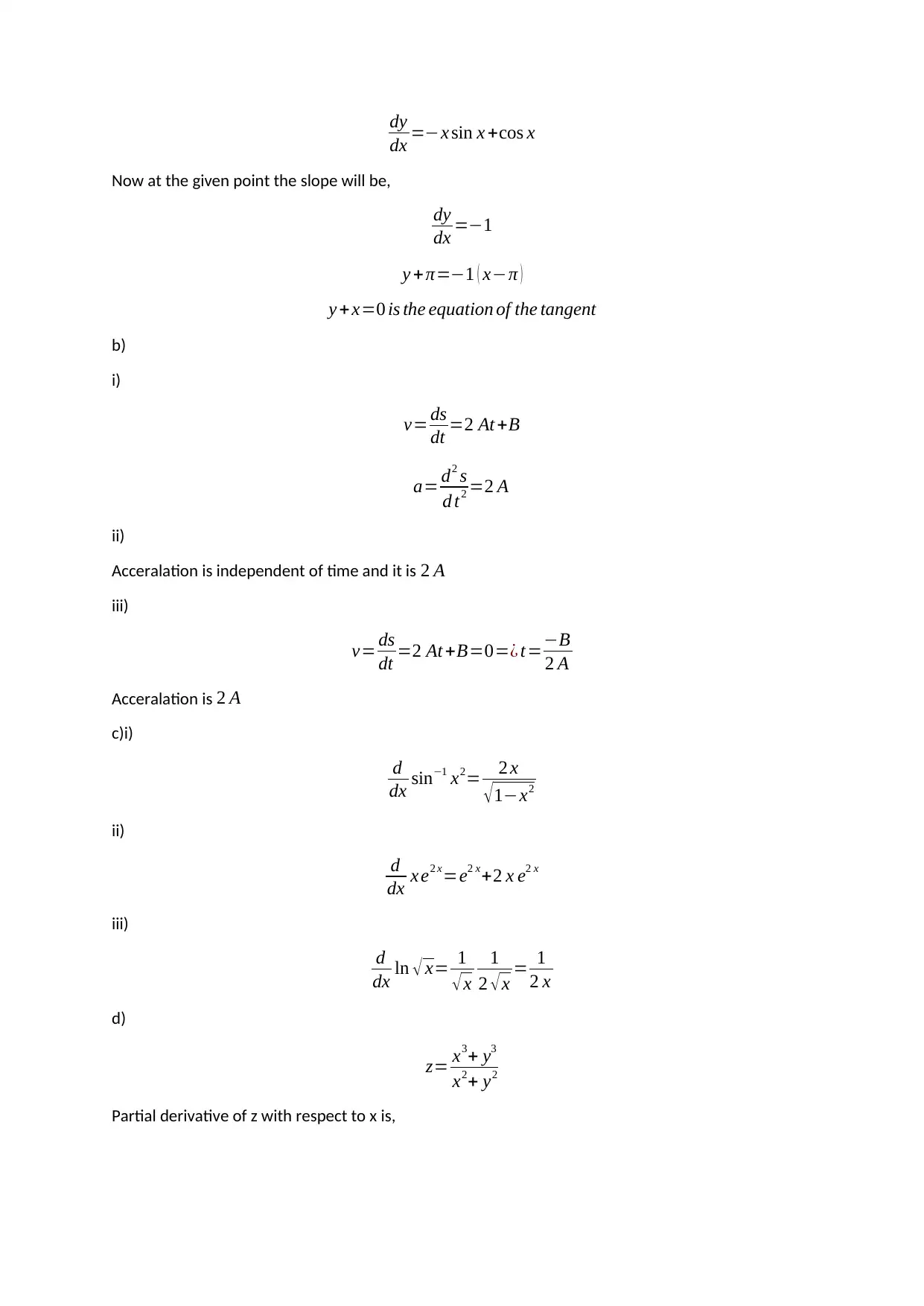
dy
dx =x sin x +cos x
Now at the given point the slope will be,
dy
dx =1
y +π=1 ( xπ )
y +x=0 is the equation of the tangent
b)
i)
v= ds
dt =2 At +B
a= d2 s
d t2 =2 A
ii)
Acceralation is independent of time and it is 2 A
iii)
v= ds
dt =2 At +B=0=¿ t=B
2 A
Acceralation is 2 A
c)i)
d
dx sin1 x2= 2 x
1x2
ii)
d
dx x e2 x=e2 x+2 x e2 x
iii)
d
dx ln x= 1
x
1
2 x = 1
2 x
d)
z= x3+ y3
x2+ y2
Partial derivative of z with respect to x is,
Document Page
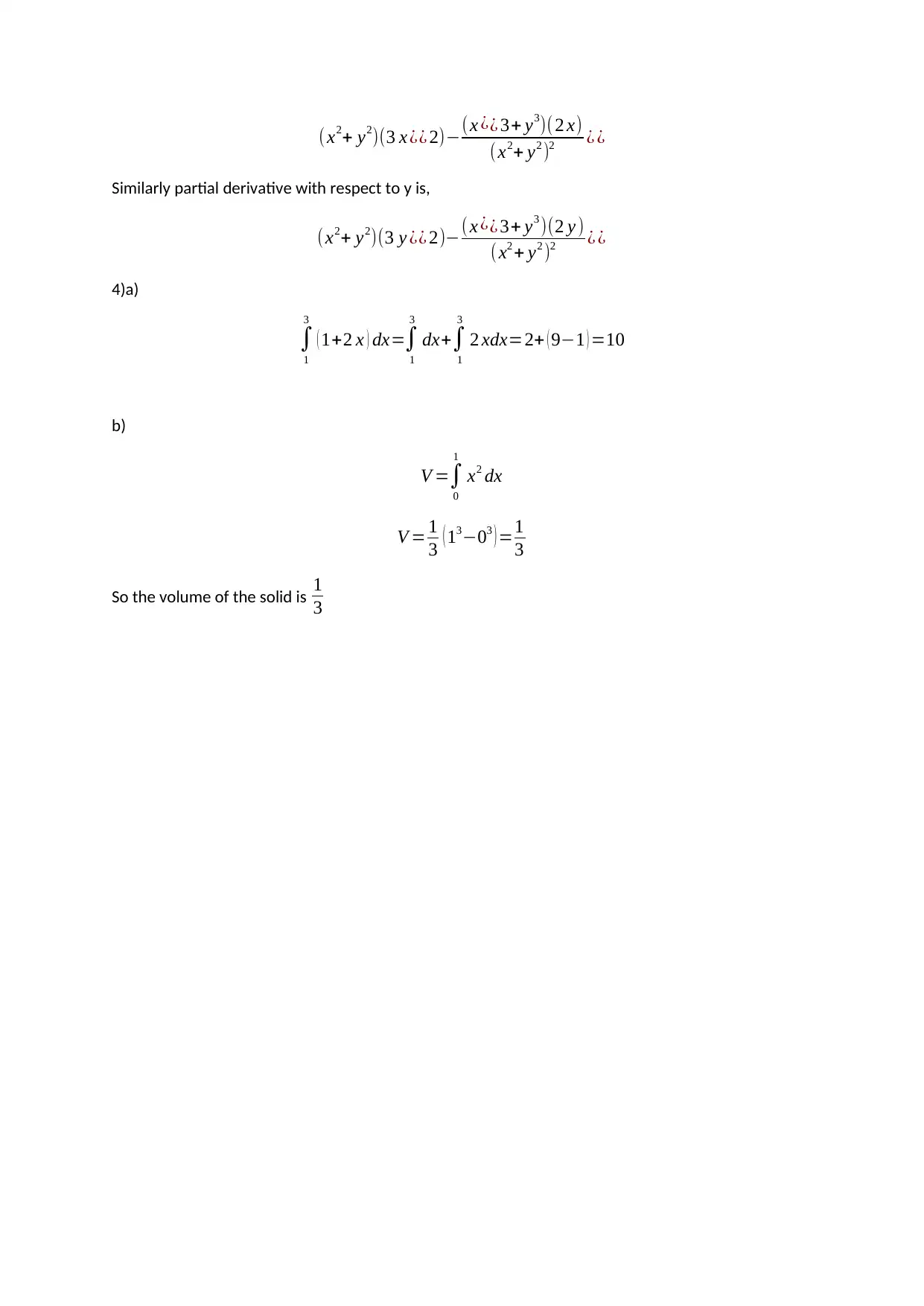
( x2+ y2)(3 x ¿¿ 2)(x ¿¿ 3+ y3)( 2 x)
(x2+ y2 )2 ¿ ¿
Similarly partial derivative with respect to y is,
(x2+ y2)(3 y ¿¿ 2)(x ¿¿ 3+ y3 )(2 y )
( x2 + y2 )2 ¿ ¿
4)a)

1
3
( 1+2 x ) dx=
1
3
dx+
1
3
2 xdx=2+ ( 91 ) =10
b)
V =
0
1
x2 dx
V = 1
3 ( 1303 ) =1
3
So the volume of the solid is 1
3
chevron_up_icon
1 out of 4
circle_padding
hide_on_mobile
zoom_out_icon
[object Object]