Report: Assessing Multicultural Workforce Impact on Teamwork at Amazon
VerifiedAdded on 2023/02/03
|23
|5516
|58
Report
AI Summary
This report presents the findings of a study evaluating the impact of a multicultural workforce on teamwork and organizational performance at Amazon, based on a survey of 111 employees in America and China. The research employed a five-point Likert-scale questionnaire to assess employee perspectives on the effects of cultural heterogeneity. Key findings reveal that while the majority of respondents do not believe that working with colleagues from different ethnicities negatively affects their work performance, language barriers and miscommunication were identified as significant challenges. The study also highlights that cultural diversity is generally viewed positively, aiding in finding innovative solutions, while religious heterogeneity does not appear to significantly impact teamwork. The report underscores the complexities of managing a diverse workforce, indicating areas for improvement in communication and the acceptance of diverse ideas to enhance teamwork and overall organizational productivity.
Chapter 4
Findings, Analysis, Evaluation and Discussion
4.0 Introduction
A five-point Likert-scale questionnaire was adopted for this research. According to Ott and
Longnecker (2010), the Likert-scale questionnaire is a quantitative research approach that
evaluates the varying levels of agreement and disagreement of a symmetric agree-disagree
scale and makes a statistical difference in understanding the viewpoint or opinion of the
selected respondents. The research questionnaire is made up of demographic sections and
Likert-scale questions. The demographic section includes three questions age, gender and
nationality. The questionnaire section includes eight Likert-scale questions. Answers to the
questions were evaluated based on the level of agreement or disagreement with the
questions posed. Respondents either strongly agreed, agreed, or were neutral to the effect
of a factor or strongly disagreed or disagreed. These responses were, thus, used to evaluate
the effect of a multicultural workforce on teamwork and organisational performance.
The target quantity of respondents for this research was set to 200. 100 questionnaires
were sent to Amazon workers in America and 100 to Amazon workers in China. This was
done to get an equal viewpoint of workers in both countries. However, only 112 responses
were received. The data was collected from Caucasian, African-American, Chinese,
Nepalese, Bangladesh, Philippines, Hispanic and Thailand nationals who work together in
multiple teams at Amazon in both America and China.
To evaluate the effect of multicultural workforces on employees in Amazon, simple statistics
like mean, frequencies and percentages were obtained. The data obtained were further
analysed to provide answers to the research questions posed.
4.1 Results Presentation
Findings, Analysis, Evaluation and Discussion
4.0 Introduction
A five-point Likert-scale questionnaire was adopted for this research. According to Ott and
Longnecker (2010), the Likert-scale questionnaire is a quantitative research approach that
evaluates the varying levels of agreement and disagreement of a symmetric agree-disagree
scale and makes a statistical difference in understanding the viewpoint or opinion of the
selected respondents. The research questionnaire is made up of demographic sections and
Likert-scale questions. The demographic section includes three questions age, gender and
nationality. The questionnaire section includes eight Likert-scale questions. Answers to the
questions were evaluated based on the level of agreement or disagreement with the
questions posed. Respondents either strongly agreed, agreed, or were neutral to the effect
of a factor or strongly disagreed or disagreed. These responses were, thus, used to evaluate
the effect of a multicultural workforce on teamwork and organisational performance.
The target quantity of respondents for this research was set to 200. 100 questionnaires
were sent to Amazon workers in America and 100 to Amazon workers in China. This was
done to get an equal viewpoint of workers in both countries. However, only 112 responses
were received. The data was collected from Caucasian, African-American, Chinese,
Nepalese, Bangladesh, Philippines, Hispanic and Thailand nationals who work together in
multiple teams at Amazon in both America and China.
To evaluate the effect of multicultural workforces on employees in Amazon, simple statistics
like mean, frequencies and percentages were obtained. The data obtained were further
analysed to provide answers to the research questions posed.
4.1 Results Presentation

Paraphrase This Document
Need a fresh take? Get an instant paraphrase of this document with our AI Paraphraser
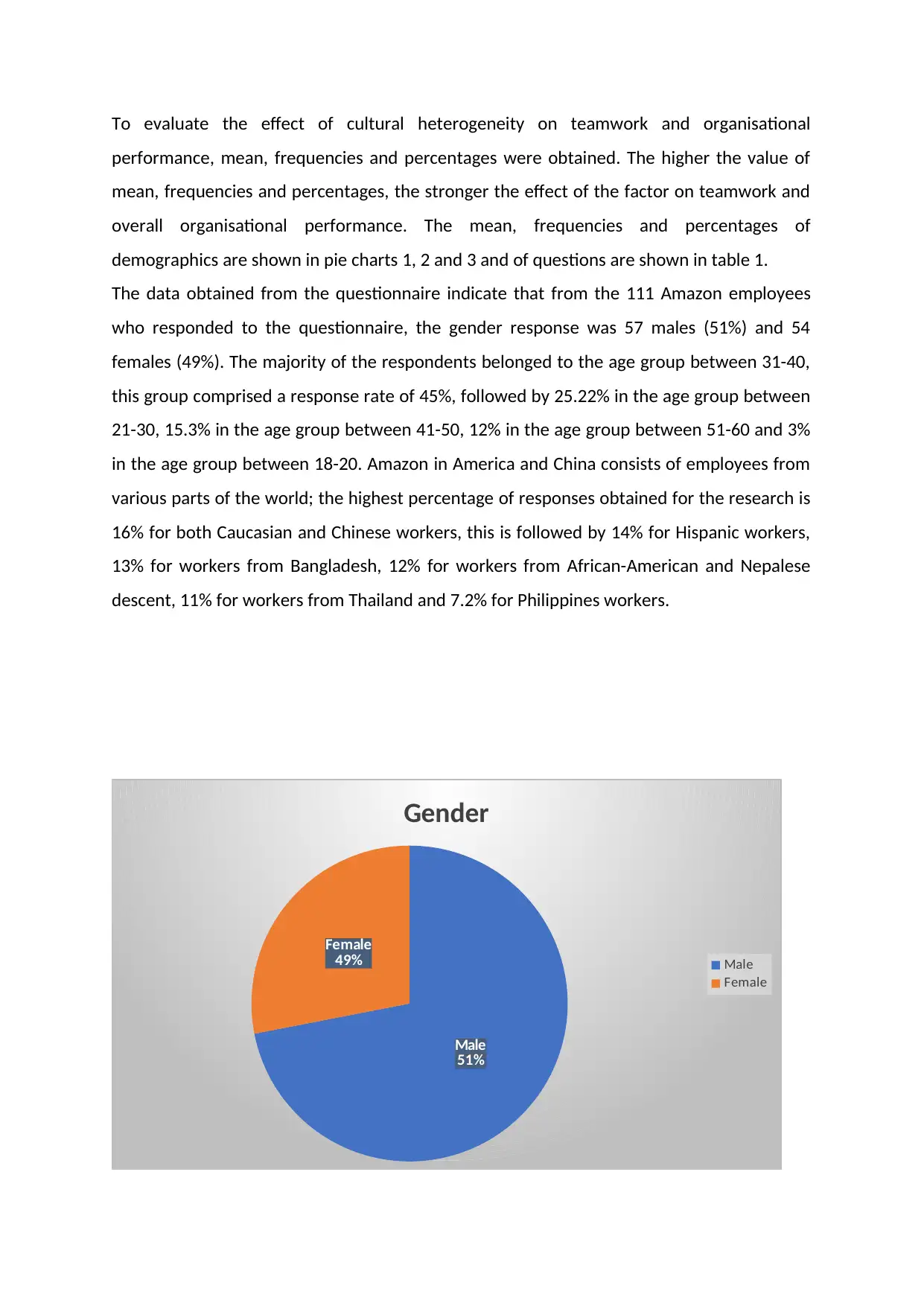
To evaluate the effect of cultural heterogeneity on teamwork and organisational
performance, mean, frequencies and percentages were obtained. The higher the value of
mean, frequencies and percentages, the stronger the effect of the factor on teamwork and
overall organisational performance. The mean, frequencies and percentages of
demographics are shown in pie charts 1, 2 and 3 and of questions are shown in table 1.
The data obtained from the questionnaire indicate that from the 111 Amazon employees
who responded to the questionnaire, the gender response was 57 males (51%) and 54
females (49%). The majority of the respondents belonged to the age group between 31-40,
this group comprised a response rate of 45%, followed by 25.22% in the age group between
21-30, 15.3% in the age group between 41-50, 12% in the age group between 51-60 and 3%
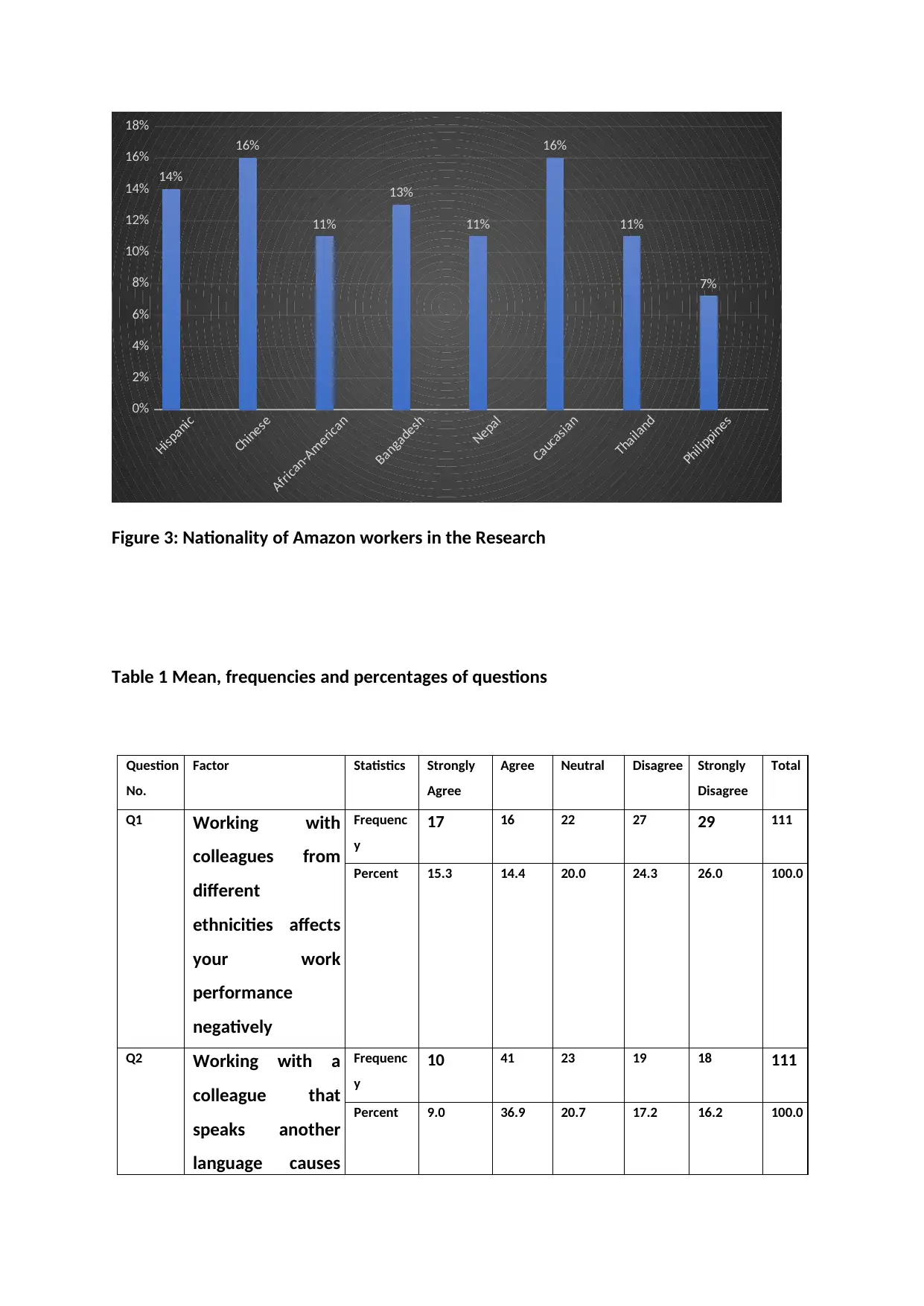
in the age group between 18-20. Amazon in America and China consists of employees from
various parts of the world; the highest percentage of responses obtained for the research is
16% for both Caucasian and Chinese workers, this is followed by 14% for Hispanic workers,
13% for workers from Bangladesh, 12% for workers from African-American and Nepalese
descent, 11% for workers from Thailand and 7.2% for Philippines workers.
Male
51%
Female
49%
Gender
Male
Female
performance, mean, frequencies and percentages were obtained. The higher the value of
mean, frequencies and percentages, the stronger the effect of the factor on teamwork and
overall organisational performance. The mean, frequencies and percentages of
demographics are shown in pie charts 1, 2 and 3 and of questions are shown in table 1.
The data obtained from the questionnaire indicate that from the 111 Amazon employees
who responded to the questionnaire, the gender response was 57 males (51%) and 54
females (49%). The majority of the respondents belonged to the age group between 31-40,
this group comprised a response rate of 45%, followed by 25.22% in the age group between
21-30, 15.3% in the age group between 41-50, 12% in the age group between 51-60 and 3%
in the age group between 18-20. Amazon in America and China consists of employees from
various parts of the world; the highest percentage of responses obtained for the research is
16% for both Caucasian and Chinese workers, this is followed by 14% for Hispanic workers,
13% for workers from Bangladesh, 12% for workers from African-American and Nepalese
descent, 11% for workers from Thailand and 7.2% for Philippines workers.
Male
51%
Female
49%
Gender
Male
Female
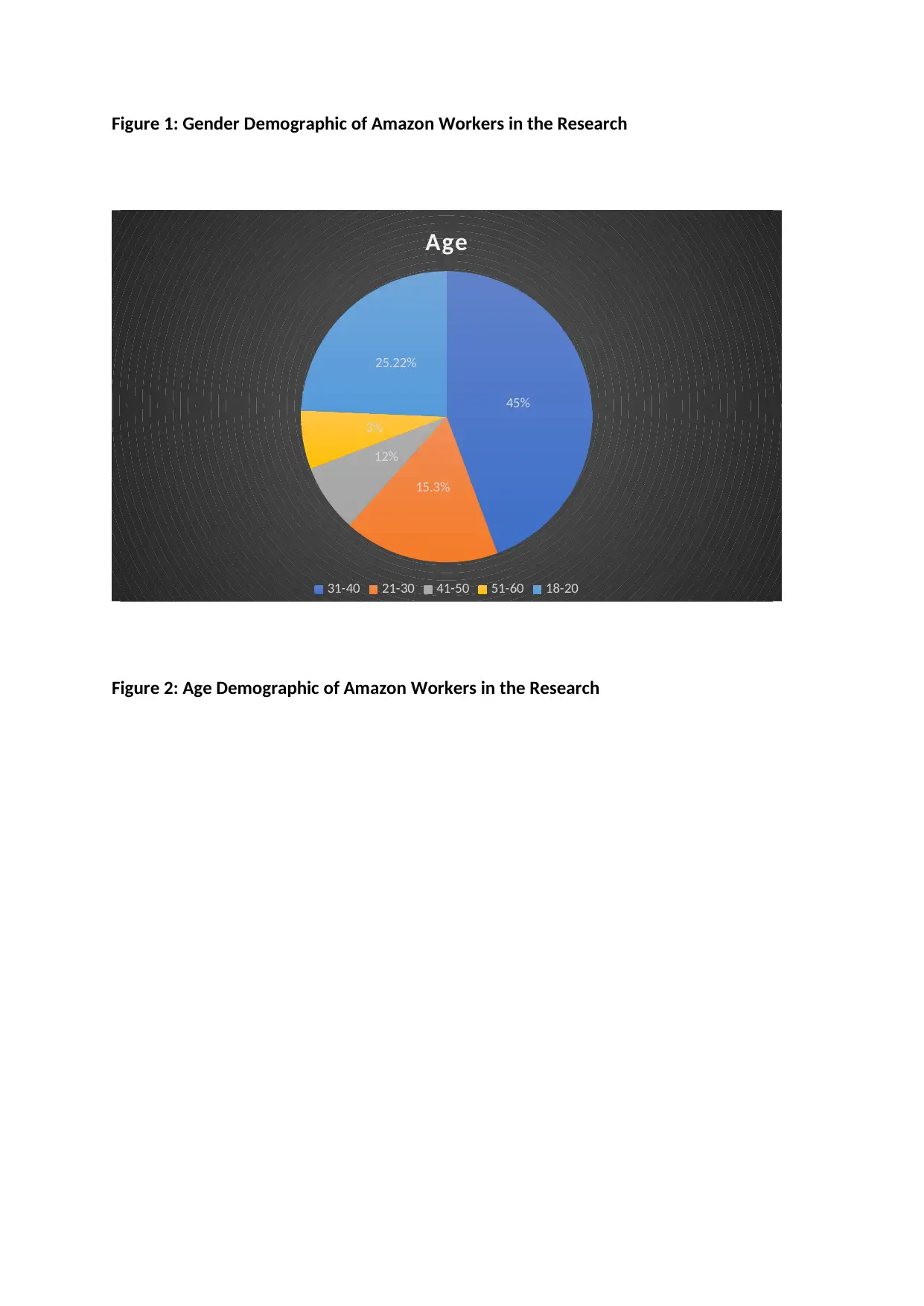
Figure 1: Gender Demographic of Amazon Workers in the Research
45%
15.3%
12%
3%
25.22%
Age
31-40 21-30 41-50 51-60 18-20
Figure 2: Age Demographic of Amazon Workers in the Research
45%
15.3%
12%
3%
25.22%
Age
31-40 21-30 41-50 51-60 18-20
Figure 2: Age Demographic of Amazon Workers in the Research
⊘ This is a preview!⊘
Do you want full access?
Subscribe today to unlock all pages.

Trusted by 1+ million students worldwide
Hispanic
Chinese
African-American
Bangadesh
Nepal
Caucasian
Thailand
Philippines
0%
2%
4%
6%
8%
10%
12%
14%
16%
18%
14%
16%
11%
13%
11%
16%
11%
7%
Figure 3: Nationality of Amazon workers in the Research
Table 1 Mean, frequencies and percentages of questions
Question
No.
Factor Statistics Strongly
Agree
Agree Neutral Disagree Strongly
Disagree
Total
Q1 Working with
colleagues from
different
ethnicities affects
your work
performance
negatively
Frequenc
y
17 16 22 27 29 111
Percent 15.3 14.4 20.0 24.3 26.0 100.0
Q2 Working with a
colleague that
speaks another
language causes
Frequenc
y
10 41 23 19 18 111
Percent 9.0 36.9 20.7 17.2 16.2 100.0
Chinese
African-American
Bangadesh
Nepal
Caucasian
Thailand
Philippines
0%
2%
4%
6%
8%
10%
12%
14%
16%
18%
14%
16%
11%
13%
11%
16%
11%
7%
Figure 3: Nationality of Amazon workers in the Research
Table 1 Mean, frequencies and percentages of questions
Question
No.
Factor Statistics Strongly
Agree
Agree Neutral Disagree Strongly
Disagree
Total
Q1 Working with
colleagues from
different
ethnicities affects
your work
performance
negatively
Frequenc
y
17 16 22 27 29 111
Percent 15.3 14.4 20.0 24.3 26.0 100.0
Q2 Working with a
colleague that
speaks another
language causes
Frequenc
y
10 41 23 19 18 111
Percent 9.0 36.9 20.7 17.2 16.2 100.0
Paraphrase This Document
Need a fresh take? Get an instant paraphrase of this document with our AI Paraphraser
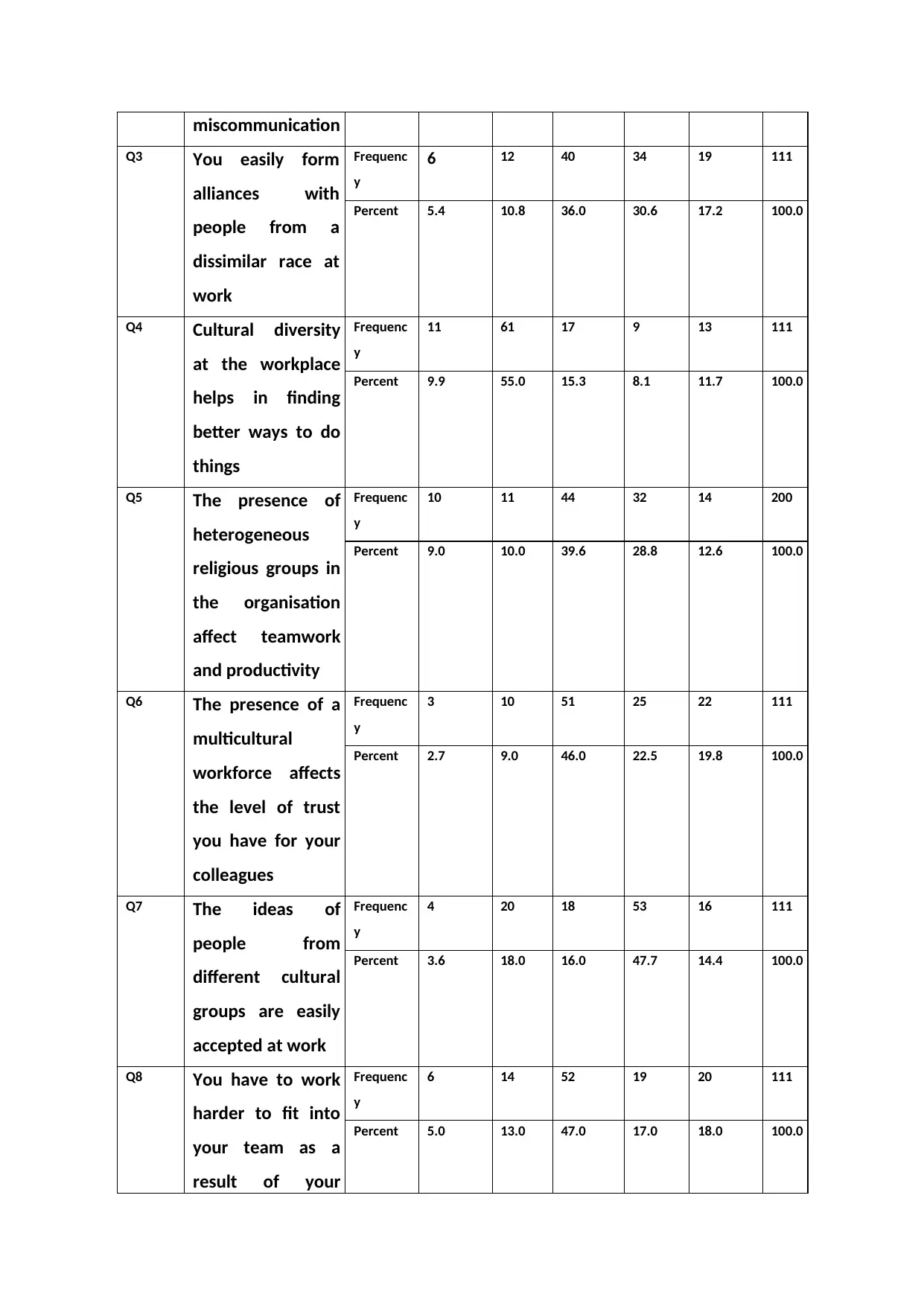
miscommunication
Q3 You easily form
alliances with
people from a
dissimilar race at
work
Frequenc
y
6 12 40 34 19 111
Percent 5.4 10.8 36.0 30.6 17.2 100.0
Q4 Cultural diversity
at the workplace
helps in finding
better ways to do
things
Frequenc
y
11 61 17 9 13 111
Percent 9.9 55.0 15.3 8.1 11.7 100.0
Q5 The presence of
heterogeneous
religious groups in
the organisation
affect teamwork
and productivity
Frequenc
y
10 11 44 32 14 200
Percent 9.0 10.0 39.6 28.8 12.6 100.0
Q6 The presence of a
multicultural
workforce affects
the level of trust
you have for your
colleagues
Frequenc
y
3 10 51 25 22 111
Percent 2.7 9.0 46.0 22.5 19.8 100.0
Q7 The ideas of
people from
different cultural
groups are easily
accepted at work
Frequenc
y
4 20 18 53 16 111
Percent 3.6 18.0 16.0 47.7 14.4 100.0
Q8 You have to work
harder to fit into
your team as a
result of your
Frequenc
y
6 14 52 19 20 111
Percent 5.0 13.0 47.0 17.0 18.0 100.0
Q3 You easily form
alliances with
people from a
dissimilar race at
work
Frequenc
y
6 12 40 34 19 111
Percent 5.4 10.8 36.0 30.6 17.2 100.0
Q4 Cultural diversity
at the workplace
helps in finding
better ways to do
things
Frequenc
y
11 61 17 9 13 111
Percent 9.9 55.0 15.3 8.1 11.7 100.0
Q5 The presence of
heterogeneous
religious groups in
the organisation
affect teamwork
and productivity
Frequenc
y
10 11 44 32 14 200
Percent 9.0 10.0 39.6 28.8 12.6 100.0
Q6 The presence of a
multicultural
workforce affects
the level of trust
you have for your
colleagues
Frequenc
y
3 10 51 25 22 111
Percent 2.7 9.0 46.0 22.5 19.8 100.0
Q7 The ideas of
people from
different cultural
groups are easily
accepted at work
Frequenc
y
4 20 18 53 16 111
Percent 3.6 18.0 16.0 47.7 14.4 100.0
Q8 You have to work
harder to fit into
your team as a
result of your
Frequenc
y
6 14 52 19 20 111
Percent 5.0 13.0 47.0 17.0 18.0 100.0
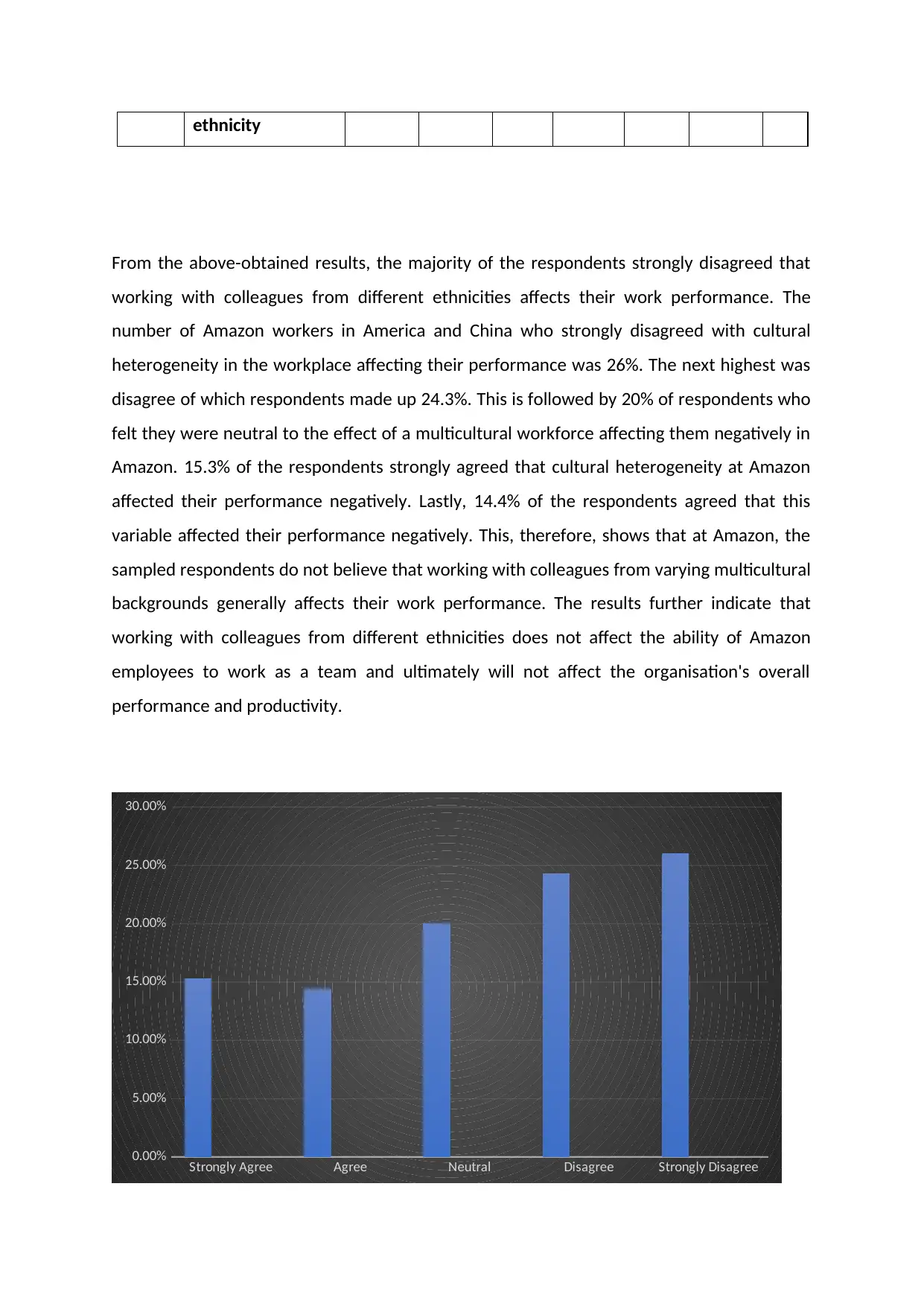
ethnicity
From the above-obtained results, the majority of the respondents strongly disagreed that
working with colleagues from different ethnicities affects their work performance. The
number of Amazon workers in America and China who strongly disagreed with cultural
heterogeneity in the workplace affecting their performance was 26%. The next highest was
disagree of which respondents made up 24.3%. This is followed by 20% of respondents who
felt they were neutral to the effect of a multicultural workforce affecting them negatively in
Amazon. 15.3% of the respondents strongly agreed that cultural heterogeneity at Amazon
affected their performance negatively. Lastly, 14.4% of the respondents agreed that this
variable affected their performance negatively. This, therefore, shows that at Amazon, the
sampled respondents do not believe that working with colleagues from varying multicultural
backgrounds generally affects their work performance. The results further indicate that
working with colleagues from different ethnicities does not affect the ability of Amazon
employees to work as a team and ultimately will not affect the organisation's overall
performance and productivity.
Strongly Agree Agree Neutral Disagree Strongly Disagree
0.00%
5.00%
10.00%
15.00%
20.00%
25.00%
30.00%
From the above-obtained results, the majority of the respondents strongly disagreed that
working with colleagues from different ethnicities affects their work performance. The
number of Amazon workers in America and China who strongly disagreed with cultural
heterogeneity in the workplace affecting their performance was 26%. The next highest was
disagree of which respondents made up 24.3%. This is followed by 20% of respondents who
felt they were neutral to the effect of a multicultural workforce affecting them negatively in
Amazon. 15.3% of the respondents strongly agreed that cultural heterogeneity at Amazon
affected their performance negatively. Lastly, 14.4% of the respondents agreed that this
variable affected their performance negatively. This, therefore, shows that at Amazon, the
sampled respondents do not believe that working with colleagues from varying multicultural
backgrounds generally affects their work performance. The results further indicate that
working with colleagues from different ethnicities does not affect the ability of Amazon
employees to work as a team and ultimately will not affect the organisation's overall
performance and productivity.
Strongly Agree Agree Neutral Disagree Strongly Disagree
0.00%
5.00%
10.00%
15.00%
20.00%
25.00%
30.00%
⊘ This is a preview!⊘
Do you want full access?
Subscribe today to unlock all pages.
Trusted by 1+ million students worldwide
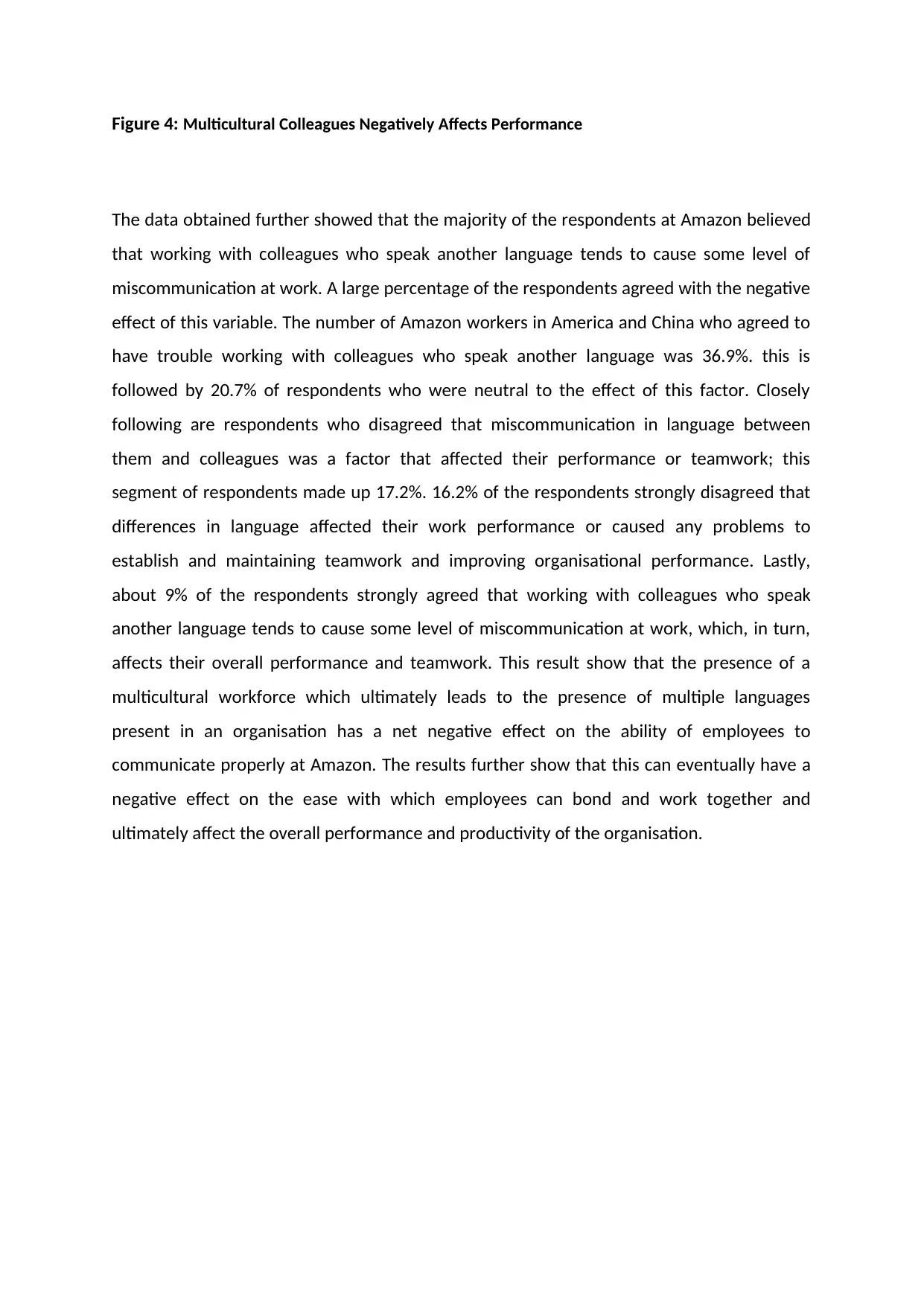
Figure 4: Multicultural Colleagues Negatively Affects Performance
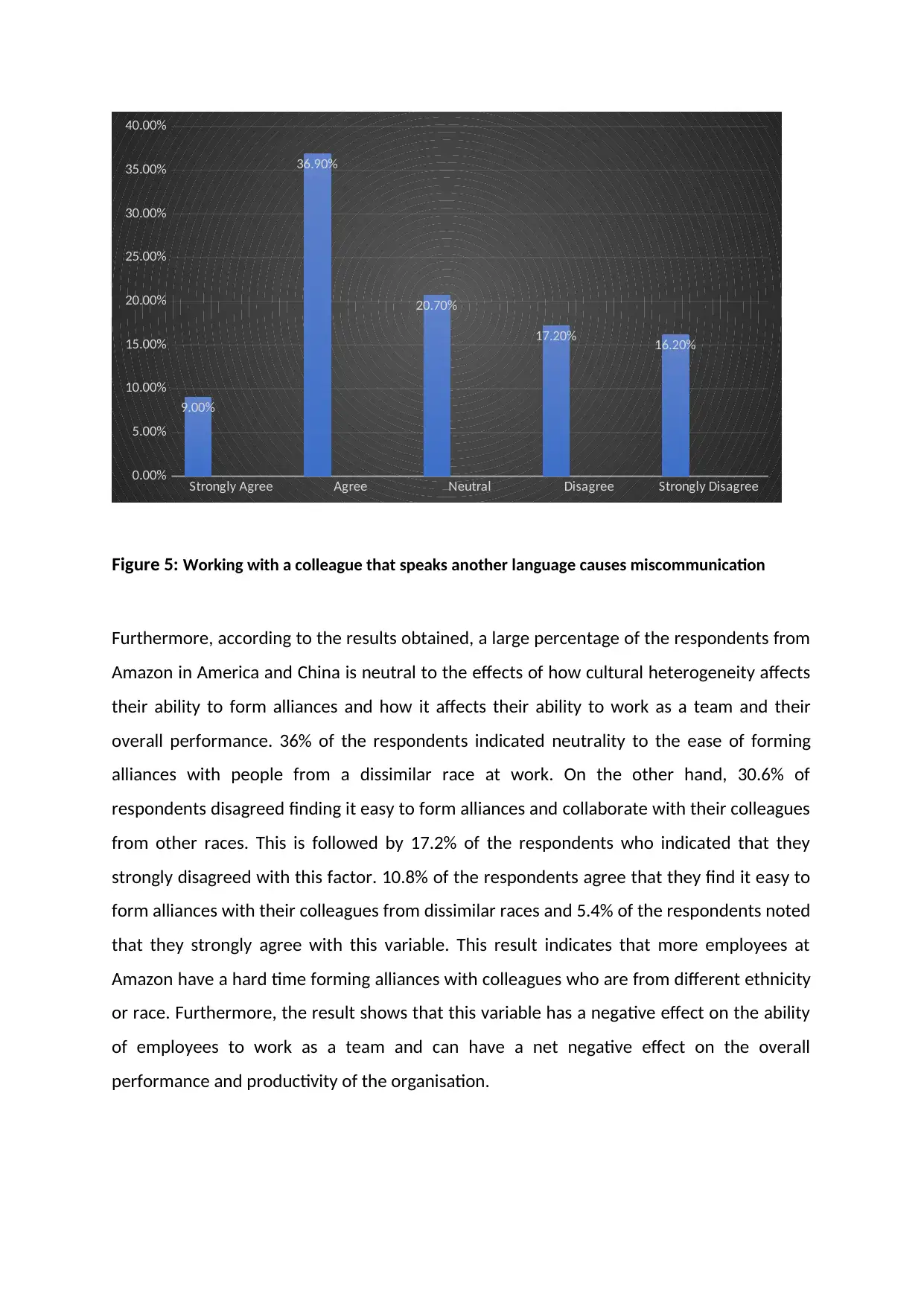
The data obtained further showed that the majority of the respondents at Amazon believed
that working with colleagues who speak another language tends to cause some level of
miscommunication at work. A large percentage of the respondents agreed with the negative
effect of this variable. The number of Amazon workers in America and China who agreed to
have trouble working with colleagues who speak another language was 36.9%. this is
followed by 20.7% of respondents who were neutral to the effect of this factor. Closely
following are respondents who disagreed that miscommunication in language between
them and colleagues was a factor that affected their performance or teamwork; this
segment of respondents made up 17.2%. 16.2% of the respondents strongly disagreed that
differences in language affected their work performance or caused any problems to
establish and maintaining teamwork and improving organisational performance. Lastly,
about 9% of the respondents strongly agreed that working with colleagues who speak
another language tends to cause some level of miscommunication at work, which, in turn,
affects their overall performance and teamwork. This result show that the presence of a
multicultural workforce which ultimately leads to the presence of multiple languages
present in an organisation has a net negative effect on the ability of employees to
communicate properly at Amazon. The results further show that this can eventually have a
negative effect on the ease with which employees can bond and work together and
ultimately affect the overall performance and productivity of the organisation.
The data obtained further showed that the majority of the respondents at Amazon believed
that working with colleagues who speak another language tends to cause some level of
miscommunication at work. A large percentage of the respondents agreed with the negative
effect of this variable. The number of Amazon workers in America and China who agreed to
have trouble working with colleagues who speak another language was 36.9%. this is
followed by 20.7% of respondents who were neutral to the effect of this factor. Closely
following are respondents who disagreed that miscommunication in language between
them and colleagues was a factor that affected their performance or teamwork; this
segment of respondents made up 17.2%. 16.2% of the respondents strongly disagreed that
differences in language affected their work performance or caused any problems to
establish and maintaining teamwork and improving organisational performance. Lastly,
about 9% of the respondents strongly agreed that working with colleagues who speak
another language tends to cause some level of miscommunication at work, which, in turn,
affects their overall performance and teamwork. This result show that the presence of a
multicultural workforce which ultimately leads to the presence of multiple languages
present in an organisation has a net negative effect on the ability of employees to
communicate properly at Amazon. The results further show that this can eventually have a
negative effect on the ease with which employees can bond and work together and
ultimately affect the overall performance and productivity of the organisation.
Paraphrase This Document
Need a fresh take? Get an instant paraphrase of this document with our AI Paraphraser
Strongly Agree Agree Neutral Disagree Strongly Disagree
0.00%
5.00%
10.00%
15.00%
20.00%
25.00%
30.00%
35.00%
40.00%
9.00%
36.90%
20.70%
17.20% 16.20%
Figure 5: Working with a colleague that speaks another language causes miscommunication
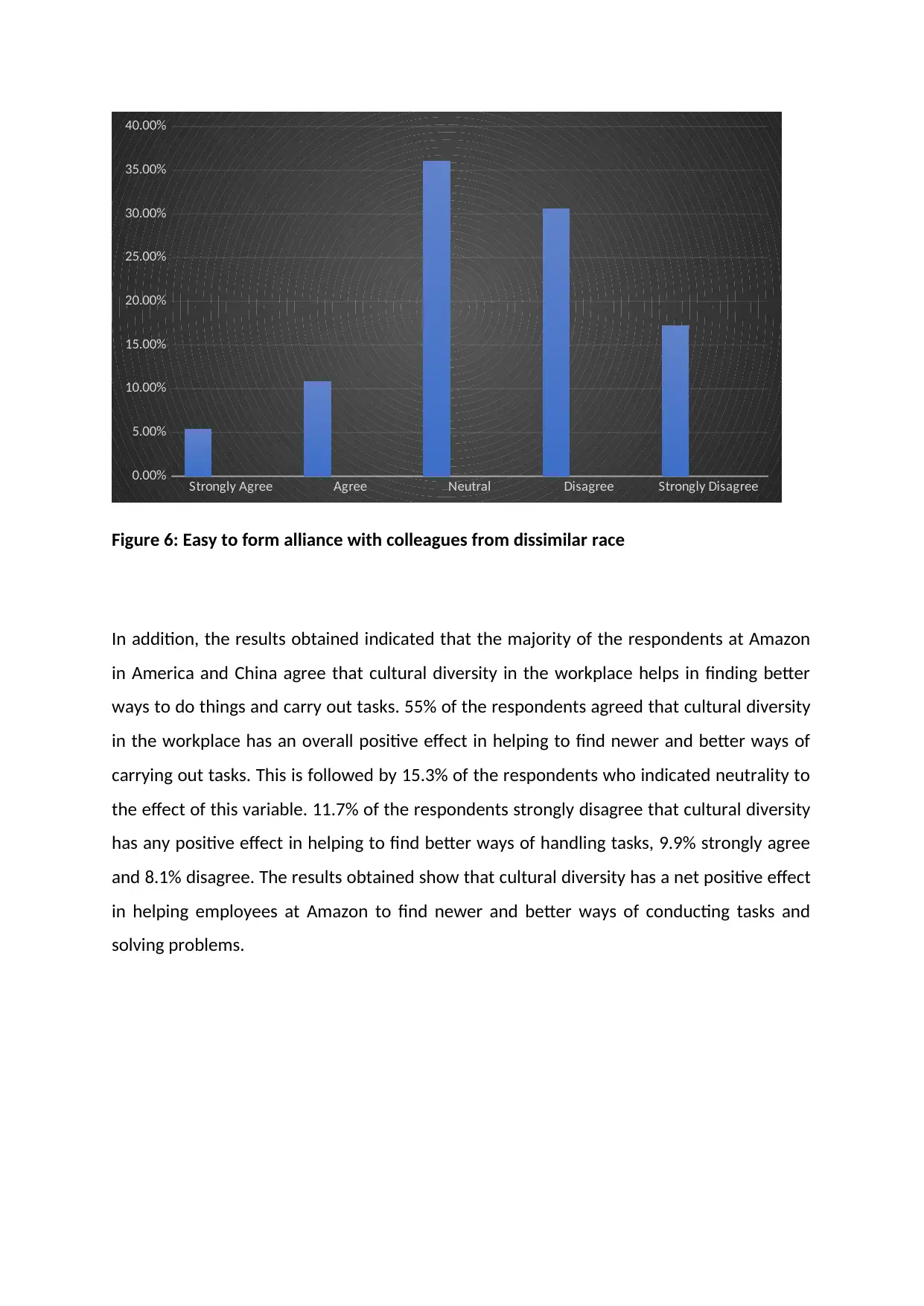
Furthermore, according to the results obtained, a large percentage of the respondents from
Amazon in America and China is neutral to the effects of how cultural heterogeneity affects
their ability to form alliances and how it affects their ability to work as a team and their
overall performance. 36% of the respondents indicated neutrality to the ease of forming
alliances with people from a dissimilar race at work. On the other hand, 30.6% of
respondents disagreed finding it easy to form alliances and collaborate with their colleagues
from other races. This is followed by 17.2% of the respondents who indicated that they
strongly disagreed with this factor. 10.8% of the respondents agree that they find it easy to
form alliances with their colleagues from dissimilar races and 5.4% of the respondents noted
that they strongly agree with this variable. This result indicates that more employees at
Amazon have a hard time forming alliances with colleagues who are from different ethnicity
or race. Furthermore, the result shows that this variable has a negative effect on the ability
of employees to work as a team and can have a net negative effect on the overall
performance and productivity of the organisation.
0.00%
5.00%
10.00%
15.00%
20.00%
25.00%
30.00%
35.00%
40.00%
9.00%
36.90%
20.70%
17.20% 16.20%
Figure 5: Working with a colleague that speaks another language causes miscommunication
Furthermore, according to the results obtained, a large percentage of the respondents from
Amazon in America and China is neutral to the effects of how cultural heterogeneity affects
their ability to form alliances and how it affects their ability to work as a team and their
overall performance. 36% of the respondents indicated neutrality to the ease of forming
alliances with people from a dissimilar race at work. On the other hand, 30.6% of
respondents disagreed finding it easy to form alliances and collaborate with their colleagues
from other races. This is followed by 17.2% of the respondents who indicated that they
strongly disagreed with this factor. 10.8% of the respondents agree that they find it easy to
form alliances with their colleagues from dissimilar races and 5.4% of the respondents noted
that they strongly agree with this variable. This result indicates that more employees at
Amazon have a hard time forming alliances with colleagues who are from different ethnicity
or race. Furthermore, the result shows that this variable has a negative effect on the ability
of employees to work as a team and can have a net negative effect on the overall
performance and productivity of the organisation.
Strongly Agree Agree Neutral Disagree Strongly Disagree
0.00%
5.00%
10.00%
15.00%
20.00%
25.00%
30.00%
35.00%
40.00%
Figure 6: Easy to form alliance with colleagues from dissimilar race
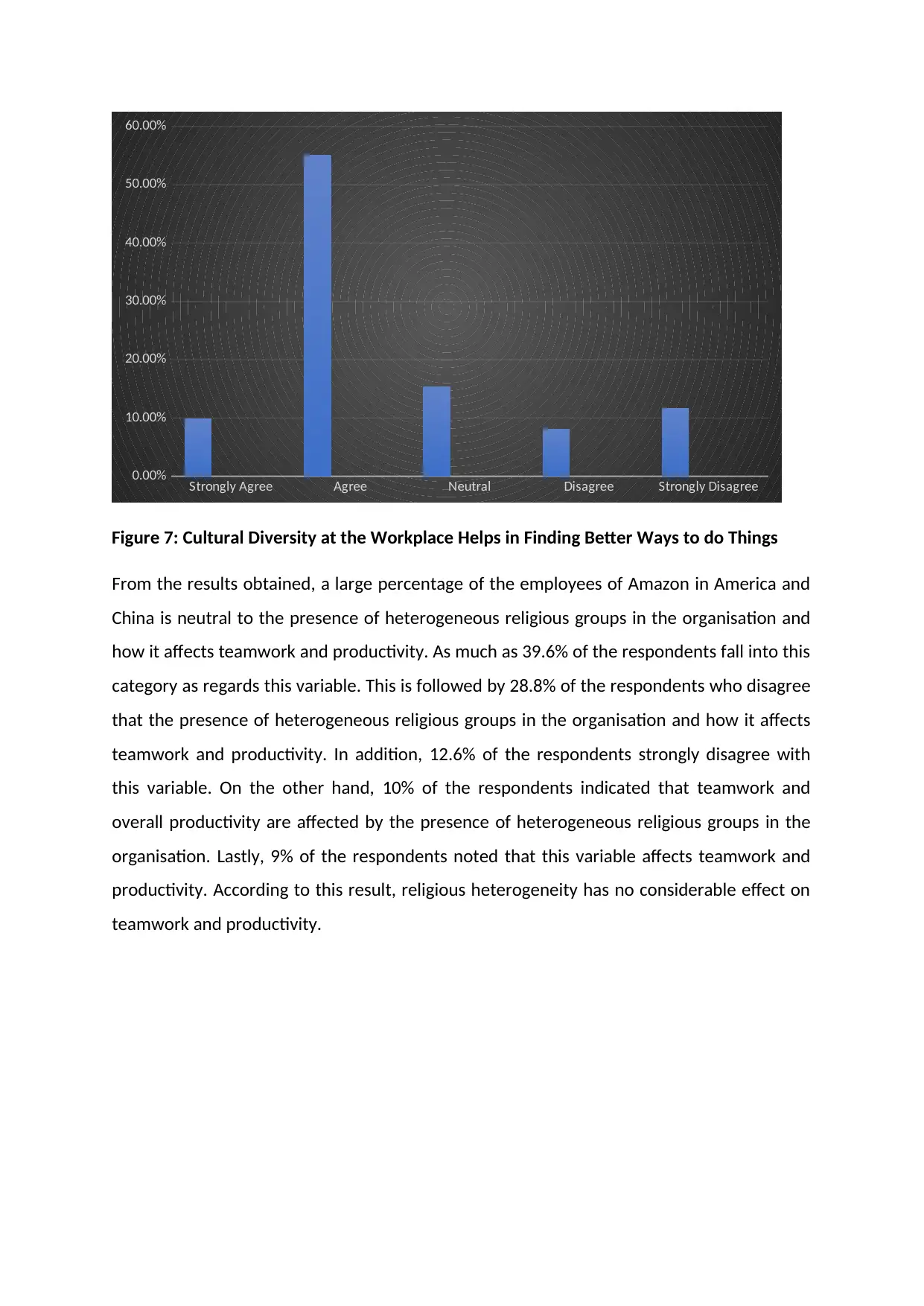
In addition, the results obtained indicated that the majority of the respondents at Amazon
in America and China agree that cultural diversity in the workplace helps in finding better
ways to do things and carry out tasks. 55% of the respondents agreed that cultural diversity
in the workplace has an overall positive effect in helping to find newer and better ways of
carrying out tasks. This is followed by 15.3% of the respondents who indicated neutrality to
the effect of this variable. 11.7% of the respondents strongly disagree that cultural diversity
has any positive effect in helping to find better ways of handling tasks, 9.9% strongly agree
and 8.1% disagree. The results obtained show that cultural diversity has a net positive effect
in helping employees at Amazon to find newer and better ways of conducting tasks and
solving problems.
0.00%
5.00%
10.00%
15.00%
20.00%
25.00%
30.00%
35.00%
40.00%
Figure 6: Easy to form alliance with colleagues from dissimilar race
In addition, the results obtained indicated that the majority of the respondents at Amazon
in America and China agree that cultural diversity in the workplace helps in finding better
ways to do things and carry out tasks. 55% of the respondents agreed that cultural diversity
in the workplace has an overall positive effect in helping to find newer and better ways of
carrying out tasks. This is followed by 15.3% of the respondents who indicated neutrality to
the effect of this variable. 11.7% of the respondents strongly disagree that cultural diversity
has any positive effect in helping to find better ways of handling tasks, 9.9% strongly agree
and 8.1% disagree. The results obtained show that cultural diversity has a net positive effect
in helping employees at Amazon to find newer and better ways of conducting tasks and
solving problems.
⊘ This is a preview!⊘
Do you want full access?
Subscribe today to unlock all pages.
Trusted by 1+ million students worldwide
Strongly Agree Agree Neutral Disagree Strongly Disagree
0.00%
10.00%
20.00%
30.00%
40.00%
50.00%
60.00%
Figure 7: Cultural Diversity at the Workplace Helps in Finding Better Ways to do Things
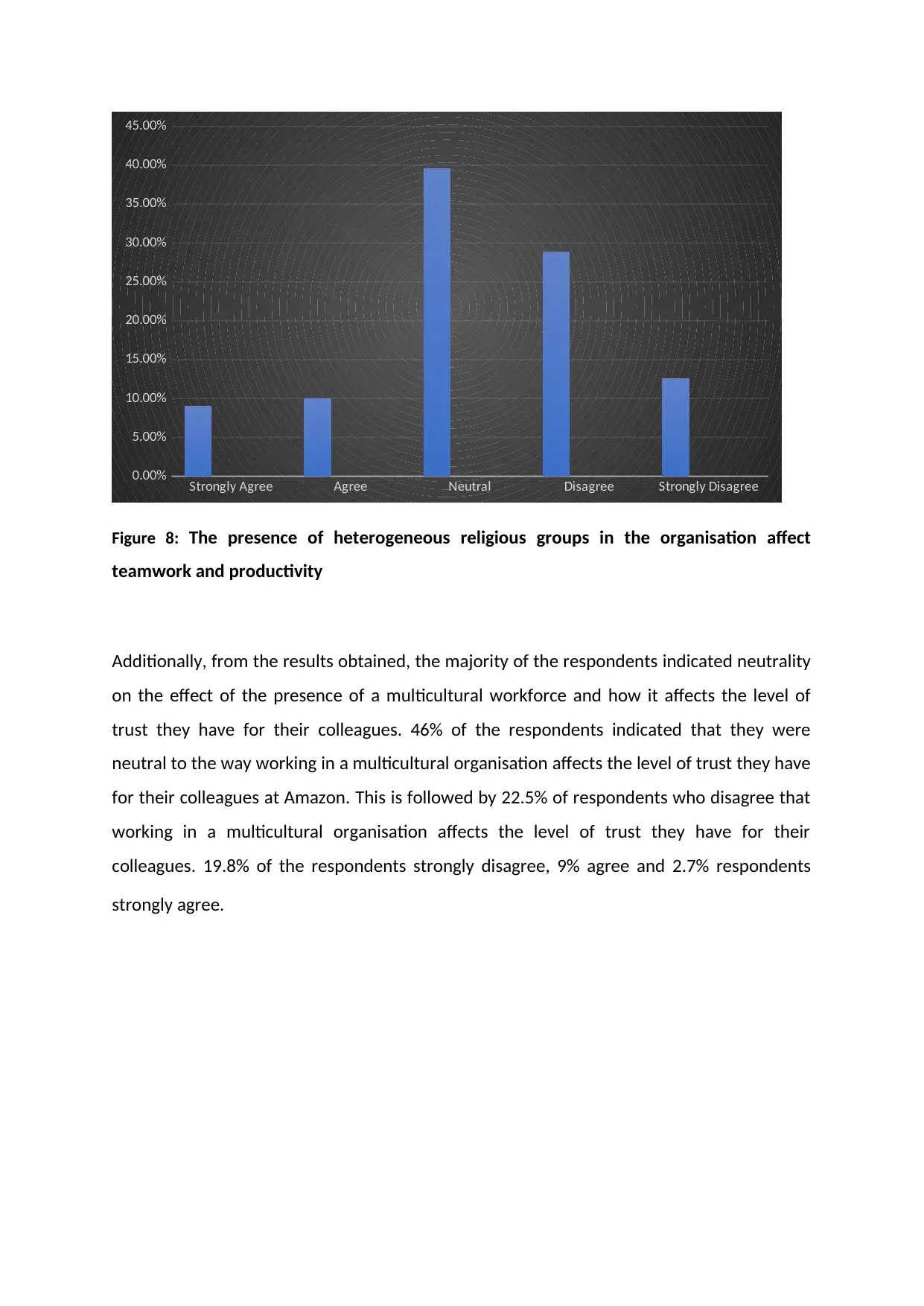
From the results obtained, a large percentage of the employees of Amazon in America and
China is neutral to the presence of heterogeneous religious groups in the organisation and
how it affects teamwork and productivity. As much as 39.6% of the respondents fall into this
category as regards this variable. This is followed by 28.8% of the respondents who disagree
that the presence of heterogeneous religious groups in the organisation and how it affects
teamwork and productivity. In addition, 12.6% of the respondents strongly disagree with
this variable. On the other hand, 10% of the respondents indicated that teamwork and
overall productivity are affected by the presence of heterogeneous religious groups in the
organisation. Lastly, 9% of the respondents noted that this variable affects teamwork and
productivity. According to this result, religious heterogeneity has no considerable effect on
teamwork and productivity.
0.00%
10.00%
20.00%
30.00%
40.00%
50.00%
60.00%
Figure 7: Cultural Diversity at the Workplace Helps in Finding Better Ways to do Things
From the results obtained, a large percentage of the employees of Amazon in America and
China is neutral to the presence of heterogeneous religious groups in the organisation and
how it affects teamwork and productivity. As much as 39.6% of the respondents fall into this
category as regards this variable. This is followed by 28.8% of the respondents who disagree
that the presence of heterogeneous religious groups in the organisation and how it affects
teamwork and productivity. In addition, 12.6% of the respondents strongly disagree with
this variable. On the other hand, 10% of the respondents indicated that teamwork and
overall productivity are affected by the presence of heterogeneous religious groups in the
organisation. Lastly, 9% of the respondents noted that this variable affects teamwork and
productivity. According to this result, religious heterogeneity has no considerable effect on
teamwork and productivity.
Paraphrase This Document
Need a fresh take? Get an instant paraphrase of this document with our AI Paraphraser
Strongly Agree Agree Neutral Disagree Strongly Disagree
0.00%
5.00%
10.00%
15.00%
20.00%
25.00%
30.00%
35.00%
40.00%
45.00%
Figure 8: The presence of heterogeneous religious groups in the organisation affect
teamwork and productivity
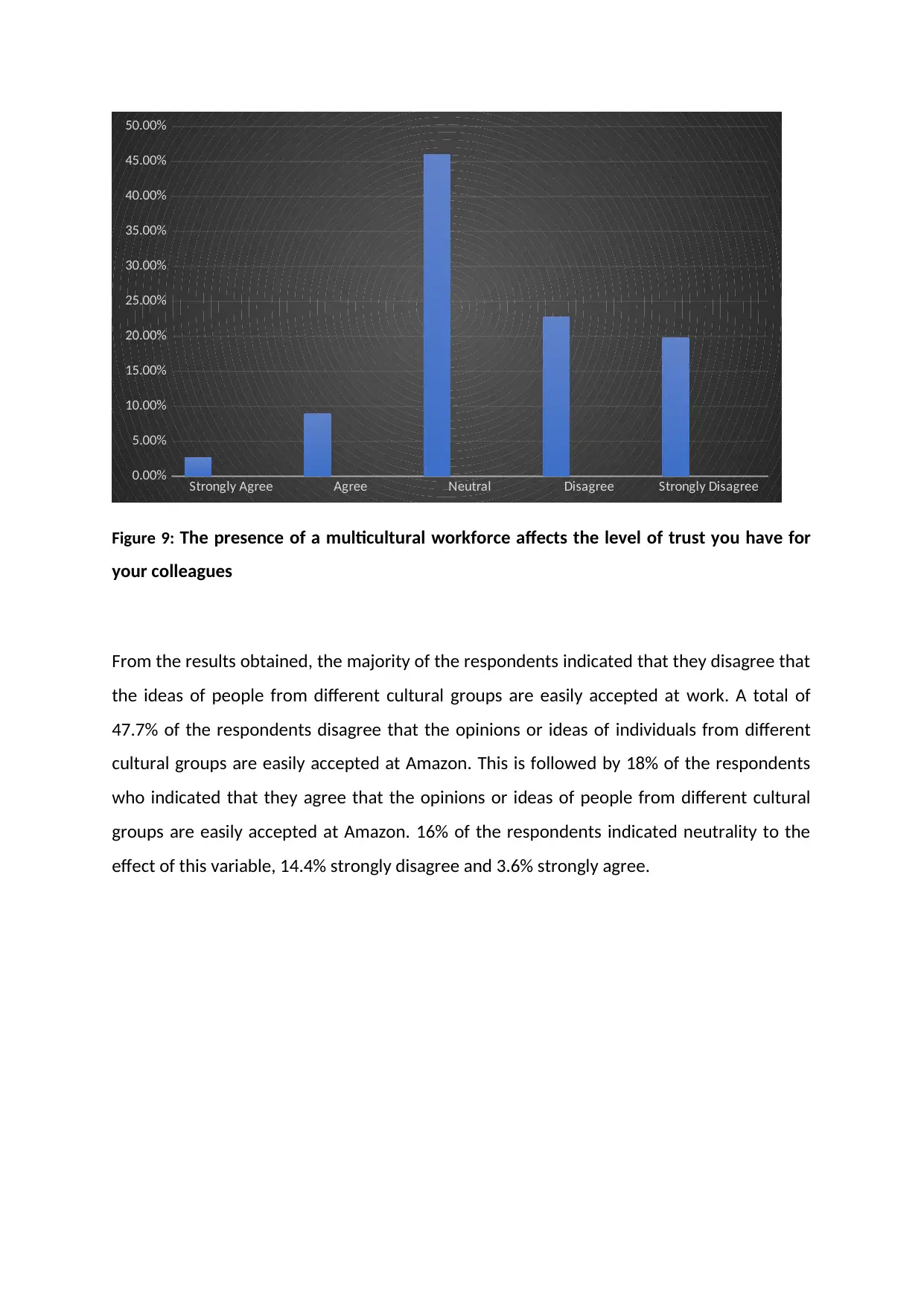
Additionally, from the results obtained, the majority of the respondents indicated neutrality
on the effect of the presence of a multicultural workforce and how it affects the level of
trust they have for their colleagues. 46% of the respondents indicated that they were
neutral to the way working in a multicultural organisation affects the level of trust they have
for their colleagues at Amazon. This is followed by 22.5% of respondents who disagree that
working in a multicultural organisation affects the level of trust they have for their
colleagues. 19.8% of the respondents strongly disagree, 9% agree and 2.7% respondents
strongly agree.
0.00%
5.00%
10.00%
15.00%
20.00%
25.00%
30.00%
35.00%
40.00%
45.00%
Figure 8: The presence of heterogeneous religious groups in the organisation affect
teamwork and productivity
Additionally, from the results obtained, the majority of the respondents indicated neutrality
on the effect of the presence of a multicultural workforce and how it affects the level of
trust they have for their colleagues. 46% of the respondents indicated that they were
neutral to the way working in a multicultural organisation affects the level of trust they have
for their colleagues at Amazon. This is followed by 22.5% of respondents who disagree that
working in a multicultural organisation affects the level of trust they have for their
colleagues. 19.8% of the respondents strongly disagree, 9% agree and 2.7% respondents
strongly agree.
Strongly Agree Agree Neutral Disagree Strongly Disagree
0.00%
5.00%
10.00%
15.00%
20.00%
25.00%
30.00%
35.00%
40.00%
45.00%
50.00%
Figure 9: The presence of a multicultural workforce affects the level of trust you have for
your colleagues
From the results obtained, the majority of the respondents indicated that they disagree that
the ideas of people from different cultural groups are easily accepted at work. A total of
47.7% of the respondents disagree that the opinions or ideas of individuals from different
cultural groups are easily accepted at Amazon. This is followed by 18% of the respondents
who indicated that they agree that the opinions or ideas of people from different cultural
groups are easily accepted at Amazon. 16% of the respondents indicated neutrality to the
effect of this variable, 14.4% strongly disagree and 3.6% strongly agree.
0.00%
5.00%
10.00%
15.00%
20.00%
25.00%
30.00%
35.00%
40.00%
45.00%
50.00%
Figure 9: The presence of a multicultural workforce affects the level of trust you have for
your colleagues
From the results obtained, the majority of the respondents indicated that they disagree that
the ideas of people from different cultural groups are easily accepted at work. A total of
47.7% of the respondents disagree that the opinions or ideas of individuals from different
cultural groups are easily accepted at Amazon. This is followed by 18% of the respondents
who indicated that they agree that the opinions or ideas of people from different cultural
groups are easily accepted at Amazon. 16% of the respondents indicated neutrality to the
effect of this variable, 14.4% strongly disagree and 3.6% strongly agree.
⊘ This is a preview!⊘
Do you want full access?
Subscribe today to unlock all pages.
Trusted by 1+ million students worldwide

1 out of 23


Your All-in-One AI-Powered Toolkit for Academic Success.
+13062052269
info@desklib.com
Available 24*7 on WhatsApp / Email
![[object Object]](/_next/static/media/star-bottom.7253800d.svg)
Unlock your academic potential
Copyright © 2020–2026 A2Z Services. All Rights Reserved. Developed and managed by ZUCOL.