Diabetes Management in Diverse Populations: A Healthcare Report

Verified

Added on  2020/02/24

|3
|543
|121
Report
AI Summary
This report delves into the critical aspects of diabetes management within a multicultural environment. It underscores the importance of cultural awareness and sensitivity in healthcare, emphasizing the need for healthcare providers to understand the values, beliefs, and perceptions of diverse patient populations, such as Hispanics and non-Hispanic blacks in the U.S., and the Indians. The report highlights the challenges of poor medication adherence and cultural perceptions about diabetes treatment, referencing the Indian context as an example. It advocates for an individualized approach to diabetes management, acknowledging that these cultural factors need to be incorporated into healthcare policies and protocols. The report emphasizes that a healthcare administrator should allocate resources according to the cultural needs of the patients and include cultural components when preparing health care policies and protocols to guide provision of competent and effective healthcare aimed at demystifying the various cultural myths associated with diabetes management. The report references key sources, including the American Association of Diabetes Educators and studies from Wangnoo et al. (2013) and Sachdeva et al. (2015), to support its arguments and conclusions.
Document Page
DIABETES MANAGEMENT IN MULTICULTURAL ENVIRONMENT
Diabetes in a Multicultural Environment
Name
Institution
tabler-icon-diamond-filled.svg

Paraphrase This Document

Need a fresh take? Get an instant paraphrase of this document with our AI Paraphraser
Document Page
DIABETES MANAGEMENT IN MULTICULTURAL ENVIRONMENT
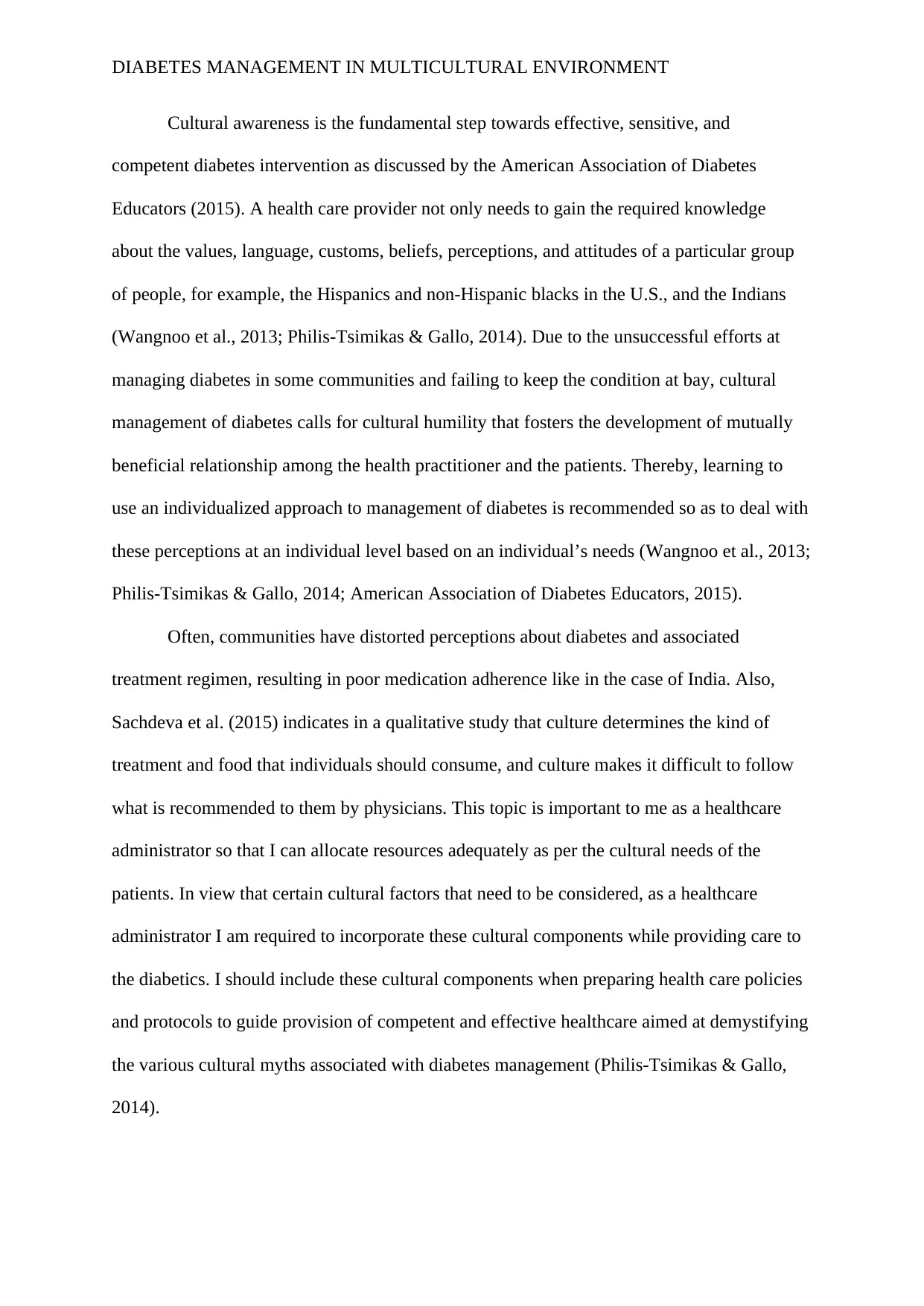
Cultural awareness is the fundamental step towards effective, sensitive, and
competent diabetes intervention as discussed by the American Association of Diabetes
Educators (2015). A health care provider not only needs to gain the required knowledge
about the values, language, customs, beliefs, perceptions, and attitudes of a particular group
of people, for example, the Hispanics and non-Hispanic blacks in the U.S., and the Indians
(Wangnoo et al., 2013; Philis-Tsimikas & Gallo, 2014). Due to the unsuccessful efforts at
managing diabetes in some communities and failing to keep the condition at bay, cultural
management of diabetes calls for cultural humility that fosters the development of mutually
beneficial relationship among the health practitioner and the patients. Thereby, learning to
use an individualized approach to management of diabetes is recommended so as to deal with
these perceptions at an individual level based on an individual’s needs (Wangnoo et al., 2013;
Philis-Tsimikas & Gallo, 2014; American Association of Diabetes Educators, 2015).
Often, communities have distorted perceptions about diabetes and associated
treatment regimen, resulting in poor medication adherence like in the case of India. Also,
Sachdeva et al. (2015) indicates in a qualitative study that culture determines the kind of
treatment and food that individuals should consume, and culture makes it difficult to follow
what is recommended to them by physicians. This topic is important to me as a healthcare
administrator so that I can allocate resources adequately as per the cultural needs of the
patients. In view that certain cultural factors that need to be considered, as a healthcare
administrator I am required to incorporate these cultural components while providing care to
the diabetics. I should include these cultural components when preparing health care policies
and protocols to guide provision of competent and effective healthcare aimed at demystifying
the various cultural myths associated with diabetes management (Philis-Tsimikas & Gallo,
2014).
Document Page
DIABETES MANAGEMENT IN MULTICULTURAL ENVIRONMENT
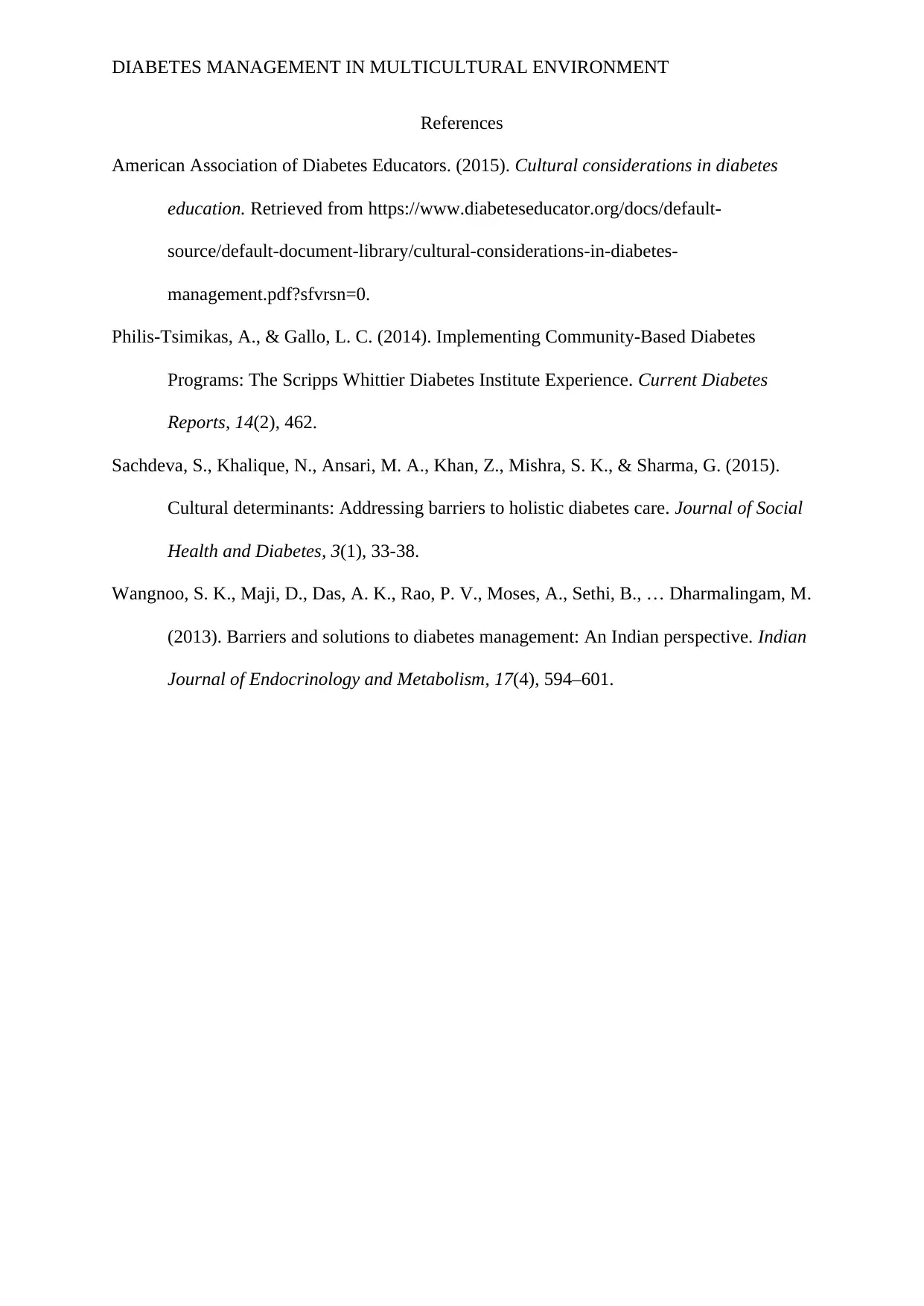
References
American Association of Diabetes Educators. (2015). Cultural considerations in diabetes
education. Retrieved from https://www.diabeteseducator.org/docs/default-
source/default-document-library/cultural-considerations-in-diabetes-
management.pdf?sfvrsn=0.
Philis-Tsimikas, A., & Gallo, L. C. (2014). Implementing Community-Based Diabetes
Programs: The Scripps Whittier Diabetes Institute Experience. Current Diabetes
Reports, 14(2), 462.
Sachdeva, S., Khalique, N., Ansari, M. A., Khan, Z., Mishra, S. K., & Sharma, G. (2015).
Cultural determinants: Addressing barriers to holistic diabetes care. Journal of Social
Health and Diabetes, 3(1), 33-38.
Wangnoo, S. K., Maji, D., Das, A. K., Rao, P. V., Moses, A., Sethi, B., … Dharmalingam, M.
(2013). Barriers and solutions to diabetes management: An Indian perspective. Indian
Journal of Endocrinology and Metabolism, 17(4), 594–601.
chevron_up_icon
1 out of 3
circle_padding
hide_on_mobile
zoom_out_icon
[object Object]