Investigating Boron's Impact on Mung Bean Growth: A Biology Project
VerifiedAdded on  2022/08/24
|7
|1605
|18
Project
AI Summary
This biology project investigates the impact of varying boron concentrations on the growth of mung beans (Vigna radiata). The study design involves applying foliar solutions with four different boron concentrations (0, 25, 50, and 75 mg/L) to mung bean plants. The experiment utilizes a randomized complete block design with three replicates, and the hypothesis focuses on the effect of boron concentration on plant growth. The research aims to determine the optimal boron concentration that promotes high growth, yield, and quality characteristics of mung beans. The experiment includes the application of H3BO3 as the boron source and the use of fertilizers and other substances to optimize plant growth. The dependent variables measured include leaf area, pod number, seed yield, and protein percentage. The study acknowledges limitations, such as the influence of uncontrollable soil nutrients. The project seeks to contribute to understanding micronutrient effects on plant development and identify the best boron concentration for mung bean cultivation.
THE BEST CONCENTRATION OF BORON FOR THE GROWTH OF MUNG BEAN 1
The Best Concentration of Boron for the Growth of Mung Bean
By Student's Name
Course Code and Name
Professor’s Name
University Name
City, State
Date of Submission
The Best Concentration of Boron for the Growth of Mung Bean
By Student's Name
Course Code and Name
Professor’s Name
University Name
City, State
Date of Submission
Paraphrase This Document
Need a fresh take? Get an instant paraphrase of this document with our AI Paraphraser

THE BEST CONCENTRATION OF BORON FOR THE GROWTH OF MUNG BEAN 2
Introduction
Four different primary factors have an impact on plant growth. These factors include
nutrients, temperature, light, and water. Based on nutrients the macronutrients may include
potassium, phosphorous, magnesium, calcium, nitrogen among other nutrients. Essential and
normally considered micronutrients include boron, iron, magnesium, zinc, and molybdenum. In
higher concentrations, these micronutrients may become toxic thus killing or affecting the
growth of the plant (Dimkpa and Bindraban, 2016). Likewise, some plants are more susceptible
to lower concentrations of these micronutrients thus impacting the growth of these plants.
This paper concentrates on Boron as the micronutrients for the growth of mung bean.
Boron is a micronutrient that is important to the growth of all plants. It is the component of the
cell walls and the reproductive structures such as flowers of the plant. According to (Dahiya et
al., 2015), Boron is a mobile nutrient within the soil as it is prone to movement within the soil. It
plays a crucial role in plant functions. It is a micro-nutrient that is vital in the growth of
flowering, cell division, pollen growth thus increasing fertilization and transportation of sugars to
the active parts of growth during the reproductive phase of plant species. The element is also
crucial in the formation of protein via its role in the stabilization of atmospheric nitrogen in the
soil with the presence of natural bacteria referred to as natural rhizobium. Its deficiency mostly
leads into empty pollen grains, reduced number of flowers and poor pollen vitality thus less
production. Also, insufficient boron in the soil can stunt root growth thus resulting in slow
growth.
Introduction
Four different primary factors have an impact on plant growth. These factors include
nutrients, temperature, light, and water. Based on nutrients the macronutrients may include
potassium, phosphorous, magnesium, calcium, nitrogen among other nutrients. Essential and
normally considered micronutrients include boron, iron, magnesium, zinc, and molybdenum. In
higher concentrations, these micronutrients may become toxic thus killing or affecting the
growth of the plant (Dimkpa and Bindraban, 2016). Likewise, some plants are more susceptible
to lower concentrations of these micronutrients thus impacting the growth of these plants.
This paper concentrates on Boron as the micronutrients for the growth of mung bean.
Boron is a micronutrient that is important to the growth of all plants. It is the component of the
cell walls and the reproductive structures such as flowers of the plant. According to (Dahiya et
al., 2015), Boron is a mobile nutrient within the soil as it is prone to movement within the soil. It
plays a crucial role in plant functions. It is a micro-nutrient that is vital in the growth of
flowering, cell division, pollen growth thus increasing fertilization and transportation of sugars to
the active parts of growth during the reproductive phase of plant species. The element is also
crucial in the formation of protein via its role in the stabilization of atmospheric nitrogen in the
soil with the presence of natural bacteria referred to as natural rhizobium. Its deficiency mostly
leads into empty pollen grains, reduced number of flowers and poor pollen vitality thus less
production. Also, insufficient boron in the soil can stunt root growth thus resulting in slow
growth.

THE BEST CONCENTRATION OF BORON FOR THE GROWTH OF MUNG BEAN 3
Deconstruct the problem
Mung bean scientifically referred to as Vigna radiata is an important edible bean that is
used as a human diet around the world. The plant is widely grown and eaten as sprouts or dry
beans in many parts of the world. For plant growth and productivity, adequate site selection, soil
preparation, amount of rainfall, temperature among other factors are considered.
Its growth development and yield may be restricted by insufficient or unbalanced macronutrients
such as potassium, phosphorous and nitrogen (Degefa, 2016).
Mung bean crop remains one of the leguminous crops which is grown in large areas thus
playing a critical role in human food security in light of the increased population in the world.
Their seeds have a high protein content ranging from 20 to 30 percent, carbohydrates ranging
from 61 to 64 percent among other elements. The plant is characterized by a short growth season
of about three to four months. The crop has also a wide environmental range. Despite the
significance of this crop, the rate productivity rate in some areas such as Iraq is still very low
when compared to the global production and growth rate (Shrivastava and Kumar, 2015).
Thus it is crucial to find out possible means that can raise high growth during the
reproductive phase of this important leguminous plant. Some of that improve the growth,
productivity and quality of any plant is the application with various kinds of vitamins and vital
elements via the use of diluted solutions and spraying them. What is required is to apply the right
concentration of these macronutrients.
Another important element that plays a critical role in plant growth is Boron. It is a
micro-nutrient that is vital in the growth of flowering, cell division, pollen growth thus
increasing fertilization and transportation of sugars to the active parts of growth during the
Deconstruct the problem
Mung bean scientifically referred to as Vigna radiata is an important edible bean that is
used as a human diet around the world. The plant is widely grown and eaten as sprouts or dry
beans in many parts of the world. For plant growth and productivity, adequate site selection, soil
preparation, amount of rainfall, temperature among other factors are considered.
Its growth development and yield may be restricted by insufficient or unbalanced macronutrients
such as potassium, phosphorous and nitrogen (Degefa, 2016).
Mung bean crop remains one of the leguminous crops which is grown in large areas thus
playing a critical role in human food security in light of the increased population in the world.
Their seeds have a high protein content ranging from 20 to 30 percent, carbohydrates ranging
from 61 to 64 percent among other elements. The plant is characterized by a short growth season
of about three to four months. The crop has also a wide environmental range. Despite the
significance of this crop, the rate productivity rate in some areas such as Iraq is still very low
when compared to the global production and growth rate (Shrivastava and Kumar, 2015).
Thus it is crucial to find out possible means that can raise high growth during the
reproductive phase of this important leguminous plant. Some of that improve the growth,
productivity and quality of any plant is the application with various kinds of vitamins and vital
elements via the use of diluted solutions and spraying them. What is required is to apply the right
concentration of these macronutrients.
Another important element that plays a critical role in plant growth is Boron. It is a
micro-nutrient that is vital in the growth of flowering, cell division, pollen growth thus
increasing fertilization and transportation of sugars to the active parts of growth during the
⊘ This is a preview!⊘
Do you want full access?
Subscribe today to unlock all pages.

Trusted by 1+ million students worldwide

THE BEST CONCENTRATION OF BORON FOR THE GROWTH OF MUNG BEAN 4
reproductive phase of plant species. The element is also crucial in the formation of protein via its
role in the stabilization of atmospheric nitrogen in the soil with the presence of natural bacteria
referred to as natural rhizobium (Tripathi et al., 2015). Based on the above scenario, this research
paper aims to design a study that can determine the best concentration of boron that can help in
the high growth of mung bean.
Design
Materials
H3BO3 (17% B), Foliar, mung seeds, distilled water, 15-liter knapsack sprayer, 0.15 ml.L-1 of
Al- zahi substance, Superphosphate fertilizer and nitrogen fertilizer
Methods and procedure
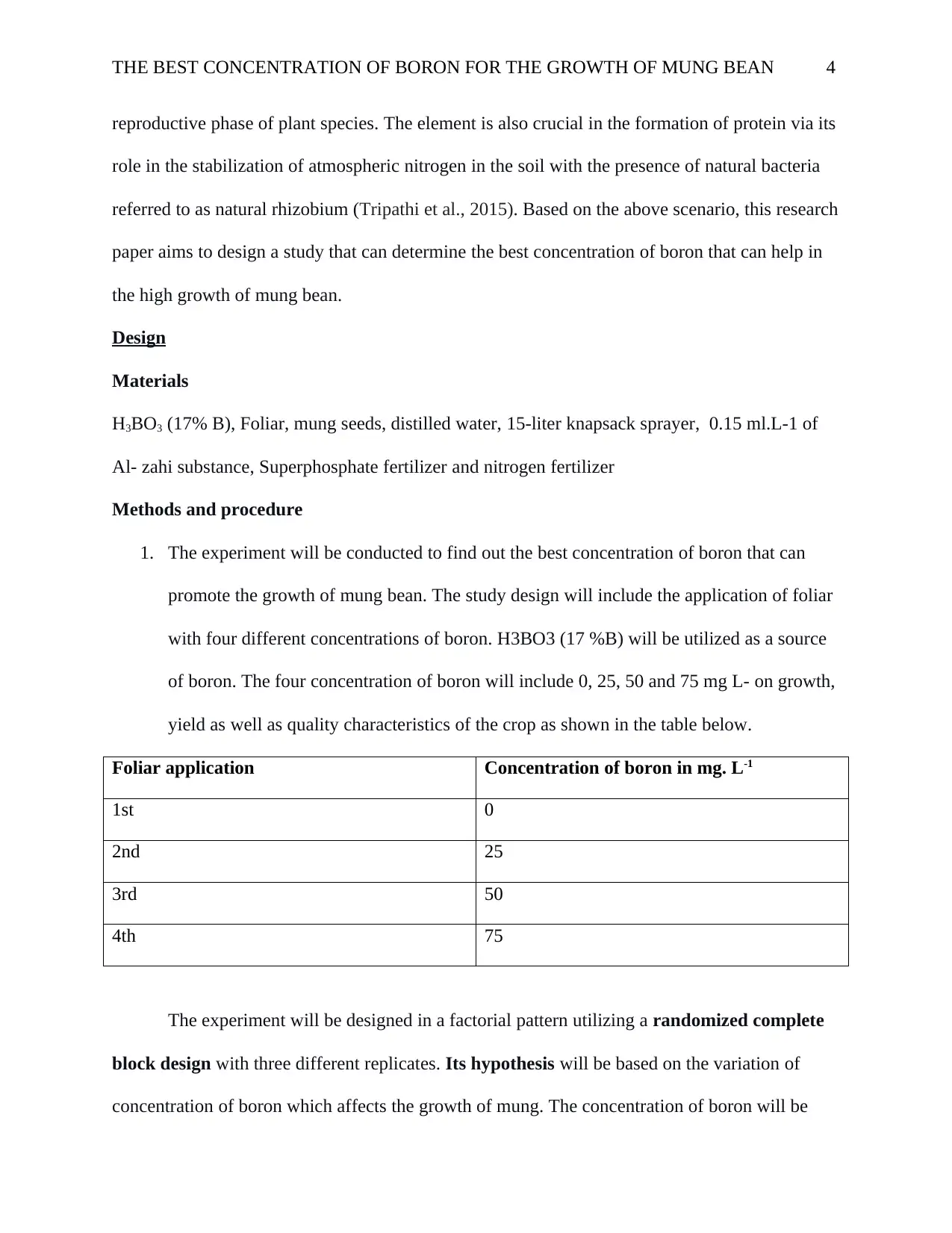
1. The experiment will be conducted to find out the best concentration of boron that can
promote the growth of mung bean. The study design will include the application of foliar
with four different concentrations of boron. H3BO3 (17 %B) will be utilized as a source
of boron. The four concentration of boron will include 0, 25, 50 and 75 mg L- on growth,
yield as well as quality characteristics of the crop as shown in the table below.
Foliar application Concentration of boron in mg. L-1
1st 0
2nd 25
3rd 50
4th 75
The experiment will be designed in a factorial pattern utilizing a randomized complete
block design with three different replicates. Its hypothesis will be based on the variation of
concentration of boron which affects the growth of mung. The concentration of boron will be
reproductive phase of plant species. The element is also crucial in the formation of protein via its
role in the stabilization of atmospheric nitrogen in the soil with the presence of natural bacteria
referred to as natural rhizobium (Tripathi et al., 2015). Based on the above scenario, this research
paper aims to design a study that can determine the best concentration of boron that can help in
the high growth of mung bean.
Design
Materials
H3BO3 (17% B), Foliar, mung seeds, distilled water, 15-liter knapsack sprayer, 0.15 ml.L-1 of
Al- zahi substance, Superphosphate fertilizer and nitrogen fertilizer
Methods and procedure
1. The experiment will be conducted to find out the best concentration of boron that can
promote the growth of mung bean. The study design will include the application of foliar
with four different concentrations of boron. H3BO3 (17 %B) will be utilized as a source
of boron. The four concentration of boron will include 0, 25, 50 and 75 mg L- on growth,
yield as well as quality characteristics of the crop as shown in the table below.
Foliar application Concentration of boron in mg. L-1
1st 0
2nd 25
3rd 50
4th 75
The experiment will be designed in a factorial pattern utilizing a randomized complete
block design with three different replicates. Its hypothesis will be based on the variation of
concentration of boron which affects the growth of mung. The concentration of boron will be
Paraphrase This Document
Need a fresh take? Get an instant paraphrase of this document with our AI Paraphraser

THE BEST CONCENTRATION OF BORON FOR THE GROWTH OF MUNG BEAN 5
sprayed as the first batch before the flowering period starts and the second one before the
formation of pods. On the other hand, the control experiment will be sprayed with distilled
water only. The dependent variables that will be used in this experiment will include leaf area,
pods number per plant, number of seeds per pod, seed yield, and seeds protein percentage. The
independent variable will be the concentration of boron which will vary from 0, 25, 50, and 70
mg L-1. Water and temperature will be controlled whereas the amount of nutrients in the soil will
be uncontrolled.
Before sunset, using a 15-liter knapsack sprayer, 0.15 ml.L-1 of Al- zahi substance will
be added as a diffuser. This will play a crucial role in reducing the surface tension of water thus
ensuring the total wetness of the leaves. This will also increase the efficiency of the solution to
penetrate through the surface of the leaves.
The soil that will be used in the study will be prepared by plowing and smoothening
which will consist of 4 furrows with a length of 4m, 75 cm from each other with seed holes of 25
cm. The seeds will be covered with a light layer of soil and then the irrigation process is done
immediately as per the need of mung seeds. For safety consideration, after one week of
germination, the plants thinning will be done to ensure the survival of every plant in each hole.
Also, in consideration with the safety of germinating seeds, weeds will be manually removed
from the experimental soil twice. Superphosphate fertilizer and nitrogen fertilizer inform of urea
will be added before planting and at the beginning of the flowering period.
The characters that will be recorded will be leaf area, pods number per plant, number of seeds
per pod, seed yield, and seeds protein percentage. All these characters will be used to analyze
and come with a conclusion on the best concentration of boron that can support the growth of
mung beans (Monreal et al., 2016). The limitation of the study is that the growth of mung bean
sprayed as the first batch before the flowering period starts and the second one before the
formation of pods. On the other hand, the control experiment will be sprayed with distilled
water only. The dependent variables that will be used in this experiment will include leaf area,
pods number per plant, number of seeds per pod, seed yield, and seeds protein percentage. The
independent variable will be the concentration of boron which will vary from 0, 25, 50, and 70
mg L-1. Water and temperature will be controlled whereas the amount of nutrients in the soil will
be uncontrolled.
Before sunset, using a 15-liter knapsack sprayer, 0.15 ml.L-1 of Al- zahi substance will
be added as a diffuser. This will play a crucial role in reducing the surface tension of water thus
ensuring the total wetness of the leaves. This will also increase the efficiency of the solution to
penetrate through the surface of the leaves.
The soil that will be used in the study will be prepared by plowing and smoothening
which will consist of 4 furrows with a length of 4m, 75 cm from each other with seed holes of 25
cm. The seeds will be covered with a light layer of soil and then the irrigation process is done
immediately as per the need of mung seeds. For safety consideration, after one week of
germination, the plants thinning will be done to ensure the survival of every plant in each hole.
Also, in consideration with the safety of germinating seeds, weeds will be manually removed
from the experimental soil twice. Superphosphate fertilizer and nitrogen fertilizer inform of urea
will be added before planting and at the beginning of the flowering period.
The characters that will be recorded will be leaf area, pods number per plant, number of seeds
per pod, seed yield, and seeds protein percentage. All these characters will be used to analyze
and come with a conclusion on the best concentration of boron that can support the growth of
mung beans (Monreal et al., 2016). The limitation of the study is that the growth of mung bean

THE BEST CONCENTRATION OF BORON FOR THE GROWTH OF MUNG BEAN 6
can be affected by other nutrients in the soil which are uncontrollable and no information can be
gained about the interactions of development age and microenvironment.
can be affected by other nutrients in the soil which are uncontrollable and no information can be
gained about the interactions of development age and microenvironment.
⊘ This is a preview!⊘
Do you want full access?
Subscribe today to unlock all pages.

Trusted by 1+ million students worldwide

THE BEST CONCENTRATION OF BORON FOR THE GROWTH OF MUNG BEAN 7
References
Dahiya, P.K., Linnemann, A.R., Van Boekel, M.A.J.S., Khetarpaul, N., Grewal, R.B. and Nout,
M.J.R., 2015. Mung bean: Technological and nutritional potential. Critical reviews in food
science and nutrition, 55(5), pp.670-688.
Degefa, I., 2016. General Characteristics Status of Mung bean.
Dimkpa, C.O. and Bindraban, P.S., 2016. Fortification of micronutrients for efficient agronomic
production: a review. Agronomy for Sustainable Development, 36(1), p.7.
Monreal, C.M., DeRosa, M., Mallubhotla, S.C., Bindraban, P.S. and Dimkpa, C., 2016.
Nanotechnologies for increasing the crop use efficiency of fertilizer-micronutrients. Biology and
fertility of soils, 52(3), pp.423-437.
Shrivastava, P. and Kumar, R., 2015. Soil salinity: a serious environmental issue and plant
growth promoting bacteria as one of the tools for its alleviation. Saudi journal of biological
sciences, 22(2), pp.123-131.
Tripathi, D.K., Singh, S., Singh, S., Mishra, S., Chauhan, D.K. and Dubey, N.K., 2015.
Micronutrients and their diverse role in agricultural crops: advances and future prospective. Acta
Physiologiae Plantarum, 37(7), p.139.
References
Dahiya, P.K., Linnemann, A.R., Van Boekel, M.A.J.S., Khetarpaul, N., Grewal, R.B. and Nout,
M.J.R., 2015. Mung bean: Technological and nutritional potential. Critical reviews in food
science and nutrition, 55(5), pp.670-688.
Degefa, I., 2016. General Characteristics Status of Mung bean.
Dimkpa, C.O. and Bindraban, P.S., 2016. Fortification of micronutrients for efficient agronomic
production: a review. Agronomy for Sustainable Development, 36(1), p.7.
Monreal, C.M., DeRosa, M., Mallubhotla, S.C., Bindraban, P.S. and Dimkpa, C., 2016.
Nanotechnologies for increasing the crop use efficiency of fertilizer-micronutrients. Biology and
fertility of soils, 52(3), pp.423-437.
Shrivastava, P. and Kumar, R., 2015. Soil salinity: a serious environmental issue and plant
growth promoting bacteria as one of the tools for its alleviation. Saudi journal of biological
sciences, 22(2), pp.123-131.
Tripathi, D.K., Singh, S., Singh, S., Mishra, S., Chauhan, D.K. and Dubey, N.K., 2015.
Micronutrients and their diverse role in agricultural crops: advances and future prospective. Acta
Physiologiae Plantarum, 37(7), p.139.
1 out of 7
Your All-in-One AI-Powered Toolkit for Academic Success.
 +13062052269
info@desklib.com
Available 24*7 on WhatsApp / Email
Unlock your academic potential
Copyright © 2020–2025 A2Z Services. All Rights Reserved. Developed and managed by ZUCOL.