Munroe Limited: Retirement Tax Planning Strategies in Ireland
VerifiedAdded on 2022/11/24
|8
|3811
|457
Report
AI Summary
This report analyzes various tax planning options available to Mr. Tom Munroe, a major shareholder in Munroe Limited, to facilitate his retirement in Ireland. It explores strategies such as increasing remuneration, dividend payments, capital gains from share disposition, obtaining loans from the company, and establishing a pension scheme. The report meticulously examines the tax implications of each option, considering Irish tax laws, including corporate tax rates, income tax slabs, and capital gains tax. It evaluates the financial impact on both the company and Mr. Munroe, providing insights into the most tax-efficient methods for extracting funds and securing a strong capital base for retirement. The analysis covers relevant legislation, including the Finance Act 2018, and provides a comprehensive understanding of the tax consequences associated with each proposed approach. The report emphasizes the importance of considering factors such as PRSI contributions, dividend tax, and capital gains tax to provide a well-rounded assessment of the financial implications.
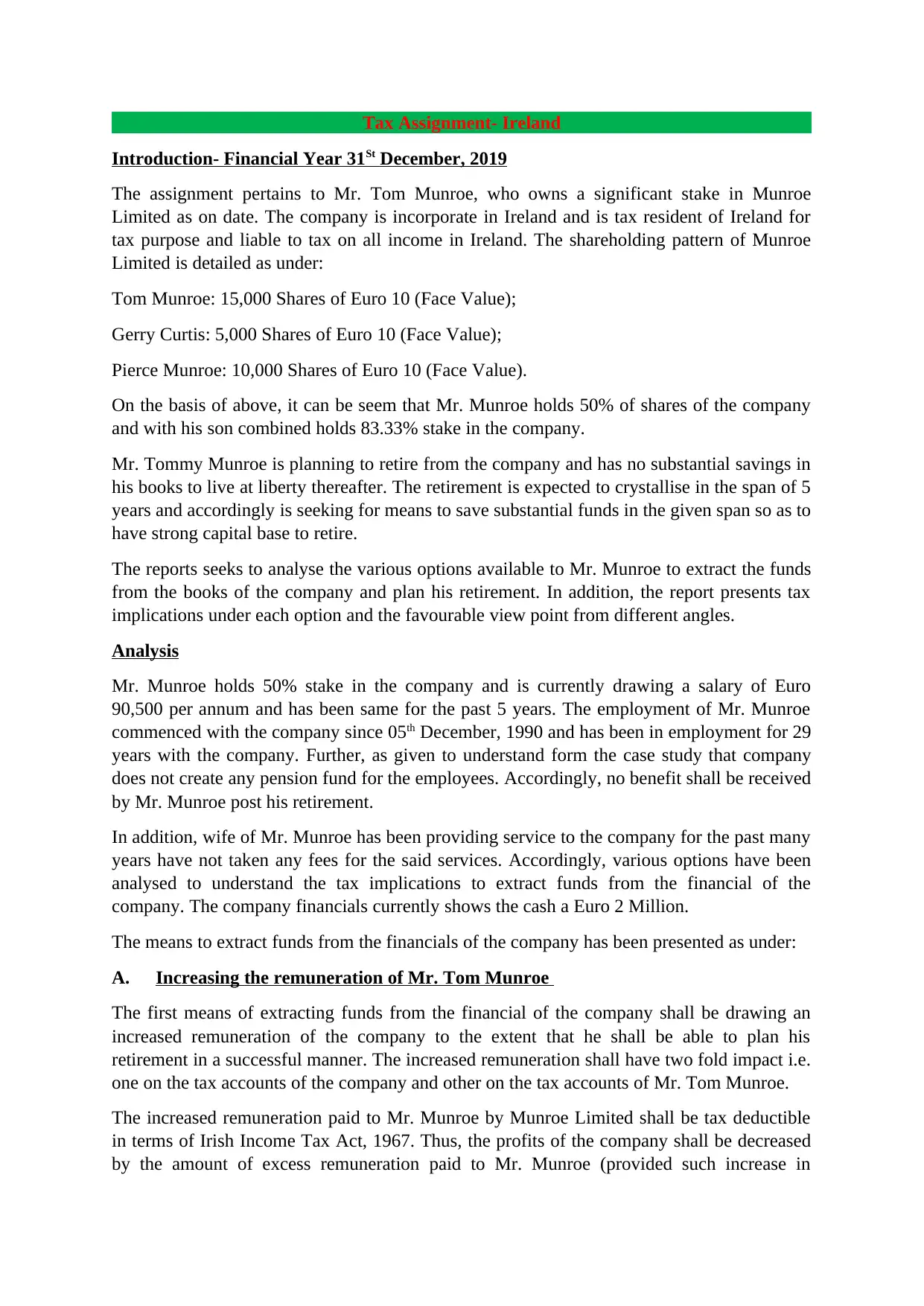
Tax Assignment- Ireland
Introduction- Financial Year 31St December, 2019
The assignment pertains to Mr. Tom Munroe, who owns a significant stake in Munroe
Limited as on date. The company is incorporate in Ireland and is tax resident of Ireland for
tax purpose and liable to tax on all income in Ireland. The shareholding pattern of Munroe
Limited is detailed as under:
Tom Munroe: 15,000 Shares of Euro 10 (Face Value);
Gerry Curtis: 5,000 Shares of Euro 10 (Face Value);
Pierce Munroe: 10,000 Shares of Euro 10 (Face Value).
On the basis of above, it can be seem that Mr. Munroe holds 50% of shares of the company
and with his son combined holds 83.33% stake in the company.
Mr. Tommy Munroe is planning to retire from the company and has no substantial savings in
his books to live at liberty thereafter. The retirement is expected to crystallise in the span of 5
years and accordingly is seeking for means to save substantial funds in the given span so as to
have strong capital base to retire.
The reports seeks to analyse the various options available to Mr. Munroe to extract the funds
from the books of the company and plan his retirement. In addition, the report presents tax
implications under each option and the favourable view point from different angles.
Analysis
Mr. Munroe holds 50% stake in the company and is currently drawing a salary of Euro
90,500 per annum and has been same for the past 5 years. The employment of Mr. Munroe
commenced with the company since 05th December, 1990 and has been in employment for 29
years with the company. Further, as given to understand form the case study that company
does not create any pension fund for the employees. Accordingly, no benefit shall be received
by Mr. Munroe post his retirement.
In addition, wife of Mr. Munroe has been providing service to the company for the past many
years have not taken any fees for the said services. Accordingly, various options have been
analysed to understand the tax implications to extract funds from the financial of the
company. The company financials currently shows the cash a Euro 2 Million.
The means to extract funds from the financials of the company has been presented as under:
A. Increasing the remuneration of Mr. Tom Munroe
The first means of extracting funds from the financial of the company shall be drawing an
increased remuneration of the company to the extent that he shall be able to plan his
retirement in a successful manner. The increased remuneration shall have two fold impact i.e.
one on the tax accounts of the company and other on the tax accounts of Mr. Tom Munroe.
The increased remuneration paid to Mr. Munroe by Munroe Limited shall be tax deductible
in terms of Irish Income Tax Act, 1967. Thus, the profits of the company shall be decreased
by the amount of excess remuneration paid to Mr. Munroe (provided such increase in
Introduction- Financial Year 31St December, 2019
The assignment pertains to Mr. Tom Munroe, who owns a significant stake in Munroe
Limited as on date. The company is incorporate in Ireland and is tax resident of Ireland for
tax purpose and liable to tax on all income in Ireland. The shareholding pattern of Munroe
Limited is detailed as under:
Tom Munroe: 15,000 Shares of Euro 10 (Face Value);
Gerry Curtis: 5,000 Shares of Euro 10 (Face Value);
Pierce Munroe: 10,000 Shares of Euro 10 (Face Value).
On the basis of above, it can be seem that Mr. Munroe holds 50% of shares of the company
and with his son combined holds 83.33% stake in the company.
Mr. Tommy Munroe is planning to retire from the company and has no substantial savings in
his books to live at liberty thereafter. The retirement is expected to crystallise in the span of 5
years and accordingly is seeking for means to save substantial funds in the given span so as to
have strong capital base to retire.
The reports seeks to analyse the various options available to Mr. Munroe to extract the funds
from the books of the company and plan his retirement. In addition, the report presents tax
implications under each option and the favourable view point from different angles.
Analysis
Mr. Munroe holds 50% stake in the company and is currently drawing a salary of Euro
90,500 per annum and has been same for the past 5 years. The employment of Mr. Munroe
commenced with the company since 05th December, 1990 and has been in employment for 29
years with the company. Further, as given to understand form the case study that company
does not create any pension fund for the employees. Accordingly, no benefit shall be received
by Mr. Munroe post his retirement.
In addition, wife of Mr. Munroe has been providing service to the company for the past many
years have not taken any fees for the said services. Accordingly, various options have been
analysed to understand the tax implications to extract funds from the financial of the
company. The company financials currently shows the cash a Euro 2 Million.
The means to extract funds from the financials of the company has been presented as under:
A. Increasing the remuneration of Mr. Tom Munroe
The first means of extracting funds from the financial of the company shall be drawing an
increased remuneration of the company to the extent that he shall be able to plan his
retirement in a successful manner. The increased remuneration shall have two fold impact i.e.
one on the tax accounts of the company and other on the tax accounts of Mr. Tom Munroe.
The increased remuneration paid to Mr. Munroe by Munroe Limited shall be tax deductible
in terms of Irish Income Tax Act, 1967. Thus, the profits of the company shall be decreased
by the amount of excess remuneration paid to Mr. Munroe (provided such increase in

Paraphrase This Document
Need a fresh take? Get an instant paraphrase of this document with our AI Paraphraser
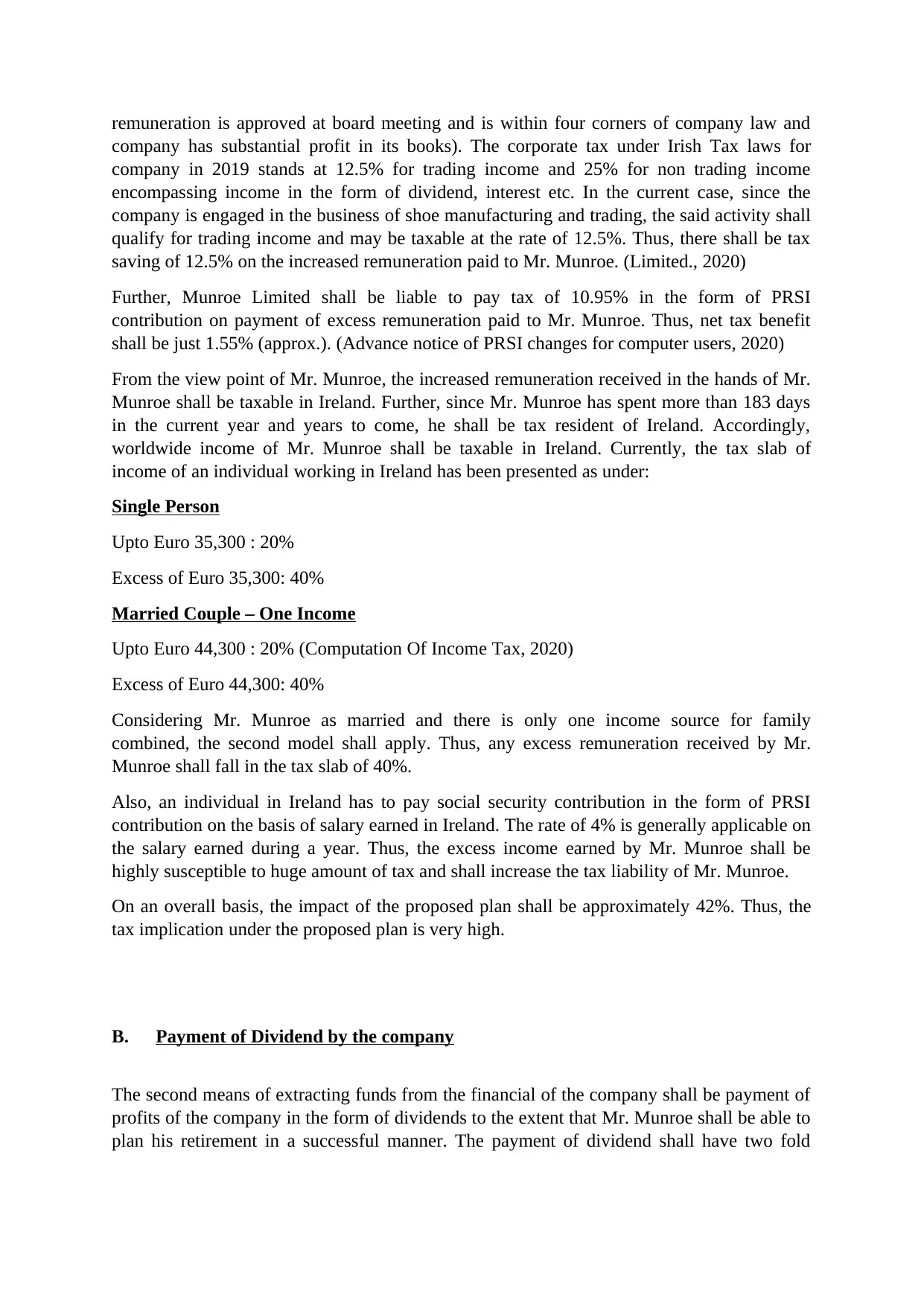
remuneration is approved at board meeting and is within four corners of company law and
company has substantial profit in its books). The corporate tax under Irish Tax laws for
company in 2019 stands at 12.5% for trading income and 25% for non trading income
encompassing income in the form of dividend, interest etc. In the current case, since the
company is engaged in the business of shoe manufacturing and trading, the said activity shall
qualify for trading income and may be taxable at the rate of 12.5%. Thus, there shall be tax
saving of 12.5% on the increased remuneration paid to Mr. Munroe. (Limited., 2020)
Further, Munroe Limited shall be liable to pay tax of 10.95% in the form of PRSI
contribution on payment of excess remuneration paid to Mr. Munroe. Thus, net tax benefit
shall be just 1.55% (approx.). (Advance notice of PRSI changes for computer users, 2020)
From the view point of Mr. Munroe, the increased remuneration received in the hands of Mr.
Munroe shall be taxable in Ireland. Further, since Mr. Munroe has spent more than 183 days
in the current year and years to come, he shall be tax resident of Ireland. Accordingly,
worldwide income of Mr. Munroe shall be taxable in Ireland. Currently, the tax slab of
income of an individual working in Ireland has been presented as under:
Single Person
Upto Euro 35,300 : 20%
Excess of Euro 35,300: 40%
Married Couple – One Income
Upto Euro 44,300 : 20% (Computation Of Income Tax, 2020)
Excess of Euro 44,300: 40%
Considering Mr. Munroe as married and there is only one income source for family
combined, the second model shall apply. Thus, any excess remuneration received by Mr.
Munroe shall fall in the tax slab of 40%.
Also, an individual in Ireland has to pay social security contribution in the form of PRSI
contribution on the basis of salary earned in Ireland. The rate of 4% is generally applicable on
the salary earned during a year. Thus, the excess income earned by Mr. Munroe shall be
highly susceptible to huge amount of tax and shall increase the tax liability of Mr. Munroe.
On an overall basis, the impact of the proposed plan shall be approximately 42%. Thus, the
tax implication under the proposed plan is very high.
B. Payment of Dividend by the company
The second means of extracting funds from the financial of the company shall be payment of
profits of the company in the form of dividends to the extent that Mr. Munroe shall be able to
plan his retirement in a successful manner. The payment of dividend shall have two fold
company has substantial profit in its books). The corporate tax under Irish Tax laws for
company in 2019 stands at 12.5% for trading income and 25% for non trading income
encompassing income in the form of dividend, interest etc. In the current case, since the
company is engaged in the business of shoe manufacturing and trading, the said activity shall
qualify for trading income and may be taxable at the rate of 12.5%. Thus, there shall be tax
saving of 12.5% on the increased remuneration paid to Mr. Munroe. (Limited., 2020)
Further, Munroe Limited shall be liable to pay tax of 10.95% in the form of PRSI
contribution on payment of excess remuneration paid to Mr. Munroe. Thus, net tax benefit
shall be just 1.55% (approx.). (Advance notice of PRSI changes for computer users, 2020)
From the view point of Mr. Munroe, the increased remuneration received in the hands of Mr.
Munroe shall be taxable in Ireland. Further, since Mr. Munroe has spent more than 183 days
in the current year and years to come, he shall be tax resident of Ireland. Accordingly,
worldwide income of Mr. Munroe shall be taxable in Ireland. Currently, the tax slab of
income of an individual working in Ireland has been presented as under:
Single Person
Upto Euro 35,300 : 20%
Excess of Euro 35,300: 40%
Married Couple – One Income
Upto Euro 44,300 : 20% (Computation Of Income Tax, 2020)
Excess of Euro 44,300: 40%
Considering Mr. Munroe as married and there is only one income source for family
combined, the second model shall apply. Thus, any excess remuneration received by Mr.
Munroe shall fall in the tax slab of 40%.
Also, an individual in Ireland has to pay social security contribution in the form of PRSI
contribution on the basis of salary earned in Ireland. The rate of 4% is generally applicable on
the salary earned during a year. Thus, the excess income earned by Mr. Munroe shall be
highly susceptible to huge amount of tax and shall increase the tax liability of Mr. Munroe.
On an overall basis, the impact of the proposed plan shall be approximately 42%. Thus, the
tax implication under the proposed plan is very high.
B. Payment of Dividend by the company
The second means of extracting funds from the financial of the company shall be payment of
profits of the company in the form of dividends to the extent that Mr. Munroe shall be able to
plan his retirement in a successful manner. The payment of dividend shall have two fold
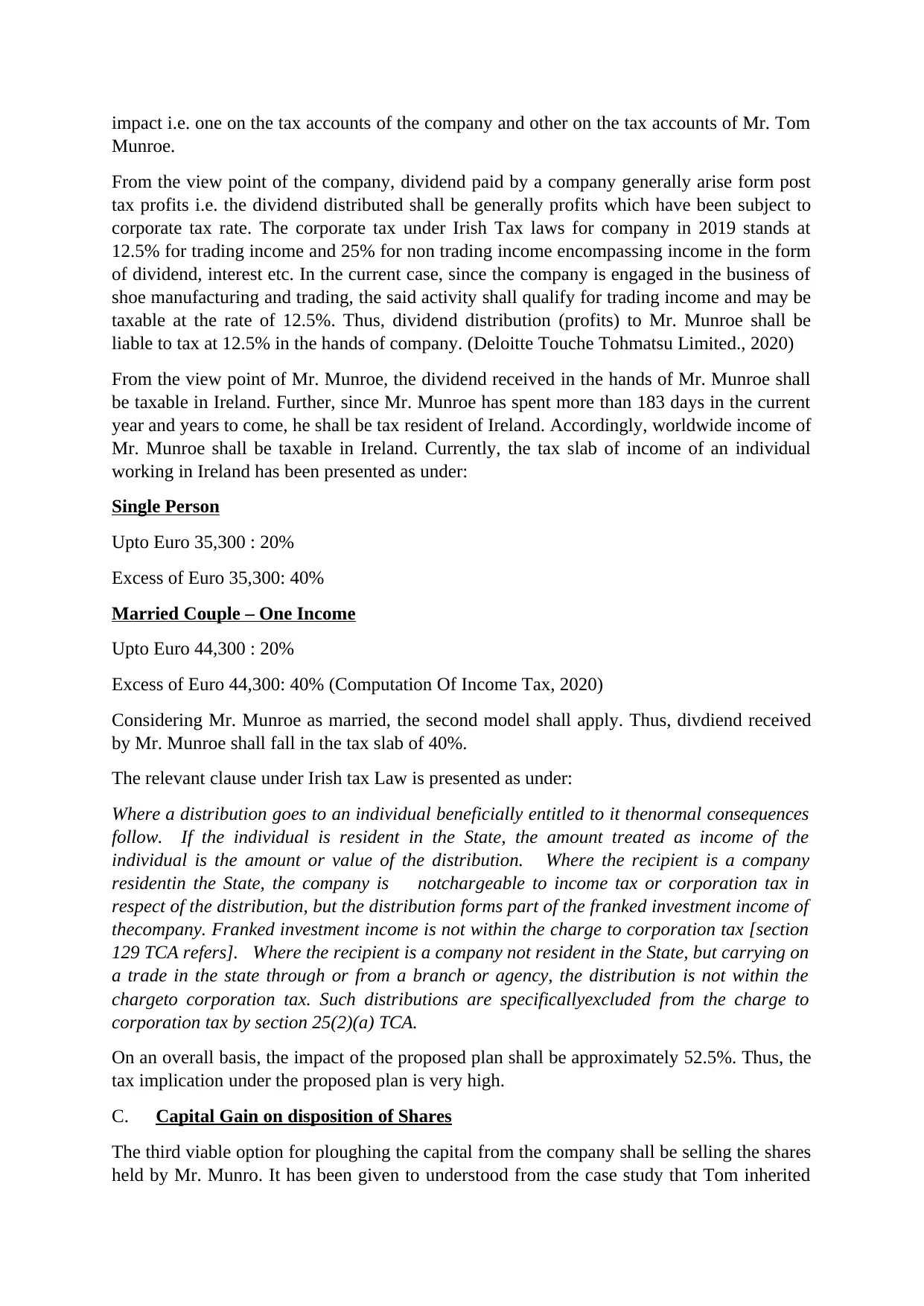
impact i.e. one on the tax accounts of the company and other on the tax accounts of Mr. Tom
Munroe.
From the view point of the company, dividend paid by a company generally arise form post
tax profits i.e. the dividend distributed shall be generally profits which have been subject to
corporate tax rate. The corporate tax under Irish Tax laws for company in 2019 stands at
12.5% for trading income and 25% for non trading income encompassing income in the form
of dividend, interest etc. In the current case, since the company is engaged in the business of
shoe manufacturing and trading, the said activity shall qualify for trading income and may be
taxable at the rate of 12.5%. Thus, dividend distribution (profits) to Mr. Munroe shall be
liable to tax at 12.5% in the hands of company. (Deloitte Touche Tohmatsu Limited., 2020)
From the view point of Mr. Munroe, the dividend received in the hands of Mr. Munroe shall
be taxable in Ireland. Further, since Mr. Munroe has spent more than 183 days in the current
year and years to come, he shall be tax resident of Ireland. Accordingly, worldwide income of
Mr. Munroe shall be taxable in Ireland. Currently, the tax slab of income of an individual
working in Ireland has been presented as under:
Single Person
Upto Euro 35,300 : 20%
Excess of Euro 35,300: 40%
Married Couple – One Income
Upto Euro 44,300 : 20%
Excess of Euro 44,300: 40% (Computation Of Income Tax, 2020)
Considering Mr. Munroe as married, the second model shall apply. Thus, divdiend received
by Mr. Munroe shall fall in the tax slab of 40%.
The relevant clause under Irish tax Law is presented as under:
Where a distribution goes to an individual beneficially entitled to it thenormal consequences
follow. If the individual is resident in the State, the amount treated as income of the
individual is the amount or value of the distribution. Where the recipient is a company
residentin the State, the company is notchargeable to income tax or corporation tax in
respect of the distribution, but the distribution forms part of the franked investment income of
thecompany. Franked investment income is not within the charge to corporation tax [section
129 TCA refers].Where the recipient is a company not resident in the State, but carrying on
a trade in the state through or from a branch or agency, the distribution is not within the
chargeto corporation tax. Such distributions are specificallyexcluded from the charge to
corporation tax by section 25(2)(a) TCA.
On an overall basis, the impact of the proposed plan shall be approximately 52.5%. Thus, the
tax implication under the proposed plan is very high.
C. Capital Gain on disposition of Shares
The third viable option for ploughing the capital from the company shall be selling the shares
held by Mr. Munro. It has been given to understood from the case study that Tom inherited
Munroe.
From the view point of the company, dividend paid by a company generally arise form post
tax profits i.e. the dividend distributed shall be generally profits which have been subject to
corporate tax rate. The corporate tax under Irish Tax laws for company in 2019 stands at
12.5% for trading income and 25% for non trading income encompassing income in the form
of dividend, interest etc. In the current case, since the company is engaged in the business of
shoe manufacturing and trading, the said activity shall qualify for trading income and may be
taxable at the rate of 12.5%. Thus, dividend distribution (profits) to Mr. Munroe shall be
liable to tax at 12.5% in the hands of company. (Deloitte Touche Tohmatsu Limited., 2020)
From the view point of Mr. Munroe, the dividend received in the hands of Mr. Munroe shall
be taxable in Ireland. Further, since Mr. Munroe has spent more than 183 days in the current
year and years to come, he shall be tax resident of Ireland. Accordingly, worldwide income of
Mr. Munroe shall be taxable in Ireland. Currently, the tax slab of income of an individual
working in Ireland has been presented as under:
Single Person
Upto Euro 35,300 : 20%
Excess of Euro 35,300: 40%
Married Couple – One Income
Upto Euro 44,300 : 20%
Excess of Euro 44,300: 40% (Computation Of Income Tax, 2020)
Considering Mr. Munroe as married, the second model shall apply. Thus, divdiend received
by Mr. Munroe shall fall in the tax slab of 40%.
The relevant clause under Irish tax Law is presented as under:
Where a distribution goes to an individual beneficially entitled to it thenormal consequences
follow. If the individual is resident in the State, the amount treated as income of the
individual is the amount or value of the distribution. Where the recipient is a company
residentin the State, the company is notchargeable to income tax or corporation tax in
respect of the distribution, but the distribution forms part of the franked investment income of
thecompany. Franked investment income is not within the charge to corporation tax [section
129 TCA refers].Where the recipient is a company not resident in the State, but carrying on
a trade in the state through or from a branch or agency, the distribution is not within the
chargeto corporation tax. Such distributions are specificallyexcluded from the charge to
corporation tax by section 25(2)(a) TCA.
On an overall basis, the impact of the proposed plan shall be approximately 52.5%. Thus, the
tax implication under the proposed plan is very high.
C. Capital Gain on disposition of Shares
The third viable option for ploughing the capital from the company shall be selling the shares
held by Mr. Munro. It has been given to understood from the case study that Tom inherited
⊘ This is a preview!⊘
Do you want full access?
Subscribe today to unlock all pages.

Trusted by 1+ million students worldwide
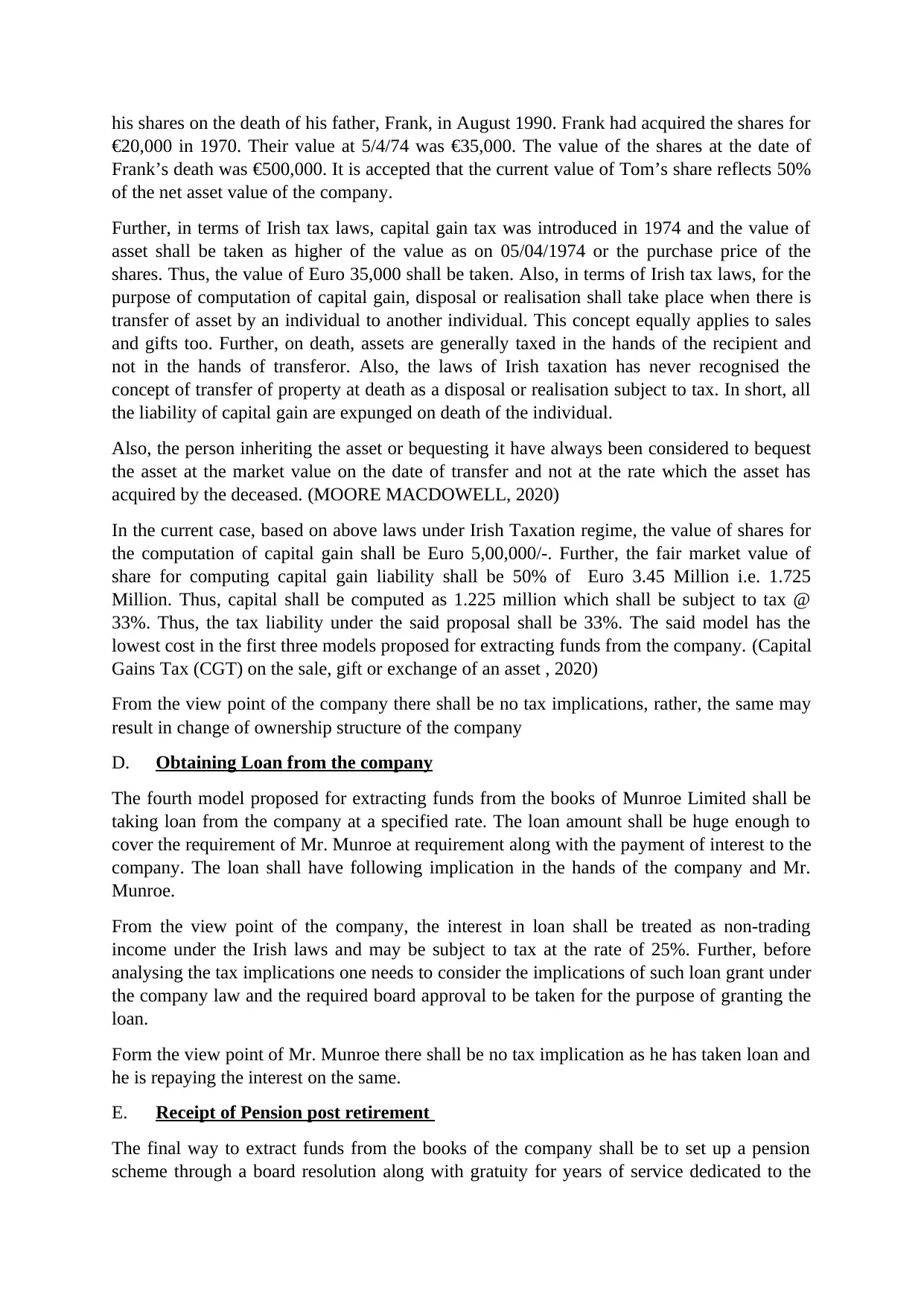
his shares on the death of his father, Frank, in August 1990. Frank had acquired the shares for
€20,000 in 1970. Their value at 5/4/74 was €35,000. The value of the shares at the date of
Frankʼs death was €500,000. It is accepted that the current value of Tom’s share reflects 50%
of the net asset value of the company.
Further, in terms of Irish tax laws, capital gain tax was introduced in 1974 and the value of
asset shall be taken as higher of the value as on 05/04/1974 or the purchase price of the
shares. Thus, the value of Euro 35,000 shall be taken. Also, in terms of Irish tax laws, for the
purpose of computation of capital gain, disposal or realisation shall take place when there is
transfer of asset by an individual to another individual. This concept equally applies to sales
and gifts too. Further, on death, assets are generally taxed in the hands of the recipient and
not in the hands of transferor. Also, the laws of Irish taxation has never recognised the
concept of transfer of property at death as a disposal or realisation subject to tax. In short, all
the liability of capital gain are expunged on death of the individual.
Also, the person inheriting the asset or bequesting it have always been considered to bequest
the asset at the market value on the date of transfer and not at the rate which the asset has
acquired by the deceased. (MOORE MACDOWELL, 2020)
In the current case, based on above laws under Irish Taxation regime, the value of shares for
the computation of capital gain shall be Euro 5,00,000/-. Further, the fair market value of
share for computing capital gain liability shall be 50% of Euro 3.45 Million i.e. 1.725
Million. Thus, capital shall be computed as 1.225 million which shall be subject to tax @
33%. Thus, the tax liability under the said proposal shall be 33%. The said model has the
lowest cost in the first three models proposed for extracting funds from the company. (Capital
Gains Tax (CGT) on the sale, gift or exchange of an asset , 2020)
From the view point of the company there shall be no tax implications, rather, the same may
result in change of ownership structure of the company
D. Obtaining Loan from the company
The fourth model proposed for extracting funds from the books of Munroe Limited shall be
taking loan from the company at a specified rate. The loan amount shall be huge enough to
cover the requirement of Mr. Munroe at requirement along with the payment of interest to the
company. The loan shall have following implication in the hands of the company and Mr.
Munroe.
From the view point of the company, the interest in loan shall be treated as non-trading
income under the Irish laws and may be subject to tax at the rate of 25%. Further, before
analysing the tax implications one needs to consider the implications of such loan grant under
the company law and the required board approval to be taken for the purpose of granting the
loan.
Form the view point of Mr. Munroe there shall be no tax implication as he has taken loan and
he is repaying the interest on the same.
E. Receipt of Pension post retirement
The final way to extract funds from the books of the company shall be to set up a pension
scheme through a board resolution along with gratuity for years of service dedicated to the
€20,000 in 1970. Their value at 5/4/74 was €35,000. The value of the shares at the date of
Frankʼs death was €500,000. It is accepted that the current value of Tom’s share reflects 50%
of the net asset value of the company.
Further, in terms of Irish tax laws, capital gain tax was introduced in 1974 and the value of
asset shall be taken as higher of the value as on 05/04/1974 or the purchase price of the
shares. Thus, the value of Euro 35,000 shall be taken. Also, in terms of Irish tax laws, for the
purpose of computation of capital gain, disposal or realisation shall take place when there is
transfer of asset by an individual to another individual. This concept equally applies to sales
and gifts too. Further, on death, assets are generally taxed in the hands of the recipient and
not in the hands of transferor. Also, the laws of Irish taxation has never recognised the
concept of transfer of property at death as a disposal or realisation subject to tax. In short, all
the liability of capital gain are expunged on death of the individual.
Also, the person inheriting the asset or bequesting it have always been considered to bequest
the asset at the market value on the date of transfer and not at the rate which the asset has
acquired by the deceased. (MOORE MACDOWELL, 2020)
In the current case, based on above laws under Irish Taxation regime, the value of shares for
the computation of capital gain shall be Euro 5,00,000/-. Further, the fair market value of
share for computing capital gain liability shall be 50% of Euro 3.45 Million i.e. 1.725
Million. Thus, capital shall be computed as 1.225 million which shall be subject to tax @
33%. Thus, the tax liability under the said proposal shall be 33%. The said model has the
lowest cost in the first three models proposed for extracting funds from the company. (Capital
Gains Tax (CGT) on the sale, gift or exchange of an asset , 2020)
From the view point of the company there shall be no tax implications, rather, the same may
result in change of ownership structure of the company
D. Obtaining Loan from the company
The fourth model proposed for extracting funds from the books of Munroe Limited shall be
taking loan from the company at a specified rate. The loan amount shall be huge enough to
cover the requirement of Mr. Munroe at requirement along with the payment of interest to the
company. The loan shall have following implication in the hands of the company and Mr.
Munroe.
From the view point of the company, the interest in loan shall be treated as non-trading
income under the Irish laws and may be subject to tax at the rate of 25%. Further, before
analysing the tax implications one needs to consider the implications of such loan grant under
the company law and the required board approval to be taken for the purpose of granting the
loan.
Form the view point of Mr. Munroe there shall be no tax implication as he has taken loan and
he is repaying the interest on the same.
E. Receipt of Pension post retirement
The final way to extract funds from the books of the company shall be to set up a pension
scheme through a board resolution along with gratuity for years of service dedicated to the
Paraphrase This Document
Need a fresh take? Get an instant paraphrase of this document with our AI Paraphraser
organisation. The said scheme shall help Mr. Munroe to meet its liability post requirement
and an annual inflow in the form of pension.
Under the Irish Tax laws, payment of pension shall have the following treatment.
From the view point of the company, pension payment is subject to deduction as the same is
treated as employee expense and company is allowed for deduction of the same. The
corporate tax under Irish Tax laws for company in 2019 stands at 12.5% for trading income
and 25% for non trading income encompassing income in the form of dividend, interest etc.
In the current case, since the company is engaged in the business of shoe manufacturing and
trading, the said activity shall qualify for trading expenditure and may result in tax saving at
the rate of 12.5%.
From the view point of Mr. Munroe, the pension received in the hands of Mr. Munroe shall
be taxable in Ireland. Further, since Mr. Munroe has spent more than 183 days in the current
year and years to come, he shall be tax resident of Ireland. Accordingly, worldwide income of
Mr. Munroe shall be taxable in Ireland. Currently, the tax slab of income of an individual
working in Ireland has been presented as under:
Single Person
Upto Euro 35,300 : 20%
Excess of Euro 35,300: 40% (Computation Of Income Tax, 2020)
Married Couple – One Income
Upto Euro 44,300 : 20%
Excess of Euro 44,300: 40%
Considering Mr. Munroe as married and there is only one income source for family
combined, the second model shall apply. Thus, any pension received by Mr. Munroe shall fall
in the tax slab as stated above.
All the above options stated does not impact or create any tax liability in the hands of Mary
and Pierce. Hence, tax analysis from the view point of above two persons has not been
carried out.
Best Option for TOM
In the above five options, the best option that TOM shall consider shall be the one in which
there is lowest tax commitment. As given to understand, the lowest tax commitment for Mr.
Tom shall be in the case of loan as under the said case, he might not be responsible to pay an
tax as he shall not be receiving any income in its hands. Thus, best option for Mr. Munroe
shall be option D, the tax implication under the said option has been described here-in-under:
The fourth model proposed for extracting funds from the books of Munroe Limited shall be
taking loan from the company at a specified rate. The loan amount shall be huge enough to
cover the requirement of Mr. Munroe at requirement along with the payment of interest to
and an annual inflow in the form of pension.
Under the Irish Tax laws, payment of pension shall have the following treatment.
From the view point of the company, pension payment is subject to deduction as the same is
treated as employee expense and company is allowed for deduction of the same. The
corporate tax under Irish Tax laws for company in 2019 stands at 12.5% for trading income
and 25% for non trading income encompassing income in the form of dividend, interest etc.
In the current case, since the company is engaged in the business of shoe manufacturing and
trading, the said activity shall qualify for trading expenditure and may result in tax saving at
the rate of 12.5%.
From the view point of Mr. Munroe, the pension received in the hands of Mr. Munroe shall
be taxable in Ireland. Further, since Mr. Munroe has spent more than 183 days in the current
year and years to come, he shall be tax resident of Ireland. Accordingly, worldwide income of
Mr. Munroe shall be taxable in Ireland. Currently, the tax slab of income of an individual
working in Ireland has been presented as under:
Single Person
Upto Euro 35,300 : 20%
Excess of Euro 35,300: 40% (Computation Of Income Tax, 2020)
Married Couple – One Income
Upto Euro 44,300 : 20%
Excess of Euro 44,300: 40%
Considering Mr. Munroe as married and there is only one income source for family
combined, the second model shall apply. Thus, any pension received by Mr. Munroe shall fall
in the tax slab as stated above.
All the above options stated does not impact or create any tax liability in the hands of Mary
and Pierce. Hence, tax analysis from the view point of above two persons has not been
carried out.
Best Option for TOM
In the above five options, the best option that TOM shall consider shall be the one in which
there is lowest tax commitment. As given to understand, the lowest tax commitment for Mr.
Tom shall be in the case of loan as under the said case, he might not be responsible to pay an
tax as he shall not be receiving any income in its hands. Thus, best option for Mr. Munroe
shall be option D, the tax implication under the said option has been described here-in-under:
The fourth model proposed for extracting funds from the books of Munroe Limited shall be
taking loan from the company at a specified rate. The loan amount shall be huge enough to
cover the requirement of Mr. Munroe at requirement along with the payment of interest to
the company. The loan shall have following implication in the hands of the company and Mr.
Munroe.
From the view point of the company, the interest in loan shall be treated as non-trading
income under the Irish laws and may be subject to tax at the rate of 25%. Further, before
analysing the tax implications one needs to consider the implications of such loan grant
under the company law and the required board approval to be taken for the purpose of
granting the loan.
Form the view point of Mr. Munroe there shall be no tax implication as he has taken loan
and he is repaying the interest on the same.
Best Option for Munroe Limited
In the above five options, the best option that Munroe Limited shall consider shall be the one
in which there is lowest tax commitment. As given to understand, the lowest tax commitment
for Munroe Limited shall be in the case of disposal of shares by Mr. Munore. Thus, best
option for Munroe Limited shall be option C, the tax implication under the said option has
been described here-in-under:
The third viable option for ploughing the capital from the company shall be selling the
shares held by Mr. Munro. It has been given to understood from the case study that Tom
inherited his shares on the death of his father, Frank, in August 1990. Frank had acquired
the shares for €20,000 in 1970. Their value at 5/4/74 was €35,000. The value of the shares at
the date of Frankʼs death was €500,000. It is accepted that the current value of Tom’s share
reflects 50% of the net asset value of the company.
Further, in terms of Irish tax laws, capital gain tax was introduced in 1974 and the value of
asset shall be taken as higher of the value as on 05/04/1974 or the purchase price of the
shares. Thus, the value of Euro 35,000 shall be taken. Also, in terms of Irish tax laws, for the
purpose of computation of capital gain, disposal or realisation shall take place when there is
transfer of asset by an individual to another individual. This concept equally applies to sales
and gifts too. Further, on death, assets are generally taxed in the hands of the recipient and
not in the hands of transferor. Also, the laws of Irish taxation has never recognised the
concept of transfer of property at death as a disposal or realisation subject to tax. In short,
all the liability of capital gain are expunged on death of the individual.
Also, the person inheriting the asset or bequesting it have always been considered to bequest
the asset at the market value on the date of transfer and not at the rate which the asset has
acquired by the deceased. (MOORE MACDOWELL, 2020)
In the current case, based on above laws under Irish Taxation regime, the value of shares for
the computation of capital gain shall be Euro 5,00,000/-. Further, the fair market value of
share for computing capital gain liability shall be 50% of Euro 3.45 Million i.e. 1.725
Million. Thus, capital shall be computed as 1.225 million which shall be subject to tax @
33%. Thus, the tax liability under the said proposal shall be 33%. The said model has the
lowest cost in the first three models proposed for extracting funds from the company. (Capital
Gains Tax (CGT) on the sale, gift or exchange of an asset , 2020)
From the view point of the company there shall be no tax implications, rather, the same may
result in change of ownership structure of the company
Munroe.
From the view point of the company, the interest in loan shall be treated as non-trading
income under the Irish laws and may be subject to tax at the rate of 25%. Further, before
analysing the tax implications one needs to consider the implications of such loan grant
under the company law and the required board approval to be taken for the purpose of
granting the loan.
Form the view point of Mr. Munroe there shall be no tax implication as he has taken loan
and he is repaying the interest on the same.
Best Option for Munroe Limited
In the above five options, the best option that Munroe Limited shall consider shall be the one
in which there is lowest tax commitment. As given to understand, the lowest tax commitment
for Munroe Limited shall be in the case of disposal of shares by Mr. Munore. Thus, best
option for Munroe Limited shall be option C, the tax implication under the said option has
been described here-in-under:
The third viable option for ploughing the capital from the company shall be selling the
shares held by Mr. Munro. It has been given to understood from the case study that Tom
inherited his shares on the death of his father, Frank, in August 1990. Frank had acquired
the shares for €20,000 in 1970. Their value at 5/4/74 was €35,000. The value of the shares at
the date of Frankʼs death was €500,000. It is accepted that the current value of Tom’s share
reflects 50% of the net asset value of the company.
Further, in terms of Irish tax laws, capital gain tax was introduced in 1974 and the value of
asset shall be taken as higher of the value as on 05/04/1974 or the purchase price of the
shares. Thus, the value of Euro 35,000 shall be taken. Also, in terms of Irish tax laws, for the
purpose of computation of capital gain, disposal or realisation shall take place when there is
transfer of asset by an individual to another individual. This concept equally applies to sales
and gifts too. Further, on death, assets are generally taxed in the hands of the recipient and
not in the hands of transferor. Also, the laws of Irish taxation has never recognised the
concept of transfer of property at death as a disposal or realisation subject to tax. In short,
all the liability of capital gain are expunged on death of the individual.
Also, the person inheriting the asset or bequesting it have always been considered to bequest
the asset at the market value on the date of transfer and not at the rate which the asset has
acquired by the deceased. (MOORE MACDOWELL, 2020)
In the current case, based on above laws under Irish Taxation regime, the value of shares for
the computation of capital gain shall be Euro 5,00,000/-. Further, the fair market value of
share for computing capital gain liability shall be 50% of Euro 3.45 Million i.e. 1.725
Million. Thus, capital shall be computed as 1.225 million which shall be subject to tax @
33%. Thus, the tax liability under the said proposal shall be 33%. The said model has the
lowest cost in the first three models proposed for extracting funds from the company. (Capital
Gains Tax (CGT) on the sale, gift or exchange of an asset , 2020)
From the view point of the company there shall be no tax implications, rather, the same may
result in change of ownership structure of the company
⊘ This is a preview!⊘
Do you want full access?
Subscribe today to unlock all pages.
Trusted by 1+ million students worldwide
Best Option for Mary & Pierce
Since Mary & Pierce is not having tax implications, however, Pierce shall always desire for
control of the company, thus option C shall not be a feasible option. Accordingly, the option
that shall be best suited is Option D which has been detailed as under:
The fourth model proposed for extracting funds from the books of Munroe Limited shall be
taking loan from the company at a specified rate. The loan amount shall be huge enough to
cover the requirement of Mr. Munroe at requirement along with the payment of interest to
the company. The loan shall have following implication in the hands of the company and Mr.
Munroe.
From the view point of the company, the interest in loan shall be treated as non-trading
income under the Irish laws and may be subject to tax at the rate of 25%. Further, before
analysing the tax implications one needs to consider the implications of such loan grant
under the company law and the required board approval to be taken for the purpose of
granting the loan.
Form the view point of Mr. Munroe there shall be no tax implication as he has taken loan
and he is repaying the interest on the same.
Advise on any non-tax consideration that your client should take into account.
All the advise majorly pertain to compliance with different laws which has already been
discussed above.
Since Mary & Pierce is not having tax implications, however, Pierce shall always desire for
control of the company, thus option C shall not be a feasible option. Accordingly, the option
that shall be best suited is Option D which has been detailed as under:
The fourth model proposed for extracting funds from the books of Munroe Limited shall be
taking loan from the company at a specified rate. The loan amount shall be huge enough to
cover the requirement of Mr. Munroe at requirement along with the payment of interest to
the company. The loan shall have following implication in the hands of the company and Mr.
Munroe.
From the view point of the company, the interest in loan shall be treated as non-trading
income under the Irish laws and may be subject to tax at the rate of 25%. Further, before
analysing the tax implications one needs to consider the implications of such loan grant
under the company law and the required board approval to be taken for the purpose of
granting the loan.
Form the view point of Mr. Munroe there shall be no tax implication as he has taken loan
and he is repaying the interest on the same.
Advise on any non-tax consideration that your client should take into account.
All the advise majorly pertain to compliance with different laws which has already been
discussed above.
Paraphrase This Document
Need a fresh take? Get an instant paraphrase of this document with our AI Paraphraser
References
Advance notice of PRSI changes for computer users. (2020, January 6). Retrieved from
www.welfare.ie: https://www.welfare.ie/en/Pages/Advance-Notice-of-PRSI-Changes-For-
Computer-Users-2019.aspx
Capital Gains Tax (CGT) on the sale, gift or exchange of an asset . (2020, January 6). Retrieved from
www.revenue.ie: https://www.revenue.ie/en/gains-gifts-and-inheritance/transfering-an-
asset/how-to-calculate-cgt.aspx
Computation Of Income Tax. (2020, January 6). Retrieved from www.citizensinformation.ie:
https://www.citizensinformation.ie/en/money_and_tax/tax/income_tax/
how_your_tax_is_calculated.html
Deloitte Touche Tohmatsu Limited. (2020, January 6). Description . Retrieved from
www2.deloitte.com:
https://www2.deloitte.com/content/dam/Deloitte/global/Documents/Tax/dttl-tax-
irelandhighlights-2019.pdf
Limited., e. T. (2020, January 6). International TaxIrelandHighlights 2019. Retrieved from
www2.deloitte.com:
https://www2.deloitte.com/content/dam/Deloitte/global/Documents/Tax/dttl-tax-
irelandhighlights-2019.pdf
MOORE MACDOWELL. (2020, January 6). Capital gains taxation in Ireland. Retrieved from
www.fraserinstitute.org:
https://www.fraserinstitute.org/sites/default/files/IntlEvidenceNoCapitalGainsTaxSec3C.pdf
Advance notice of PRSI changes for computer users. (2020, January 6). Retrieved from
www.welfare.ie: https://www.welfare.ie/en/Pages/Advance-Notice-of-PRSI-Changes-For-
Computer-Users-2019.aspx
Capital Gains Tax (CGT) on the sale, gift or exchange of an asset . (2020, January 6). Retrieved from
www.revenue.ie: https://www.revenue.ie/en/gains-gifts-and-inheritance/transfering-an-
asset/how-to-calculate-cgt.aspx
Computation Of Income Tax. (2020, January 6). Retrieved from www.citizensinformation.ie:
https://www.citizensinformation.ie/en/money_and_tax/tax/income_tax/
how_your_tax_is_calculated.html
Deloitte Touche Tohmatsu Limited. (2020, January 6). Description . Retrieved from
www2.deloitte.com:
https://www2.deloitte.com/content/dam/Deloitte/global/Documents/Tax/dttl-tax-
irelandhighlights-2019.pdf
Limited., e. T. (2020, January 6). International TaxIrelandHighlights 2019. Retrieved from
www2.deloitte.com:
https://www2.deloitte.com/content/dam/Deloitte/global/Documents/Tax/dttl-tax-
irelandhighlights-2019.pdf
MOORE MACDOWELL. (2020, January 6). Capital gains taxation in Ireland. Retrieved from
www.fraserinstitute.org:
https://www.fraserinstitute.org/sites/default/files/IntlEvidenceNoCapitalGainsTaxSec3C.pdf

1 out of 8


Your All-in-One AI-Powered Toolkit for Academic Success.
+13062052269
info@desklib.com
Available 24*7 on WhatsApp / Email
![[object Object]](/_next/static/media/star-bottom.7253800d.svg)
Unlock your academic potential
Copyright © 2020–2026 A2Z Services. All Rights Reserved. Developed and managed by ZUCOL.