Sports Nutrition: Supplement Timing and Resistance Exercise Effects

Verified

Added on  2023/06/04

|4
|667
|248
Report
AI Summary
This report examines the effects of supplement timing and resistance exercise on skeletal muscle hypertrophy, particularly among boxers. It analyzes a study by Cribb and Hayes (2006) that investigated the impact of supplement timing on muscle hypertrophy in resistance-trained males. The study compared a group that consumed supplements before and after exercise (PRE-POST) with a control group that consumed supplements at different times (MOR-EVE). The findings indicated that the PRE-POST group experienced greater lean body mass, type II muscle fibers, and IRM strength. The report concludes that strategic supplement timing, particularly with protein, glucose, and creatine, can significantly enhance muscle hypertrophy, which is beneficial for athletes like boxers who undergo intense metabolic stress and mechanical tension during training and competition. This approach ensures smoother training sessions and improved performance in the ring.
Document Page
Running head: SPORTS 1
Sports and Exercise Nutrition
Name of Student
Institution
tabler-icon-diamond-filled.svg

Paraphrase This Document

Need a fresh take? Get an instant paraphrase of this document with our AI Paraphraser
Document Page
SPORTS 2
Sports and Exercise Nutrition
Strength development among boxers is an effective part of how they improve their
resilience and success in the sport. Through constant exercise and practice, the athletes are in a
position to improve the size of their muscles, which influence body composition and enhance
their strength. Different studies have examined how massive muscle hypertrophy could be
achieved through exercise (Smilios et al., 2003; Bickel et al., 2005). On the other hand,
according to a research done by Cribb and Hayes (2006), athletes such as boxers could achieve
great muscle hypertrophy by considering the advantages of supplement timing during resistance
exercise training session. The findings of the study by the two scholars indicated the efficacy of
resistance exercise and supplement timing on muscle hypertrophy. Based on the findings, boxers
could now improve their muscle hypertrophy by adopting supplement timing during their
resistance exercise training.
Cribb and Hayes (2006) carried a randomized quantitative analysis, which involved
resistance-trained participants. The study, which was based on data that was collected during a
ten-week period, involved two groups of male trainees. The first group (PRE-POST) was
subjected to supplements before and after their exercises while the other group (MOR-EVE),
which was the control group, consumed similar supplements in the morning and late in the
evening. Cribb and Hayes (2006) compared the strength, muscle biopsies, and body composition
of the experimental group with the outcomes from the control group. The scholars found out that
the participants from the PRE-POST group attained greater lean body mass, type II muscle
fibers, and IRM strength than the MOR-EVE group. The scholars concluded that supplement
timing is associated with significant adaptations for effective resistance exercise training, which
enhances muscle hypertrophy (Cribb & Hayes, 2006).
Document Page
SPORTS 3
The conclusion of this study is a breakthrough for most boxers seeking to achieve high
muscle hypertrophy levels. The athletes could adopt a routine where the one gram of supplement
per kg of body weight is consumed before and after the resistance exercise. The supplements
could contain one of the key components such as protein, glucose, and creatine. The approach
will guarantee increased lead body mass, contractile protein, body strength, and muscle fibers.
Since boxing is associated with increased metabolic stress, mechanical tension, and damage
during the sport, having a strategy that will guarantee large muscle hypertrophy will ensure that
the athletes have a smooth training session and successful competition in the ring (Schoenfeld,
2010). The findings by Cribb and Hayes (2006) provided a wider perspective regarding effective
resistance exercise.
Document Page
SPORTS 4
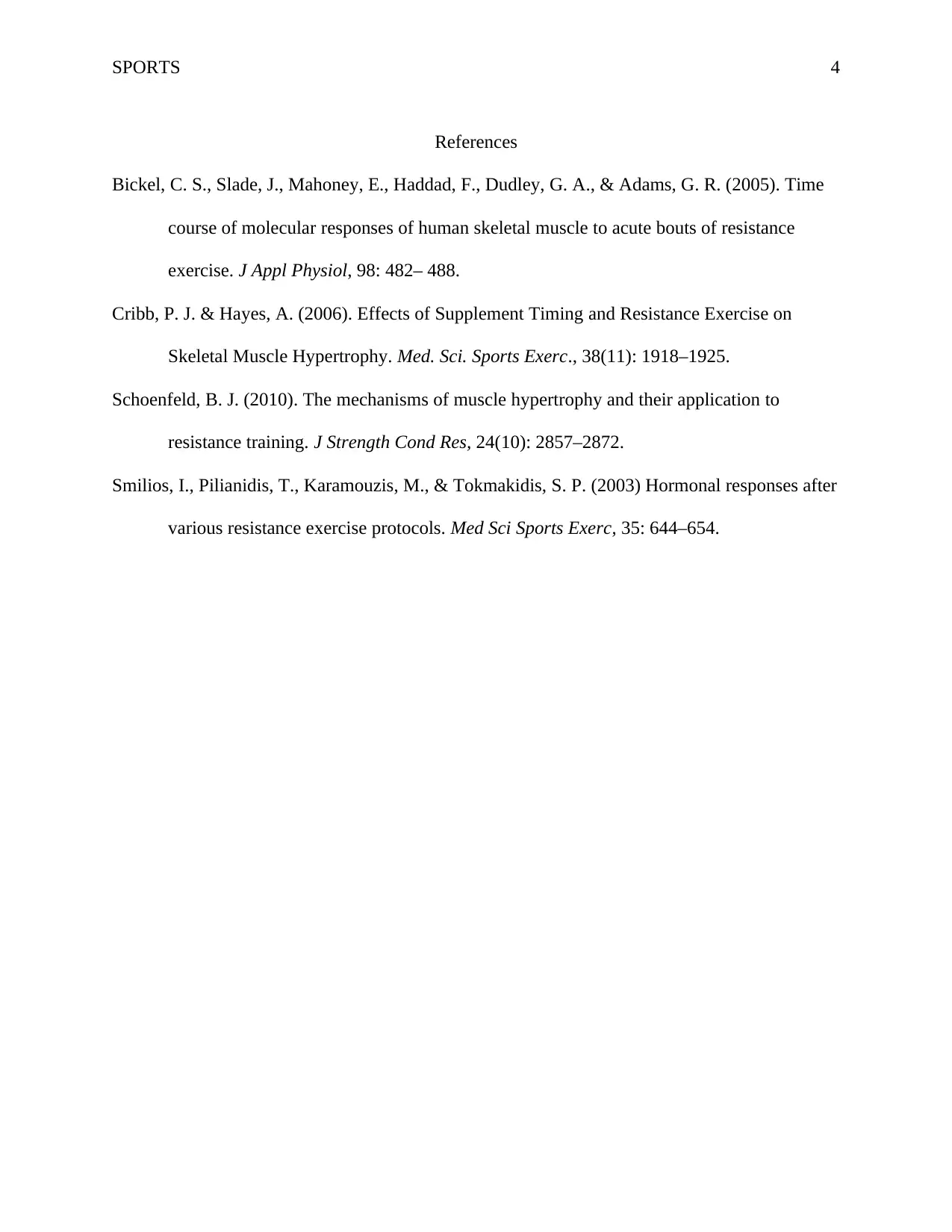
References
Bickel, C. S., Slade, J., Mahoney, E., Haddad, F., Dudley, G. A., & Adams, G. R. (2005). Time
course of molecular responses of human skeletal muscle to acute bouts of resistance
exercise. J Appl Physiol, 98: 482– 488.
Cribb, P. J. & Hayes, A. (2006). Effects of Supplement Timing and Resistance Exercise on
Skeletal Muscle Hypertrophy. Med. Sci. Sports Exerc., 38(11): 1918–1925.
Schoenfeld, B. J. (2010). The mechanisms of muscle hypertrophy and their application to
resistance training. J Strength Cond Res, 24(10): 2857–2872.
Smilios, I., Pilianidis, T., Karamouzis, M., & Tokmakidis, S. P. (2003) Hormonal responses after
various resistance exercise protocols. Med Sci Sports Exerc, 35: 644–654.
chevron_up_icon
1 out of 4
circle_padding
hide_on_mobile
zoom_out_icon
[object Object]