The Effects of Business and Industry on Music Makers and Users
VerifiedAdded on 2023/06/12
|9
|1713
|254
Report
AI Summary
This report examines the multifaceted relationship between the music industry and society, highlighting the commercialization of music and its impact on music makers. It discusses how market forces, including youth culture, technology, fashion trends, and the dominance of major music labels, influence music creation and distribution. The report also explores the role of corporate sponsorship and funding, as well as the rise of amateur and self-financed music composers facilitated by digital platforms. Ultimately, it asserts that music, while a form of art, has become a commercial commodity shaped by various exogenous factors, with music streaming emerging as a significant trend in the contemporary music landscape. Desklib provides access to similar solved assignments for students.
Running head: MUSIC INDUSTRY AND SOCIETY
Music Industry and Society
Name of the Student
Name of the University
Author Note
Music Industry and Society
Name of the Student
Name of the University
Author Note
Paraphrase This Document
Need a fresh take? Get an instant paraphrase of this document with our AI Paraphraser

1MUSIC INDUSTRY AND SOCIETY
Table of Contents
Introduction................................................................................................................................2
Music as a commodity...............................................................................................................2
Market forces and music............................................................................................................3
Youth Culture and technology...............................................................................................3
Fashion and trends..................................................................................................................4
Music companies....................................................................................................................4
Music- Corporate sponsorship and other funding..................................................................5
Amateur and self-financed music composers........................................................................5
Conclusion..................................................................................................................................6
References..................................................................................................................................7
Table of Contents
Introduction................................................................................................................................2
Music as a commodity...............................................................................................................2
Market forces and music............................................................................................................3
Youth Culture and technology...............................................................................................3
Fashion and trends..................................................................................................................4
Music companies....................................................................................................................4
Music- Corporate sponsorship and other funding..................................................................5
Amateur and self-financed music composers........................................................................5
Conclusion..................................................................................................................................6
References..................................................................................................................................7

2MUSIC INDUSTRY AND SOCIETY
Introduction
Music has been one of the primary source of entertainment and relaxation for people
in all the parts of the world, which has kept them happy, relaxed and motivated in their
otherwise busy and stressed daily lives. However, the term “Music” holds to it much more
significance and implications than just being a source of entertainment. Music is not only the
creative and beautiful representation of ones’ own imagination, but also is a crucial part of
the cultural and historical heritage of the countries across the globe (Tschmuck 2012). Over
centuries, different genre and types of music have come to existence, most of them having
their origin in the cultural, political, economical and social debacles or occurrences of the
countries or in their sub-parts.
The music makers, in the contemporary period, working in the music industry in the
global framework and in the quest of catering to the changing preferences and demands of the
clientele as well as of the society, faces the influence of different exogenous factors on their
creation. This is even more aggravated by the direct involvement of business with music in
the industry, in a more commercial global scenario. Keeping this into consideration, the
report tries to discuss the effects of society as well as the impact of business on the music
makers and on music itself (Wikström 2013).
Music as a commodity
As discussed in the above section, music although being an abstract form of art, has
long been commercialized too and the global music industry is a huge industry in its own
domain with millions of people in the supply and demand side. Music, as a profession itself
existed for centuries, however, the industry developed significantly in the last few decades,
owing to the integration and inclusiveness of the global environment attributed to
Globalization and technological advancements. Music is the livelihood of many people and
Introduction
Music has been one of the primary source of entertainment and relaxation for people
in all the parts of the world, which has kept them happy, relaxed and motivated in their
otherwise busy and stressed daily lives. However, the term “Music” holds to it much more
significance and implications than just being a source of entertainment. Music is not only the
creative and beautiful representation of ones’ own imagination, but also is a crucial part of
the cultural and historical heritage of the countries across the globe (Tschmuck 2012). Over
centuries, different genre and types of music have come to existence, most of them having
their origin in the cultural, political, economical and social debacles or occurrences of the
countries or in their sub-parts.
The music makers, in the contemporary period, working in the music industry in the
global framework and in the quest of catering to the changing preferences and demands of the
clientele as well as of the society, faces the influence of different exogenous factors on their
creation. This is even more aggravated by the direct involvement of business with music in
the industry, in a more commercial global scenario. Keeping this into consideration, the
report tries to discuss the effects of society as well as the impact of business on the music
makers and on music itself (Wikström 2013).
Music as a commodity
As discussed in the above section, music although being an abstract form of art, has
long been commercialized too and the global music industry is a huge industry in its own
domain with millions of people in the supply and demand side. Music, as a profession itself
existed for centuries, however, the industry developed significantly in the last few decades,
owing to the integration and inclusiveness of the global environment attributed to
Globalization and technological advancements. Music is the livelihood of many people and
⊘ This is a preview!⊘
Do you want full access?
Subscribe today to unlock all pages.

Trusted by 1+ million students worldwide

3MUSIC INDUSTRY AND SOCIETY
not only the signers. A lot of people work in the domain of music industry as technicians,
composers, organizers and there are many companies who investment hugely in these aspects
with the objective of creating and selling music to people in all parts of the world, so as to
maximize the returns from their investment (Toynbee 2016). Thus, in the contemporary
world, it can be safely asserted that music is produced and sold to the global population, in
many cases for profit generation and thus, can be treated as a commercial commodity, with a
monetary valuation.
Market forces and music
The music industry, as discussed above, is thus run mostly with the intention of profit
maximization and expansion of market domain, especially by the big companies which have
developed over the years, by investing on music and music makers and by buying and selling
music. There are several global trends which are found to be influencing the music makers in
the contemporary period, the primary ones being discussed as follows:
Youth Culture and technology
Youth of any country as well as of the world is said to be the driving force of the
globe in future. These population, having the ability to bring changes and disruptions as well
as the power to think and create something new, has considerable implications on the global
music industry. There lie multi-lateral causal effect relationships between the youth
population and the dynamics in the music industry as both of them gets influenced by one
another (Rose and Ross 2014).
One of the primary examples of disruption in the music industry worldwide, caused
by the change in the fashion of listening to music, came with the increased usage of the
concept of internet, especially by the youth population of the world. With the increased usage
not only the signers. A lot of people work in the domain of music industry as technicians,
composers, organizers and there are many companies who investment hugely in these aspects
with the objective of creating and selling music to people in all parts of the world, so as to
maximize the returns from their investment (Toynbee 2016). Thus, in the contemporary
world, it can be safely asserted that music is produced and sold to the global population, in
many cases for profit generation and thus, can be treated as a commercial commodity, with a
monetary valuation.
Market forces and music
The music industry, as discussed above, is thus run mostly with the intention of profit
maximization and expansion of market domain, especially by the big companies which have
developed over the years, by investing on music and music makers and by buying and selling
music. There are several global trends which are found to be influencing the music makers in
the contemporary period, the primary ones being discussed as follows:
Youth Culture and technology
Youth of any country as well as of the world is said to be the driving force of the
globe in future. These population, having the ability to bring changes and disruptions as well
as the power to think and create something new, has considerable implications on the global
music industry. There lie multi-lateral causal effect relationships between the youth
population and the dynamics in the music industry as both of them gets influenced by one
another (Rose and Ross 2014).
One of the primary examples of disruption in the music industry worldwide, caused
by the change in the fashion of listening to music, came with the increased usage of the
concept of internet, especially by the youth population of the world. With the increased usage
Paraphrase This Document
Need a fresh take? Get an instant paraphrase of this document with our AI Paraphraser

4MUSIC INDUSTRY AND SOCIETY
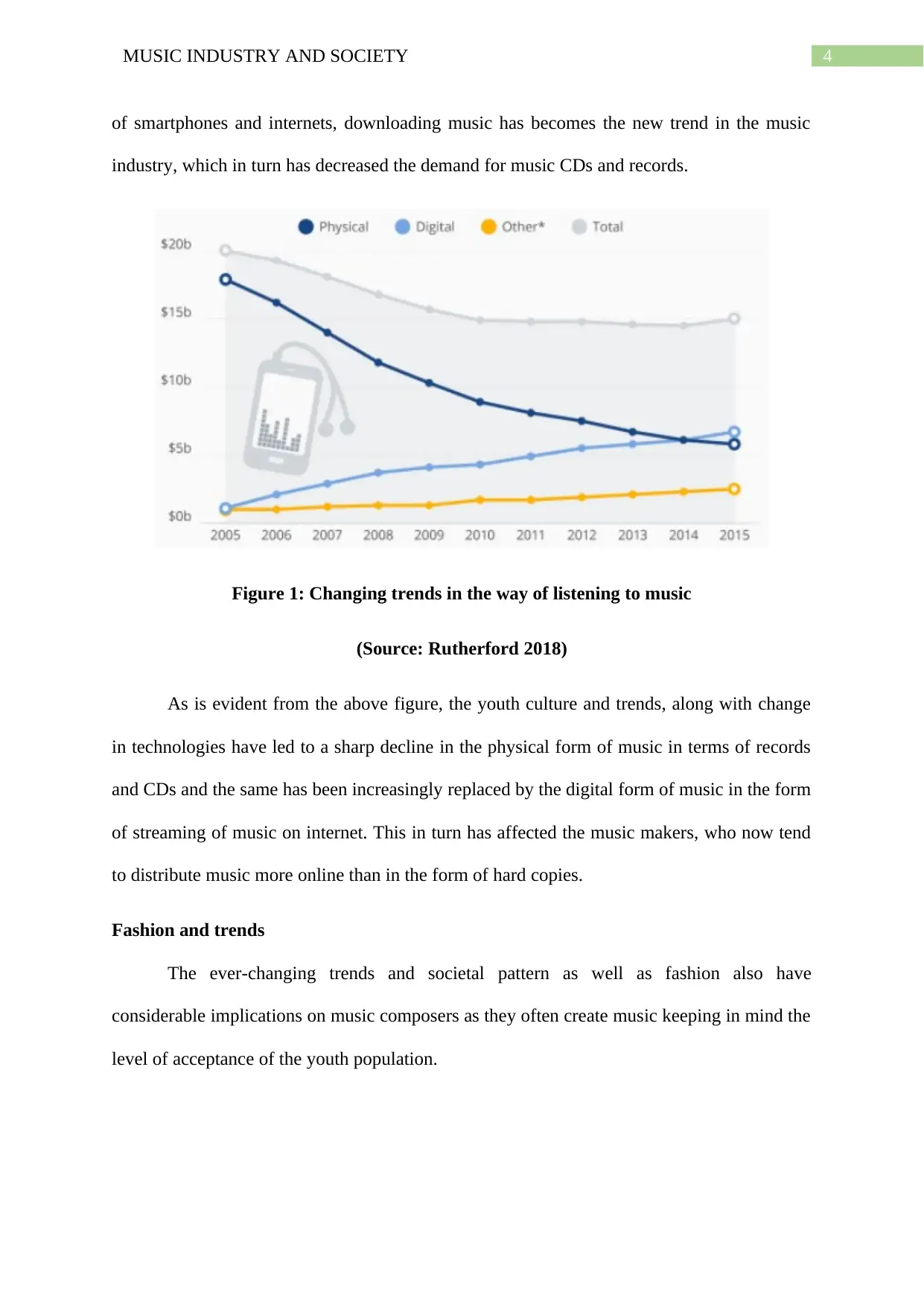
of smartphones and internets, downloading music has becomes the new trend in the music
industry, which in turn has decreased the demand for music CDs and records.
Figure 1: Changing trends in the way of listening to music
(Source: Rutherford 2018)
As is evident from the above figure, the youth culture and trends, along with change
in technologies have led to a sharp decline in the physical form of music in terms of records
and CDs and the same has been increasingly replaced by the digital form of music in the form
of streaming of music on internet. This in turn has affected the music makers, who now tend
to distribute music more online than in the form of hard copies.
Fashion and trends
The ever-changing trends and societal pattern as well as fashion also have
considerable implications on music composers as they often create music keeping in mind the
level of acceptance of the youth population.
of smartphones and internets, downloading music has becomes the new trend in the music
industry, which in turn has decreased the demand for music CDs and records.
Figure 1: Changing trends in the way of listening to music
(Source: Rutherford 2018)
As is evident from the above figure, the youth culture and trends, along with change
in technologies have led to a sharp decline in the physical form of music in terms of records
and CDs and the same has been increasingly replaced by the digital form of music in the form
of streaming of music on internet. This in turn has affected the music makers, who now tend
to distribute music more online than in the form of hard copies.
Fashion and trends
The ever-changing trends and societal pattern as well as fashion also have
considerable implications on music composers as they often create music keeping in mind the
level of acceptance of the youth population.

5MUSIC INDUSTRY AND SOCIETY
Music companies
Another factor having considerable implications on the music makers and the industry
as a whole is the presence of several big and influential companies in this industry. There are
the presence of major labels and indie labels. The major labels are usually the record labels or
companies which have strong financial backings and have been behind the development of
careers of many artists and bands. These labels provide a highly professional recording
facility and distributive and promotional channels for the artists, who sign contract with them.
Examples of such labels are Warner Music Group, BMG, Universal Group, Sony and others.
On the other hand, there also remains independent labels, where the level of funding
is lower but the level of freedom of individual artists are much higher, thereby giving their
music their own touch, which is often found to be absent in those of the major labels, where
owing to the contracts, music is often influenced by the requirements and demands of the
major companies, who in turn base their requirements on the market demands. Often the big
labels buy out the popular indie labels in order to gain greater profit, which in turn brings
those creative and self-sufficient music composers under the domain of corporate companies
(McRobbie and Mcrobbie 2013).
Music- Corporate sponsorship and other funding
Often music composers or music events are sponsored by corporate enterprises as a
mode of their publicity and promotion. This helps the music composers to gain the needed
financial support, but also to some extent attaches their names with the corporate brands,
which in turn economically profits the latter. Music is often created for different causes to
motivate people. Many philanthropic as well as non-profit funding also take place which
induces the music composers to create music targeted to a specific cause or for a specific
group of people in the society.
Music companies
Another factor having considerable implications on the music makers and the industry
as a whole is the presence of several big and influential companies in this industry. There are
the presence of major labels and indie labels. The major labels are usually the record labels or
companies which have strong financial backings and have been behind the development of
careers of many artists and bands. These labels provide a highly professional recording
facility and distributive and promotional channels for the artists, who sign contract with them.
Examples of such labels are Warner Music Group, BMG, Universal Group, Sony and others.
On the other hand, there also remains independent labels, where the level of funding
is lower but the level of freedom of individual artists are much higher, thereby giving their
music their own touch, which is often found to be absent in those of the major labels, where
owing to the contracts, music is often influenced by the requirements and demands of the
major companies, who in turn base their requirements on the market demands. Often the big
labels buy out the popular indie labels in order to gain greater profit, which in turn brings
those creative and self-sufficient music composers under the domain of corporate companies
(McRobbie and Mcrobbie 2013).
Music- Corporate sponsorship and other funding
Often music composers or music events are sponsored by corporate enterprises as a
mode of their publicity and promotion. This helps the music composers to gain the needed
financial support, but also to some extent attaches their names with the corporate brands,
which in turn economically profits the latter. Music is often created for different causes to
motivate people. Many philanthropic as well as non-profit funding also take place which
induces the music composers to create music targeted to a specific cause or for a specific
group of people in the society.
⊘ This is a preview!⊘
Do you want full access?
Subscribe today to unlock all pages.

Trusted by 1+ million students worldwide

6MUSIC INDUSTRY AND SOCIETY
Amateur and self-financed music composers
In the current period, with more usage of internet and social media, music streaming
has become the latest trend. This in turn has helped the self-financing amateur music
composers as now they can create and spread their music easily and faster through the social
media platform. The easily available and cheaper music composing and editing software have
also contributed to the rise of these amateur music composers, many of whom have also
started earning decently through their music in social media platforms (Kaplan 2016).
Conclusion
From the above discussion, it can be asserted that music, being one of the primary
sources of entertainment, has been bought and sold as a normal commodity for a prolonged
period of time and the music industry has developed into a widespread global one. The music
composers, in the contemporary period are considerably influenced by different exogenous
factors like the youth culture, the major music labels, the demand, fashion and preference in
the market as well as the types of funding they receive and the reason behind such funding.
The new age digital and social platform has also helped the amateur musicians to spread their
music on a global domain and music streaming is now the new age trend adopted by many
companies and music composers.
Amateur and self-financed music composers
In the current period, with more usage of internet and social media, music streaming
has become the latest trend. This in turn has helped the self-financing amateur music
composers as now they can create and spread their music easily and faster through the social
media platform. The easily available and cheaper music composing and editing software have
also contributed to the rise of these amateur music composers, many of whom have also
started earning decently through their music in social media platforms (Kaplan 2016).
Conclusion
From the above discussion, it can be asserted that music, being one of the primary
sources of entertainment, has been bought and sold as a normal commodity for a prolonged
period of time and the music industry has developed into a widespread global one. The music
composers, in the contemporary period are considerably influenced by different exogenous
factors like the youth culture, the major music labels, the demand, fashion and preference in
the market as well as the types of funding they receive and the reason behind such funding.
The new age digital and social platform has also helped the amateur musicians to spread their
music on a global domain and music streaming is now the new age trend adopted by many
companies and music composers.
Paraphrase This Document
Need a fresh take? Get an instant paraphrase of this document with our AI Paraphraser

7MUSIC INDUSTRY AND SOCIETY
References
Kaplan, E.A., 2016. Rocking around the clock: Music television, postmodernism, and
consumer culture. Routledge.
McRobbie, A. and Mcrobbie, A., 2013. In the culture society: Art, fashion and popular
music. Routledge.
Rose, T. and Ross, A. eds., 2014. Microphone fiends: youth music and youth culture.
Routledge.
Rutherford, T. (2018). Music Industry Revenue Today. [online] Careers In Music | Music
Schools & Colleges. Available at: https://www.careersinmusic.com/music-industry-revenue
[Accessed 20 Apr. 2018].
Toynbee, J., 2016. Making popular music: Musicians, creativity and institutions. Bloomsbury
Publishing.
Tschmuck, P., 2012. Creativity and innovation in the music industry. In Creativity and
Innovation in the Music Industry (pp. 225-251). Springer, Berlin, Heidelberg.
Wikström, P., 2013. The music industry: Music in the cloud. Polity.
References
Kaplan, E.A., 2016. Rocking around the clock: Music television, postmodernism, and
consumer culture. Routledge.
McRobbie, A. and Mcrobbie, A., 2013. In the culture society: Art, fashion and popular
music. Routledge.
Rose, T. and Ross, A. eds., 2014. Microphone fiends: youth music and youth culture.
Routledge.
Rutherford, T. (2018). Music Industry Revenue Today. [online] Careers In Music | Music
Schools & Colleges. Available at: https://www.careersinmusic.com/music-industry-revenue
[Accessed 20 Apr. 2018].
Toynbee, J., 2016. Making popular music: Musicians, creativity and institutions. Bloomsbury
Publishing.
Tschmuck, P., 2012. Creativity and innovation in the music industry. In Creativity and
Innovation in the Music Industry (pp. 225-251). Springer, Berlin, Heidelberg.
Wikström, P., 2013. The music industry: Music in the cloud. Polity.

8MUSIC INDUSTRY AND SOCIETY
⊘ This is a preview!⊘
Do you want full access?
Subscribe today to unlock all pages.

Trusted by 1+ million students worldwide
1 out of 9
Related Documents
Your All-in-One AI-Powered Toolkit for Academic Success.
+13062052269
info@desklib.com
Available 24*7 on WhatsApp / Email
Unlock your academic potential
Copyright © 2020–2026 A2Z Services. All Rights Reserved. Developed and managed by ZUCOL.