Evaluating Mutual Fund Manager Skill Using Market Models
VerifiedAdded on 2019/09/16
|5
|1297
|473
Homework Assignment
AI Summary
This assignment analyzes the performance of two mutual funds, ALFAX and PRDSX, using market models. It interprets the output from the market model, evaluating the goodness of fit based on the coefficient of determination (R-squared). The analysis compares the funds' performance and assesses their relationship with the Vanguard Total Market Index (VTI). The assignment further examines the beta coefficients of each fund in a four-factor model, interpreting their significance and comparing the results with the market model. Finally, it evaluates the skill of the portfolio manager based on the model outputs, considering the use of regression analysis and adjusted R-squared.
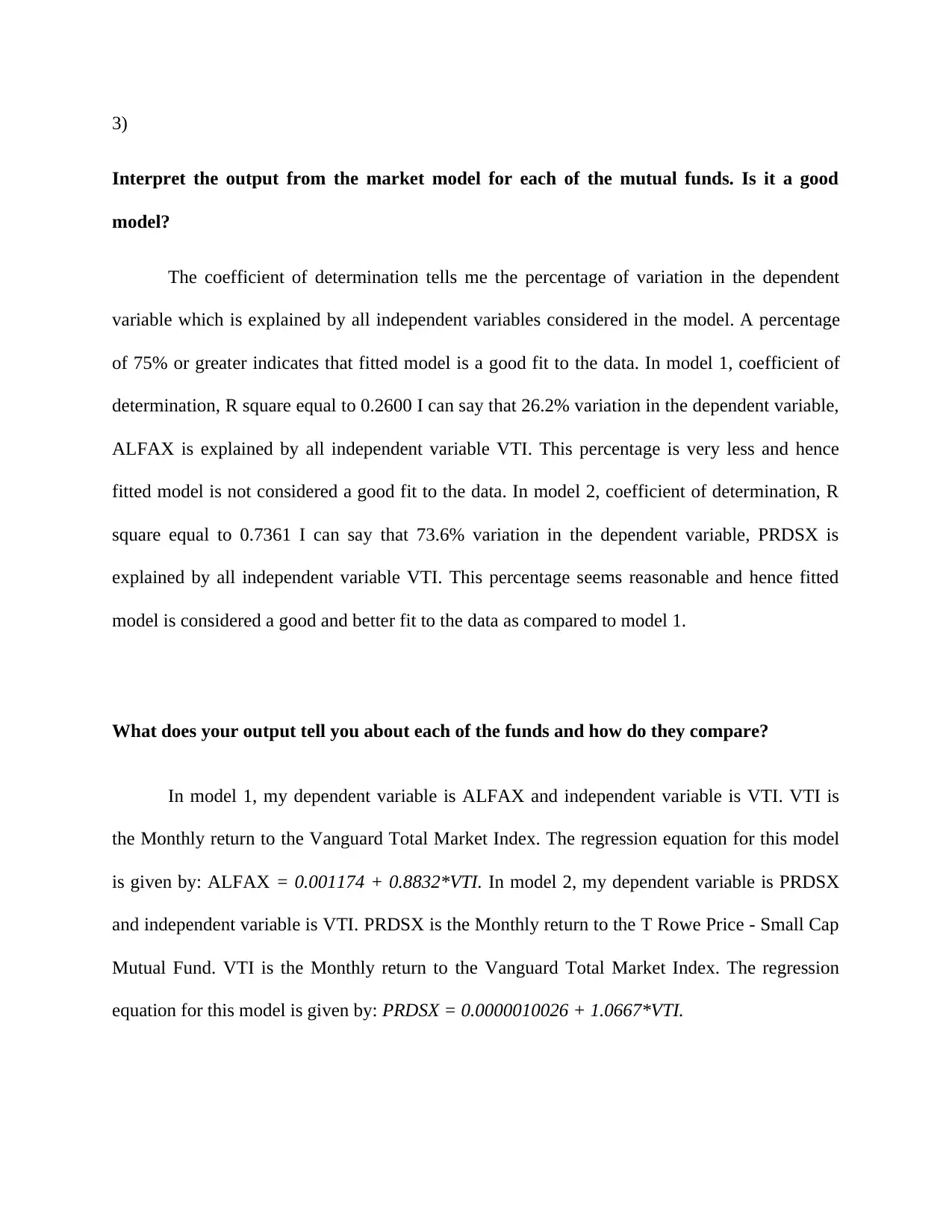
3)
Interpret the output from the market model for each of the mutual funds. Is it a good
model?
The coefficient of determination tells me the percentage of variation in the dependent
variable which is explained by all independent variables considered in the model. A percentage
of 75% or greater indicates that fitted model is a good fit to the data. In model 1, coefficient of
determination, R square equal to 0.2600 I can say that 26.2% variation in the dependent variable,
ALFAX is explained by all independent variable VTI. This percentage is very less and hence
fitted model is not considered a good fit to the data. In model 2, coefficient of determination, R
square equal to 0.7361 I can say that 73.6% variation in the dependent variable, PRDSX is
explained by all independent variable VTI. This percentage seems reasonable and hence fitted
model is considered a good and better fit to the data as compared to model 1.
What does your output tell you about each of the funds and how do they compare?
In model 1, my dependent variable is ALFAX and independent variable is VTI. VTI is
the Monthly return to the Vanguard Total Market Index. The regression equation for this model
is given by: ALFAX = 0.001174 + 0.8832*VTI. In model 2, my dependent variable is PRDSX
and independent variable is VTI. PRDSX is the Monthly return to the T Rowe Price - Small Cap
Mutual Fund. VTI is the Monthly return to the Vanguard Total Market Index. The regression
equation for this model is given by: PRDSX = 0.0000010026 + 1.0667*VTI.
Interpret the output from the market model for each of the mutual funds. Is it a good
model?
The coefficient of determination tells me the percentage of variation in the dependent
variable which is explained by all independent variables considered in the model. A percentage
of 75% or greater indicates that fitted model is a good fit to the data. In model 1, coefficient of
determination, R square equal to 0.2600 I can say that 26.2% variation in the dependent variable,
ALFAX is explained by all independent variable VTI. This percentage is very less and hence
fitted model is not considered a good fit to the data. In model 2, coefficient of determination, R
square equal to 0.7361 I can say that 73.6% variation in the dependent variable, PRDSX is
explained by all independent variable VTI. This percentage seems reasonable and hence fitted
model is considered a good and better fit to the data as compared to model 1.
What does your output tell you about each of the funds and how do they compare?
In model 1, my dependent variable is ALFAX and independent variable is VTI. VTI is
the Monthly return to the Vanguard Total Market Index. The regression equation for this model
is given by: ALFAX = 0.001174 + 0.8832*VTI. In model 2, my dependent variable is PRDSX
and independent variable is VTI. PRDSX is the Monthly return to the T Rowe Price - Small Cap
Mutual Fund. VTI is the Monthly return to the Vanguard Total Market Index. The regression
equation for this model is given by: PRDSX = 0.0000010026 + 1.0667*VTI.
Paraphrase This Document
Need a fresh take? Get an instant paraphrase of this document with our AI Paraphraser

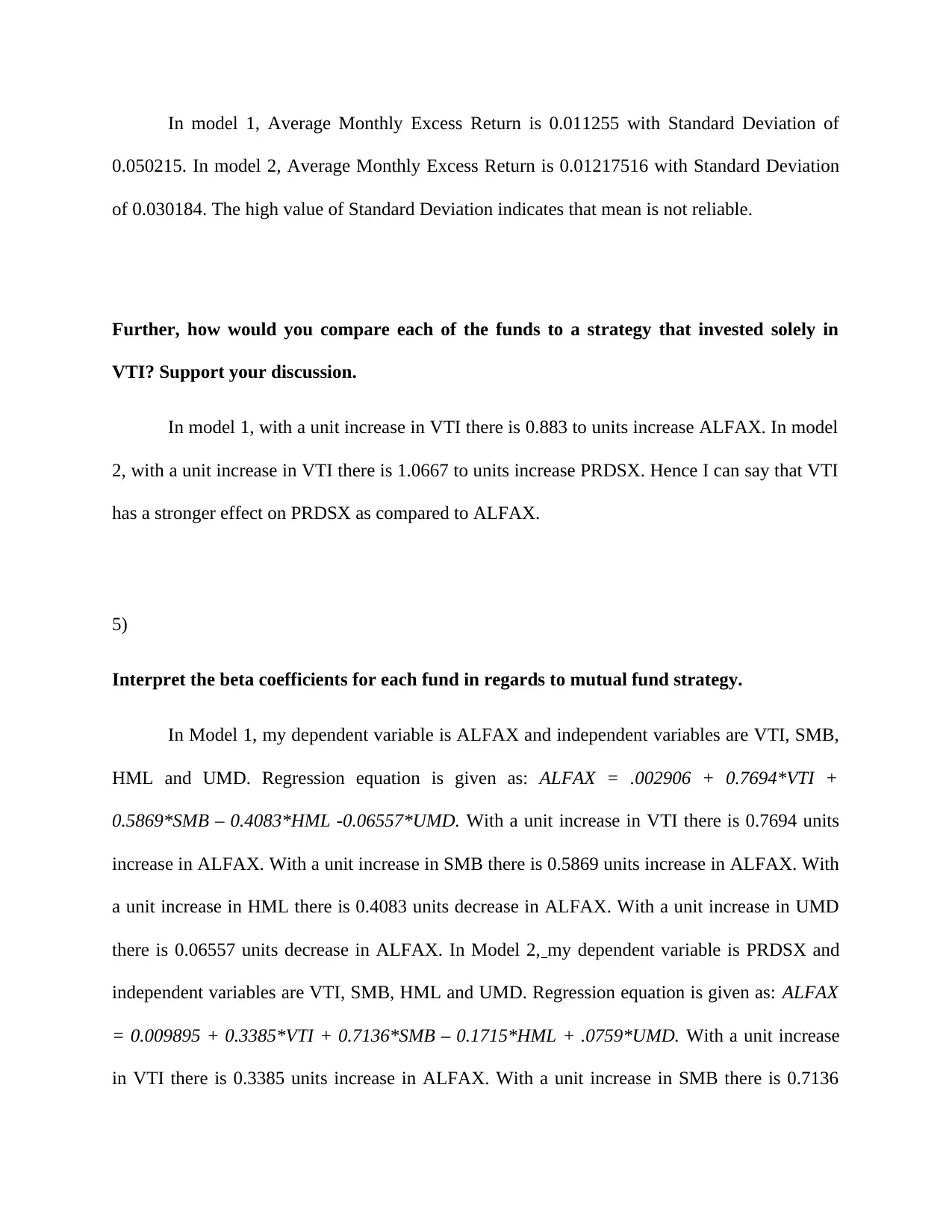
In model 1, Average Monthly Excess Return is 0.011255 with Standard Deviation of
0.050215. In model 2, Average Monthly Excess Return is 0.01217516 with Standard Deviation
of 0.030184. The high value of Standard Deviation indicates that mean is not reliable.
Further, how would you compare each of the funds to a strategy that invested solely in
VTI? Support your discussion.
In model 1, with a unit increase in VTI there is 0.883 to units increase ALFAX. In model
2, with a unit increase in VTI there is 1.0667 to units increase PRDSX. Hence I can say that VTI
has a stronger effect on PRDSX as compared to ALFAX.
5)
Interpret the beta coefficients for each fund in regards to mutual fund strategy.
In Model 1, my dependent variable is ALFAX and independent variables are VTI, SMB,
HML and UMD. Regression equation is given as: ALFAX = .002906 + 0.7694*VTI +
0.5869*SMB – 0.4083*HML -0.06557*UMD. With a unit increase in VTI there is 0.7694 units
increase in ALFAX. With a unit increase in SMB there is 0.5869 units increase in ALFAX. With
a unit increase in HML there is 0.4083 units decrease in ALFAX. With a unit increase in UMD
there is 0.06557 units decrease in ALFAX. In Model 2, my dependent variable is PRDSX and
independent variables are VTI, SMB, HML and UMD. Regression equation is given as: ALFAX
= 0.009895 + 0.3385*VTI + 0.7136*SMB – 0.1715*HML + .0759*UMD. With a unit increase
in VTI there is 0.3385 units increase in ALFAX. With a unit increase in SMB there is 0.7136
0.050215. In model 2, Average Monthly Excess Return is 0.01217516 with Standard Deviation
of 0.030184. The high value of Standard Deviation indicates that mean is not reliable.
Further, how would you compare each of the funds to a strategy that invested solely in
VTI? Support your discussion.
In model 1, with a unit increase in VTI there is 0.883 to units increase ALFAX. In model
2, with a unit increase in VTI there is 1.0667 to units increase PRDSX. Hence I can say that VTI
has a stronger effect on PRDSX as compared to ALFAX.
5)
Interpret the beta coefficients for each fund in regards to mutual fund strategy.
In Model 1, my dependent variable is ALFAX and independent variables are VTI, SMB,
HML and UMD. Regression equation is given as: ALFAX = .002906 + 0.7694*VTI +
0.5869*SMB – 0.4083*HML -0.06557*UMD. With a unit increase in VTI there is 0.7694 units
increase in ALFAX. With a unit increase in SMB there is 0.5869 units increase in ALFAX. With
a unit increase in HML there is 0.4083 units decrease in ALFAX. With a unit increase in UMD
there is 0.06557 units decrease in ALFAX. In Model 2, my dependent variable is PRDSX and
independent variables are VTI, SMB, HML and UMD. Regression equation is given as: ALFAX
= 0.009895 + 0.3385*VTI + 0.7136*SMB – 0.1715*HML + .0759*UMD. With a unit increase
in VTI there is 0.3385 units increase in ALFAX. With a unit increase in SMB there is 0.7136

units increase in ALFAX. With a unit increase in HML there is 0.1715 units decrease in
ALFAX. With a unit increase in UMD there is 0.0759 units increase in ALFAX.
Are the sign and significance of these betas as you would expect?
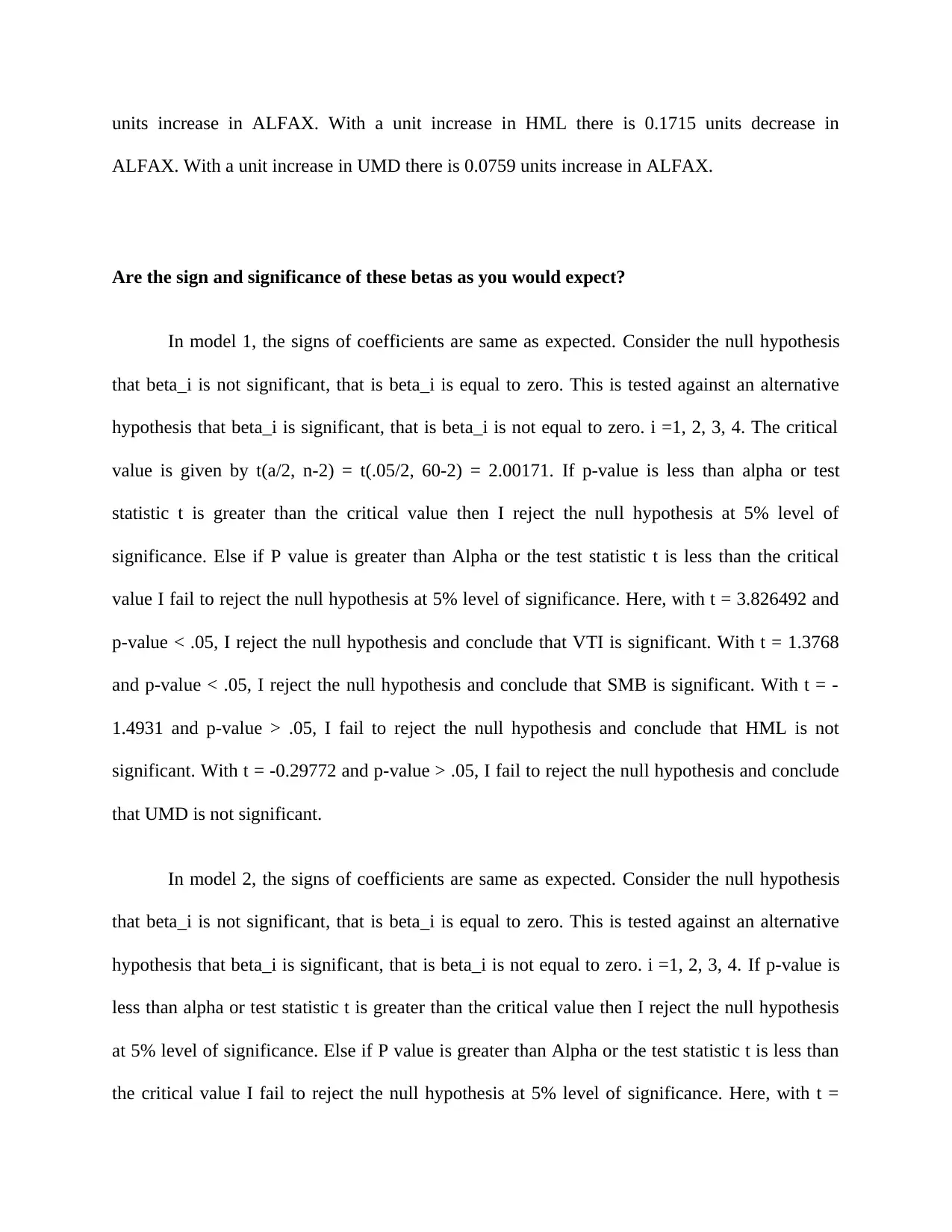
In model 1, the signs of coefficients are same as expected. Consider the null hypothesis
that beta_i is not significant, that is beta_i is equal to zero. This is tested against an alternative
hypothesis that beta_i is significant, that is beta_i is not equal to zero. i =1, 2, 3, 4. The critical
value is given by t(a/2, n-2) = t(.05/2, 60-2) = 2.00171. If p-value is less than alpha or test
statistic t is greater than the critical value then I reject the null hypothesis at 5% level of
significance. Else if P value is greater than Alpha or the test statistic t is less than the critical
value I fail to reject the null hypothesis at 5% level of significance. Here, with t = 3.826492 and
p-value < .05, I reject the null hypothesis and conclude that VTI is significant. With t = 1.3768
and p-value < .05, I reject the null hypothesis and conclude that SMB is significant. With t = -
1.4931 and p-value > .05, I fail to reject the null hypothesis and conclude that HML is not
significant. With t = -0.29772 and p-value > .05, I fail to reject the null hypothesis and conclude
that UMD is not significant.
In model 2, the signs of coefficients are same as expected. Consider the null hypothesis
that beta_i is not significant, that is beta_i is equal to zero. This is tested against an alternative
hypothesis that beta_i is significant, that is beta_i is not equal to zero. i =1, 2, 3, 4. If p-value is
less than alpha or test statistic t is greater than the critical value then I reject the null hypothesis
at 5% level of significance. Else if P value is greater than Alpha or the test statistic t is less than
the critical value I fail to reject the null hypothesis at 5% level of significance. Here, with t =
ALFAX. With a unit increase in UMD there is 0.0759 units increase in ALFAX.
Are the sign and significance of these betas as you would expect?
In model 1, the signs of coefficients are same as expected. Consider the null hypothesis
that beta_i is not significant, that is beta_i is equal to zero. This is tested against an alternative
hypothesis that beta_i is significant, that is beta_i is not equal to zero. i =1, 2, 3, 4. The critical
value is given by t(a/2, n-2) = t(.05/2, 60-2) = 2.00171. If p-value is less than alpha or test
statistic t is greater than the critical value then I reject the null hypothesis at 5% level of
significance. Else if P value is greater than Alpha or the test statistic t is less than the critical
value I fail to reject the null hypothesis at 5% level of significance. Here, with t = 3.826492 and
p-value < .05, I reject the null hypothesis and conclude that VTI is significant. With t = 1.3768
and p-value < .05, I reject the null hypothesis and conclude that SMB is significant. With t = -
1.4931 and p-value > .05, I fail to reject the null hypothesis and conclude that HML is not
significant. With t = -0.29772 and p-value > .05, I fail to reject the null hypothesis and conclude
that UMD is not significant.
In model 2, the signs of coefficients are same as expected. Consider the null hypothesis
that beta_i is not significant, that is beta_i is equal to zero. This is tested against an alternative
hypothesis that beta_i is significant, that is beta_i is not equal to zero. i =1, 2, 3, 4. If p-value is
less than alpha or test statistic t is greater than the critical value then I reject the null hypothesis
at 5% level of significance. Else if P value is greater than Alpha or the test statistic t is less than
the critical value I fail to reject the null hypothesis at 5% level of significance. Here, with t =
⊘ This is a preview!⊘
Do you want full access?
Subscribe today to unlock all pages.

Trusted by 1+ million students worldwide

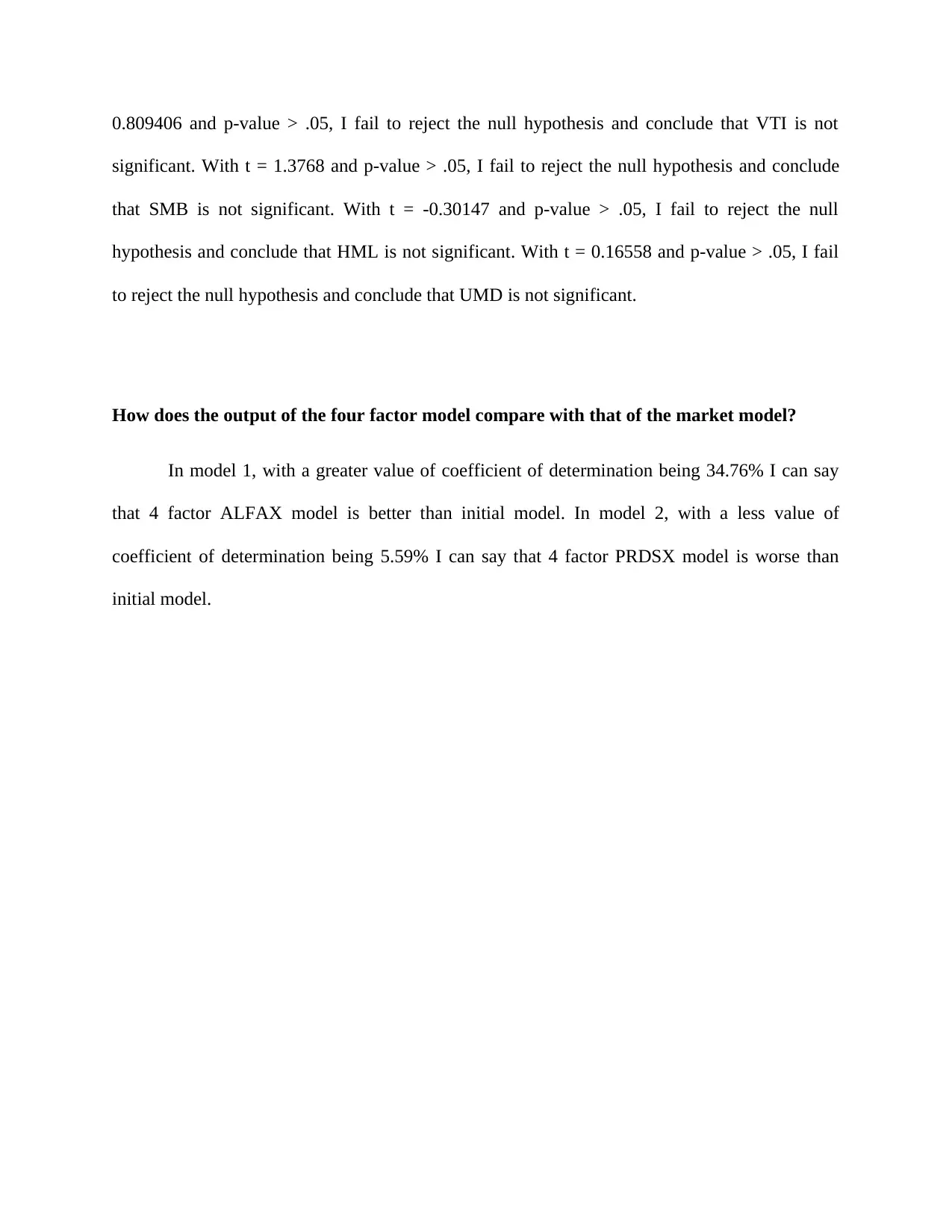
0.809406 and p-value > .05, I fail to reject the null hypothesis and conclude that VTI is not
significant. With t = 1.3768 and p-value > .05, I fail to reject the null hypothesis and conclude
that SMB is not significant. With t = -0.30147 and p-value > .05, I fail to reject the null
hypothesis and conclude that HML is not significant. With t = 0.16558 and p-value > .05, I fail
to reject the null hypothesis and conclude that UMD is not significant.
How does the output of the four factor model compare with that of the market model?
In model 1, with a greater value of coefficient of determination being 34.76% I can say
that 4 factor ALFAX model is better than initial model. In model 2, with a less value of
coefficient of determination being 5.59% I can say that 4 factor PRDSX model is worse than
initial model.
significant. With t = 1.3768 and p-value > .05, I fail to reject the null hypothesis and conclude
that SMB is not significant. With t = -0.30147 and p-value > .05, I fail to reject the null
hypothesis and conclude that HML is not significant. With t = 0.16558 and p-value > .05, I fail
to reject the null hypothesis and conclude that UMD is not significant.
How does the output of the four factor model compare with that of the market model?
In model 1, with a greater value of coefficient of determination being 34.76% I can say
that 4 factor ALFAX model is better than initial model. In model 2, with a less value of
coefficient of determination being 5.59% I can say that 4 factor PRDSX model is worse than
initial model.
Paraphrase This Document
Need a fresh take? Get an instant paraphrase of this document with our AI Paraphraser

6)
With the information you have gathered, do you think the portfolio manager of your fund
has skill? Why or why not?
among all above models, only PRDSX market model with the Vanguard Total Market
Index (VTI) as the market factor is considered reliable with coefficient of determination R^2 =
0.7361.
The portfolio manager of my fund doesn’t has the skill as he hasn’t used step wise
regression analysis and adjusted R^2. Adjusted R square increases with the addition of
significant variables. Step wise regression analysis helps to choose the best model on basis of
value of adjusted R square and considering the value of VIF to judge the multi-co-linearity in the
model.
With the information you have gathered, do you think the portfolio manager of your fund
has skill? Why or why not?
among all above models, only PRDSX market model with the Vanguard Total Market
Index (VTI) as the market factor is considered reliable with coefficient of determination R^2 =
0.7361.
The portfolio manager of my fund doesn’t has the skill as he hasn’t used step wise
regression analysis and adjusted R^2. Adjusted R square increases with the addition of
significant variables. Step wise regression analysis helps to choose the best model on basis of
value of adjusted R square and considering the value of VIF to judge the multi-co-linearity in the
model.
1 out of 5
Your All-in-One AI-Powered Toolkit for Academic Success.
+13062052269
info@desklib.com
Available 24*7 on WhatsApp / Email
Unlock your academic potential
Copyright © 2020–2025 A2Z Services. All Rights Reserved. Developed and managed by ZUCOL.