COIT20247 Database Design and Development Assignment Report

Verified

Added on  2022/10/09

|13
|1369
|19
Report
AI Summary
This assignment report details the creation of a database using MySQL Workbench, focusing on the CQUPM database system. The report covers the Crow’s foot system, Entity Relationship Diagrams (ERDs), and the implementation of ten tables including Applications, Customers, and Rentals. It includes examples of queries, a sample report, and explanations of key database concepts such as primary keys, foreign keys, and different relationship types (one-to-many, many-to-one, and many-to-many). The report also describes the workbench assignment, which involves creating a database, tables, and an ER diagram for the Customer, Rental, and Property tables, and provides an overview of the Enhanced Entity-Relationship (EER) diagrams. The report further discusses the database design process, the importance of using databases, advantages such as tailored SLAs and report generation, and disadvantages including security concerns and high implementation costs. References to relevant resources are also provided.

Document Page
RUNNING HEAD: ASSIGNMENT REPORT 1
Assignment Report
Your Name
School-Affiliated
tabler-icon-diamond-filled.svg

Paraphrase This Document

Need a fresh take? Get an instant paraphrase of this document with our AI Paraphraser
Document Page
ASSIGNMENT REPORT 2
Crow’s Foot System
This is an example of a data modelling method. Such an example is the Entity Relationship
Diagram. The Crow’s foot system makes use of the different entities, relationships and modality.
Entity refers to the place, person or thing which is used in the collection of the multiple data
instances (Zaria, 2013). The relationships helps in illustrating the entities association. Finally, the
modality otherwise called cardinality which are the indicators of the relationship through rules.
The cardinality maximizes on the entity instances that are associated with it through the entity
(Brady, 2017).
Database design and development part
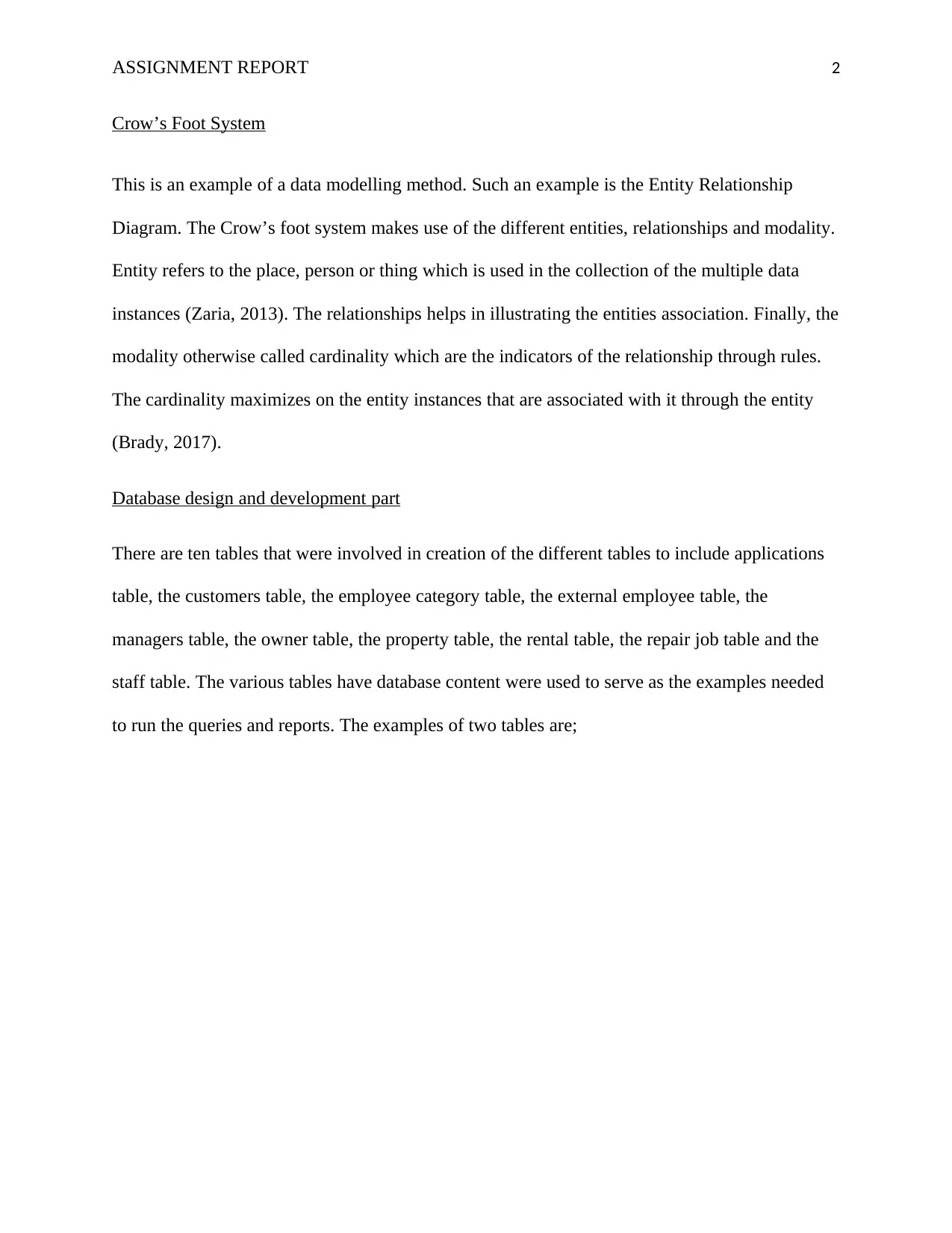
There are ten tables that were involved in creation of the different tables to include applications
table, the customers table, the employee category table, the external employee table, the
managers table, the owner table, the property table, the rental table, the repair job table and the
staff table. The various tables have database content were used to serve as the examples needed
to run the queries and reports. The examples of two tables are;
Document Page
ASSIGNMENT REPORT 3
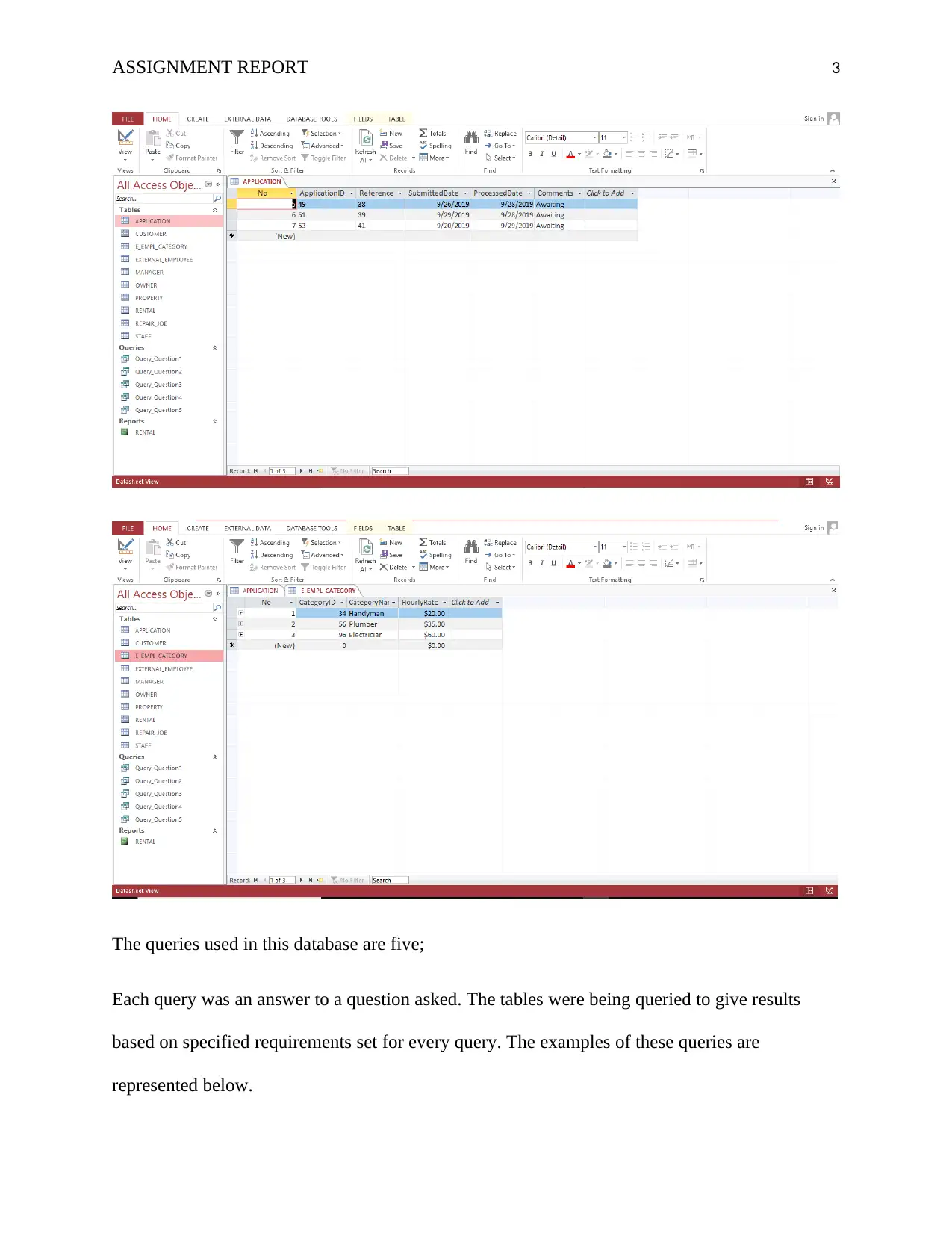
The queries used in this database are five;
Each query was an answer to a question asked. The tables were being queried to give results
based on specified requirements set for every query. The examples of these queries are
represented below.
Document Page
ASSIGNMENT REPORT 4
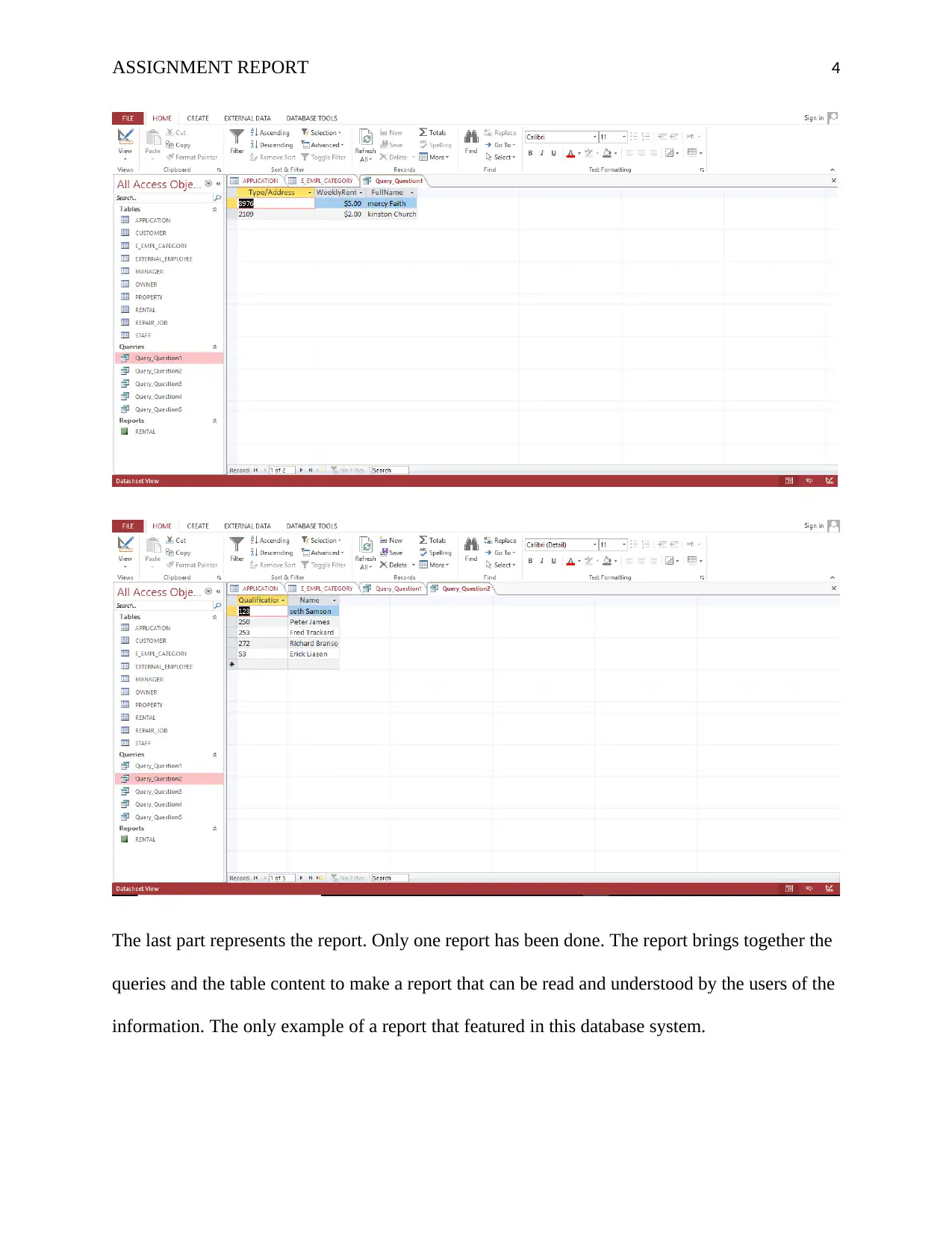
The last part represents the report. Only one report has been done. The report brings together the
queries and the table content to make a report that can be read and understood by the users of the
information. The only example of a report that featured in this database system.
tabler-icon-diamond-filled.svg

Paraphrase This Document

Need a fresh take? Get an instant paraphrase of this document with our AI Paraphraser
Document Page
ASSIGNMENT REPORT 5
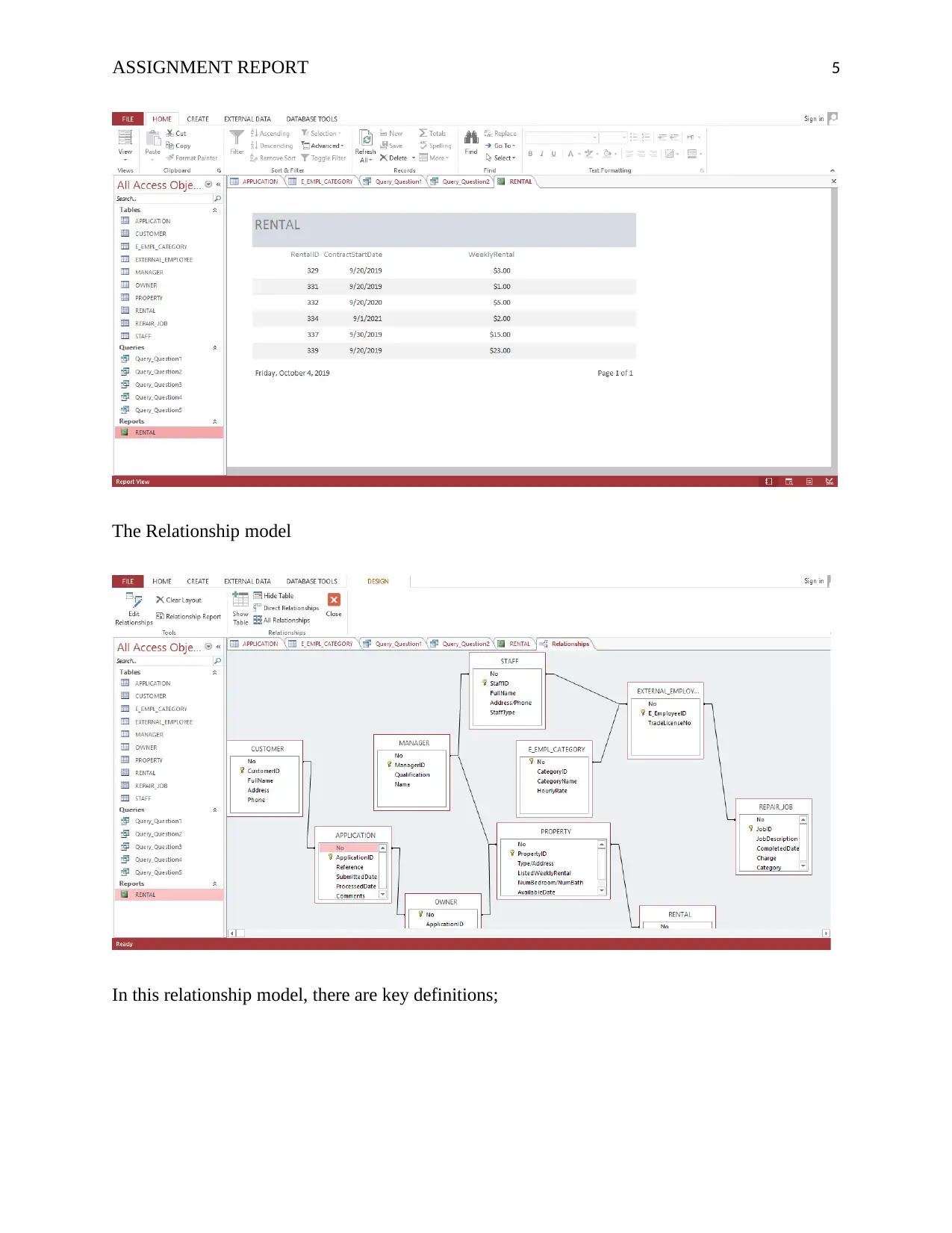
The Relationship model
In this relationship model, there are key definitions;
Document Page
ASSIGNMENT REPORT 6
Primary key; this is otherwise known as the primary keyword and is a relational database that
gives a unique identity to a record. It is an identifier that is unique like a phone number, a
national identification number. This is a keyword that is compulsory to have in a database setup.
Foreign Key; this refers to a relational database term that helps in linking data between two
tables. In a cross-reference, this key act as a link establishment between them. This could be a
column or even a group of relational columns
One-to-many relationship; in a given relational database, this relationship type happens when a
parent record in any table can reference potentially many child records in another given table.
Many-to-one relationship; in this type of relational database, a given pone record in a table
associates with one or many records that are represented in another table.
Many-to-many relationship; in this form of a relationship, many records in one table gets
associated to with many records in another table. Directly, the database cannot allow the user to
implement this type of relationship (WATT, 2018).
In the implemented relationship model above, the terms that are application include; primary
key, the foreign key, one to one relationship and the one to many relationship model.
The Workbench Assignment
The workbench contained the creation of a database, the tables and the creation of an ER-
diagram using the Mysql workbench software.
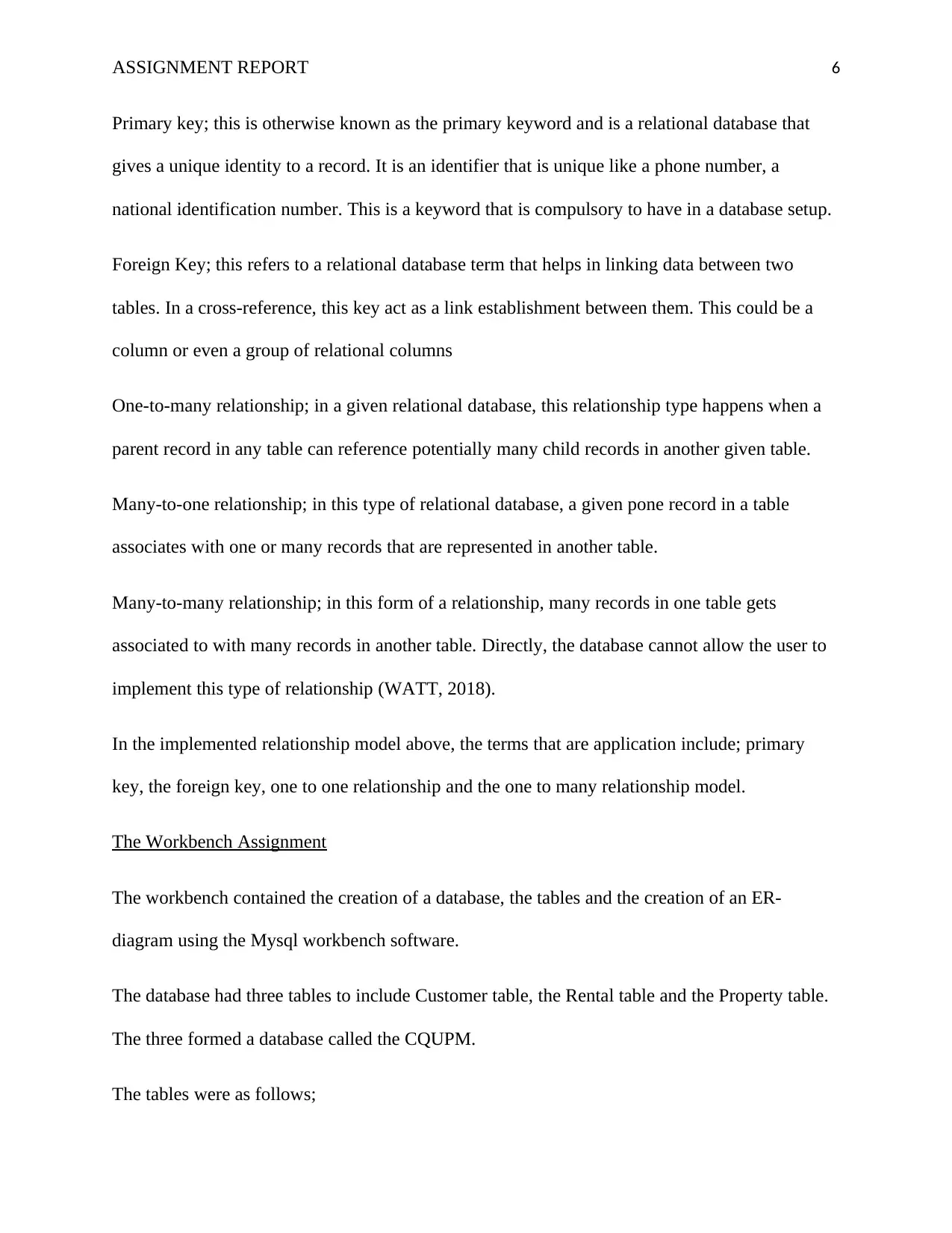
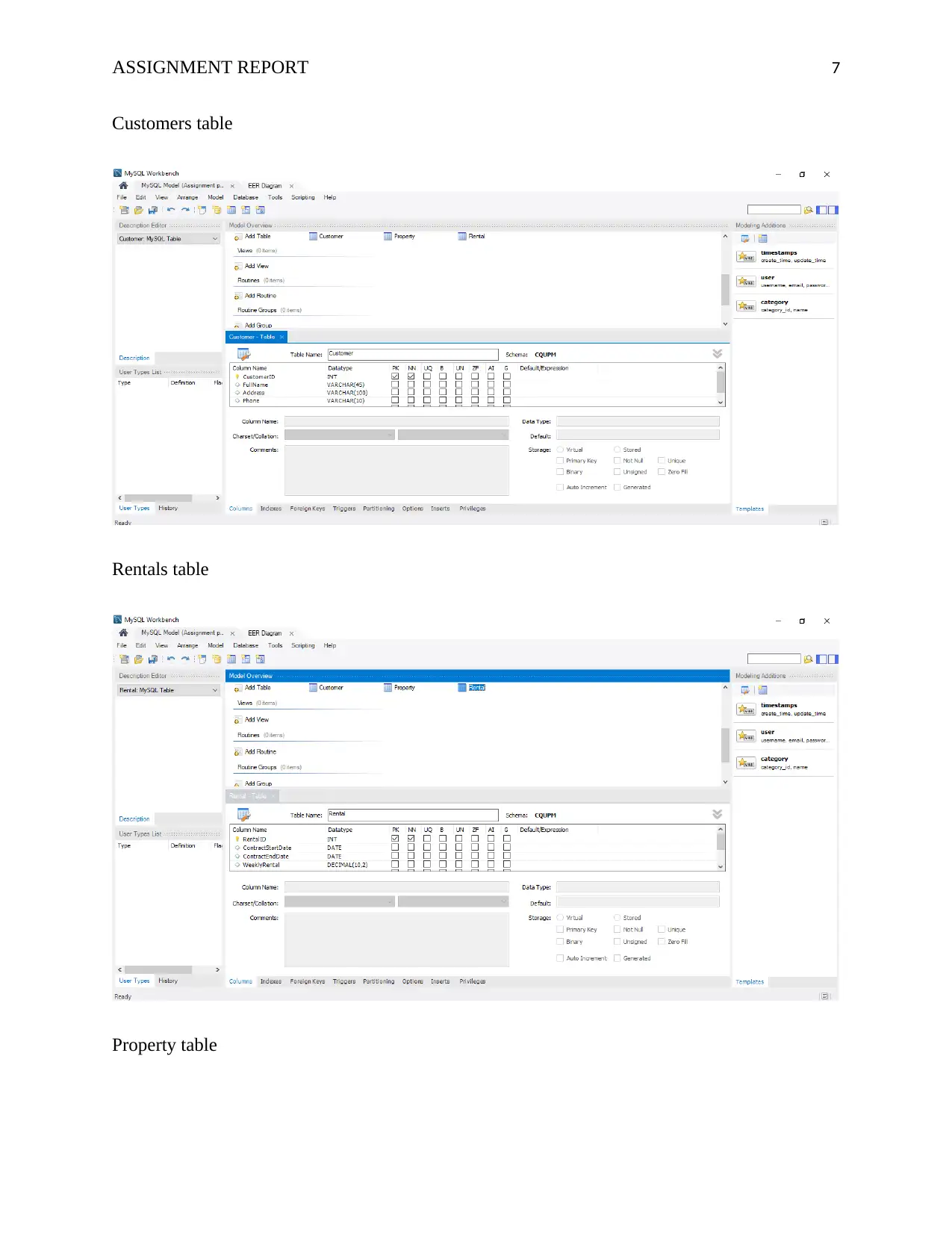
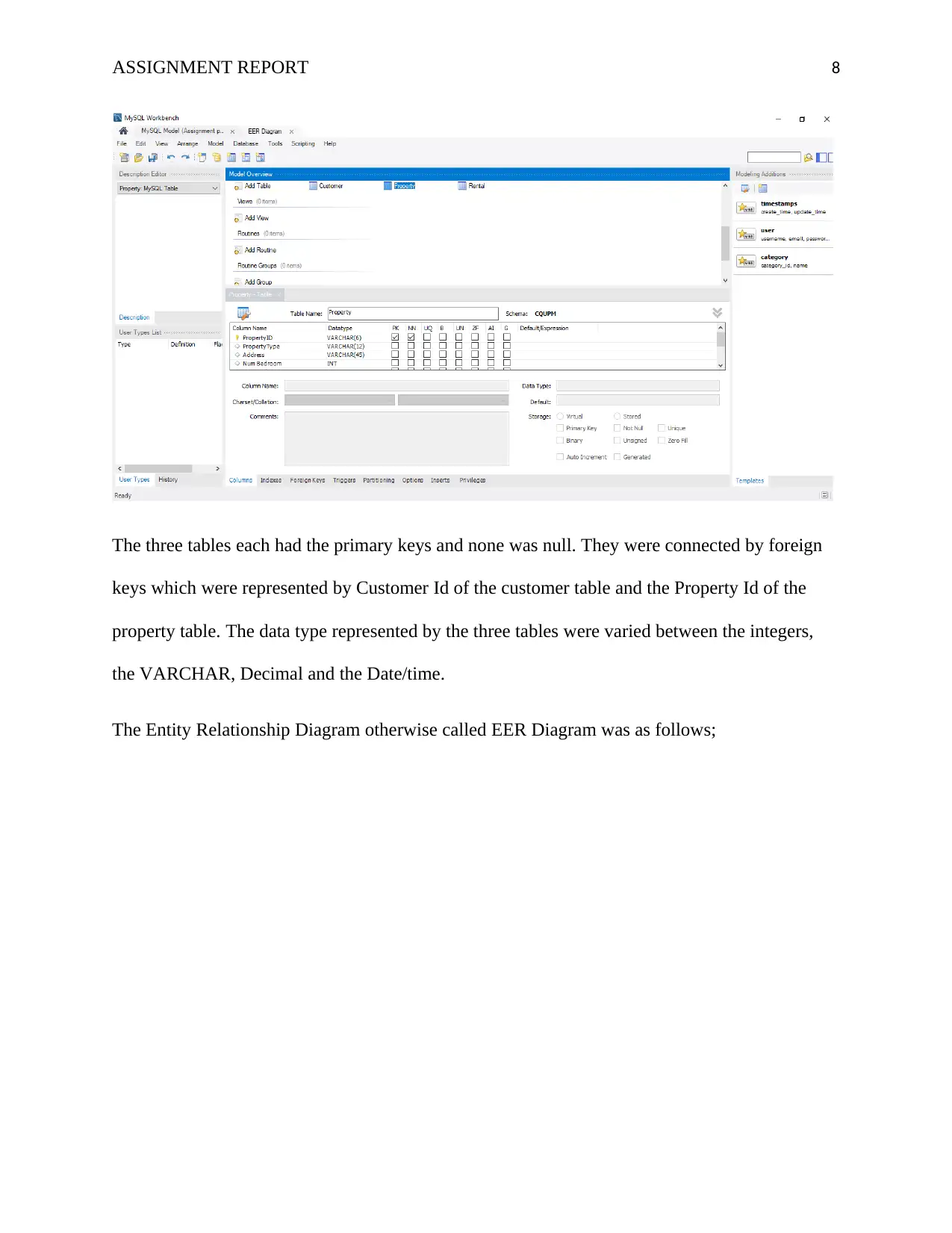
The database had three tables to include Customer table, the Rental table and the Property table.
The three formed a database called the CQUPM.
The tables were as follows;
Document Page
ASSIGNMENT REPORT 7
Customers table
Rentals table
Property table
tabler-icon-diamond-filled.svg

Paraphrase This Document

Need a fresh take? Get an instant paraphrase of this document with our AI Paraphraser
Document Page
ASSIGNMENT REPORT 8
The three tables each had the primary keys and none was null. They were connected by foreign
keys which were represented by Customer Id of the customer table and the Property Id of the
property table. The data type represented by the three tables were varied between the integers,
the VARCHAR, Decimal and the Date/time.
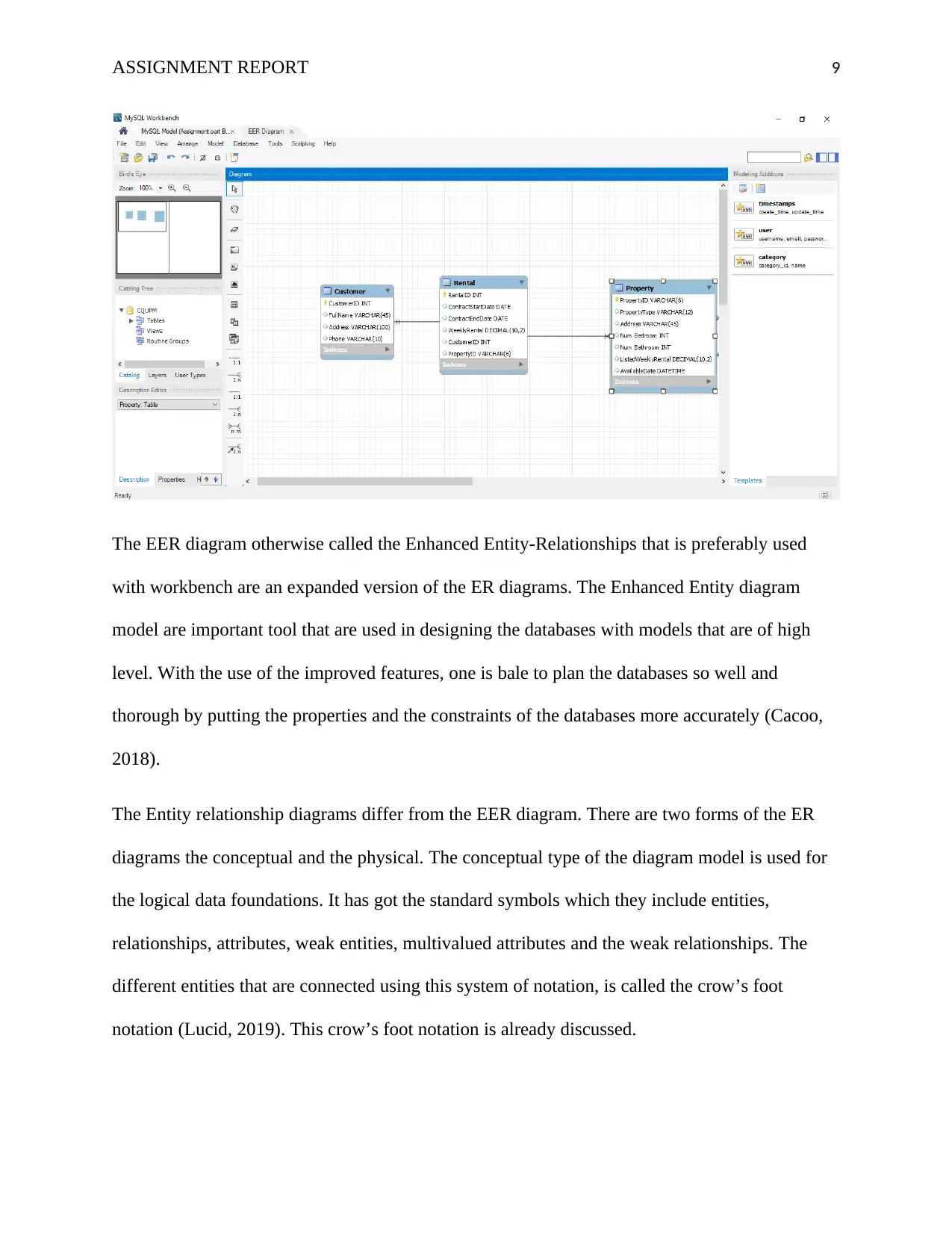
The Entity Relationship Diagram otherwise called EER Diagram was as follows;
Document Page
ASSIGNMENT REPORT 9
The EER diagram otherwise called the Enhanced Entity-Relationships that is preferably used
with workbench are an expanded version of the ER diagrams. The Enhanced Entity diagram
model are important tool that are used in designing the databases with models that are of high
level. With the use of the improved features, one is bale to plan the databases so well and
thorough by putting the properties and the constraints of the databases more accurately (Cacoo,
2018).
The Entity relationship diagrams differ from the EER diagram. There are two forms of the ER
diagrams the conceptual and the physical. The conceptual type of the diagram model is used for
the logical data foundations. It has got the standard symbols which they include entities,
relationships, attributes, weak entities, multivalued attributes and the weak relationships. The
different entities that are connected using this system of notation, is called the crow’s foot
notation (Lucid, 2019). This crow’s foot notation is already discussed.
Document Page
ASSIGNMENT REPORT 10
Database design and development
The database design process needs detailed database data model. The data models will contain
the required both logical design choices and the physical design choices with a storage
destinations parameters that must be there to ensure the design is generated.
The database design is a reality that is easy but has guidelines to strictly follow. It is of essence
to use and follow these rules to the later to make the databases work well.
Importance of using the databases
The databases have got tailored SLAs; the solutions that are flexible and administrative support
that is customized will always cater for the business needs and the required budget.
The generation of reports trough databases is creative; this is because it automates the reports of
the data.
The re-engineering of databases; the process of redesigning and restructuring of the databases
will help in establishing the relationships and adding of reports that unifies the databases.
The regular healthy checks; the process of database maintenance through constant monitoring of
the stored information and the operations tests of the data ensure the data health is maintained
(Thakur, 20 Advantages of Database Management System (DBMS), 2015).
Disadvantages of the databases
The security of the information stored is not always guaranteed. This is because security is never
absolute therefore, databases need more security features that make them complex and had to
work with.
tabler-icon-diamond-filled.svg

Paraphrase This Document

Need a fresh take? Get an instant paraphrase of this document with our AI Paraphraser
Document Page
ASSIGNMENT REPORT 11
The databases for designing and developing systems are costly and therefore apart from the
purchase costs the systems will need to be maintained. Therefore the startup cooperation and
personnel may find it hard to acquire a database system for use (Thakur, 9 Disadvantages Of
Database Management System (DBMS), 2016).
Document Page
ASSIGNMENT REPORT 12
References
Brady, M. (2017). Exploring the use of entity-relationship diagramming as a technique to
support grounded theory inquiry .
https://pdfs.semanticscholar.org/e617/df796b4100f6a9ee29450b863d55d4c88717.pdf
Accessed last on 9/10/2019.
Cacoo. (2018). ER diagrams vs. EER diagrams: what’s the difference?
https://cacoo.com/blog/er-diagrams-vs-eer-diagrams-whats-the-difference/ Accessed last
on 9/10/2019.
Lucid. (2019). Entity-Relationship Diagram Symbols and Notation.
https://www.lucidchart.com/pages/ER-diagram-symbols-and-meaning accessed last on
9/10/2019.
Thakur, S. (2015). 20 Advantages of Database Management System (DBMS).
https://whatisdbms.com/20-advantages-of-database-management-system-dbms/ Accessed
last on 9/10/2019.
Thakur, S. (2016). 9 Disadvantages Of Database Management System (DBMS).
https://whatisdbms.com/disadvantages-of-database-management-system-dbms/Accessed
last on 9/10/2019.
WATT, A. (2018). Database Development Process.
https://opentextbc.ca/dbdesign01/chapter/chapter-13-database-development-process/
accessed last on 9/10/2019.
chevron_up_icon
1 out of 13
circle_padding
hide_on_mobile
zoom_out_icon
[object Object]